Your ShelfYour Projects

Signs of the Times, Vol. 31, No. 26.

THE BLESSEDNESS OF FORGIVENESS

Signs of the Times

Jun 28, 1905

Pacific Press Publishing Company · Mountain View, California · Jun 28, 1905

THE BLESSEDNESS OF FORGIVENESS


Blessed is he whose transgression is forgiven,
Whose sin is covered.
Blessed is the man unto whom Jehovah imputeth not iniquity,
And in whose spirit there is no guile.
When I kept silence, my bones wasted away
Through my groaning all the day long.
For day and night Thy hand was heavy upon me;
My moisture was changed as with the drought of summer.
I acknowledged my sin unto Thee,
And mine iniquity did I not hide;
I said, I will confess my transgressions unto Jehovah:
And Thou forgavest the iniquity of my sin.
For this let every one that is godly pray unto Thee in a time when Thou mayest be found;
Surely when the great waters overflow they shall not reach unto Him.
Thou art my hiding-place; Thou wilt preserve me from trouble;
Thou wilt compass me about with songs of deliverance.
I will instruct thee and teach thee in the way which thou shalt go;
I will counsel thee with Mine eye upon thee.
Be ye not as the horse, or as the mule, which have no understanding;
Whose trappings must be bit and bridle to hold them in,
Else they will not come near unto thee.
Many sorrows shall be to the wicked;
But he that trusteth in Jehovah, loving-kindness shall compass him about.
Be glad in Jehovah, and rejoice, ye righteous;
And shout for joy, all ye that are upright in heart.

BRIEF BOOK MENTION

The Boy Puzzle. Does the conduct of your boy or girl puzzle you? If so, the puzzle may be solved by reading this masterly treatise of the subject, by a master in experience.
217 pages, illustrated, cloth bound, price 75c.

The Mutiny of the Bounty.

A thrilling story of the settlement of Pitcairn Island by the mutineers of the ship Bounty, and the working out of the problem of human life in this small dot in the Pacific, as told by a native daughter.
266 pages, illustrated, paper covers, price 50c.

The Yosemite Valley.

A book portraying by pen and illustration the grandeur of this sublime spot, and world renowned, marvelous wonderland of the Sierras, also giving much interesting history of the early days in California.
500 pages, 150 illustrations, tourist's edition, paper covers, price 75c.; cloth bound, $2.75.

Education.

The object of true education and how it may be realized by the youth, the parent, the teacher, the writer, the farmer, and the business man is the great theme of this book. Lays down sound principles, helpful to all classes. 321 pages, handsomely bound in cloth, price $1.25.

Health

Health. How to find it when it is lost; how to keep it when it is found. A reliable treatise on the subject, giving valuable statistics, advice on foods and food combinations, and instruction in the home treatment of disease.
222 pages, thoroughly indexed, cloth bound, price $1.00.

At the Door.

A new art booklet giving the prophetic history of the world as foretold by Christ, illustrated by fifty engravings, arranged with historical notes and comment.
Price, plain cover, 15c.; fancy cover, 25c.

Bible-Based Christian Education

The Place of the Bible in Education. An appeal to Christians for Christian education, showing how the Bible may be used as the basis in the search for all truth.
250 pages, paper covers, price 25c.

Siberia and the Nihilist

A thrilling volume exposing the cruelties of the Russian Government, also containing a brilliant lecture on Nihilism. Intensely interesting.
160 pages, illustrated, paper covers, price 25c.

Occult Mysteries and Their Moral Aspect

Modern Mysteries. A masterly treatise on the subjects of Hypnotism, Clairvoyance, Telepathy, Theosophy, New Thought, and Pantheism, from the standpoint of their moral aspect.
Paper covers, price 15c.

A Few Bargains Left

We still have a few slightly damaged books left which we will mention once more. We would call particular attention to the Prophecies of Jesus, considered by many to be the best book written on the prophecies.
List Price. Net Price Post-paid.
6 Prophecies of Jesus, Cloth, Marble Edge $2.25 $1.10
13 Prophecies of Jesus, Library, 3.00 1.45
5 Great Controversy, Plain 2.00 1.00
5 Heralds of the Morning, Gilt 1.50 .75
9 Christ's Object Lessons 1.25 .75
15 Vest Pocket Dictionaries, Leather .50 .25
5 Yosemite Valley, Paper .75 .35
4 Christ Our Saviour, Board .50 .30

New Tracts

Future Probation, B. S. L. No. 190, Price 2c. The Priesthood, B. S. L. No. 191, Price 1c. "Come, for All Things Are Now Ready," A. G. L. No. 87, Price 1c.

SIGNS OF THE TIMES

The Home of "The Signs of the Times."

PUBLISHED WEEKLY

(Entered September 15, 1904, as second-class matter at the Mountain View, Cal., post-office, under act of Congress of March 3, 1879.)
H. H. HALL, - - - - BUSINESS MANAGER.

Terms of Subscription.

Per Year, post-paid. . . . . . . . . . . . $1.50 Six Months, 75 cts. Three Months, 40 cts. To Foreign Countries, per year, $1.75.

SPECIAL TERMS.

  1. One new yearly subscription and one renewal, or two new yearly subscriptions, sent at one time, $2.50.
  2. Two new yearly subscriptions and one renewal, or three new yearly subscriptions, sent at one time, $3.25.
  3. Three new yearly subscriptions and one renewal, or four new yearly subscriptions, sent at one time, $4.00.
Sample copies sent on application.

TO OUR PATRONS.

Please be careful to write all names of persons and places plainly. Send money by Post-office Money Order, Express Order, or Bank Draft on New York, Chicago, or San Francisco. Orders and Drafts should be made payable to the Pacific Press Publishing Co. Paper money or silver should be sent in a registered letter. Registered mail is safe. Unregistered mail is at the risk of the sender. Postage-stamps in five or ten cent denominations will be accepted for small amounts. The address label on your paper will indicate the time to which your subscription is paid. In case of non-receipt of papers, or any other irregularity, please notify us immediately. When subscriptions expire, no more papers are sent to the party except by special arrangement. You are requested to watch the date on your label, and renew early, and save the loss of papers. We can not always furnish missing numbers. When requesting change of address, be sure to give both old and new addresses. Important.—If you order SIGNS, Our Little Friend, books, etc., at the same time, use a separate sheet of paper for each. If this request is complied with, it will materially assist in the prompt and accurate despatch of the business. When writing to the editor, be sure to use a separate sheet of paper.

POINTERS TO SUCCESS

IN

Missionary Book Canvassing.

BY E. R. PALMER.
THE PACIFIC PRESS has just issued a booklet of 72 pages with the above title, containing a systematic arrangement of helpful suggestions for our canvassers. The principles set forth cover every phase of canvassing, and are the fruit of long experience and observation in several countries and with many agents. It should be in the hands of every one entering the canvassing work.
Bound in heavy paper covers. Price 10 cents.
Address Publishers of this paper.

The Sabbath and the Law

The Sabbath and the Law.—A treatise on the Sabbath, giving its Biblical and secular history for six thousand years. 190 pages. Price, 15 cents.

Sunday in History

Sunday in History.—A vast array of historical facts regarding its development, and startling admissions of eminent clergymen relative to its sacredness. A mine of information in a nutshell. 232 pages. Price, 30 cents.

Address the Publishers

Address publishers of this paper.

Pacific Press Publishing Company

MOUNTAIN VIEW, CAL.

"THERE IS NOTHING TOO HARD FOR THEE."

The Healer of the Worst.
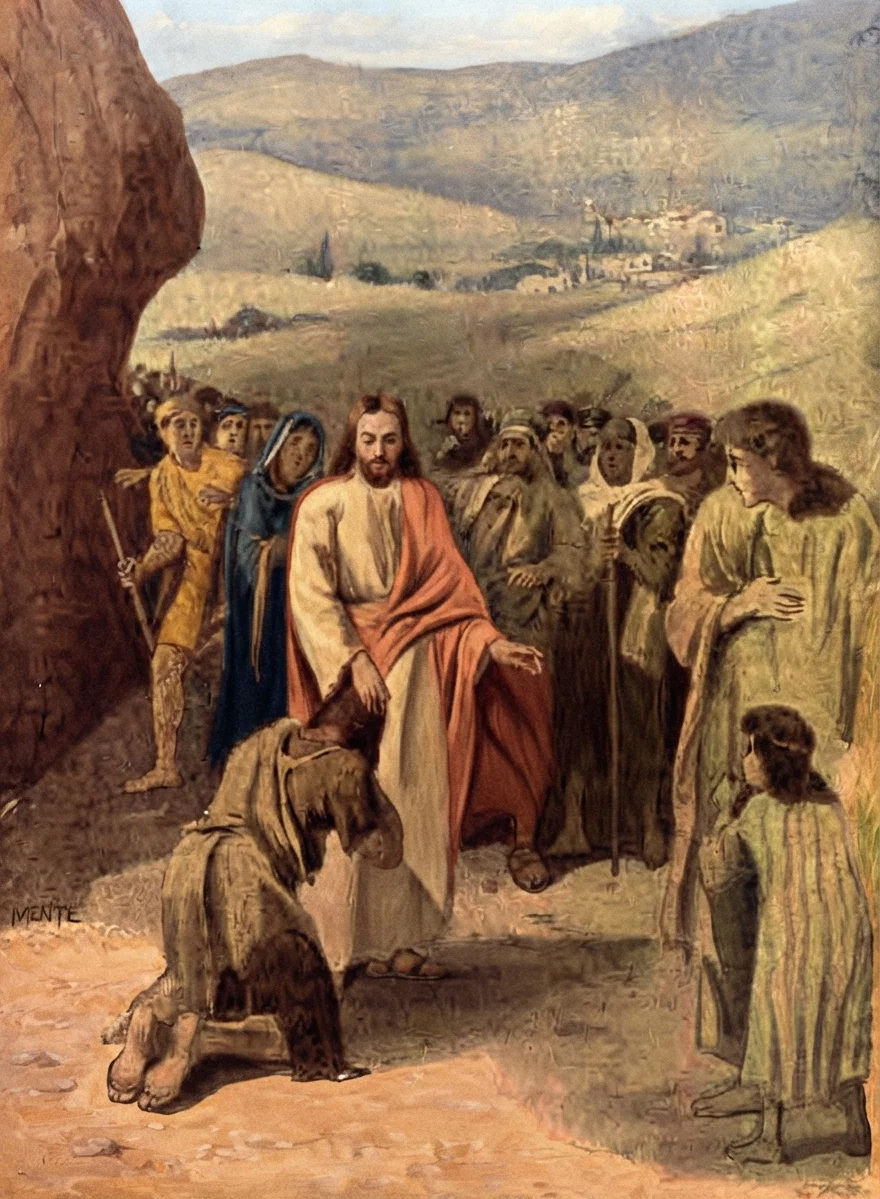
THERE is no disease in all the world so much to be dreaded as leprosy. Once afflicted, there is no human cure. Its virus permeates and possesses the very life-blood of the afflicted one. For a time there may be no consciousness of the disease, so gradual and deceptive is its coming. It is from three to ten years before the disease manifests itself after infection.
THERE are no premonitory symptoms, no warning chills, no burning fever. A pimple, a discoloration, a lack of sensibility in some part, reveals it, and the awful, sickening sensation sweeps over the victim that he is doomed to a living death. A deadly foe has entered the citadel of life to go out no more till the noble frame is hopelessly marred; part after part may drop away, and the poor human walks or creeps before his kind a revolting spectacle, finally to drop into the grave, regretted not even by himself.
EGYPT is said to be the cradle of the disease, even as she stands in the Scriptures for infidelity and defiance of God. The Chinese anciently killed the lepers. Different nations banished them. Nearly all have segregated them. In some countries they have been compelled to wear a peculiar garb, and carry a rattle or clapper to warn people of their approach. Under the Jewish law the leper wore a bandage over his mouth, and whenever approached by men, he was forced to give warning. Dolorous indeed was the sad cry wafted to the ears of the traveler as the leper cried, "Unclean, unclean." And they were shunned by all.
Jesus put forth His hand, and touched him, saying, I will; be thou clean. And immediately his leprosy was cleansed.
HERE is a typical scene of those far-off days in Judea. A great Teacher had been instructing a vast multitude on a pleasant mountainside. From His lips had fallen such truths as their ears had never listened to before. The vast multitudes were astonished and inspired by His teaching. With hearts burning and minds expectant of new things they follow Him down the mountain into the city. Suddenly their progress is arrested by the mournful tones of an approaching leper, "Unclean, unclean."
THE crowd fell back as the loathsome being came forward. Doubtless the disciples and others wondered that the Teacher did not shun the leper. But there the Master stands with no signs in face or attitude save of pity. The leper's faith takes new hold. He presses forward, falls on his knees before the Man of pity; and with broken heart-utterances, pleads as tho he almost expected to be refused, "Lord, if Thou wilt, Thou canst make me clean." He believed in Christ's power; but his faith almost doubted, or could not grasp, the love of God. All men had so often shunned; this Man also might.
BUT not so. The Man of Sorrows, grieved never for Himself, ever moved for others' woes, extends His hand and touches the unclean; yet not to become Himself unclean, but to burn away by the touch of infinite power the uncleanness of the object He touched. Yea, He touched the leper, and, with voice of infinite tenderness, He responds, "I will; be thou made clean. And straightway his leprosy was cleansed."
By no long process of elimination or inoculation, by no germicidal concoction, by no matter of eating or drinking or fasting or drug-taking, was the cure and cleansing wrought. At once, as the Master spoke, as the Master touched, the leper was cleansed. The divine energy, the life of God, passed through every fiber of his frame, burned out the poison and death, and created new tissue where disease had destroyed the old. It was the manifestation of the Gospel of God in the human body, not by a life from within, but by a life from without and above entering in and taking possession where sin, disease, and death had hitherto wrought havoc.

The Great Lesson.

THIS miracle was recorded to give hope to the sinner. Sin is moral leprosy. It is as deceptive in its beginnings as is leprosy. It is as destructive to the soul as leprosy is to the body. It may not be manifest outwardly in its earlier stages, but it is as surely at work on heart and motive and conscience as tho wecould actually behold its ravages. And there is no cure. "Sin, when it is finished, bringeth forth death." All remedies, however potent, can not cure the leprosy of sin. No earthly physician can properly diagnose a case affected. Many essay to do this, many claim a panacea, many claim a cure; but ever the disease eventuates in death. Better to accept the diagnosis of the great Physician. "The heart is deceitful above all things, and it is exceedingly corrupt ["desperately sick," R. V.]; who can know it? I, Jehovah, search the mind, I try the heart." Jer. 17:9, 10. "From the sole of the foot even unto the head there is no soundness in it; but wounds, and bruises, and putrefying sores." Isa. 1:6. That is the condition of sinful man, of every man by nature; "for all have sinned, and come short of the glory of God." Rom. 3:23. Men may argue and endeavor, but the great, awful fact remains, that the whole world is sick, each and all, incurably sick unto death, with the dread leprosy of sin.
BUT there is cure, there is a panacea for its multiform ills; and the sin leper can find it just where the other leper did, at the feet of Jesus. He may come all laden with sins. Others may reject Him and seek to disbar him. He may be shunned as a leper. He may be ostracized by the Pharisees of society; but let him come to Jesus. Listen to His voice: "Tho your sins be as scarlet, they shall be as white as snow; tho they be red like crimson, they shall be as wool;" "Him that cometh unto Me I will in nowise cast out." Then come. Yield all to Him. Place all rebellion to His government, all disloyalty to His law, all corruption of your heart, on the Sin-bearer, Sin-cleanser, and hear from His blessed lips, in response to your prayer, "I will; be thou clean."
WILL the word be potent? It was potent when the earth was created; when He said, "Let there be light;" when He said to the leper, "Be thou clean;" when He raised the dead. Not by a long process will He cleanse; not by crosses and penance and fasts, or shriving of human priests; but by His own divine word of forgiveness will He cleanse, and cleanse now. He was the leper's Friend and Healer; He longs to be the same to any sinful leper.

THE FORTY DAYS' FAST.

JESUS did not fast forty days in the wilderness just to show what He could do. He did not do it on a wager, or tell about it in a boastful manner. He did not claim to be the champion faster, nor did He ever adduce the fact of this fast as evidence of His divinity. He was entering upon a great work, and with it assuming the great burden of the sins of the world. Because of this weighty responsibility, and His consciousness of the weakness of human flesh, He would humble Himself; He would seek spiritual strength by being alone with the Father. So the Spirit led Him away into the wilderness. The fasting was an incident of the situation. He was learning by experience that "man shall not live by bread alone, but by every word that proceedeth out of the mouth of God." It is more than probable that He did not give the matter of eating any consideration at all; or if He did, He was fasting and praying that He might gain more spiritual strength with which to cope with the great adversary whose sway over the minds of men He had come to break down.
But this season of personal fasting and prayer and communion with God, altho prolonged, must close. His work was not to be accomplished in the role of a recluse. He was not establishing monasteries in solitary places. While the demands of appetite, which had been made a means in the spiritual overthrow of the first Adam, must be brought under control, it was natural that after so long a fast the second Adam would experience real hunger. So at this critical moment, when physically weakened by a long fast, the arch tempter naturally deemed it a rare opportunity to assail Him with an apparently harmless suggestion.
Was it not his mission to manifest Himself to the world as the Son of God? and would it not be desirable first to establish that fact to the satisfaction of the one who claimed, by right of conquest, the dominion of the earth? "If Thou be the Son of God, command that these stones be made bread." Why not? He was hungry, and He was abundantly able to make bread, and where was the harm? That is the question that has overthrown so many when, without the Spirit of overcoming grace, they have been confronted with temptation. But while the long fast had somewhat weakened the body, the spirit had been far more than correspondingly strengthened by prayer and clinging to God for strength in just such emergencies. Jesus had gone into the wilderness in obedience to the Spirit's unction, to prepare for what the Spirit knew was coming. His faith in the Spirit's leading was implicit, and in the trying moment a great initial victory was won, which was the precursor of all that should follow.
Do you ask, Wherein would have lain the harm of Christ's making the much-needed bread to satisfy His hunger?—It would have been yielding to a suggestion of the adversary, and, like the one act of yielding on the part of the first Adam, would have forever broken His power to resist. It would have forever thwarted the purpose to save sinners. Jesus, the Son of God, would have gone the way of so many millions of others who have stopped to inquire, Where is the harm? when apparently innocent temptation came their way. It was not necessary to prove to Satan that Jesus was the Son of God. He knew that already, and that was the reason he was trying to overthrow Him. Had He been an imposter, there would have been no need of tempting Him.
This was not by any means the last time that Jesus denied Himself physical food in order to pursue the object of His mission. When His disciples knew He was hungry and urged Him to eat, His reply was: "I have meat to eat that ye know not of. . . . My meat is to do the will of Him that sent Me, and to finish His work." To know of that meat experimentally would save many a Christian from falling into temptation when he doesn't know where the next meal will come from. A people with such an experience, tho but a "little flock," would soon carry the Gospel of the kingdom to all the world. Fasting as a means of grace, or of self-denial for the truth's sake, is a far different thing from fasting for a wager, or as a mere trial of endurance. In these specially-trying times it is well to heed the Saviour's counsel, "Fast and pray, lest ye enter into temptation." G.

AN OMINOUS PERPLEXITY.

THERE is an increasing prevalence of perplexity in the world to-day. Every nation and every people is burdened with a weight of dread. It is an ominous condition, and it has a meaning.
The perplexity of the nations was to be one of the signs to Christ's followers that His coming was near at hand. It was to be a perplexity that was to be present in all the nations at the same time—a mutual perplexity, a dread which they would share in common. The cause of the perplexity was not restricted to any one thing, to one nation's dread of another. This has been shown by the worldwide perplexity over the insidious growth and the deadly power of Anarchy. The dread of it is greatest in those countries that inflict the most rigorous punishments upon its adherents. The dread of it and the perplexity regarding it are increased by the fact that its adherents are not known in those countries save to one another; and that it is possible for most dangerous Anarchists to be servants, or apparent friends, in the households of statesmen, governors, kings, and emperors. The recent numerous assassinations in Russia and Finland, the assassination of the King of Italy, and the more recent attempts upon the life of the king of Spain, with this last attempt upon his life and that of the president of France with whom he was riding—all serve to emphasize that dread and that perplexity.
Wars and rumors of wars, the apparent necessity for haste in preparing for defense, the discontent of the people under heavy, grinding taxation, the necessity for finding markets for the industrial products of overcrowded manufacturing centers,—all these have been perplexing the nations with an ever-increasing power and persistence. The perplexity which Anarchy is causing is but heaping up the load which the world has been carrying, adding to the general perplexity. This is in truth the age of perplexity; it is the age of distress of nations; it is the age of a universal dread of war; it is the age of violence; it is the age in which all these things are to culminate. That culmination comes with the second coming of Christ. Here are His own words in reference to these things and that event:
"There shall be signs in the sun, and in the moon, and in the stars; and upon the earth distress of nations, with perplexity; the sea and the waves roaring; men's hearts failing them for fear, and for looking after those things which are coming on the earth; for the powers of heaven shall be shaken. And then shall they see the Son of Man coming in a cloud with power and great glory." Luke 21: 25-27.
We are in the time there brought to view, as everything in the earth to-day bears witness, and the coming of the Just One draweth nigh. As we look upon the perplexity and distress of nations, let us remember that God has faithfully warned us what it all means, and what it portends. Then let us lay ourselvesupon the altar of God, permitting Him to take out of our hearts the anarchy that has separated between us and Him, so that when the opening heavens shall reveal Him—as soon they will—we can look up to Him as a loving heavenly father, and fly to the shelter of His outstretched arms. That is the blessed privilege that is held out to-day to every son and daughter of Adam. To reject it is sorrow and death; to accept it is joy, peace, and life everlasting.

REPLY TO SOME ANTI-SABBATH ARGUMENTS.

BY inspiration of the Spirit, David says: "The fear of the Lord is the beginning of wisdom; a good understanding have all they that do His commandments." This fact may be cited as good reason for believing that men who disregard the law of God are not reliable expositors of His Word. A contributor to the Messenger, published in Ellsworth, Kan., in endeavoring to teach men that the Sabbath of the Lord is not to be observed by Christians, is obliged to place some strange constructions on the Scriptures. According to this expositor, we are not to base our decision as to the day of the Sabbath on the reason given in the second chapter of Genesis. But the Lord not only gives us the statement in verses 2 and 3 as the reason, but He repeats that same reason in His law, and afterward honors the day in His example when on earth.
Again we are told that the period of time designated as a day in the first chapter of Genesis "was by no means the same as that on which we base our chronology." The author tells us that "a better translation of the original would be 'periods of time,'" etc. But none of the translations, all of which were made by the best scholarship of their time, so render the text. The reference to what geology proves is far from being evidence, as geology is made to prove almost anything, and nothing is more contradictory than the deductions of geologists.
The days of Genesis 1 were days with evenings and mornings, and the same original word for day is used after the sun was instilled as the light-bearer, as is used for the days prior to that time. At any rate, we have the fifth and sixth days as solar days, which fixed the duration of days before the Sabbath was established, and the first Sabbath day, and therefore the Sabbath days thereafter, were measured by that rule. All this is demonstrated by the falling of the manna for the children of Israel in the wilderness.
It is claimed that we do not know which is the seventh day now. But there will be no trouble on this score if we accept the testimony of the Scriptures. Moses knew which was the seventh day before he came to Sinai, as is shown in Exodus 16. The Lord knew which was the seventh day when He marked it and emphasized it by three miracles every week for forty years. After the Babylonian captivity, Ezra and Nehemiah knew which was the Lord's Sabbath, and, as the Jews never again turned to idol-worship, it is evident that they did not lose sight of the day, however much they may have perverted its observance. When Christ came He observed the same day the Jews did, altho not altogether in the same manner. We suppose that He knew the day, for He was Lord of the Sabbath day (Mark 2:28), and His disciples "rested the Sabbath day according to the commandment" (Luke 23:56) while He rested in the tomb.
At that time the first day of the week was the solar holiday of the pagans, and when, some centuries later, the first day was formally adopted by the Catholic Council of Laodicea as the sabbath, it was the next day after the Sabbath observed by the Jews and that class of Christians who were opposed to the union of church and state. And all along the line to the present time the days have been recognized without any dissent as to which was the first day and which the seventh day of the week. In the history of time there have been changes in the months and in the years, but these things did not cause any change in the week, and we have no record that there ever was any confusion in this respect—only as men averse to the law of God have endeavored to cause confusion. The Jews never have had any confusion regarding the identity of the seventh day, and Sunday observers never have had any difficulty in identifying the first day. At any rate, most of them are so sure of it that they are willing to sustain state laws for its enforcement.
The perversion of Paul's testimony in Hebrews 4, calls for a word of comment. The author to whom we have referred, asserts that "the Sabbath rest of God after Creation, extends over the whole period of time in which we are now living." Now how could God have put a blessing upon a day because in it He had rested, when the day would not end for thousands of years yet to come? How could men have observed thousands of days within the day whose events they were to memorialize after that day was passed? The Lord did not bless and sanctify the seventh day till after He had rested on it, and, if that long day has not passed yet, then it has not yet been set apart for man's observance. Such absurdity could only be conceived in a desire to evade the truth.
Paul says, "There remaineth therefore a rest to the people of God." This is what God designed in the first place, and if man had remained faithful, he had it then. God ceased from His work as a finished work; He "rested" and "was refreshed" in the contemplation of it. But man fell, yet God did not give up His design, nor His commemorative rest-day. The plan of redemption came in, and the eternal rest was still a possibility. Man has failed over and over again, but God's purpose does not fail. Abraham, Isaac, and Jacob were given promises which they did not receive in this life. But the rest remaineth, and it will surely come to the faithful child of God. Israel could not enter in because of unbelief (Heb. 3:18, 19). "Let us labor therefore to enter into that rest, lest any man fall after the same example of unbelief." Chapter 4:11. Those who enter into that rest will be such as "keep the commandments of God, and the faith of Jesus." Rev. 14:12. "If ye be Christ's, then are ye Abraham's seed, and heirs according to the promise." Gal. 3:29. To cite Hebrews 4 as an argument against keeping the Sabbath of the Lord, is surely a wresting of the Scriptures to one's own hurt. See 2 Peter 3:15-18.
Yes, the Christian is dead to sin, which is "the transgression of the law" (1 John 3:4), and he is "dead to the law" in that Christ died for him, and he has accepted Christ as his Saviour from the penalty of the law. By faith he becomes obedient, and "there is therefore now no condemnation to them which are in Christ Jesus, who walk not after the flesh, but after the Spirit." Rom. 8:1. But the law is not dead, for Christ came not to change "one jot or one tittle" of it (Matt. 5:17, 18), and Christ died that it might be "fulfilled in us." Rom. 8:3, 4. The wicked are condemned because they are not subject to it (verses 6-9). "By the law is the knowledge of sin" (Rom. 3:20; 7:7), and "where no law is, there is no transgression" (chapter 4:15; 5:13).
Christ rose from the dead on the first day of the week, but He didn't rest that day; nor did He ever set apart that day for His disciples to rest. His activity on that day could not be commemorated by resting. Nor has He ever intimated that His resurrection "blessed that day above all others." Such an assertion is a clear case of imputing to the Lord what He hath not spoken. See Eze. 13:6, 7. His death and resurrection are memorialized in the ordinance of baptism. See Rom. 6:3-8; Col. 2:12-17. We are cited to verses 16 and 17 because they caution us not to revert to Jewish ceremonials. Well, the Sabbath that God established in Eden was not a ceremonial; it was a memorial of an accomplished fact. There is no parallel between the Sabbath and circumcision. The Jewish ceremonials pointed forward to Christ, and His advent ended them, ceremonial sabbaths and all. The fact of God's rest after Creation never can end, nor can its importance end, nor could the fact of His rest on the seventh day ever be changed to its having taken place on any other day.
Our critic inquires, "Is it not the spirit of the law which is to be kept, as well as the letter?"—Adventists all admit that the spirit of the law must be obeyed, else it is not obedience at all. But no one can obey the spirit of any law by persistently violating its letter. It is only by the letter that the spirit can be known. When God says that a certain act must be done on a certain day, it is not obeying the spirit of the law to choose any time one pleases to do that act. The Israelites found that out to their sorrow, and others would do well to heed the many lessons to that effect "written for our learning." The spirit of the law of God is not in keeping any one day in seven, but in obeying the voice of the Lord, and keeping His "holy day" (Isa. 58:13, 14), for the reason that He Himself assigns.
The contributor who assails Seventh-day Adventists through the Messenger, sets up "the writer's opinion" that it "makes no great difference" which day is observed, but that men, for convenience, have adopted the first day. We do not know how it is with this particular writer; but we know a great many men who hold to that "no-difference-which-day" theory, when it best answers their purpose, and they almost invariably advocate civil law to compel every one to observe the day set apart "for convenience." Bringing the law of God down to a matter of man's convenience, always has proved disastrous, and always will.
G.
Continue reading: WHY NOT ON MONDAY ALSO?