Signs of the Times, Vol. 31, No. 34.

THE MASTER BIDS THEE

Signs of the Times

Aug 23, 1905

Pacific Press Publishing Company · Mountain View, California · Aug 23, 1905

THE MASTER BIDS THEE
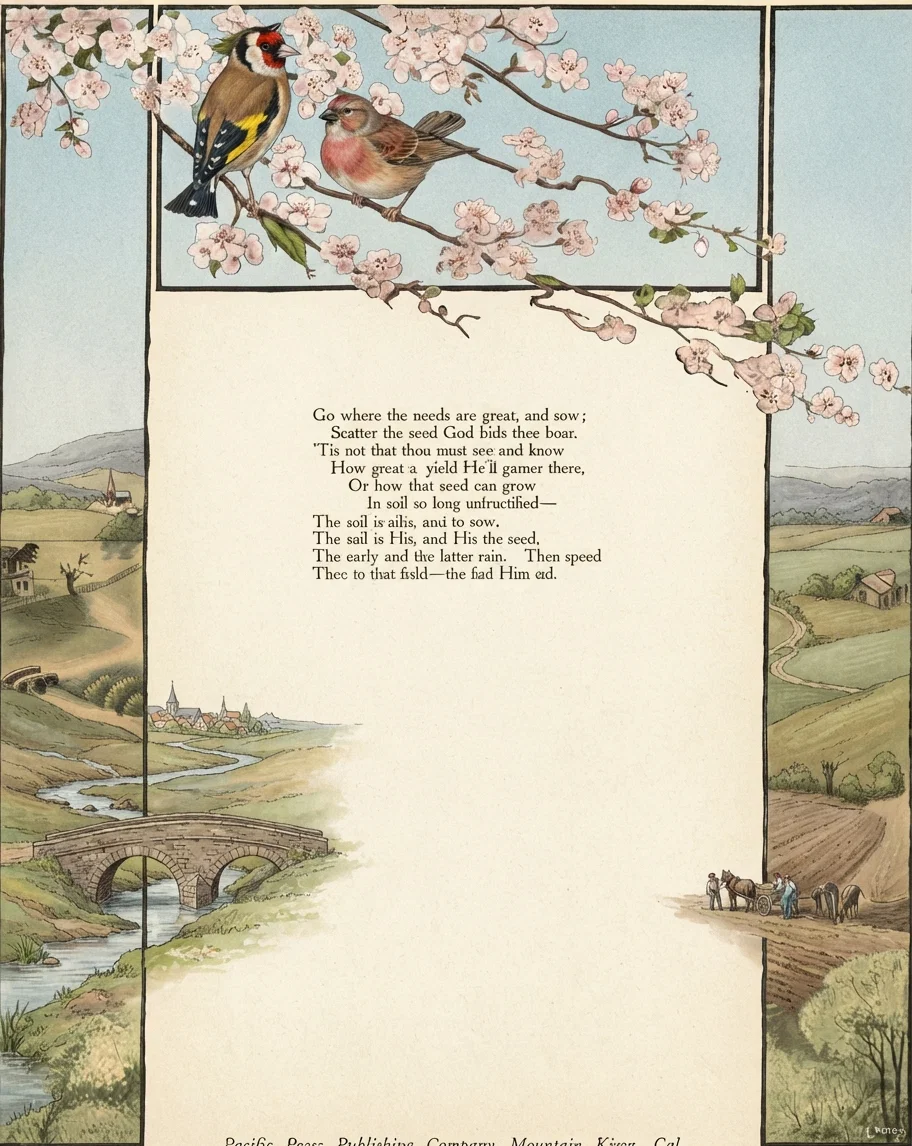
Go where the needs are great, and sow; Scatter the seed God bids thee bear. 'Tis not that thou must see and know How great a yield He'll garner there, Or how that seed can grow In soil so long unfructified— Thy mission is to sow.
The soil is His, and His the seed, The early and the latter rain. Then speed Thee to that field—the field in need. They've waited long in wo; So long in need, so long denied, Tho Christ so long, so long, has bid thee go.
Sow where the needs are great; the seed Is in the keeping of thy God. Thy very life may fill some need If it but show His love abroad, Or soothe some aching heart, Long tossed on life's uncharted sea, Or heal some biting smart— Then art thou His, thy life His seed, And He will sow it where the need Is greatest. Yield, and let Him lead To field beyond the sea, To Afric, Ind, or far Cathay— To whatsoever land has need of thee.
And when the harvest comes, that field Where hard the labor was and long May cause thee wonder by its yield Of precious fruit, and stir to song Of gladness all thy soul. Then fret thou not—in God's own time The earnest or the whole Shall rise where thou didst sow thy seed. Then hie thee thither with all speed To needy lands where'er He lead; And there, in His control, Or here, if that thy mission be, Sow and be sown, till God shall reap the whole. C. M. SNOW.

GLEANINGS FOR ANOTHER SEED SOWER.

"I hear many words of praise for our good pioneer missionary paper, the SIGNS.
"Yours for service,
"Mrs. R. C. Porter."
"I receive your valuable paper, the SIGNS OF THE TIMES. It is a welcome visitor every week. I do enjoy it so much, and expect to renew when my subscription expires. I have read the book which you sent me ("Power for Witnessing") and have been benefited a great deal, and now my neighbors are reading and enjoying it very much."
"I would feel lost without the SIGNS OF THE TIMES to read on Sabbath."
"I feel I can not do without the SIGNS. It is such a comfort to me."

A MEMBER GONE.

Weyerhaeuser, Wis., June 27, 1905.
Dear LITTLE FRIEND:
Enclosed please find fifty cents for one year's subscription. Have been without you for some time and feel as tho a member of the family were gone.
Yours as ever,
BOOK DEPARTMENT NOTES

INSTRUCTIVE PAMPHLETS

LAST DAY TOKENS "Fearful sights and great signs shall there be from heaven." All are more or less familiar with the accounts of the darkening of the sun and moon, and the falling stars, but how many ever saw a full moon in four quarters, each a different color; or a large red cross in the heavens with the letters J. K. S. under it; a Greek cross on the moon; light shooting off from the moon and forming the appearance of a man; a great army in the sky, clothed in red, fighting each other until all were dead; a bright sun two hours after sunset, surrounded by seven stars, the latter finally disappearing into the sun, after which it vanished from sight. These are only a few of the many wonders described in this book and reproduced in their natural colors. Besides these strikingly interesting features, the book contains a complete outline of the Gospel message for our day. It contains 200 pages and the price is only 25 cents.
MIRACULOUS POWERS A pamphlet giving accounts of a large number of extraordinary incidents and experiences, carefully compiled from various sources, showing the mighty miracle-working power of God in the latter days, and establishing the truth of the scripture which says, "These signs shall follow them that believe." Here are a few of the remarkable incidents given,—John Wesley Delivered from a Mob, Fed by a Bird, A Storm Averted, An Engineer's Premonition of Danger, A Heavenly Horseman, Was it an Angel, Saved from Savages, A Supernatural Voice. A work calculated to inspire confidence in God as a protector and mighty helper. 128 pages. Price 15 cents.
PLACE OF THE BIBLE IN EDUCATION The author of this work believes that the Bible is the greatest educational book in the world,—that it contains that which will completely educate mankind in an all-round symmetrical life, and should therefore be the standard in all Christian education. He clearly demonstrates how the Bible may be used in such studies as Anatomy, Physical Culture, Literature, History, Law, Logic, etc. It contains an interesting chapter on the Schools of the Prophets, and another on the Failures of the Popular Education. The work is a strong appeal to Christians to return to the source of all knowledge for their education. 246 pages. Price 25 cents.
SUNDAY IN HISTORY The Bible is silent as to any change of the Sabbath from the seventh to the first day of the week. It is therefore interesting to note what history says concerning the development of Sunday as a rest day. This work gives the testimony of the fathers, statements and admissions of eminent clergymen of the various denominations regarding its sacredness, and a vast array of historical facts gleaned from many sources, in convenient form for ready reference. Every one should have this work in their library. 232 pages, thoroughly indexed. Price 30 cents.
SIBERIA AND THE NIHILISTS A thrilling narrative regarding the Russian exile system, and the atrocities practised in the Siberian penal colonies. Also a lecture on Nihilism, telling of the work of this party and what its aims are. The book contains illustrations of the king's winter palace, Russian prisons, homes of the exiles, and other Siberian scenes. 160 pages. Price 25 cents.
MODERN SPIRITISM An interesting booklet, giving the origin of Spiritism, showing its manifestations, the source of its power, character of its teachings, extent of its belief, the danger of meddling with it; its relation to Christ's second coming, and its final deception. 70 pages, flexible cloth binding. Price 25 cents.
MODERN MYSTERIES "Beware lest any man spoil you through philosophy and vain deceit, after the tradition of men, after the rudiments of the world, and not after Christ." To aid you in following the advice of this scripture we have published a pamphlet under the above title, dealing with some of the latter-day deceptions, such as Hypnotism, Clairvoyance, Telepathy, Theosophy, New Thought, and Pantheism. 107 pages. Price 15 cents.
THE LORD'S DAY This pamphlet treats the great Sabbath question in the light of the three dispensations, giving the testimony of Bible and history, and the statements of prominent men, covering all time. It shows that the Sabbath has been God's great test in all ages. Illustrated. 125 pages. Price 10 cents.

PUBLISHED WEEKLY

The Home of "The Signs of the Times."

PUBLISHED WEEKLY

(Entered September 15, 1904, as second-class matter at the Mountain View, Cal., post-office, under act of Congress of March 3, 1879.)
H. H. HALL, - - - - BUSINESS MANAGER.

Terms of Subscription.

Per Year, post-paid . . . . . . . . . . . . . . . . . . . . . . . . . . . . . . . . . . . . . . . . . . . . . . . . . . . . . . . . . . . . . . . . . . . . . . . . . . . . . . . . . . $1.50 Six Months, 75 cts. Three Months, 40 cts. To Foreign Countries, per year, $1.75.

SPECIAL TERMS.

  1. One new yearly subscription and one renewal, or two new yearly subscriptions, sent at one time, $2.50.
  2. Two new yearly subscriptions and one renewal, or three new yearly subscriptions, sent at one time, $3.25.
  3. Three new yearly subscriptions and one renewal, or four new yearly subscriptions, sent at one time, $4.00.
Sample copies sent on application.

TO OUR PATRONS.

Please be careful to write all names of persons and places plainly.
Send money by Post-office Money Order, Express Order, or Bank Draft on New York, Chicago, or San Francisco.
Orders and Drafts should be made payable to the Pacific Press Publishing Co.
Paper money or silver should be sent in a registered letter.
Registered mail is safe. Unregistered mail is at the risk of the sender.
Postage-stamps in five or ten cent denominations will be accepted for small amounts.
The address label on your paper will indicate the time to which your subscription is paid. In case of non-receipt of papers, or any other irregularity, please notify us immediately.
When subscriptions expire, no more papers are sent to the party except by special arrangement.
You are requested to watch the date on your label, and renew early, and save the loss of papers. We can not always furnish missing numbers.
When requesting change of address, be sure to give both old and new addresses.
Important.—If you order SIGNS, Our Little Friend, books, etc., at the same time, use a separate sheet of paper for each. If this request is complied with, it will materially assist in the prompt and accurate despatch of the business.
When writing to the editor, be sure to use a separate sheet of paper.
The Isolation Hospital, showing the modern power house and the new infectious pavilion.

XVII. A STORY ABOUT FISHING.

Its Lessons.
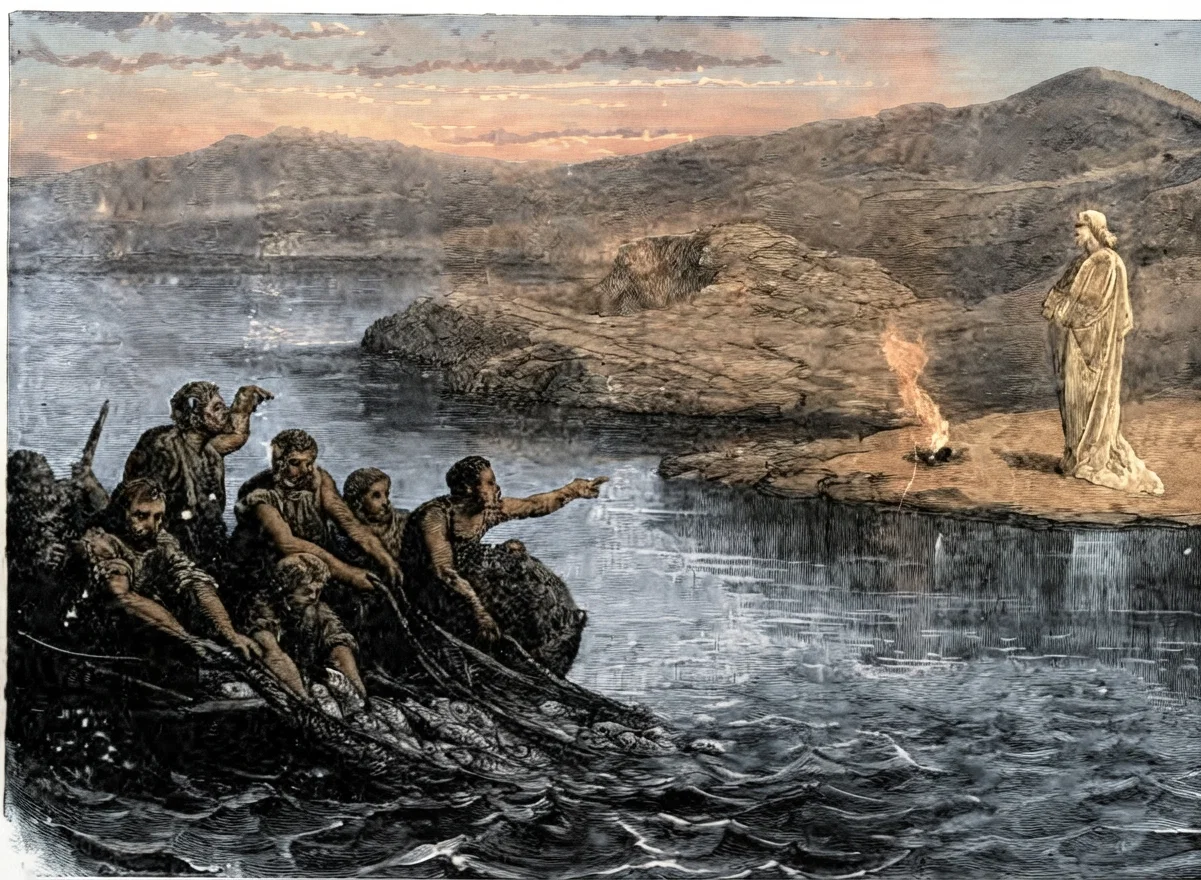
The Narrative.—Our illustration presents a boat-load of men on the sea hauling in a net full of fishes, and on the adjacent shore a single watcher standing by a small fire. The figure on the shore is Jesus of Nazareth; the men in the boat, seven of His disciples. The sea is that of Galilee. The time is after His resurrection. The narrative runs thus:
"After these things Jesus manifested Himself again to the disciples at the sea of Tiberias; and He manifested Himself on this wise. There were together Simon Peter, and Thomas called Didymus, and Nathanael of Cana in Galilee, and the sons of Zebedee, and two other of His disciples. Simon Peter saith unto them, I go a-fishing. They say unto him, We also come with thee. They went forth, and entered into the boat; and that night they took nothing. But when day was now breaking, Jesus stood on the beach; yet the disciples knew not that it was Jesus. Jesus therefore saith unto them, Children, have ye aught to eat? They answered Him, No. And He said unto them, Cast the net on the right side of the boat; and ye shall find. They cast therefore, and now were not able to draw it for the multitude of fishes." John 21:1-6.
Doubt and Perplexity.—The brief story has its important lessons, some of which we wish to notice. Jesus had told the disciples after His resurrection that He would meet them in Galilee, and it was to keep this appointment that the disciples were here. They were not yet fully enlightened. They did not yet understand the nature of Christ's kingdom. They knew He had risen from the dead, that he lived a conqueror; but what they were to do, where they were to go, they did not yet know. As they returned to Galilee, the home of their early life, the old recollections and associations of their former life as fishermen returned. Not knowing the prospect before them, they seem to have concluded that it was best for them to return to their old occupation.
Looking Backward.—They evidently had forgotten the scene three years before, when, fishing on the same sea, they had heard the voice of the Master saying, "Come ye after Me, and I will make you to become fishers of men." Mark 1:16-20. Doubtless they had felt confirmed in the truth of these words on more than one occasion as the great crowds had followed their Master and them; but now all men had forsaken Him, and even one of the twelve had proved a traitor. What could be better or wiser than for them to return to their old occupation, and again earn their living by fishing? They must have reasoned somewhat after this sort, forgot the command of the Master, and followed their own devices.
Human Schemes.—Simon Peter makes the proposition, "I go a-fishing." The other disciples, ready to fall in with the old occupation, said, "We also come with thee." The result of that purely human plan and human effort is thus given: "They went forth, and entered into a ship immediately; and that night they caught nothing." Alas, how many times has the experience been repeated! God has called His church, given His own divine directions, His own divine organization, His own divine means and equipments, and told His servants to go forward, whether His leading was visible or invisible. But how often have they become discouraged, lost sight of the Master, forgotten His commands, directions, and means, and started out for themselves. They have some beautiful society in theory. Some Simon has said, "I go," and he has found others ready to say, "We also go with thee." They have adopted their own plans and methods and means, and have toiled, oftentimes through days and nights and years and centuries, and have accomplished nothing; and when the Master has asked, "Children, have ye any meat?" they could only answer, "No."
Apart from Christ.—Without Christ we can do nothing. Human wisdom, human effort, human expedients, human organizations, human might, coupled even with former successful experience, without Christ will accomplish nothing for God. Man may praise and flatter, may admire the beautiful fabric we have reared, but without Christ it is hollow, vain, empty. "Without Me ye can do nothing," are His words to all. This was the important lesson conveyed in His delicate question, "Children, have ye any meat?"
With Christ.—But with Christ the story is different, the scene changes. His words ring across the water and thrill the souls of the disciples with a deeper meaning than had similar words on a former occasion (see Luke 5:4): "Cast the net on the right side of the ship, and ye shall find." There is no particular significance in the term "right side," except its definiteness. It was the right-hand side; they probably were then fishing on the left-hand side, and had doubtless fished all around the boat. Jesus might have said the left-hand side; the result would have been the same. Where He commanded to cast the net, there were fish to be caught. Either side if commanded by Him was the right or true and only place, and either side without Him was the wrong side. It all rested in His word, in His instruction. In the command of God is all-potency. It is itself a promise. What He commands, however impossible it may seem, will be accomplished if we will but submit to it.
The Great Twofold Lesson.—The result of obedience to Christ's command was a net full of fishes, and a welcome meal waited the weary fishers on the shore. Their duty in Galilee was to wait for the Saviour, not to return to the old life; but they went a-fishing in their own wisdom, and caught nothing. They went back from the exalted mission of being fishers of men to fishers of fish. They turned from the service of Christ to the service of self.And the service of self proved, as it always proves, fruitless. The great twofold lesson of the narrative is that apart from Christ man can do nothing, and following Christ's command always brings success. Fishing themselves for themselves, there was no success; fishing in the same sea, by the same boat, in the same place, at the command of Christ, there was success. O, that the servants of God would but heed the Master's teaching, simple and unreasonable tho it seems! Toiling all night—the best hours for fishing—in their own strength and wisdom, they may think that with the dawning morning and the seemingly barren sea there is no further use to fish for souls; but let them by simple faith say with the disciples of old, "Nevertheless at Thy word I will let down the net." Luke 5:5. "No word of God shall be void of power." Child of God, trust the word of the Master. Do His service in His way, and you will reap the sure harvest.

OUR OBEDIENT EXAMPLE.

He who came to live our example and die our sacrifice has left us a very plain lesson indeed in the matter of obedience to the law of God. Never in anything that He said or did is there even the most vague intimation that He had come to set up a will or law of His own in opposition to the law and will of God.
He expressed His purpose in such words as these: "I seek not Mine own will, but the will of Him that sent Me." John 5:30. "I am come down from heaven, not to do Mine own will, but the will of Him that sent Me." John 6:38. He taught His disciples to pray, "Thy will be done, as in heaven, so on earth." And when it came to the supreme test where He must lay down His life for man's transgression of the law of God, He prayed: "My Father, if this can not pass away, except I drink it, Thy will be done." Matt. 26:42. "I delight to do Thy will, O My God; yea, Thy law is within My heart." Ps. 40:8.
That is our example, our pattern in loyalty; that brings God and man into harmony, makes them at one. That removes the enmity—that child of a carnal heart—of the natural man toward the law of God. "For to be carnally minded is death; but to be spiritually minded is life and peace. Because the carnal mind is enmity against God; for it is not subject to the law of God, neither indeed can be." Rom. 8: 6, 7. While the "carnal mind," or the fleshly mind, is dominant in the man, there is opposition to the law of God; and opposition to the law of God means opposition to God Himself, whose character is expressed in that law. Christ manifested none of that feeling—He was here to teach us the very opposite. As was prophesied of Him in Isa. 42:21, He did "magnify the law, and make it honorable."
Christ could not have been the Saviour of men if He had taken any course other than the one He did, a course of complete submission to the law of God; for there is only one final authority in the universe, and that is God. For Christ to attempt to change the law of God or to set up a law of His own, would be to put Himself in the place of God, to set up another government, and bring in discord, disharmony, rebellion—the work which Satan did. Instead of attempting to do any such work, He humbled Himself and became obedient to the established order and law of the Father. It was Satan's work of opposition to the law and the established order of God's government that made necessary Christ's work of reconciliation, obedience, and sacrifice. The works which He did He declared to be the works of the One who sent Him. His whole ministry was a ministry of reconciliation—not to reconcile God to man, but to reconcile man to God. See 2 Cor. 5:18-20.
Then, when Christ returned to the Father, and left with His followers the same "ministry of reconciliation," He left with them the example of His own life to follow. Thus speaks the disciple John: "He that saith he abideth in Him ought himself also to walk even as He walked." 1 John 2:6. How must we walk in order to walk as He walked? The same writer tells us in the sentences just preceding this quotation. "Hereby we know that we know Him, if we keep His commandments. He that saith, I know Him, and keepeth not His commandments, is a liar, and the truth is not in him; but whoso keepeth His word, in him verily hath the love of God been perfected. Hereby we know that we are in Him: he that saith he abideth in Him ought himself also to walk even as He walked." 1 John 2:3-6. That, says John, is the test which we may apply to ourselves, to know whether we are in Him or not. If we walk as He walked, we are "in Him," if we do not, then we are not "in Him."
If Christ had set up laws of His own in opposition to the will of the One who sent Him, He would have nullified His own mission, and made the breach between man and God wider than ever. That would have placed Him also in the ranks of those who needed to be reconciled. Lucifer, the one-time covering cherub, did that very work; and the load of sin under which the universe groans to-day is the result of that act.
Notwithstanding that fact, and in the plain light of the terrible consequences of that act, our Lord Jesus Christ is continually accused—and by those who profess to honor Him—of doing the same thing, of setting up another law, instituting another Sabbath, thus supplanting the law written by the finger of God upon the tables of stone and upon the hearts of men; and that accusation is made in the face of the plain and emphatic declaration of Christ recorded in Matt. 5:18, "Till heaven and earth pass, one jot or one tittle shall in nowise pass from the law, till all be fulfilled."
That was the uncompromising position which Christ Himself took. It was the only position He could take and be man's Redeemer. The law which He "magnified" was the established law of the Father; He set up no will but the will of Him that sent Him; He wrought no works for His own glory, but rather emptied Himself of the glory that He had with the Father before the world was—all that He might establish in the hearts of men the law which man had broken. That law is the very law which professed Christians are to-day accusing Him of having abolished, supplanted, overthrown; the very law (His Word) which the psalmist declares is settled forever in the heavens. Ps. 119:89.
Nothing would have suited Satan better than to have caused Christ to transgress that law, or seek to abolish it. So he tempted Christ on both tables of that law. If Christ had fallen down and worshipped Satan as Satan demanded, He would have broken the first table; if He had allowed Himself to covet the kingdoms of this world, as Satan sought to cause Him to do, He would have broken the last table of the law. But He yielded in neither. The ground of man's hope in Christ is the fact that He was a law-keeper rather than a law-breaker, a law-changer, or a law-abolisher. Christ loyally adhered to and magnified the law of God; and they that are His will do as He did. Knowing His example, we must follow it, or we can not expect His approbation in the great day of God.
S.

The Great Controversy Between Good and Evil

SUGGESTIVE PROPOSITIONS ON THE PRIESTHOOD OF CHRIST.

The Great Controversy between Good and Evil.

No. III.

WHEN Christ ascended up on high after His crucifixion and resurrection, He entered upon His Melchizedek priesthood for this world, appointed by the oath of God. "Having been made perfect," "having obtained eternal redemption," "He became unto all them that obey Him the Author of eternal salvation." Heb. 5:9; 9:12. Then began His ministry, as in the type, in the sanctuary above, the first act of which was the anointing of the entire sanctuary, the holy and most holy places, with all the furniture and utensils thereof. Lev. 8:10, 11. The ministration of Christ in the holy place was indicative of His service and work rather than of some exact position or location. There He appears in the presence of God for us, ministering by virtue of His own life, transferring confessed sins from the sinner to the sanctuary on high. Heb. 9:24; Rev. 5:6, compare with 4:5, 6; 8:8. The candlestick and the altar were in the holy place of the earthly sanctuary. Here Christ, our Melchizedek Priest, ministers His life for His children, as father of the race of men, but ever looking forward to the ultimate, the final sin-cleansing. Heb. 6:19; 9:27, 28.
16. While ministering His life, He is seated in authority at the right hand of the Father, on His Father's throne, that the promise of the Father may be fulfilled—to subdue the foes of Christ under Him. Heb. 8:1, 2; Rev. 3:21; Ps. 110:1; 1 Cor. 15:24-28.
17. When the end of Christ's ministration draws nigh, He is, before all the angelic host, brought in before the Father to receive the kingdom He has won. Dan. 7:13, 14.
18. The closing work of His ministration is referred to in the Scriptures as the cleansing of the sanctuary, the finishing of the mystery of God, the viewing of the guests in the marriage feast, the antitypical day of atonement, literally a judgment work. Dan. 8:14; Rev. 10:7; Matt. 22:11, 12; Dan. 7:9, 10. While still the merciful and faithful High Priest of all that come to Him, He is also taking part in that work of final separation of the evil from the good, pleading His blood for the perfect-hearted erring ones who have died in His service, and whose names come before the High Court for examination, as recorded in the Book of Life; and, too, sending forth His light and truth for the perfecting of those living on the earth, that they may be without spot or blemish, when His work of mediation for sin ceases. As judgment is passed upon each case according to the record, either the soul's record of sin is blotted out forever, as it must be out of his heart (Acts 3:19), or his name is forever blotted out of the Book of Life (Rev. 3:5).
19. The finishing of "the mystery," the Gospel, of God is the last act of the great drama. In the cleansing of the earthly sanctuary two goats were taken, upon which lots were cast, one goat for Jehovah, one for Azazel, the Revolted One. These goats typify the two great contrary characters, between which the great controversy has waged, and in each of which has been promised freedom and future life; and these now come before Jehovah for final and universal choice. One, in whom centers the whole of holy character, who took upon Himself the sins of the world voluntarily, who chose death that others might have life, is chosen of Jehovah. As the substitute of man, He bore, He suffered, man's sin. Jehovah hath made to meet, to light, on Him the iniquity of us all. All were focused on Him. But in His character He demonstrated His power over man's deadly foe, and rose triumphant over sin and death. As man's substitute, as the sin-offering, He died. As the sinless, suffering, righteous One He lives eternally, made a priest of an endless life.
20. Lucifer in the beginning took all the sin of the world, of the universe, upon himself, when he coveted and attempted to obtain by the "right" of might and craft the throne of the universe. In his sinning and seduction of others to evil Lucifer made himself responsible for all the consequences which might follow.
21. The Son of God bore the sin of the world as tho there had been no adversary in the universe; but He demonstrated that sin does not belong to Him, as will all who are righteous in Him demonstrate that sin does not belong to them. Yet for all the centuries the charge has been laid against God that He was unjust in placing upon the innocent the guilt of the wicked. And were this guilt thus eternally placed, the charge would be true. But the power and mercy and love of God have demonstrated that not to the righteous, tried Innocent belong the guilt, the sins; but to the instigator and choosers of sin, to the Wicked One and his branches. Anciently it was said to God by the father of the faithful: "That be far from Thee to do after this manner, to slay the righteous with the wicked; and that the righteous should be as the wicked, that be far from Thee. Shall not the Judge of all the earth do right?" The question is answered when God's plan of salvation is worked out, when God has demonstrated that He is just and the justifier of him that believeth in Jesus." Divine eternal love and mercy in the heart of God's dear Son led Him to give Himself, led His Father to give His Son, for a race of rebels, to take upon Himself their penalty, and so achieve the salvation of all who desired to overcome sin. And Divine, eternal justice and love demands that the sin of the righteous, the innocent, shall be placed back upon the instigator who took them all upon himself when he sinned. Then shall the redeemed ones sing in the light of fact as they have trusted by faith: "Great and marvelous are Thy works, Lord God Almighty; just and true are Thy ways, Thou King of Ages."
(To be continued.)

A MARKED CONTRAST.

IT is claimed for the Sunday institution that it is both civil and religious. A prominent advocate of Sunday legislation once said, in a public convention: "We, the Sabbath Union, W. C. T. U., all the churches, and the Y. M. C. A., are laboring with all our might to carry the religious Sabbath with our right arm and the civil Sabbath with our left. Hundreds of thousands will receive it as a religious institution, and all the rest will receive it as a civil institution, and thus we will sweep in the whole nation."
This explains how it is that this "mark" is to be received by the people "in their right hand, or in their foreheads; and that no man might buy or sell, save he that had the mark, or the name of the beast." See Revelation 13. And it is this mark, which men receive, as both a religious and civil, or secular, institution (anything that it may be formally recognized), against which the "third angel" of the last days warns the world. See Rev. 14: 6-11, and note particularly the dire consequences of being deceived into receiving this mark.
Note also, in connection with this fiery ordeal, that some have heeded the warning; for it is said in verse 12 that "here is the patience of the saints; here are they that keep the commandments of God, and the faith of Jesus." The mention of their patience shows that they have passed through very trying experiences in overcoming the pressure to receive the mark in opposition to the commandments of God.
Reverting to the quotation concerning the religious and the civil features of the Sunday-sabbath, the "hundreds of thousands" who "receive it as a religious institution" are they who receive the mark in the forehead primarily. We concede that they do so conscientiously—their consciences have been so far perverted by education. But "all the rest," who "receive it as a civil institution," do so by compulsion of the civil law. They simply concede recognition by stopping work, thus receiving the mark "in their hands."
God also has a mark—a "sign" (Ex. 31: 16, 17; Eze. 20: 12); a "seal" (Rev. 7: 1-4). This mark, or sign, is the Sabbath, of which the "mark of the beast" is a counterfeit. This mark or seal of God is received only "in the forehead." It is a religious institution exclusively, and is received in the mind. It is a matter of conscience only, and is not enforced upon men by civil law. The Lord does not appeal to civil law for the enforcement of His law. He accepts only voluntary obedience. Enforced obedience can result only in hypocrisy. A willing obedience is all that will save men from the devouring sword in the judgment. Isa. 1: 18-20. "My son, give Me thine heart," is the Lord's appeal. This done, and the work of the hand will be in harmony without the special aid of human law. G.

THE YOKE OF CHRIST.

A YOKE signifies servitude, but it does not necessarily mean irksome labor or degrading, menial service. That depends altogether upon whose yoke one wears. The yoke of Satan—which means self-service, or labor to please men—is a very heavy, galling yoke. The reason is, one has to bear the burden himself; no one cares to lighten it for him. It is all labor, wearisome labor, with no help. The yoke of Christ on the contrary, not only signifies service, but it implies help in that service, with loving, sympathetic companionship. Whoever wears that, is yoked up with Christ—not simply under Him. It was being yoked with Him that enabled Paul to say, "I can do all things through Christ which strengtheneth me." It is trying to do without Him that makes the yoke of life heavy; for He says, "Without Me ye can do nothing." So the yoke of Christ lightens the burdens of Christ in this sin-laden, wearisome life. Hence the wisdom of His counsel: "Come unto Me, all ye that labor and are heavy laden, and I will give you rest. Take My yoke upon you, and learn of Me; for I am meek, and lowly in heart; and ye shall find rest unto your souls. For My yoke is easy, and My burden is light."
Continue reading: Question Corner