Pacific Press Publishing Association · Mountain View, California · Dec 23, 1913
Victory Complete, Absolute, and Eternal
By Ellen G. White
Tempted to Presumption — Tempted by World-Embracing Glory — Victories by the Power of the Divine Word — A Universe Triumphs in the Result
BY MRS. E. G. WHITE
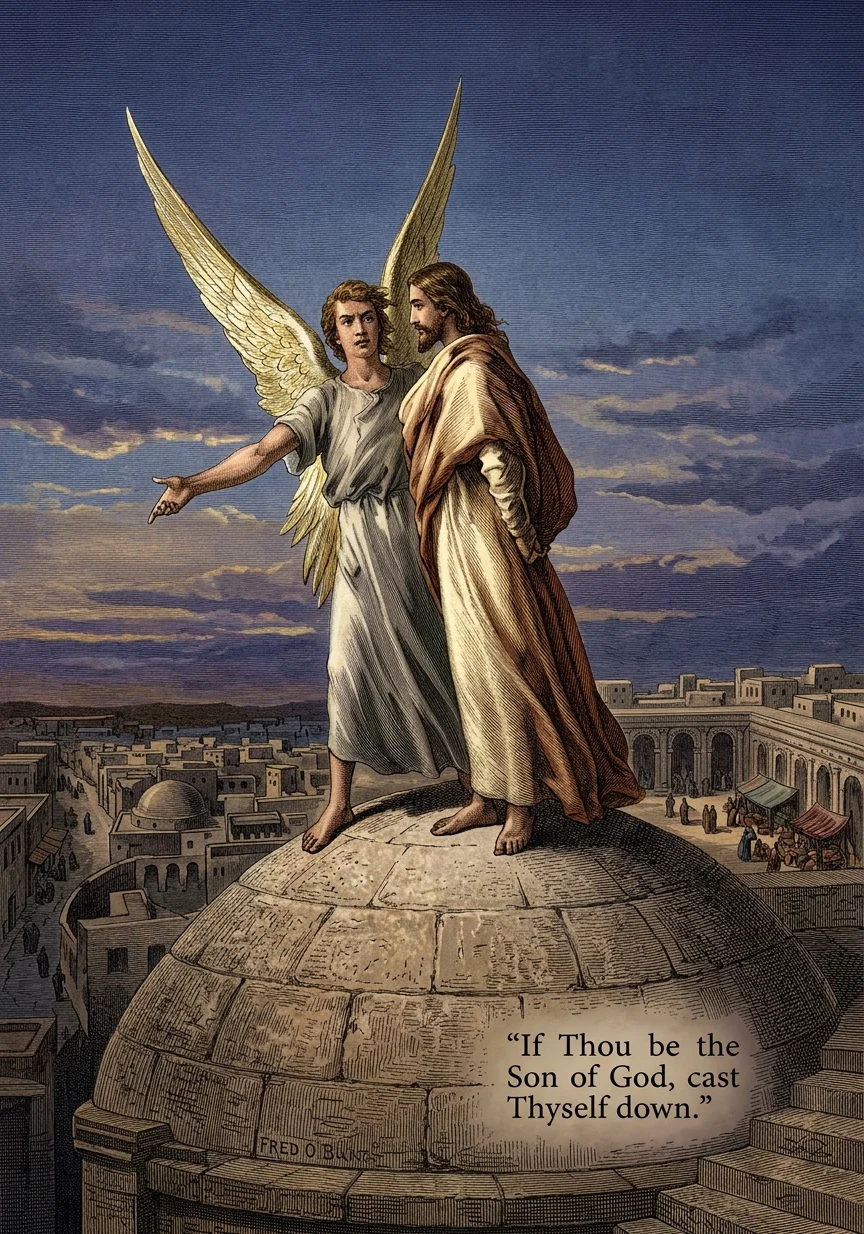
“If Thou be the Son of God, cast Thyself down.”
SATAN now supposes that he has met Jesus on His own ground. The wily foe himself presents words that proceeded from the mouth of God. He still appears as an angel of light, and he makes it evident that he is acquainted with the Scriptures and understands the import of what is written. As Jesus before used the word of God to sustain His faith, the tempter now uses it to countenance his deception. He claims that he has been only testing the fidelity of Jesus, and he now commends His steadfastness. As the Saviour has manifested trust in God, Satan urges Him to give still another evidence of His faith.
The Insinuation of Distrust
But again the temptation is prefaced with the insinuation of distrust, “If Thou be the Son of God.” Christ was tempted to answer the “if”; but He refrained from the slightest acceptance of the doubt. He would not imperil His life in order to give evidence to Satan.
The tempter thought to take advantage of Christ’s humanity, and urge Him to presumption. But while Satan can solicit, he can not compel to sin. He said to Jesus, “Cast Thyself down,” knowing that he could not cast Him down, for God would interpose to deliver Him. Nor could Satan force Jesus to cast Himself down. Unless Christ should consent to temptation, He could not be overcome. Not all the power of earth or hell could force Him in the slightest degree to depart from the will of His Father.
The Tempter Can Not Compel
The tempter can never compel us to do evil. He can not control minds unless they are yielded to his control. The will must consent, faith must let go its hold upon Christ, before Satan can exercise his power upon us. But every sinful desire we cherish affords him a foothold. Every point in which we fail of meeting the divine standard is an open door by which he can enter to tempt and destroy us. And every failure or defeat on our part gives occasion for him to reproach Christ.
Left Out an Essential Part
When Satan quoted the promise, “He shall give His angels charge over Thee,” he omitted the words, “to keep Thee in all Thy ways”; that is, in all the ways of God’s choosing. Jesus refused to go outside the path of obedience. While manifesting perfect trust in His Father, He would not place Himself, unbidden, in a position that would necessitate the interposition of His Father to save Him from death. He would not force Providence to come to His rescue, and thus fail of giving man an example of trust and submission.
Jesus declared to Satan, “It is written again, Thou shalt not tempt the Lord thy God.” These words were spoken by Moses to the children of Israel when they thirsted in the desert, and demanded that Moses should give them water, exclaiming, “Is the Lord among us, or not?” God had wrought marvelously for them; yet in trouble they doubted Him, and demanded evidence that He was with them. In their unbelief they sought to put Him to the test. And Satan was urging Christ to do the same thing. God had already testified that Jesus was His Son; and now to ask for proof that He was the Son of God, would be putting God’s word to the test—tempting Him. And the same would be true of asking for that which God had not promised. It would manifest distrust, and be really proving or tempting Him. We should not present our petitions to God to prove whether He will fulfil His word, but because He will fulfil it; not to prove that He loves us, but because He loves us. “Without faith it is impossible to please Him: for he that cometh to God must believe that He is, and that He is a rewarder of them that diligently seek Him.”
Faith and Presumption in Contrast
But faith is in no sense allied to presumption. Only he who has true faith is secure against presumption, for presumption is Satan’s counterfeit of faith. Faith claims God’s promises, and brings forth fruit in obedience. Presumption also claims the promises, but uses them as Satan did, to excuse transgression. Faith would have led our first parents to trust the love of God and to obey His commands. Presumption led them to transgress His law, believing that His great love would save them from the consequences of their sin. It is not faith that claims the favor of Heaven without complying with the conditions on which mercy is to be granted.770
Genuine faith has its foundation in the promises and provisions of the Scriptures.
Often when Satan has failed of exciting distrust, he succeeds in leading us to presumption. If he can cause us to place ourselves unnecessarily in the way of temptation, he knows that the victory is his. God will preserve all who walk in the path of obedience, but to depart from it is to venture on Satan’s ground. There we are sure to fall. The Saviour has bidden us, “Watch ye and pray, lest ye enter into temptation.” Meditation and prayer would keep us from rushing unbidden into the way of danger, and thus we should be saved from many a defeat.
Yet we should not lose courage when assailed by temptation. Often when placed in a trying situation, we doubt that the Spirit of God has been leading us. But it was the Spirit’s leading that brought Jesus into the wilderness to be tempted by Satan. When God brings us into trial, He has a purpose to accomplish for our good. Jesus did not presume on God’s promises by going unbidden into temptation, neither did He give up to despondency when temptation came upon Him. Nor should we. “God is faithful, who will not suffer you to be tempted above that ye are able; but will with the temptation also make a way to escape, that ye may be able to bear it.”
Satan Manifests His Real Self
Jesus was victor in the second temptation, and now Satan manifests himself in his true character. But he does not appear as a hideous monster, with cloven feet and bats’ wings. He is a mighty angel, though fallen. He avows himself the leader of rebellion and the god of this world.
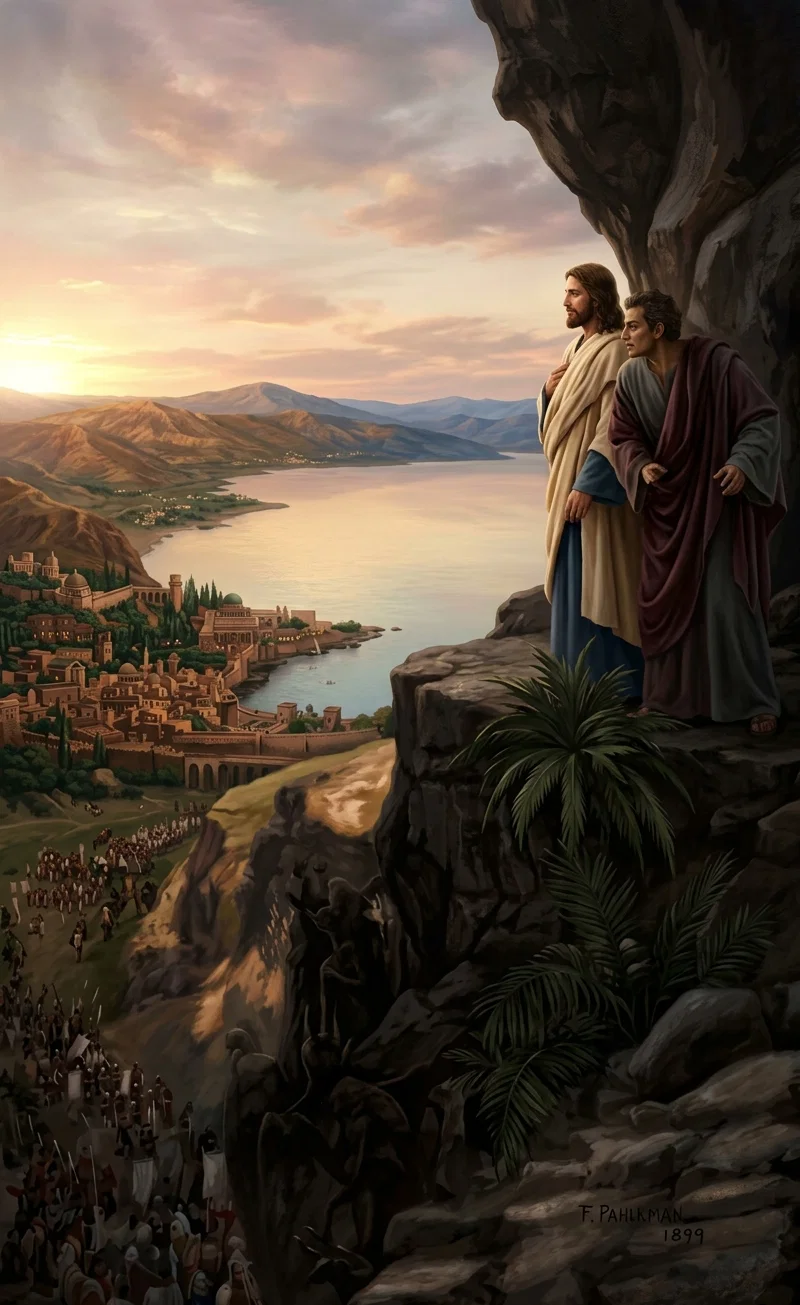
Placing Jesus upon the high mountain, Satan caused the kingdoms of the world, in all their glory, to pass in panoramic view before Him. The sunlight lay on tempted cities, marble palaces, fertile fields, and fruit-laden vineyards. The traces of evil were hidden. The eyes of Jesus, so lately greeted by gloom and desolation, now gazed upon a scene of unsurpassed loveliness and prosperity. Then the tempter’s voice was heard: “All this power will I give Thee, and the glory of them: for that is delivered unto me; and to whomsoever I will I give it. If Thou therefore wilt worship me, all shall be Thine.”
Christ’s mission could be fulfilled only through suffering. Before Him was a life of sorrow, hardship, and conflict, and an ignominious death. He must bear the sins of the whole world. He must endure separation from His Father’s love. Now the tempter offered to yield up the power he had usurped. Christ might deliver Himself from the dreadful future by acknowledging the supremacy of Satan. But to do this was to yield the victory in the great controversy. It was in seeking to exalt himself above the Son of God that Satan had sinned in heaven. Should he prevail now, it would be the triumph of rebellion.
Satan Not a Rightful Prince
When Satan declared to Christ, “The kingdom and glory of the world are delivered unto me, and to whomsoever I will I give it,” he stated what was true only in part, and he declared it to serve his own purpose of deception. Satan’s dominion was that wrested from Adam; but Adam was the vicegerent of the Creator. His was not an independent rule. The earth is God’s, and He has committed all things to His Son. Adam was to reign subject to Christ.
When Adam betrayed his sovereignty into Satan’s hands, Christ still remained the rightful King. Thus the Lord had said to King Nebuchadnezzar, “The Most High ruleth in the kingdom of men, and giveth it to whomsoever He will.” Satan can exercise his usurped authority only as God permits.
When the tempter offered to Christ the kingdom and glory of the world, he was proposing that Christ should yield up the real kingship of the world, and hold dominion subject to Satan. This was the same dominion upon which the hopes of the Jews were set. They desired the kingdom of this world. If Christ had consented to offer them such a kingdom, they would gladly have received Him. But the curse of sin, with all its wo, rested upon it. Christ declared to the tempter, “Get thee behind Me, Satan: for it is written, Thou shalt worship the Lord thy God, and Him only shalt thou serve.”
More Successful with Men
By the one who had revolted in heaven, the kingdoms of this world were offered Christ, to buy His homage to the principles of evil. But He would not be bought. He had come to establish a kingdom of righteousness, and He would not abandon His purpose. With the same temptation, Satan approaches men, and here he has better success than with Christ. To men he offers the kingdom of this world on condition that they will acknowledge his supremacy. He requires that they sacrifice integrity, disregard conscience, indulge selfishness. Christ bids them seek first the kingdom of God, and His righteousness; but Satan walks by their side, and says: “Whatever may be true in regard to life eternal, in order to make a success in this world, you must serve me. I hold your welfare in my hands. I can give you riches, pleasures, honor, and happiness. Harken to my counsel. Do not allow yourselves to be carried away with whimsical notions of honesty or self-sacrifice. I will prepare the way before you.”
Thus multitudes are deceived. They consent to live for the service of self, and Satan is satisfied. While he allures them with the hope of worldly dominion, he gains dominion over the soul. But he offers that which is not his to bestow and which is soon to be wrested from him. In return, he beguiles them of their title to the inheritance of the sons of God.
CHRIST AND SATAN ON THE MOUNTAIN
“Satan caused the kingdoms of the world, in all their glory, to pass in panoramic view before Him.”
ALL THINGS WORK FOR GOOD
By Lilla Warren
“We know that all things work together for good to them that love God.” Rom. 8:28.
By LILLA WARREN
WHEN Satan gained consent of God
To let Job pass beneath the rod,
Could Job say, in the path he trod,
That all things work for good?
For Satan of poor Job had said
He served the Lord to save his head.
His wife said, “Curse God, and be dead.”
Do all things work for good?
Job said, “I'll trust Him though He slay,
For I am His, and will obey.”
I think he from his heart could say
That all things work for good.
For when his friends him did abuse,
And 'gainst him trying language use,
He prayed for them — did not refuse —
For all things work for good.
And when he prayed, his bondage turned.
No more was he by dear ones spurned.
God gave back more than he had earned.
Yes, all things worked for good.
But now the time would fail to tell
Of all to whom affliction fell,
And how they oft have proved full well
That all things work for good.
And all who love God here below,
E'en if they can not see, will know —
For God's own word will make it so —
That all things work for good.
The New Altruism and Its Prospects
By G. W. Rine
Will It Close the Breach Between the Clashing Factions of Society? — Where May We Look for the Golden Age?
By PROF. G. W. RINE
This is the sixth article that Professor Rine, of the Pacific Union College, has furnished on the “economic situation.” In previous articles, he has told of the pending world-wide industrial revolution; of the unequal distribution of wealth as the great cause of discontent; the conflict of industrial autocracy with the sentiments and teaching of democracy; the extravagance and wantonness of the few and the destitution of the many; Syndicalism, or the world-wide organization of the I. W. W.; and last week the professor showed that the prophets of the Bible foretold all these conditions specifically and in detail. Editor.
Among the last written words of that venerable physicist, the late Alfred Russell Wallace, are the following: “We see a continuous advance of man’s power to utilize the forces of nature, to an extent which surpasses everything he had been able to do during all the preceding centuries of his recorded history.”
“We also see that the result of this vast economic revolution has been almost wholly evil. We see that this hundredfold increase of wealth, amply sufficient to provide necessaries, comforts, and all beneficial refinement, . . . for our whole population, has been distributed with such gross injustice that the actual condition of those who produce all this wealth has become worse and worse, no efficient arrangements having been made that from the overflowing abundance produced all should receive the mere essentials of a healthy and happy existence.
“We see millions still struggling in vain for a sufficiency of the bare necessaries of life (which, in their misery, is all they ask), often culminating in actual starvation, or in suicide, to which they are driven by the dread of starvation.”
“And while this is going on in the depths, . . . a little higher up, among the middlemen distributors of the necessaries and luxuries of life, bribery, adulteration, and various forms of petty dishonesty are rampant.”
“And higher yet, among the great capitalists, the merchant princes, the captains of industry, we find hard taskmasters who drive down wages below the level of bare subsistence, and who support a more gigantic and wide-spread system of gambling than the world has ever seen.
“And finally our administration of what we call ‘justice’ . . . is utterly unjust, because it is based on a system of money fees at every step; because it is so cumbrous and full of technicalities as to need the employment of attorneys and counsel at great cost, and because all petty offenses are punishable by fine or imprisonment, which makes poverty itself a crime while it allows those with money to go practically free.”
Professor Wallace has painted a dark but true picture of British economic society, and completes his sketch with the following lurid touches (italics his):
“Taking account of these various groups of undoubted facts, many of which are so gross, so terrible, that they can not be overstated, it is not too much to say that our whole system of society is rotten from top to bottom, and the social environment as a whole, in relation to our possibilities and claims, is the worst that the world has ever seen.”
It was upon British society that the foregoing vitriolic stricture was written. Who, however, would think of denying that the same insufferable conditions exist in all the other nations of the civilized world? Further still, who would think of denying that some of the evils so trenchantly depicted by Professor Wallace are still more glaringly in evidence in our own country?
Sweeping Rehabilitation of Society Demanded
At any rate, all thinkers are at one in holding that the breach between the two great classes of the industrial world has become so great as to call for a sweeping economic rehabilitation of society. Otherwise social war is not only inevitable but actually impending. Accordingly thousands of thinking men in all parts of Christendom are strenuously working to effect such social reforms as in their judgment would prove efficacious in closing the ominous breach between the capital and the laboring class. By such reforms they hope to establish permanent industrial peace and consequent social contentment and tranquillity. Professor Wallace himself, in the face of the portentously dark picture he has left us, was sanguine that the philanthropic instincts of society were sufficiently general and potent so to transform the industrial world in the near future as to insure the dawn of a social era marked by justice, fraternal good will, and, in consequence, by universal industrial peace and prosperity.
Transferring the Golden Age
Dr. Josiah Strong thinks it a highly significant fact that men to-day are transferring the golden age to the future, instead of to the past, as former generations were wont to do. Like nearly all other social workers, Dr. Strong bases his hope of the world’s future, not upon the immutable pronouncements of inspired prophecy, but upon the power and willingness of man himself to erect upon the ruins of our present social order an Edenic social state—the kingdom of God on earth.
It is true that these social leaders—men of great moral earnestness—often quote the numerous prophetic promises that the kingdom of heaven should ultimately be realized on earth; but they utterly fail to see that these same prophecies declare again and again that the realization of that kingdom, or of an ideal human society, can and will be effected only through the personal, visible coming of Christ in glory to our world. We all know, of course, that it is morally incumbent upon all Christian believers to do all in their power to promote the well-being and happiness of their fellows, and thus ameliorate the conditions of society; but they have no Scriptural warrant to expect the advent of the kingdom of God to this world except through the advent of the personal Christ, “the last Adam,” to this world. Did not the Master Himself declare that it is when the Son of man should come, with all the holy angels, that He would sit upon the throne772of His glory? It is then that He will say to “them on His right hand,” “Come, ye blessed of My Father, inherit the kingdom prepared for you from the foundation of the world.”
The New Knowledge
Those benevolent men and women who are laboring for the moral renovation and rehabilitation of society in this world as it is, reason that the two great sources of human misery and the two great obstacles to moral progress are ignorance and selfishness. Ignorance is the mother of fear and superstition, and, in a measure, of want and famine. Selfishness leads men to prey upon one another by war, oppression, slavery, robbery, theft, fraud, and by the commission of a thousand other wrongs. They contend that these two sources of all human woe—ignorance and selfishness—are now in process of being removed by the new knowledge and the new altruism.
The new knowledge is what is commonly called science. No one will deny that the nineteenth century witnessed a mighty cataclysm in the intellectual life of the race. Prof. A. E. Dolbear names nineteen distinct sciences which had no existence one hundred years ago. “These sciences,” he avers, “embody almost all the knowledge we have.” Alfred Russell Wallace asserts that the scientific discoveries and their practical applications effected during the last century outweigh and outnumber all that had preceded in all time. It is generally contended that the achievements of science have only begun. The marvels of telephony, of wireless telegraphy, of aviation, of auto-motor power, etc., are referred to as the prophecies of the still more glorious human achievements of the long future. The Carnegie Institution at Washington, fortified with an endowment of $25,000,000, is devoted exclusively to scientific research. Prof. Charles S. Minot informs us that there are now more than ten thousand men of distinction carrying on original scientific researches.
The Scientific Dogma of Evolution
It is maintained that the discovery of the scientific dogma of evolution has given us a new conception of revelation, of God, of the future as well as of the past history of man, and, above all, it has shown us that “this is not a finished world, but one in process of becoming.” Of course, to believers in the evolutionary dogma, the human race has been for hundreds of thousands of years, and still continues to be, in process of evolution from a lower to a higher plane of being. From the evolution premise, the deduction is inescapable that man is ever rising spiritually as well as intellectually. Hence the realization of an ideal humanity by virtue of the “new knowledge,” or modern science, based on the new god, Evolution, is to the scientific reformer a certitude.
Says Dr. Strong, “There is good promise that social science will in due time enable us in large measure to shape the future of the race.” After referring to the sad fact that millions are now eating such food, living in such houses, working under such conditions and with such wages, as to make their living normal lives wholly impossible, he says further, “But all these conditions are remediable; and sociology gives us good courage to expect that the curse of poverty will be removed.” Pasteur’s proud declaration, “It is within the power of man to rid himself of every parasitic disease,” has become the slogan of the new scientific medicine. Dr. Broda, a noted writer on ethics and sociology, declares with gusto that evolution not only demonstrates the unity of nature, but also proves the brotherhood of the world and the solidarity of creation, and so gives us the foundation for a new moral ideal, “and provides a new theory of ethics, and is thus eminently fitted for becoming the basis for a new manifestation of the religious spirit.”
“It is the province of science,” avers Dr. Strong, “to discover to us natural laws by which we subdue nature to the uses of human welfare, and to reveal the laws of life, both individual and social, by the knowledge of which society may live in harmony with the laws of its own being, thus actualizing the highest possibilities, and realizing our social ideal.”
It would be easy indefinitely to adduce evidence of the same tenor showing that social reformers cherish the conviction that the “new knowledge”—modern science—is destined to prove an all-potent agency in bringing about the social, industrial, and ethical solidarity of man; that is, universal human brotherhood will be largely realized through increasing intellectual enlightenment applied to the promotion of human well-being.
The New Altruism
Not only the estimable men and women who, from philanthropic motives, are devoted to the task of social regeneration, but also many publicists, journalists, and clergymen maintain that men generally are becoming less and less selfish—less egoistic, more altruistic. This contention is fulminated from the pulpit, the platform, and through the press. It is urged that man realizes as never before that he is his brother’s keeper, that the interest of each is the interest of all. Dr. Strong declares with evident gusto, “This new spirit is so obvious that it is almost superfluous to cite illustrations.” It is held that universal competition is in rapid process of giving way to universal cooperation—to a system of economic brotherhood, as of a great family, or friends.
Philanthropic Social Civilization
In demonstration of the belief that a new and essentially philanthropic social civilization is soon to be realized, we are reminded that in nearly all the large cities of Christendom vast social settlements, such as that of Hull House in Chicago, have been created for the relief of the suffering poor; that many governments have placed upon their statute-books laws establishing a minimum wage for the more helpless classes of toilers, laws stipulating the maximum number of hours a day in which women or children may labor, employers’ liability laws, laws providing for state industrial insurance, laws requiring that all sorts of labor shall be performed only under approved sanitary conditions, etc. Attention is called to the fact that in Philadelphia alone there are 2,376 separate agencies engaged in benevolent work, and that the number of similar agencies has been nearly doubled in the last decade, in New York City, and that, for the purpose of giving intelligent direction to these altruistic efforts, several schools of philanthropy have been opened, in which hundreds of young men and women are trained for these new professions. “The churches also are beginning to see that they have a mission to society as well as to the individual.”
“There is abundant reason to believe,” says a noted social reformer, “that progress toward the realization of a high social ideal for the world is to be increasingly rapid in the future. . . . Knowledge and benevolence are all that are needed to make men efficient collaborers with God in building the holy city in the earth. . . . What possibilities of wise intelligence, of controlled power, of heroic endurance, of sacrificial service, of glowing love, of radiant beauty, of unspeakable blessedness, of godlike character, there are in human nature!”
An Illusive Hope
It is obvious that this army of social reformers are grounding their hope of success upon the intrinsic goodness and power of man. Observe that it is “in human nature” that the forces requisite to the moral renovation of society are to be found. Instead of “looking unto Jesus,” “the wisdom of God and the power of God,” these workers look to man for the necessary “sacrificial service,” “glowing love,” “controlled power,” and “heroic endurance.” This they do in the very face of the divine injunction, “Put not your trust in princes, nor in the son of man, in whom there is no help.”
It is as obvious as a mathematical axiom that the moral transformation of society is not possible except through the moral transformation of the individuals who compose society. Now, the Spirit of truth expressly declares that it is as impossible for a man to change his character as it is for the Ethiopian to change his skin, or the leopard his spots. Again, inspiration pronounces a blessing only upon those whose trust is in the Lord and whose hope the Lord is. On the other hand, the same inspired Word declares that those whose trust is in man, in the arm of flesh, bring upon themselves only a curse. Jer. 17:5-8.
Express Prophetic Testimony
We are assured, by the express testimony of our Lord, that in the days immediately preceding His second coming society would be ethically and morally as society was “in the days of Noah,” and as it was “in the days of Lot.” That is, eating, drinking, building, sowing, reaping, etc., would be the exclusive objects of their interest and concern. The same Spirit-given testimony is borne through the apostle Paul. He declares that “in the last days” men should be “lovers of self [No altruism here], lovers of money, . . . lovers of pleasure rather than lovers of God.” In the same connection he finally pronounces that “evil men and seducers shall wax worse and worse, deceiving, and being deceived.”
“The word of God . . . can not be broken,” and it uniformly teaches that society will be renovated only through the intervention of the second advent of our Lord. He must come and send His angels to gather out all them that offend—to separate the tares from the wheat. The tares must be burned with unquenchable fire,773and the wheat alone will be gathered into the garner of the kingdom of Christ. Then, and not till then, will the glory of the knowledge of the Lord cover the earth as the waters cover the sea. Then, and not till then, will His kingdom have come, and His will be done in earth as it is done in heaven. When God’s “people shall all be righteous,” then, and not till then, will universal economic justice and industrial peace eternally prevail.
VIA DOLOROSA
By Mrs. L. D. Avery-Stuttle
The road from the Mount of Olives to Golgotha, along which Jesus passed to the place of His crucifixion
By Mrs. L. D. Avery-Stuttle
'Neath Ecce Homo's lonely arch
There winds a rough and rugged path,
And 'mong those echoing walls of stone
Rise voices loud and spent with wrath,
And down the narrow sound-girt streets
I see the hurrying rabble press,
Midst publicans and Pharisees
And pompous priests in gorgeous dress,
With hate-filled voices mad and shrill —
All hurrying toward Golgotha's hill.
And One I see, with blood-stained face,
With pallid cheek and thorn-crowned brow,
And 'neath the cross, with godlike grace,
I see the patient Sufferer bow.
For thee and me that cross He bore.
For thee and me that crown He wore.
For thee and me — O, praise His name! —
For thee and me He bore the shame.
Ah, you and I alone must stand
'Neath Ecce Homo's arch some day,
Must lift our cross with trembling hand,
Midst Dolorosa's dreary way —
Alone, alone, yet not alone,
Mid sorrow's overwhelming tide,
For through our blinding tears we see
The Man of Sorrows by our side.
Then cheer, faint heart, though faith is dim!
Why needst thou fear or be dismayed?
Our Dolorosas lead to Him —
To Him who saith, “Be not afraid,”—
Who comforts thee mid pain and loss,
And for thee bears thy heavy cross.