Your ShelfYour Projects

Review and Herald, Vol. 89, No. 7.

Truth Never Dies

Review and Herald

Feb 15, 1912

Review and Herald Publishing Association · Takoma Park Station, Washington, D. C. · Feb 15, 1912

Truth Never Dies

TRUTH never dies. The ages come and go; The mountains wear away; the seas retire; Destruction lays earth’s mighty cities low; And empires, states, and dynasties expire; But caught and handed onward by the wise, Truth never dies.
Though unreceived and scoffed at through the years; Though made the butt of ridicule and jest; Though held aloft for mockery and jeers, Denied by those of transient power possessed, Insulted by the insolence of lies, Truth never dies.
Truth answers not; it does not take offense; But with a mighty silence bides its time. As some great cliff that braves the elements, And lifts through all the storms its head sublime, So truth, unmoved, its puny foes defies, And never dies.
— Selected.

...THE...

ROME VS. FREEDOM NUMBER

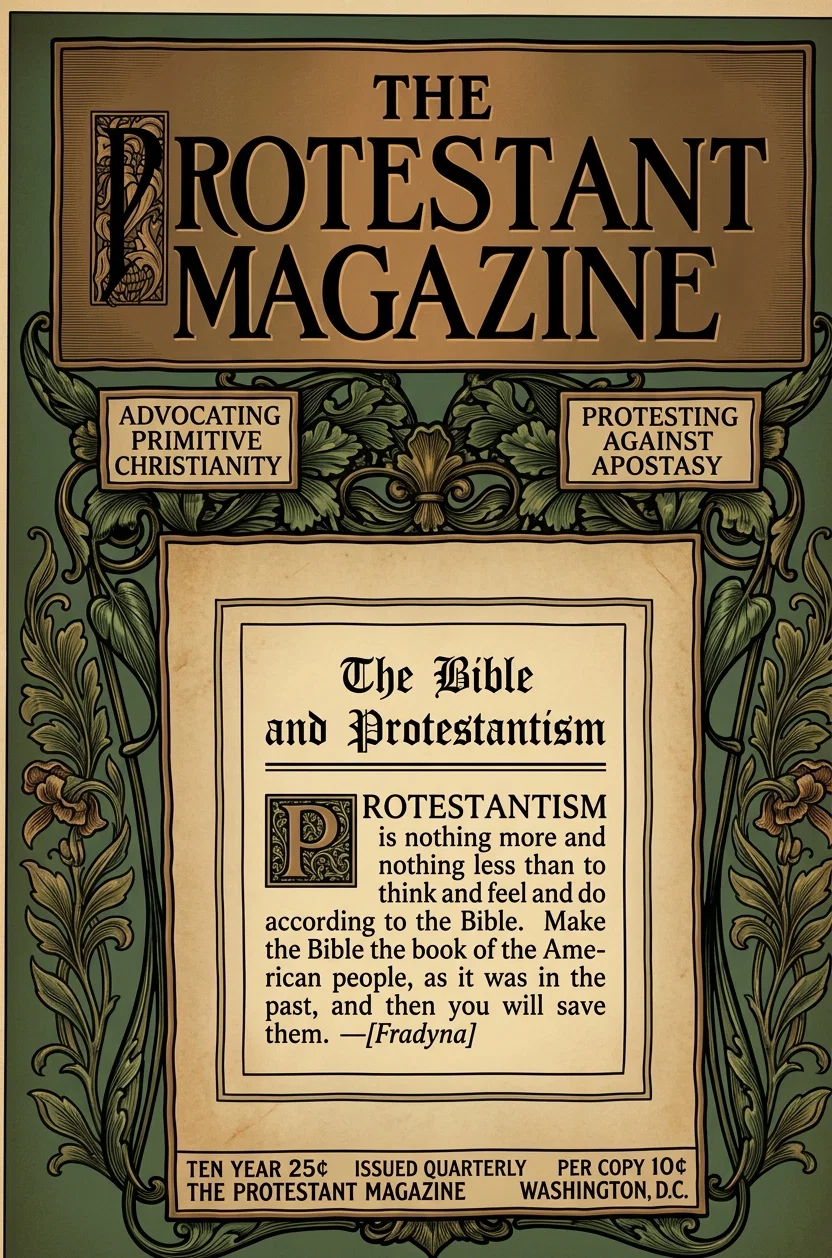
Every genuine Protestant and truth-loving Catholic will want to read and preserve the valuable “documents” it contains.
A government official in Washington, D. C., writes: “American Protestantism is in need of just such a publication as you are putting out.”
A Good Proposition for Agents!
PRICES: 25 cents a year, 10 cents a copy; 5 to 40 copies, 5 cents each; 50 or more copies, 4 cents each. Send 10 cents for sample copy. Better still, send $1.00 for 20, or $2.00 for 50. Discount to agents on yearly subscriptions.

SOME FEATURES

The Bible and Protestantism.
Double Frontispiece, President and Mrs. Taft attending St. Patrick’s Church on Thanksgiving day (two photographs).
The Needed Protest.
The Mediation of Christ.
President Taft’s Thanksgiving Service.
Rome’s Organized Newspaper Campaign.
Catholic opposition to “Papal Infallibility.”
The Cardinal’s Oath, Persecution of “heretics,” etc.
Sane Christian Liberty, Cardinal Falcone’s View of American liberties.
Rome’s Challenge.
The Gleam of Hope.
Rome’s Campaign of Abuse.
Papal Syllabus of Errors, the famous encyclical of Pope Pius IX, in parallel English and Latin Columns. Condemns eighty principles of freedom.
Rome’s Attack on Congressman Stephens.
Why the Pope Forbids Catholics to Sue Criminal Priests, Bishops, or Cardinals, and many other articles.
Special Offer on Ten, One Year: 10 or more copies, one year to one address or to ten separate addresses, cash with order, only 15 cents each. Sender may include his own name as one of the ten. Send this number to every editor, attorney, and public-school teacher in your county. We can furnish the names and addresses.

PLEASE ORDER THROUGH YOUR TRACT SOCIETY

If you do not know your Tract Society address, send to “The Protestant,” Washington, D. C.

The 1912 Temperance Instructor

Ready to Mail February 15

THE EDITION WILL BE 500,000 COPIES

Partial Contents

The following is only a part of the many good things the 1912 Temperance Annual will contain. It will be by far the climax of all previous Temperance issues in contents as well as in appearance. It will be a good seller and a great power for good.
Why the Liquor Traffic Still Exists in America, by J. Frank Hanly, ex-governor of Indiana.
In a Felon’s Cell and in the Halls of Congress.—How drink placed a man in the cell, and how reform placed him in the halls of Congress.
Be Not Deceived: Know for Yourselves.—Revealing the falsity and hypocrisy of the brewers.
From the Shadow of Death.—A life experience of one who had drunk himself penniless, homeless, and friendless; and who then reformed and became a trusted, honorable man.
From a Lawyer’s Diary.—The evils of a licensing system.
A Physician’s Experience.—The home influences that made a drunkard and a criminal of an only child.
Before Voting, Answer Candidly.—Nineteen whys to be answered before casting a ballot for the liquor traffic.
Why I Am a Prohibitionist.—Twenty-three good reasons.

TOBACCO

A Talk to the Schoolboys, by Edward Hyatt, superintendent of public instruction of the State of California.
The Slaughter of the Innocents.—Methods and cures.
Judge Ben B. Lindsey’s Testimony.—No boy does his duty to either himself, his home, school, city, flag, or country who will indulge in the vile habit of smoking cigarettes.
The Price He Paid.—A true story of one who lost a desirable position because of cigarette smoking.

ORDERS SHOULD BE SENT IN EARLY, AND THROUGH THE CONFERENCE TRACT SOCIETIES

“Acquaint Now Thyself With Him”

MRS. E. G. WHITE
“I WILL give them an heart to know me, that I am the Lord.” “Acquaint now thyself with him, and be at peace: thereby good shall come unto thee. Receive, I pray thee, the law from his mouth, and lay up his words in thine heart.”
From the beginning it has been Satan’s studied plan to cause men to forget God, that he might secure them to himself. Therefore he has sought to misrepresent the character of God, to lead men to cherish a false conception of him. The Creator has been presented to their minds as clothed with the attributes of the prince of evil himself,—as arbitrary, severe, and unforgiving,—that he might be feared, shunned, and even hated by men. Satan has striven so to confuse the minds of those whom he has deceived that they would put God out of their thoughts. He would then obliterate the divine image in man, and impress upon the soul his own likeness; he would imbue men with his own spirit, and make them captives according to his will.
At times, Satan’s contest for the control of the human family has appeared to be crowned with success. During the ages preceding the first advent of Christ, the world seemed to be almost wholly under the sway of the prince of darkness. Even the covenant people, whom God had chosen to preserve in the world the knowledge of himself, had so far departed from him that they had lost all true conception of his character.
Christ came to reveal God to the world as a God of love, a God of mercy, tenderness, and compassion. By the world’s Redeemer the thick darkness with which Satan had enshrouded the throne of the Deity was swept away, and the Father was again manifest to men as the Light of life.
It was the pitiable condition of the fallen race that led Christ to give his life for their redemption. And what a life of humiliation and suffering was his! Not in his glory, heralded by the heavenly host, did he come to this world. Born of humble parentage, and brought up in obscurity at Nazareth, a small town of Galilee, he began his work in poverty and without worldly rank. That he might stand at the head of humanity, he took upon himself our nature. With his human arm he encircled the human race, while with his divine arm he grasped the throne of the Infinite.
Christ is saddened by the sight of men so absorbed in worldly cares and business perplexities that they have no time to become acquainted with God. To them heaven is a strange place; for they have lost it out of their reckoning. Not familiar with heavenly things, they tire of hearing about them. They dislike to have their minds disturbed in regard to their need of salvation. But the Lord desires to disturb their minds, that they may become acquainted with him, in time to accept his offer of salvation. Soon, very soon, whether they desire it or not, they will all know him. The angel of mercy is now folding her wings, almost ready to depart.
To eclipse the beauty and loveliness of the Prince of Light, Satan seeks to engross the minds of men with exciting games and other worldly pleasures. He endeavors so to occupy the attention with trivialities that no time will be taken to think of Jesus. Even after the most solemn presentation of the Word of God, the enemy will, if possible, destroy the impressions made by the Holy Spirit.
In the books of heaven are accurately recorded the sneers and the trivial remarks of sinners who pay no heed to the call of mercy made, as Christ is presented to them by his ministering servants. As the artist takes on the polished glass a true picture of the human face, so the angels of God daily place upon the books of heaven an exact representation of the character of every human being.
Dear reader, are you of the number who slight the instruction and warnings of the Word of God? Do you despise the great salvation proffered you? Are you willing that God and the Saviour who died for you shall say: “Because I have called, and ye refused; I have stretched out my hand, and no man regarded; but ye have set at naught all my counsel, and would none of my reproof: I also will laugh at your calamity; I will mock when your fear cometh; when your fear cometh as desolation, and your destruction cometh as a whirlwind; when distress and anguish cometh upon you. Then shall they call upon me, but I will not answer; they shall seek me early, but they shall not find me: for that they hated knowledge, and did not choose the fear of the Lord: they would none of my counsel: they despised allmy reproof. Therefore shall they eat of the fruit of their own way, and be filled with their own devices.”
The Lord is coming. If he were to come to-day, would you be ready to meet him? Have you made your peace with him? Do you desire to be sent away from God’s presence to share in the humiliation and punishment of Satan and his angels? If, during your lifetime you rob God of the service that he has purchased with his own blood, if you spend your time in idle talk and foolish amusement, you will lose heaven. Can you afford to barter away for worldly pleasure the gift of eternal life?
My brother, my sister, to-day the Spirit invites you to come to Jesus. “Look unto me, and be ye saved,” is God’s gracious invitation. Will you not choose life, eternal life?
Those who are saved must follow the same road over which Christ journeyed. He says, “Whosoever will come after me, let him deny himself, and take up his cross, and follow me.” The character is to be formed according to the Christ-likeness.
In the Word the Saviour is revealed in all his loveliness. In the Bible, filled with assurances of what God will do for those who come into right relation to him, there are comfort and consolation for every soul. How can any one, with the privilege of studying the Scriptures, lose his interest in heavenly things, and find pleasure in the amusements and enchantments of this world?
We are to commune with the One who gives us life, the One who keeps the heart in motion and the pulse beating. To every member of his great family here below God is ever giving the breath of life. And he has given his Son as a propitiation for sin, in order that we might stand on vantage-ground with God. He deserves our sincere reverence, our earnest devotion. When we consider what he has done for us, how can we help loving him?
To every sinner with whom we come in contact we are to tell what infinite pains Heaven has taken to enable us to attain to a knowledge of God. We are to show that we are amenable to the One higher than any human being; that to God we must render an account for the deeds done in the body; that, notwithstanding his great love for us, he can not take us to heaven as unrepentant sinners.
The day will come when the awful denunciation of God’s wrath will be uttered against those who have persisted in their disloyalty to him. The day will come when he must speak and do terrible things in righteousness against the transgressors of his law. But you need not be among those who will come under his wrath. We are living in the day of his salvation. The light from the cross of Calvary is shining forth in clear, bright rays, revealing Jesus, our sacrifice for sin. “We have redemption through his blood, the forgiveness of sins.”
God desires to restore his image in you. Believe that he is your Helper. Resolve to become acquainted with him. As you draw nigh to him with confession and repentance, he will draw nigh to you with mercy and forgiveness. As you work out your own salvation with fear and trembling, he “worketh in you both to will and to do of his good pleasure.”

A Word to the Worldly

L. D. SANTEE
You are reaching after riches While the years are rolling by; You are yielding to ambition As the seasons swiftly fly; You have lost the love for Jesus That you cherished long ago; Joy and hope have left your bosom, And the peace you used to know. In your madness you are striving As some vessel tempest-tossed; Have you lost your hope of heaven? O my brother, are you lost?
You are reaching after riches; In the dark days and the fair; In the noontide and the gloaming, You are reaching for them there. In your haste you have forgotten Loves and friends that once were dear, Or you only pass them coldly, Not with old-time words of cheer; For the heart that once was fervent Now congeals with winter’s frost; Have you lost your hope of heaven? O my brother, are you lost?
You are reaching after riches; You have lost the bloom of youth; You have ceased to find contentment In the beauty of the truth; In the path of your ambition Disappointments oft are spread; You have left old friends behind you In your haste to “get ahead.” On before are wrathful billows, Your path with storms will oft be crossed; Have you lost your hope of heaven? O my brother, are you lost?
Moline, Ill.

Our Literature as an Evangelizing Agency

ALLEN MOON
It may be of interest to the readers of the REVIEW to know how good religious literature is regarded by the better class of religious workers. By good religious literature is not meant the popular religious novels of the day, but that which is helpful in bringing out the cardinal truths of Christianity.
At the Ecumenical Missionary Conference held in the city of New York in 1900, several hours were devoted to the discussion of the importance of Christian literature for use in evangelical work. The successors of Carey from India united with the leading missionaries from all heathen countries in an urgent call for a pure, helpful literature.
Miss Isabella Thoburn, of India, said: “There is a special good that literature can do. When it once goes out of our hands, it goes to bless, and it may be used when we have passed away,—we who have begun the work.” Rev. Timothy Richards, of China, said: “In all successful mission work, whether in barbarous or civilized countries, the Bible has had to be supplemented by other books. In order to capture the attention and regard of the best minds in non-Christian lands, we must offer to them the highest product of our best intellects. Nothing less than this is a sufficient Christian literature.”
Rev. Richard Lovett, of London, in a paper read before the conference, said: “The two most potent factors in the life of the Christian church have been the living voice and the printed page. We sometimes forget that this has been so from the first, and is of divine appointment. There is greater need to-day than ever for Christian literature. The achievements of the past in this respect are, at the best, very imperfect; hence the different boards of directors at home should give more attention to this work.”
The burden of testimony of many missionaries was the great need of a literature in all lands that would serve as helps to Bible study. The missionary, as no one else, appreciates the value of such helps; for he is face to face with the fact that the Bible, and not modern civilization, must be relied upon to Christianize the heathen world. It is likewise true that the Bible must be relied upon to Christianize the ungodly of civilized countries, and a literature that opens up the Word of God to the understanding of mankind is as greatly needed in these lands. This is provided as never before in the Christian literature in connection with the giving of the last message to the world; and whether they recognize it or not, this literature is just what the missionaries of all denominations have felt the need of, and have censured the home boards for their failure to produce. Never in the history of the world has a religious literature exerted such a widespread influence as does ours.
At the very beginning of the preaching of the last-day message, when the believers were very few in number, the printing-press was utilized. Elder James White and his few associates began publishing to open the way for personal work, and the little papers and tracts were the pioneers to blaze the way for preaching the gospel more fully. From that time on, during the spread of the knowledge of the truth in this country, the preaching by word of mouth and by the printed page went hand in hand. When our missionaries began to go abroad, it was estimated by those well informed that for the work accomplished in this country, the credits were about equally divided, about as many persons having accepted the truth as the result of reading our literature as through the effort of the living preacher.
Again: our literature has been the agency for opening up the way for the living missionary in the countries beyond. Our literature had reached Great Britain, Scandinavia, Germany, Switzerland, and other countries on the Continent, in advance of the minister; and when our work had been established in these countries, the pioneer work still went on by means of our publications; and from Basel and Hamburg it penetrated Russia and the Levant, Africa and the Orient.
Time would fail to speak of the vast work accomplished through this agency. But of the future we may say, We are still a small people, and have a vast work before us. By our past experience and through the spirit of prophecy, the Lord has taught us of the potency of this agency. The multiplication of books and periodicals and the increased sales during the last few years, are the best evidences of the Lord’s blessing upon this work as an evangelizing agency.
South Bend, Ind.

The Burning Fire

ROBERT TREIBLE
JESUS is “the light of the world,” “that lighteth every man.” He is the word made flesh. At Pentecost when the former rain was given, cloven tongues of fire rested on the heads of the disciples. The Spirit of truth had come to guide them into all truth. They were now the light of the world.
Truth is light. “Sanctify them through thy truth: thy word is truth.” The light was the word which they carried to all the world. “Is not my word like a fire?” Jer. 23:29. “Did not our heart burn within us?”
Do we really desire more of his Spirit? He is more willing to give than we are to receive. The Spirit will teach the humble, and direct them in service. Wecan not direct the Spirit or teach him: the Spirit guides us into all truth. “The words that I speak unto you, they are spirit, and they are life.” “Thy word have I hid in mine heart, that I might not sin against thee.” The followers of Christ should be lighted up with God’s Word. Is there oil in our lamps? Are they trimmed and burning? “Arise, shine; for thy light is come.” With the help of the mighty “sword of the Spirit,” we shall be able to resist the evil one even unto death. “Mark the perfect man,” Christ Jesus. By the Word Christ overcame every temptation that we meet. By that Word also we must overcome. He was in continual communion with heaven. If he needed this, do we not need it daily and hourly? Let not Satan crowd the mind with other things.
If we feed constantly on the bread of life, Christ’s righteousness will not only be imputed, it will be imparted. The overcomer will finally enter the city with the nation that keeps the truth. Are we on fire with God’s wonderful truth? What is the truth to us? Are we living to give to dying souls the glorious light that a loving Father has given us?
Hazel, Ky.

Indecision

ROXETTA RUNCK, M. D.
“How long halt ye between two opinions? if the Lord be God, follow him: but, if Baal, then follow him.” How many of us halt between two opinions? Will God’s prophet have to call down fire from heaven to set us right?
And Elijah called upon his God to turn the people’s hearts back to the true Saviour, to establish them in the true path, the right decision. He cries: “Hear, O Lord! hear! Convince them that thou art the only true God.” Fire came down from heaven and consumed the sacrifice which had twelve barrels of water poured over it. What was the result of this demonstration of the mighty power of the living God before an idol-serving people? They fell on their faces and said: “The Lord, he is the God; the Lord, he is the God.” Elijah slew the prophets of Baal.
Elijah prayed for rain, and the Lord sent this blessing to the people. But Ahab went to Jezebel to tell her what Elijah had done, how he had slain the false prophets. Ahab had so soon forgotten the Lord’s blessing and his power. He was halting between two opinions. “A double-minded man is unstable in all his ways.” The wicked Jezebel sought to kill Elijah; but he fled for his life. We can see him sitting under the juniper-tree requesting the Lord to take his life, to let him be numbered among the rest of the true prophets who had been slain. Elijah was faint—weary in well-doing; but an angel came and strengthened him; he gave him food and commanded him to pursue his journey, and Elijah went. He heard the still, small voice of his Lord and obeyed his will. All the knees had not bowed to Baal. Elijah’s work was not finished. Let us put off double-mindedness and listen to the still, small voice. Then shall we receive strength to pursue our journey and break the bread of Life to those who are bowing the knees to Baal. Perchance, they will see the consuming fire from heaven, yet it destroy their sins, and say: “The Lord, he is the God.” There is none other like him. “Let the people renew their strength: let them come near.” “And the Lord shall guide thee continually, and satisfy thy soul.” Remember Elijah’s cloud, and get ready for the latter rain.
Madison, Wis.

The Loud Cry—What Is It?

W. E. GILLIS
“The time of test is just upon us, for the loud cry of the third angel has begun in the revelation of the righteousness of Christ, the sin-pardoning Redeemer. This is the beginning of the light of the angel whose glory shall fill the whole earth.”—Mrs. E. G. White, in the Review and Herald of Nov. 22, 1892.
This testimony, written nineteen years ago, gives us a hint as to the real character of the loud cry. It is a call to perfection; for the righteousness [right-doing] of Christ was perfect in all points. It is a call to be just the opposite of what the angel of Rev. 18:1 declares to be the condition of the popular churches. It is a call to be so separated from the world and its foibles that all will immediately discern who serves God and who serves him not.
In “Spiritual Gifts,” Vol. I, pages 138, 139, we have this statement: “The work of this angel [Rev. 18:1] comes in at the right time to join in the last great work of the third angel’s message, as it swells to a loud cry. And the people of God are thus prepared [by the message of this angel] to stand in the hour of temptation which they are soon to meet. . . . This message seemed to be an addition to the third message, joining it as the midnight cry joined the second angel’s message in 1844.”
Now, what are the conditions? The people of God are in a spiritual state which demands a message of which the midnight cry of 1844 was a type. Then, in order to know the nature of the work and the object to be accomplished, we must review the experiences of the fall of 1844.
Referring to the opening chapters of “Rise and Progress of Seventh-Day Adventists,” we learn that the disappointment of the spring of that year had brought into the ranks of the believers a feeling of uncertainty, and a strong tendency to say, by word and action, “My Lord delayeth his coming.” Many manifested a desire to maintain a strong hold upon the things of this world, so that in the event of a failure in the fulfilment of the expectations of the advent message they would still have a name and a place among men.
Here was a condition of affairs that could result only in disappointment and shipwreck of faith to all who yielded to it. The midnight cry discovered to the believers the fallacy of such a position, and pointed out to them the only course that they could possibly take if they would meet the Lord in peace. “Ye can not serve God and mammon.” “This is the victory that overcometh the world, even our faith.”
In reviewing the history of that time, it will be noted that the midnight cry was not given by a different people, but by those who had given the first message. They studied and followed on to know the will of the Lord in their trying experience, and the giving of the message was a strong factor in preserving their integrity in the truth.
To show how thorough a knowledge was had of the necessary preparation that must be made to meet the coming Saviour, we quote from “Rise and Progress” an extract taken from the Midnight Cry of Oct. 3, 1844. Every point made should appeal with much emphasis to our people in the present testing hour. The excerpt is as follows:—
“It requires the same faith that led Abraham to offer up Isaac, or Noah to build the ark, or Lot to leave Sodom, or the children of Israel to stand all night waiting for their departure out of Egypt, or for Daniel to go into the lions’ den, or the three Hebrews into the fiery furnace. We have fancied that we were going into the kingdom without such a test of faith, but I am satisfied we are not. This last truth brings such a test, and none will venture upon it but such as dare to be accounted fools, madmen, or anything else that antediluvians, Sodomites, a lukewarm church, or sleeping virgins, are disposed to heap upon them.”—“Rise and Progress of Seventh-Day Adventists,” page 54.
Under date of Oct. 10, 1844, was published the now memorable article known as “Storrs’s Flat Rock.” In it occur these stirring lines:—
“How shall we be ready for that day?—Believe God’s truth, and venture out upon it, by strong faith that gives glory to God. . . . Venture now, and venture all.”—Id., pages 54, 56.
Here are principles that must ever characterize the advent people if they would be accounted worthy of life when the Saviour appears. Here are the principles of the church in Philadelphia that was prepared to meet the Lord in the fall of 1844; the church for whom the revelator finds no words of censure; the type of the church that must finally meet the Lord of glory.
Following the passing of the time in 1844, the work of the third angel of Revelation 14 developed, and with it a wealth of literature and knowledge of the truth of God. As the years passed, the Laodicean message became necessary, and was proclaimed to our people. In 1888 began the spiritual awakening referred to in the opening quotation of this article. The Saviour was now being given his true place in the last great message. As new knowledge marked the beginning of the midnight cry of theformer message, so, as was indicated in “Early Writings,” new knowledge ushered in the loud cry.
“Not I, but Christ, be honored, loved, exalted; Not I, but Christ, be seen, be known, be heard; Not I, but Christ, in every look and action, Not I, but Christ, in every thought and word.”
For nearly a quarter of a century this loud cry has been swelling, and the aged servants of God are listening, O, so expectantly! for the harmonies that will mark its triumph. What hinders? The greatness of the work?—No, not that. This work can not be accomplished at all until the advent people have heeded the message, “Awake, awake, put on thy strength, O Zion; put on thy beautiful garments [the robes of Christ’s righteousness—the wedding garment], O Jerusalem.” And then will the Lord cut the great work short in righteousness.
The great essential feature of the loud cry and of the third angel’s message has been briefly stated, the details may be found in the world-wide ramifications of the work of this people.
Shanghai, China.

Be of Good Cheer

A. W. SPAULDING
With what glad words does our Saviour greet us at the threshold of sorrow! “In the world ye shall have tribulation: but be of good cheer.” Used as we are to the world’s experience and the world’s philosophy, with the thought of tribulation we connect dejection; with trouble, gloom; with sorrow, tears. But Jesus presents his own and Heaven’s way: “Ye shall have tribulation: but be of good cheer.” And in his philosophy, then, with his point of view, we connect with tribulation, cheer; with trouble, joy; with sorrow, smiles.
Not without reason does he ask us to be of good cheer; and he immediately gives his reason: “I have overcome the world.” If we meet our troubles by ourselves, we shall find no cheer; for we shall find those troubles oppressors, conquerors. Only when hidden in Him, wrapped up in his purpose, his work, do we find victory. Is my chief concern how I may make a living? Do I fear to follow his directions for work because I may starve? Then in trouble I can not be of good cheer. Is my mind intent on my reputation or advancement, on my standing with the world or with the brethren? then every word of disparagement, every evil report against me, every opposition, will cause me grief, and drive me farther from God. But, wrapped in the ardent love of Christ, burning to forward his work and to save souls, intent only on doing what he has told me to do, then, in the face of privation, criticism, misrepresentation, I find good cheer; for all those things my Saviour has overcome, and in him I also find them naught.
But leaving the personal matters, let us look at the real difficulties. The personal tribulations are tribulations only to the novice; the true Christian worker, having triumphed over those, finds nevertheless a more distressful tribulation in the conditions facing God’s work,—a tribulum [thrashing instrument] that afflicts even heaven itself.
The evangelist looks upon the flock he is leading into the truth: he sees perhaps in them unconquered pride, or levity, or passion, or deceit; he sees souls whom he has committed to God letting go the heavenly hand, and slipping down to perdition.
The teacher sees the gross materialism of those who have been long in the truth, and should have been sanctified by it; he sees the unrestrained passions of the children, the low ideals and unholy ambitions of the youth, the indifference and disobedience of adults; he sees families ungoverned and untaught, fathers and mothers with eyes blinded to the greater faults and minutely critical of the lesser faults of their children; he sees the love of the world swaying God’s people, and the love of the truth being lost.
The medical worker beholds especially the misery that springs from the indulgence of appetite and passion, the dirt and squalor of city hovel and country hut, the suffering that exists also through the ignorance and indifference to law of the dwellers in palace and temple; he sees the crime, the physical misery, the mental woe, the hopelessness of soul, of the transgressors of God’s law.
Afar over the land the eye travels, to behold in crowded city and spreading plain and desolate heights, only selfishness, greed, strife, degradation of body and mind and soul. This is the tribulation, the thrashing, that the heart of the Christian worker knows. It is his work to bring out from that seething mass of corruption, pure, undefiled lives and homes and workers.
Ah, how the human mind and heart quail before the prospect! Where to begin, what to do, how much to expect,—these questions present themselves to the worker; and in what he can see of good, in what view he may have of past accomplishments, he of himself can find room only for fear and discouragement. Then come the Master’s words, “In the world ye shall have tribulation: be of good cheer; I have overcome the world.” Blessed are these words of cheer:—
“Christ sees all the misery and despair of the world, the sight of which would bow down some of our workers of large capabilities with a weight of discouragement so great that they would not know how even to begin the work of leading men and women to the first round of the ladder. . . . Christ’s heart is cheered by the sight of those who are poor in every sense of the term; cheered by his view of the ill-used ones who are meek; cheered by the seemingly unsatisfied hungering after righteousness, by the inability of many to begin. He welcomes, as it were, the very condition of things that would discourage many ministers. . . . He works through those who discern mercy in misery, gain in the loss of all things. When the Light of the world passes by, privileges appear in all hardships, order in confusion, the success and wisdom of God in that which has seemed to be failure.”—Testimonies for the Church, Vol. VII, pages 271, 272.
Hidden in him, we take up with cheer the immediate duty that each of us has to perform: the father and mother in the home, the teacher in the church, the minister in the field, the canvasser on the frontier, the medical missionary in the haunts of misery and vice, the Christian helper wherever the needs of the world are crying for help. Beholding Christ the conqueror, we lose sight of the fear and the hopelessness that confronted us. We sow the seed, and leave it there for him to germinate, knowing that the harvest surely comes. Striving daily to do in his strength that which lies at our hand, we meet the opposing circumstances with a refusal to be dismayed, with a confidence in victory, and, in the midst of tribulation, with Christ’s good cheer.
Alpharetta, Ga.

Love, Service, and Holy Living

Love and loving service and holy living are the fulfilment of the law.—J. M. Wilson.

Little Things That Count

“I CALL that real kind. Sit right down, Mary, and write him a letter and thank him for it. There wasn’t many would have done it. It was certainly nice of him, it was—”
All this, and more, is what an old farmer said about just receiving a post-card—a picture post-card. He had been away from home several weeks in a neighboring village having a sore eye treated. While there he used to chat to the postmaster when he called at the post-office for his mail. Now that he had returned home, the postmaster had remembered him, and sent this post-card to inquire about his eye. And the farmer was delighted to receive it. Indeed, few people receiving the gift of a hundred dollars would have been more grateful or more genuinely pleased than this man was about his post-card; but it was more the thought of the man who sent it that gratified him. He continued: “I won’t forget Mr. Burgess for this; and if ever I get a chance to do him a good turn, I will do it. Sit right down, Mary, and write the letter.”
Does not this old man’s reception of his post-card go to show us how easy a thing it is to make some one glad, how little a thing may make some people happy? And yet we are so sparing of the little thoughtful act, the little kindly deed. There are a great many simple, honest, grateful persons not far away from us who are almost left out of things apart from their own immediate families and their homely duties of the day, and even a little thing means so much to them.—Selected.
Continue reading: Editorial