FATHER, our praise we bring to Thee,
Giver of all our earthly store;
O’er all the earth Thy grace we see,
And our hearts love Thee more and more.
In highest joy or deepest pain,
Where’er Thy hand our path shall lay,
In poverty or earthly gain,
Our tongue shall praise Thee day by day.
Joyful our lives we give to Thee,
O God of love, whom we adore;
Glad we await eternity,
Where we shall praise Thee evermore.
Oakland, Cal. C. A. SMITH.
KEEP THE BOYS INTERESTED.
By Mrs. M. E. R. Alger
Fathers and mothers ask me this question every day, “What shall I do with my boys? My girls are all right.” This is a simple problem and easy to answer. Girls are naturally timid and dependent; they grow up by their mother’s side, imitate the mother, and receive the greatest share of her attention. Boys are more restless and independent, and need the most careful guidance. They must be kept employed and interested. Don’t expect them to sit for any length of time; keep them busy; help them go over their school-work; tell them how you remember the hard work you had to do when you were at school. Read the newspapers to them; discuss any interesting happening of the day, and note discussion, especially the news of the world’s doings, in the daily papers. Send them to bed with the feeling that their father amounts to something in their young lives and is a true friend and companion.—Mrs. M. E. R. Alger, in Good Housekeeping.
The Value of Nursing Infants
A GERMAN doctor placed twenty-one artificially fed infants, suffering from gastric troubles, in the care of wet-nurses, and they all promptly recovered. A healthy wet-nurse will probably cure more ills of infants than any other prescription.—Hom. Recorder.
And the best wet-nurse to be found is the mother of the infants, provided the mother has milk in proper quantity and quality. There should be no question as to the diet of the first year of each baby's life. The mortality of bottle-fed babes is 51 per cent., while that of those nursed is 8 per cent. Words are unnecessary. Forty-three infants out of each hundred are killed by being deprived of their natural food.—The Clinic.
Manila’s Self-Government Charter
THE Philippine Commission has given the city of Manila a charter for self-government. By its terms the city council may prohibit bawdy houses, cock-fighting, ball-playing, and keeping domestic animals; but it has no power to close saloons. As the commission is a creature of the United States Government, the authorities at Washington have supervision of its acts and are responsible for them. Almost unlimited power is given in the matter of arresting the people; but the saloon, where four-fifths of the crime originates, is practically ensconced as a permanent fixture.
SIGNS CALENDAR FOR 1902
By Editor
We are busy making an extraordinary calendar.
Its size is ten by fifteen inches.
In the center is a photograph of the home of the SIGNS OF THE TIMES.
Under this photograph is a monthly “tear-off” calendar for 1902.
As a border we have arranged a unique Golden-Text-Calendar feature which is illustrated by the following selection:—
JANUARY, 1902
13 M Be of good courage
14 T He shall strengthen thine heart
15 W Look unto Me
16 T Thou art my Rock
17 F Casting all your care upon Him
18 S For He careth for you
From this illustration you will see that the border contains a scriptural selection for each day in 1902.
These selections might well be called, “Texts That Have Helped,” from the way they have been secured. We invited Christians of experience to furnish such texts as have been particularly helpful to them, and their response has made possible the publication of this beautiful and helpful wall decoration.
It is copyrighted and owned by the SIGNS OF THE TIMES, and can be obtained from no other source. Copies will not be sold but furnished free to our subscribers only. Notice carefully the conditions:—
TO NEW SUBSCRIBERS
To each new yearly subscriber to the SIGNS at $1.50, whether sent in by the subscriber or by another person.
To the person also who takes such a subscription, as well as the subscriber himself, provided in both cases it is asked for.
TO OLD SUBSCRIBERS
To each old subscriber who extends his subscription one year at the regular price of $1.50, and asks for the calendar.
TO CLUB READERS
Many of our readers take their papers through a large church club. We will supply the calendar to such provided they will subscribe for ten copies one year. This subscription should be given to the Librarian as usual. In such cases the Librarian should order the calendar direct to the individual.
It will also be sent, if asked for, to any individual or society ordering ten copies for one year—price $7.50—direct from us or through their State Tract Society.
Not knowing how long our supply of these calendars will hold out, we do not guarantee to fill any orders received after December 15, therefore please act at once.
ADDRESS
SIGNS OF THE TIMES
OAKLAND, CALIFORNIA
A HUMBLE HEROINE.
By Mrs. F. D. Burrell
Elizabeth Egede.
[Mrs. F. D. Burrell, in the Gospel Message.]
A HUNDRED and fifty years ago, in the quiet village of Faagen, which clings to the edge of a deep fjord in the Lofoden Islands, dwelt a Moravian pastor, Hans Egede, and his frau-pastorin, Elizabeth. Here he had come in his early manhood, filled with the love of souls, and with his gentle wife had ministered to the small necessities of the simple Northern folk, content to love and be loved by them, with no thought of the busy world beyond. There was no disturbance of this outward peace until,—“by chance,” as the world would say, by God’s providence, as the sequel showed,—an ancient chronicle fell into the pastor’s hands. Therein he read of a distant land, hemmed in by seas and bergs of ice, but so rich in meadows and flowers that they called it Greenland—and there was no Gospel there.
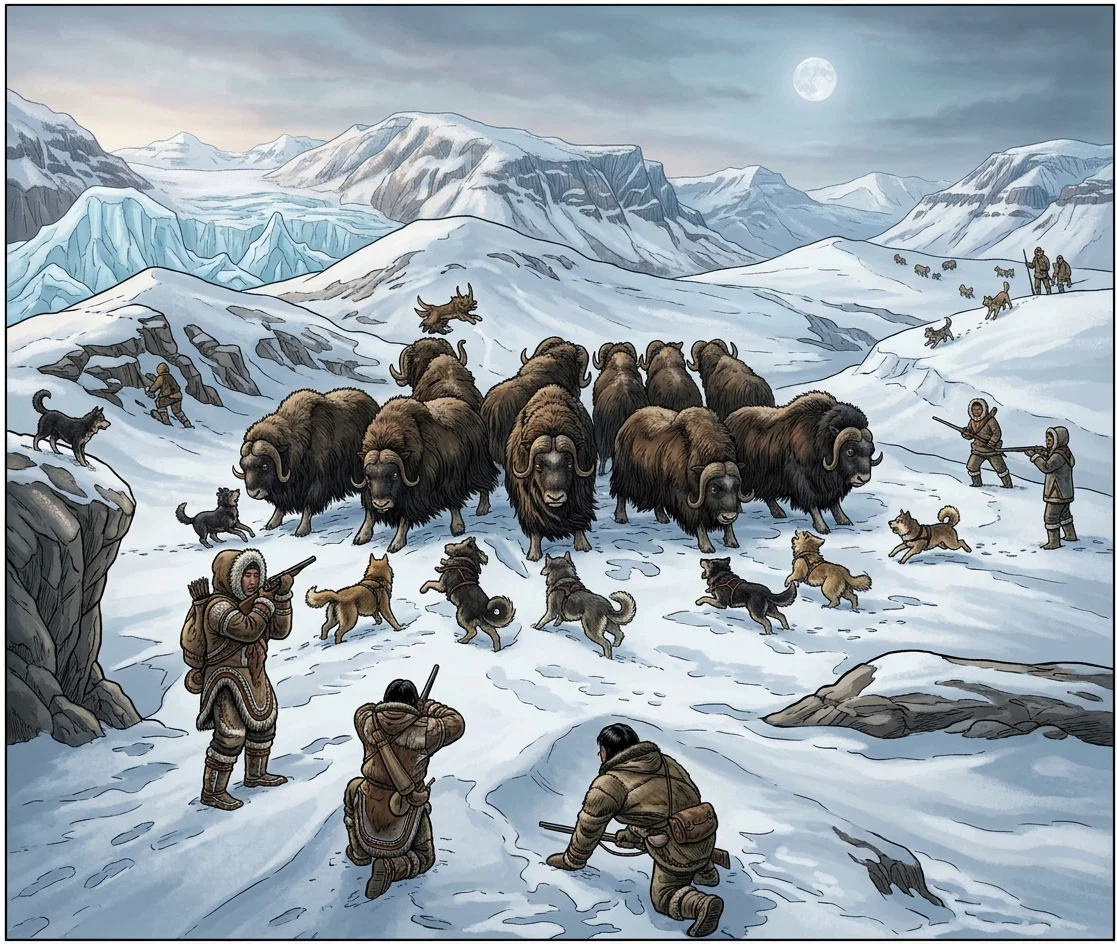
Hunting the Musk-ox in Greenland.
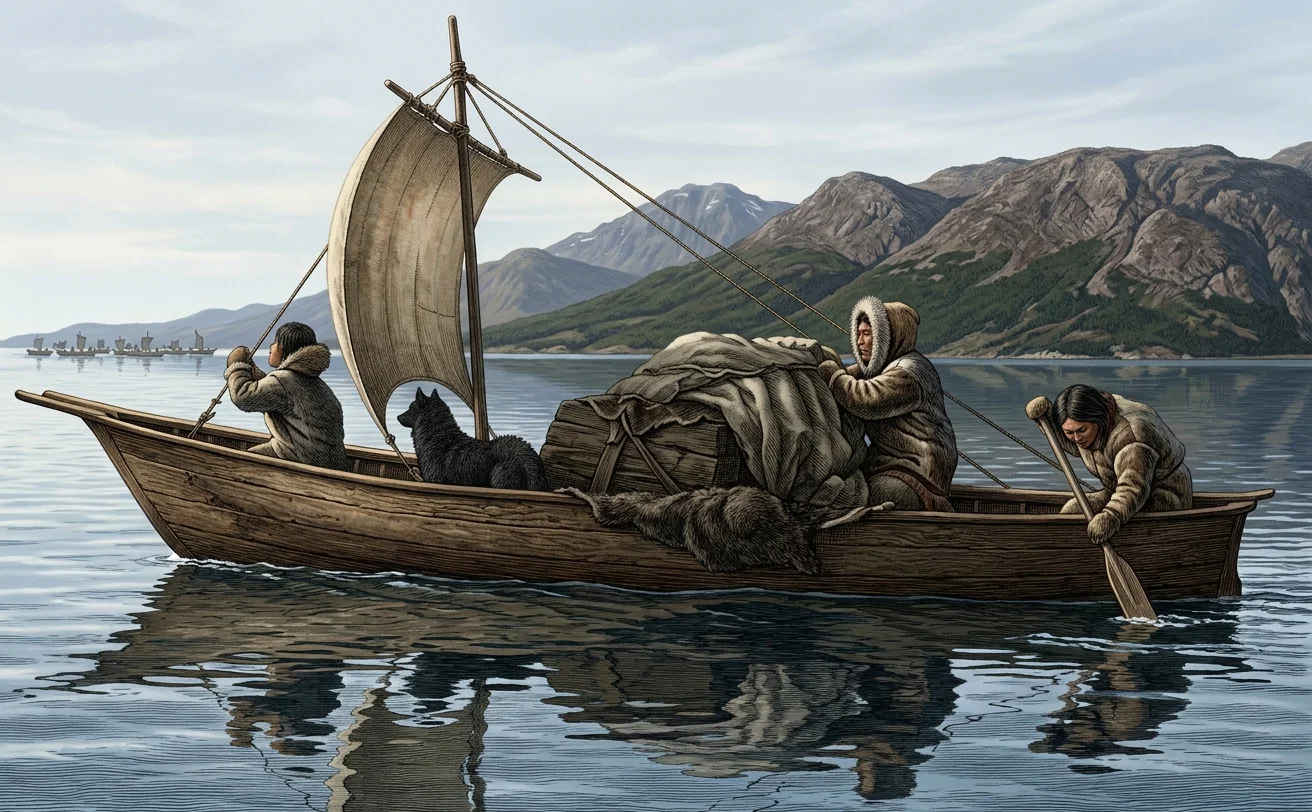
Traveling in Greenland.
The heart of simple Hans was touched. His conscience began to say, “Hast thou no lamp for this darkness?” At length he could no longer forbear to speak to his good wife, Elizabeth. He told her of those people, a thousand miles away, shut out from the world by crystal walls and barriers, and said, “Elizabeth, can I refuse to go?”
Her heart was stunned by the sudden appeal. She wrung her hands, crying, “No, no! It would be tempting God! The people love you here, and the dear household would be broken up, and the Greenland is a thousand miles away amid the ice.”
And he could only smile sadly, and answer, “I have thought of it all; the people, and the wife, and the little ones, and the graves in the churchyard; but over it all I hear again and again the Master’s words, ‘He that loveth father or mother more than Me is not worthy of Me; and that loveth son or daughter more than Me is not worthy of Me.’”
But Elizabeth’s pleading, her tears and reproaches, prevailed at last, and the pastor in silence went about his accustomed tasks.
Four years rolled on; unknown to each other, the pastor and his wife were both thinking hard on the darkness of those ice-bound people. One morning Hans suddenly spoke,—
“My wife, I have received a three-fold sign from heaven!”
With a sinking heart she cried,—
“Ah, good pastor, is it concerning the Greenland?”
“Yes, God will be heard! Here is a letter from our good Bishop Krog. He writes me that I must go, and promises all possible support. And here is another from Bergen, from Bishop Randuff. He writes also that I must go, and, most wonderfully, in almost the very words of Bishop Krog.”
“And the third sign?”
“Ah, that is the most wonderful of all. This is from both Denmark, my old fatherland, and Norway, my adopted land. The richest of our merchants have undertaken to reopen the trade with Greenland, and promise one of their ships for me and my family. Elizabeth, is it not the hand of God?”
It was then that the heroic faith of Elizabeth proved itself stronger than her woman’s fears. Her eyes were filled with a sudden grief; there was a reaching forth of the hand as if to offer sacrifice, and she said,—
“O my husband, if the Lord calls, I will no longer hold thee. But like Ruth to Naomi, I will say, ‘Whither thou goest, I will go; and where thou lodgest, I will lodge; thy people shall be my people, and thy God my God.’”
That day a faith was born which no hindrance, discouragement, or apparent failure was ever able to destroy.
But the voyage to Greenland was not plain sailing yet. No sooner was it noised abroad in the village than the people began to besiege their good pastor with entreaties to remain. “For the sake of our households, our dear church, our souls, leave us not!”
Oftentimes his resolution would have failed, had not the brave Elizabeth enheartened him. He was reluctant to surrender his pension and give up the comforts of home. He shrank from exposing his four little-ones to the rigors of an Arctic climate. But his helpmate spoke many comfortable things. “Fear not, Hans,” she would say, “the God of the sparrows will not suffer us to want.” So he was moved again to say, “The Lord bless thee, dearest wife!” Her faith constantly rebuked him.
In the spring of 1721, the ship that was to carry away the dear pastor of Faagen cast anchor in the bay, and the people began to say one to another, “It is true, it is true.” Sad indeed were those days of leave-taking. Groups of tearful men and women stood by the parsonage doors. Frequently had Elizabeth to repeat for Hans’ encouragement, “He that loveth father or mother more than Me is not worthy of Me; and he that loveth son or daughter more than Me is not worthy of Me.”
The little procession at last came down from the village to the beach, and pastor Hans set his foot on the plank to embark; at that moment a sailor accosted him,—
“May I make bold to ask whither you sail?”
“To Greenland.”
“Then in God’s name tarry at home.” And he proceeded to relate what his own eyes had witnessed of hardship and suffering in that far-off land, telling of distasteful food, of plagues, and, worse still, of cannibals inhabiting this land. The minister’s heart failed him. “O Lord, how can I take my loved ones to a land so desolate and cruel?” He turned his face toward his weeping parishioners who besought him, “Stay with us, it is God’s will.”
This was the moment of great trial of Elizabeth’s faith. She stepped boldly upon the plank, and laid her hand upon her husband’s arm.
“Hans, be a man and a true servant of God! Listen, listen, O people of little faith! I hear from far away the voices of the souls that perish in the Greenland! I hear them calling, ‘Come and help.’ Will ye hinder? Husband, in the name of God, we must go!”
Then she walked aboard the boat, and the people through their tears saw the herr-pastor and the frau-pastorin, with the light of holy consecration on their faces, sail away to their appointed work.
Space does not permit a narrative of the trials and privations endured by the missionary’s family and the little colony of traders who accompanied them to their home amid the dreary ice plains and mountains of the North. They met little success. A stolid race was the Eskimo, and seemed to have no perception of spiritual things. But Hans and his faithful wife toiled on. At the end of a year their provisions were exhausted. No news came from home, no reinforcements nor supplies for the approaching winter. The colonists determined to return. They were endeavoring to persuade their pastor to cease his labors among the dull Eskimos, when Elizabeth suddenly confronted them. “Are ye men, thus to counsel a retreat from the blessed work of God? What is it that hath broken your courage? Hunger? Then take the food which we have kept for our children! Take it, go and leave us peacefully to our Lord’s will! The sails will come! God will not forget us!” They stood silent and ashamed, then resolved to wait yet a little while. On the third day a ship was sighted, and at evening the little colony had news from home, and food—and courage.
There is little more to tell. In 1735 Elizabeth died at the Lord’s work, but not until her eyes had seen an earnest of that mighty harvest of souls which was soon to follow her death. In the church of St. Nicholas, at Copenhagen, is a stone bearing the simple name, “Elizabeth Egede.” The marble tells naught of her self-denial, her faith, but these are written in the book that contains the record of all faithful lives. May God write our names therein!
The Joy of Living.
By Julian S. Cutler
O, give me the joy of living,
And some glorious work to do;
A spirit of thanksgiving,
With loyal heart and true;
Some pathway to make brighter
Where tired feet now stray;
Some burden to make lighter
While ’tis day.
O, give me the joy of living
In the world where God lives, too;
And the blessed power of giving,
Where men have so much to do;
Let me strive where men are striving,
And help them up the steep;
May the trees I plant be thriving
While I sleep.
On the fields of the Master gleaning,
May my heart and hands be strong;
Let me know life’s deepest meaning,
Let me sing life’s sweetest song;
With some faithful hearts to love me,
Let me nobly do my best;
And, at last, with heaven above me,
Let me rest.
—Rev. Julian S. Cutler.
SAVING THE CHILDREN.
By H. W. Brayton
The Children’s Home-Finding Society seeks homeless, neglected, and destitute children of all ages, and finds homes for them in worthy Christian families. It aims to save the child to society, to the State, and to the Church by placing it in the best educational institution in the world—the family home. In this work we must rely upon the intelligent co-operation of these families for the best results.
More than is generally supposed, young children under twelve years of age yield to these influences and are permanently benefited. The families receiving them also are blessed, thus verifying the Saviour’s words, “Whoso receiveth one such little child in My name receiveth Me.” By the age of fourteen habits have become fairly well formed, hence the necessity of receiving them while young and in their plastic years. In these early years the most unpromising may be benefited and saved. It is to combat the widely prevalent opinion that these unfortunate little ones are doomed, and to secure the co-operation of Christian families in the alleviation of their condition, that these thoughts are presented. It is wonderful what transformations may be effected by a little change of environment. A little soap, clean clothes, decent surroundings, and Christian associations work wonders with these children. It is the decided opinion of the writer, gathered from some ten years of study and observation in direct work for these little ones, that the encouragements to labor in their behalf are very great, and the results most satisfactory. We are not at all surprised that Charles Loring Brace, founder of the New York Children’s Aid Society, should have considered the encouragements to labor in this field so great as to be drawn toward it in preference to all others. We are sure that no field of Christian endeavor offers such inducements as this for the Christian worker, and especially for the Christian family that is in a position to undertake the task. The co-operation of such is requested and earnestly solicited.
H. W. Brayton, Supt. C. H. F. S.
906 Market St., San Francisco.
COULD YOU HAVE DONE IT?
In one of the schools in India a little girl of about eight years had her love for Jesus tested in the following manner:—
It was a feast day, and her father told her not to go to school that day, as he wished to take her to a temple to worship their god.
“But,” said the child, “I can not go to the temple to worship Buddha, because I love Jesus, and I only worship Him now.”
“You must,” replied the father, “I will make you.”
Later in the day, in spite of the little girl’s entreaties, she was taken to the temple.
“Now,” said her father, “prostrate yourself before Buddha.”
“Father,” she said, “I love Jesus, and may not worship Buddha.”
“Then I will make you.”
So seizing the little one, he threw her on her face, dragged her along on the ground on her face, and after beating her let her go.
The poor little girl was so badly cut that she was unable to return to the mission school for a very long time; and when at last she recovered enough to come, her face still showed the scars of the wounds she had received for Christ’s sake.
When the teacher asked her how it was her face was so cut, she hung her head and said nothing. But one of the other children told the story.
Then the little one looked up with a radiant smile and said,—
“Teacher, I could not help it; I love Jesus too much to worship Buddha. Jesus loves me, and I love Him!”—Exchange.
A MINISTRY WITHOUT WORDS.
If Christian service were all talking and praying in meetings and visiting the sick, it would be discouraging to some talentless people. But are our tongues the only faculties we can use for Christ? There are ways in which even silent people can do service for God and be a blessing in the world. A star does not talk, but its calm, steady beam shines down continually out of the sky and is a benediction to many. A flower can not sing bird-songs, but its sweet beauty and gentle fragrance make it a blessing wherever it is seen. Be like a star in your peaceful shining, and many will thank God for your life. Be like a flower in your pure beauty and in the influence of your unselfish spirit, and you may do more to bless the world than many who talk incessantly. The living sacrifice does not always mean active work. It may mean the patient endurance of a wrong, the quiet bearing of a pain, cheerful acquiescence in a disappointment.
“Noble deeds are held in honor;
But the wide world sadly needs
Hearts of patience to unravel
The words of common deeds.”
—Glimpses Through Life’s Windows.
MISSION NOTES.
THE jubilee of the Zenana Bible and Medical Mission was celebrated in London a few weeks ago. The society has three hospitals under its charge, where 24,000 patients are treated annually; 65,000 receive help at the dispensaries. Numerous elementary schools are maintained at its mission stations, besides excellent high schools for girls at Bombay, Lahore, and Panchgani, and the help rendered to similar schools in Poona and Benares.
THERE was very sound theology on its practical side, in the negro laborer’s reply. A large steamer was taking on its cargo, and this man was laboring very earnestly at his appointed work. But another man was idling in the shade, and his comrade called out to him. “Sam, do you want to go to heaven?” “Yes,” was the reply of the idler. “Then take a hold and lift.”
A mission hospital has been opened on the shores of the Sea of Galilee. It is under the charge of Dr. D. W. Torrence, a medical missionary of the Free Church of Scotland. The floors of the hospital are of marble; the operating-room is supplied with every known scientific appliance; and a trained nurse from the Royal Infirmary at Edinburgh is in attendance.
THE British and Foreign Bible Society has sold in Singapore on an average about 3,500 copies per annum of the Malay Scriptures; but last year the sales exceeded 11,000 copies. “In Japan the sale of Bibles and portions of Scripture last year was 137,422 copies, as against 98,439 the previous year.”
PROTESTANTISM is gaining strength in Italy. The Waldensian Church has over 20,000 communicants, and the Wesleyan and Methodist Episcopal churches are represented. “All these bodies own church buildings in different cities in Italy, and spend large sums for buildings and schools.”
“The church that is no longer evangelistic will soon cease to be evangelical.”
A DREARY COUNTRY.
By E. J. Burnham
GREENLAND is a land of glaciers and icebergs. Beyond the narrow strip of coastland, which is snow-covered eight or nine months in the year, is the great inland ice-field, “rough, crevasse-torn, white, earthless, moraineless, lifeless,” stretching in the distance to a dim, misty horizon of ice, and in places rising to a height of several thousand feet above the level of the sea. The approach to the inland ice is “generally in the form of a glacier offshoot which has crept down into a fiord, or is making its way to the sea in one of the mossy valleys lying between two high cliffs,—valleys noisy with mallmucks or with the weird screams of cormorants” which have established colonies in various sheltered nooks. On reaching the sea, the glacier plows along the bottom, until the force of the water buoys it up. Presently a great mass is broken off, and as an iceberg it sails away, a menace to the safety of ships in warmer seas.
In the southern part of the island more snow falls than in the north, and traveling is more difficult. While the people in the northland are enjoying lovely rides over the sparkling ice, lighted by the flashing glories of the aurora, those in the south are often snow-bound for a prolonged season, confined to within a few yards of their homes, if the snow is not too deep for them to get even this short distance.
The vegetation of Greenland is arctic. There are no forests, and farming is impossible. When Hans Egede declared that he would support his family in that distant field by cultivating the land, he was told that there was no land to cultivate; and this is true. “No crops, in the strict acceptation of the term, are cultivated in Greenland, but at Godthaab attempts have been made to grow turnips, radishes, lettuce, and chervil, in little gardens made with earth brought from the site of old Eskimo houses. Potatoes never grow larger than marbles, while peas only produce seeds barely recognizable.”
In this dreary, desolate country Hans Egede and his noble wife chose to labor for the wild, degraded, pagan Eskimos. Truly it took Christian heroism and love, the love of Christ for perishing souls to enable them to face such hardships and suffering as fell to their lot. Fifteen years they labored there. Elizabeth died at her post, then Hans, with his children and the dead body of his wife, returned to the home land. But others were already there to take up the work as it fell from their hands. It was prosecuted with great difficulty and even danger; but great have been the results, for as a people the natives have abandoned their old pagan ways, and are enjoying the blessings of civilization and Christianity.
There are about three hundred Danes on the island and ten thousand Eskimos. The latter live by hunting and fishing. Along the west coast of their possessions the Danes have established trading stations, where for exportation they collect from the natives oil, seal-skins, eider down, and other products of the chase and of their fisheries. The musk-ox and ermine are found only in the extreme north, beyond the Danish settlements.
At the best Greenland is, as Hans Egede called it, a land “desolate and cruel;” but the missionaries, while opening for the poor Eskimos a door of hope for the future life, have greatly improved their condition in the present life. E. J. BURNHAM.
IF MEN WERE WISE.
By Charles Mackay
What might be done if men were wise—
What glorious deeds, my suffering brother,
Would they unite
In love and right,
And cease their scorn of one another?
Oppression’s heart might be imbued
With kindling drops of loving-kindness;
And knowledge pour
From shore to shore,
Light on the eyes of mental blindness.
All slavery, warfare, lies, and wrongs,
All vice and crime might die together;
Fresh wine and corn,
To each man born,
Be free as warmth in summer weather.
The meanest wretch that ever trod,
The deepest sunk in sin and sorrow,
Might stand erect
In self-respect,
And share the teeming world to-morrow.
What might be done? This might be done,
And more than this, my suffering brother—
More than the tongue
E’er said or sung,
If men were wise and loved each other.
—Charles Mackay.
WHAT HAS INFIDELITY DONE?
Has infidelity ever raised a man or woman from the haunts of vice, and made his or her life clean? Has it ever taken a drunkard from the gutter, the gambler from his cards, the fallen from a life of shame? Has it ever found a man coarse and brutal in character and life, and made him a kind husband and faithful father? Has it ever gone out into the heathen lands, and found a people ignorant and barbarous, delighting in rapine and murder, and by the power of its teachings lifted them out of their degradation until they adopted the customs of civilized nations? Is there in all the history of infidelity a story of its moral triumphs that will match the regeneration of the Fiji Islands under the labors of the Wesleyan missionaries? Has it added anything to the sum of human happiness? Does it bring one ray of comfort into the chamber of death, filling the soul of the dying with peace, and the hearts of weeping friends with hope? The religion of Jesus Christ has done all these things. The tree is known by its fruits.—Light-Bearer.
HOLMAN BIBLES
Family editions in six languages. Pronouncing Teacher’s Bibles in great variety. Catalogue free. A. J. HOLMAN & CO., 1222-1226 Arch St., Philadelphia, Pa.
LESSON XII.—DECEMBER 21.—“THIS MAN RECEIVETH SINNERS.”
NOTE.—In the preparation of these lessons all Scripture references, and the pages of “Christ’s Object Lessons,” should be thoroughly studied first, then the questions. The questions are not the lessons. They are only for the purpose of finding out what we have observed while studying. More of the preciousness of these lessons will be obtained if the lesson is studied each day throughout the week. In the parables of Jesus there is salvation from sin for every type of sinner—from the Pharisee to the prodigal. The notes are wholly selected from such portions of “Christ’s Object Lessons” as apply to each lesson.
1 “Now all the publicans and sinners were drawing near unto Him for to hear Him. 2 And both the Pharisees and the scribes murmured, saying, This man receiveth sinners, and eateth with them.
3 “And He spake unto them this parable, saying, What man 4 of you, having a hundred sheep, and having lost one of them, doth not leave the ninety and nine in the wilderness, and go 5 after that which is lost, until he find it? And when he hath 6 found it, he layeth it on his shoulders, rejoicing. And when he cometh home, he calleth together his friends and his neighbors, saying unto them, Rejoice with me, for I have found my 7 sheep which was lost. I say unto you, that even so there shall be joy in heaven over one sinner that repenteth, more than over ninety and nine righteous persons, which need no repentance.
8 “Or what woman having ten pieces of silver, if she lose one piece, doth not light a lamp, and sweep the house, and seek 9 diligently until she find it? And when she hath found it, she calleth together her friends and neighbors, saying, Rejoice 10 with me, for I have found the piece which I had lost. Even so, I say unto you, there is joy in the presence of the angels of God over one sinner that repenteth.”
SUGGESTIVE QUESTIONS.
What class of people drew near to Jesus? How many came? For what purpose? Who murmured? What did they say?
To meet this case, what parable did Jesus give?
To whom did he appeal in the parable of the lost sheep? How many were in the flock? How many were lost? Could He have mentioned a smaller number? In His haste to find the lost sheep, where were the ninety-nine left? How long is the search continued?
Having found the sheep, how is it brought home? In carrying the sheep homeward, what is the shepherd’s state of mind? What does he first do on reaching home? For what purpose? Is there a parallel to this in the salvation of the sinner?
How many pieces of silver are lost? Who searches for the lost one? To whom does it still belong? With what care is the search made? How is her diligence rewarded? Having found it, what does she do?
Unto what is this scene of rejoicing likened? In its lost condition, what does the sheep realize?—That it is lost.
What does the lost piece of silver not realize?
How do some of the sheep happen to go astray? Read Eze. 34:1-31. Who will seek them? Verses 11-16.
Let each Christian determine whether his actions place him among those who scatter the flock, or with him who gathers. Let all the wounded, bleeding, lost, and apparently forsaken ones take courage. Our Chief Shepherd is now gathering His flock, He will not omit any.
NOTES.
As THE shepherd loves his sheep, and can not rest if one be missing, so, in an infinitely higher degree, does God love every outcast soul. Men may deny the claim of His love, they may wander from Him, may choose another master, yet they are God’s, and He longs to recover His own. He says, “As a shepherd seeketh out his flock in the day that he is among his sheep that are scattered, so will I seek out My sheep, and will deliver them out of all places where they have been scattered in the cloudy and dark day.”
In the parable of the lost sheep, Christ teaches that salvation does not come through our seeking after God, but through God’s seeking after us.
EVERY soul whom Christ has rescued is called to work in His name for the saving of the lost. This work had been neglected in Israel. Is it not neglected to-day by those who profess to be Christ’s followers?
IN this work all the angels of heaven are ready to co-operate. All the resources of heaven are at the command of those who are seeking to save the lost. Angels will help you to reach the most careless and the most hardened. And when one is brought back to God, all heaven is made glad.