Another institution of the same character is in operation in South Africa.
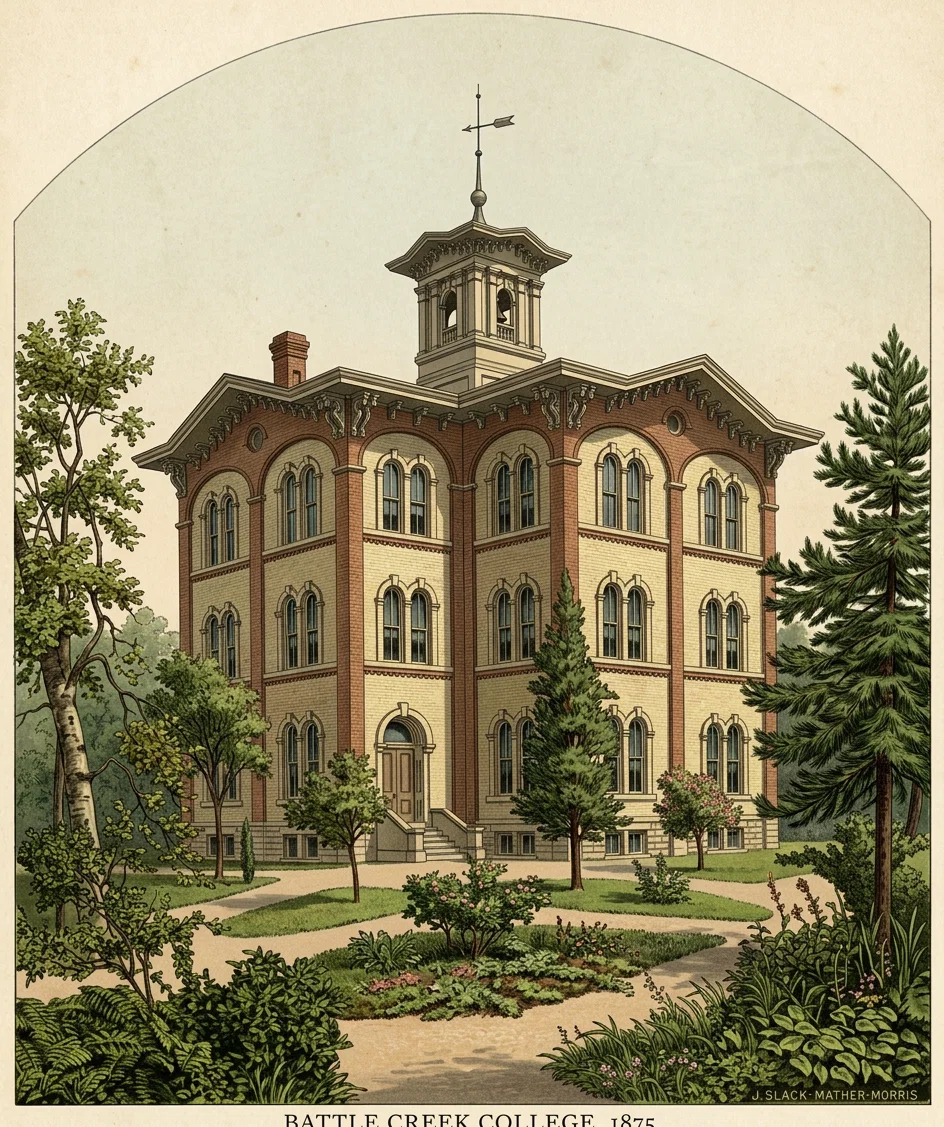
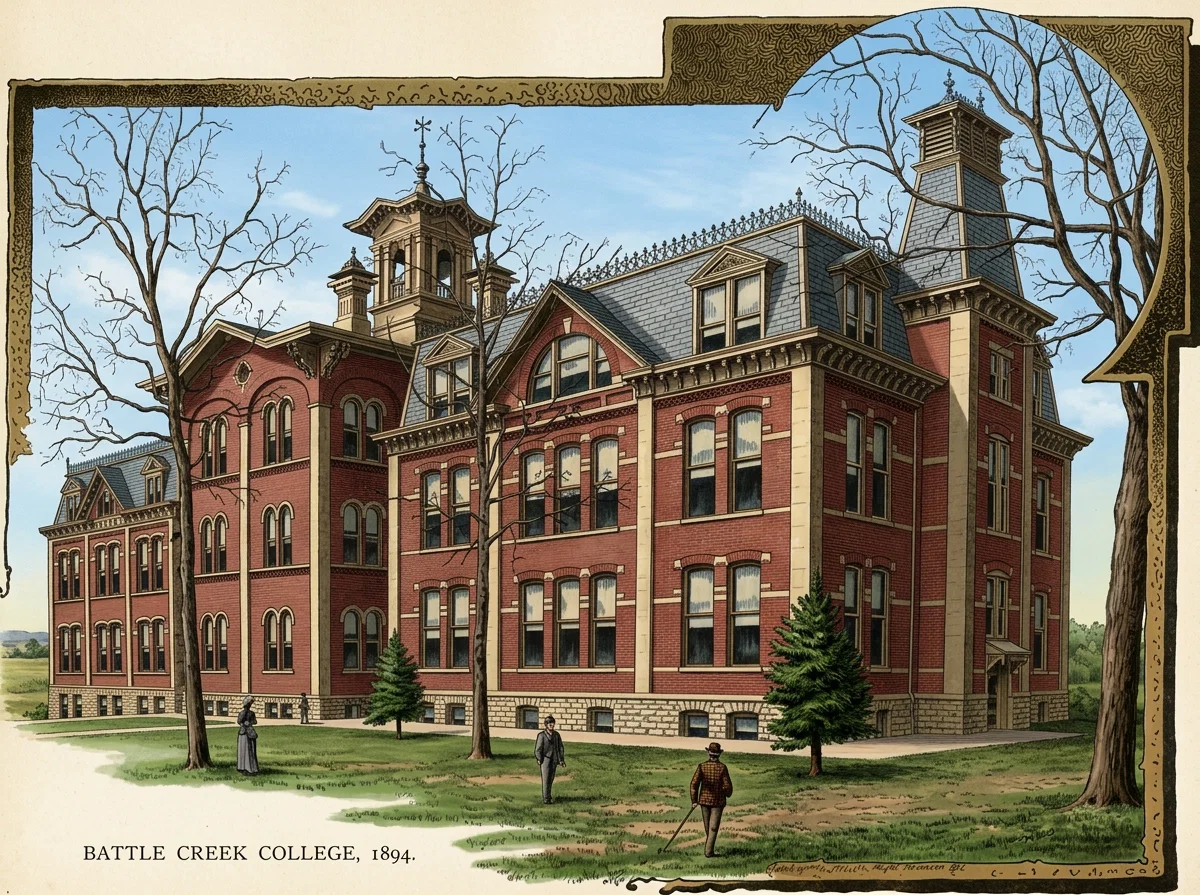
4. Educational Institutions. — The first school was founded in the early history of the work, in Battle Creek, Mich. True religion is educational. The S. D. A. Educational Society was incorporated in Battle Creek, March, 1874. The first college built by them was opened for students in 1875. Now the denomination has five colleges, as follows: Battle Creek, Mich.; Union College, at College View, Neb.; Walla Walla College, at College Place, Wash.; Healdsburg College, at Healdsburg, Cal.; Claremont College, at Claremont, South Africa. Besides these institutions there are schools doing work of academic grades at South Lancaster, Mass.; Mt. Vernon, Ohio; Keene, Texas; Graysville, Tenn.; Frederikshavn, Denmark;
and a preparatory school in West Virginia, a Bible school in Australasia, a school in Guadalajara, Mexico, two schools in the islands of the Pacific for natives, one in the Bay Islands of the Carribean Sea, and fifteen different church schools, two General Conference Bible schools, and other schools not regularly organized.
The enrollment of students for the present year in this country is as follows: Battle Creek College, 628; Union College, 436; South Lancaster Academy, 170; Walla Walla College, 162; Texas Academy, 160; Healdsburg College, 130; Mt. Vernon Academy, 122; Graysville Academy, 102; West Virginia school, 64; Bible schools, 386. Total, 2,360. The total reported in all schools, 2,835. A safe estimate places over 3,000 pupils in Seventh-day Adventist schools, while many pupils are found in public schools and other institutions of learning. The real basis of education in all these schools is the word of God, and yet thorough instruction is given in other lines. With some of these institutions manual training is connected, and steps will be taken as rapidly as possible to make each school a manual training school, giving the student healthful exercise, and a useful
HELPERS' DORMITORY OF SANITARIUM.
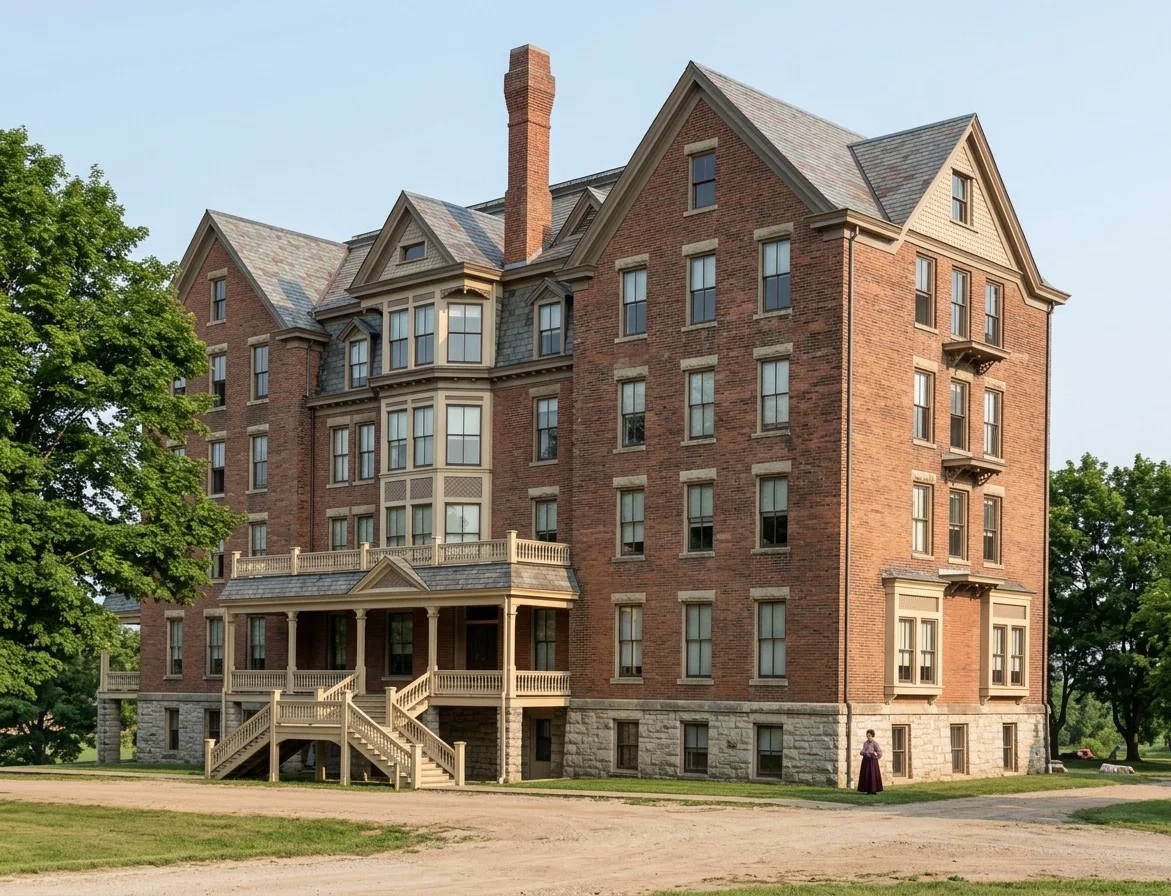
SANITARIUM HOSPITAL, 1894.
trade, enabling the poor to pay in part or in whole their way, and conserving youthful human energy for a noble purpose. While doing this it is in no way designed to lower the grade of intellectual work. In these schools many of the youth of the denomination have been soundly converted to Christ, and from them many noble workers have gone out in the great Gospel field.
As we look back over the past, we can but exclaim, "What hath God wrought!" It is all of him. He it is who has given the word. His is the message. Through evil report, contumely, falsehood, poverty, outward discouragement, false brethren, and various obstacles and difficulties, God has given success. Our boast is in his cross; our glory, in his name. There are and have been more rapid movements; there are none stronger. This is founded not on the word of man, but the word of God. In the words of one of old, we say to all, "Come thou with us, and we will do thee good; for the Lord hath spoken good concerning Israel." This is the time of sacrifice; the glorious future lies just on before.
BATTLE CREEK COLLEGE, 1875.
BATTLE CREEK COLLEGE, 1894.
HASKELL HOME FOR ORPHANS, BATTLE CREEK, MICH.
MAIN BUILDING, SANITARIUM (RURAL HEALTH RETREAT), ST. HELENA, CAL.
A Child’s Day
A CHILD’S day, like the day of a grown person, has its lights and shadows, its trials and anxieties. Temptation has met the little one in the playground, the street, or the schoolroom, and she has had her fits of naughtiness, her gusts of temper, or her disappointments, as great to her as her father's to him. A cup can be more than full to the brim, let its size be what it may.—Selected.
THE ONLY EFFECTIVE LAW.
THE only perfect and absolutely effective law against evil is the law of God. No evil can survive when brought in contact with that, and sooner or later all evil will be brought in contact with it and destroyed; but what we should do is to let all the evil within us be brought in contact with the law now, by being taken away from us through faith in Christ. "The law of the Spirit of life in Christ" gives freedom from sin and death. Rom. 8:2. But if we do not allow God to separate the evil from us now, the law of God will destroy us with it at the last day.
Consecrated to Him Alone
By Frances Ridley Havergal
"Not your own!" to Him ye owe
All your life and all your love;
Live that ye His praise may show
Who is yet all praise above.
Every day and every hour,
Every gift and every power,
Consecrate to Him alone
Who hath claimed you for His own.
—F. R. Havergal.
THE MASTER'S TOUCH.
By Horatius Bonar
In the still air the music lies unheard;
In the rough marble beauty lies unseen;
To make the music and the beauty needs
The Master's touch, the sculptor's chisel keen.
Great Master, touch us with thy skillful hand;
Let not the music that is in us die.
Great Sculptor, hew and polish us; nor let,
Hidden and lost, thy form within us lie.
Spare not the stroke! do with us as thou wilt!
Let there be naught unfinished, broken, marred;
Complete thy purpose, that we may become
Thy perfect image, thou our God and Lord.
—Horatius Bonar.
CHRIST OUR COMPLETE SALVATION.
By Ellen G. White
BY MRS. E. G. WHITE.
THE character of the Lord Jesus Christ is to be reproduced in those who believe in him as their personal Saviour. They will be "rich in good works, ready to distribute, willing to communicate; laying up in store for themselves a good foundation against the time to come, that they may lay hold on eternal life." Our acceptance with God is not upon the ground of our good works, but our reward will be according to our works. "For what the law could not do, in that it was weak through the flesh, God sending his own Son in the likeness of sinful flesh, and for sin, condemned sin in the flesh; that the righteousness of the law might be fulfilled in us, who walk not after the flesh, but after the Spirit."
"The carnal [or natural] mind is enmity against God; for it is not subject to the law of God, neither indeed can be." Human nature could not keep the law, even if it would. Apart from Christ, without union with him, we can do nothing. "Not that we are sufficient of ourselves to think anything as of ourselves; but our sufficiency is of God." The law requires us to present to God a holy character. It demands of men to-day just what it demanded of Adam in Eden,—perfect obedience, perfect harmony with all its precepts in all relations of life, under all circumstances and conditions. No unholy thought can be tolerated, no unlovely action can be justified. As the law requires that which no man of himself can render, the human family are found guilty before the great moral standard, and it is not in the province of law to pardon the transgressor of law. The standard of the law cannot be lowered to meet man in his fallen condition. No compromise can be made with the sinner to take less than the full requirement of the law. The law cannot acquit the guilty, it cannot cleanse the sinner, or give power to the transgressor to raise himself into a purer, holier atmosphere. Standing before a holy, good, and just law, and finding ourselves condemned because of transgression, we may well cry out, What shall we do to be saved?
There is but one way of escape for the sinner. There is but one agency whereby he may be cleansed from sin. He must accept the propitiation that has been made by the Lamb of God, who taketh away the sins of the world. The shed blood of Christ cleanseth us from all sin. "For he hath made him to be sin for us, who knew no sin; that we might be made the righteousness of God in him." "Him hath God exalted with his right hand to be a Prince and a Saviour, for to give repentance to Israel, and forgiveness of sins." A complete offering has been made; for "God so loved the world, that he gave his only-begotten Son,"—not a son by creation, as were the angels, nor a son by adoption, as is the forgiven sinner, but a Son begotten in the express image of the Father’s person, and in all the brightness of his majesty and glory, one equal with God in authority, dignity, and divine perfection. In him dwelt all the fullness of the Godhead bodily.
John said, "We have seen, and do testify that the Father sent the Son to be the Saviour of the world." The Son of God took upon him human nature,—"the Word was made flesh, and dwelt among us." "God was manifest in the flesh." The union of divinity with humanity brings to the fallen race a value which we scarcely comprehend. The human and the divine were united in Christ, in order that he might represent those who should believe in him. He took our nature, and passed through our experiences, and as our representative he assumed our responsibilities. The sins of men were charged to Christ, and, innocent though he was, he engaged to suffer for the guilty, that through faith in him the world might be saved. "We were reconciled to God by the death of his Son." Christ reconciled the world unto himself, not imputing their trespasses unto them. O, what compassion and love are here revealed! How is humanity exalted through the merits of Christ! His sacrifice was ample and complete. The Holy One died instead of the unholy. He clothed himself in our filthy garments, that we might wear the spotless robe of his righteousness, which was woven in the loom of heaven. He paid the whole debt for all who would believe in him as their personal Saviour. His blood cleanseth from all sin and purifieth from all unrighteousness. In him, through him alone, we have forgiveness of sins. Through faith in his blood we have justification in the sight of God.9It will avail nothing for us to do penance, to afflict the body for the sin of the soul, or to flatter ourselves that by our good works we shall merit or purchase an inheritance among the saints. When the question was asked Christ, "What shall we do that we might work the works of God?" he answered, "This is the work of God, that ye believe on him whom he hath sent." We are not to do something in order to purchase our entrance into heaven; for the Lord gives us heaven through the merit of Jesus Christ, and not through any merit of our own. Good works are the result of faith and love; for, conscious of the debt of love and gratitude which we owe to God for the infinite sacrifice made in our behalf, we show forth the praises of him who hath called us out of darkness into his marvelous light. Every one is under bonds to God to manifest obedience to all his commandments, relying fully on the righteousness of Christ for his acceptance with God. Accepting the grace of Christ, we are to live to the honor and glory of God, keeping the commandments at any sacrifice to ourselves. "There is none other name under heaven given among men, whereby we must be saved."
The atonement of Christ was not made in order to induce God to love those whom he otherwise hated; it was not made to produce a love that was not in existence; but it was made as a manifestation of the love that was already in God's heart, an exponent of the divine favor in the sight of heavenly intelligences, in the sight of worlds unfallen, and in the sight of a fallen race. "For God so loved the world, that he gave his only-begotten Son, that whosoever believeth in him should not perish, but have everlasting life." We are not to entertain the idea that God loves us because Christ has died for us, but that he so loved us that he gave his only-begotten Son to die for us. The death of Christ was expedient in order that mercy might reach us with its full pardoning power, and at the same time that justice might be satisfied in the righteous substitute. The glory of God was revealed in the rich mercy that he poured out upon a race of rebels, who through repentance and faith might be pardoned through the merits of Christ, for God will by no means clear the guilty who refuse to acknowledge the merit of a crucified and risen Saviour. It is only through faith in Christ that sinners may have the righteousness of Christ imputed unto them, and that they may be "made the righteousness of God in him." Our sins were laid on Christ, punished in Christ, put away by Christ, in order that his righteousness might be imputed to us, who walk not after the flesh, but after the Spirit. Although sin was charged to his account on our behalf, yet he remained perfectly sinless.
O, what a history we have in the life and death, resurrection and exaltation of Christ! He was the incarnate God, the Lord of life and glory; yet for our sakes he was delivered into the hands of wicked men. Satan and the whole confederacy of evil men and evil angels raged around him, and he suffered that which would have been insupportable to any human being. His life was one of utter self-denial and self-sacrifice, full of achievements of divine mercy, goodness, and power. Disease fled at his touch, the blind saw, the deaf heard, demons were cast out, the dead were raised. The tempest-tossed waters were stilled at his command, and as he hung upon the cross, nature gave signs that she sympathized with her dying Author. The earth reeled and heaved beneath the feet of men; the sun clothed itself in sackcloth. When the mighty angel descended from heaven, parting the darkness from his track, the Roman guard fell as dead men before the resplendent glory, and Christ in his Godhead shone forth as he burst from the tomb, and rose triumphant over death and the grave. The disciples understood, when they saw him arisen from the dead, what he meant when he said, "Destroy this temple, and in three days I will raise it up."
Shall our faith ever falter again? What stronger evidence could God have given us that Jesus is the Son of God? What greater evidence could be given of the power and coming of our Lord Jesus Christ than that which has been given by those who were eyewitnesses of his Majesty? Will those who claim to believe in Christ as a personal Saviour, dishonor God by doubting that he to whose guardianship they have committed their souls will keep that which has been committed to his trust against that day? Jesus is a risen Saviour. He came forth from the grave to vindicate his previous claims, to confirm the faith of his followers, to establish the truth of his Godhead before men, to make doubly sure the assurance that whosoever believeth in him should not perish, but have everlasting life.
THE COMING OF CHRIST.
Is it not reasonable for Christians to believe, in view of the promises of God's word, that Jesus Christ will come again? We thus read:—
"So Christ was once offered to bear the sins of many; and unto them that look for him shall he appear the second time without sin unto salvation." Heb. 9:28.
Christ came the first time, heralded by the prophets, by signs, and by special messenger. He "empted himself" of his glory with the Father, came down to this sin-cursed earth, took upon himself the nature of fallen man, stooping to the very depths, the greatest weakness, of that nature, and became obedient unto death. Phil. 2:5-8; Gal. 4:4; Heb. 2:10-18. This he did that he might lift fallen man up to God. After his victory over death, which was also triumphant victory over sin, Christ ascended to heaven to plead the virtue and power of his sacrifice and victory for fallen man; for the raising of Christ from the dead was the manifestation of God's power over sin full grown (James 1:15, R. V.), and therefore it means hope and victory for everyone who will ally himself with Christ. This is the power which the apostle Paul desires that we may know. He says:—
"That ye may know what is the hope of his calling, and the riches of the glory of his inheritance in the saints, and what is the exceeding greatness of his power to us-ward who believe, according to the working of his mighty power, which he wrought in Christ, when he raised him from the dead, and set him at his own right hand in the heavenly places, far above all principality, and power, and might, and dominion, and every name that is named not only in this world, but also in that which is to come; and hath put all things under his feet, and gave him to be the head over all things to the church, which is his body, the fullness of him that filleth all in all." Eph. 1:18-23.
Christ is now a priest-king, "after the order of Melchizedek" (Heb. 5:10), on his Father's throne (Heb. 8:1), and in that capacity he is gathering out from the nations of earth a people to serve him forever in his everlasting kingdom (Zech. 6:12, 13; Eph. 2:19-21). But his work as priest will sometime be over. He will finish his ministration for fallen man. Every soul which will have heeded the message of mercy will be eternally sealed and saved, and from those who have rejected the message, Christ will turn with reluctance but with justice. They rejected righteousness and life; they preferred sin and death; and, sad as it is that they have so chosen, Infinite Love gives them their choice. Then, when all has been done that could be done, will the eternal fiat go forth: "He that is unjust, let him be unjust still; and he which is filthy, let him be filthy still; and he that is righteous, let him be righteous still; and he that is holy, let him be holy still. And, behold, I come quickly." Rev. 22:11, 12. Christ, therefore, will come again when his priestly work is ended.
Christ's second coming will not be by his Spirit; for his Spirit is the manifestation of Christ's presence in his personal absence. Said Jesus:—
"But now I go my way to Him that sent me. . . . But because I have said these things unto you, sorrow hath filled your heart. Nevertheless I tell you the truth: It is expedient for you that I go away; for if I go not away, the Comforter [the Holy Spirit] will not come unto you; but if I depart, I will send him unto you." John 16:5-7.
This is certainly positive testimony that the sending of the Spirit of God is not synonymous with the coming of Christ.
Christ's coming is not at death. This is evident from the following scripture:—
"Peter seeing him saith to Jesus, Lord, and what shall this man [John] do? Jesus saith unto him, If I will that he tarry till I come, what is that to thee? follow thou me. Then went this saying abroad among the brethren, that that disciple should not die; yet Jesus said not unto him, He shall not die; but, If I will that he tarry till I come, what is that to thee?" John 21:21-23.
The disciples knew that death was not Christ's coming; and therefore they knew that if John tarried till Christ came again, he would not die at all. For Christ's coming means life. It meant life to Lazarus (John 11), and so it will to all who sleep in Christ. Death, instead of being a friend, or coming in the stead of our best Friend, is an enemy, "the last enemy that shall be destroyed." 1 Cor. 15:26.
Christ's coming is not any of these; it is a personal coming. Read the testimony of two of the heavenly messengers who escorted him on his triumphal return to heaven, spoken to the disciples from whom he had just separated:—
"Ye men of Galilee, why stand ye gazing up into heaven? this same Jesus, which is taken up from you into heaven, shall so come in like manner as ye have seen him go into heaven." Acts 1:11.
"For the Lord himself shall descend from heaven with a shout." 1 Thess. 4:16.
These are conclusive proofs that Christ's second coming will be personal, his own personal presence.10
His Coming Visible and Glorious.
His coming will not be a secret coming, known only to a few elect ones. True it is that he shall appear to those who look for him (Heb. 9:28), but the emphasis is not on he "shall appear," but he shall appear the second time unto the salvation of those who look for him. He will not come as a sin offering, bearing the iniquities of the world. He will not come in the likeness of sinful flesh, but in his own glorified person, the Lord himself, this same Jesus. And he will be seen of all who are upon the face of the earth.
The wicked will see him and perish in the brightness of his glory. They rejected his presence when he was priest before he came, the presence of his Spirit, by which he longed to dwell with them here, by which he would have cleansed them from all sin, and strengthened them in all righteousness. They will not endure his presence here; they cannot endure it when he comes. Says John:—
"Behold, he cometh with clouds; and every eye shall see him, and they also which pierced him; and all kindreds of the earth shall wail because of him." Rev. 1:7.
"And the kings of the earth, and the great men, and the rich men, and the chief captains, and the mighty men, . . . said to the mountains and rocks, Fall on us, and hide us from the face of him that sitteth on the throne, and from the wrath of the Lamb." Rev. 6:15, 16.
"And then shall that wicked be revealed, whom the Lord shall consume with the spirit of his mouth, and shall destroy with the brightness [shining forth] of his coming [present]." 2 Thess. 2:8.
The righteous will see him, and will rejoice, for "he shall come to be glorified in his saints." 2 Thess. 1:10.
"For this we say unto you by the word of the Lord, that we that are alive, that are left unto the coming [presence] of the Lord, shall in nowise precede them that are fallen asleep. For the Lord himself shall descend from heaven, with a shout, with the voice of the Archangel, and with the trump of God; and the dead in Christ shall rise first; then we that are alive, that are left, shall together with them be caught up in the clouds, to meet the Lord in the air; and so shall we ever be with the Lord." 1 Thess. 4:15-17, R. V.
Glad day to the child of God! The promise of the Master will be realized to the sorrowing disciples: "I will come again, and receive you unto myself; that where I am, there ye shall be also." John 14:3. "Blessed hope" it is indeed, "the glorious appearing of the great God and our Saviour Jesus Christ." Titus 2:13. We enjoy the personal presence of those whom we truly love. We desire them with us; we delight in their companionship. So also if we know Christ, if we love him, we shall love and long for his second coming, his personal presence. It means to the child of God, home, rest, peace, joy, life, and unalloyed bliss forever, of which the presence of the Spirit of Christ has given us the "earnest," or foretaste, here.
His Coming Near.
And his coming draweth near. (1) Not less than twelve distinct lines of prophecy in the books of Daniel, Matthew, Mark, Luke, 2 Thessalonians, and the Revelation proclaim that Christ's coming is near at hand. (2) Between twelve and twenty special signs of the last days show that Christ's coming is near. The word of God tells us that these would come in "the last days," showing that the end of the age was near, that Christ was about to come and take to himself his own kingdom and reign. These signs would be hung out before the world, where all could see them. They would be seen in the sun, moon, and stars, in aerial disturbances, in sea and land, in wind and wave, in the social, financial, political, and religious world. There would be increase of knowledge, increase of riches, increase of sin, of drunkenness, of wickedness in high places and religious circles. The church would unite with the world, and God's true people would be persecuted. All these things and more are told in numerous scriptures, and their fulfillment and fulfilling may be seen by the eyes, felt by the hearts, and perceived by the minds of this generation. And so our Lord tells us that the generation which witnesses all these things will not pass away till he shall come, and that when they see them all they may know that Christ's coming is near, even at the doors. Matt. 24:32-35. The very scoffers themselves are a proof that the last days are here and Christ is near to come. 2 Peter 2:1, 2; 3:3, 4. The prophecies may be set aside by man, the signs may be scoffed at, but Jesus says, "Heaven and earth shall pass away, but my words shall not pass away." Matt. 24:35.
How can Christians—those who believe, know, and love Christ—not love his appearing? May the writer and reader be among those who shall say in that day when "he shall swallow up death in victory;" "Lo, this is our God; we have waited for him, and he will save us; this is the Lord; we have waited for him, we will be glad and rejoice in his salvation." Isa. 25:9. "He which testifieth these things saith, Surely I come quickly. Amen. Even so, come, Lord Jesus."