AND on the seventh day God ended His work which He had made; and He rested on the seventh day from all His work which He had made." Gen. 2:2. The Revised Version reads, "And on the seventh day God finished His work." It has been said by some that the rendering of this text in the King James Version is incorrect; and we have been referred to the Septuagint, the Syriac, and the Samaritan translations for a more correct understanding of this scripture, which we are informed reads, "And on the sixth day God ended His work which He had made," etc.
Our Saviour said, "The Sabbath was made for man." Mark 2:27. And we are frequently asked when the Sabbath was made, and we reply that it was made at the end of the creation-week. Therefore as God made the Sabbath, it must have been a part of His creative work. We have been told that man was the crowning work of God's creation in the beginning. But God could7have made man on some other day of the week besides the sixth day and he would have been man just the same. But the sixth day could not have been made the Sabbath at its close, from the fact that God did not rest on that day. Neither could the first day of the week have been made the Sabbath, for that would imply rest before labor, and rest from labor before the labor had been performed would be impossible.
But God, after He had made the world and all things therein in six days, then, in order to make the Sabbath for man, rested on the seventh day from all His work which He had wrought on the six days, and then He made the Sabbath by resting upon the seventh day. And as rest and sabbath are synonymous terms, the seventh day was not only God's rest-day, but it was His Sabbath day. And as He had rested on the seventh day, He blessed the seventh day and sanctified it; because that in it He had rested. And thus the seventh day became His holy rest-day or His holy Sabbath.
Therefore we can see no trouble with our English translation, which says, "And on the seventh day God ended His work which He had made; and He rested on the seventh day from all His work which He had made." Gen. 2:2. For His resting on the seventh day made it the Sabbath, and His blessing and sanctifying the Sabbath made it the holy Sabbath for man. And as we are to "Remember the Sabbath day to keep it holy," it is a gentle reminder, not only that God is the Creator of the heavens and the earth, but that in making the Sabbath, blessing and sanctifying it on the seventh day, was the crowning work of the Creator accomplished. Therefore God ended or finished His work, and the whole arrangement of God's creative work was completed on the seventh day.
J. N. WILKINSON.
In the Forest.
By B. L.
I HAVE knelt in a vast cathedral,
And in silence worshiped God;
And my heart went out to its Maker,
As I knelt where saints had trod.
But I never knew the quiet
That can steal o'er the hearts of men,
Till I stood in the summer woodland
Of a peaceful forest glen.
The world and its cares were forgotten,
And the peace of God, from on high,
Filled the earth with His loving-kindness,
And beamed from the vaulted sky.
The burden of sorrow rolled from me,
And life's passions seemed all at rest;
And I almost knew the glory
That will fill the souls of the blest;
When the trump of the great Archangel
Shall ring thru the halls of Time,
And the dead shall arise in their glory
From every age and clime;
When the vileness of sin is forgotten,
And all of life's worry shall cease,
And the heart know only the beauty
Of God's wonderful love and peace;
When friendship's cord is ne'er broken,
And hearts that are severed here,
United in God's sweet presence,
Shall be filled with trust and cheer;
When the shadows of sin can not enter
The heart that is weary and worn,
And we shall all stand in the splendor
Of the resurrection morn.
Sweet Christ, we pray Thee to hasten
That wonderful advent day,
When earth and its sinnings forgotten,
We bask in the beauteous ray
Of peace, and love, and friendship,
And bliss without alloy,
And the blessed smile of Thy presence
Shall fill our hearts with joy.
Let the lesson of peace Thou hast written
In this forest, old and dim,
Remain forever with me,
Like the grace of a parting hymn;
Fill my heart with truth and patience,
With mercy, and trust, and love,
Till we meet in Thy wonderful mansions
In the glorious heaven above.
B. L.
The Sabbath in History.
By B. F. Kneeland
Testimony: Divine and Human.
THE fourth commandment says: "Remember the Sabbath day, to keep it holy. Six days shalt thou labor, and do all thy work: but the seventh day is the Sabbath of the Lord thy God, in it thou shalt not do any work, thou, nor thy son, nor thy daughter, thy man servant, nor thy maid servant, nor thy cattle, nor thy stranger that is within thy gates; for in six days the Lord made heaven and earth, the sea, and all that in them is, and rested the seventh day; wherefore the Lord blessed the Sabbath day, and hallowed it." Ex. 20: 8-11.
Sunday is the first day, and not the seventh. Why should Protestants follow the lead of the Roman Catholic Church in worshiping on the first day of the week, which the Bible says came "when the Sabbath was past"? Mark 16: 1, 2. It is beyond question that when Christ said "The Sabbath was made for man" and "The Son of Man is Lord even of the Sabbath day," He referred to the seventh-day Sabbath instituted at Creation and kept by God's people till the close of the Bible history.
Allow me to call attention to some statements from reliable historians and Biblical scholars who can not be accused of being prejudiced against Sunday observance.
Dr. Coleman says: "No law or precept appears to have been given by Christ or the apostles, either for the abrogation of the Jewish Sabbath, or the institution of the Lord's day, or the substitution of the first for the seventh day of the week."—Ancient Christianity, chapter 26, section 2.
The Augsburg Confession declares: "The observance of the Lord's day [Sunday] is founded not on any command of God, but on the authority of the church."—Cath. Sabbath Manual, part 2, chapter 1, section 10.
Sir William Domville of the Church of England says: "Centuries of the Christian era passed away before Sunday was observed by the Christian church as a Sabbath. History does not furnish us with a single proof or indication that it was at any time so observed previous to the Sabbatical edict of Constantine, A.D. 321."—Examination of Six Texts, page 291.
"Unquestionably the first laws, either ecclesiastical or civil, by which the Sabbatical observance of Sunday is known to have been ordained, is the Sabbatical edict of Constantine, A.D. 321."—International Cyclopedia, Art. "Sunday."
Is it not passing strange that the murder-stained hand of a half-Christianized pagan should be the first to frame a law compelling people to rest on Sunday?
Just one word more from Cardinal Gibbons: "You may read the Bible from Genesis to Revelation, and you will not find a single line authorizing the sanctification of Sunday. The Scriptures enforce the religious observance of Saturday, a day which we never sanctify."—Faith of Our Fathers, page 111.
Why not honor the Sabbath of the Lord?
B. F. KNEELAND.
The Vision of the Awakened Church
By Robert E. Speer
THE vision of the awakened church, with all our members alive to the joy of the missionary obligation, and with the bending of all our energies to the enterprise of the evangelization of the world, is a noble dream, but the prosecution of the enterprise does not need to wait for the realization of the dream. —Robert E. Speer.
God’s Law the Rule of Duty
By Charles G. Finney
The will of God, as expressed in His law, is the rule of duty to moral agents.—Rev. Chas. G. Finney.
Some Day.
SOME day all doubt and mystery
Will be made clear;
The threatening clouds which now we see
Will disappear.
Some day our weary feet will rest
In sweet content;
And we shall know how we were blest
By what was sent.
And looking back with clearer eyes
On life's short span,
We'll see with wondering, glad surprise,
God's perfect plan.
And knowing that the path we went
Was God's own way,
We'll understand His wise intent,
Some day, some day.
—Anon.
The Second Coming of Christ.
How? When?
1. JESUS CHRIST the Son of God once came to this world in literal, visible, human form. He is coming again.
"So Christ also, having been once offered to bear the sins of many, shall appear A SECOND TIME, apart from sin, to them that wait for Him, unto salvation." Heb. 9: 28.
2. He Himself promised that He would come again.
"Let not your heart be troubled: believe in God, believe also in Me. In My Father's house are many mansions; if it were not so, I would have told you; for I go to prepare a place for you. And if I go and prepare a place for you, I COME AGAIN, and will receive you unto Myself; that where I am, there ye may be also." John 14: 1-3.
3. His angels left us the promise that He would come again.
"THIS SAME JESUS, who was received up from you into heaven, SHALL SO COME IN LIKE MANNER as ye beheld Him going into heaven." Acts 1: 11.
4. When He comes, it is to raise to life the sleeping saints and gather them to Himself.
"For this we say unto you by the word of the Lord, that we that are alive, that are left unto the coming of the Lord, shall in nowise precede them that are fallen asleep. For the Lord Himself shall descend from heaven, with a shout, with the voice of the Archangel, and with the trump of God: and the DEAD IN CHRIST SHALL RISE first; then we that are alive, that are left, shall together with them be caught up in the clouds, to meet the Lord in the air: and so shall we ever be with the Lord." 1 Thess. 4: 15-17.
5. Not until His second coming will His people receive their reward.
"For the Son of Man SHALL COME in the glory of His Father with His angels; and THEN SHALL HE RENDER UNTO EVERY MAN ACCORDING TO HIS DEEDS." Matt. 16: 27.
6. Not until His second coming will Jesus Christ take His own throne.
"But WHEN the Son of Man shall come in His glory, and all the angels with Him, THEN shall HE SIT on the THRONE of His glory." Matt. 25: 31.
7. This coming will be literal, personal, visible.
"Behold, He cometh with clouds; and EVERY EYE SHALL SEE HIM, and they that pierced Him; and all the tribes of the earth shall mourn over Him. Even so, Amen." Rev. 1: 7.
8. To His own children, that coming will be a source of joy and gladness.
"And it shall be said in that day, Lo, this is our God; WE HAVE WAITED FOR HIM, AND HE WILL SAVE US: this is Jehovah; we have waited for Him, we shall be GLAD AND REJOICE IN HIS SALVATION." Isa. 25: 9.
9. It is for this event the children of God are taught to look, as the glorious consummation of their hopes.
"For the grace of God hath appeared, bringing salvation to all men, instructing us, to the intent that, denying ungodliness and worldly lusts, we should live soberly and righteously and godly in this present world; looking for THE BLESSED HOPE AND APPEARING OF THE GLORY OF THE GREAT GOD AND OUR SAVIOUR JESUS CHRIST." Titus 2: 11-13.
"Come Unto Me."
THIS is the invitation of our blessed Lord to every weak, sinful soul. "Come unto Me" really means contact with Christ. It is not "Come toward Me," or "Come right near Me," but "Come unto Me." "Come right up to Me, right up to My side. Here is My yoke, put that on, the other end is with Me; yoke up with Me." The invitation of Christ embraces all that. The weary soul finds rest in the presence of Christ.
Nothing can keep the soul who heeds that invitation back from Christ. He may be immured in the lowest dungeon Rome ever builded with double-barred doors. They can not prevent the soul's union with Christ.
Man may anathematize and curse the soul for its sinfulness; that will not shut him away from Christ. Men may close and bar church doors, may proclaim the soul outside of the bounds of mercy, may count him as an enemy and a heretic; but that does not shut him away from the compassionate Christ. "Behold, I have set before thee a door opened which none can shut."
Christ uses men and churches to win and bring souls to Him, that they may be saved; but neither men nor churches can shut away the souls from Christ who go to Him in simple faith. Salvation lies wholly between the soul and God.
The One Saviour.
THERE is but one Saviour from sin and its consequences in this universe—Jesus Christ. He of God is made unto us—sinners—"wisdom and righteousness and sanctification and redemption." And this was done that man might not glory in himself or any other creature; but "he that glorieth, let him glory in the Lord." 1 Cor. 1:30, 31.
Any religion, therefore, any system of philosophy, which offers man salvation in himself or in itself, is false. The Roman Catholic Church in practise, whatever it may teach in theory, makes that Church a saviour. Christian Science, and New Thought, and Theosophy, and other cults, make man divine and place his salvation within himself, where he is told to seek it. As well may he seek sweet water from a bitter fountain, or speech from the closed lips of the dead. Christ is the way, the truth, the life; and all salvation is from Him.
THE book of Romans contains climax after climax in its presentation of the deliverance from sin. In the study of previous verses in the book, we have learned, among other things, of the plan by which the Lord gives us His own righteous life in exchange for all our past life of sin; we have learned of the plan by which He gives power to keep us in the life of right-doing; how He gives us control over every fleshly lust; how He adopts us into His own heavenly family as sons and daughters, making us "joint-heirs" with His own Son; and then we come, in the next verses to be considered, to the further climax of the knowledge of the fact that our heavenly Father has arranged for His own Holy Spirit to pray for us:
"For in hope were we saved: but hope that is seen is not hope: for who hopeth for that which he seeth? But if we hope for that which we see not, then do we with patience wait for it.
"And in like manner the Spirit also helpeth our infirmity: for we know not how to pray as we ought; but the Spirit Himself maketh intercession for us with groanings which can not be uttered; and He that searcheth the hearts knoweth what is the mind of the Spirit, because He maketh intercession for the saints according to the will of God." Rom. 8:24-27.
We are saved in hope. "But hope that is seen is not hope." The life that is beyond can not be known by sight. Neither do we have the knowledge that comes by sight in our salvation from sin; this knowledge comes by faith thru the operations of the mind. This knowledge that comes by faith fills us with hope. And so we are willing to wait patiently for that which has inspired our hope.
While in this waiting, testing time, knowing the strength of the sinful tendencies that we have to combat, we might be tormented by fear lest we should eventually fail of reaching that for which we are striving; therefore the Lord gives us the strong and assuring promise: "In like manner the Spirit also helpeth our infirmity." The mighty power of the Spirit of God is given to help our infirmity. Our weakness is recognized, and the Lord sends His own omnipotent strength into that very weakness so that we may be sure of constant victory. Human weakness can not successfully combat sin; but divine power can, and this power comes to each of God's children thru the agency of the Spirit.
A hundred pounds would seem an impossible load for the average man if he were asked to carry it half a mile; but the same hundred pounds would not be felt by a powerful locomotive in case the weight were thrown upon a car of its moving train. And so it is in the matter of overcoming sin. If we have power enough with which to combat sin, the task is not only rendered possible, but it is handled with ease. The gift of the Spirit of God is also the gift of the mighty power of God.
Said the Master to His disciples, "Ye shall receive power, when the Holy Spirit is come upon you: and ye shall be My witnesses both in Jerusalem, and in all Judea and Samaria, and unto the uttermost part of the earth." Acts 1:8. Here is the secret of the whole matter: "Ye shall receive power." The question is not in regard to the magnitude of the sins we have to combat, but it is the plenitude of the power that our God sends to us and places within us. The task of overcoming the sin may seem to us an insurmountable one. The clamorings for gratification and indulgence may seem so strong as to be past the possibilities of control. But all of these clamorings, these besetments, these lusts, are swallowed up in the infinite ocean of divine power.
Then we need not, and we should not, live in the agony of fear lest we should not be able to overcome. We should live amid the delights and the adorations produced by the knowledge and the experience that pervades the soul thru the indwelling of the Spirit of God.
"For we know not how to pray as we ought; but the Spirit Himself maketh intercession for us with groanings which can not be uttered." Christians are often asked to pray for people; but we may have the9Spirit of God Himself to make intercession for us. He goes into the very depths of our inner hearts and lives, and brings forth those things that can not be uttered—longings and yearnings that we have no power to express; He goes even deeper than that and brings petitions before the throne of God for things that we do not understand and that we can not appreciate the need of, “for we know not how to pray as we ought.”
Then when the Spirit presents before the throne of God these deep things—things that our fellow men who live the most intimately with us could not understand if we should try to tell them, yes, even things that we ourselves do not understand about ourselves and about the far-reaching possibilities of our defects and failings, yet are they intelligible to our Father. For “He that searcheth the hearts knoweth what is the mind of the Spirit, because He maketh intercession for the saints according to the will of God.”
God searches our hearts. He knows what they contain. He knows what we each and every one need in order to perfect our characters. And so He sends His Spirit into our hearts to search out everything that stands between us and perfection, and this is all brought before His throne so that it may be put out of the way, destroyed forever thru the atoning blood of Christ.
Then those who are afraid that there may be some sin that they will overlook and so not have it confessed and put out of the way may take courage. We are not left to the task of searching our own hearts in our finite strength. If we but place our cases in His hands, the divine Father will do this searching, and every hidden spring of evil will be uncovered, and strength and wisdom will be imparted to put it all away. If we place our cases with Him and keep them there, we may rest assured that there is no possible chance for failure. He who is infinite in power and wisdom can assure success in each case. T.
"The Blessed Hope."
THE second coming of our Lord is the hope of the church. To set aside the promises and prophecies which have been given of that event is to set aside the Scriptures as the word of God. By no just principle of interpretation, by no sound logic, can the predictions and declarations concerning His first advent be received as literal and those concerning His second advent be spiritualized away. Was His first coming literal?—So will His second coming be. He whom the opening heavens received was the literal Jesus with whom for years His disciples had companied, under whose instruction they had sat, whose blessed ministry they had enjoyed. "This same Jesus" is coming again. The open heavens will disclose Him, coming in the very manner He ascended—with power and great glory.
Over and over, the Old Testament voices the hope of the church. On an average of one verse in twenty-five, Mr. Moody declared, the New Testament refers to that crowning event of the ages. The words of our Lord Himself repeatedly assure us that He is coming again. Do you believe the Bible? then why not believe that our Lord Jesus Christ is coming again, literally, personally, visibly? Then will the Christian hope be realized. Are you looking for, longing for, expecting, His coming? If not, why not?
Sunday-Law Propaganda.
It is neither local nor ephemeral. It is not, however, a disease indigenous to American soil, if research and diagnosis lie within the times when the government was founded on the Declaration of Independence and the Federal Constitution. But it is fast becoming chronic in every state; and in some sections, owing to unwholesome local conditions, it is periodically epidemic.
From the view-point of either the church or the state, it is anomalous that such a thing as a Sunday law should have an existence. Setting aside the much mooted question as to whether Sunday is a holy day or not, it is an institution of a great part of the church. It is a religious institution. The churches who hold to its sacredness ought to believe that the power of God’s Gospel is behind it, as it is behind every Christian institution—the Lord’s Supper, for instance. Never has His Gospel needed the help of the civil arm. In fact, the civil arm has ever proved a curse to the church. It has led the church to look to man instead of to God; and “thus saith Jehovah: Cursed is the man that trusteth in man, and maketh flesh his arm, and whose heart departeth from Jehovah. For he shall be like the heath in the desert, and shall not see when good cometh, but shall inhabit the parched places in the wilderness, in a salt land and not inhabited.” “Wo to them that go down to Egypt for help, and rely on horses, and trust in chariots because they are many, and in horsemen because they are very strong, but they look not unto the Holy One of Israel, neither seek Jehovah! . . . Now the Egyptians are men, and not God; and their horses flesh, and not spirit; and when Jehovah shall stretch out His hand, both he that helpeth shall stumble, and he that is helped shall fall, and they all shall be consumed together.” These are the lessons God would teach His children in all ages.
Tho Sunday-keeping be right, and tho it be the duty of the church to teach it, it is not her duty to condemn those who do not observe it or to seek to compel them to observe it. Jesus said: “My kingdom is not of this world.” He said again: “If any man hear My words, and believe not, I judge him not; for I came not to judge the world, but to save the world.” And one of His great apostles declares: “Not that we have lordship over your faith, but are helpers of your joy; for in faith ye stand fast.” That church who turns from her Lord for power to enforce in any way religious dogmas or institutions upon men, is forsaking Christ and committing fornication with the state. And the end of that is death.
The state can not afford to admit the demand for religious legislation made by religionists under any plea whatsoever. As soon as this is done the state becomes a party in religious controversies. It must decide as to which of two parties is right. It assumes the place of God and becomes the judge of conscience. It is forced to belittle, demean, humiliate, censure, penalize, and incriminate a class of its own subjects, who may be equally good citizens and as truly Christian as those whose side the state espouses. The state which once yields to such demands begins a downward road which ends in destruction. All history has writ the warning large; it is sad to see men like Justice Brewer, of the Federal Supreme Court, and Judge Wallace, of Kansas City, Mo., carried away by such religious prejudice and pressure.
Every patriot, as he loves his country, ought to oppose Sunday-laws, or religious legislation of every kind. Every Christian should not only be ashamed to ask such a thing, but should protest against it with all his might. Agitate, agitate, to one’s content; but leave the decision between the soul and God.
Our lesson this week begins with the manifestation of God’s approval after the prayer of Solomon in sending down fire from heaven to consume the sacrifices. The remainder of the chapter gives an account of the feast that was held, the finishing of the house of Jehovah, and God’s gracious message to the king.
Chapter eight records some of the various buildings erected by Solomon; his treatment of the Canaanites that were left in the land, incidents connected with his wife, the daughter of Pharaoh; and the appointments of the priests; also the fact that he had ships which were sent to the land of Ophir for gold. This Ophir is supposed by some to be in South Central Africa.
Chapter nine records the visit of the Queen of Sheba; the vast riches of Solomon, and the luxury and magnificence of his court, some of the very things which led him astray.
Chapters ten to twelve inclusive are a brief record of the reign of Rehoboam, the son of Solomon; his foolishness in taking the advice of the young men instead of the old; the rebellion of ten tribes; the cities which he builded; the wives which he married, and his humiliation under Shishak, king of Egypt, the first one who despoiled the temple of the gold which Solomon had placed there. King Rehoboam put shields of brass in the place of the shields of gold; an evidence that the glory had already departed from Judah. Chapter thirteen is an account of the reign of Jeroboam in Israel, covering the reign of Rehoboam, and a part of the reign of Abijah. Between these kingdoms there was war in which Judah conquered.
Chapters fourteen, fifteen, and sixteen record the acts of king Asa, one of the truly great kings of Judah, yet one who ended his days in foolishness, his wrath having been aroused by the prophet of God who reproved him. He died of sore diseases, the record stating that he sought not to Jehovah, but to the physicians. That he was loyal to God is evidenced in the character of the son who followed him, a greater king even than his father. The story of his reign is given in chapters seventeen to twenty. Jehoshaphat was truly a great king. He appointed teachers throout the land of Judah to teach the people the right way. The great mistake that he made was in entering into alliance with Ahab of Israel, for which he was reproved by the prophet. His loyalty and devotion to God show that when he was reproved he humbled himself under the reproof; when in trouble he sought to the God of his fathers. The twentieth chapter is a blessed record of victory by faith; a victory assured by faith before it was actually accomplished.
While Jehoshaphat was the best of kings, the great mistake that he made in allying himself with the house of Ahab was the means of the corruption of his own household. Jehoram, his son who followed him, as told in the 21st chapter, married the daughter of wicked Ahab and Jezebel. The beginning of his reign was signalized in the destruction of all his brethren, the sons of Jehoshaphat. Edom, which had been subject to Judah, revolted under his reign, as did also Libnah. God could no longer impress upon the subject peoples His fear. He also led the people away from the worship of God to idolatry and finally died of an incurable disease after a brief reign of eight years. It is said that he departed without being desired. The people would not give him burial in the sepulcher of the kings. Ahaziah, his youngest son, followed him, beginning his reign at the age of forty-two, reigning one year only, following in the footsteps of his mother Athaliah, the grand-daughter of Omri. He was slain by Jehu, who found him with the king of Israel when he came to execute the Lord’s vengeance upon the house of Ahab. The fiendishness of his mother is manifest in the destruction of all the seed royal when she heard that her son was dead. She slew all the king’s sons with the exception of one infant which was stolen by his nurse and brought into the temple and nourished therein.
Our lessons in Proverbs are from the 12th to the 18th chapter inclusive. Intensely striking and practical are all these wonderful sayings, full of wisdom for every walk of life.
Number of Battle-Ships Building.
According to current literature, the total number of battle-ships of the huge type demanded by President Roosevelt which are built, or are building, or have been provided for, now totals forty-eight. Of these, Brazil is getting three; Japan, three; Great Britain, ten; United States, six; Germany, seven. China proposes three more; Chile, two. The whole tendency throughout the world is in direct fulfilment of what the divine prophecies have for centuries predicted of the very times in which we are living. “Prepare war, wake up the mighty men.” “Let the weak say, I am strong.” See Joel 3:9-12; Jeremiah 25.
The Letter to Abgar a Forgery
The so-called newly discovered letter, said to have been written by our Saviour to Abgar, the toparch of Edessa, may be set down as a fake pure and simple, one of the imaginary creations of the early centuries.
The Sunday-Law Agitation in Kansas City
By Editor
[We wrote our esteemed contributor, John S. Wightman, for a report of the progress of the Sunday-law movement in Kansas City, and elsewhere in the Mississippi Valley. We found him so busy in his campaign as Secretary of the Central States Religious Liberty Association that he could not write up a report, but he sent us some facts from which we present the following article. We have some further very interesting matter to follow from the same source. The battle in that field is truly on in earnest.]
As is well known to the readers of the SIGNS OF THE TIMES, Kansas City has been for quite a while a strong storm-center for the Sunday-law movement. Judge William H. Wallace, of the criminal court, is the leader of the aggressive forces. He has aided and encouraged the making of a number of arrests, and at the present writing his court has a vacation and he is out campaigning in the Sunday-law interests, and incidentally for governor.
In a recent report of his work, Judge Wallace said that 40,000 people who seven months ago were laboring on Sunday are now resting on that day; business places to the number of 5,000 in addition to 700 groceries that were selling on Sunday have been closed during the same time; many small places of business, as well as barber-shops, have been closed on Sunday; of the eight theaters that were running wide open on Sunday, the judge says he has been successful in closing six.
Mr. Wallace is a criminal judge, and he began this campaign last fall by instructing the grand jury to indict any individual they might find violating the Sunday law. Three thousand indictments followed, and the theater people, managers and all, have taken the lead in the defense against the prosecutions. Some of the cases were carried to the United States court, but the judge refused to interfere, and discharged them.
Then there came an application for a change of venue, and the transfer of the cases to Judge E. E. Porterfield's court. A writ of mandamus from the Missouri Supreme Court was served on Judge Wallace, which he obeyed and transferred the cases.
The trial of the first case resulted in the disagreement of the jury. This failure to convict called from Judge Wallace some very caustic remarks concerning the jury, and he publicly threatened to have the grand jury investigate the petit jury that refused to render a verdict of guilty.
To this threat of Judge Wallace, Judge Porterfield replied in his court that no jury where he presided would be thus intimidated and threatened, and that there would be no further trials for infractions of the Sunday law until this language of the judge was modified. Judge Wallace then softened his remarks by certain explanations, and the almost immediate result was the nolle pros ("an entry of record in a civil or criminal case, to signify that the plaintiff or prosecutor will not press it") of the nearly 3,000 cases in Judge Porterfield's court in less than five minutes, an unprecedented record for the withdrawal of suits. "Insufficiency of evidence" was the stereotyped remark of the public prosecutor as the cases were passed; but there is little doubt of the affair resulting as a rebuke to Judge Wallace.
Jackson County Court-House, Kansas City.
But this is not the end of these cases. One hundred and forty fresh indictments were made during the week ending May 23, and motion was filed by each defendant for a change of venue to Judge Porterfield's court, where it is generally conceded that the defendants will have things pretty much their own way.
The manager of one of the theaters, however, was convicted in one of the first trials that were held, and he appealed his case to the United States District Court. If he is decided against in this court he is planning to appeal to the Supreme Court for a decision as to whether the statute under which he is convicted forbids theaters, plays, and the like; he wants to have it decided if acting on the stage is "labor" within the meaning of the statute.
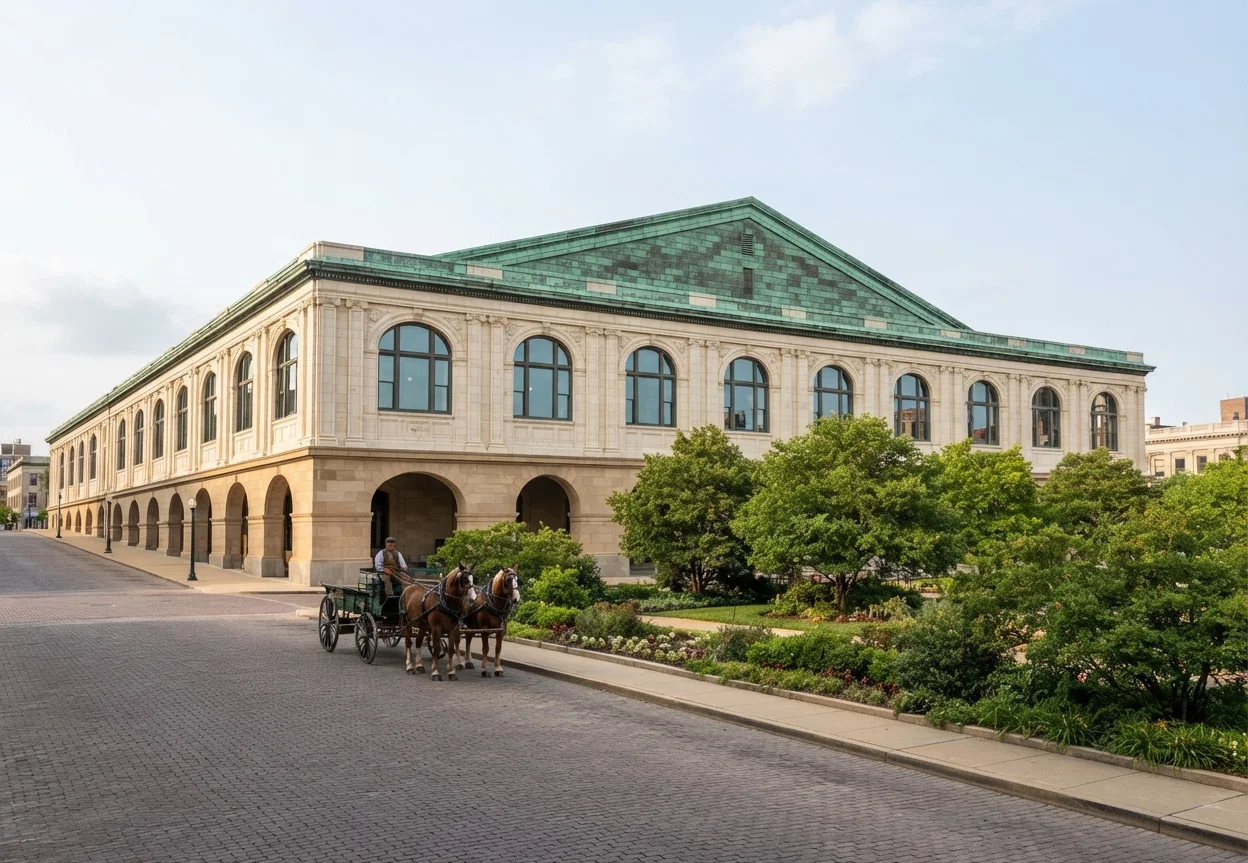
Convention Hall, Kansas City.
It is clear, so far as the statute is concerned, that the defendant has violated the law, and Judge Porterfield ruled as follows:
"If the jury believes that the defendant on Sunday, March 29, performed labor by selling tickets, you should convict the defendant, and assess his punishment to be a fine of not less than $10.00. Selling tickets in a theater on Sunday is labor and is a violation of the law."
When a judge takes oath to enforce the law, he is expected to enforce it just as he finds it; he is not on the bench to make law but to enforce it. But what the mass of the people fail to see is that all such laws as Sunday statutes are religious legislation. They do not see or recognize that the observance of a sabbath or the non-observance of a sabbath is not a question as between man and man, but it is one that should rest wholly between the individual and God.
Unfortunately saloon men, brewers, theater managers, and also all that go to make up the "red-light districts" of our great cities have arrayed themselves against the Sunday law and its enforcement. This enables certain individuals to point the finger of scorn and contempt at all decent people who oppose these measures from principle and conscientious conviction.
Judge Wallace is appealing to the church people of his state on his Sunday-law record as the principal, if not the sole, reason why he should be nominated and elected as governor of Missouri this coming fall. Church federation between both Protestants and Catholics is being urged on every hand, and the central point on which all can unite, it is claimed, is the Sunday question. The confederation of large and powerful religious bodies to influence and control legislation has always been dangerous. When they have the power in their hands, they have invariably persecuted and oppressed those who differed from them.
Christ was put to death by the enforcement of law; the apostles were put to death by the enforcement of law; all the martyrs all thru the ages have been put to death to gratify some spite, and in nearly every case the prosecutor and the persecutor had the civil law on their side.
These facts should put all truly liberty-loving people on their guard; and in saying this we want to repeat and emphasize that we have no sympathy whatever with the clamors of the saloonist, the brewer, and the libertine, to have none of the impediments of law in the way of their iniquitous work. But we fail to see the consistency of giving these demoralizing purveyors of evil the sanction and the dignity of the protection of the law for six days in the week and think to atone for it all by shutting their places up on Sunday.
As the churches combine more and more to insist upon their wishes being enacted into law, the politician who has no ambition higher than to secure office will be a very obsequious and obliging servant. And the prophecies, as is pointed out continually in the pages of this journal, show that the climax will be the cruelest and the bitterest persecution that this world has ever known.