THE well-grounded opposition of the American people against a union of church and state, shown in the frequent rebuffs which the advocates of religious legislation have met, has led the Sunday-law agitators to seek for civil and economic reasons for their measures, which were formerly advocated wholly upon religious grounds.
But changing the name of a thing does not alter its character. And transplanting a religious institution onto civil ground does not make it a civil institution, any more than transplanting a peach-tree into an apple orchard will change it into an apple-tree.
Most of the so-called civil and economic reasons for Sunday laws are based upon the parental theory of government, which treats grown-up citizens as if they were infants without any rights, and with no capacity to decide personal matters for themselves.
For example, it is said that "The law of rest is deeply written in man's physical nature." Why, then, should it need to be written on the statute-book? The demand for food, for drink, and for sleep, are also deeply written in man's physical nature; but we do not hear anything about the necessity of a civil statute to compel people to eat11when they are hungry, to drink when they are thirsty, or to sleep when they are sleepy.
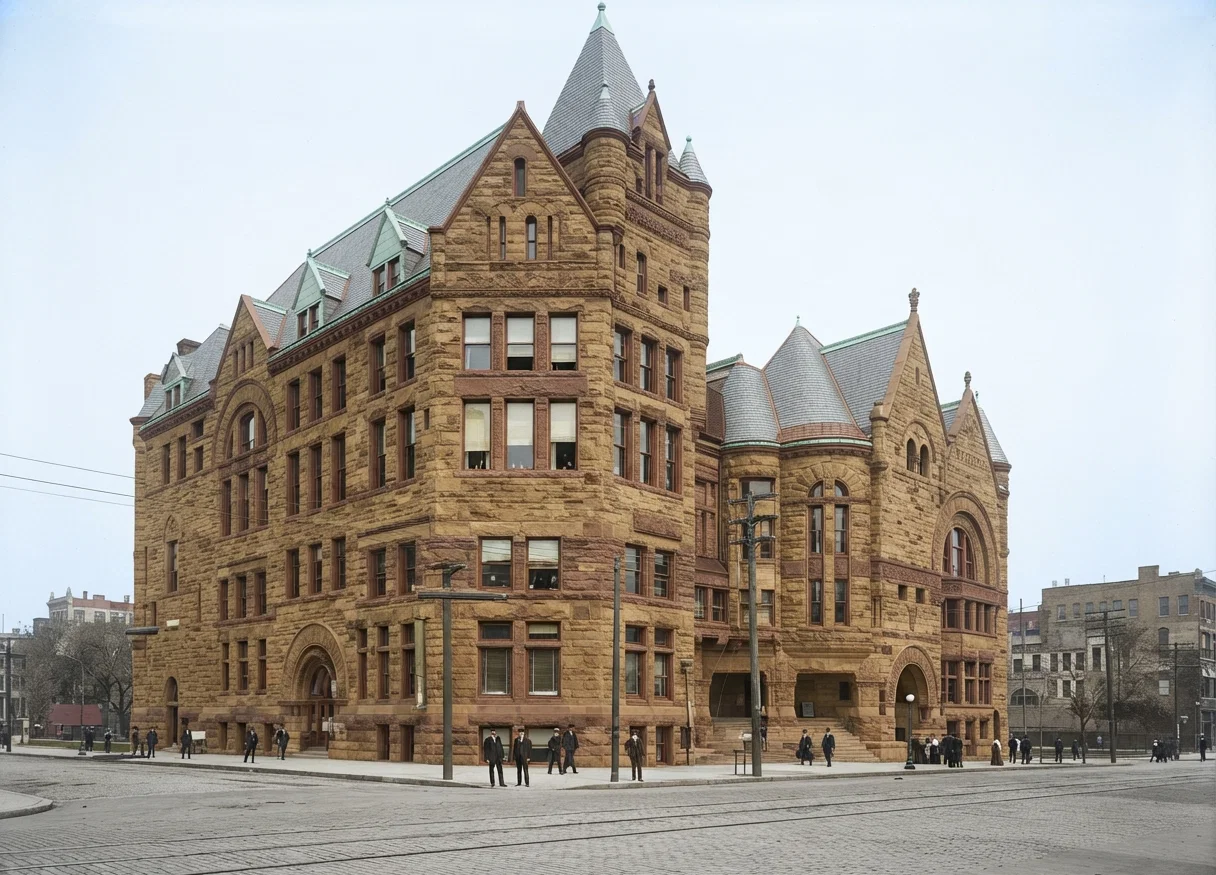
City Hall, Kansas City.
The more you try to compel a man to sleep or to rest, the farther will sleep or rest depart from him. What is rest? Is it not a state of relaxation, of comfortable relief from everything that binds, or chafes, or annoys? How much rest does a child get while he is forced to sit still for one hour? Is that rest, or is it torment? Some people punish their children in that way. And now some of the professed Christian people are asking Congress and the state legislatures to punish all the grown-up people of the nation, and the children, too, in a similar way. I protest that bodily and mental comfort and repose can not be forced upon any one.
Enforced Labor.
But we are told that “many persons who desire to rest on Sunday are forced to labor against their will.” For example, Jones signs a contract to work for Smith. He agrees to work for two dollars a day. He agrees to work on Sunday. He also agrees to work each Wednesday night. He is visited by the pastor of the church, who wants to know why he works on Sunday. Jones says that he can not help it, that he is forced to work on Sunday. Yes, Jones is forced to work on Sunday; he is forced to work on Wednesday night; he is forced to work for two dollars a day; and he is forced to work for a man by the name of Smith. How is he forced?—Why, by his contract, of course. And by the same contract Smith is forced to pay him his wages when the work is done.
But suppose that Jones did not agree to work on Sunday; but after he has worked awhile, his employer says, “I want some work done on Sunday; are you willing to do it? If not, I shall have to dismiss you and find another man.” What shall Jones do? Well, suppose Jones did not agree to work on Wednesday night, and his employer was about to dismiss him because he would not work at night. What, then, shall Jones do? Shall he petition the Legislature for a statute forbidding any one to labor on Wednesday night? And would all the Christian people of the country join him in the petition? Why not?
“But is not a weekly rest-day for the benefit of all?”—Certainly. And retiring early at night is for the benefit of all. A daily bath is for the benefit of all. “Fervent effectual prayer” is for the benefit of all. But that is not a sufficient reason for enforcing these things by law. The right of each individual to decide personal matters for himself is for the benefit of all. Therefore, with the inspired apostle, we say, “Let every man be fully persuaded in his own mind.” See Rom. 14: 4-12.
The assertion that the purpose of Sunday laws is to protect the rights of citizens is exactly the opposite of the fact. Rights are optional, while duties are imperative. To say that a person has a right to do a thing is to admit that he has an equal right not to do that thing. Now if the purpose of a Sunday law is to protect the right of a citizen to rest, then it should also protect his right not to rest in case he desires to work or to play. To compel a person to rest is to treat the matter as a duty and not as a right.
The difficulty in understanding this question arises almost wholly from the fact that few persons have a clear conception of the exact difference between “moral” and “civil,” and between “duties” and “rights.” The fact is that Sabbath observance is a civil right, while at the same time it is a moral duty. The state should treat the matter as a right, protecting each citizen in resting or in working as he may choose. In the final judgment-day, God will punish the Sabbath-breakers as He sees fit for their neglect of a moral duty, but He has not delegated this authority to any human court. “Therefore thou art inexcusable, O man, whosoever thou art that judgest: for wherein thou judgest another thou condemnest thyself; for thou that judgest doest the same things. But we are sure that the judgment of God is according to truth against them which commit such things.” Rom. 2: 1, 2. A. Delos Westcott.
On One Page of a Daily Paper.
That death is in the land is evident from the records of crime, accident, and calamity found in the public prints every day. In a paper dated May 25, the following are recorded on the first page:
One man killed and fifteen injured in a street-car collision in San Francisco.
Three killed and fifty hurt in a wreck of trolley-cars in Philadelphia.
Denver man killed in collision of automobile and electric car in Chicago. Two others injured.
Maniac stabbed a priest at Salisbury, Mo.
Three drown while fording a river, in a buggy at Brimson, Mo.
Sixteen people hurt in air-ship accident at Berkeley, Cal.
Score drowned and many missing, with five thousand people driven from their homes by rise of Trinity River, Fort Worth, Texas.
Carryall with eighteen students rolls down Mount Hamilton, near San Jose, Cal., six seriously injured, one fatally.
Guarantee of Peace.
By Editor
We have received a circular letter from the National Farmers' Association asking us to advocate a powerful navy as a guarantee of peace. We have nothing to advocate in this line. The SIGNS OF THE TIMES is not in politics in any way. It does see certain tendencies which are fulfilling prophecy, and which, carried out to the ultimate, mean the destruction of earthly kingdoms. Over and over again God has predicted in His word a great coming war of Armageddon. In the fourth and twenty-fifth chapters of Jeremiah, and the sixteenth chapter of Revelation, and the fourteenth of Zechariah and elsewhere, we are warned of that time when all the nations of the earth shall be prepared for battle. It is utterly impossible for a nation to become what is considered well prepared, without stirring up a spirit of boasting and aggressiveness on the part of the people of such a nation. When one nation feels that it is prepared for its possible foes, other nations will prepare and feel the same way.
At the present time commercialism is ruling the world. Together with the war-ships, they are building ships for commerce, and the war waged in the commercial field is as tense and earnest as the war waged with musket and gun. And when commercialism demands, as it has again and again, battle-ships will be called to defend "our commerce," and the outcome is bound to be war. It may be delayed for a while; prophecies of God's word indicate that that is the case; delayed because nations wish to be prepared to meet other nations who are prepared; but sooner or later the great crash will come and will be all the worse because of the time and money which has been expended in preparation for it.
If we were to view it from a purely worldly standpoint, our opinion would be that if America would attend to her own business at home in the development of her own resources, she would not need any such great world-power navy. The products of her lands and industries would be so needed by the other governments of earth that there would be no desire to go to war with her. That, however, is not the dominant spirit in the world to-day. When pugilists train for combat, they are never resting in the assurance that the training is for ease and labor. The nations of the earth are becoming great pugilists, and they are training for war.
Plant Trees.
By Editor
THERE has come to our table from the United States Department of Agriculture, circular No. 140 entitled “What Forestry Has Done,” by Treadwell Cleveland, Jr., an expert in this line.
It is issued under the date of Jan. 28, 1908. The one who has charge of the department is Mr. Gifford Pinchot. We wish that those who have land could read the document. It goes on to show how whole countries have been denuded of their forests, and the steps that are taken in different parts of the world to supply this need. There are millions and millions of acres on farms throuout the East and West that are of themselves utterly worthless, stony and barren. There are trees like some of the species of the blue gum, or eucalyptus, that, once well planted, will grow and which nothing can kill. In a little while these bare places could be covered, moisture would be retained, rainfall promoted, and the country blessed in every way. If each farmer or ranch owner would decide to plant a few trees at least every year, and hold to his decision, he would become a greater blessing to the country in general. And governments could not do better than to plant large forests in the barren tracts which have been denuded of timber. Trees are indeed a blessing, as God’s word has assured us.
Famine in British East Africa
Crop failure in British East Africa has resulted in severe famine, in which 40,000 natives are said to have died. The government is feeding 50,000 people until new crops come on.
Foreigners Leaving the United States
It is estimated that since the financial flurry of last October, five hundred thousand foreigners have left the United States for their former homes. The total for the week ending May 23 was upward of seventeen thousand. The steerage capacity of many steamers is constantly taxed to the limit.
Disastrous Floods in Central Russia
Despatches from St. Petersburg state that central Russia is being devastated by the most disastrous floods in the memory of man. Moscow and adjoining provinces are cut off from all communication, with light and power cut off in the city of Moscow, owing to the flooding of the electric station.
Lusitania Breaks the Speed Record
May 22, the “Lusitania” arrived at New York, having made the Atlantic passage in four days, twenty hours, and twenty-two minutes, breaking the average speed record. Her average speed was 24.83 knots. When her sister ship, the “Mauretania,” reaches a speed of 24.5 knots, the owners will be given the British mail subsidy of $750,000.
Lord Gwydyr Enters His Ninety-Ninth Year
Lord Gwydyr, who is known as “Father of the House of Lords,” has just entered upon his ninety-ninth year. Hale and hearty, with a live interest in his duties in the English Senate, he attributes his long life to “God’s blessing, no smoking, temperance in eating and drinking, and plenty of exercise.” His own life is a strong proof of the efficacy of his prescription.
Presbyterian Foreign Missions Statistics
The Board of Foreign Missions of the Presbyterian Church reports 889 missionaries in 15 countries, with 3,129 native helpers; 441 organized churches; 70,447 communicants; 83,452 pupils in Sunday-schools. They have also 115 hospitals and dispensaries; 1,145 day-schools with 36,924 pupils. Printing-presses are in operation at Shanghai, China, and Beirut, Syria, which last year printed 136,051,647 pages of religious publications in 27 languages. Their hope is to raise $6,000,000 a year.
Air-Ship Disaster at Berkeley
Sixteen men seriously injured, two of them probably fatally, is the record of the attempted flight of a huge air-ship at Berkeley, Cal., May 24. The inventor was urged, on account of the flimsy character of the air-ship, not to make the ascent; but he was determined, and the 450-foot gas-bag was inflated. With sixteen men on board, the craft ascended about two hundred feet, when it suddenly collapsed and shot to the earth. About twenty of the five thousand people who watched the ascent were injured in the panic which ensued when the air-ship fell.
An Expensive Smoke
An Expensive Smoke.—Smoking a cigaret in bed, a young man in San Francisco, May 23, fell asleep. The cigaret slipped from his lips, ignited the bedding, and the resultant fire destroyed the lodging-house where he slept, together with five other buildings, causing a total loss of $80,000. Fifteen lodgers barely escaped with their lives, and a fireman was severely burned while fighting the fire. Slave to a filthy habit, one man destroyed the property and took away the means of livelihood of many people, jeopardizing many lives. Surely it costs too much.
Our Workers in China.
By Editor
MRS. ROBERTS, who recently went to China from the Pacific Press, writes us under date of April 10, 1908, from Shanghai, as follows:
"We are quite comfortably settled in our new home. Brother Anderson and Brother Hankins were here to meet us; in fact had been here for a couple of weeks and had been looking for a suitable house for us. Brother Winslow and his wife arrived just a week before we did. We have now leased a three-story house for one year, and we can all live in it, altho we will be rather crowded. Brother Winslow and his family have the top floor of three rooms, and a small kitchen; and Dr. and Mrs. Miller, Mrs. Miller's aunt, and ourselves [Mr. and Mrs. Roberts] have the two lower floors. We each have a room on the second floor, and will have our dining-room and kitchen on the first floor, or basement, as they call it here, for it is a cement floor that is laid on the ground. There are two large rooms and a tiny kitchen on the first floor. Dr. Miller will fit up one room for his dispensary, and we will use the other together as a dining-room, but will have separate tables. The kitchen is always the darkest place in the house here, and after one puts in a stove and a small table and a sink, there is very little empty space left in which to work.
Printing-Office.
"A very good place has been found in which to start our printing-plant until we have a building of our own. It is a native house and is owned by a Chinese Christian who built it for a printing-office, but as he has not succeeded as well with his business as he had hoped to, he is only too glad to rent it to Christian people. He talked with us about our views, and as to what we believed before renting us the building.' This place is fitted up already for our machinery, and it is not far from where we live. Before finding this place we made it a subject of earnest prayer. When we found it we knew that the Lord had guided. Part of the machinery has reached us, and the rest will be here soon.
Our Workers.
"Sister Westrup and her little boy were down here taking a rest when we arrived. Dr. Selmon and his native evangelist came down to meet Professor and Mrs. Cottrell and Miss Schilberg who were in our party, and who go to the mission at Chang-sha. We greatly enjoyed hearing the workers from the interior tell of their work and its progress. The Lord is in such a marked manner bringing souls into the truth who will make efficient workers among their own people. Brother Pilquist and his family will return on the 'Minnesota' for a rest in America as they are greatly broken in health. They have been thru some severe trials and hard sickness the last year.
Drs. A. C. and Mrs. A. Selmon at the Siang Cheng Mission in Honan.
Japan.
"We stopped about ten days in Japan and had a pleasant visit with the workers there. Brother Field came down from Tokyo to Yokohama to meet us, and we spent a couple of days at his home. It is in a quiet part of the city, near the Imperial University. Brother Field is doing considerable work among the students. The sanitarium at Kobe is doing very well, and the workers there spared no pains to make it pleasant for us during our three days' stay. We visited with Brother and Sister Benson the old capital of Japan, where we spent a day in sight-seeing. Some of the largest temples in Japan are there. Here also we got our first glimpse of heathen life and worship, and we truly felt that we had never before known the awfulness of heathenism. We enjoyed meeting some of the Japanese Christians. Altho we could not talk with them, yet the expression on their faces is so different from that of their heathen brethren that one can see what a change the love of God makes in them.
"Our friends may be wondering why we did not go to Sin Yang Cheo, as we had expected to do for a short time. But when we reached Yokohama, Dr. Miller received word from Brother Anderson that the mission at that place had been sold, as it had been decided that it would be preferable to put the publishing work and the headquarters of the China mission field in Shanghai.
"Rents are very high here, and it is difficult to get a building suited to the needs of the work, and we are all looking forward to the time when there will be sufficient means to buy land on which to build a house for the printing work. Our address will be, United States Post-Office, Shanghai. We can send mail at United States rates, thru the American Post-Office, and I have been told that mail from America can be sent at the same rate."
We are thankful, indeed, for this good letter from Sister Roberts; we pray that the special blessing of God may rest upon our few workers in that great field.
In a Typical Day.
By Editor
LAST week we gave a little sketch of Brother J. D. Baker's work among the Kavirondos of Africa. We meant then to say that he was formerly one of our own boys, and his father is still engaged in work at the Pacific Press. He has given his life for the heathen, as the article from him indicated last week. This little note is from a letter which he writes to his father, giving the idea of a day's work in assisting the natives around them:
"Our typical day's work usually begins immediately after breakfast, and for an hour or an hour and a half, one and sometimes both [himself and wife] are kept busy. One man with a suppurating ulcer about the size of my hand comes to us; another, with a sore foot, the odor of which you can discern when he is coming; a boy with an ulcer on the ankle; and a baby which had its foot badly burned. Following these came two men and a woman with colds; and then a boy who came bringing four cents for medicine for his brother who is sick; and this afternoon two other men with coughs. One of them had a cough sometime ago. We treated him and he was perfectly well, but he comes pleading for 'yet.' Knowing13he is well, I mixed a quart of saline solution. He was very soon sick enough, and did not want more medicine. We only wish we were better qualified to help them. These awful ulcers, together with fevers, pneumonia, tuberculosis, diphtheria, and other troubles, tax our abilities to the utmost. To see these poor people come with sore eyes, some of them blind with cataracts, makes us wish we were able to give them their sight. Some of them, after cleansing out the sores and giving them treatment, when we tell them that we can do no more, are so disappointed."
Another interesting item in the letter is the mention that he makes of the garden that he is trying to grow there, teaching the natives also how to raise vegetables. He speaks of his corn, melons, squashes, and beans which are growing nicely, but of his tomatoes he tells us that he had planted them four times. The first lot the natives tramped out; the next the white ants ate; "the first of the week we put out another that were up nearly two inches, unfortunately the grasshoppers have taken most of these." And he hopes to get some from the fourth crop. Surely we ought to pray for those who are out in the great needy, dark fields. May God give him fruit, not simply in his garden-patch, but in the greater field which he is cultivating, the souls of the Kavirondos.
My Confidence.
By Max Hill
I WILL both lay me down in peace, and sleep,
For Thou, O Lord, Thy child wilt ever keep;
With Thee to guard me surely all is well,
In safety Thou wilt ever make me dwell;
Asleep or waking, Thou sustainest me;
Mine enemies, Thou makest them to flee;
I will not be dismayed tho thousands press;
I will not be afraid for Thou dost bless.
MAX HILL
Our Work and Workers.
FIVE were recently added to the church at Fort Scott, Kan.
BROTHER AND SISTER H. C. GILES report eight additions to the church at Bath, Maine.
BROTHER H. W. REED has been laboring at Crandon, Wis., and reports five accessions to the truth there.
"A LETTER from Brother Stebbins brings the cheering news of four additions to the church in Superior, Wis., by baptism."—The Wisconsin Reporter.
SISTER JENNIE EDWARDS, Bible worker at Chanute, Kan., has a good interest. Three of her readers have united with the church, and others are deeply stirred.
PUBLICLY reviewing a tract written against the Sabbath truth, Brother W. F. Martin, a worker at Roseburg, Wash., demonstrated its errors in so convincing a manner that six were led to the truth.
GERMAN workers at Cleveland, Ohio, Brother and Sister H. F. Graf and Brother G. P. Gaede, have been meeting with success in their labors. Six of fourteen baptized late in April were Germans, and four more were almost ready to take the step.
"ON Monday, May 11, following the close of the Lodi (Cal.) camp-meeting, thirty-one candidates were taken to the river near the town and buried with their Lord in baptism. A number of these were from the church school. Elders Luther Warren and A. Brorsen had charge of the ceremony."—Pacific Union Recorder.
Book Notices.
By Editor
"Our Misunderstood Bible; Common Errors about Bible Truths and Texts." By H. Clay Trumbull, late editor of the Sunday School Times. Price, $1.00, net. The Sunday School Times Company, Philadelphia.
The scope of this suggestive little work may be well indicated by some of its chapter headings: "Bible Words Not Always a Safe Guide;" "Principles Rather Than Rules in the Bible;" "Love in the Old Testament, Law in the New;" "The Holy Spirit's Mission to and thru Believers;" "Needless Worry As to Being Born Again;" "Bearing the Cross, Not Bearing Crosses;" "Clergymen Not the Chief Preachers;" "Mizpah a Barrier, Not a Bond;" "Love Not A Matter of Feeling." The author points out that there are words of Satan in the Bible as well as words of God. We should discriminate. Angels are shown not to be young women, and cherubim are not babes. The reader may not always agree with the author, but he will find the book a tremendous thought-sharpener and plenteous in good things.
"The Spirit of American Government." By J. Allen Smith, LL.B., Ph.D., Professor of Political Science, University of Washington. Half leather, $1.25, net. The Macmillan Co., New York and London.
This is one of the latest numbers of the Macmillan Co.'s "Citizen's Library of Economics, Politics, and Sociology." The special subject of this volume is the study of the Constitution, its origin, influence, and relation to democracy. The purpose of the author is to trace the influence of our Constitutional system upon the political conditions which exist in this country to-day. He thinks that there are features in the Constitution which are not in harmony with the present enlarged ideas as to democracy, and that it has been the practise of political writers for the most part to pass very lightly over these undemocratic features of the Constitution, leading the general reader to believe that universal suffrage, under our system of government, insures the rule of the majority.
The English government of the 18th century is outlined; the American government of the Revolutionary period, the Constitution as a reactionary document to limit the power of the majority; the significance of the amendment feature of the Constitution; the Federal judiciary, which he considers in some of its aspects as a monarchical survival, especially in its veto power; the checks and balances of the Constitution; the party system; changes in State Constitutions; municipal government; individual liberty in the Constitution modified by the economic system; the influence of democracy upon the Constitution; effect of the transition from minority to majority rule upon morality; and the democracy of the future are all fairly considered. It has also a copious index; the citation of various authorities can be easily found. Dr. Smith believes that the democracy of the future would raise government to the rank and dignity of a science; a thing which certainly is to be wished, but which one can hardly hope for in the light of present conditions. Some of the very evils which exist and which he points out in connection with the arbitrary power of the Supreme Court, and kindred evils, seem to us to be a drifting away from the basic principles of the government, rather than the application of them, and that there was more of real democracy in the early days of the Republic than is manifest at the present time. The spirit of monopoly is essentially monarchical or aristocratic. And while we have many organizations talking democracy, the trend of nearly all is to the government by the few or by the class which assumes to be the people. The publication, however, presents an excellent study of its subject, and should be read by those who wish to get a better knowledge of American institutions.
"Christian Theology in Outline." By William Adams Brown, Ph.D., D.D. 468 large octavo pages. Price, $2.50. Charles Scribner's Sons, New York.
The author of this work is Roosevelt Professor of Systematic Theology in the Union Theological Seminary, New York; and the work itself is the outgrowth of the author's experience as a teacher of theology. The book is the attempt to meet a definite need, which his experience shows exists; a brief handbook, in which the subject-matter of Christian theology should be treated from the modern point of view. The work is divided into six parts, exclusive of Introduction and Appendix. These parts are as follows: The Postulates of Christian Theology; the Christian Idea of God; the Christian View of the World; of Man and His Sin; of Salvation thru Christ; the Christian Life; and a Classified Bibliography. It is a brief theological compendium, and is probably as good in its condensed form as many more elaborate works; and it is as conservative a view of modern theology as can be found. One feels as he scans the pages of modern dogmatic theology that it lacks in both authority and life, the two things which are found preeminently in Christianity.
"Races and Immigrants in America." By John R. Commons, Professor of Political Economy, University of Wisconsin. Illustrated; price, $1.50, net. The Macmillan Company, New York and London.
Mr. Commons attempts to describe class conditions as they are in America and not as idealists would like to have them. He thinks there are castes now, and that "there is lacking but one essential to the East Indian system; namely, a religion which ascribes to God Himself the inequalities contrived by man." The thought is that democracy is passing, and mighty problems are before the republic, and Mr. Commons states these. Whether we agree with his suggested remedies or not, we may learn much of the problems in the negro, the various alien races of so many different types, the questions of labor and city life, and political conditions. Here is an array of problems at the present time which may well stagger the statesman. The book contains index and a valuable reference list.
"The Gang of Six." By Horace M. DuBose, editor of the Epworth Era. Price, 50 cents. Publishing House of the M. E. Church, South. Smith and Lamar, agents, Nashville, Tenn.
Mr. DuBose in this interesting little work has pictured a typical gang of youngsters, just forming in one of our large cities. A young lawyer, with a heart burdened for boys, becomes acquainted with them, enters into their hearts and plans, joins the "gang," and thus working, brings them to Christ and starts a decided reform movement for boys. The little book is full of hints, helps, and inspirations.
From Chas. H. Kerr & Co., of Chicago, we have received the following: "Evolution, Social and Organic," by Arthur M. Lewis, cloth, 50 cents; "Human, All Too Human," by Friedrich Nietzsche, cloth, 50 cents; "The Common Sense of Socialism," by John Spargo, cloth, $1.00, paper, 35 cents; "Stories of the Struggle," by Morris Winchevsky, cloth, 50 cents; "Karl Marx—Biographical Memoirs," by Wilhelm Liebknecht, translated by Ernest Untermann.
Tremendously prolific in literature are the Socialists; some of it political, presented properly within political bounds; most of it based on the doctrine of evolution, and not a little of it positively irreligious and infidel. The first of the above works is along the line of pure human and creature evolution, with God left out of the question. The second of these is in perfect harmony with its title, "Human, All Too Human." From beginning to end it is human speculation, a cry of an unsatisfied human who could have found a solution of his perplexities in the revelation of God. The third, however, is a series of letters to an inquirer, in which the author has endeavored to clearly and simply define the principles and objects of political Socialism. In this small volume one can get a good idea of what political Socialism teaches. The fourth is composed of sketches and stories bearing upon the Social struggle. The last is a sketch of the life and personality of the great Jewish-German Socialist, Marx, written by one who worshiped at his shrine.
The Sower, the Seed, the Results.
THE New York Bible Society is working especially in New York City, and among the sailors and immigrants. Among the last-named class, 17,000 volumes of scripture were distributed last year. Here is an instance of seed-sowing years ago, and its fruit, showing the power of the word:
"A Swede was recently coming into our country thru Ellis Island. As he landed, a worker of the New York Bible Society stepped up to him offering him a Swedish New Testament. The Swede stopped, apparently startled, and stared at the worker, saying, 'Weren't you here twenty-six years ago? I think you are the same man,—yes, you are the same man.' The worker told him he had been engaged for twenty-eight years distributing the Scriptures to the immigrants and giving to each one a book in his mother-tongue. 'Well,' said the Swede, 'twenty-six years ago I landed here a stranger, and you gave me a New Testament in the Swedish language, just as you offered me one now. I read it, and thru reading it I became a Christian. After a few years I made up my mind to become a preacher, and for twenty years I have been preaching the Gospel in Colorado. It all began with your giving me a New Testament.' 'The sower soweth the word,' Mark 4:14; this seed fell in good ground and is still bringing forth fruit. This is only one of many interesting results of the work that is being done every day in the harbor and city of New York."
The treasurer is James H. Schmelzel, and the secretary is Rev. G. W. Carter, 66 Bible House, New York City.