Your ShelfYour Projects

Review and Herald, Vol. 90, No. 8.

Almost Home

Review and Herald

Feb 20, 1913

Review and Herald Publishing Association · Takoma Park Station, Washington, D. C. · Feb 20, 1913

Almost Home

ARTHUR W. SPAULDING
I’m almost home at last,     Almost home, Driving before the blast,     The sheeted foam, The wrack and roar of waves Eager to open graves. Yea, but each comber laves     The shores of home!
Almost home at last,     Almost home! Dark is the weltering past I chose to roam: Wrecks of the gifts of life, Prizes—the scars of strife. Yea, but the winds are rife     With sounds of home!
For I’m almost home at last,     Almost home! The signs are clustering fast     Amid the gloom. I see the twinkling lights, The star-illumined heights; I sense the dear delights     Of welcome home!
Home, blest home, Where night and storm and scar Fade in the stillness of a life afar!     Home, dear home, I’m almost home!
Sanitarium, Cal.

“THE END JUSTIFIES THE MEANS”

Rome’s Policy Proved By Court Records!

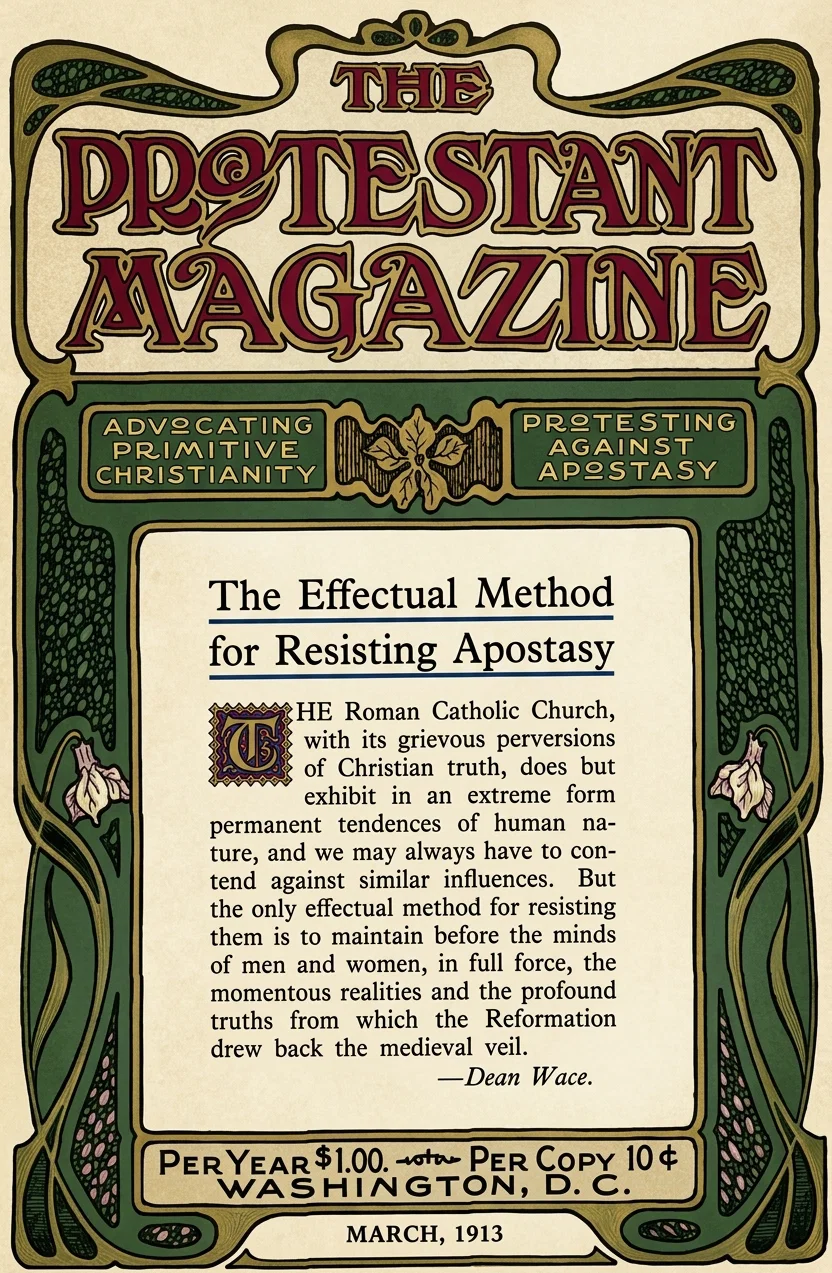
In the March, April, May, and succeeding numbers will appear the startling court record concerning “A Convent Tragedy,” also other records of Rome’s policy of KIDNAPING CHILDREN, from the times of the Waldenses (1100 A. D.), before the word “Protestant” was known, until now.

WHERE ARE THE PROTESTANTS?

Where are the Protestants in America? The very name “Protestant” itself was repudiated by the so-called “Protestant” Federal Council of Churches in Chicago, Ill., Dec. 5, 1912, on the plea that it is “a word that is NOT A UNITING BUT A DIVIDING WORD,—a word that recalls a most unhappy and trying experience.” One of the delegates argued thus: “By using this word you make it more difficult for many of your Christian brethren to work with you.” This action was taken to express the “earnest hope” for the “FELLOWSHIP OF CATHOLIC UNITY.” “Then,” says an eye-witness, “the report was promptly and unanimously adopted, and with applause.”

Show Your Protestantism By

Sending the PROTESTANT MAGAZINE to Your Friends

BE A SUBSCRIBER. You can earn your own subscription by sending us two yearly subscriptions accompanied by $2.00—three for $2.00.
TO TEN FRIENDS. You can send $3.00 for 10 six months’ (or 5 yearly) subscriptions, in behalf of your friends. These will be sent to as many different names (your own included) as desired, or all to one address. Hundreds send 5, 10, and 20 subscriptions, others as many as 300, in a single letter.
BE OUR AGENT. You can become our agent for your locality, and purchase from 5 to 1,000 copies every month at the wholesale rates: 5 to 40 copies ordered at one time, cash with order, 5 cents a copy; 50 or more copies, 4 cents a copy.
Only a very few more subscriptions can be started with the January number.

ORDER THROUGH OUR NEAREST AGENCY

  • (If you do not know the address of our Agency, ask the “Protestant Magazine,” Washington, D. C.)*
PRICES, POST-PAID

Yearly subscription . . . . . . $1.00 Six months . . . . . . .50 (Subscriptions for less than six months not accepted) Three years (or 3 subs. 1 year) . . . . 2.00 Five years (or 5 subs. 1 year) . . . . 3.00 Five copies, one year, to one or more addresses . . . . 3.00
NO EXTRA CHARGE ON FOREIGN SUBSCRIPTIONS

“Tea and Coffee” and “Deep Breathing” Number

$1.00 a Year
10 Cents a Copy

MARCH FEATURES

What to Do First Consumption a Curable Disease The Hygiene of Deep Breathing How to Feed the Sick Prostituted Periodicals Education and Health Saloon Versus Safe Travel How to Make Good Soups
Chronic Rheumatism Your Children’s Teeth Archery for Health The Farm Baby: Remedies—    Contagious Diseases Are Tea and Coffee Harmful? Help the Man Lower Down Chronic Appendicitis
Try selling this “Tea and Coffee” and “Deep Breathing” number in your neighborhood. Our agents make from $2.00 to 5.00 a day.
Earn your own subscription by sending us two yearly subscriptions at $1.00 each.

ORDER THROUGH OUR NEAREST AGENCY

(If you do not know the address of our Agency, ask “Life and Health,” Washington, D. C.)
NATURAL BRIDGE, VIRGINIA

Resisting Temptation

MRS. E. G. WHITE
The people of God have allowed many things to come in between their souls and God, and their thoughts of God have been far below what it is their privilege to have. They are not on the high vantage-ground where God would have them, and they should realize this keenly, that they may repent and turn to God with all the heart. It is sad to think that though they have professed the truth for these many years, many have failed to understand how to take God at his word, that they may be strengthened in the time of temptation.
Temptation will come upon all the children of God. James writes: “My brethren, count it all joy when ye fall into divers temptations; knowing this, that the trying of your faith worketh patience. But let patience have her perfect work, that ye may be perfect and entire, wanting nothing.”
The Word does not say that we are to count it all joy when we fall under temptation, but when we fall into temptation. It is not necessary to fall under temptation, for temptation comes upon us for the trying of our faith. And the trying of our faith worketh patience, not fretfulness and murmuring. If we put our trust in Jesus, he will keep us at all times, and will be our strength and shield. We are to learn valuable lessons from our trials. Paul says: “We glory in tribulations also: knowing that tribulation worketh patience; and patience, experience; and experience, hope: and hope maketh not ashamed; because the love of God is shed abroad in our hearts by the Holy Ghost which is given unto us.”
Many seem to think that it is impossible not to fall under temptation, that they have no power to overcome; and they sin against God with their lips, talking discouragement and doubt, instead of faith and courage. Christ was tempted in all points like as we are, yet without sin. He said, “The prince of this world cometh, and hath nothing in me.” What does this mean?—It means that the prince of evil could find no vantage-ground in Christ for his temptation; and so it may be with us. “For we have not a high priest which can not be touched with the feeling of our infirmities; but was in all points tempted like as we are, yet without sin. Let us therefore come boldly unto the throne of grace, that we may obtain mercy, and find grace to help in time of need.”
As a people we are looking for the coming of the Lord in the clouds of heaven, and how carefully should we examine our hearts, that we may know whether or not we are in the faith. There seems to be a mist before the eyes of many, for they fail to discern spiritual things, and do not recognize the workings of Satan to entrap their souls. Christians are not to be the slaves of passion; they are to be controlled by the Spirit of God. But many become the sport of the enemy, because when temptation comes they do not rest in Jesus, but worry themselves out of his arms, and in perplexity lose all their faith and courage.
They do not remember that Jesus has helped them out of difficulties in the past, that his grace is sufficient for the daily trials, and that he can help in the present trouble. We make failures in our little, daily difficulties, and allow them to irritate and vex us; we fall under them, and so make stumbling-blocks for ourselves and others. But blessings of the greatest importance are to result from the patient endurance of these daily vexations, for we are to gain strength to bear greater difficulties. Satan will press upon us the most severe temptations, and we must learn to come to God in any and every emergency, as a child would come to its parents.
We profess to be Bible Christians, and we are not left in the dark to take step after step in uncertainty. We are to know where we are going. We can not be in darkness if we are following Christ as our leader; for he says, “He that followeth me shall not walk in darkness, but shall have the light of life.” When the way seems beset with difficulty and clouded with darkness, we must believe that there is light ahead, and not turn to the right or left, but press forward, notwithstanding all our trials and temptations.
Take courage, tempted soul, for the Lord knoweth them that are his. “There hath no temptation taken you but such as is common to man: but God is faithful, who will not suffer you to be tempted above that ye are able; but will with the temptation also make a way to escape, that ye may be able to bear it.” Keep talking faith, and the victory is yours; for “this is the victory that overcometh the world, even our faith.” Jesus has said we should not walk in darkness, but should have the light of life, and we believe it. We are to keep talking of the light, to keep praying and believing, and the light will break upon us when our faith has been tried and patience has had its perfect work.
We are not to be like the man who said, “I have prayed and prayed, but I do not receive.” A companion said to him, “Let us pray together, then, and claim the promise of God.” So they bowed in prayer; but when they rose from their knees, the man said, “I don’t feel any different, and I didn’t expect I should.” This is the way that many present themselves before God; theywould be surprised if God should answer their prayers. They do not expect the Lord to answer their prayers, nor think that the Lord will hear them, and their petitions are in vain; for they go away as they came.

WORTHIE HARRIS HOLDEN

From the Exile to the Throne

WORTHIE HARRIS HOLDEN

Down the ladder all resplendent With the radiance from above Come the feet of shining angels On their ministry of love,— Golden pass from earth to heaven Through One human and divine That allures me to look upward And makes heaven-mercy mine.
Earth gave but a stony pillow To the wanderer lone and sad, But my Father sends the vision, And my waking heart is glad. Though my sin has reaped its sorrow, I may here a Bethel raise To Jehovah, who preserved me, And will keep me all my days.
'Tis unbounded love that reaches From the exile to the throne; Naught else ever could have drawn me, Since I strove for self alone. Now my being thrills to praise him Who redeems a wretch like me, And I yearn for that glad morning When his beauty I shall see.

Tithes Paid by the Ancients

WILLIAM COVERT
ABOUT two thousand years before Christ was born, Abraham paid tithes to Melchizedek, an honored priest of the Lord. An account of this transaction is recorded in the fourteenth chapter of Genesis, and one who studies the narrative will conclude that tithe paying was a custom well understood and followed before this particular event occurred. The tithe which Abraham paid to Melchizedek was a tenth of the spoils that Abraham had recovered from some marauders who had invaded the country along the plains of Jordan, about Sodom and Gomorrah, where Lot, the nephew of Abraham, dwelt.
This victory gained over the invaders of homes and disturbers of peace was of such importance to the cause of righteousness that ‘Melchizedek king of Salem brought forth bread and wine: and he was priest of the most high God. And he blessed him, and said, Blessed be Abraham of the most high God, possessor of heaven and earth: and blessed be the most high God, which hath delivered thine enemies into thy hand,’ Gen. 14: 18-20.
When Melchizedek, who had come to lead in the religious services of the occasion, had completed his work, Abraham gave him a tithe of all the goods that had been recovered from the enemy.
Then the king of Sodom, who was present, said that Abraham was by right entitled to all the goods he had returned; but Abraham, in answering the king, said, ‘I have lift up mine hand unto the Lord, the most high God, the possessor of heaven and earth, that I will not take from a thread even to a shoe-latchet, and that I will not take anything that is thine, lest thou shouldst say, I have made Abram rich.’ Gen. 14: 21-23.
Both Melchizedek and Abraham spoke of God as the owner of all that is in heaven and earth. Melchizedek spoke of it in his blessing upon Abraham, and Abraham reminded the king of Sodom of it when he paid the tithes to Melchizedek.
Abraham was handling the goods with conscience toward God. Since they had come into his possession, he wished to give them to the proper owners, so he paid the Lord his tithe. He knew this was the Lord’s share in all property. And as this property had fallen into Abraham’s hands untithed, he tithed it, and then returned the nine tenths to the original claimants.¹ And what they got back was in reality all that belonged to them, so Abraham had not taken a thread from them, for the tithe which he gave to Melchizedek was only the Lord’s part.

A Lesson for Us

The way that Abraham handled the recovered goods has a beautiful lesson for those who study it. The payment of the tithe to the Lord was a rebuke to the king of Sodom and his subjects for not having tithed their property themselves. This incident of ancient history shows that patriarchs and priests thought that people and kings should pay a tithe of their income to the Lord. And when they were made responsible for handling such estates, they tithed them. If their teachings and practises were right then, they are right now. Then should not all who get a support from the bounties of heaven pay a tithe to the Lord for the support of his cause?

The Antiquity of Tithing

The incidents recorded in this transaction lead to the conclusion that tithing was well understood and in common usage among God’s people even before the days of Abraham and Lot.
Here was Melchizedek, the priest of the most high God, who was king of Salem, and greater than Abraham, acting for the Lord, blessing the patriarch, and receiving the tithe of all the people at the hands of Abraham. Not a word is said at that time about the institution of the tithing system, but it is treated as a matter well understood and as a custom of long standing. Abraham was a man sent of the Lord to look after the interest of divine things in that country, and Melchizedek was God’s kingly priest, who came to assist and bless Abraham in his responsible work. And without doubt they handled the matter of tithing after the ancient custom of their people.
The genealogy of Melchizedek seems to have been purposely omitted from the Scripture that he might be as nearly as possible a type of Christ and Christ’s priesthood work, yet his character and work are well defined in the Sacred Writings. This great man, Melchizedek, was contemporary with Shem (some believe he was Shem), at least for a time, and Shem was contemporary with ten or more generations of his own offspring, including Abraham and Isaac; and with Noah, his father, four hundred fifty years; with Lamech, his grandfather, ninety-five years; and with his great-grandfather Methuselah ninety-eight years. See the genealogy in Gen. 5: 25-32 and 11: 10-32 and 12: 4, with Acts 7: 2-4.
These facts of contemporary association show of whom Abraham and Melchizedek had a chance to learn of God’s statutes and judgments. God said Abraham obeyed his voice and kept his commandments, his statutes, and his laws. Gen. 26: 5. This Melchizedek is like Christ in that he is both priest and king. His beginning and end, like Christ’s, are not known. Like Christ, Melchizedek is king of righteousness and also king of peace. According to Robert Young the meaning of the name is ‘My king is righteous.’
The conduct of Abraham and Melchizedek plainly shows that tithing was a custom practised by God’s people in very ancient times, probably from the days of Adam. Judging from the way the subject is treated by men of ancient times, it is reasonable to conclude that the teachings regarding it were handed down from Christ through Adam for mankind; and if so, then tithing has been in vogue ever since gospel work began, and is binding upon all men while gospel work is needed.

Deductions by Paul and Others

Referring to the fact that Abraham paid tithes to Melchizedek, Paul shows that tithe paying belongs with the priesthood of Christ because Christ is a priest after the order of Melchizedek. He says, ‘But he [Melchizedek] whose descent is not counted from them [Levitical brethren] received tithes of Abraham, and blessed him that had the promises. And without all contradiction the less is blessed of the better. And here men that die receive tithes; but there he receiveth them, of whom it is witnessed that he [Christ] liveth.’ Heb. 7: 6-8. The tithes were paid to Christ because the priest who received them stood as Christ’s representative, being in the same priestly order (Ps. 110: 4; Heb. 7: 21-28) as that to which Christ belongs.
Paul argues that Christians are Abraham’s seed and heirs according to the promise which God made to Abraham (see Rom. 9: 8; Gal. 3: 26-29), and Christ says that the children of Abraham will do the works of Abraham. John 8: 39. Since the children of Abraham (Christians) will do the works of Abraham, they will be faithful in tithe paying as Abraham was faithful, and they will pay it where it belongs, as Abraham did. And when they do this faithfully, the cause of God will not be crippled for want of funds.

The Advent of the Spirit

The Holy Spirit—No. 6.

The Advent of the Spirit

G. B. THOMPSON
“And I will pray the Father, and he shall give you another Comforter, that he may abide with you forever.” John 14: 16.
Will “give you another Comforter.” Another implies that they had with them a comforter, or helper. He was now to leave them; but “another” would take his place in their midst, that they might not be left comfortless.
And more than this is conveyed to us by the words “another comforter.” The usual meaning of such language would seem to carry the idea that the other one who was to come was not simply the influence of himself, but another person who would come and take his seat in the church with his followers till the end of church history. Another would imply that there were two. I am leaving you, but another is coming who will take my place. This thought is further emphasized in the words, “I will not leave you orphans: I will come to you.” John 14: 18, margin. An orphan is one whohas been bereaved of a parent. Jesus had been a helper, a protector, a parent, so to speak, to them. Now he was going away. But he said, I will not leave you bereaved, with none to care for you, but will pray the Father and he will send another Helper, who will take my place, and be the personal companion and counselor of each and all till the end.
Again he says, “Nevertheless I tell you the truth; It is expedient for you that I go away: for if I go not away, the Comforter will not come unto you; but if I depart, I will send him unto you.” John 16: 7. “If I depart, I will send him.” Jesus has taken his departure, and just as surely as the one Comforter ascended, shall the other Comforter descended. Just as surely as the one Comforter is with the Father on his throne, the other Comforter is with the church on earth.
This promise to send another Comforter was fulfilled on the day of Pentecost, when with one accord the disciples were all together in one place. “And when the day of Pentecost was fully come, they were all with one accord in one place. And suddenly there came a sound from heaven as of a rushing mighty wind, and it filled all the house where they were sitting. And there appeared unto them cloven tongues like as of fire, and it sat upon each of them. And they were all filled with the Holy Ghost, and began to speak with other tongues, as the Spirit gave them utterance.” Acts 2: 1-4.
The coming of the promised Comforter was a glorious hour for the church. “As the manger of Bethlehem was the cradle of the Son of God, so was the upper room the cradle of the Spirit of God; as the advent of ‘the Holy Child’ was a testimony that God had ‘visited and redeemed his people,’ so was the coming of the Holy Ghost. The fact that the Comforter is here is proof that the Advocate is there in the presence of the Father. Boldly Peter and the other apostles now confront the rulers with their testimony: ‘Whom ye slew and hanged on a tree. Him hath God exalted with his right hand to be a Prince and a Saviour, for to give repentance to Israel, and forgiveness of sins. And we are his witnesses of these things; and so is also the Holy Ghost, whom God hath given to them that obey him.’ As the sound of the golden bells upon the high priest’s garments within the holiest gave evidence that he was alive, so the sound of the Holy Ghost, proceeding from heaven and heard in that upper chamber, was an incontestable witness that the great High Priest whom they had just seen passing through the cloud curtain, entering within the veil, was still living for them in the presence of the Father.”—“Ministry of the Spirit,” pages 39, 40.
Peter, in explanation of the marvelous manifestation of the Holy Spirit seen at Pentecost, which was not comprehended by the people, said: “This Jesus hath God raised up, whereof we all are witnesses. Therefore being by the right hand of God exalted, and having received of the Father the promise of the Holy Ghost, he hath shed forth this, which ye now see and hear.” Acts 2: 32, 33. To this Dr. A. T. Pierson adds the following comment:—
“This language, which occurs only here, is too marked to pass unnoticed. The Holy Spirit was God’s ascension gift to Christ, and his ascension gift to his church. Hence Christ had said, ‘And, behold, I send the promise of my Father upon you.’ This was the promised gift of the Father to the Son, and the Son’s promised gift to his believing people. How easy now to reconcile the apparent contradiction of Christ’s earlier and later words: ‘I will pray the Father, and he shall give you another Paraclete;’ and then, afterward: ‘If I depart, I will send him unto you.’ The Spirit was the Father’s answer to the prayer of his Son; and so the gift was transferred by him to the mystical body of which he is the head.”
Notice the expression, “It sat upon each of them.” When Christ had “purged our sins,” he “sat down on the right hand of the Majesty on high.” This indicates permanence of position and condition. In like manner the other Comforter, the Holy Spirit, took his place in the church. It became henceforth his abiding place, to be his seat, his holy see, so to speak, over which he would preside as the vicar of the Son of God.
The coming of the Holy Spirit means much to the church. Notice the following from the spirit of prophecy:—
“The Holy Spirit was the highest of all gifts that he could solicit from his Father for the exaltation of his people. The Spirit was to be given as a regenerating agent, and without this the sacrifice of Christ would have been of no avail. The power of evil had been strengthening for centuries, and the submission of men to this satanic captivity was amazing. Sin could be resisted and overcome only through the mighty agency of the third person of the Godhead, who would come with no modified energy, but in the fulness of divine power. It is the Spirit that makes effectual what has been wrought out by the world’s Redeemer.”—“Desire of Ages,” page 671.
In harmony with the above, the following clear exposition from the pen of another will be read with profit:—
“Jesus Christ is the revelation that our sins are forgiven, that God has taken them on himself; his death on the cross is the evidence that all their consequences have been borne. The Holy Spirit convinces us of sin, and makes us feel the need of forgiveness; and convinces us of righteousness, and makes us trust the forgiveness through Christ. Of what benefit would it have been to man that a sacrifice had been offered to take away sin, if he had not felt the need of such an offering, or if, feeling the need, he had not been able to trust it? What good would it have done to man that the Holy Spirit had convicted him of sin, if he had not known also of the forgiveness of sins, and the means by which he might secure that forgiveness? ‘In the Christian life Jesus Christ is its rule, the Holy Spirit its power. What would be the benefit of a rule that we had no power of following, or of a power that we did not know how to direct? The example of Jesus Christ is in all respects so perfect that when it is set before us we can but feel how hopeless it is for us to try to imitate it. But the Holy Spirit is promised to those who faithfully seek to follow that example, to teach them how to apply it to their own position, and to give them strength to carry it out in their lives. On the other hand, the Holy Spirit alone, separated from the revelation of life, which has come through Jesus Christ, would impel men to a vague striving after a holiness for the attainment of which they would have no guide. The case would never really occur; but some men have fancied themselves to be so guided by the Holy Spirit that they have no need of the Word to direct them. They have become a law unto themselves, with the result of losing all holiness of life.”

Power of the Tongue

WILBUR G. MC KEEN
The greatest victory that any person can achieve is spoken of in Prov. 16:32: “He that is slow to anger is better than the mighty; and he that ruleth his spirit than he that taketh a city.”
We can not become mighty by taking a city, but by the help of the Lord we may be better in the sight of God than the one who accomplishes such an undertaking. God has said, “Seest thou a man that is hasty in his words? there is more hope of a fool than of him.” Prov. 29:20. We always consider the fools hopeless. How then must God look upon us when we are hasty in our speech? I find these words in “Testimonies for the Church:” “We can have the salvation of God in our families, but we must believe for it, live for it, and have a continual, abiding faith and trust in God. We must subdue a hasty temper, and control our words; and in this we shall gain great victories. Unless we control our words and temper, we are slaves to Satan. We are in subjection to him. He leads us captive. All jangling, and unpleasant, impatient, fretful words are an offering presented to his satanic majesty. And it is a costly offering, more costly than any sacrifice we can make for God; for it destroys the peace and happiness of whole families, destroys health, and is eventually the cause of forfeiting an eternal life of happiness.”—Vol. I, page 310.
We are admonished by the Word to “cease from anger, and forsake wrath: fret not thyself in any wise to do evil.” Ps. 37:8. The American Revised Version has it: “Fret not thyself, it tendeth only to evil-doing.” Whether we control our tongue or not is a test of our religion; for we read, “If any among you seem to be religious, and brideth not his tongue, but deceiveth his own heart, this man’s religion is vain.” James 1:26. Such a one is self-deceived. Itis a solemn thought that we may think ourselves on the right track, and at last, when it is too late, find that we have been deceived.
David said: “I will take heed to my ways, that I sin not with my tongue: I will keep my mouth with a bridle.” Ps. 39:1. That is a resolution we should all make, relying on the strength of God to enable us to keep it. This is a question of the utmost importance, for Christ says: “But I say unto you, That every idle word that men shall speak, they shall give account thereof in the day of judgment. For by thy words thou shalt be justified, and by thy words thou shalt be condemned.” Matt. 12:36, 37.
It is remarkable that our divine Master, in telling us of the coming judgment, makes the final destiny of all men to depend upon whether in this world they have exercised or have not exercised the grace of kindness. We are not done with life as we live it. We shall meet it all again, not only the great things we do, but the little things. Even our lightest words take their place among the fixed things of life, and will be recalled in the judgment.
“Jesus said, ‘Every idle word that men shall speak, they shall give account thereof in the day of judgment.’ He does not say every wrong or evil word, but every useless, purposeless, or frivolous word. The meaning is that the smallest things in life, both evil and good, will be taken account of in the judgment.”—“The Beauty of Kindness,” pages 9, 10.
“For in many things we offend all. If any man offend not in word, the same is a perfect man, and able also to bridle the whole body. . . . The tongue is a fire, a world of iniquity: so is the tongue among our members, that it defileth the whole body, and setteth on fire the course of nature; and it is set on fire of hell.” James 3:2-6.
What shall we do with this unruly member? No man can tame it. In Col. 1:9-11, we have the promise that we shall be “strengthened with all might, according to his [Christ’s] glorious power.” He has overcome every sin for us; so if we will accept this proffered power, we may have the victory over every sin, including this one of an unruly tongue that pours forth evil or idle words. Let us remember that “a soft answer turneth away wrath: but grievous words stir up anger. The tongue of the wise useth knowledge aright: but the mouth of fools poureth out foolishness.” Prov. 15:1, 2.
The Christian should have an object in view in his conversation. “Let no corrupt communication proceed out of your mouth, but that which is good to the use of edifying, that it may minister grace unto the hearers. And grieve not the Holy Spirit of God, whereby ye are sealed unto the day of redemption.” Eph. 4:29, 30. “Let your speech be always with grace, seasoned with salt, that ye may know how ye ought to answer every man.” Col. 4:6.
Certain kinds of speech should never be indulged in by the followers of Christ. “But fornication, and all uncleanness, or covetousness, let it not be once named among you, as becometh saints; neither filthiness, nor foolish talking, nor jesting, which are not convenient: but rather giving of thanks.” Eph. 5:3, 4.
“Those who profess to believe the third angel’s message often wound the cause of God by lightness, joking, and trifling. I was shown that this evil was all through our ranks. There should be a humbling before the Lord; the Israel of God should rend the heart, and not the garment. Childlike simplicity is rarely seen; the approbation of man is more thought of than the displeasure of God.”—“Testimonies for the Church,” Vol. I, page 133.
Melrose, Mass.

PHILIP GIDDINGS

Morsels

PHILIP GIDDINGS

“Mozart says in his letters that whenever he saw a grand mountain or a wonderful piece of scenery, it said to him, ‘Turn me into music, play me on the organ.’ So is every performer on the different instruments in the varied departments of life’s orchestra, who is full of his subject and attuned to it. Tone replies to every note, music is transposed from musing, and he turns every text into sermonic texture.
Some people want education as children want toys,—to play with; others like sharp tools to work with.
Notion, or even emotion without motion, does not carry. Sentiment is good when there is sense to it. Feelings for others to be felt by them must be handled. “Depart in peace, be ye warmed and filled”—with nothing—is the platitude of an empty plate, a crusty piety not worth the pity of a pie crust.
“Withhold not good from them to whom it is due, when it is in the power of thine hand to do it. Say not unto thy neighbor, Go, and come again, and tomorrow I will give; when thou hast it by thee.” Prov. 3:27, 28.
If all rich men would connect thoughts on coffer with coffin (and coffin was the earlier form of coffer), remembering that “we brought nothing into this world, and it is certain we can carry nothing out” (1 Tim. 6:7), they would see the wisdom for that better trade where “godliness with contentment is great gain”—which kind we can carry out.
There is a fixed life-and-death policy in which an undertaking relates to undertaker. As you bury your soul in coffer, so you will be in your coffin. How you live on earth decides how you leave it.
The electrical genius and wizard, Thomas Alva Edison, has invented many wonders in his line, but his phonomotor, or vocal engine, which will saw wood with the power exerted when one speaks, strikes us as an invention with an acted moral that speaks louder than words.
You are worth what your work says you are worth. “How you do” is the answer to “Who are you?” The how proves the who. An Israelite indeed is an Israelite indeed. Abraham’s children do deeds—of Abraham. The manner proves the man. The superior race are those in superior running. To be great, one must do greatly, for the verb to be is only the copula to join the subject to the real predicate; so see to it that thou be doing. High-school boys should be high schoolboys.
“And the children of Joseph spake unto Joshua, saying, Why hast thou given me but one lot and one portion to inherit, seeing I am a great people . . . ? And Joshua answered them, If thou be a great people, then get thee up to the wood country, and cut down for thyself there in the land of the Perizzites and of the giants, if mount Ephraim be too narrow for thee. And the children of Joseph said, The hill is not enough for us: and all the Canaanites that dwell in the land of the valley have chariots of iron, both they who are of Beth-shean and her towns, and they who are of the valley of Jezreel. And Joshua spake unto the house of Joseph, even to Ephraim and to Manasseh, saying, Thou art a great people, and hast great power: thou shalt not have one lot only: but the mountain shall be thine; for it is a wood, and thou shalt cut it down: and the outgoings of it shall be thine: for thou shalt drive out the Canaanites, though they have iron chariots, and though they be strong.” Joshua 17:14-18.
What the children of Israel need to prove their greatness is not simply a mouthophone, but a phonomotor. Vocal energy without a vocal engine goes on an errantry instead of an errand. Powder without shot may fire off, but it shoots nothing. Don’t try to hatch a chicken without an egg. The incubator may be ever so perfect, and the temperature ever so exact, but Fahrenheit alone never produces feather. Give matter to the manner. Direct your thoughts and words in channels of usefulness. It is not the fussing, but the fusing; not so much “to-do” as to do.
To some education is only headication that puffeth up,—a head knowledge of mere folio as a tree of mere foliage. But true education is a “tree of knowledge” whose branches bear fruit. It is a “tree of life”—a life-tree rooted deeper than head-soil, into heart-soil; a tree of righteousness bearing much fruit by which God is glorified.
True education edifies. It builds, with the combined labor of head, heart, and hand, an edifice for eternity.
It is good to be spiritual, but with a spiritual understanding.
Motive qualifies motion. The upright on earth reach right up into heaven.
Look and live, but live where you look, lest you be among those who “feared the Lord, and served their own gods.” 2 Kings 17:33.
Latent energy, like hidden talent, needs the friction of application to ignite it. Scratch the match.
The time to be is the golden medium now. Will be has not yet come; was is passed. Now is the accepted time. “Now is the day of salvation.”
Continue reading: The Spirit of Christ