Your ShelfYour Projects

Review and Herald, Vol. 90, No. 9.

The Power of Little Things

Review and Herald

Feb 27, 1913

Review and Herald Publishing Association · Takoma Park Station, Washington, D. C. · Feb 27, 1913

The Power of Little Things

CHARLES MACKAY
A traveler on a dusty road Strewed acorns on the lea; And one took root and sprouted up, And grew into a tree. Love sought its shade at evening-time, To breathe its early vows; And Age was pleased, in heights of noon, To bask beneath its boughs. The dormouse loved its dangling twigs, The birds sweet music bore: It stood a glory in its place, A blessing evermore.
A little spring had lost its way Amid the grass and fern; A passing stranger scooped a well Where weary men might turn. He walled it in, and hung with care A ladle on its brink; He thought not of the deed he did, But judged that Toil might drink. He passed again; and lo! the well, By summer never dried, Had cooled ten thousand parched tongues, And saved a life beside.
A nameless man, amid the crowd That thronged the daily mart, Let fall a word of hope and love, Unstudied, from the heart. A whisper on the tumult thrown, A transitory breath, It raised a brother from the dust, It saved a soul from death. O germ! O fount! O word of love! O thought at random cast! Ye were but little at the first, But mighty at the last.
— The Examiner.

A MESSAGE OF HOPE TO CONSUMPTIVES

Send $1.00 FOR 20 COPIES

Of This “Tea and Coffee,” “Tuberculosis,” and “Deep Breathing” Number
Sell only 10 copies to get your money back. Invest your profit—$1.00—in another 20 copies. Give the other 10 copies away if you want to.
Better still, send $1.00 for 20 copies, sell them for $2.00, and invest the $2.00 received in 50 COPIES MORE.

A MESSAGE OF HOPE TO CONSUMPTIVES

The article “Consumption is a Curable Disease,” by Dr. D. H. Kress, is well worth the price of this number. Millions of victims of the “Great White Plague” are anxiously waiting for this message of hope.

ARE TEA AND COFFEE HARMFUL?

The article “What Are the Effects of Tea and Coffee?” is a symposium showing what prominent medical men think of these beverages. Show this number to the tea “topers” and victims of the “coffee habit” in your neighborhood.

DOES DRUNKENNESS AFFECT POSTERITY?

Our editor’s stirring reply to the recent article in the American Magazine, attempting to prove that drunkenness does not affect posterity, should be read by every temperance worker.

FOUR ARTICLES AGAINST ALCOHOL

Read what Col. L. M. Maus, chief surgeon of the Eastern Division of the United States Army, says in this number on the effect of alcohol upon our Army boys. Also, in another article note what Dr. Woodward, Health Officer of the District of Columbia, says upon whisky in the District. See also statistics of Southern Pacific and other railway systems showing the relation between “The Saloon and Safe Travel.” Read also “Railroad Abstainers,” or the strict temperance regulations of the Pennsylvania Railroad.

WARFARE AGAINST NEWSPAPER LIQUOR ADVERTISEMENTS

Don’t fail to read the article on page 120 entitled “Prostituted Periodicals.” Perhaps YOUR child may be led astray through some of these seductive liquor advertisements. Your help is solicited in this campaign.

OTHER STRIKING FEATURES

What to Do First The Hygiene of Deep Breathing What Do Your Children Chew With? Chronic Rheumatism Questions and Answers Department The Farm Baby: Remedies — Contagious Diseases How to Feed the Sick How to Cook for Health Also many other vital health topics

HOW TO ORDER THIS EASY-SELLING NUMBER

Send $2.00 for 50—To get your money back, sell 20—Profit on 50, $3.00 Send $4.00 for 100—To get your money back, sell 40—Profit on 100, $6.00 Send $6.00 for 150—To get your money back, sell 60—Profit on 150, $9.00 Send $8.00 for 200—To get your money back, sell 80—Profit on 200, $12.00
Single copy, 10 cents; 5 to 40 copies, 5 cents a copy; 50 or more copies, 4 cents a copy.

ORDER THROUGH OUR NEAREST AGENCY

(If you do not know the address of our Agency, ask “Life and Health,” Washington, D. C.)

Having Faith in God

MRS. E. G. WHITE
We must have faith in God. “He that cometh to God must believe that he is, and that he is a rewarder of them that diligently seek him.” Our faith is to be tried by trials and temptations, that patience may have her perfect work and we may be perfect, wanting nothing. We know nothing about the strength of our faith until it is tried. You may not understand the way in which God is leading you, you may not be filled with joy, but may be in heaviness because of temptation; but in all this it is your privilege to say, “I believe the Lord will give me the things I have asked for. I can and will trust God.” When you have done this, be thankful, knowing that the trying of your faith worketh patience.
Do not become restless, full of faultfinding, under the test and proving of God. Do not fret and talk discouragement and grieve the Holy Spirit of God from you.
That which you sow, you will reap; and you will not find that a harvest of doubt is a pleasant thing to reap. You must be careful what kind of seed you sow, for it will bear a harvest after its kind.
Talk light and faith and hope, and educate yourself to see light when God reveals it to you.
“But let patience have her perfect work, that ye may be perfect and entire, wanting nothing.” If you feel that you lack wisdom in this, plead the promise of God. He says, “If any of you lack wisdom, let him ask of God, that giveth to all men liberally, and upbraideth not; and it shall be given him. But let him ask in faith, nothing wavering.” Come to God with all your needs. Don’t go to others with your trials and temptations; God alone can help you. If you fulfil the conditions of God’s promises, the promises will be fulfilled to you. If your mind is stayed upon God, you will not go from a state of ecstasy to the valley of despondency when trial and temptation come upon you. You will not talk doubt and gloom to others. You will not say, “I do not know about this or that. I do not feel happy. I am not sure that we have the truth.” You will not do this, for you will have an anchor to the soul both sure and steadfast. When we talk discouragement and gloom, Satan listens with fiendish joy; for it pleases him to know that he has brought you into his bondage. Satan can not read our thoughts, but he can see our actions, hear our words; and from his long knowledge of the human family, he can shape his temptations to take advantage of our weak points of character. And how often do we let him into the secret of how he may obtain the victory over us. O, that we might control our words and actions! How strong we would become if our words were of such an order that we would not be ashamed to meet the record of them in the day of judgment. How different will they appear in the day of God from what they seem when we utter them.
What harm is wrought in the family circle by the utterance of impatient words; for the impatient utterance of one leads another to retort in the same spirit and manner. Then come words of retaliation, words of self-justification, and it is by such words that a heavy, galling yoke is manufactured for your neck; for all these bitter words will come back in a baleful harvest to your soul. Those who indulge in such language will experience shame, loss of self-respect, loss of self-confidence, and will have bitter remorse and regret that they allowed themselves to lose self-control and speak in this way. How much better would it be if words of this character were never spoken. How much better to have the oil of grace in the heart, to be able to pass by all provocation, and bear all things with Christlike meekness and forbearance.
Home religion is greatly needed, and our words in the home should be of a right character, or our testimonies in the church will amount to nothing. Unless you manifest meekness, kindness, and courtesy in your home, your religion will be in vain. If there were more genuine home religion, there would be more power in the church. We may have a great deal more faith than we now have, by living up to the light God has given. Says the apostle, “Now faith is the substance of things hoped for, the evidence of things not seen.” As you would believe in a friend, so you are to trust God. If your friend has never denied your requests, you will not doubt his promise to favor you in some new desire. You are to believe that Jesus knows just what you need, and will supply all your wants; so you can go on in faith, saying, “I have laid my burden upon the Lord, and I will not lay it upon any human being. God will hear and answer my prayers.” Satan may say, “You do not feel any better, you are just as miserable as ever.” But tell him you believe that God will do just as he has said, and rest your whole weight on his promise.
We must have a practical faith, a faith which works by love and purifies the soul. This genuine faith has a purifying, refining influence upon the Christian’s character. Those who have this faith will not be careless and rough in wordor deportment. They will realize that they are of value in the sight of God, his sons and daughters, and they will be circumspect in deportment, careful in habits and dress. They will realize that they are a spectacle unto men and angels, and will feel the necessity of having a pure mind, of speaking choice words, and acting in a refined manner. They will keep before them the fact that they are preparing for the society of the heavenly angels.
Brethren and sisters, do not let every one know your thoughts and emotions. Do not manifest impatience; keep yourself under control, master yourself. Satan will take advantage if you give him the least chance. You must fight the good fight of faith, and lay hold on eternal life. You may gain one victory, but this is not enough; you must gain victory after victory, going from strength to strength. We are to occupy some place in the Lord’s spiritual temple, and the important question is not as to whether you are a large or small stone, but whether you have submitted yourself to God that he may polish you, and make you emit light for his glory. If we are in the Lord’s temple, we must emit light. Are we permitting the heavenly Builder to hew, square, and polish us? Have we faith to rest in him?
We must have a faith that is not dwarfed and sickly, but one in keeping with the great truth committed to us. O, let us come up to the help of the Lord, to the help of the Lord against the mighty! We have a truth that will sanctify the soul, if we will only allow it to work in us and make us holy. Shall we be sanctified through the truth? May God help us to let his grace and light into our souls.

Spirit of God

L. D. SANTEE
I NEED thy sweet Spirit, my Saviour, For my life is aweary with care, And the sorrows that chasten my spirit Are oftentimes heavy to bear. Before thee I humbly am kneeling, For strength in my weakness I pray; O, come with the touch that brings healing, And drive all the shadows away!
I need thy sweet Spirit, my Saviour, To guide through the day and the dark. When the tempests of earth break in fury, I would fly as a dove to the ark. I would rest in the arms everlasting, And sweet shall my confidence be; For the hand that I love has been casting My sins in the depths of the sea.
I need thy sweet Spirit, my Saviour, Till I pass from time's desolate shore To the city of love and of gladness, Where sorrow can come nevermore, Where is joy for the brows that are weary, Where is rest for the hands that hang down, Where no life is loveless or dreary, But peace weaves her glorious crown.
Moline, Ill.

Does the History of Turkey and Egypt Since 1798 Fulfill the Prophecy of Dan. 11:40-44?
— No. 6
A. G. DANIELLS
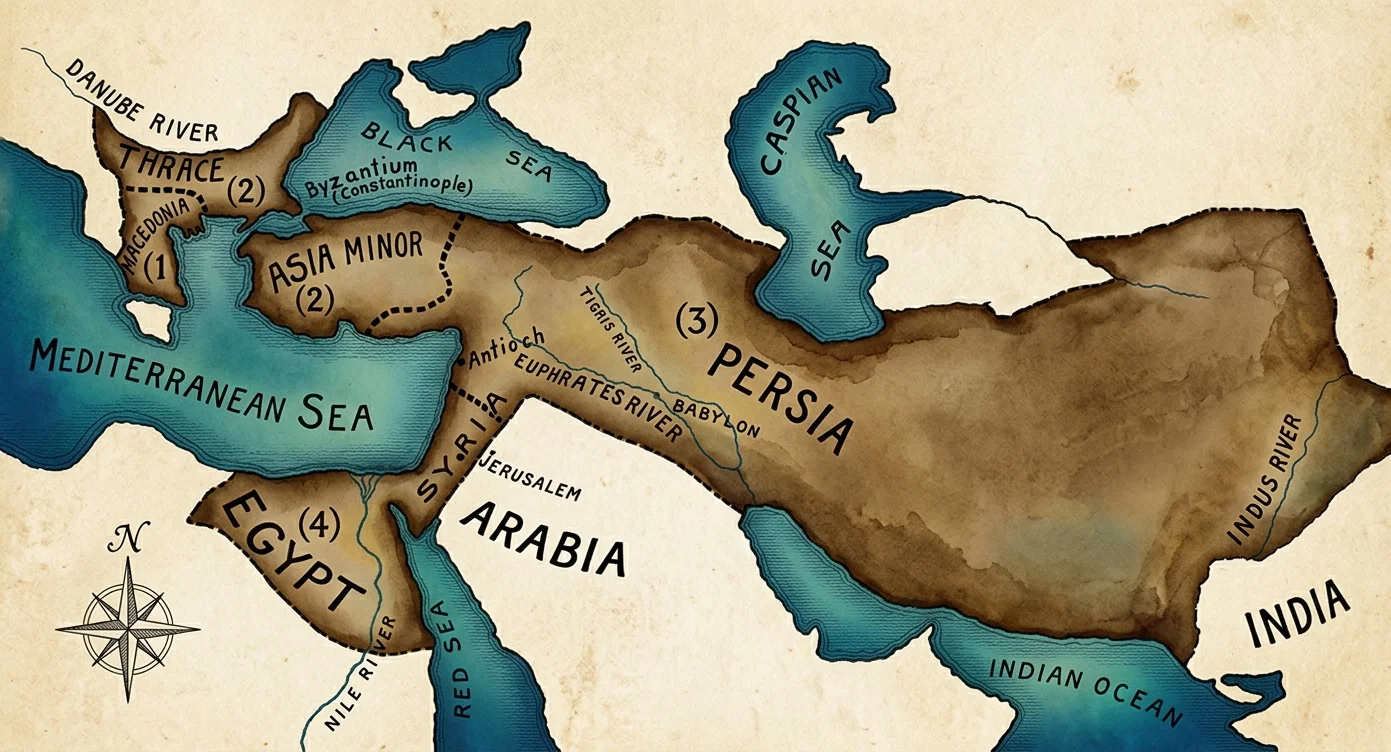
As already shown, it was in the year B. C. 281 that Seleucus, king of Syria, defeated Lysimachus, king of Thrace and Macedon, and added what were originally the western and northern divisions to his eastern division. Duruy tells us that at this point “the number of kings was for the moment reduced to two, by the union of Thrace, Macedon, and Asia in the hands of Seleucus. The former satrap of Babylon [Seleucus] ruled, therefore, over the whole of Alexander’s empire, except Greece and Egypt.” Thus was fulfilled the prophecy of Dan. 11:5, which foretold the dominant place two of the four kingdoms were to reach in the changes that were to take place in the breaking up of Alexander’s empire.
Map showing Alexander’s empire at the time of his death. (1) Macedon, kingdom founded by Cassander; (2) Thrace and Asia Minor, kingdom founded by Lysimachus; (3) Syria and Persia, kingdom founded by Seleucus; (4) Egypt, kingdom founded by Ptolemy.
Seleucus was an old man when he found himself master of the greater part of Alexander’s vast dominions. He made no attempt to govern from his Asiatic capital the European territory which came into his hands when he defeated Lysimachus. The arrangement decided upon was this:—
“Asia Minor was now incorporated into the monarchy of the Seleucidæ; Thrace reserved for the children of Agathocles; while Seleucus, giving up to his son Antiochus all Asia from the Hellespont to the Indus, laid claim to Macedonia for himself. But when he crossed the Hellespont, late in 281, Ptolemy Ceraunus, Philadelphus’s elder brother, who had been, because of his dissolute and savage character, excluded by his father from the succession to the Egyptian throne, murdered the old king in the chersonese, and usurped authority in the European territories of Lysimachus.”—“History of All Nations,” Vol. III, pages 388-395.
“Seleucus appointed his son Antiochus, who had for a long time administered the upper satrapies, regent of Asia, desiring himself to reside in Macedonia, in order to end his days in the land of his birth, while he intended Thrace for the child of murdered Agathocles. He had already landed in Europe, when the dagger of Ceraunus, the very man who had shortly before fled to him beseeching help, struck the unsuspecting old king, 281 B. C. The murderer made himself master of Macedonia and Thrace.”—“The World’s History,” Vol. IV, page 147.
This arrangement left Antiochus, who succeeded his father, Seleucus, in possession of all the Asiatic part of the kingdom. Then in full accord with the prophecy of Dan. 11:6-15 there began, and continued for one hundred sixteen years, a terrible struggle between the dynasties of Seleucus and Ptolemy. The perfect agreement of the prophecy and the history of these two kingdoms until they were absorbed by the Roman Empire, proves beyond all question that they were the kings of the north and the south. In the continuous wars they carried on, their boundary lines were continually changing, but one never exterminated the other. They remained separate and independent until the Roman conquests.

The Kingdom of the South

Egypt, the kingdom of the south, remained under the rule of the Ptolemies until it was taken by the Romans.
“Upon the capture of Alexandria by the triumphant legions of Octavius Cæsar, in B. C. 30, Antony and Cleopatra both committed suicide, and Egypt became a Roman province. Thus ended the Egyptian kingdom of the Ptolemies, afteran existence of almost three centuries (B. C. 323 to B. C. 30).”—“Library of Universal History,” Vol. III, page 799.
The overthrow of Syria, the kingdom of the north, is given in these few words by one historian:—
“In B. C. 65 the Roman general, Pompey the Great, defeated Antiochus Asiaticus and converted Syria into a Roman province.”—Id., page 789.
In 330 A. D. the capital of the Roman Empire was transferred by the emperor Constantine from the city of Rome, on the Tiber, to the city of Byzantium, on the Bosporus. The new capital was named Constantinople in honor of its founder, Constantine.
At the death of the emperor Theodosius, 395 A. D., the Roman Empire was permanently divided between the east and the west, and left to his sons Arcadius and Honorius.
“The eastern half bequeathed to Arcadius included the Balkan Peninsula, bounded on the north by the Danube, Asia Minor, the Taurus Peninsula (Crimea), Syria, Palestine, Egypt, Lower Libya, and the Pentapolis.”—“Historians’ History of the World,” Vol. VII, page 26.
A reference to the map will show that eastern Rome almost exactly covered the territory of the kingdoms of the north and the south, established in 281 B. C. by Seleucus and Ptolemy. It will be helpful to trace very briefly the principal changes that have since taken place in the Eastern Empire.

Decline of Egypt

Egypt, the southern part of eastern Rome, soon fell into the hands of the Arabs. “The decline of Egypt was due to the purely military government of the Romans. . . . At last the country was merely held by armed force, and the authority of the governor was little recognized beyond the capital, where garrisons were stationed. . . . Thus the Moslem conquest was easy.”—Encyclopedia Britannica, article “Egypt.”
“The Arab conquest of Egypt took place in the eighteenth year of the Hegira, or A. D. 639. It was with only a hundred camels, fifty slaves, and thirty horses that the Arab colonization of Egypt was begun by Kaisaby-Ebn-Kelthoom near the spot now occupied by the more modern city of Cairo. Fostat, or the city of the tents, was the name given to this first capital of the Arabs under Amru, and here was reared the first mosque devoted to Islamism.”—“History of the Egyptian Revolution,” Vol. I, pages 7, 8.
This dynasty ruled Egypt a period of two hundred thirty years, when it was overthrown by the Fatimites.
“The establishment of the Fatimite califate happened in this wise:—
“Moezz, the so-called Fatimite, and great grandson of Obeidallah, being in possession of a considerable territory in northern Africa, invaded Egypt, in the year 969 of the Christian era, his force being to a considerable extent composed of Sicilian Saracens, headed by Gohar- el-Caid, also a Sicilian; for in those days, Palermo, instead of being a city of Italian gardens and palaces, with a Corso and an opera, was a Moslem town, with mosques, baths, and bazaars. It was after this important event that Cairo proper was built, to the north of the town of Touloun.”—Id., page 18.
After reigning two hundred two years, the Fatimite dynasty was overthrown by the Mamelukes of Egypt, in 1171.
“As to the Mamelukes themselves, the reader no doubt knows that the word means slave (literally the ‘possessed’), and that they were brought in youth from northern countries to serve in the south. Saladin himself was a Kurd, and long before his accession to power, Turkish and Kurdish mercenaries were employed by the califs of Bagdad and Cairo, as the Pope employs the Swiss.”—Id., pages 42, 43.
The reign of the Mamelukes continued unbroken until 1517 A. D., when Selim, sultan of Turkey, invaded Egypt, and annexed it to his empire. But this did not destroy the power of the Mamelukes nor terminate their rule in Egypt.
“It was after Selim’s conquest that Egypt was divided into twenty-four districts, ruled by twenty-four Mameluke beys, according to the Turkish policy. . . . Seven of the beys formed the divan of Cairo, under the pasha sent by the Ottoman sultan. In the sixteenth and seventeenth centuries the pashalic was a reality, but after that period, when the power of the Porte began to decline, and Austria and Russia pressed hard upon her northern frontiers, her government of Egypt became more or less nominal, and such was the state of affairs up to the period of the French invasion. . . . The pasha resided in the castle. His political power was entirely nominal, while all the efforts that had been made to divide these haughty and rebellious vassals [the Mamelukes], and turn the shadow of power into a reality, had been unsuccessful. . . . The pasha of the rich realm of Egypt was rather the servant of the Mamelukes than the substitute of the sultan.”—Id., pages 70, 71, 74, 75.
Thus, with only a slight and short interruption, Egypt remained under the rule of the Mamelukes until Napoleon’s invasion, in 1798 A. D.

The Kingdom of the North

As to the northern division of eastern Rome, it gradually passed into the hands of the Saracens and Turks. Beginning with the conquest of Persia in 637 A. D., they steadily extended their conquests westward through Syria, Asia Minor, Thrace, Macedon, and Greece. Constantinople, the capital of eastern Rome, was taken by the Ottoman Turks in 1453. This brought to an end all pretense of government by eastern Rome.
Thus the whole of the territory over which Seleucus had made himself master, at the time of his death passed into the hands of the Turks. Turkey became the kingdom of the north, and still holds the territory of “the king of the north” of Dan. 11:6-15.
Thus we find that when, in 1798 A. D., Napoleon began his invasion of Egypt and Syria, these countries which were originally the “king of the south” and the “king of the north” were under the dominion of the Mamelukes and the Turks.

Freedom Through the Son

“If the Son therefore shall make you free, ye shall be free indeed.”

G. B. THOMPSON

The Holy Spirit — No. 7

G. B. THOMPSON

The Paraclete

“And I will pray the Father, and he shall give you another Comforter, that he may abide with you forever.” John 14: 16.
The word from which Comforter is translated is the Greek word paraclete. The first instance of its use in the Bible is in the above text. This word is used five times in the New Testament, four times by Jesus in the upper room discourse to his disciples (John 14: 16, 26; 15: 26; 16: 7), where it refers to the Holy Spirit, and once in 1 John 2: 1, where it is translated advocate and refers to Christ: “My little children, these things write I unto you, that ye sin not. And if any man sin, we have an advocate [paraclete] with the Father, Jesus Christ the righteous.”
The Holy Spirit is not merely an influence, or power, or some enthusiasm; but, as the word paraclete suggests, a personality exerting an influence, wielding a power, awakening enthusiasm.
I am aware that we should tread softly here. We are dealing with One whose nature is a mystery, where we have been instructed that no “fanciful views” or “human construction” of Scripture should be given. We have no desire, nor do we deem it wise or profitable, to seek to define and analyze the personality of either God the Son or the Holy Spirit. When it comes to definitions here, silence is indeed golden. The Godhead is incomprehensible to man. But the Spirit himself, speaking to the church through his chosen instrument, calls the Holy Spirit the “third person of the Godhead,” and it is manifestly proper to carefully study the statements of the Word of God and seek for light, and rejoice in what we find, whether we can fully understand it or not, for the “things which are revealed belong unto us and unto our children forever.”
Much light is thrown on the subject of the position and work of the Holy Spirit by a careful study of the word paraclete, which our Saviour used in the upper room discourse, and which is translated Comforter. “I will send another Paraclete,” said the Master. “If any man sin, we have a paraclete,” says the beloved disciple. In the Revised Versions the word Comforter is given in the text John 14: 16. The margin, however, reads, “or Advocate, or Helper, Gr., Paraclete.”
Scholars tell us that the word paraclete is really an untranslatable word, it being difficult to find any word in the English tongue which fully expresses the meaning. The word advocate, as given in 1 John 2: 1, perhaps comes nearer toconveying the real meaning than any other word.
That we may arrive as nearly as possible at the true meaning of this word, I shall quote several definitions from recognized authorities.
Grimm-Thayer defines it as “summoned, called to one’s side (esp. called to one’s aid). 1. One who pleads another’s cause before a judge, a pleader, counsel for defense, legal assistant, advocate. 2. (Universally) one who pleads another’s cause with one, an intercessor. 3. (In the widest sense) a helper, a succorer, aider, assistant.”
Liddell and Scott: “1. Paraclete, called to one’s aid, assisting, especially in a court of justice. Latin, advocatus: hence as substitute, a legal assistant, advocate. 2. Generally a helper.”
“Another Comforter, or ‘Paraclete.’ This word is used not only of a person called in to plead another’s cause, but of one who is a helper in any matter, or generally a patron.”—Henry and Scott, comments on John 14: 16.
“This word paraclete, like its Latin equivalent, advocate, which is once used to translate it, seems to embody mainly the conception of being called to one’s aid or summoned to act as a substitute; as, in a court of law, an advocate offers to conduct a case or cause in another’s behalf and as his representative.”—“Acts of the Holy Spirit,” by A. T. Pierson, page 14.
It is quite clear from the definitions of the word paraclete given above, that it carries with it the idea of personality. The word means a “helper,” an “advocate,” one who “comforts,” all of which are titles of persons. “Another Comforter” does not mean simply the influence of the same “Comforter.” It is another, who is called in the spirit of prophecy “the third person of the Godhead.” Our paraclete in heaven is Jesus Christ the righteous; our paraclete on earth is the Holy Spirit. With God the Father in heaven there is the Man Christ Jesus to plead the cause of men; with man on earth there is the Holy Spirit to plead the cause of God.
“Paraclete is composed of two words — clete, which means ‘called,’ and para, which means ‘along with.’ It thus means exactly ‘one who is called along with another,’ or ‘one who is called to another’s aid.’ More definitely, the paraclete is one who is called along with the clete to aid him. And to understand the work of the paraclete, we need to understand the position of the clete.
“A man is called to appear before a court of justice to answer a charge made against him. He is clete, or ‘called.’ But he is ignorant of the law, and unable to plead well before his judges; therefore another is called to help him. There is no charge against this other; but he knows the law, and he is able to state the case well; therefore he is ‘called to help’ the former; he is his para-clete. In this case the word ad-vocate corresponds both in etymology and in meaning with the Greek word, and expresses the function which the paraclete is expected to perform.
“Or again, a man is called on to do a certain piece of work required of him; he is clete. He finds that it is utterly beyond his power to do it alone; so another of greater strength is ‘called to aid’ him in that work; he is his para-clete.
“The word thus means, not merely a helper, but one who is called or appointed to help another. He may be called to help by comforting as a comforter, by pleading as an advocate, by aiding as a fellow worker, or in some other way, according to the needs of the case. The name does not belong to him till the office or work is assigned to him, and the office or work depends on the requirements of those whom he is called to aid.”—“The Holy Spirit the Paraclete,” pages 6, 7.
This understanding of the meaning of the word paraclete will help us to more fully comprehend the statement in John 7: 39. “The Holy Ghost was not yet given; because that Jesus was not yet glorified.” Had not the Spirit been in the world before? — Certainly.
It is through the work of the Holy Spirit on the heart that we are converted. Without the influence of the Spirit of God on the heart there would be no conversion. He produces conviction of sin. He awakens godly sorrow, and leads us to repentance. All who have been converted and experienced a change of heart since the fall of man have been moved by the Spirit of God. He had been striving with sinners everywhere. Why then the statement, “not yet given.” In “Desire of Ages,” page 671, the Holy Spirit is called the “third person of the Godhead.” On page 669 we are told that this “third person of the Godhead” is “Christ’s representative,” and sent “to be his successor on earth.” The Holy Spirit, then, and not the Pope, is Christ’s special representative, successor, or vicar in the church on earth. The blasphemous claim of the papal church, therefore, unseats the true representative of the throne of God and seats a man instead.
It is evident, in the proper order of things, that the Holy Spirit could not take his official position in the church as the “successor” of Christ until after the ascension. As one writer says, “The divine Artist could not fitly descend to make the copy before the original had been provided.” In the sense of his official capacity the Spirit was “not yet given.” But on the day of Pentecost he descended in fulfilment of the prophecy of Joel and the promise of Jesus, and took his official seat in the church, to remain with the church as the representative of Christ, who is the great Head of the church. Another has stated this so well that I quote his words: —
“Had the Holy Spirit not been among them? Had there been no divine guidance, no spiritual life? — Yes, there had. The Holy Spirit had worked in the world, but he had not been given to the world. He had inspired prophets; he had helped those who believed and obeyed, but he had not been given as a ‘gift not to be withdrawn.’
“We can understand this by comparing it with the gift of Jesus Christ. Had the eternal Word done nothing in the world before his incarnation? — Certainly he had; not only had he spoken in creation and in conscience, he had guided his people as the angel of the covenant. He had given the message to the prophets which the Spirit had inspired them to comprehend. He had worked; but he had not been given. He had come as a presence that might come or go at pleasure. But when he came in the flesh, he was given not to be withdrawn. Nothing can now cancel or reverse the fact that the eternal Word has become a partaker of human nature, has passed through the course of human existence from birth to death, has done the work necessary to redeem mankind, and is in glorified humanity a partaker of our nature to all eternity.
“So, too, the Holy Spirit had worked before the coming of Jesus Christ, but it was not till Jesus Christ had been given and had finished his work, that the Holy Spirit was given, an abiding presence with man, to carry out Christ’s work in all generations. Had he been given previously, there would not have been the same full revelation of God and his purpose to apply to man, there would have been a waste of divine energy for want of a purpose on which to work. Not till the one Paraclete was given in his fulness, could the other Paraclete be given in his full power to apply the work.”—“The Holy Spirit the Paraclete,” pages 22, 23.
We greatly fear that we have lost much through a failure to recognize that the Holy Spirit is here, as one in our midst. It may be questioned whose loss is the greater, his who thinks that the Holy Spirit is present with him when he is not, or his who thinks not that the Spirit is present with him when he is.
Takoma Park, D. C.

Judging Men with Compassion

Men’s actions are very difficult to judge. Nobody can judge them but God, and we can hardly obtain a higher or more reverent view of God than that which represents him to us as judging men with perfect knowledge, unperplexed certainty, and undisturbed compassion. Our habit of judgment is so nearly incurable, and its cure is such an interminable process, that we must concentrate ourselves for a long while upon keeping it in check, and this check is to be found in kind interpretations. Sight is a great blessing, but there are times and places in which it is far more blessed not to see.— F. W. Faber.

Grace Exceeds Our Greatest Sins

“WHERE’ER the greatest sins abound, By grace they are exceeded; God’s helping hand is always found, With aid, where aid is needed; His hand, the only hand to save, Will rescue Israel from the grave, And pardon his transgression.”
Continue reading: Growing Better