A SERIES of Missionary Volunteer institutes has just closed, and we resume our work at the office with renewed courage; for the hundreds of splendid young men and women we met gave us a new vision of the possibilities of the young people's work. We feel as never before that “with such an army as our youth, properly trained, might furnish,” soon, very soon, “the message of a crucified, risen, and soon-coming Saviour might be carried to the world.”
Nevada, Iowa, November 1-4
The series of institutes opened with a two days' meeting at Nevada, Iowa. Prof. W. W. Ruble, the Northern Union Missionary Volunteer secretary, and Brother George McNay, the Missionary Volunteer secretary of Iowa, were present. The attendance was good, and workers, students, and nurses, as well as the lay members of the church, helped to make the meeting a success. Victories were gained. Some took their stand for Christ, and many pledged themselves to be more faithful in Bible study, prayer, and soul-saving work.
Clinton, Mo., November 11-13
The second institute was held at the German Seminary in Clinton, Mo. The faculty and students took hold enthusiastically from the first. Prof. M. B. Van Kirk, the Central Union Missionary Volunteer secretary, Elder P. G. Stanley, the conference president, and a few other workers attended. The German Reading Course was given an impetus by Brother J. J. Reiswig. We are expecting some new members of Attainment from that school soon. But best of all was the spirit of consecration for service that prevailed. Two of the students recently sailed to take up work in the Neglected Continent.
Keene, Tex., November 15-18
We expected to have a good institute at Keene, for we had not forgotten the one held there two years ago. We were not disappointed. There was a spirit of full cooperation. A few conference presidents and several of the conference Missionary Volunteer secretaries in the Southwestern Union, together with other workers, helped in this institute. The meetings were well attended. All subjects presented met with hearty response. Many saw the importance of the Standard of Attainment plan, and resolved to prepare for membership. Already twenty-two of them have reached the goal. The Spirit of the Lord came in with mighty power. Many of the young people stepped over the line, and before the institute closed twenty-seven of them were buried in baptism with Jesus, their Creator, Redeemer, and Friend.
Huntsville, Ala., November 23-25
From Keene, we went to the Oakwood School, where our colored young people are being trained for service for the needy Southern field. I think I never shall forget the earnest zeal and consecration of the noble workers who are devoting their lives to help train laborers to give the third angel's message to the colored race. Neither can I forget the eager and inspiring faces of those young people. Their eyes fairly clung to the speakers, fearing lest some word should fail to reach their listening ears. We were pleased to have with us in this institute several of the colored workers. More than a score of the young men and women enrolled in the Reading Courses, and before the close of the institute all the unconverted young people took their stand for Christ.
Atlantic Union Missionary Volunteer secretary, several conference Missionary Volunteer secretaries, one or two conference presidents, and a few other workers were with us. The faculty, students, and others who came in manifested a deep interest. The studies on the Reading Courses, the Standard of Attainment, and the Temperance Instructor campaign brought forth particularly animated discussions. Before the institute closed, the workers present decided to adopt a union financial policy. And the Missionary Volunteer officers of the village organization expressed their determination to do all in their power to make their society indeed and in truth a life-saving station during 1913. Christmas night was spent at the Melrose sanitarium. There also is a splendid host of young men and women.
New York City, December 26-29
En route for the next institute, we had one good meeting with the young people in New Haven, Conn. Our Missionary Volunteers in New York City are placed in the midst of a great and difficult field, but God is blessing their efforts. The institute held in Tollner Hall, Brooklyn, was well attended by representatives from the English, German, and the Scandinavian Missionary Volunteer Societies. Elder R. D. Quinn, the conference president, and other workers there entered heartily into the work of the meetings. We were glad for the inspiration received and for the privilege of studying the young people's work with the workers, parents, and youth in that great metropolis.
Mount Vernon, Ohio, January 16-19
Despite inclement weather, the meetings at Mount Vernon, Ohio, were well attended by old and young. Prof. N. S. Ashton, Missionary Volunteer secretary of the Columbia Union, two conference presidents, three conference Missionary Volunteer secretaries, a few other workers, and delegates from some of the near-by societies joined us in this institute. Almost all phases of the Missionary Volunteer work were presented, and good discussions followed. Before leaving, we were pleased to learn that Prof. Lawrence Anderson that morning organized a Standard of Attainment band with about thirty members. This band, it is planned, will meet weekly for the study of Bible doctrines or denominational history. The Columbia Union is aiming to have one hundred new Attainment members before March, 1914.
Berrien Springs, Mich., January 23-26
The last institute in the series was held at Berrien Springs. As we remembered the good meeting there of two years ago, we prayed earnestly that this one might be better still, and we believe it was. The attendance surpassed our most sanguine hopes. Prof. C. A. Russell, Missionary Volunteer secretary of the Lake Union, nearly all the conference Missionary Volunteer secretaries in the union, two or three conference presidents, and about one hundred delegates and visitors from local societies were present. Nearly every session the chapel was well filled, and often it was crowded. All phases of the young people's work received consideration. When the Standard of Attainment subject came up, plans were suggested for pushing it more successfully.210The Lake Union aims to have two hundred new Attainment members before March, 1914. In the last afternoon meeting, a delegate from each society represented rendered a two-minute report of his local organization. We think those of us who heard them, said within our hearts, God, we thank thee for a movement which is leading the youth into such noble Christian service. The institute very appropriately closed with a consecration service, in which hundreds expressed their determination to let God have all there is of them for service in seeking the lost.
The key-note of all these institutes was Personal Evangelism. And I think no other talks were appreciated so much as were Elder MacGuire's three studies on this all-important theme. In the institute program, some time was allotted for a devotional service every day, and also for a secretaries' council, at which time we talked over informally the problems before us as young people's workers. The general Missionary Volunteer Department sent to all these institutes an exhibit of charts, leaflets, and books considered excellent for young people and young people's workers. In all the institutes young people were invited to write a synopsis of each meeting. Some splendid papers were submitted, and we think this plan will help to make the results more permanent. As young people's workers, our hearts are full of gratitude to God for his guidance and blessing in this series of meetings, and we trust him for greater victories in the days to come.
M. E.
Young People's Work
Conducted by the Young People's Missionary Volunteer Department of the General Conference
M. E. Kern — Secretary
Meade MacGuire — Field Secretary
Matilda Erickson — Corresponding Secretary
The Mountain View Missionary and Bookmen's Convention
By J. R. Ferren
In attendance at this convention were the union and field agents and the tract society and missionary secretaries from the entire field supplied by the Pacific Press Publishing Association. This territory includes the conferences in the Northern, Central, North Pacific, Pacific, and West Canadian Union Conferences. It was the first general convention representing the entire territory.
The men had looked forward to this gathering as an “experience meeting,” a time when the lessons of the past might be applied to the problems of the present and the future. Truly this was done. Many questions bearing upon their work were carefully studied. Here were men bearing similar responsibilities in the subscription book work from widely separated fields. Some had been specializing on certain books, some working in Catholic communities, and others successfully working the cities. The convention gave opportunity for an exchange of experiences and methods from which all could profit.
For the larger number of the thirty tract society and missionary secretaries in attendance this was the first privilege they had ever had of counseling with fellow secretaries about any feature of their work. The Lord’s Spirit was present from the first; and throughout the session, which continued for ten days, a spirit of earnest endeavor for higher efficiency was manifest. From 8:15 A. M. throughout the entire day, and usually during the evening, progress was made. There can be no question that the ground covered and the standards of efficiency raised will give strength and impetus to the work in these conferences throughout the year.
Field Work
An action concerning field work, presented early in the convention and indorsed enthusiastically by the entire body later in the session, was really a continuation of an action taken last year, when a portion of the field men pledged themselves to spend at least two weeks during the year with the prospectus from house to house. A partial record of the work done is here given:—
AGENTS
HOURS
ORDERS
VALUE
F. E. Painter
128
70
$260.50
A. A. Cone
80
70
247.80
W. R. Beatty
48
..
172.50
C. G. Bellah
226
157
685.60
H. E. Loop
25
..
70.50
C. C. Morlan
75
108
106.25
R. H. Miller
56
33
123.00
Totals
638
438
$1,666.15
Brother W. L. Manful, representing Western Canada, spoke earnestly of what his personal field work had accomplished. During ten weeks he took orders for $1,500 worth of books, some of the time working within sight of nine big thrashing crews. In this way he was able to keep his men in the field, and they sold more than $15,000 worth of books during the year.
Following is the resolution which was enthusiastically adopted by the convention:—
“Whereas, The work done by us as union and field agents in personal canvassing for two weeks or more during the past year, has brought great blessing and benefit to us, (1) By increasing our enthusiasm, confidence, and efficiency; (2) by better acquainting us with the conditions our canvassers have to meet; (3) by strengthening our grasp on the selling points in our books; (4) by proving an inspiration to our canvassers and to others; therefore,—
“Resolved, That we continue this policy for this year; and that the tract society secretaries, branch office and departmental managers, and the secretary of the publishing department engage in at least one week of active field work during the coming year.”
Canvassing Bands
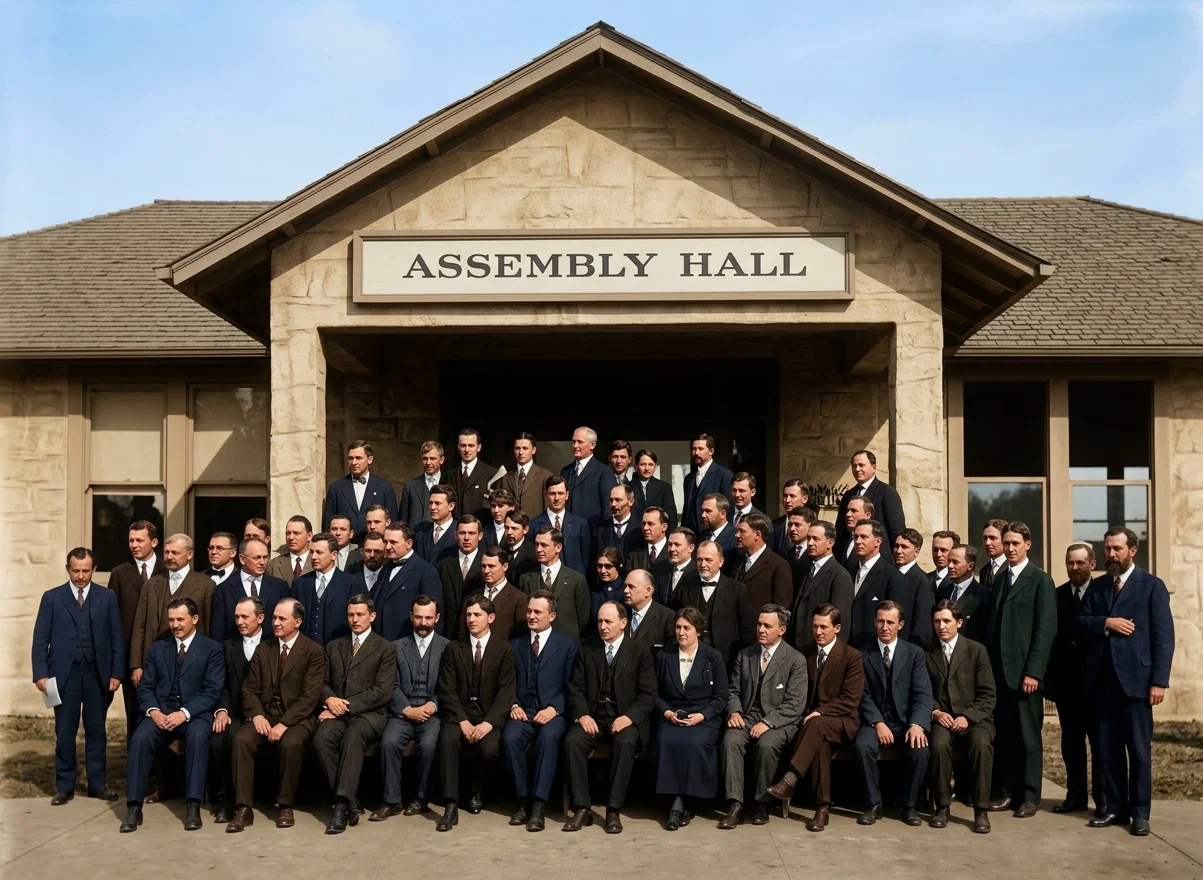
DELEGATES TO THE MISSIONARY AND BOOKMEN’S CONVENTION AT MOUNTAIN VIEW, CAL.
Union agents reported that the membership in the canvassing bands in the schools is as follows: Pacific Union Conference, 109; North Pacific Union, 161; Northern Union, 148; Central Union, 177; and West Canadian, 40. This makes a total of 635 in these schools who are following the outline study and gaining a preparation for the colporteur work. Steps were taken at the convention to give special study during the year to ways of strengthening the band programs, particularly with the experienced student canvasser in mind.
City Work
Experiences were given which show that the people of the cities are inquiring with reference to world conditions, “What do these things mean?” “Too great a gulf has been fixed in the minds of our men between the people of the city and the people of the country,” was the reason given by one leader why we have not done more for the cities. He and others gave recent experiences of how they had worked successfully among the well-to-do people, introducing themselves in the usual way as Christian workers. “Bible Readings,” “Daniel and the Revelation,” and other large books are, where earnest effort is put forth, being sold in the cities. It was the general feeling that through better preparation and more determined effort, this year would see a greater work accomplished with our books in the cities.
Development of Workers
A half-day was spent in the study of methods by which higher standards may be reached in the development of workers. Methods in self-improvement for the canvasser, for the field agent, and for all, were presented and studied.211Elder N. Z. Town, the secretary of the Publishing Department, who took a leading part in the convention, spoke particularly of the crying need for developed men in the foreign fields. He referred to some who had, after a training in this country, gone to South America, India, and other countries, where they are doing successful work. He appealed to the leaders in these union conferences to do everything in their power to help their men so to develop that God can lay upon them greater responsibilities.
Subscription Books in Foreign Languages
In response to strong appeals made in behalf of the millions of foreigners in the United States and Canada, many of whom will buy our books, the following recommendation was passed:—
“We recommend, That steps be taken at once to provide ‘Patriarchs and Prophets’ in Portuguese, Italian, and Polish; and ‘Great Controversy’ in Finnish and Russian; and that as soon as possible subscription books be provided in the other predominant foreign languages in the United States and Canada; and—
“We further recommend, That in each instance the full book be translated.”
Home Workers’ Books
During the past year our field men have united more vigorously with the tract society secretaries in securing agents for the small books generally known as home workers’ books. Some of these have gone into the field with the new home workers’ prospectus, and have met with success, which has given them a deeper interest than ever in this class of books. There is a growing demand among the best people for suitable good books for the children and young people, and these books open the way for the larger doctrinal works. Many of our people who gain their first experience with the small books soon take up the work of selling the large subscription books. So the field agents favor pushing the sale of this class of books throughout the year.
Magazines
The question of how to organize our growing magazine work better was carefully considered. There were present men who had made a specialty of the magazine work, and an entire evening was given to its study. One conference missionary secretary reported the sale of 20,743 magazines by 20 agents in 2,238 hours. They received $2,074.30 for these magazines, or an average of 92 cents an hour in sales. These results had been accomplished, he said, because of careful districting of the territory, getting Christian homes for the workers, giving them proper instruction in institute and field.
The Tract Society Feature
The closing days of the convention were spent on questions relating more particularly to the work of the tract society secretary. This was studied under two leading divisions,—the handling of the work that comes, and methods by which he can help to build up the various lines of missionary work in the conference.
The Conference Treasurer
Two excellent papers were read regarding the duties and responsibilities of the conference treasurer. Some charts helped to illustrate the points made. As practically all the tract society secretaries also hold the position of conference treasurer, the help given was greatly appreciated.
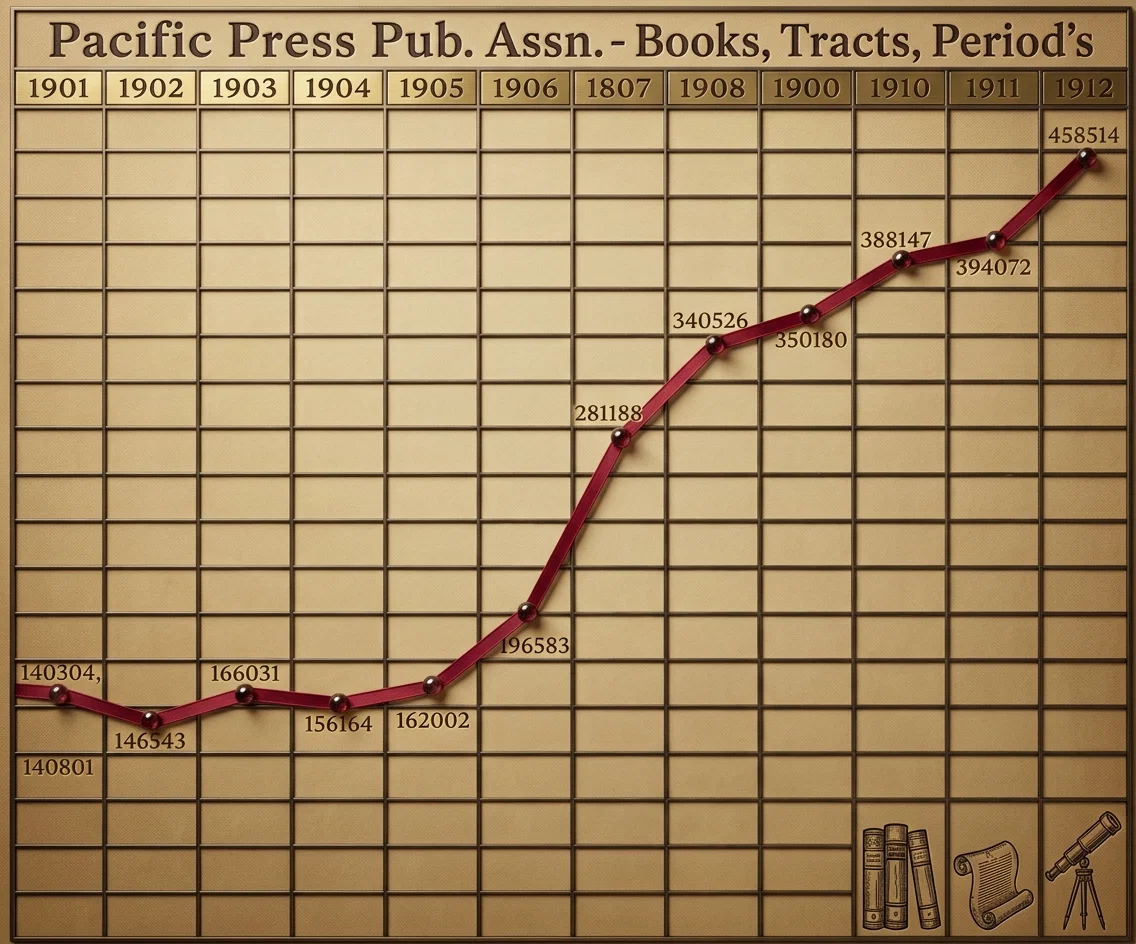
“Hitherto Hath the Lord Helped Us”
The above chart shows the increase in literature sales of the Pacific Press since their disastrous fire of 1906.
Those present felt indeed that the Lord had been their helper. The spiritual help obtained during the morning devotional hour and the inspiration gained in the evening stereopticon lectures, added greatly to the good influence of the convention. In one of the evening lectures given by Brother Clarence C. Crisler, the struggles through which the pioneers in this work passed were vividly brought to view. On another evening Brother C. H. Jones gave an illustrated lecture on the history and work of the Pacific Press. Another evening was spent in studying the steps in the revival of our book work since 1902, when the message came that it should be revived and go forward with increasing success.
The faith and inspiration of those present were still further increased by a visit to the home of Mrs. E. G. White, where, during her address to them, the Lord’s presence was near. She pleaded with them to press on and on, and assured them of the help and strength of Him who has gone the way before.
There were present with the bookmen and secretaries during a portion of the convention fifteen union conference and local conference presidents from the territory represented. All returned to their fields feeling that they had gained strength, knowledge, and inspiration from this gathering, which, with the Lord’s help, would enable them to do more and better work during 1913.
J. R. FERREN,
Secretary for the convention.
The Publishing Work
By N. Z. Town
Conducted by the Publishing Department of the General Conference
N. Z. Town - - - - - Secretary
Protesting Through the Papers
By W. L. Burgan
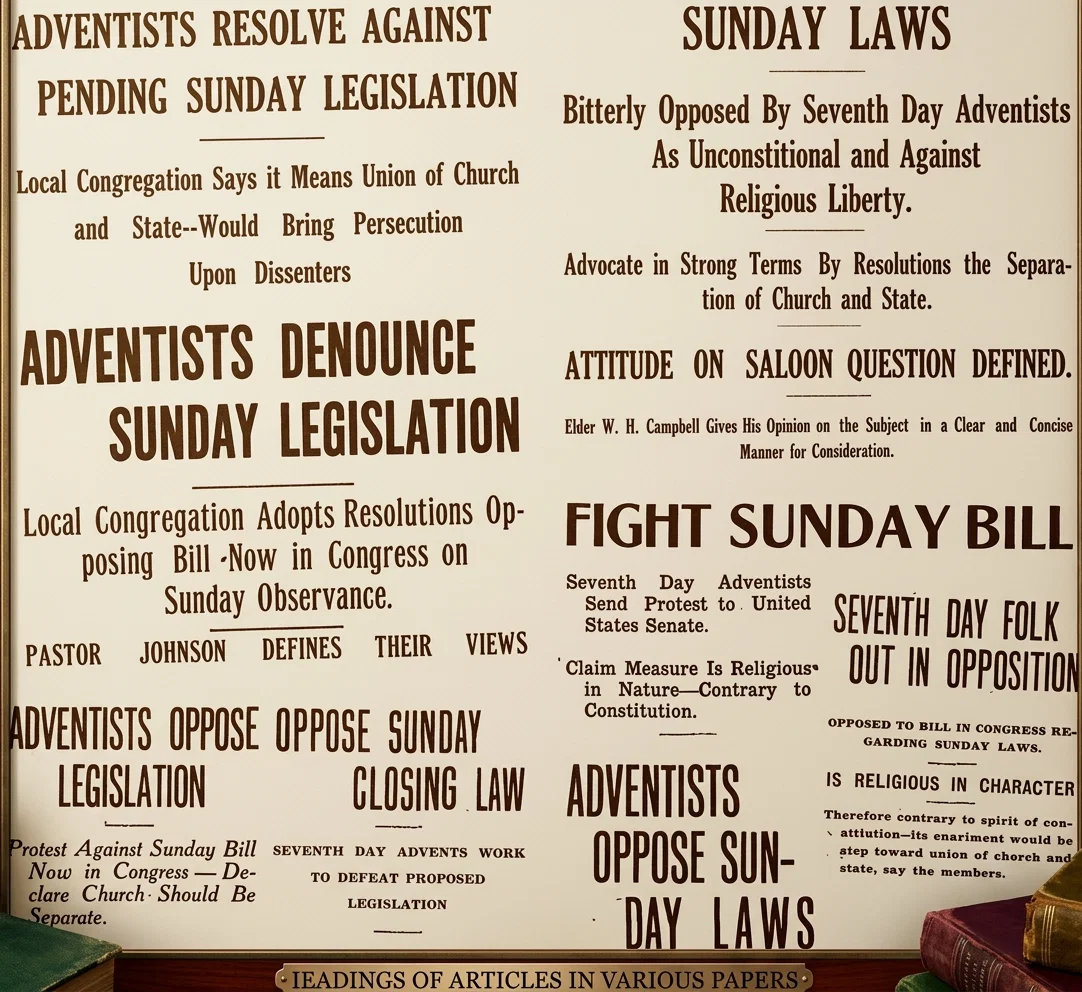
A STRIKING indication of the readiness of newspapers of this country to print reports of events transpiring among Seventh-day Adventists is shown in the prominence of the headings placed on the articles dealing with the remonstrances recently passed by our churches throughout the country against the proposed Johnston Sunday Bill for the District of Columbia.
Reproduced in this department is a photograph of several headings that appeared on reports dealing with this question. These headings have been taken from reports published in newspapers in various parts of the country. Copies of an article in which were incorporated the remonstrance, some salient points as to our attitude as a denomination on the dangers of uniting church and state through the enactment of Sunday laws, and the liquor traffic, were sent to about212two thousand of the elders in the United States, with the request that they be submitted to the local newspapers for publication.
Up to February 17, clippings of the report had been sent to the General Conference Office from cities and towns in thirty-three States. The total circulation of these papers amounted to 960,429. Computing four readers to a paper, as is the reckoning of practically all newspaper officials, the number of persons reached in this one effort was 3,841,716. The States in which reports appeared were:—
HEADINGS OF ARTICLES IN VARIOUS PAPERS
Arkansas, Connecticut, Kansas, Minnesota, Montana, New Jersey, North Dakota, Oregon, South Dakota, Utah, Washington, California, Idaho, Maine, Mississippi, Nebraska, New York, Ohio, Pennsylvania, Tennessee, Vermont, Wisconsin, Colorado, Iowa, Michigan, Missouri, New Hampshire, North Carolina, Oklahoma, Rhode Island, Texas, Virginia, Wyoming.
Quite a number of the large cities were reached in this effort, and through the publication of the resolutions thousands of persons were made acquainted with some of the principles of religious liberty as held by our denomination. Among the large cities in which reports were printed were Philadelphia, Milwaukee, Los Angeles, Buffalo, Salt Lake City, Ogden, Nashville, Spokane, Knoxville, Portland (Maine), Pueblo (Colo.), and Altoona (Pa.).
It was interesting to study the prominence given to the reports in many of the papers. A large number of the reports appeared on the front page, while a few were made the leading topics in the papers. One newspaper in northern New England thought so well of the account that a new introduction was written, stating that it was news to many of the residents of the city that a Seventh-day Adventist church was in their midst. The article was given the leading column in the paper. It may not be amiss to urge that the brethren in this city ought to take advantage of the liberality of the editor and continue to hand him reports filled with words of truth.
The results of this effort should give those who have been utilizing the columns of the secular papers fresh courage, and arouse those who have been backward in using this medium, to get a fresh supply of pencils or ink and paper and wield the weapon that is stronger than the sword.
W. L. BURGAN.
Work as a Divine Calling
THERE are hours in which work is transfigured—in which it does not appear drudgery, but a mission; in which every duty is attractive. All work then becomes a divine calling: and we see that men are not only called to be apostles, but also called to be carpenters, called to be merchants, soldiers, sailors, called to be artists, inventors; and that one can sweep a room for the sake of God, and be happy in doing it. Until our work is thus transfigured, and we see religion in it, it must be often a burden and a drudgery.—James Freeman Clarke.
State and Church
By W. W. Prescott
Reports, Notes, and Comments Pertaining to the Current History of Religious Freedom, and the Campaign “to Make America Catholic.”
Conducted by the Religious Liberty Association.
W. W. PRESCOTT
SECRETARY
Four Sunday Bills in Oklahoma
By I. A. Crane
FOUR Sunday bills have been introduced into the Oklahoma Legislature. Of these we believe three have been killed. The last one may not be so easily disposed of.
We have endeavored to place before the legislators the true principles of liberty. A remonstrance was prepared, which was read by the reading clerk of the senate. Later a copy was placed in the hands of each member of the legislature.
Our people have been sending in their petitions and letters. Some have already reported good experiences and an awakened interest as the result of their efforts in securing signatures to the petitions.
Our purpose has not been from a selfish view, but with the desire to improve the opportunity afforded by the agitation of this question to give the last message. Knowing that the work is of God, we believe all our people have felt it a privilege to do their part as individuals and leave the results with God. It certainly is evident to all that the lines are becoming more and more drawn upon this question.
Two of the newspapers have helped us some, but the leading paper of the city, while apparently friendly, has so far managed to give us no recognition.
At the present time the city of Sapulpa is having very earnest contests over Sunday closing. It seems that a few ministers are on one side, and the business men on the other. A meeting is called for to-night from which the ministers are asked to remain away. It is expected that next Sunday will be an interesting time in the city. We plan to leave for that place early in the week with a good supply of literature. Pray for this branch of the work.
I. A. CRANE.
Oklahoma City, Feb. 14, 1913.
Committee Hearings on Sunday Bills
By J. E. Jayne
In New York State public hearings on five bills in which Sunday legislation is involved have been held by the committees to which these measures have been referred.
In New Hampshire similar hearings have been held on six bills of like character.
These hearings have afforded excellent opportunities for the discussion of the fundamental principles involved in religious legislation. These opportunities have been improved to the utmost of our ability and of the time available. Our representatives have received respectful attention, and the principles advocated have occasioned very favorable comment. The following-named brethren have been in attendance in their respective districts: W. H. Holden, E. L. Cardey, and E. A. Raymond, of New York; L. T. Nicola, of Greater New York; F. W. Stray, E. G. Farnsworth, and D. K. Royer, of New Hampshire; and the writer.
A Victory in New Hampshire
New Hampshire House Bill No. 515 proposed to so amend the existing statute that it would read as follows:— “SECTION 5.— No person shall keep his shop, warehouse, cellar, restaurant, or workshop open for the reception of company, or shall sell or expose for sale any merchandise whatsoever on the Lord’s day; except in case of necessity or mercy.”
This bill was supported by the Lord’s Day Alliance, represented by Rev. M. D. Kneeland, of Boston, Mass., also by a good-sized company of New Hampshire clergymen. Although each succeeding speaker emphasized religious reasons for its enactment into law, an earnest effort was made to impress the committee with the idea that there was really nothing religious about the bill itself.
For us, Elder Stray very effectively presented the real character of the measure and urged that in order to enforce it properly, the civil magistrate, in determining what in each individual case shall and shall not be deemed works of necessity and mercy, must of necessity become an inquisitor. After the hearing, a Roman Catholic member of the committee held a long interview with Elder Stray and expressed himself as very favorably impressed with the principles we advocated. Since then the committee has reported upon the bill, “Inexpedient to legislate.” Its report has been adopted, and this measure is dead.
In New Hampshire also, on the eleventh instant, two hearings were held at the same hour. One of these was before the House Committee on Labor and the other before the House Committee on Fisheries and Game. We divided our forces, Brethren Stray and Royer remaining with the committee on labor, and Brother Farnsworth and the writer appearing before the other committee.
House Bill No. 427 seeks to enforce by law one day’s rest in seven. It was associated with several other measures relative to labor problems, and was considered by the labor committee at the same hearing. In this instance the representatives of the Lord’s Day Alliance were assisted by representatives of laboring men. This particular bill is so drawn as to appear to enable an employer to require his employee to work on Sunday, provided he allows him to rest one other day in the week. When attention was called to this fact and to the principles involved in legislation of this character, labor representatives and employers present became very much interested and urged the committee to grant another hearing on the bill. This request was granted, and another hearing is to be held soon.
The committee on fisheries and game considered at the same time House Bills Nos. 111, 133, and 164. The former of these bills does not mention Sunday or the Lord’s day, but seeks to secure a certain amount of Sunday legislation by prohibiting certain forms of labor and amusement except upon “the first twelve week-days of December.” The two other bills define Sunday as the “Lord’s day” and the “Sabbath day.” This gave opportunity to consider the real character of the proposed legislation and the lessons of history in connection therewith.
This is the first time hearings of this kind have been held before the New Hampshire Legislature, and the discussion has aroused much interest in both the senate and the house. Brother Farnsworth is supplying the members with appropriate literature.
One of the most prominent speakers213of the Lord’s Day Alliance assured the committee that Seventh-day Adventists are an excellent people; that you can safely trust them with your pocketbook and your soul, but that they are fossilized, thousands of years behind the times, and seek to engraft an ancient institution upon the life of to-day. Again, when we made reference to the fact that the national government has never provided a Sunday law for the District of Columbia, Rev. M. D. Kneeland interrupted to assert that it would do so immediately, that the bill now before the national Congress will certainly be enacted into law.
In New York State, last year, very little religious legislation was attempted. At this time they seem to be trying to make up for lost time. However, there is considerable agitation favorable to liberalizing the existing Sunday legislation. About one half of the bills introduced have this object. Democratic Assembly Leader Mr. A. J. Levey introduced a bill modifying the existing exemption clause so that those who observe Sabbath day from sundown Friday night to sundown Saturday night may not be prosecuted for Sunday labor upon the ground that they worked Saturday evening. The codes committee for the assembly granted a public hearing upon this and three other bills involving Sunday legislation. Mr. Levey appeared before the committee and spoke for almost an hour in support of his bill. He dwelt at length, eloquently and logically, upon the fundamental principles involved in religious legislation. He said many most excellent things, and we were reminded of what is said relative to how God will influence men in places of public trust to speak strongly for the truth in the hour of need.
The committee granted much more than usual liberty and latitude to the discussion. The writer improved this opportunity to deal directly with fundamental principles. Although the committee had been in continuous session for several hours, it gave excellent attention, and several of its members openly manifested approval as the character and work of the true church of Christ, the character, purpose, and limitations of civil government, and its proper attitude toward all religions, were set forth. This committee has since voted to report favorably those bills seeking to liberalize the existing statute; so this matter will be discussed on the floor of the assembly.
Senate Bill No. 247 seeks to further extend Sunday restrictions. It was referred to the Senate Committee on Codes, which granted a public hearing. The writer appeared for our people. The friendly questions asked by members of the committee indicated they thought the principles sound and the cause righteous.
Other hearings are to be held the coming week in Boston, Concord, and Albany. Certainly, the present is a time when our people living in these States may well engage in “supplications, prayers, intercessions, and giving of thanks . . . for kings, and for all that are in authority; that we may lead a quiet and peaceable life in all godliness and honesty,” and that we may the most effectually prosecute the work entrusted to us. J. E. JAYNE.
News and Miscellany
Notes and clippings from the daily and weekly press
— It is estimated that 200,000 men have been killed in the Balkan war.
— Raymond Poincare was inaugurated president of the French Republic on February 18.
— The United States is to have a tax on incomes of above $5,000. An amendment to the Constitution which makes such a tax possible has now been adopted by a sufficient number of States to furnish Congress the necessary authority.
— The Burnett-Dillingham immigration bill, vetoed by President Taft because it imposed a literacy test upon immigrants, was passed over the President's veto by the Senate on February 18, with a majority of fifty-four votes, but the House refused to override the President's veto, and the bill is killed.
— Serious rioting continues in Kioto, Japan. A great mob taking part in a demonstration recently attacked the newspaper offices and stoned the residences of the new constitutionalist-unionist party, founded by former Premier Prince Katsura. Gendarmes were called out before the demonstration could be suppressed.
— Joaquin Miller, the well-known “poet of the Sierras,” died at his home near Oakland, Cal., on February 17.
— After Jan. 1, 1914, Reno, Nev., will no more be a paradise for divorcees. The lawmakers of that State have passed a bill requiring a residence of one year instead of six months before a divorce can be obtained.
— On February 15, fines ranging from $1 to $10,000 were imposed on the fourteen individual and thirteen corporation defendants convicted recently in the trial of the so-called bath-tub trust, for criminal conspiracy in restraint of trade.
— Hereafter, in some of the New York hotels, when a person pays his bill in the café, he is to be allowed a rebate of ten per cent. This rebate is to be retained by the waiter in lieu of the customary tip, thereby relieving the guests of the necessity of paying for service twice.
— Spain's new ambassador to the Vatican presented his credentials to the Pope and was received recently. The post has been vacant since the summer of 1910, when the ambassador of the Holy See was withdrawn from Spain because of the strained relations between the Vatican and the government of Premier Canalejas.
— Pres. John H. Patterson, of the National Cash Register Company of Dayton, Ohio, was sentenced on February 17 to serve one year in the county jail at Troy, Ohio, and to pay a fine of $5,000, for violation of the Sherman antitrust law. Twenty-eight other officials and employees of the company were given jail sentences varying from three months to one year.
— The physicians at Johns Hopkins Hospital, in Baltimore, Md., are now making long-distance heart examinations by the use of the cardiograph, or heart-recording instrument. They can record the heart condition of a patient 500 miles from the hospital. The specialist, hundreds of miles from the patient, can examine the heart and give the attending physician specific directions. The telephone has made this latest achievement possible.
— With the exception of an armistice of less than twenty-four hours, fighting between the federal and rebel troops in Mexico City continued until February 18. On that date Pres. Francisco I. Madero was arrested in the national palace by one of his own commanders, and forced to sign his resignation from the presidency. Gen. Victoriano Huerta, one of the Diaz sympathizers, has been proclaimed provisional president of the republic. Madero is held as a prisoner, and most of his cabinet ministers are under arrest. As the result of the conflict in Mexico City 2,000 persons are dead, and between 8,000 and 10,000 wounded. The majority of the victims are non-combatants, women, and children. Mexico is to-day honeycombed and torn asunder by many revolutionary movements. The principal of these are the Orozco movement in the north and the Zapata uprising in the south. Lawlessness has become rife, and robber bands, masquerading as revolutionists, have sent terror through the states, from the Rio Grande to Yucatan.