Your ShelfYour Projects

Signs of the Times, Vol. 30, No. 29.

MOUNTAINS OF REFUGE

Signs of the Times

Jul 20, 1904

Pacific Press Publishing Company · Oakland, California · Jul 20, 1904

MOUNTAINS OF REFUGE.
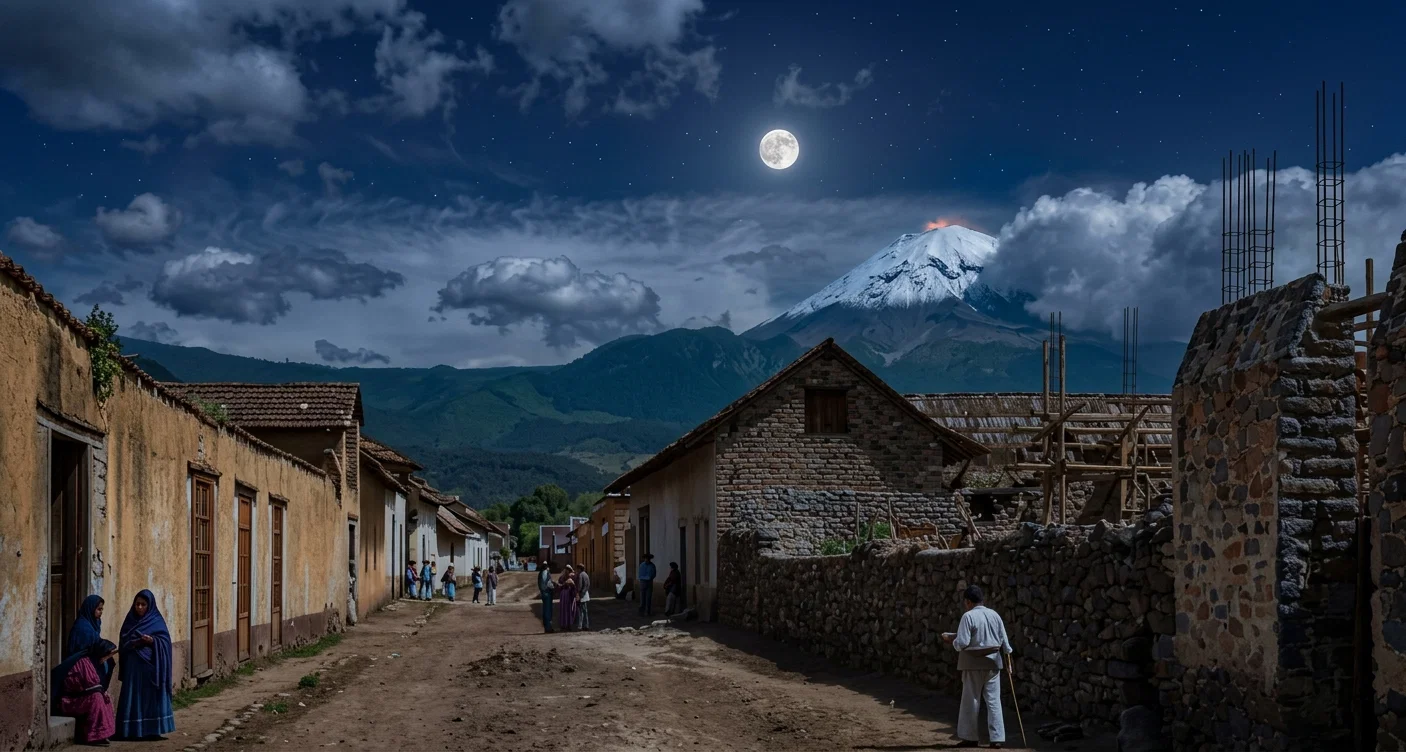
In times of great calamities the people have instinctively sought refuge in the mountains or upon the high places. When the waters of the Deluge were washing out the sin of a polluted world, the people, spurning the true refuge, sought refuge upon the mountain tops. When the descendants of Noah let go their hold on God and turned themselves to their own selfish service and the pleasures of sense, they must have a tower of refuge. Forsaking the refuge already prepared, they would make a refuge of their own, and thus prevent the destruction of their lives by another visitation from God. They thus seemed to think themselves able to protect themselves against any judgment God might see fit to bring upon them as a punishment for their iniquity. Such is the foolishness of human vanity and selfishness. When hostile armies invaded a land, it was a common thing for the inhabitants to flee to the most inaccessible mountains to escape death or deportation to another country.
Popocatepetl, the Greatest of Mexico's Volcanic Mountains.
BECAUSE of this the people came to look upon the mountains as protectors, deliverers, and places of refuge. To the heathen mind this came, finally, to have a religious significance, and they placed the polluting symbols of their idolatrous worship upon the hills and mountains. Whenever the Israelitish nation was ruled by wicked, sensual kings, this heathen idea was carried out throughout the realm, and the people went after Baal and Ashteroth whose altars were on the high places. When a king came upon the throne who feared and served the true God, the hill groves of idolatry were hewn down, the mountain altars were overthrown, the people learned righteousness, and learned to seek the true place of refuge.
Now, in the time of the approach of earth’s greatest calamity, the people are preparing for themselves places of refuge—towers of their own construction—or are fleeing to refuge hills created by their own philosophies. The antediluvians fled to their hills of refuge; but the waters of judgment lapped the highest crags and went over them, to silence forever their ribald mirth and stop forever the profanity of their career. The dwellers on the plains of Shinar built their tower to protect themselves from the consequences of their sins; but the lightnings of the Lord demolished their tower and scattered them with the tongue of confusion to the four corners of the earth. The ancient mountains of refuge have become things of terror, trembling with the suppressed power of execution, or belching out death in fiery missiles or poisonous hurricane. Vain are all such attempts to find deliverance in a way or a place that God has not prepared.
TO-DAY many are spurning the work of the Redeemer in their behalf, and are turning their eyes inward to find within themselves the tower of their strength and salvation, the high mountain of their deliverance. Others are living upon a perverted interpretation of God’s requirements, trusting more in their own powers to make a convenient way of salvation than in the one only way already provided by the Lord Himself. Others are trusting in “good works,” or in self-asserted “holiness” or “sanctification,” without regard to the distinct requirements of God’s great, perpetual, unchangeable law; others in their wealth or station; and others there are who make no pretense of seeking a refuge or trusting in anything whatsoever. But the day is coming, and that soon, which will “try every man’s work of what sort it is,” every man’s refuge of what material it has been builded.
In that great day when long-patient justice begins to perform its great and impartial work, every man will look first to that in which he has been trusting. Those who have been trusting implicitly in God and the way He has prepared will look up and lift up their heads, because their redemption draweth nigh. They will say: “Lo, this is our God; we have waited for Him, and He will save us; this is Jehovah; we have waited for Him, we will be glad and rejoice in His salvation.” Isa. 25:9. The class that has at that time been trusting in Him as a refuge, in His Word as a guide, in His law as an expression of His will, will be the only class that will have any spirit of gladness, any desire for rejoicing. Of the refuge of thatother class, represented by the ancient enemy of God’s people, Moab, the Word says: “The high fortress of thy walls hath He brought down, laid low, and brought to the ground, even to the dust.” In that great day the mountains will furnish no refuge; for “the heaven was removed as a scroll when it is rolled up; and every mountain and island were moved out of their places. And the kings of the earth, and the princes, and the chief captains, and the rich, and the strong, and every bondman and freeman, hid themselves in the caves and in the rocks of the mountains; and they say to the mountains and the rocks, Fall on us, and hide us from the face of Him that sitteth on the throne, and from the wrath of the Lamb: for the great day of Their wrath is come; and who is able to stand?” Rev. 6: 14-17. But the mountains will refuse to hide them, tho they flee to the topmost pinnacle. The Lord says through Isaiah: “The day of the Lord of hosts shall be . . . upon all the high mountains” (ch. 2: 13-14); “The mountains shall be melted with their blood, . . . and the heavens shall be rolled together as a scroll” (ch. 34: 3, 4); “Thou shalt thresh the mountains” (ch. 41: 15).
BUT in that most searching and trying time the Lord’s promise to His people is, as to His people anciently, when entering the typical land of promise: “The eternal God is thy refuge, and underneath are the everlasting arms.” And through the Psalmist He tells us: “Jehovah also will be a high tower for the oppressed, a high tower in times of trouble;” “God is our refuge and strength, a very present help in trouble. Therefore will we not fear, tho the earth do change, and the mountains be shaken into the heart of the seas.” So let us say with David: “My soul taketh refuge in Thee; yea, in the shadow of thy wings will I take refuge, until these calamities be overpast.” That is the true refuge, the only refuge there is worthy a moment’s thought. In the great day of earth’s greatest tribulation, so fast approaching, they who have chosen that mountain of refuge, that high tower of strength, will have no need of fear. The everlasting arms are underneath; the protecting wings are over and around; and they are safe.

THE GREAT APOSTLE TO THE GENTILES.

BY MRS. E. G. WHITE.
From a zealous persecutor of the followers of Christ, Paul became one of the Saviour’s most effective and devoted workers. At the gate of Damascus, the vision of the Crucified One changed the whole current of his life. The days of darkness spent in solitude at Damascus were as years in his experience. The Old Testament scriptures stored in his memory were his study, and Christ his teacher. To him also nature’s solitudes became a school. To the desert of Arabia he went, there to study the Scriptures and to learn of God. He emptied his soul of the prejudices and traditions that had shaped his life, and received instruction from the source of truth.
His after-life was inspired by the one principle of self-sacrifice, the ministry of love. “I am debtor,” he said, “both to the Greeks, and to the barbarians; both to the wise, and to the unwise.” “The love of Christ constraineth us.”
Henceforth his life was wholly devoted to the service of the Master. Afterward when engaged in ministry for Christ, he would relate, in the power of the Spirit, the circumstances of his conversion. So impressive were his words that those who were filled with the bitterest hatred against the Christian religion, could not withstand them.
Paul was an unwearied worker. He traveled constantly from place to place, sometimes through inhospitable regions, sometimes on the water, through storm and tempest. He allowed nothing to hinder him from doing his work. He was the servant of God, and must carry out His will. By word of mouth and by letter he bore a message that ever since has brought help and strength to the church of God. To us, living at the close of this earth’s history, the message that he bore speaks plainly of the dangers that will threaten the church, and of the false doctrines that the people of God will have to meet.
From country to country and from city to city Paul went, preaching of Christ, and establishing churches. Wherever he could find a hearing, he labored to counterwork error, and to turn the feet of men and women into the path of right. Those who by his labors in any place were led to accept Christ, he organized into a church. No matter how few in number they might be, this was done. And Paul did not forget the churches thus established. However small a church might be, it was the object of his care and interest.
Paul’s calling demanded of him service of varied kinds,—working with his hands to earn his living, establishing churches, writing letters to the churches already established. Yet in the midst of these varied labors, he declared, “This one thing I do.” One aim he kept steadfastly before him in all his work,—to be faithful to Christ, who, when he was blaspheming His name and using every means in his power to make others blaspheme it, had revealed Himself to him. The one great purpose of his life was to serve and honor Him whose name had once filled him with contempt. His one desire was to win souls to the Saviour. Jew and Gentile might oppose and persecute him, but nothing could turn him from his purpose.
Writing to the Philippians, he describes his experience before and after his conversion. “If any other man thinketh that he hath whereof he might trust in the flesh,” he says, “I more: Circumcised the eighth day, of the stock of Israel, of the tribe of Benjamin, an Hebrew of the Hebrews; as touching the law, a Pharisee; concerning zeal, persecuting the church; touching the righteousness which is of the law, blameless.”
After his conversion, his testimony was:— “Yea, verily, and I count all things to be loss for the excellency of the knowledge of Christ Jesus my Lord; for whom I suffered the loss of all things, and do count them but refuse, that I may gain Christ, and be found in Him, not having a righteousness of my own, even that which is of the law, but that which is through faith in Christ, the righteousness which is from God by faith.”
The righteousness that heretofore he had thought of so much worth was now worthless in his sight. The longing of his soul was: “That I may know Him, and the power of His resurrection, and the fellowship of His sufferings, being made conformable unto His death; if by any means I might attain unto the resurrection of the dead. Not as tho I had already attained, either were already perfect; but I will follow after, if that I may apprehend that for which also I am apprehended of Christ Jesus. Brethren, I count not myself to have apprehended, but this one thing I do, forgetting those things which are behind, and reaching forth unto those things which are before, I press toward the mark for the prize of the high calling of God in Christ.”
See him in the dungeon at Philippi, where, despite his pain-racked body, his song of praise breaks the silence of midnight. After the earthquake has opened the prison doors, his voice is again heard, in words of cheer to the heathen jailer, “Do thyself no harm; for we are all here,”—every man in his place, restrained by the presence of one fellow-prisoner. And the jailer, convicted of the reality of that faith which sustains Paul, inquires the way of salvation, and with his whole household unites with the persecuted band of Christ’s disciples.
See Paul at Athens before the council of the Areopagus, as he meets science with science, logic with logic, and philosophy with philosophy. Mark how, with the tact born of divine love, he points to Jehovah as the “Unknown God,” whom his hearers have ignorantly worshiped; and in words quoted from a poet of their own he pictures Him as a Father whose children they are. Hear him, in that age of caste, when the rights of man as man were wholly unrecognized, as he sets forth the great truth of human brotherhood, declaring that God “hath made of one blood all nations of men for to dwell on all the face of the earth.” Then heshows how, through all the dealings of God with man, runs like a thread of gold His purposes of grace and mercy. He “hath determined the times before appointed, and the bounds of their habitation; that they should seek the Lord, if haply they might feel after Him, and find Him, tho He be not far from every one of us.”
Hear him in the court of Festus, when King Agrippa, convicted of the truth of the Gospel, exclaims, “Almost thou persuadest me to be a Christian.” With what gentle courtesy does Paul, pointing to his own chain, make answer, “I would to God, that not only thou, but also all that hear me this day, were both almost, and altogether such as I am, except these bonds.”
Thus passed his life, as described in his own words, “in journeyings often, in perils of waters, in perils of robbers, in perils of mine own countrymen, in perils by the heathen, in perils in the city, in perils in the wilderness, in perils in the sea, in perils among false brethren; in weariness and painfulness, in watchings often, in hunger and thirst, in fastings often, in cold and nakedness.”
“Being reviled,” he said, “we bless; being persecuted, we suffer it; being defamed, we entreat;” “as sorrowful, yet always rejoicing; as poor, yet making many rich; as having nothing, and yet possessing all things.”
In service he found his joy, and at the close of his life of toil, looking back on its struggles and triumphs, he could say, “I have fought a good fight.”

HEART-CLEANING

HEART-KEEPING is very much like housekeeping. There must be a continual sweeping out of dirt and clearing out of rubbish—a daily washing of dishes, and a perpetual battle with all sorts of vermin. If heart-cleaning could be done up once for all, then the Christian might discharge all his graces and have an easy time of it. And just because the assaults of subtle temptations are so constant, and the uprisings of sinful passions are so frequent, and the task of keeping the inward man what it ought to be is so difficult, many a one who begins a religious life gets discouraged and makes a wretched failure. The question with every Christian is: Shall these accursed Amalekites of temptation burn up all my spiritual possessions and overrun my soul? Shall outward assaults or inward weakness drive me to discouragement, and disgrace me before my Master and before the world? Or shall they drive me to Jesus Christ who will give me the victory?—Theodore L. Cuyler, D.D.

THE OPENED FOUNTAIN.

BY E. V. SHACKELFORD.
O ANCIENT house of David, Thou chosen of the Lord, Established, blessed forever, By His own gracious word;
Thou house of ancient glory, Of ancient, regal power, Thy ancient walls are shattered, Thy city and thy tower.
But, O, the cooling fountain, Whose waters never fail, Has stood the tests of ages, And ever shall avail.
It flows to all the nations; They drink and bathe and live, And weary, dusty travelers May one and all receive.
Thou precious, healing fountain Upon earth's desert shore, O, heal us, cleanse us, keep us, Now and forevermore.
Los Angeles, Cal.

LIFE IN THE VEGETABLE KINGDOM.

BY WILLIAM COVERT.
In the vegetable kingdom there is organic life, but no consciousness. In creation the Lord adapted the vegetable to serve the animal. Every individual plant runs its whole course without sensing its own existence. The goodness and wisdom of the Creator established it so. Things made capable of loving life, and of desiring to keep it, were not designed to prey upon other creatures that possess similar capabilities. Fear, pain, and destruction can not accord with eternal principles; therefore, the Lord did not ordain in the beginning that animal should devour animal. Such provision would consume, but not perpetuate, life—that which all animate beings hold most dear.
The work of creation was based upon harmonious principles. First, the mineral kingdom was set in order; then the vegetable, which feeds and depends upon the mineral, was organized; and, last of all, the animal was created and made to subsist upon the vegetable.
When this work was perfected, the Lord announced to man that he and all the lower animals were to subsist upon that which the earth should bring forth. “And God said, Behold, I have given you every herb bearing seed, which is upon the face of all the earth, and every tree, in the which is the fruit of a tree yielding seed; to you it shall be for meat. And to every beast of the earth, and to every fowl of the air, and to everything that creepeth upon the earth, wherein there is life, I have given every green herb for meat; and it was so.” Gen. 1:29, 30.
Should the legitimate and righteous order be observed among all creatures that subsist through eating, this would, of itself, remove a large amount of the sin, the pain, and the sorrow, which sadden the world. Plants, nuts, fruits, and grains do not suffer in preparation for the table, nor do they dread the ordeal of being eaten. They require no contrivance for depriving them of life. No mourning is experienced by them at the loss of their mates. None are ever disturbed by the removing of a neighbor. They make no battle against being taken, nor institute a warfare of retaliation. All food in the vegetable kingdom was made to be an unconscious, passive vehicle, in which the Creator could bear life to the animal world. The vehicle was pure, and admirably adapted to the lawful demands of every creature. Therefore, when the complement of earth’s first six days had taken on material form, the contemplation of it was refreshing even to Him who created it. “And God saw everything that He had made, and, behold, it was very good. And the evening and the morning were the sixth day.” Gen. 1:31. “And on the seventh day He rested, and was refreshed.” Ex. 31:17.

The Cedars of Lebanon.

The trees growing in the central ridge of the Lebanon range in Palestine are an interesting exhibition of life. Around them rise the loftiest peaks of the whole system, covered with perpetual snow. Among these the Lord has set apart a limestone hill conserving the historical cedars. About a dozen ancient trees in this grove, of which the Bible poets wrote, are living still. Some of them measure nearly forty feet in girth. These patriarchs of the hills are surrounded by a family of some four hundred younger members. Among the offspring are those which seem to have lived a thousand years.
David attributed the origin of this grove directly to the planting of the Lord. He said, “The trees of the Lord are full of sap; the cedars of Lebanon, which He hath planted; where the birds make their nests.” Ps. 104: 16, 17. What an excellent provision the Lord has made in the branches and foliage of these trees for the shelter and nestling of birds! Countless thousands of the feathered tribe have fledged under the protection of their evergreen boughs.
Nearly five hundred years after David wrote of these beautiful trees, there appeared in the poetry of Ezekiel a reference to the same grove, which he describes as “the cedars in the garden of God.” Eze. 31: 3, 8.

Building Up the Forest.

Behold the grand old sentinels of the forest, lifting their heads on high, like huge giants. As one looks upon these lofty ensigns of God’s grace, like ten thousand monuments pointing to the sky, feelings of awe come over his soul, and he is impelled to fall down and worship Him who “hath made His wonderful works to be remembered.”
While admiring these things of life, one is moved to search for the hiding-place of that power which lifts them up. Is it secreted in that little cone whence the mighty oak sprang? Did the chestnut burr, with its double trust of life, hold within its house the power to build up the tree? Were there knowledge and strength wrapped up in the winged maple seed, which enabled it to rear that symmetrical form? Did the soil and the seeds combine into a kind of trust to do all these wonderful things? Did the infant plants create within themselves those silent little pumps, which, by perpetual motion, propel their own machinery? Did they, of their own accord, enlarge and perfect themselves?
Rather, are not all these wonders performed by the abiding power of God, which, in the beginning, brooded over the earth? Is it not yet brooding over all nature? Understanding it thus, the mystery of budding seeds and growing plants is revealed.
A seed beneath the soil sends upward its little blade. Above are clods and crusts, which bind it down. But the life beneath seeks for light and air, and the hardened earth is forced to part and let the life be manifest. This is only the birth of a tiny plant, yet the process teaches an impressive Gospel lesson.
The Saviour, in showing how the working of grace within the heart is symbolized by the deliverance of the little blade from the ground, and by its subsequent development until the gathering of the ripened harvest, says: “So is the kingdom of God, as if a man should cast seed into the ground, and should sleep and rise night and day [in his anxiety to know how the seeds grow], and the seed should spring and grow up, he knoweth not how. For the earth bringeth forth fruit of herself; first the blade, then the ear, after that the full corn in the ear. But when the fruit is brought forth, immediately he putteth in the sickle, because the harvest is come.” Mark 4: 26-29.
There is ample potency embodied in every fertile seed; and this ever-present power opens the crusted ground, often turning aside things which it would be impossible for the infant germ to move.
In the same manner does the power of God lift the heavy burden from the anxious heart, break every yoke, and let the oppressed go free.
To the one who knocks for salvation, He says, “The door shall be opened.” No power can silence the plea. “Shall I bring to the birth, and not cause to bring forth? saith the Lord; shall I cause to bring forth, and shut up the womb? saith my God.” Isa. 66: 9.

MUSINGS

BY ELIZA VEEDER DOW.
“If ye love Me, keep My commandments.” God, Christ, and the prophets have been speaking to the human race down the ages.
A very small percentage of the human family is keeping the commandments of God, or even know if there be an eternal, all-powerful, everlasting God. How many people do you know, in your limited acquaintance, who are keeping the commandments of God, or that know exactly what the commandments are?
The average youth of to-day, in our high-schools and universities, know more of Hercules than they do of Samson; more of Spencer than of Moses; more of Shakespeare than of Isaiah; more of the ragtime songs than of the Psalms of David.
In fact, the rising generation is being educated by men and women who are void of spirituality and are not seeking to discover the soul of the youth.
The youth of to-day would rather yell, scream, run, screech, and yell some more, than to lift the soul to Almighty God in prayer and thanksgiving for their faculties of mind and body.
“If ye love Me, keep My commandments.”
O, Almighty and Everlasting One! We adore Thee, praise Thee, give Thee our hearts, minds, and souls! We want to understand Thy will concerning us, and we want to see Thy hand in all the changes that come to us.
May we all study the precepts, statutes, and commandments of God, and be factors in giving the Third Angel’s Message to the world. Let us be full of hope, courage, and good works, and keep the commandments of God, and be ready to meet the Lord when He shall come with the innumerable throng of holy angels.

God’s Will Glorifies Life’s Ills

Like some black cliff, smitten by sunrise into rosy and golden glory, the ills of life are tinted and glorified when the light of God's recognized will falls on them.—Alexander MacLaren.

The Industrial Conflict in the Light of Revelation.

By Geo. W. Rine.

THE CRY OF THE OPPRESSED; OR, PENURY VERSUS OPULENCE.

NEVER before was the material wealth of the world so great as it is to-day. The United States has quadrupled her wealth during the last fifty years. Her wealth is to-day greater than was that of the entire world one hundred years ago. During the nineteenth century the wealth of Christendom increased at a rate five times as great as did that of its population. If in 1860 all the money of the United States could have been divided in such a way as to give an equal share to every man, woman, and child, each would have received $13.85. By the year 1900 this per capita share of the monetary circulation had nearly doubled, being $25.98. If the richest man in America is able to earn even a net two per cent. on his capital, it means an increase of $20,000,000 a year. The greatest thinkers of the age regard the recent fabulous augmentation of wealth as one of the most marvelous and impressive phenomena of all history.

Destitution in the Midst of Plethora.

Yet, contradictory as it may appear, in the midst of our superabounding wealth a very large part of the human family is smitten with poverty as with an epidemic. The plethora of the palace stands in juxtaposition to the destitution of the hovel. Fabulous abundance on the one hand accentuating the ragged wretchedness on the other. The world is girdled with one unbroken wail of suffering and misery coming up from the huts and hovels of the poor. Beggary and semi-starvation are the estate of more than four hundred millions of Asiatics. “Unless the baleful forces that are now rampant in our civilization can be reversed, our land also will become—aye, is becoming—a receptacle for millions of famished dead.”
And yet there is obviously no limit to our ability to create wealth. The world is now, as was shown in an earlier article of this series, in the very plenitude of its harvest of literal gold. There is more than abundance for all. And yet we are confronted with the painful anomaly that, tho there is more wealth in the world than ever before, there is, on the other hand, more grinding poverty, more dire suffering from sheer want, than in any age of the past. There is obviously something awry in our social and industrial system. There is either a painful lack of charity or of justice or of both in the social world of to-day.
The oncoming of wide-spread poverty in the United States could not have been anticipated by the strong, rugged fathers who laid the foundations of our political and social institutions. They had come to a virgin world—a world practically inexhaustible in its sources of material riches. They made a covenant that, as far as in them lay, this land should be the home of religious, political, and industrial freedom forever. They saw that where freedom holds sway, there hope and abundance must likewise reign. Boundless were the resources of plain and valley, of field and hillside, of lake and river, of mine and forest.
The late Dr. Ridpath wrote an impressively vivid description of the roseate prospect which this land of the free presented before the rapt vision of the builders of the Republic. I quote in part:—
Nothing more bountiful ever offered itself to the cheerful hopes and ennobling ambitions of men than was revealed to the sober, industrious, and frugal people who came here out of smothered Europe, and began, in the seventeenth and eighteenth centuries, to occupy this glorious and prophetic land. It was the new Atlantis. Population came on like a sunrise. Intelligence abounded. Just before the Revolution there was not a native adult in all New England who could not read or write. We got on well. Poverty was unknown. Like patriot Titans we shook ourselves out of the Old-World condition and began an auspicious career of peace and plenty. We abandoned the past. We abolished primogeniture. We sent entail into the limbo of the moon. We mocked at Dei gratia as an absurd delusion of antiquity. We declared three inalienable rights of man; namely, life, liberty, and the pursuit of happiness. We ought to have added the free possession of land.
Under such auspices it is difficult to see how poverty could ever have supervened in the United States. Why should the cry of the poor be heard in this land, which was for nearly two centuries the home of open opportunity, and therefore of hope, plenty, and contentment?
The condition of social equality, of free industrial pursuits, of comparatively equal distribution of wealth, of common happiness, with superfluity for none and destitution for none, continued to prevail in our country down to the outbreak of the Civil War. The humble homes of the common people abounded with the essentials of human well-being.
When the French author de Tocqueville visited America in 1833, he remarked with enthusiasm that nowhere else had he seen so equable a distribution of the country’s wealth and so marked an absence of capitalistic speculation. However, fifty years later, when the Hon. James Bryce, M. P., visited America, he was so astonished at what he saw there in the shape of industrial trusts and money princes that he exclaimed, “I see the shadow of a new structure of society—an aristocracy of riches.”
It is an axiom of history that just to the degree that a nation’s wealth becomes consolidated under the control of a few, does poverty, with all its attendant woes, become general and acute. Dr. Lyman Abbott recently told his readers that one hundred and twenty-five families own as much wealth as all the other families in the United States put together. This being true, must it not also be true that, in the very nature of things, scores of thousands of families must be hopelessly poor? In the terse phrase of Bishop Potter, “The growth of wealth and of luxury, wicked, wasteful, and wanton, . . . has been matched step by step by a deepening and deadening poverty.”
“We are the richest people under the sun,” proudly ejaculated one of the political orators in the last presidential campaign. “And the poorest,” was the shrewd retort of a listening workman. Yes, we are both the richest and the poorest. “Despite the boast of wealth and luxury,” declares a recent writer, “we find upon inspection an increasing amount of poverty and wretchedness, coupled with unremunerative toil. Modern fortunes are no longer the reward of honest industry, but of governmental favoritism, over-exaction from the masses, and the power of cumulative wealth. . . . The iron heel of aggregated capital is tramping on the rights of the laborer, and converting him into a slave. Like a heavy pall the doom of perpetual servitude hangs over the enslaved masses, while increasing comforts, luxuries, and ease are for the favored few. The ‘communism of capital,’ which is begotten of selfish greed, and born of grasping avarice, is as heartless as Moloch. Like a vampire it sucks the life-blood of honest industry.”
About four years ago the Chicago Times-Herald soberly affirmed that there were 8,000 families in that city who were suffering the agonies of slow starvation; that it had 40,000 mothers, fathers, and children begging for a pittance of food to keep body and soul together. In the winter of 1896–97, wrote the editor of a New York paper, there were, on an average, seventy families daily evicted from the New York tenements for non-payment of rent. They could get no employment, and of course could pay no rent. The sufferings of the unfortunate tenement people became so appalling that the courts finally had to refuse to issue writs of ejectment on stormy days, because the heartless landlords would place half-famished women and children in the street with no place of shelter from raging blizzards. And in that same city, perhaps the richest in the world, eight per cent. of the population own all the land on which the city is built.
In a report of the New York Board of Lunacy, it is stated that in the metropolis alone, 7,000 women become insane every year as the result of their being the victims of the torturing fear and suffering begotten of extreme poverty. What a horrible travesty is this gruesome fact on the allegation repeated with so much unction by clergymen and others who ought to know better, that this is a “Christian nation”! The stinging arraignment of the “social system” which makes such a tragedy possible, uttered by the late Senator Ingalls, is most pertinent in this connection. I insert a short excerpt:—
A social system which offers to tender, virtuous, dependent women the alternative between prostitution and suicide as an escape from beggary is organized crime for which some day unrelenting justice will demand atonement and expiation.
Mr. Godard, an English writer on the social sciences, commenting upon our Lord’s statement, “For the poor ye have always with you,” wrote: “To-day we take up the same bitter cry. Nay, it has grown in volume as the years have sped; and increasing prosperity seems but to accentuate it. The nation [England] has accumulated riches, but the poor remain; and the very advance of civilization, with its diversified refinements, comforts, and luxuries, its expansion of industry, and development of commerce, has given rise to forms of poverty peculiar to itself; and with the masses of the workers, has rendered their toil more severe, their surroundings more dreary, and their lot more depressing. ‘Progress and poverty’ have gone hand in hand.”
Another writer declares that never before in the history of England, excepting the short, disastrous period at the beginning of the last century, has the absolute number of the very poor been so great as it is now. Nearly one-tenthof the population are in receipt of the Poor Law relief. But a much larger portion of the English people suffer abject want without being actually penniless, and just contrive to drag on a more or less cheerless existence by means of intense and bitter drudgery.
The noted English critic and orator, Mr. Frederick Harrison, said, but a few years ago:—
Ninety per cent. of the actual producers of wealth have no home that they can call their own beyond the end of the week; have no bit of soil, or so much as a room that belongs to them; have nothing of value of any kind except as much as will go in a cart; have the precarious chance of weekly wages which barely suffice to keep them in health; are housed for the most part in places that no man thinks fit for his horse; are separated by so narrow a margin from destitution that a month of bad trade, sickness, or unexpected loss, brings them face to face with hunger and pauperism.
The Royal Commission appointed to inquire into the housing of the working classes, reported that the evils of overcrowding, especially in London, were a public scandal, and were becoming, in certain localities, more serious than ever before. Six to twelve persons of both sexes living in one small room; seven persons in an underground kitchen, six in a wash-house, thirty-eight persons in one small house, and in one instance, the husband, wife, four children, and a widow with her child, occupied a single room. They found people sleeping on shelves as on ship-board; children sleeping under their parents’ beds; and a typical case was a house of nine rooms, occupied by sixty persons, with but one bed in each room. “In the richest city in the world, one out of every five persons, or probably one of every four adults, dies a pauper’s death,” the Commission declared.
The readers who have read Mr. Riis’s notable book, “How the Other Half Lives,” know that the condition of the poor in our own metropolis, New York, is almost equally terrible and hopeless.
In January, 1903, Justin McCarthy, M. P., in an article contributed to the New York Independent, stated that the number of the unemployed in London is growing greater and greater every day. He says that the poor in London amount to a population numerically as great as the whole population of many a foreign capital; that in the East End of the city there was absolute starvation going on at the time he wrote. All the charitable institutions had exhausted their means in trying to raise supplies of food for the famishing residents in the “garrets and cellars of London lanes and alleys.”
Mr. McCarthy frankly avers that much of this destitution was the direct result of the fact that the nation is “overtaxed in order to meet the expenses of the recent campaigns in South Africa, and a part of the taxation has been raised by a duty on the material from which bread is made, and by an increased duty on sugar.” He significantly adds: “The mere existence of such a class of sufferers is in itself a cruel satire on the glories of war. Perhaps there may be some comfort to the men now vainly seeking for bread in London streets and lanes after their return from the fields of fight, when they call to mind the fact that they are starving in the cause of England’s supremacy over the two South African Republics.” This he wrote in a vein of scorching irony.
It has been estimated by a conservative statistician that one of the richest English dukes gets as much money in one year for doing nothing as a skilled workman would get for 4,000 years of hard and useful work. Of the 40,000,000 people of the British Isles, 25,000 own more than one half of the entire national wealth. One-fifth of the 40,000,000 people live constantly “face to face with starvation.” This again shows how very rich are the English rich, and how very poor the poor.
(This article will be concluded next week, by a consideration of the “Paramount Cause of Poverty.”)
Continue reading: FIRST SAMUEL