The mission selected and located by Brother Anderson, and known as the Barotseland Mission, consists of five thousand acres, part of which is open and part bush—veldt or prairie. The place is two and a half miles wide, and three and a half miles long. It lies the long way east and west. The Magoi River, a small stream the year round, runs through the farm the narrow way, dividing it with three thousand acres to the east, and two thousand to the west. The buildings and improvements are on the west side. The whole farm lies on an elevated plateau that constitutes the water-shed between the Zambezi and Kaffue Rivers. The soil is a deep, sandy loam, and very productive, if one can judge from the crops and native grass, much of which is ten feet high. In addition to the Magoi, there are two other small streams running through the farm, and a large fountain, or water-hole, from which water is obtained for cooking and drinking purposes.
It is now nearly two years since Brother Anderson began to make improvements on this place. In that time, he has built a pole-and-mud dwelling-house, twelve by forty-eight feet; a storeroom, twelve by thirty-six; a dining-room and schoolroom combined, twelve by twenty-four, and eleven round huts for natives, six feet high and twelve feet across. All these buildings are made of poles and mud, and roofed with grass, except the dwelling, which is covered with corrugated iron. About three hundred feet back of the natives' quarters, they have built a large cattle kraal, and divided it into different compartments, one to contain the oxen, another the cows, and a third the calves and goats. These kraals are built by planting long poles side by side deeply into the ground, and binding them together toward the top with bark, or withes. When finished, it makes a strong enclosure, averaging from twelve to fifteen feet in height, and furnishing perfect protection for the cattle against lions, hyenas, and other ferocious beasts with which the country is at present infested.
In addition to these improvements, he has a good-sized dooryard enclosed with posts and wire fence, and a back garden through which there is a walk leading back to the boys' quarters, on either side of which there is a row of papei-trees in bearing. In the same lot, back of the rows of papei-trees, he has planted seventy citrus-trees, divided between the orange, lemon, and grapefruit. Around this same lot he has twelve banana plants, fifty guava-trees, and nine passion-fruit vines. Elsewhere on the place he has twenty-five grape-vines, six apple-trees, six apricot-trees, six fig-trees, one plum-tree, and twelve quince-trees. Of farm crops he has eighty acres in mealies that look remarkably well; eight acres in peanuts, and twelve acres divided between potatoes, pumpkins, Cape gooseberries, and tomatoes. In the stock line, he has seventeen oxen, thirty-six cows, thirty-two calves, and thirty goats. The mission family at present consists of thirty-six boys, one married woman, and a young girl. No buildings have as yet been erected to accommodate girls. All the work of caring for the stock, planting and cultivating the crops, and looking after things in general has been done by the boys outside of school hours. The daily program by which the mission is run is as follows: Rising, summer, 5 A. M.; winter, 6 A. M.; work from 5 to 7; breakfast and worship, 7 to 8; work, 8 to 10; school, 10:30 to 1:30 P. M.; dinner, 2 to 3; work, 3 to 6; worship, 6:45 to 7:15; evening study, 7:15 to 8:45; retiring bell, 9.
It is Brother Anderson's plan to build up a central mission at this place, from which native teachers may be sent out to the tribes living within a radius of fifty or one hundred miles. Already one of his boys has begun work at a point fifty miles from the mission. We visited a few kraals during my short stay, that I might get some idea of the people, and their mode of living, and general habits of life. The ones we visited were indeed raw heathen, living in ignorance, squalor, and filth, almost on a level with their cattle and goats, with whom, in some instances, they shared their dwellings. It is certainly virgin soil in which this mission is located, and the prayers of God's people, far and near, should ascend to heaven, that Brother Anderson and his assistants may be preserved in health, and given wisdom to know how to reach this people with the gospel, which alone can rescue them from the darkness of heathenism and ignorance into which they have fallen, and fit them for a home in the kingdom of God.
In harmony with the program laid out for my trip, I was obliged to leave Brother Anderson's mission on Wednesday, February 20, and return to Buluwayo, at which place I arrived Friday morning, February 22, and was met by Brother Sturdevant, and driven in a farm wagon, drawn by four mules, to the Solusi Mission, which is located thirty-two miles a little south of west of Buluwayo. Owing to the recent heavy rains, the roads were bad, and some of the rivers we had to cross were swollen, which, with their steep banks, and deep, sandy bottoms, made them both difficult and dangerous to cross. But the Lord favored us on our journey, and much to our delight, we reached the mission nearly15an hour before the beginning of the Sabbath.
Little did I think, when associated with Brother and Sister Sturdevant in labor in the southern part of the United States eleven years ago, that the next time we should meet would be at the Solusi Mission in South Africa. I was pleased to see them looking so well, and to learn that the Lord had dealt kindly with his servants during their five years' residence at the Solusi Mission.
Word had gone out that I was expected at the mission on Sabbath, so when the day came, there was a large attendance of the natives from the kraals near by. Among the company there were five chiefs, including the paramount chief of the district. I spoke to them through an interpreter for over an hour upon the third angel's message, giving the time and showing from the large map the place of its rise. I then traced its progress through the different countries, pointing out the places where our various missions in their own country were located, telling them at the same time how rapidly this message is going in these last days, and that it will be closed in this generation, by the coming of the Lord, when those who are prepared by the forgiveness of their sins and obedience to his commandments, will be taken home to glory. They all listened intently, and seemed to comprehend the greater part of what was said, for in the years that this mission has been in operation, they have heard more or less about the third angel's message.
The Solusi Mission consists of two farms, of six thousand acres each. This land was selected by Peter Wessels and Brother Druillard in the year 1892, and the mission was formally opened in 1894 by the arrival of Brethren Tripp and Anderson and Dr. Carmichael. This mission was first known as the Matabele Mission, but lately the name was changed to “Solusi,” in honor of the head chief of the district. During the Matabele uprising of 1896-97 our brethren had to flee to Buluwayo for a time for safety. During their absence the government built upon the mission farm, one half mile from the mission buildings, what they called Fort Solusi. It consisted simply of earthworks, thrown up around a good-sized umquoampunzi-tree, in three forks of which, about fifteen feet from the ground, was placed a Gatling gun, so as to command the mission and surrounding country. The primary object was to protect the loyal natives in the surrounding kraals, yet at the same time it stood as a protection to the mission.
The first few years of this mission were marked with an up-and-down experience, not occasioned, however, by any lack of energy or consecration upon the part of the missionaries, but from the absence of any definite plan to work to, and the lack of experience in this kind of work, and a series of calamities over which they had no control. Just as they were getting fairly started in their work, the Matabele uprising broke out, and they were compelled to flee to Buluwayo for protection, where they remained nearly seven months. Directly after this was over, and they were fairly getting started again, the famine came on as a result of the war, and a large number of the natives died. The famine was followed by a plague among the cattle, known as the rinderpest. In September, 1897, Brother and Sister Armitage connected with the mission, and he at once began the erection of three brick dwelling-houses. These houses were finished by the end of the year, and taken possession of by the three families at the mission; namely, Brother Tripp and family, Brother Anderson and family, and Brother Armitage and family. In about one month following, or in February, 1898, an epidemic of fever broke out, which prostrated nearly every member of the mission family, and resulted in the death of Elder Tripp and his little boy, Dr. Carmichael, Sister Armitage, and Brother Sparrow's little girl.
Brother Taba, their native interpreter, and a number of other natives connected with the mission, also succumbed to the disease.
In the month of April, 1899, the mission force was strengthened by the arrival of Elder F. L. Mead and family, Dr. Green and wife, Brother Lloyd and wife, Brother Chaney, and Sister Hiva Starr, in all a company of ten. This number, added to those who survived, or escaped the fever; namely, Brother and Sister Anderson and Brother and Sister Armitage (formerly Sister Tripp), made a company of fourteen. Up to this time, practically nothing had been done in the way of a school for the natives, except the teaching of the twenty-five orphans who had been gathered in as a result of the famine.
After the arrival of Elder Mead, school work for the natives began to develop gradually, but for the two years following his arrival, nearly the entire time of the men connected with the mission was devoted to trading with the natives, buying their grain in small quantities, and hauling it to Buluwayo, and selling it at an advanced price. Two or more outposts for trading were established, and in this way quite a profitable business was carried on. The means thus obtained was used in paying the workers, erecting buildings, and increasing the facilities for carrying on an industrial mission for the training of native evangelistic workers.
Near the close of the year 1899 Hiva Starr returned to the States, and in 1900 Brother Lloyd and wife followed. In the early part of 1901 Dr. Green and wife also returned to the States. Later on, in the same year, Brother Armitage and wife went to Somabula, one hundred and fifty miles to the northeast, and opened up a new mission. During the same year Brother Chaney went to Cape Town on account of failing health. Near the close of the same year, Elder Mead died at Kimberley, on his way to Cape Town to attend the meeting called to organize the South African Union Conference.
Early in the year 1902, Elder Sturdevant and family arrived to connect with the mission. Shortly after his arrival, Sister Mead and her son and daughter returned to Cape Town, where Sister Mead died a few months later. Thus in a little over three years, the company of ten that came to the mission with Elder Mead were all gone from the mission and mission work, except Brother Chaney,—five returning to the States during the first two years, Elder Mead and wife having died, and their children taken up their residence at the Cape.
FALLS OF THE PARANA — THE NIAGARA OF SOUTH AMERICA
In 1903 Brother Anderson left the mission, and spent a few months in Barotseland, searching out a site for a new mission. Returning from this expedition, he spent a short time at the mission, and then went to Cape Town, where he remained until the first of March, 1904, when he and his family sailed for the States for a year's vacation. Returning to Africa in May, 1905, he and family went directly to Barotseland, and began work on their new mission in the month of June. In this way, the company of fourteen referred to elsewhere in this article as all being at the Solusi Mission at one time, were all gone inside of four years, and Brother and Sister Sturdevant were left alone.
The Solusi Mission, being the first one established, and the largest and best equipped of any of our missions in South Africa, and the one where all our experience thus far in conducting native missions has been obtained, I thought that this bit of history, gleaned from different persons formerly connected with the mission, might be read with interest, and studied with profit.
Santa Cathrina and Paraná Conference
By F. W. Spies
F. W. SPIES
The first year of the existence of the Santa Cathrina and Paraná Conference has terminated with its annual meeting just held at Curityba, Paraná. The president's address showed an encouraging growth both in finances and members, in this young conference. And as the growth in tithe was relatively more than in members, this evidently indicates a greater consecration to the work, and hence an encouraging growth spiritually.
The membership at the time of organization, Jan. 1, 1906, was 486, and the tithe paid during the year 1905 amounted to $1,624.30. At the close of 1906 the membership had increased to 549, being an increase of thirteen per cent, and the tithe paid during 1906 amounted to $2,229.95, thirty-three per cent more than the preceding year.
Although this new conference might have pleaded its great need of more men, and, consequently, more means, it has cheerfully given a tithe of its tithe to the South American Union Conference, amounting to $223; all its Sabbath-school offerings, $346.72; its week-of-prayer and a few other offerings, amounting to $108.33; thus giving the union, for its fields still more needy, the sum of $678.05. Thus the division of the former Brazil Conference, which included all of Brazil, has not only proved a blessing to the local work, in that it has greatly strengthened it, but these new conferences are assisting the union conference in a very material way in establishing the work in the yet unentered parts of South America. It is indeed encouraging to see this spirit of willingness to help beyond their own borders, on the part of these new conferences.16
Although not so largely attended as had been the meeting for organization, owing to the fact that Paraná is more thinly populated, and that it is very far from our Santa Cathrina brethren, nevertheless the conference was a blessing, and we trust the brethren will, as they return to their homes, seek for a closer walk with God, and greater earnestness and faithfulness.
Among the resolutions adopted was one expressing thanks to the Heavenly Father for the degree of blessing that has attended the work during the past year, and still greater faithfulness was pledged to the Lord and his work.
All companies were encouraged by a resolution to organize tract and missionary societies, where such do not already exist, with a view to carrying on a more organized missionary campaign.
As the past year's experience had demonstrated that the territory of the Santa Cathrina and Paraná Conference is still too large to be properly administered by one president, a resolution was passed providing that "we request the South American Union Conference to send another minister into this conference, who could take the responsibility of directing the work in one of the States, and thus steps be taken to effect a further division of this territory." The reasonableness of this request was apparent to all present as they realized that their president had not been able yet to visit all the companies in his conference during its first year's existence.
Another resolution recommends "that the officers of our churches give attention to encouraging discipline and order in their respective folds, especially giving attention to the proper keeping of the various books of the church and Sabbath-school, and the prompt sending in of reports at the end of each quarter to headquarters."
Steps were also taken to reopen the Brusque mission school, by asking the South American Union Conference to provide a teacher for that institution. All business of the conference was dispatched with the greatest unity. The nominating committee reported as follows: President, W. Ehlers; Secretary and Treasurer, Mrs. Mary Ehlers; Secretary of the Sabbath-school Department, Mrs. Mary Ehlers; Executive Committee, W. Ehlers, Aug. Olm, Jorge Wishral, Adolf Hort, Gustav Richter.
The committee on credentials and licenses presented the following report: For credentials, Waldemar Ehlers; missionary license, José Hindermann and Gustav Jankowski.
And now as this conference starts out on its second year's work, may the Lord's rich blessing attend all efforts put forth to advance his kingdom.
The Message in China
By A. C. Selmon
A. C. SELMON
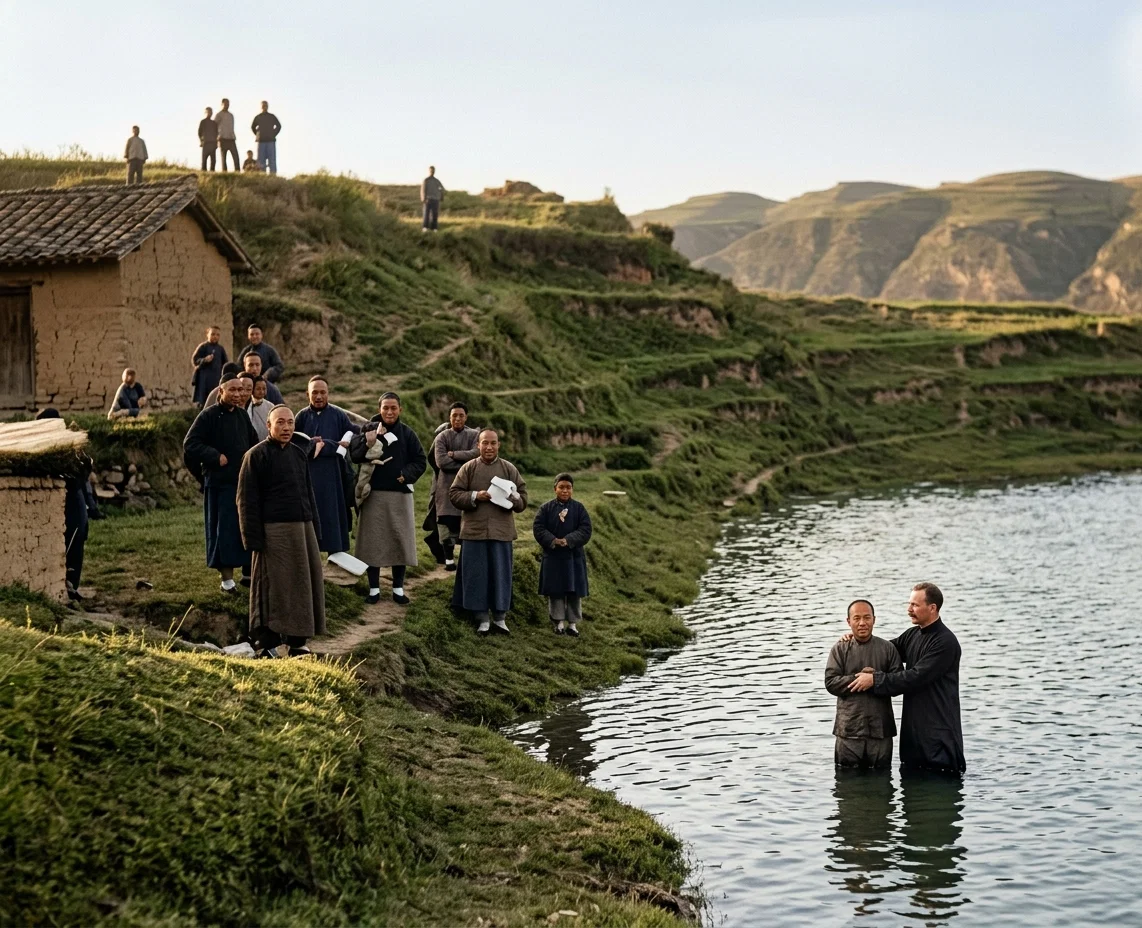
Last Sabbath, January 12, we baptized our first convert, Evangelist Wun. He has been keeping the Sabbath for two years. He has a good knowledge of the Bible, and is an able preacher. For some time he has been ready for baptism, but I felt that nothing would be lost by waiting. It is far better, especially in work for the Orientals, to be slow about baptizing, and wait to see the fruits of the Spirit.
DR. SELMON BAPTIZING EVANGELIST WUN
It was a good day for all the brethren here, just at the close of a two-weeks’ course of Bible studies and the week of prayer. In the evening of the same day four men signed the covenant to keep the commandments and to take the Bible as a guide in all things. It is really a beginning, and I am sure that there are not many among these people who will take hold of the truth, yet the Lord is beginning to gather out the few. The Sabbath truth is coming to the attention of many Sunday-keeping native Christians, through the influence of the little literature that we have been able to get out. It produces a stir among them, and in the end brings the faithful ones out.
No work in the Lord’s vineyard appeals to me so much as that of having a part in the training of native laborers, that they may go out and proclaim this message. I have faith to believe that the Lord will raise up a host of them, and that it will be almost entirely through this means that China’s millions will be warned of the soon coming of our Saviour. No foreigner can hope ever to get the language so that he can speak it anything like as freely as a native of this country. And then there is needed a knowledge of the people that comes only by long years of contact with them.
It has been remarkable to me how they respond to training: For example, this man, Evangelist Wun, was only a farmer boy when we first met him, and had only a meager education. We have taught him diligently for over a year now, and he is as different from the boy that came here as if he were another man. By having a sound Christian experience, his whole life has been changed; and when you know how superstitious and covetous, as well as insincere, the ordinary Chinaman is, you can see that to get rid of these traits makes a decided change. It seems evident that we can not expect enough foreign workers to come to China to spread the message, but there should be many fold more than there are here now, just to train native workers. The Lord has shown us that our literature will bring forth much fruit, and now we are seeking him to open up the way, that we may have facilities to push this work.
Siang-cheng Hsien, Honan.
Mission Notes
The following quotation from the Missionary Review shows the distribution of the Mohammedan peoples: “Of the estimated 200,000,000 Mohammedans, 5,000,000 are in Europe, 60,000,000 in Africa, and 135,000,000 in Asia. Of these 18,000,000 are under Turkish rule, 26,000,000 under other Moslem rulers, 32,000,000 under heathen rulers, and 124,000,000 under Christian rule or protection. Over 60,000,000 speak Indian languages — Urdu, Bengali, Pushtu, Gujerati, etc.; 45,000,000 Arabic, 28,000,000 Hausa and African languages, 20,000,000 Chinese, 15,000,000 Malayan, 13,000,000 Slavonic, 9,000,000 Persian, and 8,000,000 Turkish. Nearly every important city in the Moslem world of over one hundred thousand population is a center of missionary effort by printing-press, hospital, school, or college.”
Those whom fidelity to truth calls into lonely places and subjects to the ridicule and contempt of their generation, may take comfort from the fact that contempt does not always kill. To-day the advocates of foreign missions can look back with mingled amusement and pity at the attitude of those who opposed the sending of the gospel to the heathen a hundred years ago. One man, a stockholder of the East India Company, said in public at that time:—
“The sending of missionaries into our Eastern possessions is the maddest, most expensive, most unwarrantable project that was ever proposed by a lunatic enthusiast. Such a plan is pernicious, impolitic, unprofitable, unsalutary, dangerous, unfruitful, fanatic. It is opposed to all reason and sound policy; it endangers the peace and the security of our possessions.”
Things as bad as this, and with as little sound reason, are being said to-day about unpopular truths. But while such talk injures the one who indulges in it, and may stir up the passions of the thoughtless, it can not hinder or delay the triumph of truth.—Selected.
The Tamils of South India
By J. S. James
MARCH 15 I arrived in South India, my future field of labor, where my family had preceded me by two months. My coming to this part of India was for the purpose of working for the Tamils. A few words concerning this interesting people would not be out of place.
The languages of South India are of Dravidian origin. It is not known exactly when the Dravidians entered India, but the latest date is given in the fourth century. They come from the pure Aryan stock that entered India from Central Asia, by the northwest passage of the Himalaya Mountains. They made their way south, and scattered over the southern peninsula, where they are at present represented by twelve different tongues, six of which are cultivated languages. Chief among these six is the Tamil, which I am now studying. It is the earliest cultivated of the Dravidian dialects, and is considered the most copious, and contains the greatest number of ancient forms. About forty per cent of the language is borrowed from the Sanskrit.
Tamil is spoken from Nellore, fifty miles north of Madras, to beyond Cape Comorin on the south, and westward to the Ghats. This is an area of sixty thousand square miles, or larger than that of the State of Illinois. This contains sixteen million Tamil-speaking people alone, to say nothing of the millions speaking other important tongues, such as Telugu, Kanarese, and Malayalam. About one third of the population of the island of Ceylon speak Tamil, and it is spoken also in parts of Burma and the East Indies. The latest census places the entire Tamil-speaking race at eighteen millions, or more people than are found in Ohio, Michigan, Indiana, Illinois, Iowa, and Missouri. It is for these people that we expect to devote our lives, that they may have the third angel’s message in this generation. Think of a lone man and his family being set apart to work for a nation of people! Some of our workers in the home field are greatly burdened if asked to conduct a tent effort in some little village hamlet alone. Dear brethren, the race is not equal. These fields are calling for the gospel, and our prayers join their cries daily, that God will send more means and laborers into these needy fields. I am hoping that some good brother and his wife can be found to come and join us in this field. We believe the Lord will lay the burden on some of our dear brethren at home not only to give of their means, but to give their lives also for the needy millions of South India.
Shortly after arriving home, I was fortunate in securing the services of a first-class munshi (teacher). He is regarded in South India as an authority on Tamil, having contributed several works on education, in that language. He is a heathen, a high-caste Brahman, all of which is considered much to our advantage in getting hold of the real language. At the present writing (March 31) he has been teaching us about two weeks, and we are now able to read and write and pronounce two hundred and sixty different characters and combinations of the alphabet. Mrs. James is taking full work with me, and we endeavor to devote six hours each day to hard study. We are now reading in the first reader. This may sound simple, but it is necessary for one to begin at the bottom, and build up, in learning one of these languages, if he desires to translate and speak it intelligently.
The Tamil people are a very industrious race. They have been styled the Greeks or Scotch of the East. They are the least superstitious and most persevering of the Hindus. The majority of the coolies on the plantations of Ceylon are Tamils, and the majority of the money-making classes in Colombo belong to this people. The greater number of the domestic servants of the Europeans and of the camp followers in every part of the Madras Presidency are Tamils. They are noted for having built the largest temples above ground. Christianity has made encouraging progress among them, and they seem to yield quite readily to Western effort and influence. Other denominations have self-supporting churches among them, a thing very unusual in India.
Everything seems to clearly indicate that the time has come to take the message of our Lord’s soon coming to this people. As soon as I am able to do something with the language, I expect to visit the Tinnevelly district, where there is at present a community of five hundred native Christians who are keeping the Sabbath, and observing other features of present truth in a crude form. These people speak the Tamil language.
My family and I are enjoying the best of health, and our courage in the work was never better. We ask an interest in the prayers of our people in the home field, that our work in South India among this people may be blessed of God.
J. S. JAMES.
Bangalore, Mysore, India.
The Chile-Bolivian Mission Field
By F. H. Westphal
On my trip north I baptized six souls in Iquique. Others are awaiting baptism. In Antofagasta the elder baptized three: the elder at Copiopo, two; the local elder at Santiago, six; and the local elder at Nueva Imperial, six. On my last visit to Nueva Imperial and Bajo Imperial, five more were baptized, and here at Pitrufquen we are expecting to administer the rite to-morrow.
The circulation of literature is also progressing nicely. Brother Eduardo Thomann writes:—
“The Lord is blessing the circulation of literature very much. It is really wonderful how our paper is sold. Yesterday my sister went out at eight o’clock in the morning, taking with her seventy-five copies of the January number and twenty-five of the February issue of the Señales, and at two o’clock she returned, having taken seven subscriptions and sold seventy-seven single copies. This was her first experience in canvassing in Valparaiso.”
“I went out the evening after the Sabbath, and sold in two hours forty-nine copies of Señales, two Signs of the Times, and four Gute Gesundheit, making altogether a sale of $5.90. Yesterday (Sunday) I went out in the morning, and in four hours disposed of papers to the value of $9.30.”
Brother Steele writes: “I sold sixty-one Señales in one hour.” This is a little more than one every minute. Truly, if many were at work selling our literature, the drops of the latter rain would moisten the earth in all parts, and the Lord would soon come to gather his waiting people to their long-looked-for home. F. H. WESTPHAL.
Convents and Institutional Work in the Roman Church
By Chas. T. Everson
WHILE much corruption and sin exist in the convent and monastery, yet in the Church of Rome they occupy an invaluable place; for the mystery of iniquity can easily use means that would not be legitimate in the work of the mystery of godliness.
The convents and monasteries are indispensable to the progress, and we might say the very existence, of the Church of Rome. Catholicism depends very little upon preaching as a means of propaganda. Protestantism preaches and instructs the people, and thereby endeavors to build them up in the principles of righteousness. But the Church of Rome preaches very little, as her power is found to flourish best among those who are little informed, but who have a blind, bigoted faith. The Catholic Church therefore does not depend much upon preaching to hold its prestige and enlarge its borders, but puts its reliance largely upon institutional work. It maintains large hospitals, orphanages, schools, colleges, and institutions of various kinds. These institutions are generally under the control of some convent or monastery.
In the hospitals maintained by the church, or in which they have a leading voice, the interests of the church are served in a remarkable way. The hooded nun has long been associated in the public mind with the care of the sick. In the hospitals under Catholic control the monks and nuns are the nurses, and even in the government hospitals of Italy the nuns still serve as nurses, and hold almost a monopoly of this branch of the medical science. The influence that the Church of Rome wields in this branch of its work can not be overestimated. The Catholic nurses work upon the hearts of the sick and suffering with kindness and insinuations, so that those indifferent to the church become attached to it by new ties. The Protestant coming under their care is kindly treated, and every effort is made to induce him to embrace the Catholic religion. But if they find that he remains stubborn in his “heresy,” they try a new tactic upon him, and threaten and abuse him. Every means is used under these favorable conditions to gain converts to the Church of Rome.
Not long ago a young priest who had recently left the Church of Rome fell sick, and as there is no Protestant hospital at Rome, he was brought to a Catholic one. He was so hampered and dogged by the priests and nuns that he18finally yielded to taking the Catholic communion before he died. After his death a friend of mine who went to see this priest was told that they had taken care of him, and would bury him in their cemetery as he had returned to the church before dying. Such incidents as this ought to show us the necessity of having some place here at Rome where those who are struggling after the light and truth might go when sickness overtakes them, and where the impressions of the truth might be deepened instead of destroyed.
The reason that the nuns are retained as nurses is not because they necessarily make the best workers in this capacity, but because they have a monopoly of the place. The people would gladly accept other help of this kind; but who will provide it? Here is an opening waiting for the consecrated nurses of the third angel’s message to step in; and they are really the ones to fill it. I hope that something may be done in this direction before long.
The church depends upon its convents to furnish the needed help to carry on its hospitals. Also the monastic life enters into the work of the orphanages. The nuns by means of orphanages gain hundreds and thousands of members for Catholicism every year. The principles of Catholicism are instilled with persistence into the tender young minds of those who are wholly dependent upon institutions. As a consequence the orphans, when grown to manhood and womanhood, go forth from these institutions bigoted Catholics, and it takes miracles to gain them from the bosom of the church. These, in turn, found families, and to the minds of their children they impart the same superstitious teachings and prejudices which they have received while in the orphanage. Thus the influence of the convent is felt for generations. These monastic orders hold other institutions also under their sway, such as old people’s homes, and institutions for the blind, cripples, etc. If one of the inmates of these homes were disposed to embrace any other religion than the Catholic, he would find himself immediately at a great disadvantage.
In Turin we have a member of our church who is in an old people’s home that is a government institution, but under clerical influence. One can hardly imagine the struggle this brother has had in order to remain faithful to the principles of the truth.
Likewise in the institutions for the infirm these religious orders dominate and rule the inmates, soul and body. You will doubtless ask what advantage the church gains from these institutions for the blind, the infirm, etc. They serve a double purpose in the economy of Catholicism. In the first place, for these institutions they can get large endowments and gather many alms, and thus greatly enrich the church; and in the second place, they serve to keep the people faithful to the church, as it will provide them with a place of refuge in old age or in case of some infirmity of any other nature. In countries where the people live from hand to mouth with little prospect of laying by any money, the helplessness of old age and sickness is ever a giant specter before them. The church has institutions where they can be cared for in old age, and consequently they must try to hold the friendship of the church.