WHEN God in His infinite love for lost humanity “gave His only begotten Son, that whosoever believeth in Him should not perish, but have eternal life,” He gave more, infinitely more, than He could possibly receive in exchange. When the Son of God died for this rebel race, the reward for His sacrifice was utterly inadequate. But He asked nothing, knowing that the world in its sinful condition could give Him nothing worth having. And yet, in spite of the poor recompense, the Son of God is content with the bargain, if only man is redeemed, for “He shall see of the travail of His soul, and shall be satisfied.”
How, then, can men complain if after years of labor and the expenditure of vast sums of hard-earned money, little fruit is seen in the harvest? Missions are supported for years and years, and the results are so meager. Men give their lives to the work of teaching the Gospel, and die with but a handful of believers to show for the years of service. But in scores of dark places in the earth where this has been the experience, sometimes where not a soul has been converted, in the after years an abundant harvest has developed. Still must the believer toil on—the harvest must come, for God is true, His word will not return unto Him void, but, He declares, “it shall accomplish that which I please, and it shall prosper in the thing whereto I sent it.”
Therefore, “in the morning sow thy seed, and in the evening withhold not thy hand: for thou knowest not which shall prosper, whether this or that.” It may be that all may appear to be lost, but as God Himself is our example, we may not withhold the sowing. He freely gave Heaven’s best for man; we can give our little for no better purpose.
H.
Compromise With Sin
By Ellen G. White
REAL piety begins when compromise with sin ends.— Mrs. E. G. White.
Not in Oneself
Not in oneself is life, tho it is so taught by some of the isms of to-day. Poor, fallen, hopeless mankind are told to look within themselves for strength and encouragement, and yet the source of life lies outside of man. “With Him [God] is the fountain of life.” Jesus declares: “I came that they might have life.” The very expression implies that the world was without the life which He had to give. Again we are told that “he that believeth on the Son hath eternal life; but he that obeyeth not the Son shall not see life.” The life’s source is in God, and man only obtains life by a living connection with God through Christ Jesus. He does not obtain that by looking within himself, but by looking away from himself to Christ. When the Israelites, bitten by the poison serpents, were dying in the wilderness, they found no help in looking to themselves, or in hoping that power within themselves could save them from the deadly poison coursing through their veins. Their only hope was to look to the serpent lifted up on high in simple obedience to the word of God. It was not the piece of brass upon the pole which healed, it was faith in the living Word.
The first day's reading of our Old Testament lessons covers the last two chapters of 2 Kings: the taking of Jerusalem by Nebuchadnezzar; the carrying into captivity of many of the children of God; the rebellion of Zedekiah and the final capture of the Jewish nation. A little company under Gedaliah was left in the land.
The books of Chronicles are in the third part of the Jewish calendar where they form one book and are called “Words or Acts of Days.” That is, they are minutes of events, lists of names, and the like. In the Septuagint they are called by a Greek word meaning “Things omitted or passed over.” Our common name comes from the Latin title Chronica. Some suppose that they were compiled and written by Ezra. The writer and compiler of Chronicles gives much more attention to the house of Judah and the priesthood than does the writer of Kings. The first nine chapters give us lists and genealogies of the various tribes with now and then some very interesting matters thrown in. Chapter 10 records the death of Saul and gives us the reason for his reverses; David’s mighty men are numbered in chapters 11 and 12. Chapters 14-18 are concerned with David’s plan concerning the building of the house of God and various things that took place in connection with it. Included in this information is the bringing of the ark of God to Jerusalem and the inspiring psalm found in the 16th chapter.
Our New Testament lessons begin with the 5th chapter of John and close with the 7th chapter. Remarkable and spiritual instruction from our Lord concerning His work, the power conferred upon Him, and the necessity of eating of the Bread of Life. The week’s lessons are packed full of great spiritual truths which will feed the soul that truly desires to be fed.
The Captive Hasteneth
By R.
THE captive exile hasteneth that he may be loosed, and that he should not die in the pit.” Isa. 51:14. This is the natural law of captivity. Man loves freedom and hates restraint. If his liberty is taken from him, and he is shut in a dungeon, under all ordinary circumstances he is glad and ready and eager for release. When the day comes that ends the prisoner's sentence, he waits with eagerness for the moment when the warden will come, open the door, and let him forth to freedom. At such a time he needs no earnest invitation; he “hasteneth.”
But there is a captivity with which men seem satisfied. The proclamation of soul-emancipation has been issued; the door stands open; the bonds are loosed. But the “captive . . . hasteneth” not; he loves his imprisonment; he has been a captive and a slave so long that he prefers it. When the news comes that tells him he is free, he still sits in his dungeon. “Shake thyself from the dust; arise, . . . loose thyself from the bands of thy neck, O captive.” Isa. 52:2.
In 1903 three colored people were found in Mississippi who did not know that nearly forty years before they and all their race had been set free by the sovereign power of the United States. They had been picking cotton on a plantation many miles from any community. No one came to tell them they were free. If they tried to get by the patrols on the outskirts of the plantation, they were whipped and sent back to work. Finally they planned an escape that proved successful. When they reached the outside world they met with a gigantic surprise. For many years they had been slaves, altho made free by the highest power of the land.
Even more fully and absolutely every human being in this world is set free. God through His Son Jesus Christ has issued an emancipation proclamation, bidding the oppressed go free and that all bonds of the soul be broken. It is extremely sad that there are yet many who do not know this blessed truth. There are thousands of souls in benighted lands who do not know of the blessed Gospel of freedom from sin’s bondage. It is the duty of every freeman of Christ to send to these speedily the news of their glorious emancipation.
But what shall be said of him who knows of this glorious freedom of the children of God, and yet will not accept it? What shall be said of him who prefers, instead of liberty, the awful bondage of corruption? There are thousands who know that they may be free, at least they have heard the message, but they hasten not. “Loose thyself, . . . O captive.” O speed to thy freedom, lest thou die in the pit.
“Ye have not received the spirit of bondage again to fear.” Rom. 8:5. No, no, a thousand times no! God has not sent forth the spirit of slavery; there is not a suggestion of fear or slavery in it or about it; He has sent forth “the spirit of adoption,” and whoever receives it hastens to his freedom, crying out his gratitude to the great Emancipator.
“Ye shall know the truth, and the truth shall make you free.” John 8:32. Christ comes, on His own confession, “to heal the broken-hearted, to preach deliverance to the captives, and . . . to set at liberty them that are bruised.” Luke 4:18. He Himself proclaimed that liberty, and bids us, His followers, proclaim it to the utmost bounds of the earth.
Man need not be a slave to any circumstance. Under God he is the king of all circumstances that oppose his soul-bought freedom. Such circumstances he is to rule as a sovereign, and not cringe before them like a cowering slave. The history of the ages shows that the Christ-freed soul triumphs over the most frightening circumstances. The eleventh chapter of Hebrews is a glorious roll-call of the countless heroes who once were slaves, but who under the impulse of a holy faith moved up to a mighty and enduring freedom.
It is a miserable acknowledgment of failure when a mental genius like Byron confesses:
“My days are in the yellow leaf;
The fruit, the flower of life, is gone,
The worm, the canker, and the grief
Are mine alone.”
The picture of the wasted poet, pining out his life, is indeed a sad one, but it need not have been. We put beside it the picture of one who lived for God. As life closes we hear him sing his song of triumph. “I have fought a good fight, I have finished my course, I have kept the faith: henceforth there is laid up for me a crown of righteousness, which the Lord, the righteous Judge, shall give me at that day: and not to me only, but unto all them also that love His appearing.” 2 Tim. 4:7, 8. Byron is moaning out his failure; Paul is shouting his victory.
We make our lives failures or victories. There is no question about this. A man reaps what he sows. There is no effect in denying the fact. There is no changing the law because we do not see or realize it. We may know it, for God’s word plainly declares it. “Be not deceived; God is not mocked: for whatsoever a man soweth, that shall he also reap.” Gal. 6:7.
“The tissues of the life to be
We weave with colors all our own,
And on the field of destiny
We reap what we have sown.
Still shall the soul around it call
The shadows it has gathered here;
And painted on the eternal wall
The past shall reappear.”
Habits bind men with an iron chain, and these habits are the results of one’s own living. It is proof enough that our imprisonment is voluntary. We have willed it so. But even so, there is hope. Christ has given command to “break every yoke.” He is able to save unto the uttermost those who come to Him. Heb. 7:25. O soul, accept His blood-bought freedom. Arise, O captive, hasten to be free, “loose thyself,” lest thou die in the pit. R.
Play Life’s Great Game
“If you find gladness, you must play life's great game with eagerness and fairness.”
The Bible in Greece
(From Our Own Correspondent)*
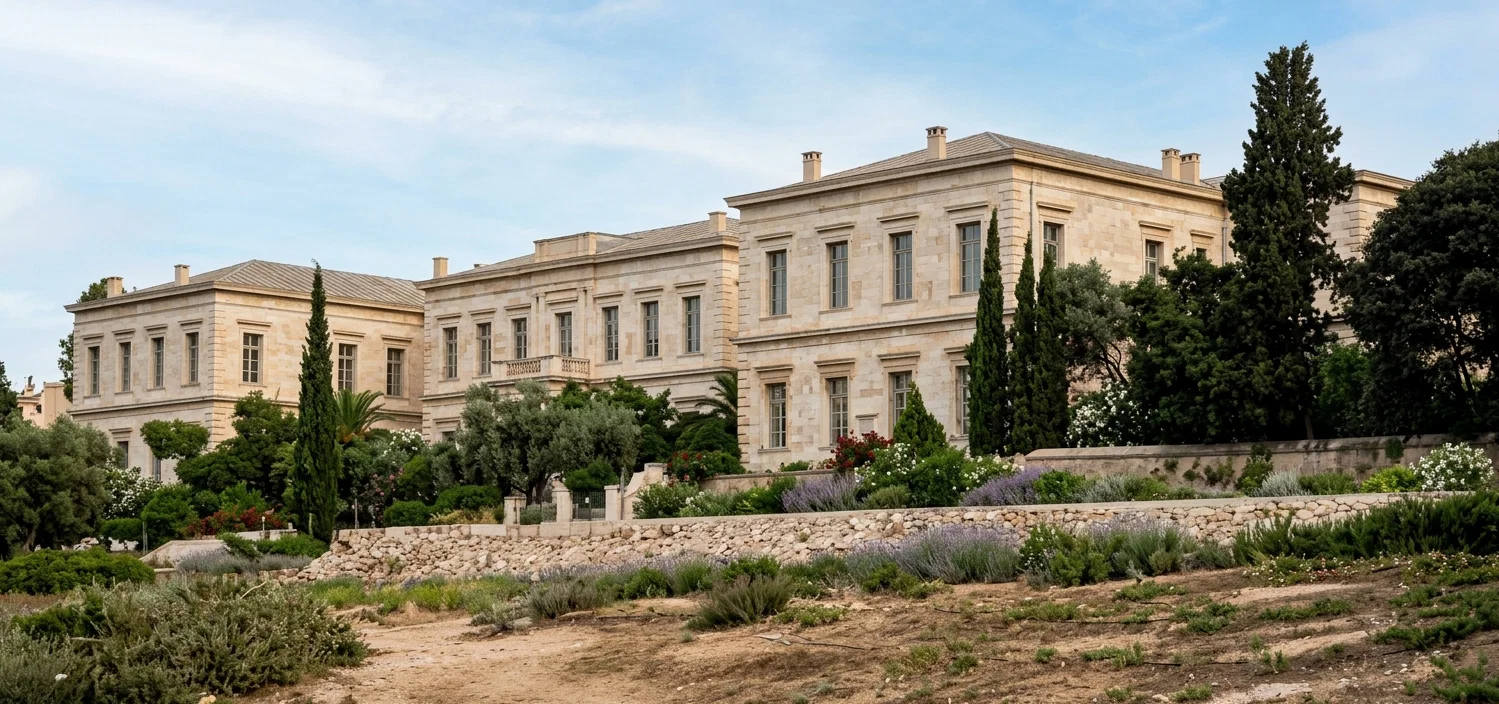
RUSSIAN HOSPITAL.
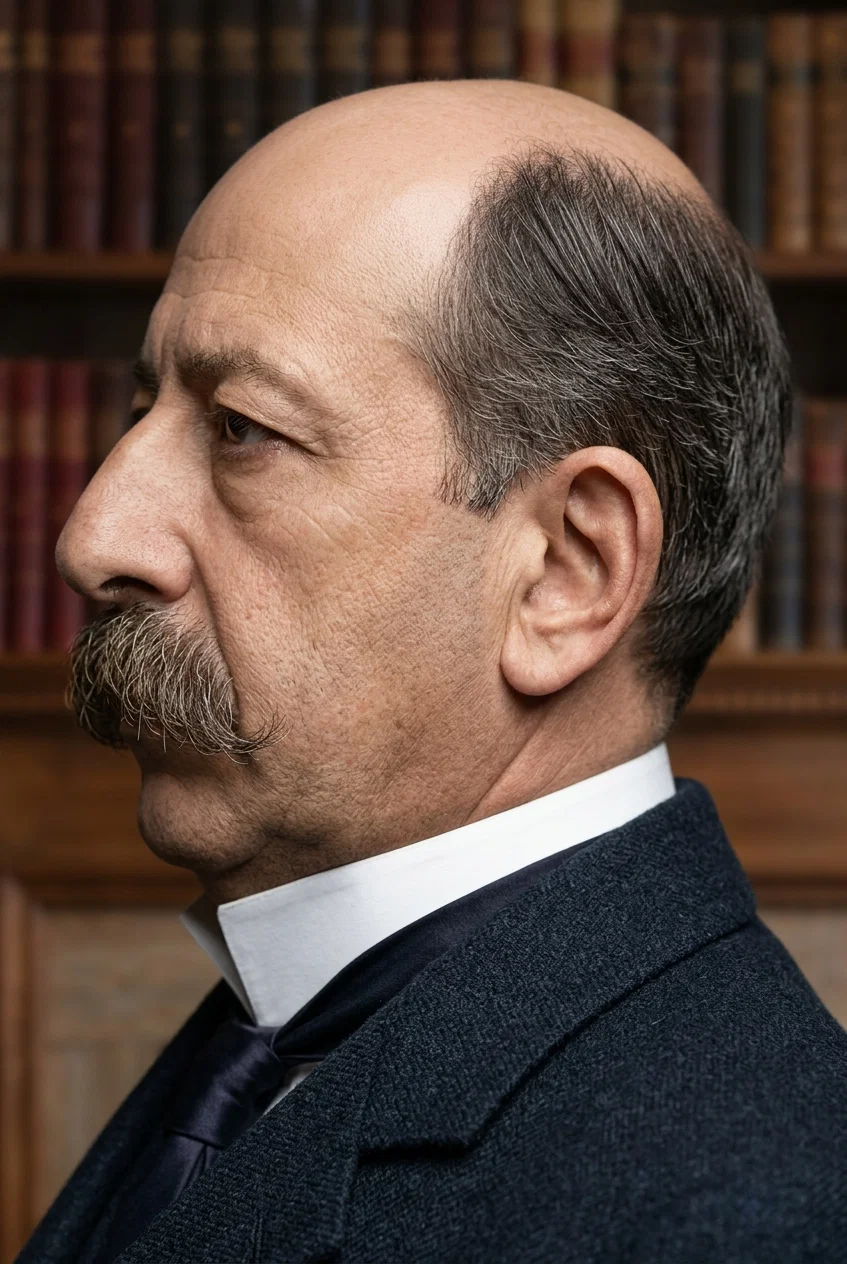
MR. TRICOUPES.
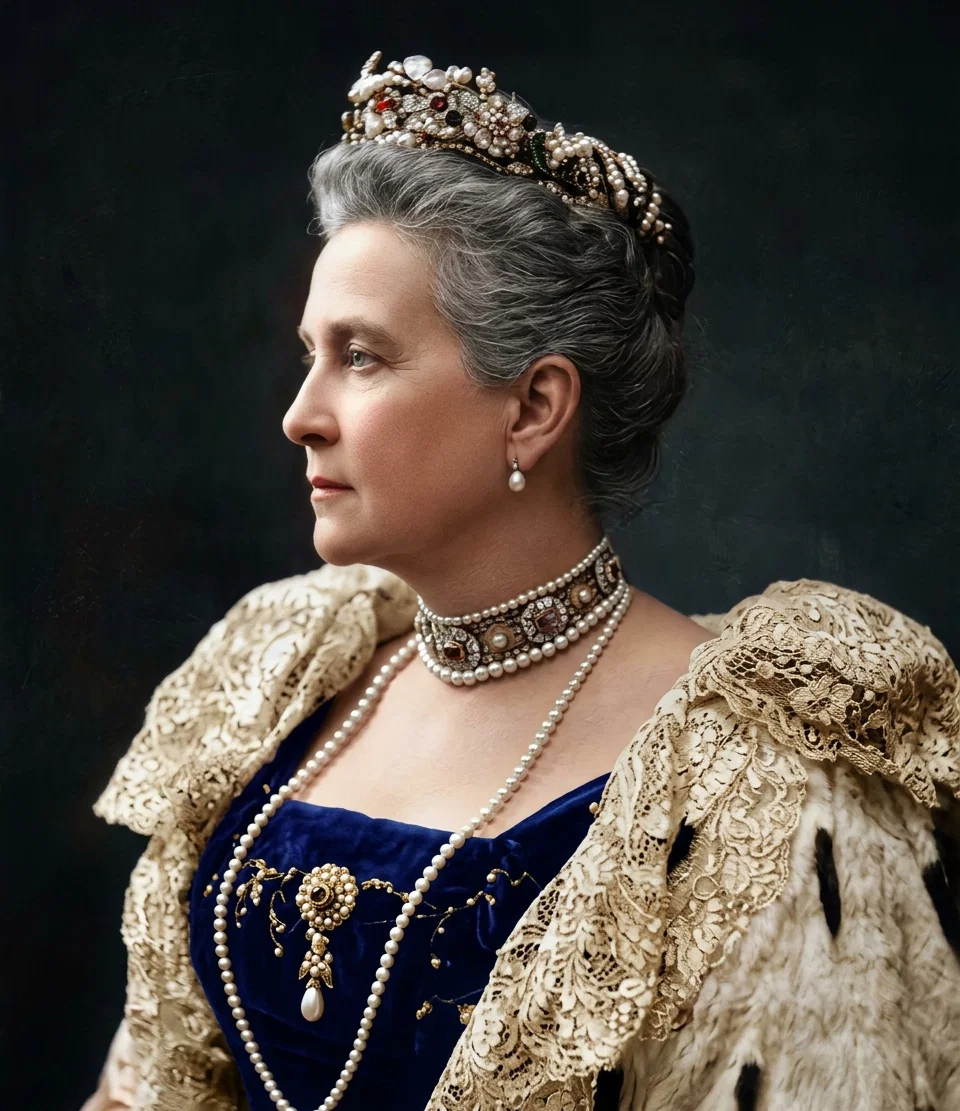
Queen Olga
HOSPITAL ANNUNCIATION.
II. A Royal Incident
GREECE and Turkey went to war in 1897 over the question of annexing Crete to Greece. Crete was the principal battle-ground, and the war was of short duration. During its progress and at its close the more seriously wounded Greek soldiers were brought to the hospitals in Athens to be cared for. Here during their convalescence they were visited by
Queen Olga
A few words of a general nature regarding the Queen of Greece would be in place here, inasmuch as she was responsible for one measure bearing a close relation to the question of circulating a modern Greek version of the Bible in Greece.
Queen Olga is a Russian by birth, being a daughter of the present Czar's uncle, and is a Greek Catholic in religion. She was married to King George, a Protestant, with the understanding between them and the Greek people that their children should all be Greek Catholics. The reader will readily understand that it is not a difficult matter, in a religion that practises infant baptism and that is in close union with the state, for parents to choose their children's religion for them even before the birth of the latter. A recent example is that of Prince George of Greece, the queen's second son, and of course a Greek Catholic, who a little more than a year ago married Princess Marie Bonaparte of France, a Roman Catholic, with the understanding that their children should be Greek Catholics. Their little son born in Paris the other day is accordingly destined to become an adherent of the orthodox faith. In the Greek church infants are baptized at the age of three to six months. True to the arrangement at the time of her marriage, the queen's five sons and two daughters have all been baptized into the Orthodox Church of the East, as the Greek Catholics themselves designate their church.
The queen is universally reputed to be of a very religious turn of mind. This is plainly in evidence in the royal summer palace, which it was the writer's privilege to visit a short time ago. In their sleeping apartment there hangs on the wall just above the head of the bed, a bronze image of Christ on the cross. In a glass case standing in the corner near the queen's pillow is a costly representation of the Virgin Mary and the Child Jesus. A little further on hangs a painting of the Saviour on the cross. In the entire chamber, all the pictures, large and small, and there are not a few, represent with scarcely an exception, some scene in the Bible or the history of the church. The queen has built at least one church and one hospital in Greece, and is patron of several other hospitals and philanthropic institutions. The Prime Minister of Greece once bore this testimony concerning her: "She spends her time at the pillow of the sick, and devotes her life to the aiding of the unfortunate."
A Beneficent Move
Now it occurred to the queen, while visiting the wounded soldiers from the Cretan war, that it would be a desirable thing to supply the convalescents with copies of the New Testament to read while they had so much time at their command. She accordingly distributed testaments among them at her own expense. She soon learned, however, that the soldiers found difficulty in understanding what they read, as the testaments were all printed in the original Greek. It was then that she conceived the commendable idea of making a translation of the New Testament into modern Greek, that the soldiers might read and understand.
Attitude of the Holy Synod
Wishing to be loyal to her church, and to issue her translation with the approval of the highest ecclesiastical authority, she summoned the Metropolitan of Athens to inquire whether the step she was about to take would receive his indorsement or not. He replied that personally he approved the plan, but as president of the Holy Synod he could not indorse any translation or modification of the original Greek text. Subsequently the synod took formal action on the matter, addressing a letter to the queen to the effect that the synod could not place its approval on the translation, but adding that it would not constitute a sin if she chose to make it.
In the light of this decision, the queen decided to issue a translation privately. She accordingly engaged a niece of one of the university professors to do the work of translating under the supervision of her uncle. The product is said to have been a good one, and copies were distributed gratuitously under the direction of the queen. This good work was interrupted, however, by events11that followed a year or two later, which we have yet to narrate.
Attitude of the Government
The government and the Holy Synod are supposed to stand together on all matters ecclesiastical as well as political. The metropolitans and bishops are no mean politicians, and the government dignitaries can all but pass muster as officiators in this mongrel church-and-state religion. That the government found itself in a somewhat embarrassing position at this juncture, with one of its sovereigns leading out in a movement that has been characterized again and again, both officially and unofficially, as destructive to both the church and the state, is evident from the following record of previous official action (1882), which will explain itself:
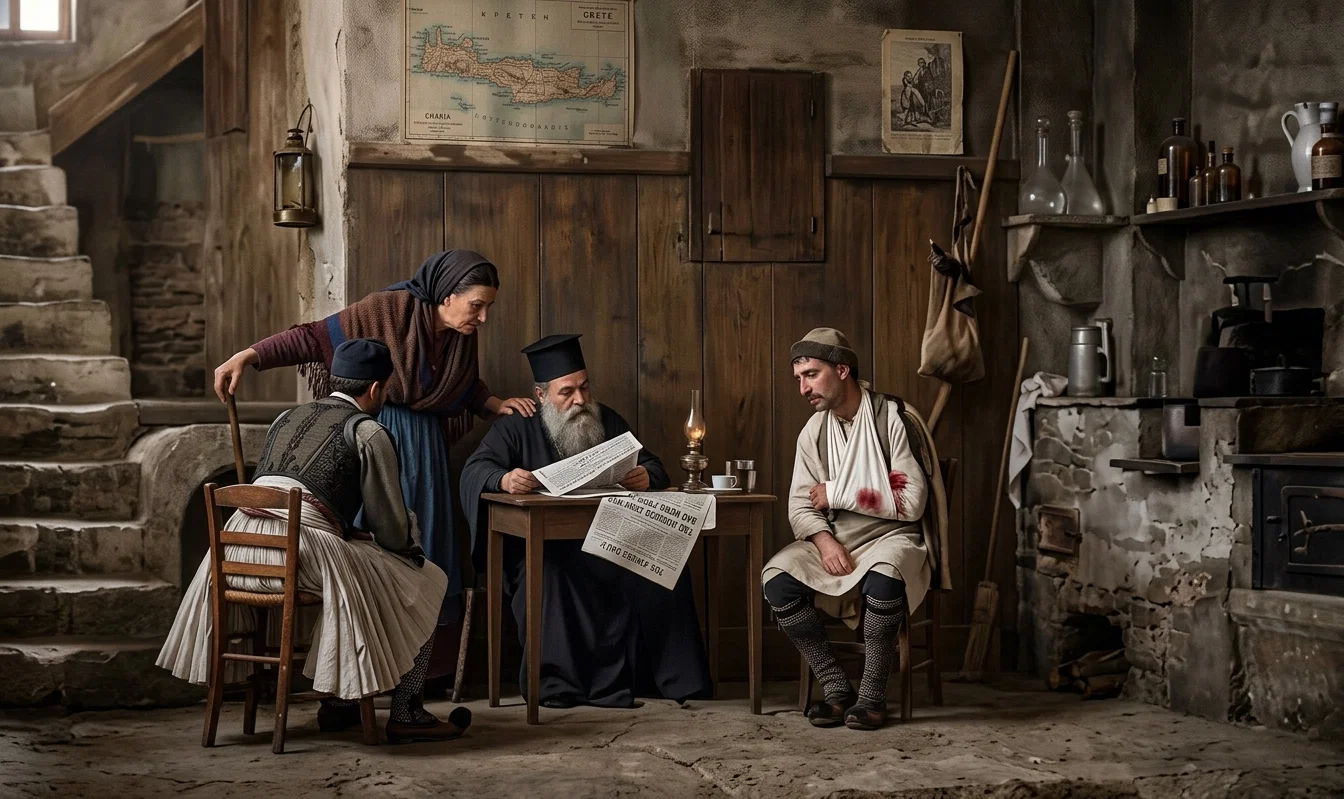
BAD NEWS FROM THE WAR. Scene in time of Cretan War (1897). Note the wounded soldier.
“Concerning the Return of Donated Copies of the New Testament.
“Lady Robertson, English, through the Athens agency of the [British and Foreign] Bible Society, donated to the first regiment of infantry 150 copies of the New Testament, translated in 1880 from the Greek edition of 1855, to be distributed to the soldiers of the same. Since, however, the reading of this publication is prohibited, and since the Holy Synod of the church of Greece does not permit the distribution and consequently the delivery of the same, we hereby order the said regiment, as also every other military body to which there may by chance come a like gift, to return to the donor all the said copies through the same channel by which they came, expressing appropriate thanks to her for the benefaction. “Signed: Department of War, “By Tricoupes, See'y.”
Division Rather than Unity
ONE Nicholas Zamoro, a Methodist preacher in the Philippines, has set up an independent Methodist Church in those islands. He is a convert from the Catholic Church, a wonderfully effective speaker, and a leader among his people. Dr. Rader says of him, “He is a man of remarkable pulpit ability, being the only man we have ever heard who could hold our attention for an hour or more when we were unable to understand a word he said.” Whether his attempt to organize an independent church will be successful or not can not be stated. The organization of the Methodist Church in Japan has spread a general feeling of independence and disintegration among the churches in the Orient. Dr. Rader remarks, “We shall be agreeably surprised if a like movement is not inaugurated within the next few years by our membership in China and India.”
Such a movement is already on in South Africa, where the native Wesleyan Church wants independence. The California Christian Advocate concludes: “England taught history to the natives of India, and immediately the natives began to assert their primary rights. It is a penalty, a price of knowledge and inspiration, that civilization, Christianity, must pay.” But is it true of Christianity? Should not the Gospel of Christ bring unity in the fullest sense of the word? The Author of this Gospel prayed: “Neither for these only do I pray, but for them also that believe on Me through their word; that they may all be one; even as Thou, Father, art in Me, and I in Thee, that they may be in Us; . . . I in them, and Thou in Me, that they may be perfected into one.”
The Battleship Florida
On March 9 there was laid at the Brooklyn navy-yard the “Florida,” which on the day of her launch will be the largest battleship afloat. A sister ship, the “Utah,” is being built by the New York Shipbuilding Company, Camden, N. J. The “Florida” is 521½ feet over all, will have 88 feet 2½ inches beam, or a few inches more than the “Mauretania.” Her normal displacement will be 21,825 tons, her full load displacement 23,034 tons. She will be driven by 28,000 horse-power Parsons turbines at a speed of 20¾ knots. Her armament will consist of ten 12-inch and sixteen 5-inch guns.—Scientific American.
A Way Out of the Dilemma
By W. E. Howell
Despite the inward feelings of both civil and ecclesiastical authorities, this unique but delicate situation created by the queen’s zealous activity in bringing the word of God within reach of the common people, was winked at for the time being. A year or two later a layman undertook to issue the New Testament in the vernacular by first running his translation in small instalments through the columns of a daily newspaper in Athens. This action afforded a way out of the dilemma without directly opposing the course of the queen. The people took the initiative, and what of riot and bloodshed that followed, with the accompanying revelations of the real spirit animating rulers and people on this all-important question, constitutes the most interesting and instructive part of our story, to be told in our next.
W. E. HOWELL.
Soft Drinks.—
Many who would not think of taking a drink of liquor will be surprised to read the reports of Dr. Harvey W. Wiley, national champion of pure-food laws, concerning soft drinks. He states that “investigations at the United States bureau of chemistry, where we analyzed 100 samples of the sirups used in the manufacture of these drinks, has convinced me that they contain a liberal percentage of caffein and marble dust, both highly injurious to the system. Caffein is a habit-forming drug.” He says further: “The children should be taught to abstain entirely from these soft drinks. No parent should permit his child to drink the concoctions served at the soda fountains. A rigid law should be made and enforced to prevent the sale of these drinks which contain caffein, and almost all of them do contain it. We are working for such a law, because our investigations and analyses have convinced us of its necessity.”
Nature’s Laws in Scripture
The Detroit “News Tribune” remarks that Mr. Burbank has discovered nothing new in principle; most of the things that he has discovered for himself, the wind and the bees and other insects have been teaching since the creation of man; and it notes other great experimenters along the same line. But the laws by which all work, have been suggested for centuries in the Scriptures of truth.
Catholic and Protestant Friendliness.
Recently W. Bourke Cockran, bishop of a Catholic diocese, was invited by a company of eight hundred Protestant ministers to address them, much to his surprise. In his speech he said: “As a public speaker this invitation to speak to a body of this kind is the most satisfactory of my entire life. That a Roman Catholic, quite well known for his adherence to that faith, should be invited here to address you, is very satisfying to me. In this age we may rejoice in those Christian confidences we have together in common, rather than in quarrels of faith.” Whether a matter of rejoicing or not, it is true that modern Protestantism and Catholicism have much in common; and when we consider that history demonstrates the truth of the boast of the Catholic Church that she never changes, we see clearly which has made the compromise. There are few “quarrels of faith” because there are so few differences.
Protecting Children in England.—
What is generally termed “The Children’s Charter” has just become effective throughout Great Britain. By it a large number of reform measures for the treatment of children, both criminal and dependent, are introduced. “Baby farming” is subjected to strict supervision, and no child may be kept on premises that are overcrowded, dangerous, or insanitary. Severe punishment is provided for death by overlaying while the parents are under the influence of drink. Begging or receiving alms on the street, and juvenile smoking, are suppressed. Child vagrancy is abolished. The practise of giving infants intoxicating liquor comes under heavy penalties, and children are forbidden to enter saloons. Conditions among the poorer classes, especially in London, certainly warrant stringent laws.
Jewish Business Genius in Hungary
An interesting incident has just been recorded in a Hungarian journal. A number of the Catholic congregations who were compelled to leave France by the Separation law have settled in Hungary, and have brought with them an enormous fortune of 60,000,000 francs. Recently they were engaged in making arrangements for the establishment of various undertakings for the employment of their capital. Some members of the council of the order went to Paris to submit their proposals to the “General” of the order. He asked them if a Jew was to be at the head of the enterprise. They were amused, and asked the “General” what a Jew had to do with such a pious undertaking. He retorted that all the Catholic business in Hungary had gone to rack and ruin for lack of the directing genius of a Jew.—Hebrew Standard.
The Pope’s Atheist Physicians
The Pope employs two consulting physicians; neither one of these is Catholic. Both are said to be atheistic. An objection was made to him regarding this. He replied by saying: “Science does not demand at what altar you worship.” And yet other things being equal, we think that we should prefer a Christian physician. The names of the pope’s physicians are Mazzoni and Rossini. They are noted and able physicians.