I promised in my previous letter to deliver myself this week on the question of amusements. My advice is very short,—Don't. Do you ask my reasons? You shall have them. Amusement, or rather the supposed need for it on the part of young people, proceeds from a false assumption. It is assumed that the young man's daily work is a sort of drudgery, which he goes through more or less mechanically, longing for the time to come when he can put his real self into something more congenial,—games, social enjoyment, and the like. The office is supposed to be a prison-house; office hours over, the weary captive once more feels himself free, his spirits rise, and he is a man again. No doubt there are thousands who have just this conception of what they call "the daily grind," and neither is there any doubt that these thousands never become indispensable to their employers. They are the kind whose places it is easy to fill. No, children may require to be amused; but not the responsible young man.
What you want to do is to put your whole self into your work. See it on its interesting and significant side, keep your eyes wide open, every brain cell alert and active, and the whole system engrossed in what you are doing. Do this thoroly, and you will never suffer from the vacant, listless feeling that craves for amusement. You may at times feel brain-weary, you may be physically tired, and in need of rest,—the sound sleep that falls to the lot of the man who does an honest day's work; but you will not feel in need of amusement. If you put your heart into your work, you will find it highly interesting, even fascinating. You will gain from it the same satisfied feeling that other young people get from their so-called amusements. Your energies have been drawn into activity, your mind has been absorbed, you have been actively and pleasingly employed. But you have the additional satisfaction, after doing such a day's work, that you have accomplished something worth while, that you have justified your existence. There is no more deeply satisfying feeling than the healthy weariness that follows useful toil, just as there is nothing so intolerable as the feeling that you have nothing really to do in the world, and that you could drop out without being missed.
But I would not leave the matter here. While I object to amusement, using the term in the generally accepted meaning as some light, frivolous mode of entertainment which will help one to pass away a few hours pleasantly, I do not in the least object to recreation, by which I mean some wholesome activity which will divert one's mind from the ordinary workaday channels, and at the same time do actual good in building up the body. Recreation suggests renovation, renewal of the powers of mind and body; it suggests pleasure of the kind that does not cloy.
How, then, shall we recreate? Recreation for an indoor worker like you should spell out-of-doors. It should be taken under the open heavens in sunshine or in rain. Such kind of recreation will do two things for you: build up your health, and make you mentally fit for the wearing cares of business life. Of course, if you were doing hard physical labor in work hours, then your leisure hours might very properly be devoted almost exclusively to mental activities. What a man wants in recreation is contrast. It is this that gives rest to overworked faculties, and brings into use those which have been dormant. It is because the amusement generally sought by young men so badly fails of meeting this requirement, that it is so harmful.
A young man, we will say, is working as you do behind a counter. He sees faces all the day, people are coming and going in a steady stream, and there is continual noise from the street. Such a young man's recreations ought to take him out in the country, where he can see the blue sky overhead and enjoy the restful companionship of nature. But where does he go?—To the theater, the variety show, the moving picture gallery. And what is the result? Does he get any real rest?—No; these amusements only further deplete his vitality, drawing still more largely upon the nervous energy, without giving anything in return. Thus the same faculties are at work throughout the period of labor and that of recreation, and the final result is nervous breakdown.
When amusement is sought in society, the result is not more satisfactory. If popular social gatherings were of a helpful character—which they are not—even then the late hours and unwholesome excitement would make it impossible to recommend them as a form of recreation. Time spent on such follies is worse than wasted. The average young man who goes in for the gay social round is in a very real sense unfitting himself for the stern realities of life, and is prematurely wearing himself out.
Change of employment is probably the best kind of recreation that a young man fully alive to the finest possibilities of life can give himself. It is delightful, after a wearing day in business, to make the chips fly, or to hoe in the garden. And for the man who is physically tired, but at least fairly fresh mentally, it is most interesting to pick up a well-written and well-printed book dealing with some of the intensely interesting problems that confront us to-day. Yes, it is fine recreation of the nobler kind to read the pages of Holy Writ, to follow the footsteps of our Saviour as He wandered over the hills of Galilee, to hear Him tell those beautiful parables so full of the sunshine and the birds and the flowers and all the teeming life of the open air. It is a great mistake to suppose that only light reading, such as the modern novel, can be recreative. The very opposite is the case. It is the books that most inspire us that form the best companions, alike for our tired moments and when we are fresh.
Change of employment has this advantage over recreation for its own sake, that it gives one a sense of production that is in itself inspiring. Gladstone used to have two tables in his library, at one of which he studied and wrote on political subjects, at the other on religion. When he had worked long enough at one to become tired, he stepped over to the other, and found rest in the change. Then at the end of each year he had something to show for these hours of recreation in the way of articles written for the reviews as well as increased knowledge of many things. And these tables were only to be employed in the leisure time of an extremely busy life. But he knew how to use the moments.
Many have found great delight in music, and it must be confessed that it stands high as an element of culture. Luther thought singing the best of all recreations. He believed that it had a refining influence on the character, while at the same time unbending the mind and bringing rest and refreshment to the overwrought nerves. There is no doubt that the harmony of sweet sounds possesses recreative power of no mean order, and that it would greatly increase the efficiency of our working hours if we oftener composed our minds with music.
After all, perhaps one gets one's greatest recreation from pursuing that which is or is to be one's life-work. The men who have accomplished most in their various fields of usefulness have been with few exceptions the men who literally enjoyed it; yes, who got the same kind of enjoyment out of it that other men got from their games and other forms of unproductive recreation. "While I am doing this" (plying the artist's pencil), said Reynolds, the famous portrait painter, "I am just as happy as I can be." Yes, he was happy, and that was one at least of the secrets of his remarkable success. And so he painted day after day, and found so much enjoyment in it that he had no thought of other recreation.
There was one form of recreation, however, that he did enjoy, and that was to meet Samuel Johnson, and Goldsmith, and other congenial spirits at some little inn, and have an evening together. Conversation was something of an art in those days. Nowadays it is not in fashion, and much is the pity. I mean, of course, conversation about something worth while. There is always some one who can talk about the weather, that inexhaustible subject; there is always some one who knows the latest bit of gossip; and most people can say a few things about politics; but of really helpful, uplifting conversation of the sustained kind, very little is heard in these days. The loss is a severe one. Conversation is really a13most enjoyable and highly educational form of innocent recreation. It should be cultivated. If you can once a fortnight or so gather a few congenial friends about you and talk over things that are worth while, you will not only have many enjoyable evenings, but you will as a result of these meetings, make steady growth in knowledge and in power of expression. Conversation carried on on a proper level is highly stimulating intellectually, and affords a keen sense of pleasure to the young man who has a mind and likes to use it.
Before closing I want to emphasize those forms of recreation that are the most help physically. You are not getting as much exercise as you need,—at least not outdoor exercise, and that is quite a different thing from exercise indoors. The next time you have a half-holiday, just take a long walk, say eighteen or twenty miles, and keep up a pretty good pace. When you come home, take a rub-down, and go early to bed. You will feel like a new man in the morning. Walks can also be taken in the evening. You may think that you have enough exercise because of having to stand on your feet so much during the day; but standing is not the same as walking. A man who is tired from standing, can sometimes rest himself by vigorous walking. Then there is also the run. A rapid run of a mile in the evening shortly before retiring is good for the whole body, and especially good for the lungs. Physical culture in other phases, such as the use of the pulley weights and of gymnastic apparatus, is also a useful form of recreation—useful in the sense of giving all-round physical fitness to the body, and thus indirectly a beneficial effect upon the mental powers.
I have written somewhat at random in this letter. I hope that in your next you will tell me how you are situated in reference to time for recreation, and also how you are getting along with your rather confining work.
Sincerely yours,
L. P.
What Is Noble?
By Charles Swain
What is noble?—to inherit
Wealth, estate, and proud degree?—
There must be some other merit
Higher yet than these for me!
Something greater far must enter
Into life's majestic span,
Fitted to create and center
True nobility in man.
What is noble?—'Tis the finer
Portion of our mind and heart,
Linked to something still diviner
Than mere language can impart:
Ever prompting, ever seeing
Some improvement yet to plan;
To uplift our fellow being,
And like man, to feel for man.
—Charles Swain.
Heart Pictures
By Helen M. Wilde
To look for the good in all things God has created, helps one to become noble and true. The ability to perceive the lessons of love connected with all God's creatures is a Christian virtue. The angels lift their voices in anthems of praise as they behold their King, and rejoice in His gifts to men. Shall not our lips echo sweet melody in harmony with theirs? Shall not the harp of our hearts be in tune with the heavenly choir? Or shall they be chilled to discord by coldness and indifference?
We can not always tell by outward appearance what a treasure may be within. A rough exterior may, perchance, conceal a precious gem, that, with patience and forbearance, may reflect the likeness of Christ. By looking upon the hopeless with hope, we may help the fallen to rise. Let our hearts and hands reach out to all God's children, weeping with those that weep, rejoicing with those that rejoice.
Can we, in viewing a picture, tell just how the artist may look? We are all making pictures. Close by our side is the great Master Artist, viewing with tender interest the pictures we portray. He hungers to discern in us a likeness to Himself. Let us, then, speak words of cheer; give a kindly glance of recognition. Love and sympathy come from God, and will make us like Him.
HELEN M. WILDE.
Our
By Ella King Sanders
Little Folks'
Bible
Nature
By Ella King Sanders
Our great world is one expression of the wonderful thoughts of God, and to study nature is to better understand these thoughts.
This new child's book gives simple graded lessons on Bible nature, beginning with Light, without which life would soon become extinct.
By easy steps the beginner is given an acquaintance with the wonderful works of God as seen in nature. An excellent book for the home training of children or as a help in the school.
One hundred and forty-four pages, illustrated with new drawings especially made for this book and with thirteen colored plates. Beautifully bound. Board covers, 25 cents; cloth, 50 cents.
Pacific Press Publishing Assn.
Mountain View, California
Portland, Ore. Kansas City, Mo.
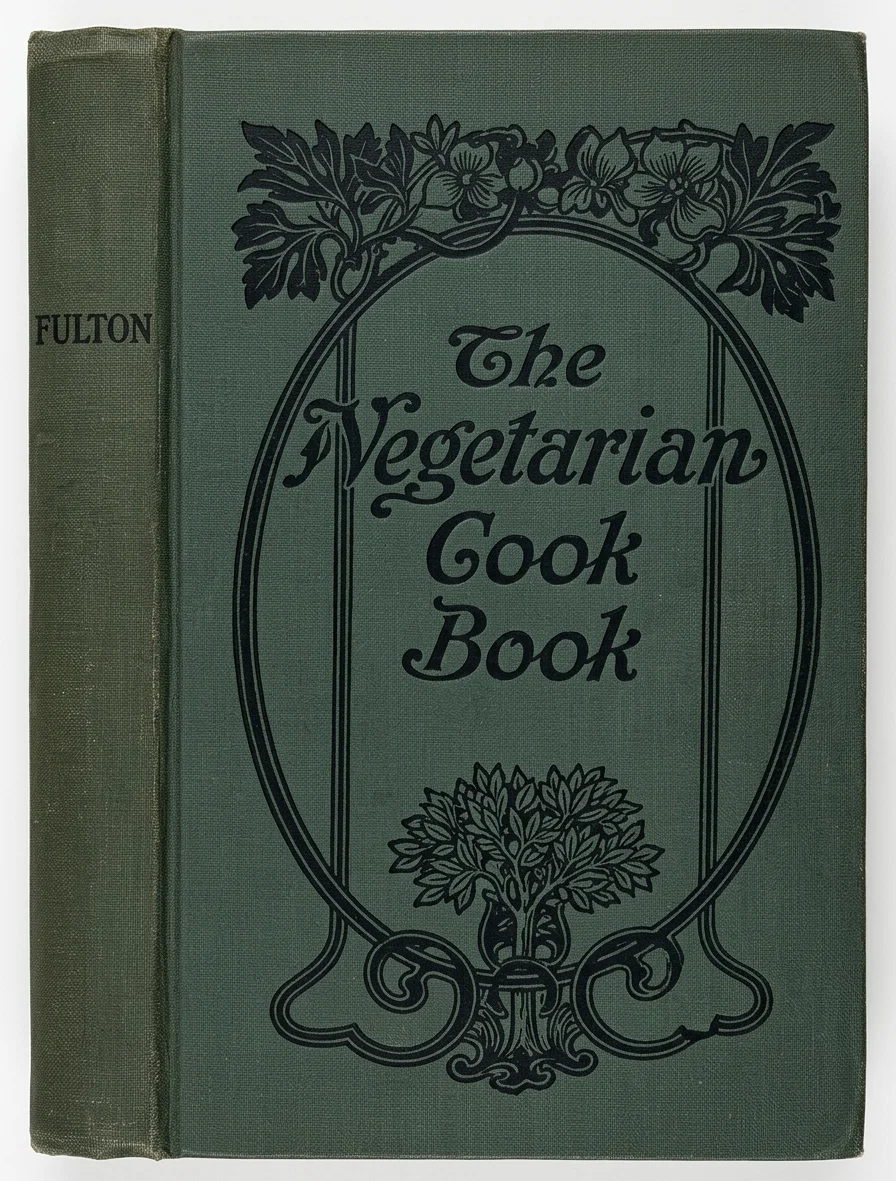
The Vegetarian
By E. G. Fulton
Cook Book
By E. G. FULTON
THE author has had years of experience in vegetarian cookery and in the management of vegetarian cafes and cafeterias. With its aid the chef, cook, or housewife is able to prepare appetizing, healthful meals without the use of any flesh food.
This book contains 419 pages, including a handy and well-arranged index of all the recipes given.
Tastily bound in cloth, price,post-paid, $1.00
Pacific Press Publishing Assn.
Mountain View, California
Portland, Ore. Calgary, Alberta. Kansas City, Mo.
A Treat for the Children
By Editor
Those interested in the children and desiring that they have some really interesting little Bible studies will appreciate the special series of studies now running in "Our Little Friend." They are presented in a way particularly fascinating and comprehensive, and will prove of untold worth to many a child. Send thirty cents for a six-month subscription and have the paper sent to some one of your "little friends." Better yet, send it to several of them at thirty cents each. They will thank you heartily for its cheering little pages. How much we who are older would have appreciated something similar when we were young! There is a real treat in store for all the "Little Friend" readers. Subscribe now through the Tract Society. Sixty cents a year. Our Little Friend, Mountain View, California.
Hygienic Vegetable Cooking Oil
No More Healthful Shortening Made
Like Olive-oil and keeps indefinitely. 5-gal. can, $4.50; two cans, $8.50; 8 1-gal. cans, $7.75; half barrel (about 32 gal.), 76c per gal. Cash with order. By freight from Louisville or New Orleans. Address Dr. O. C. Godsmark, Chattanooga, Tenn. Department D.
1,000 Samples Free
Washing Made Easy
I want 1,000 lady readers of the "Signs" to try E-Z Washing Tablets and will send 1,000 packages free. Washing is so easy when you use E-Z Washing Tablets. Just boil your clothes in a solution of water, soap, and Tablets for 20 minutes and they are clean without rubbing. Enclose two 2-cent stamps to pay postage. Address Alfred Mallett, 721 H St., Sacramento, Cal.
An Offer to Our Young People
An opportunity for you to secure a professional training, including all expenses, uniforms, etc., with monthly cash payments the second and third years. Only nine hours per day. Overtime extra. At the St. Helena Sanitarium and Hospital Training School for Missionary Nurses.
The course is especially strong because of the large number of patients, providing ample experience in both medical and surgical practise. Our San Francisco dispensary provides opportunity for experience in city mission work. Consecrated graduate nurses readily find employment in institutions and mission fields at home and abroad. Just now we desire to secure ten or more at good salaries.
It is not yet too late to join the spring class. Mention these offers to your friends who may be interested.
Write immediately for particulars and full information, addressing —
DR. H. F. RAND, Medical Superintendent,
or MRS. S. J. WHITNEY, Secretary,
Sanitarium, Napa County, California.
Approximate Chronology
"Type and Antitype"—a booklet giving the Scriptural and historical facts, physical and climatic conditions, and astronomical calculations, that enable us to establish in our own modern calendar time the exact date of the Passover, Crucifixion, and Resurrection of Jesus. Price 25 cents. Address H. H. Perry, 67 19th St., San Diego, California, or your tract society secretary.
A clear, tho brief, setting forth of the Bible types and symbols, the services in connection with
CHRIST OUR ADVOCATE
the earthly sanctuary, the effectual sacrifice and priesthood of our Lord, to which all these types pointed, and the great prophetic period of Dan. 8:14.
Contains 112 pages and is illustrated. Price ten cents. PACIFIC PRESS Mountain View, Cal.
Daniel and the Revelation
By Uriah Smith
Daniel and the Revelation. By U. Smith. Revised edition. A history of the rise and fall of nations, being an exposition, verse by verse, of the important prophecies of Daniel and John, comparing Scripture predictions with historical facts. It follows in the track of no other commentary; but, guided by the obvious rule that the Bible should be its own interpreter, it aims to arrive at the exact meaning of the sacred writers in harmony with the great plan of redemption as presented throughout the Scriptures. The author has devoted over thirty years to the study of the Bible, and believes that the prophecies of Daniel and John were written for our admonition, and that the subjects they unfold are the coming themes for the religious world, destined to engage the attention of all thoughtful minds. Over 900 pages, with illustrations, beautifully bound. Cloth, marbled edges, $3.00. Address this office.
Taoism
By I. H. Evans
About the time of Confucius another man was born in China whose influence over the Chinese people has been second only to that of the greater teacher. He is called Lao-tsze. It was he who laid the foundation of the elaborate ritual still maintained in the idolatrous worship of the rulers and the people. Taoism "contains the principal elements of heathen religions generally. . . . It has a system of exorcism of devils and propitiation of gods, conducted by a priesthood with observance of a ritual highly developed, created to a great extent in imitation of Buddhism. It is a universalism which purports to render man happy by such exorcism and propitiation, and, moreover, by teaching him the discipline of securing assimilation with the Tao, or order of the universe."—"The Religion of the Chinese."
Taoism has greatly increased the number of gods worshiped by the Chinese, "owing to boundless vagaries in the domain of cosmology, astrology, and other occult sciences." Humility, self-effacement, is strictly enjoined by such teachings as these: "When your meritorious work is done, and fame is thereby gained, to retire to the background is the Tao [or in harmony with the order] of heaven."—Lao-tsze. Again Lao-tsze says:15
Water benefits all things, and yet occupies the lowest places, which all men dislike. The reason why the large rivers and the seas are able to act as kings of the streams which flow down into the valley, receiving tribute from them all, is their skill in taking a lower level than they.
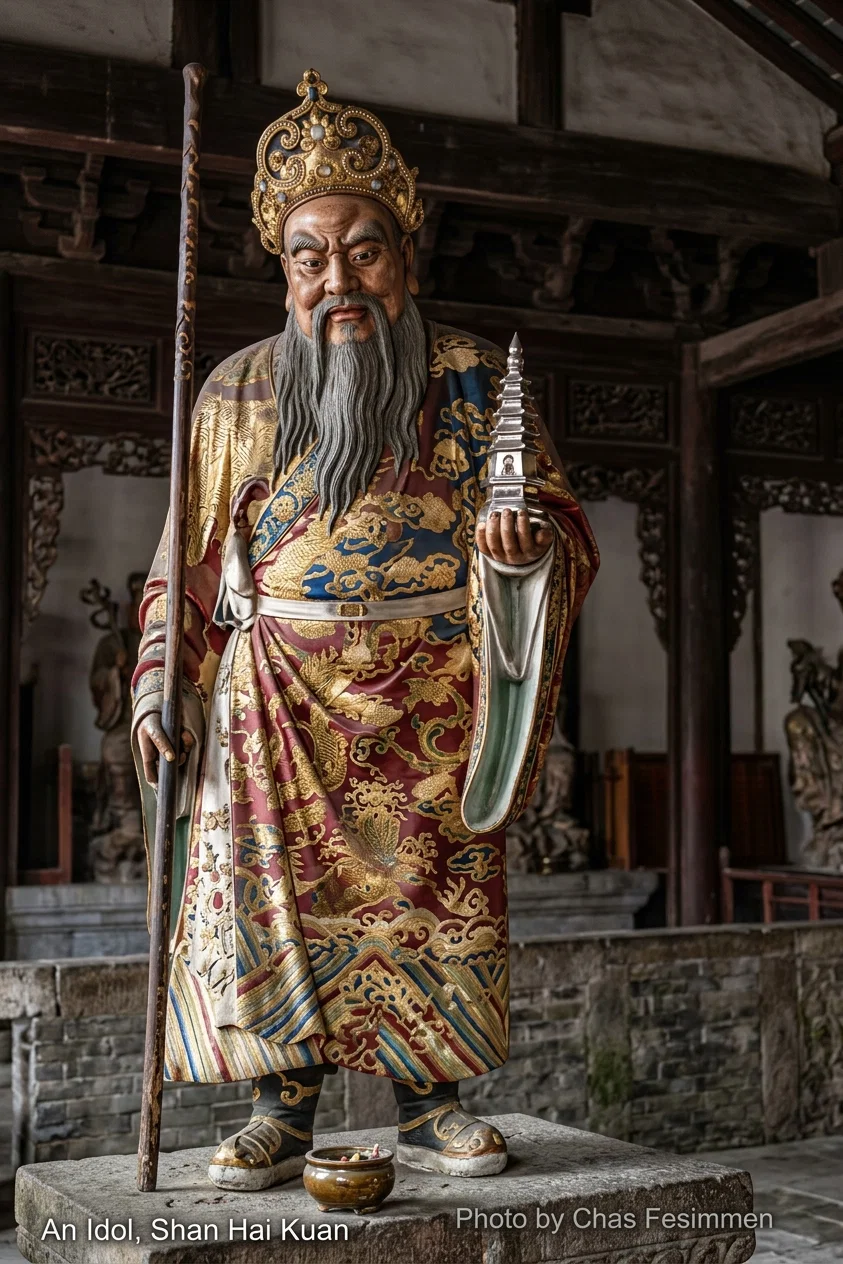
An Idol, Shan Hai Kuan
Then there is the virtue of "emptiness,"—the passive state, the absence of passion. This condition is considered ideal, as it is akin to heaven, and places its possessor above the earth, ranking him with the gods. One chief power claimed by the Taoist priest is the power of exorcism. By this craft and the funds derived from it, the priesthood receives a large measure of its support. But Taoism, like Confucianism, is nothing more nor less than a human religion, without love and without a Saviour. It has certain moral precepts, but its whole foundation is built on demon and spirit worship. "Magic has always been the central nerve of the Taoist religion, and always determined the functions of its priesthood." To promote the destruction of evil spirits and to propitiate the gods, by means of charms, spells, music, and other cunning devices, seems to be the principal work of the Taoist priest.
Buddhism
The last of the great religions of China is Buddhism. This religion seems to have come to China during the first century of the Christian era, and soon made rapid headway in all parts of the Chinese Empire. Buddhism met a want in the experience of man entirely lacking in both the other religions of the people. It promised to those who lived acceptable lives, immortality, Paradise, and a state of supreme happiness in the world to come. Speaking of the Buddhist sects in China, De Groot says:
"They possess everything pertaining to a complete religious system; founders and prophets, a hierarchy and a pantheon, initiation and consecration, religious rituals, meeting places or chapels with altars, religious festivals, sacred books and writings, even theology, a Paradise and a hell."
A system of merits and demerits is figured out, so that a ledger account can be kept and a man work out his own salvation. Buddhism approximates Catholicism in many of its forms and services. Prof. Max Müller, speaking of the Buddhist priesthood in Tibet as found there by Hue and Gabet, says there was found among the priesthood "the crozier, the miter, the dalmatic, the cope, the service with two choirs, the psalmody, exorcism, the use of censers held by five chains which shut and open by themselves, blessings given by lamas in extending their right hand over the heads of the faithful, the use of beads for saying prayers, the celibacy of the priesthood, spiritual retreats, worship of saints, fastings, processions, litanies, holy water,—enough it would seem to startle Roman Catholic missionaries."
Thus China has a triune religion—Confucianism, Taoism, and Buddhism. The State, orthodox religion is Confucianism; but so blended and so interwoven are the three, but few of the Chinese laity really know whether they are of one faith or of all. In all these religions morality is inculcated, but God is hidden from man, and man is left in total darkness concerning all that he most desires to know. The whole worship is only to procure to one's self and friends temporal benefits from the spirits and to purchase the favor of the gods, that calamity and misfortune may be warded off.
Menaced by Fear of Demons
To the Chinese, the whole world is full of demons. Trees, shrubs, and herbs, mountains, rivers, and seas,—in fact all nature, is possessed with souls determined to inflict evil on mankind. These demons must be deceived, bought, propitiated, scared, or fooled, that their evil purposes will fall on some other than the worshiper. Probably the world has never seen a more spirit-fearing people than the Chinese. Their whole lives are hedged in with fear of these evil spirits. Sickness comes because they have failed to propitiate the god of that disorder; droughts, pestilences, death, all are visitations of demoniacal or god-spirits' wrath. They hate the demons and have no love for the gods; but it is a cold business transaction to ward off the demons and to propitiate the gods so that no harm can come to them.
Thus the priests are hired to practise their exorcism over demons. Streets, walls protecting cities, entrances to houses, graves, wells, days for marriage, all are determined with respect to the spirits. The richest mines of coal ever discovered by man have lain for ages, all untouched, while untold millions of lives have been spent in the futile effort to get fuel to cook the simple food, because of the fear of these evil spirits. A man falls into the water and in vain struggles to get out; but not a helping hand is offered, because of the fear of evil spirits. The land, the sea, the air, are filled with these spirits, and they must be obeyed. More than four hundred millions of people in China live under this awful dread of demons. They never loved God, they know nothing of the Gospel of His Son Jesus Christ. Their religion, while it teaches high moral precepts, offers no mercy for sin, fills the soul with constant fear and dread of evil spirits, and lets the life go out without hope in God. The nation bows in dread terror before the religions imposed upon them by their classical literature. What it says they believe; and its teaching fills all nature with living, active spirits whom to ward off or deceive, or to purchase their favor, is an important part of a Chinese life.
China is to be pitied. An intelligent, industrious, hard-working people, so oppressed with superstitions and fears of the spirit world, are surely to be pitied. Nothing but knowledge of the Word of God can ever dispel this awful darkness resting upon the people. They need sympathy, love, and help. They can never help themselves, for they know not the way, nor have they teachers to show them the better way. Their help must come from the Christians of this generation. They need the Word of God enforced by the lives of those who have sat at the feet of the great Teacher.
I. H. EVANS.
The Religions of China
CHINA not only has a religion, but it has a triplet of religions, sometimes existing as separate and distinct sects, and sometimes so blended and interwoven that there is no way of knowing which predominates. These religions are known as Confucianism, Taoism, and Buddhism.
The Sage Confucius
Confucius, the greatest of Chinese sages, was born B.C. 551; and it is his reputed writings and teachings that have laid the foundation of Confucianism, the religion which has probably had more followers than any other religion the world ever knew. Confucianism, or the teachings of Confucius, is the national religion of the Chinese race. For more than two thousand years the teachings of this great man,—for truly he was great, judged by the enduring work he did,—have been accepted as unchallenged truth by the leaders in Chinese thought and by the rulers in the empire. The orthodox Christian believes no more in the divine inspiration of the Word of God, than the Confucianist believes in the infallibility of the writings of the sage of Shantung. Practically the entire Chinese race are Confucianists, while Japan and Korea belong to the same cult. Outside the teachings of the Scriptures, nothing that any one man ever did or said has so influenced such a multitude of human beings as the writings and teachings of Confucius. Those who have read his writings tell us there is nothing in all the teachings of Confucius that imparts any belief in God, or would cause one to suspect that he believed in God.
Confucianism Described
Confucianism is a system of governmental and moral philosophy, ethics, social manners, and instructions in the worshiping of the gods. The Confucian religion is nature-worship. Says De Groot:
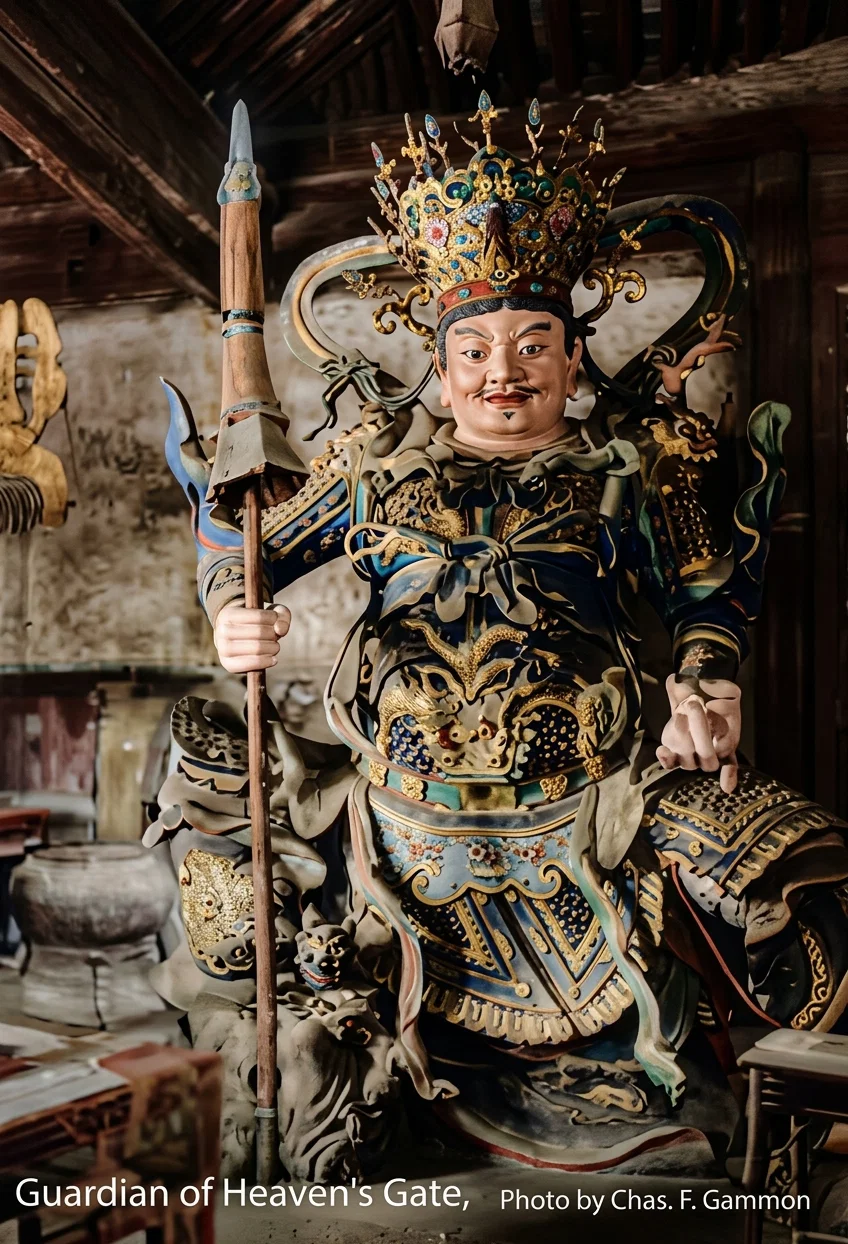
Guardian of Heaven's Gate
We may then define the Confucian religion as a mixture of nature-worship and worship of the dead; or, seeing that the souls of the dead are also parts of nature, we may define it as nature-worship pure and simple.
Ancestral worship is the worship prescribed for the people, and yet they not only worship the spirits, but they worship heaven and earth, the sun and moon and stars, and all animated nature wherever superstition or the hope of temporary reward may lead them.
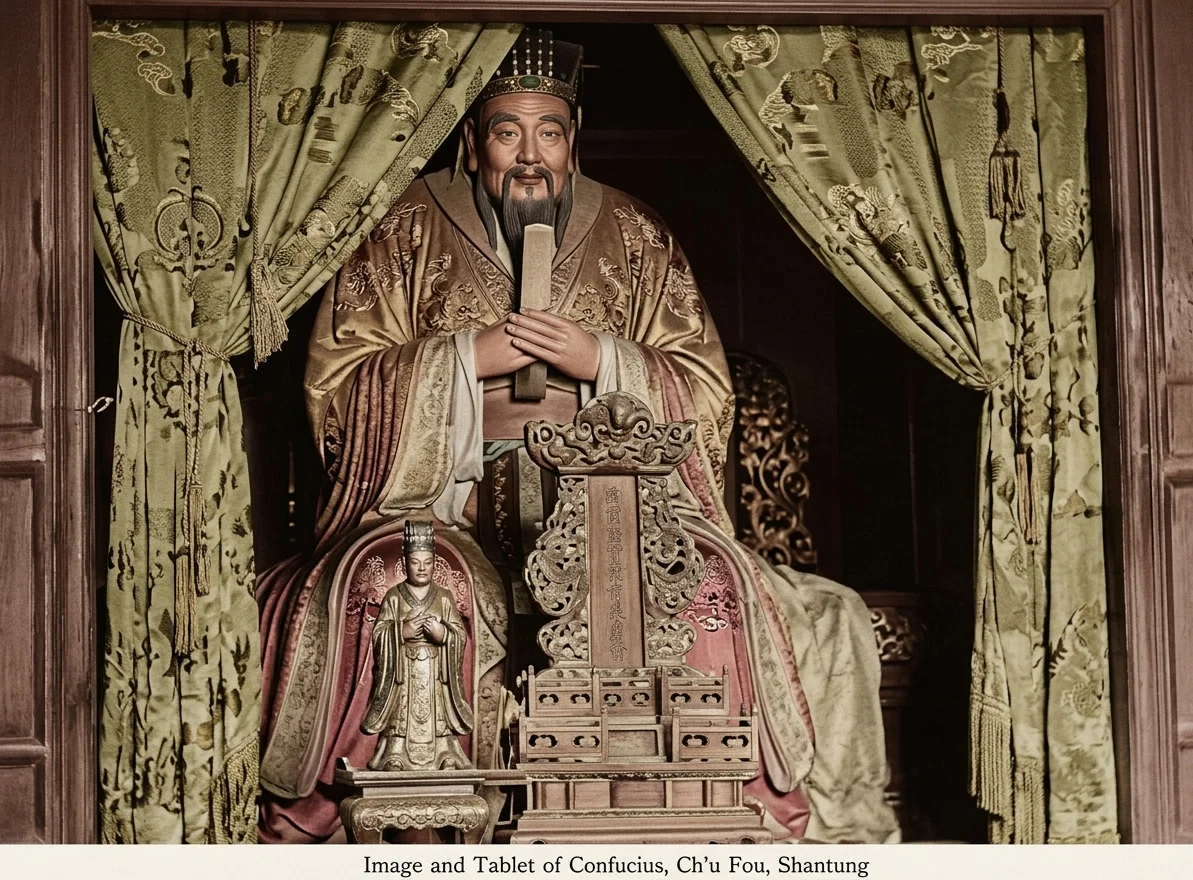
Every heathen home in China has its ancestral tablet in which it is sincerely believed the spirit of the departed dead dwells. Before these tablets food and drink are placed, incense is burned, prayers are said, and the aid and protection of the spirits importuned. "It is the rule to represent the gods who are believed to have lived as men, by images in human form, and the others by tablets inscribed with their principal divine titles. Images as well as tablets are inhabited by the spirits, especially when, at sacrifices, they have been formally prayed to or summoned, with or without music, to descend into these objects. Confucian worship and sacrifice, then, being actually addressed to animated images, constitutes pure idolatry. Certainly it is quite inconsistent with the Chinese spirit that such tablets and images are mere wood and paint."
Image and Tablet of Confucius, Ch'u Fou, Shantung
Not only at home is this ancestral worship carried on, but at the grave and in the village temple or the temple of the clan, as well. Before the altars or tablets erected or placed for the habitation of the spirits, the children of the dead bring their offerings of food, tea, or wine, and pay homage to the spirits that dwell in or visit these material shrines. When we add to this ancestral worship the worship of heaven and earth, the heavenly planets, the mountains, rocks, stones, streams, horses, camels, goats, tigers, fishes, serpents, trees, plants, lightnings and thunder, and a host of other animate and inanimate things, it can be seen to what an extent this people has fallen into idolatry.
Confucianism offers no help to a better life. It holds no promise of a Paradise nor the hope of a better world than this. It leaves every man to order his life so that he shall be in harmony with the universe, without any pardon for failure or reward for merit, or help to attain this harmony. It peoples heaven and earth, the air and water, with innumerable spirits, some good and some evil. There is no love in its religion, either in the family or community. Filial piety is enjoined; but beyond that, there is neither love for the gods nor love for man such as is taught by the Man of Calvary. It fails to satisfy the heart of man, as witnessed by its most devoted worshipers; for they are never satisfied, but wander from temple to temple, worshiping gods and goddesses that they know not, trusting that they may appease wrath and secure to themselves the favor of these gods who it is vaguely hoped will do them good.
Friend in the Kitchen
By Editor
Friend in the Kitchen.—This is an educational cook-book. Its object is to educate people away from flesh-eating by presenting to them a far better way. This “better way” consists of 400 thoroly tested recipes for the preparation of good, wholesome dishes, none of which include meat of any kind. The book gives the nutritive value of foods, time required to digest various foods, rules for dyspeptics, best food for infants, substitutes for meats, and, in fact, about everything a person wishing to reform his dietary needs to study. Durably bound in flexible cloth, 25c. Address this office.
IN THREE DAYS
SAN FRANCISCO
Overland Limited
TAKES YOU
To Chicago
ACROSS GREAT SALT LAKE
AND
HIGH SIERRA BY DAYLIGHT
Luxurious High-class Equipment
Electric Lighted Throughout
Pullman Drawing-room
Stateroom
Vestibuled Sleeping-cars
Careful and Attentive Dining Service
Parlor Observation-car with
Library and Cafe
Ladies’ Reading-room
Gentlemen’s Smoking-room
Daily News Bulletins
Latest Papers and Magazines