Signs of the Times, Vol. 39, No. 11.

Question Corner

Signs of the Times

Mar 12, 1912

Pacific Press Publishing Association · Mountain View, California · Mar 12, 1912

Question Corner

"IF YE WILL INQUIRE, INQUIRE YE."

This Inquirers’ Department is conducted for the purpose of helping those who are studying the Bible. The answers are oftentimes only suggestive. They are never to be considered infallible, only as they agree with the infallible Word. The writer who may answer them does not consider that his opinion is infallible. He will simply give the best that he has, and plead with the inquirer to search the Word. Such questions only will be answered as, to the editors, seem to minister to the good of the readers and to the mission of the paper. We can not answer repeatedly in the same volume questions upon the same scripture. The name and address must accompany question, not for publication, but as an evidence of good faith, and that answer may be made by letter if deemed advisable. No letters are answered which do not contain the name of the writer. It is well always to enclose stamp for reply.

3688 — The Round World Again

A Methodist minister tells me that had the Pilgrims come the other way around the world, the seventh day of the week would come different—that on account of the loss or gain of a day, the going around the world makes the cycle of seven days of man a mere happen-so, or chance. Please explain. F. H.
Presumably, then, this same Methodist minister is not at all particular as to Sunday; he does not consider that it has any holiness whatever. It is merely a chance as to whether we are keeping the first day; or, in other words, the first day is any day which we may so designate, depending on where we begin to number. In that case, of course, Christ did not rise from the dead on any first day of the week, but on no day in particular. Of course the mere statement of the thing shows its absurdity. The Lord rested on a definite day, blessed a definite day, sanctified or set apart, for man's use, a definite day. For forty long years during the wilderness wanderings of the children of Israel, a double portion of manna fell on the day before the seventh day. None fell on that seventh day. That which was preserved from the day before kept over the seventh day without spoiling, while that kept over from any other day became ruined by time. All this with a tremendous emphasis places the definite day of the cycle. Then, too, God's numbering would do this always, had it always been followed. It was "first day," "second day," "third day" of the weekly cycle, or Sabbath cycle. Consequently, the whole seven days themselves were called a Sabbath, or week; and the first day of that week was the first day toward the Sabbath, or into the Sabbath; and the second day, and so on. Man never could have forgotten the week if he had been true to his Maker; but God forestalled all this by pointing out, 2,500 years after the setting apart of the Sabbath, the particular, definite day to Israel. There is no question of a loss, or change, of time from that time to the resurrection of Christ; but nevertheless, in order that there might be no question concerning it, the Lord pointed out the Sabbath and the first day of the week, as recorded in Matt. 28:1: "In the end of the Sabbath, as it began to dawn toward the first day of the week." The Sabbath, then, was the day just previous to the first day of the week. There is no question whatever among scientific men regarding the loss of time since then.
God knew that the world was round, as pointed out in another question, and He set apart the Sabbath for man, knowing that man would live on all parts of the earth. It is a mere cavil to say that if—and if—and if—this thing, or that thing, or the other thing, had happened, things would have been different. All that may be true, and may not be true. If the Lord had never set apart a Sabbath, we would not have had any; and if He had made the first day of the week the Sabbath, that would have been His Sabbath, but He did not.
The Pilgrims did not come to us from the east; and if the world had been circumnavigated at that time, they would doubtless have understood clearly enough that they ought to make a change in time in crossing the Pacific Ocean. All that we need to know is the order of the days that God Himself so clearly established, and then keep the seventh day as it comes to us, or, if we wish to put it otherwise, as we come to it. The day may be considered stationary, and the earth rolls around to the day. We may begin on the eastern coast of Asia and proceed westward to the western coast of America, and we are in harmony with the people all the way regarding the day of the week. This is true, also, if we reverse our journey. It is only when we cross the great body of the Pacific Ocean that we either drop a day or add a day, depending on which way we are going. In one way, in going around the world, we continually lengthen our day, by going with the sun; and going the other way we shorten our day, by going against the sun; and in passing clear around the world, we either lengthen or shorten it to the extent of one day, and that men take into the account of their reckoning when crossing the Pacific Ocean, but nowhere else.

3690 — The Spirits in Prison

Please explain 1 Peter 3:17-20.
"For it is better, if the will of God be so, that ye suffer for well-doing, than for evil-doing. For Christ also hath once suffered for sins, the just for the unjust, that He might bring us to God, being put to death in the flesh, but quickened by the Spirit; by which also He went and preached unto the spirits in prison; which sometime were disobedient, when once the long-suffering of God waited in the days of Noah, while the ark was a preparing, wherein few, that is, eight souls were saved by water."
It seems to us there can be no question over the 17th and 18th verses. They are a very clear statement of what they mean. It is better to suffer for doing well than for doing evil. Christ also has given us an example in suffering for us: He was put to death in the flesh while He was here upon the earth; He was made alive by the Spirit, or quickened by it—that same Spirit by which He went and preached to the spirits in prison. "Spirits in prison" refers to those who are shut up in the prison-house of sin. Part of our Lord's mission, of course, was to open "the prison to them that are bound." Isa. 61:1; Luke 4:18. Jesus came to deliver the captives. But this was not a work which He did while here upon the earth alone, but at all times. He is "Jesus Christ the same yesterday, and to-day, and forever." Heb. 13:8.
2. "He went and preached." When? The text itself tells us: "When once the long-suffering of God waited in the days of Noah." That was just before the Flood; and the next clause also tells us—"while the ark was a preparing." Here are two adverbial phrases that tell us when it was our Lord preached. He preached when these souls were disobedient, suffering by their disobedience, in the days of Noah, while the ark was in preparation.
3. How He preached is told in the 19th verse—"by which" (by the Spirit). Noah was a prophet of God, and a servant of God; and Peter has already told us in the same epistle, verses 10, 11 of the first chapter: "Of which salvation the prophets have enquired, . . . searching what, or what manner of time the Spirit of Christ which was in them did signify, when it testified beforehand the sufferings of Christ, and the glory that should follow." It was Christ's Spirit testifying through Noah God's message to those who were disobedient at that time. Thus understood there is no contradiction with other scriptures.

3687 — The Tabernacle of David, Acts 15:14-17

When will the tabernacle of David be set up, and who are the residue of men, and when will they seek the Lord?
H.
The tabernacle of David evidently refers to the great and glorious kingdom of God, when Christ will reign over the house of David,—in a general way, the everlasting kingdom. That kingdom had gone to ruin—God's kingdom on the earth; it was fallen down. The Lord had set Himself to build it again. One important part of the kingdom is its subjects, and so Christ our Lord is represented in the 6th chapter of Zechariah as sitting upon the Father's throne and building the temple of the Lord, gathering out the stones which will form it. This is the teaching of the New Testament, as in Ephesians 2—gathering out from all nations, irrespective of birth or lineage, those who believe in the Lord Jesus Christ, and who will form a part of the heavenly kingdom. And the residue of men are all those Jews who will seek after the Lord; and all the Gentiles are the others, not of that Jewish fold, who would come into the fold, and there would be one fold and one shepherd. That was something that the Jews could not learn,—that the Gentiles were to come into God's plan, and be a part of it. This is emphasized over and over in the New Testament, and all the promises of the Old Testament ought to be read in the greater light of the New. This is especially emphasized in Eph. 3:3, 5, 6, "How that by revelation He made known unto me the mystery . . . which in other ages was not made known unto the sons of men, as it is now revealed unto His holy apostles and prophets by the Spirit; that the Gentiles should be fellow heirs, and of the same body, and partakers of His promise in Christ by the Gospel." See also chapter 2: 11-22.

3689 — Why the Mistake?

How did William Miller, and other Adventists, make the mistake of setting definite time for the second coming of Christ, when the Scriptures so plainly teach that we know not the hour, and not even the angels? and when did they notice the mistake?
It is a strange thing, and yet not strange, in a way, either, that men do not see all that is in Scripture. William Miller began by studying the prophecies of the Old Testament, especially the prophecies of Daniel. He saw the vision of Daniel 8, the 2,300 days, and the explanation of that vision in chapter 9, which gave the beginning of those days in B.C. 457. At the end of those days, or 2,300 years, the sanctuary was to be cleansed. He gathered that that sanctuary was the earth. For this he had no authority in Scripture, but he seemed to take it as a matter of course that the earth, or some part of the earth, was the sanctuary, and the cleansing of the earth was to be by fire, as the Bible abundantly teaches, and therefore the earth was to be cleansed at the second coming of Christ. And therefore Christ's second coming must be at the end of the 2,300 days; and logically, he felt that according to the type it must be on the tenth day of the seventh month of the Jewish year. Then the passage in Matthew 24, "Of that day and hour knoweth no man," was understood as, "No man maketh known the day or the hour"—God Himself would make that known. The real meaning of that text seemed to be covered from his view, and it was not until after the disappointment, when men began to study the prophecies of God anew, that they saw that the sanctuary was not the earth, but that that vision of Daniel pointed forward to a work which was to begin at a certain definite time — in 1844 — and continue an indefinite time, until Christ should come. It was not God's time then to appear. The earth must be more fully enlightened regarding His law before He could come.

3691 — The Angels that Sinned

Kindly explain 2 Peter 2:4.
The passage is a fact taken for granted regarding the angels that sinned: "If God spared not the angels that sinned, but cast them down to hell, and delivered them into chains of darkness, to be reserved unto judgment." These angels, of course, dwelt in the presence of God in light previous to their casting down. The term "hell" there comes from a word which occurs but once in the entire Scriptures. It is "tartarus," generally held to mean the aerial regions surrounding this earth. They were cast down from the light and glory of the atmosphere of heaven to the atmosphere of this earth, no more to dwell in the light of the righteous God, but in the darkness of sin. See Eph. 6:12, where the angels are referred to as the "principalities," the "powers," the "rulers of the darkness of this world," the "wicked spirits in heavenly places," as in the margin. In other words, they were not allowed to roam to other worlds; they are confined to this section represented by "tartarus" until the judgment-day.
Schedule for Week Ending March 23, 1912

The Closing Chapters of Deuteronomy

From the remainder of the book of Deuteronomy, chapters 26 to 34, we omit chapter 29, as consisting of reading not so important. The book brings us to the close of the life of a wonderful man, that of Moses. If the thought of his birth, his early education, his development of character, is kept in mind, we are sure that our readers will agree with us that we have traversed the life of one of the greatest men of all history. He failed in one instance, and therefore could not be a perfect type of Him who carries His people safely through without failure, our Lord Jesus Christ. Yet notwithstanding his failure, he is honored as no other was ever honored, in his death. God buries him, and heavenly angels alone are the attendants at the funeral. Later, we learn from other scriptures, God brings him forth, and we find him just before our Lord's crucifixion talking with Him of the trials through which our Saviour must pass. Joshua 1 and 2 show clearly that God had placed the spirit of Moses upon his successor, Joshua; and our week's reading closes with another psalm, which also shows God's providential dealing with His children, and rehearses for us once more some of the events over which we have been passing.

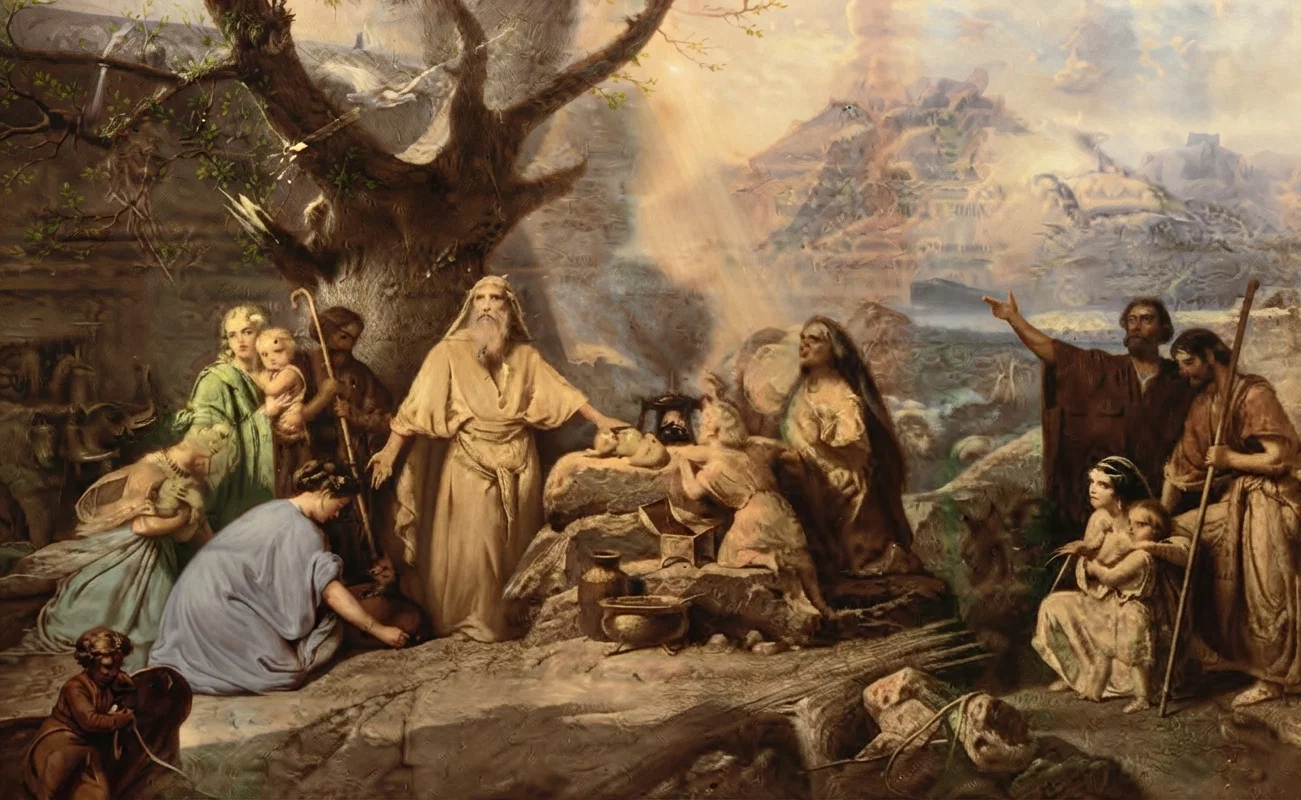
The Last Warning to Men

(Based on Genesis 6)
The world was sunk in darkness That sin alone had brought. No ray of light relieved the gloom, And none was ever sought.
Then rose that faithful prophet, The man whom God had sent To warn a world all judgment bound, And call it to repent.
That prophet's name was Noah; That age, before the Flood, When violent and wicked men Made haste in shedding blood.
No fear of God restrained them, No law could stay their hand; Iniquity of every sort Stalked boldly through the land.
H. F. Schopin
H. F. Schopin
Antediluvian sinners Were coarse and unrefined. Some sinned by yielding to the flesh, While others sinned in mind.
Full many had the knowledge That leads to mental pride; They spurned God's truth and prophet, His message they deride.
The rich oppressed the hireling, And would not pay his wage. They had no pity on the poor, As in the present age.
Refinement, wealth, and power Held high their lordly head, And cared not that the many Were crying loud for bread.
They reasoned God entirely Out of this world He made. They deified poor sinful man, Who like the leaf must fade.
Self was enthroned, and was not God ever in their thought. Base was the law that ruled them. The good they set at naught.
But limit, then, there must be To God's long-suffering care. Vainly His Spirit strove with men Who did not fear to dare
To grieve that faithful monitor Forevermore away, And so commit that awful sin For which we may not pray.
So God commanded Noah A mighty ark to build. A century or more he toiled Ere was his task fulfilled.
Full many were the sinners That helped to build that craft; But none believed the prophet— They only joked and laughed:
"What is this arrant nonsense Old Noah has to tell? He says: 'There's going to be a flood. Take heed and mark it well.'
"He thinks that he'll be safe for sure Inside his precious boat That he's building on a hilltop— How can it ever float?
"He says the end is very near, And to warn us he is sent. He threatens us with judgment dire, Unless we soon repent.
"Just let him bring his flood along; We'd like to see it here. He's trying now to frighten us,— So never, never fear."
Thus they ridiculed his warning, And heeded not his call. They thought that he was surely mad— They said so one and all.
They would not be persuaded That they'd be swept away, For unbelief forbade them Escape that dreadful day.
Noah saw their danger clearly, And pitied their sad fate. But all in vain his warning; Repentance came too late.
At last the ark was finished. God called His creatures in; And then came Noah's family, Salvation thus to win.
So it was faith that saved them, Like sinners saved to-day. O, let the unbeliever heed What I'm about to say!
A week, a weary week passed by; Still wilder grew the mirth Of sinners high and sinners low, Through length and breadth of earth.
"'Tis plain as day," the wise men said, "That science gives the lie To Noah's wild, fanatic course— Raise now the wine cup high!"
And so the feast went merry on, And so they bought and sold. So, too, they built them houses, And so they coined their gold.
For Jubal's lyre then ceased not Its merry, merry sound, As lightly tripped they in the dance, And passed the red wine round.
The smiling eye, the sylph-like form, The skin so fair and white; The diamonds sparkled in their hair With radiance so bright.
Thus beauty charmed the hearts of men Until that fateful day.
In marriage were fair maidens sought, And Cupid then held sway.
They did not dream of danger, But planned for future day. They thought of fun and frolic, And death seemed far away.
But soon there came a morning That rose all bright and fair, With sunlight on the hilltops, With perfume in the air.
The birds ne'er sang so blithely, And ne'er so sweet the flowers. All nature smiled serenely— Right swiftly sped the hours.
A short, brief span of time remained To gladden that old earth. Then all men's earthly treasures Would prove of little worth.
O, why that awful stillness? O, why that frowning sky? Behold the frightened cattle And birds, that homeward fly!
Still blacker the horizon, With inky clouds o'erspread. The lightnings flash, the thunders crash Destruction from o'erhead.
Men tremble now in terror They can not even name; Their hearts all melt within them, As prayers they try to frame.
The farmer leaves his plow in field; The carpenter his plane; The scholar, too, his pen and book; The merchant all his gain.
Dire consternation now prevails, As to and fro they run. To Noah loud they cry for help As they have never done.
But Noah can not hear them— Probation's at an end. Too long have they neglected Their lawless ways to mend.
God's Word they have rejected, His law they've set at naught. The consequences they must bear Which they themselves have brought.
Tho sinners all of Noah's day Made sport of Noah's ark, Yet when they quenched the light he brought, It left them in the dark.
Still louder pealed the thunder; The rain began to fall; The brooks were turned to rivers; The rivers—oceans small.
That old world then was pregnant; She travailed as in birth, And brought forth floods of waters That deluged all the earth.
The wicked sinners of that day Now wished they'd not denied A listening ear to Noah, And had not said he lied.
The world with all its treasures Would be a price too small, If only God would listen And hear them as they call.
But all too late their sorrow,— 'Tis not of faith, but fear. They trembled all like demons small, Because destruction's near.
The charming maid, the mother old, The husband in his prime, The doting wife, the darling child— All crave a little time,—
Time to repent and turn to God And make election sure. But all in vain their useless plea— They've spurned the message pure.
And so did God fulfil His word To age of faith devoid. The righteous eight were fully saved, The wicked were destroyed.
  • *
"As 'twas in days of Noah's Flood, It shall be in the end. As Sodom and Gomorrah too No listening ear would lend."
"Twas thus the Saviour did foretell Just how the end would be. Blind unbelief would laugh and scoff And jeer at those who see
The signs around fulfilling, All that our Lord then said— The pious, unbelieving church With doubt has been well fed.
The way to heaven is broad indeed, The modern preachers say; And it is thronged by multitudes Who love to walk that way.
The faith of men like Noah Too seldom do we find. The Word of God is juggled now To suit the skeptic mind.
Religion must be popular To please the well refined; And such as dare the cross to bear, Are very hard to find.
The signs in sun and moon and stars Have long since passed away. And the signs among the nations Portend the coming day.
The famines, earthquakes, plague, and pest That devastate mankind, All warn us that the end is near— Yet multitudes are blind.
The peace and safety cry is heard, Borne forth on every gale, Altho the forge and foundry tell Us quite another tale.
Dire weapons of destruction, Of long and deadly range, Are multiplying rapidly; And so, it isn't strange
That men whose eyes are opened, Should tremble at His Word, And strive, as much as in them lies, To warn those who've not heard.
The strikes and lynchings, too, fulfil The lawless days foretold. The rich are never satisfied In piling up their gold.
Millions and billions, dark with rust, Are deaf to hunger's cry. The virtuous, needy, wretched poor Are left to starve and die.
The baser passions, too, hold sway, Nor safe the marriage vow. As men transgressed in Noah's day, So do they even now.
They will not quench their carnal lusts That hold in bondage fast. They want to live here as they list, And go to heaven at last.
Thus crimes we dare not mention, Prevail 'mong men to-day, Just as Saint Paul predicted In ages passed away.
Nor are men now contented To be by prophets led. They spurn the Bible and its truth, And turn unto the dead.
They say that it is safer To trust what witches tell, And know not that all such are doomed To be cast into hell.
"The devil is a myth," they say, "And hell can never be. The darkest crimes pure virtue are, And good for you and me.
"The sins that shock humanity Are rungs in ladder tall, That yet shall lift us to the height Of holy angels all."
Theosophy, and "new thought," too, Hypnotic power, all bad; And "Christian Science," falsely called, Are making many mad.
They think they're revelations grand, Both marvelous and true,
And know not that they're pagan lies, And neither safe nor new.
The carnal heart still hates the cross, And will not have the light. Men harden more their stubborn necks, And will not do the right.
Blind unbelief has come to stay In pulpit, pew, and school. The man who humbly trusts God's Word Is reckoned now a fool.
So Jesus said it e'en would be When He should come again; For unbelief instead of faith Would rule the hearts of men.
And Peter also prophesied That scoffers would arise, In latter days, in time of end, And ask, as in surprise,
"O where, pray tell us, are the signs That show His coming near? Just give us now one little proof That we have aught to fear.
"For all things still continue As from creation's day"— And willingly are ignorant Of what the prophets say.
And so it is, and so 'twill be, That signs as plain as day, Which tell of coming judgments, Turn few from sin away.
For now the final message Is going to all mankind. Its voice like sound of trumpet Is borne on every wind.
The judgment-day is nearing. Let all men now beware! Heed well these solemn warnings! Make haste! Take care! Prepare! Batavia, Java, September 17, 1911.

Temptation—What Is it?

By Mrs. E. G. White
WHAT is temptation? — It is the means by which those who claim to be the children of God are tested and tried. We read that God tempted Abraham, that He tempted the children of Israel. This means that He permitted circumstances to occur to test their faith, and lead them to look to Him for help. God permits temptation to come to His people to-day, that they may realize that He is their helper. If they draw nigh to Him when they are tempted, He strengthens them to meet the temptation. But if they yield to the enemy, neglecting to place themselves close to their Almighty Helper, they are overcome. They separate themselves from God. They do not give evidence that they walk in God’s way.
Thus the Lord determines character. Thus He decides whether we are obedient or disobedient. He does not do this for His own enlightenment; for He reads all things as an open book. He does it that the secret motives of men’s hearts may be manifest, that His true witnesses may be strengthened, that others may become intelligent in regard to the ways and works of God as contrasted with the ways and works of the enemy.

No Sin in Temptation

Temptations will pour in upon us; for by them we are to be tried during our probation. This is the proving of God, the revelation of our own hearts. There is no sin in having temptation; but sin comes in when temptation is yielded to.
When Jesus was led into the wilderness to be tempted, He was led by the Spirit of God. By going into the wilderness, He did not invite temptation. But Satan knew that the Saviour had gone there, and he thought it the best time to approach Him.
Christ went to the wilderness to be alone, to contemplate His mission and work. He had taken the steps which every sinner must take, in conversion, repentance, and baptism. He Himself had no sins of which to repent, and therefore He had no sins to wash away. But He was our example in all things, and therefore He must do that which He would have us do. Christ fasted and prayed, bracing Himself for the blood-stained path which He must travel. He was the Son of the eternal God, but as man’s surety, He must meet and resist every temptation with which man is assailed.

Knew of the Conflict on Appetite

When Christ had fasted for forty days and forty nights, the enemy came, tempting Him to make bread of the stones. Christ knew that He would be assailed upon appetite, for it was upon this point that Adam and Eve had failed. And with the terrible weight of the sins of the world upon Him, He withstood the fearful test upon appetite, upon the love of the world, and upon that love of display that leads to presumption. He endured these temptations, and overcame in man’s behalf, working out for him a righteous character, because He knew that man could not do this of himself.
The world’s Redeemer, the second Adam, by His suffering and death worked out a redemption for the human race. He was tempted in all points like as we are. He knew that the enemy would come to every human being, to take advantage of hereditary weakness, and to ensnare, by his false insinuations, all whose hope and trust is not in Christ. And by passing over the ground which man must travel, by showing that, through the divine power granted him, man can overcome every form of temptation, Christ prepared the way for us to gain the victory.

Satan’s Specious Plan

If Satan can persuade people to follow a course that is contrary to the principles underlying and running through every enactment of God’s law, he has a chance to work upon their minds. One venturesome step in deceptive practises, under the specious direction of Satan, leads to a second such step. Those who follow this course depart from God. The poisonous malaria of worldly principles is so disguised by the enemy that the actors become willing to work in lines which are contrary to the will of God. They make use of the world’s artifices in order to gain an advantage over their neighbors. This creates a train ofthought which separates the soul from the Spirit of God. The mind becomes more and more infatuated, and the power to overcome temptation is destroyed. The tendencies thus cultivated are transmitted to the offspring, as Adam’s disobedience was transmitted to the human family.

Not at a Disadvantage

Christ came to our world as man’s surety, preparing the way for him to gain the victory by giving him moral power. It is not His will that man shall be placed at a disadvantage. He would not have those who are striving to overcome, intimidated and discouraged by the crafty assaults of the serpent. "Be of good cheer," He says; "I have overcome the world."
With such a general to lead us on to victory, we may indeed have joy and courage. He came as our champion. He takes cognizance of the battle that all who are at enmity with Satan must fight. He lays before His followers a plan of the battle, pointing out its peculiarities and severity, and warning them not to join His army without first counting the cost. He tells them that the vast confederacy of evil is arrayed against them, and shows them that they are fighting for an invisible world, and that His army is not composed merely of human agencies. His soldiers are coworkers with heavenly intelligences, and One higher than angels is in the ranks; for the Holy Spirit, Christ’s representative, is there.

The Struggle and the Deliverance

Then Christ summons every decided follower, every true soldier, to fight for Him, assuring them that there is deliverance for all who will obey His orders. If Christ’s soldiers look faithfully to their Captain for their orders, success will attend their warfare against the enemy. No matter how they may be beset, in the end they will be triumphant. Their infirmities may be many, their sins great, their ignorance seemingly insurmountable; but if they realize their weakness, and look to Christ for aid, He will be their efficiency. He is ever ready to enlighten their dulness and overcome their sinfulness. If they avail themselves of His power, their characters will be transformed; they will be surrounded with an atmosphere of light and holiness. Through His merits and imparted power they will be "more than conquerors." Supernatural help will be given them, enabling them in their weakness to do the deeds of omnipotence.

Witnesses to the Conflict

Those who fight for Christ are fighting in the sight of the heavenly universe, and they should be soldiers, not cowards. Those who truly desire to serve God will not follow their own wisdom, or the wisdom of the archdeceiver, who is playing the game of life for their souls. By faith they are to look calmly upon every foe, exclaiming: "We fight the good fight of faith, under the command of an omnipotent Power. Because He lives, we shall live also. Through Jesus, who is the author and finisher of our faith, we may withstand all the fiery darts of the enemy."
Abraham certified his obedience to God when, with Isaac by his side, he journeyed on his way, in response to the command, "Take now thy son, thine only son Isaac, whom thou lovest, and get thee into the land of Moriah; and offer him there for a burnt offering upon one of the mountains which I will tell thee of." Job was permitted to suffer; he was severely tempted; but he would not speak one word against God. During Christ’s life on earth the scribes and Pharisees, instigated by Satan, tempted Him in every possible way. But He never allowed these temptations to lead Him from the path of obedience. When God speaks, let us obey, no matter how the enemy may tempt us to disobey; for the path of obedience is the only safe path.

Continual Resistance Necessary

Christ’s example shows us that our only hope of victory is in continual resistance of Satan’s attacks. He who triumphed over the adversary of souls in the conflict with temptation understands Satan’s power over the race, and has conquered in our behalf. As an overcomer, He has given us the advantage of His victory, that in our efforts to resist the temptations of Satan, we may unite our weakness to His strength, our worthlessness to His merits. And sustained by His enduring might, under strong temptation, we may resist in His all-powerful name, and overcome as He overcame.
Continue reading: What Shall We Do with the Fourth Commandment?