PORT OF SPAIN.—The following is an extract from Sister L. M. Crowther's letter, of August 30, to friends in Dakota: “It is with a sad heart that I write to you this morning to tell you of my husband's death, which occurred Sunday, August 25. He was buried on Monday. Our doctor called it pernicious malarial fever; another doctor called it jungle fever. His death was very sudden; he was sick one week.”
“Sabbath morning, August 13, he talked in the meeting, but had to leave before it closed. He took his bed, and never got up again. I had two trained nurses and the doctor, and all was done that could be. The day before he died, he seemed so bright and cheerful we thought he would be up in a few days.”
“He and Elder Kneeland had gone to Tabago to look over the work there and get it started, but he stayed only a few weeks and came home sick. Elder Kneeland came home the day after my husband was buried, sick with the same fever. I have not heard from him this morning; yesterday he was a little better.”
“Pray for us, that we may be faithful, and meet him when Jesus comes, as he died rejoicing in the Lord.”
FLORIDA.
By Irving Keck
THE work is onward in Florida. At the coming Conference we shall be out of debt as a Conference, and shall have made a material reduction in our tract society debt, with a good prospect of soon reaching the end of it also. Three new church buildings are ready for dedication without a dollar of debt, and a fourth is up and occupied, but not entirely finished. Three church schools have been in operation, with good success.
In Jacksonville fire seriously interfered with the work, as our laborers had been concentrated there during the winter, and for six months had labored with fair success. But now it has been scattered by the fire that destroyed so much of that city in May last.
A Working Woman's Home at Tampa is established, and we hope to make it permanent and an influence for good in that important center.
The annual Conference convenes at Fort Ogden, November 1, and we hope for a good attendance.
IRVING KECK.
PACIFIC UNION CONFERENCE.
By John Norton Loughborough
SINCE my last report I have attended four local camp-meetings in this Conference. The first was at Bountiful, Utah, ten miles north of Salt Lake City. This was held from August 8-18. This meeting was attended by about sixty-five of our people, and was a source of strength to the cause in that new field. It is reported by the workers that the public interest is increasing in that field.
The second meeting at Bozeman, Mont., from August 13-19, was attended by about ninety of our people. Not only was this meeting a source of strength to those already in the faith, but the public interest demanded a continuance of the meetings. At last report ten or more had already taken their stand with our people.
The third meeting was at Missoula, Mont., from August 25 to September 1. In the Sabbath-school the second Sabbath there were one hundred and fifteen in attendance. Brother Knox, President of Pacific Union Conference, was with us the most of this meeting. The spiritual tone of this camp was good. Like Bozeman, the public interest was such that it was decided to continue the meetings. Brother White, President of the Conference, is much encouraged with the outlook in his field.
The fourth camp-meeting was at Seattle, Wash., in the North Pacific Conference, from September 5-15. The Sabbath-school the second Sabbath of this meeting numbered two hundred and fifty. Besides many of the Conference laborers, Brother Martin, of the California Conference, aided in the labors of this meeting. The large church in Seattle could have derived more benefit from the meeting if more of them could have camped on the ground. It was not deemed needful to follow up this meeting, as it had been preceded by a tent effort.
Brother Knox and myself are here in Portland, Ore., on our way to attend the camp-meeting at Weiser, Idaho. These local camp-meetings have afforded an excellent opportunity for personal labor with the people. Many souls have come out into the liberty of the gospel, and many others have taken their stand with the Lord's people. To the Lord be all the praise.
J. N. LOUGHBOROUGH.
MINNESOTA.
MADELLA.— Some features of our work are encouraging. Good attendance Sunday nights. Others are about to decide. Presbyterians and Baptists hold secret meeting, saying, “Peace and safety.” Remember us.
TENT COMPANY,
per O. O. Bernstein.
KIMBALL AND CROW WING.— Most of the time since the middle of July I have spent in the country south of Kimball. My experiences here have been of various kinds. There are not many open doors, but lots of prejudice, so that some of the schoolhouses are closed against us. But the truth cannot be shut out, and like leaven it is slowly working.
The most of the people are poor, and it is difficult to make sales, yet last week I sold three copies of “Christ’s Object Lessons,” and took twelve orders.
From July 30 to August 4 I had the privilege of being with the Scandinavian brethren at Crow Wing. I was glad I went there, and I believe they were, too. My prayer is that they may lean upon the arm of Christ and continue faithful. F. JOHNSON.
ELMDALE AND LITCHFIELD.— From Crow Wing I went to Elmdale, and held a quarterly meeting with the little Scandinavian church. They all seemed to be of good courage, and we had a blessed time together. Last Friday, August 30, I went, on my wheel, to Litchfield, and stayed with the church over Sabbath. The membership is small, but with the children, the Sabbath-school numbered over twenty. I was glad to meet with them and enjoy the presence of the good Spirit. F. J.
The Minneapolis church school will be taught by Etta Flaiz. Celia Tichenor will be the teacher at the St. Paul church school; Della Burdick, at Good Thunder; Elma Detamore, at Wells; Emma Collins, at Dodge Center; Lillian Stevens, at Sauk Center; Anna Nelson, at Henning; James Mork, at Moose Lake; Thirza Mason, at Lewiston; Mary Nelson, at Isanti; Ethel Maddock, at Brainerd; Caroline Hopkins, at Medford; Ethel Sanford, at St. Cloud; M. Leatherman, at Mankato; and C. L. Butterfield, at Gilchrist. It has not been fully decided who will be the teachers at Pine Island, Anoka, Highland, and Canby.
MANITOBA.
THE following is taken from a private letter written by Sister Alice Robinson, Secretary and Treasurer of the Manitoba Tract Society: “We have nine organized churches, several companies, twenty-four Sabbath-schools, and about fifty isolated members.” Sister Robinson has accepted an invitation to return to South Dakota as one of the Conference laborers.
KENTUCKY.
By Mr. B. Hagle; Mrs. B. Hagle
RENDER.—We closed the work in Render, August 27, and left a company of thirty keeping the Sabbath. All the members of this company, with the exception of five, are new in the faith. They accepted all points of faith, and we left them of good courage.
From Render we went to the State camp-meeting at Franklin, where we enjoyed much of the blessing of God. We were glad of the privilege of becoming acquainted with a number of the brethren and sisters in this Conference.
From Franklin, I came to Murfreesboro, Tenn., and settled my family for the winter. There are a few scattered Sabbath-keepers here, and I believe by the help of the Lord, we shall soon have more to unite with us—as soon as we can hold a series of meetings here. From this place we go to Goshen, Tenn., to hold a series of meetings, then we intend to come back to this place.
May the Lord give heavenly wisdom, that the work may prosper and many souls accept these precious truths. We are of good courage in the Lord; for we know He is with us.
MR. AND MRS. B. HAGLE.
THE OSWEGO (N. Y.) CAMP-MEETING.
By John A. Brunson
The New York State camp-meeting was held in the beautiful and prosperous city of Oswego, from August 29 to September 8. The camp was pitched in Kingsford Park, whose rich carpet of soft green grass, and whose spreading elms, contributed much to the comfort of the campers, while its central location enabled many visitors from the immediate vicinity to attend and enjoy the meetings. From the beginning, the city attendance was encouraging. At night the congregations would number perhaps two thousand, who gave respectful audience to the truths presented. Many of the distinctive features of the message were clearly expounded, while the grand central truth, RIGHTEOUSNESS BY FAITH, that truth without which no man can enter the kingdom, was not neglected. There was an earnest effort to make the way of salvation so plain and simple that even a child could grasp it and rejoice therein. The effort was appreciated, and many gained a more intelligent apprehension of the facts of faith upon which to build their hope of ultimate success. Christ, dying in the sinner's stead as the only ground of acceptance with God, became more precious than before to disquieted, timid souls.
More than twenty were baptized during the meetings. The interest awakened continued to the close, and a competent corps of workers were left there to develop it further.
The various branches of work were all considered and the business was conducted with becoming harmony and good will. Considerable interest in the sale of “Christ's Object Lessons” was developed. Different individuals agreed to dispose of numbers of copies, aggregating ten hundred and forty-eight. Altogether the meeting was pleasant and profitable.
JOHN A. BRUNSON.
Leading Events of Week Ending September 28.
By A. J. B.
— The Venezuelan troops have captured La Hacha from the Colombians.
— Dispatches from China state that “Peking is quiet since the foreign troops have left.”
— A number of papers are now calling for a “censorship of the press” in this country.
— Seth Low, President of Columbia University, has been nominated for mayor of New York City.
— President and Mrs. Roosevelt have taken up their residence in the White House at Washington.
— A submarine cable is to be laid from California to Hawaii and the Philippines, with branch lines to Japan and China.
— China proposes to send “commissions to America, the Philippines, Australia, and elsewhere, to collect contributions to the indemnity fund, from Chinese in those countries.”
— The trial of Leon F. Czolgosz lasted two days. On the 24th ult. the verdict rendered by the jury was, “Guilty of murder in the first degree, as charged in the indictment.”
— New York capitalists have bought up 1,000,000 marks’ worth of the Hamburg-American Packet Company’s shares. The Germans now begin to fear that J. Pierpont Morgan is trying to get control of the German steamship lines.
— Russia is said to have offered $2,500,000 to China for the ships of her Pei-Yang squadron, which consists of three fast cruisers, four torpedo-boat destroyers, and some third-class cruisers. Russia is willing to thus help poor China reduce her enormous war indemnity.
— The United States Steel Corporation has set aside several million dollars’ worth of its stock “for purchase, at inside figures,” by the 165,000 men which it employs. A similar scheme has been successfully carried on by the Carnegie steel companies ever since 1892.
— It is estimated that the great steel strike, just ended, “cost the strikers and the trust altogether about $25,000,000, of which $15,000,000 is apportioned to the trust. But the trust won some slight compensations, while the men gave up $10,000,000 in wages for a little less than nothing.”
— Chemical analysis proves that Czolgosz’s bullet was not poisoned.
— The United States has yet 100,000,000 acres of arid land to give away.
— Russia offers her protection to Armenia, but “wants it accepted promptly.”
— It has been decided by a federal judge that “the anti-trust law of Nebraska is unconstitutional.”
— A national monument will be erected in Canton, Ohio, to the memory of William McKinley.
— The Chicago post-office clerks are making a fight for an eight-hour workday, and are likely to win.
— Dr. W. C. Gray, editor of the Interior, is critically ill at his home in Oak Park, Ill. He is not expected to live.
— The first race between the “Columbia” and “Shamrock II” was won on the 28th ult., by the American yacht. There are no more races.
— By appointment of President Roosevelt, Dr. Rixey, Mrs. McKinley’s physician, will become Surgeon General of the United States Navy upon the expiration of the term of Surgeon General Van Reypen.
— The Puget Sound Conference of the Methodist Episcopal Church has adopted “a resolution practically boycotting the Boston Theological School and the Garrett Biblical Institute, on account of the higher criticism.”
— In connection with the socialist congress now being held at Lübeck, Germany, “two official stenographers have been assigned by the Prussian government to report the proceedings, for the purpose of making proof of forbidden utterances.”
— According to the annual report of Maj.-Gen. Elwell S. Otis, commander of the Department of the Lakes, “desertions are increasing in the regular army. So many soldiers have been guilty of this crime that General Otis comments on the lack of accommodations for prisoners” responsible for this offense.
— Upon arriving at the Auburn (N. Y.) penitentiary, the 27th ult., Czolgosz completely broke down, shrieking with terror. He now occupies one of the five death cells in the penitentiary, two guards being constantly present to prevent any attempt on his part to commit suicide. He now acknowledges his mistake, and says he would not commit such a crime had he the opportunity to do so again.
— A Queenstown dispatch, dated the 27th ult., states that the “Lucania,” which sailed from New York the 21st for Liverpool, and arrived there Friday, “reports having communicated for two hours with the steamer ‘Campania’ in mid-ocean, by means of wireless telegraphy. The shortest distance in which communication was effected was thirty-three miles, and the longest, sixty-five miles.”
— Speaking of the situation in the Philippines, a mail dispatch to the Chicago Tribune, dated August 12, and just published, states that “it is freely predicted that a renewal of guerilla hostilities is to be expected. Malvar still has enough men to be troublesome. There seems to be little doubt that the Hongkong junta is in communication with him, and is still holding forth the hope of intervention.” But later dispatches state that “all the Filipino forces in the province of South Camarines have surrendered.”
— During his recent visit to France the Czar was approached by the French President in regard to settling the Boer war by arbitration. A recent dispatch states also that “the Dutch Minister of Foreign Affairs has forwarded to the members of the administration council of the court of arbitration at the Hague, and also to the legations, a copy of the Boer appeal for arbitration, with a notification that he intends to bring the appeal up for consideration at the first meeting of the council.” It is thought, however, that the council will “declare itself incompetent to deal with the subject,” although it has not yet taken any action.
— A Cape Town correspondent of the London Daily Express declares in a letter dated the 23d ult., that “the Dutch element in the colony is in revolt, and it is useless to disguise the fact.” It appears that “from Orange River to the sea Cape Colony is in a condition of open or incipient rebellion. Everything is in readiness for a Dutch uprising in both Cape Colony and Natal. . . . The British government, which prorogued the Cape Colony Parliament until August 27, so as to make the government free to resort to martial law, has extended the prorogation to November 20. . . . The British cruiser ‘Burracouta’ is on its way to Mossel Bay, only about 225 miles east of Cape Town, with re-enforcements for the trenches that defend the bay.”
— Forest fires are doing much damage near Eldora, Colo.
— The illness of Secretary Root is causing great uneasiness to his friends.
— Thirty-two persons were recently killed in a railway collision at Palota, Austria.
— Russia has decided to build five war-ships of 20,000 tons each, in her own shipyards.
— The Illinois Free Methodists began their forty-first annual conference at Elgin, the 25th ult.
— It is reported that Governor Dole, of Hawaii, has sent his resignation to President Roosevelt.
— President Roosevelt is preparing his first message to Congress, in which he will fully outline his policy.
— The National Conference of Unitarian churches met September 23, at Saratoga, N. Y., Senator Hoar being president of the same. Among the noted speakers were Edward Everett Hale, Minot J. Savage, and Miss Jane Addams, of Chicago.
— The twenty-seventh annual convention of the Roman Catholic Young Men’s Union met in Philadelphia, September 24–26. Some of the subjects discussed were “State paternalism in education, temperance, Christian socialism, and education in the Philippines.”
— According to the Church Standard (Episcopal) of Philadelphia, “the Cape Dutch are helping the Boers, and the number of the latter now on the field is estimated at 11,000. Their armies and ammunition are constantly renewed, and they are within forty miles of Cape Town and eighteen miles from Ladysmith.”
— The will of William McKinley, filed for probate the 28th ult., shows that he was worth about $250,000. Mrs. McKinley has a life interest in the entire estate, with the exception of $1,000 a year, which goes to Mr. McKinley’s sister Helen, his mother, the original legatee being dead. His life was insured for $67,000.
— The people of North Carolina have been notified by the governor that “all petitions for the pardon of convicts must first be advertised for some length of time in the newspapers of the locality where the offender lived, or where the crime was committed.” It is thought this will put an end to “the business of obtaining pardons quietly and without due sifting of the matter in a public manner.” A most sensible idea, indeed.
— The British torpedo-boat destroyer “Cobra” foundered in the North Sea, Wednesday morning, the 18th ult. Of the seventy-nine persons on board, only twelve escaped. The ship struck on the Cadzosz Rocks at 7:30 A. M., causing the boilers to explode and the vessel to break in two. Lieutenant Bosworth Smith, the commander, stood upon the bridge with his arms folded, “as impassive as if on parade, and went down with the vessel.” The vessel had put to sea in a furious gale, to test its boilers. The “Cobra” was the fastest vessel in the world, having made a record of 43.5 miles per hour.
— During the recent visit of the Czar to France, President Loubet “urged the essentially pacific character of the alliance of Russia and France,” which, in his language, “has contributed powerfully to the maintenance of the balance between the forces of Europe, a necessary condition of peace; the good which it has done is a pledge that will do still more.” To this the Czar replied that “the intimate union of the two great Powers, animated by the most pacific intentions, and who, while able to make their rights respected, do not seek to injure in any way the rights of others, is a precious element of appeasement for the whole of humanity.”
— Speaking of the Turkish problem, the Atlanta Constitution believes that “the growing power of Russia and the new realignment of the European Powers is inevitably paving the way for Turkey’s dismemberment. The old balance of power between European countries has been destroyed, and Russia’s ambitions are stretching out in the direction of the Sultan.” Continuing, it says: “There can be no doubt that the end of the Turk is imminent. There are but three courses open to the diplomacy of Europe: (1) Allow Russia to seize the empire; (2) extend the authority of Greece over the Turkish Empire, thus maintaining the present balance; or (3) general European war, the result of which no man can foresee. The situation is grave indeed, and the coming conflict is but a matter of time.” These statements show what the editors of the daily press see directly ahead. The student of prophecy should be able to see what is really involved in the proposed dismemberment of the Turkish Empire.
A. J. B.
Collection for the Haskell Home.
By S. H. LANE
As next Sabbath, October 5, is the time for the regular collection for the Haskell Orphans’ Home, and the James White Memorial Home for the aged, we trust every member of our denomination in the United States will donate liberally for the support of these two institutions. The writer feels sure, if every one who reads this article could visit these two institutions, that he would be favorably impressed with the work that is being carried on by them.
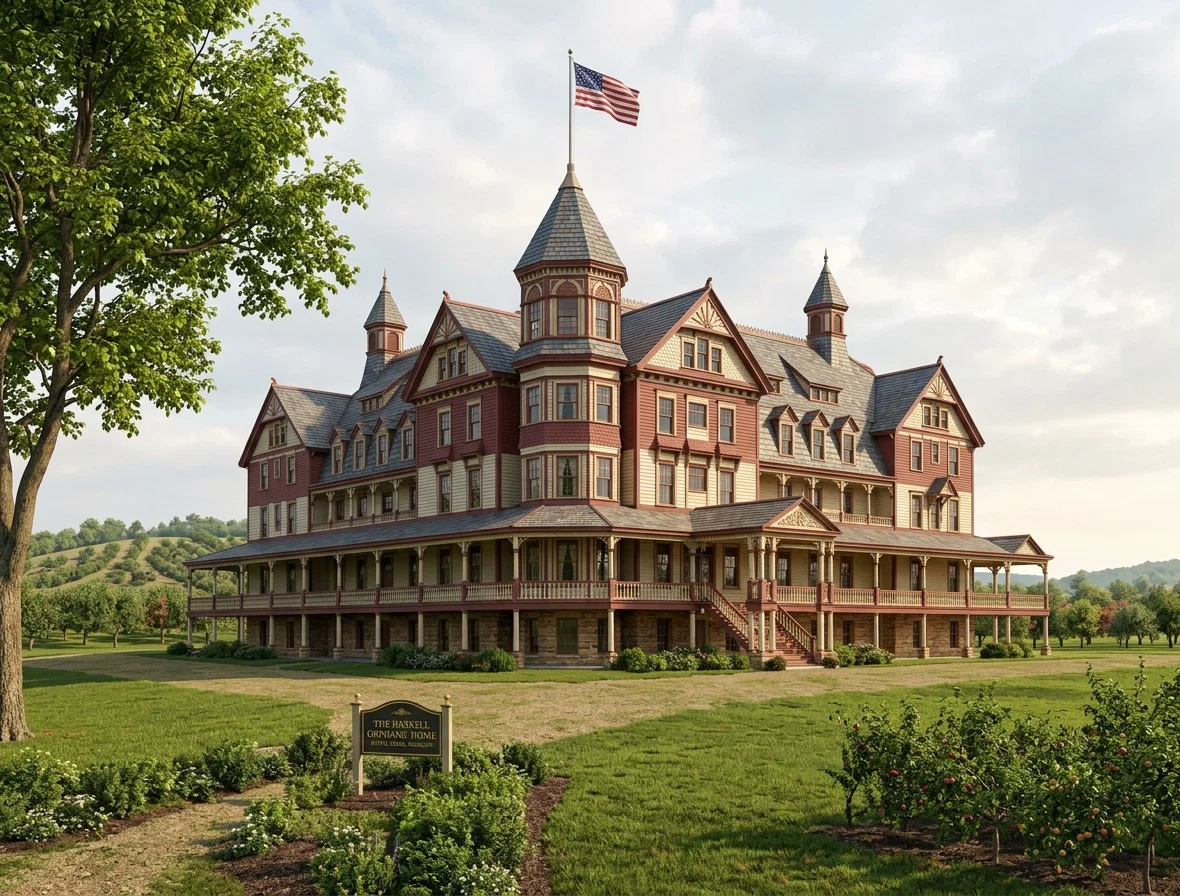
The Orphans’ Home, a picture of which is given below, has connected with it at the present time over one hundred orphans. These children come from different States, some of whom are the descendants of those who have been faithful in the work. These children are receiving a real practical education in several lines of industrial work.
THE HASKELL HOME.
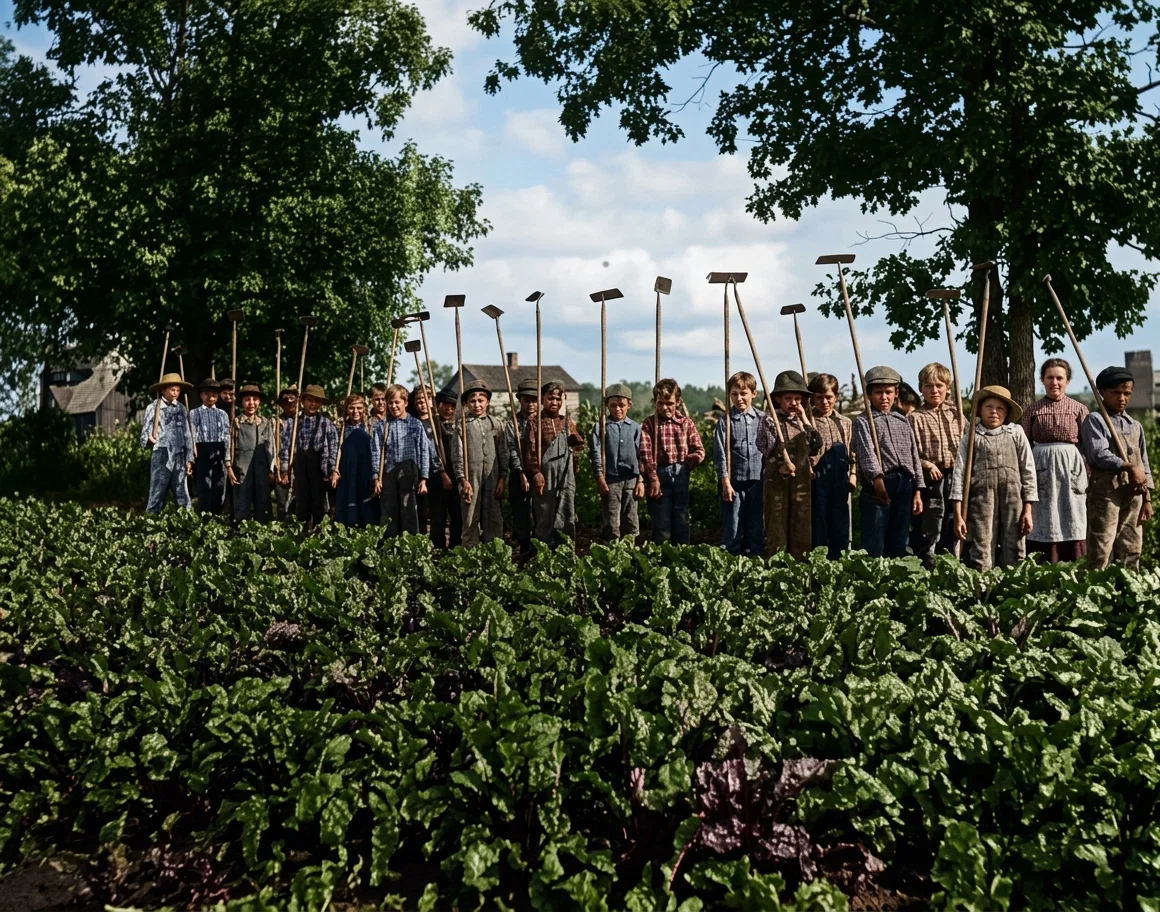
The farm consists of sixty-seven acres, and has been set out quite largely to fruit, consisting of apples, peaches, pears, plums, strawberries, raspberries, and blackberries. The peach and plum orchards are just now getting into a bearing condition, the orchard producing more fruit this year than during any previous year. The orchard consists of 1,200 peach, 1,000 plum, 300 pear, and several hundred apple trees. The children have canned 3,972 quarts of plums, pears, peaches, strawberries, and grapes. The farm has five acres of strawberries, which produced 10,000 quarts of berries this past summer; seven acres of raspberries, one acre of currants and gooseberries, and a vineyard of grapes. They sold $345 worth of fruit besides what they consumed. The children are taught to plant and hoe the garden and pick the berries, and by so doing aid to some extent in supporting themselves.
CHILDREN WORKING IN BEET FIELD.
Those hired in the institution work at a sacrifice. The Superintendent, and his wife, who has acted as matron for the last two or three years, have received no wages at all for their services, simply being boarded for their work. The sisters, who act as mothers, generally for the first year give their services. They receive twelve dollars a month for the second year, and fifteen dollars a month for the third year. The teachers who instruct the children receive from twelve to fifteen dollars a month.
It has been the writer’s good pleasure to speak several times to the children, and recently he attended a funeral service of one of them. Everything is carried on with so much order and decorum at all the meetings that it is indeed refreshing to be associated with them. They are very obedient and keep perfect order. No light, boisterous laughing or disagreeable romping is heard, yet all seem to be cheerful and well disposed.
Last summer the writer held a Sabbath service in a church a few miles distant from the city. The assistant superintendent brought a load of children to attend the meeting. The children took part in the Sabbath-school and answered so promptly the questions in the review that the brethren of the church were delighted, and after the service was over, several of the church-members came to me and said: “We are so glad the children came out. How bright and intelligent they are, and how wonderfully well they behave. Surely their training must be complete at the Home.” As we have said before, Could each reader of this article visit the Home, and see the children at work or in meeting, and mark their deportment and the courtesy with which they treat each other and strangers who come about the institution, he would be delighted.
As these children reach about the age of fifteen years, homes are found for them in families. Some go out to labor, and everywhere they are proving themselves to be well behaved, steady, industrious persons, and as the institution begins to turn out such individuals into society, it is being seen more and more that the education received at the Home is of a genuine substantial nature. The writer takes pleasure in assuring every reader of this article that in giving to the aid of the Haskell Home, and for the maintenance of the aged people in the James White Memorial Home, he is doing a commendable thing.
The Haskell Home, although presenting a fine appearance, as the above picture will indicate, is furnished and finished very plainly,—indeed so plainly that its inside appearance seems really elegant on account of its plainness.
The James White Memorial Home is a building which was once owned by Elder James White, and was his home for several years. It has been enlarged and does not appear as it did when Elder White lived in it, but it furnishes a very comfortable home for some fifty or more old people. As one visits the institution, as the writer has often done, and spoken to the old people, he finds them nicely, yet very plainly attired, and they seem happy and contented in their home. Some are very earnest in their praise for not only the Home itself, but for the treatment they receive at the hands of all who labor in the institution. The society in the Home is constantly changing, as many of them are of that age that it is only a question of time until they depart this life; but all seem to be earnest, devoted Christians, and all who drop away, rest in hope. The applications from our ranks to find a place in the home are many. As soon as one drops away through death, another stands ready to take his place, and it is hard to tell just what would be done if we as a denomination did not have such a home.
Each church should care for its own poor and needy as far as possible; yet even when this is done, there are always some that are isolated from the church, or belong to very small churches, and need homes, and can find none better than the James White Memorial Home. So there is a real necessity for the sustenance of such a home.
The old people are well fed and cared for, and when sick, are tenderly nursed by nurses from the Sanitarium, and also have the best medical treatment. Everything is done for them that can be done, and the health of the inmates is excellent considering their advanced age. The health of the children in the Haskell Orphans’ Home is wonderful. Very little sickness invades the institution, and when such is the case, as a rule it is quickly vanquished by efficient nurses and physicians.
These institutions are certainly doing a good work, and we trust that every one will donate liberally. All the donations taken up on Sabbath, October 5, are given to the support and maintenance of these two institutions. On this day especially remember the aged and orphans by your prayers and means. Let the donation be a large one. Send all donations to Elder L. McCoy, Sanitarium, Battle Creek, Mich., or to your State Tract Society secretary.
S. H. LANE.
The Southern Publishing House.
By R. M. Kilgore
It was my pleasure recently to spend some time in counsel with the managers of this institution at Nashville, Tenn. The new building, now nearing completion, is a model structure, and its large, well lighted, airy rooms are nicely planned, and well adapted for the purpose to which it is dedicated. Their motto is, “No debts; pay as we go.”
Throughout the building everything gave evidence of life, thrift, and push. Their orders are crowding them. More necessary new machinery is called for. This demand is imperative and calls loudly for more money, and our good brethren everywhere should take shares of stock, and lift now with those who are struggling against odds to make this institution what it should be.
The Lord has spoken definitely concerning this work at Nashville. It now stands where the publishing houses at Battle Creek and Oakland once stood in their infancy and poverty, when the friends of the cause were few and poor and without influence in the world. They have grown to be towers of strength and power in disseminating the light of present truth. Here now stands another in a “world of its own,” in “a field peculiar to itself,” being fitted up for a special line of work that our other publishing houses cannot do.
The house is also publishing two periodicals: the Gospel Herald, designed for the missionary paper, and the Southern Watchman, our Conference paper. It is the plan to make this paper the organ of all the Conferences in the Southern Union Conference. Instead of each Conference having a State paper, all will unite in making this one a paper of which we may feel justly proud. Elder C. P. Bollman is now the editor, who we all know will make it a first-class Conference paper. But our people in the Southern Union Conference must all become patrons and make it self-sustaining. It should be a regular visitor to every Sabbath-keeping family in the Southern field. It will contain the reports of laborers from every part of the Conference. Both of these periodicals are adapted specially to the Southern field and are worthy of the confidence and patronage of all. We are sure the change of name, size, and dress of these papers will meet the approval of every one. The publishers are anxious and determined to make them just what they should be,—live, up-to-date expositions of the work and truths of the Third Angel’s Message.
Let the Conferences and churches plan to give them a wide circulation by clubs and working for single subscriptions. Our ministers and other Conference workers should interest themselves in making these papers a power in this field, both by writing short, live reports, incidents, and experiences, and by raising the subscription lists. We have only a short time in which to work. Let us agitate and work fast.
R. M. KILGORE.
Nurses’ Training Class.
THERE will be opened, Nov. 1, 1901, in the Colorado Sanitarium, at Boulder, Colo., a training class for missionary nurses. The time covered by this course will be a period of two years. The instruction will be such as will fit young men and women of adaptation and ability to become efficient, practical nurses. Probably the best, most matured, and largest class ever started in the sanitarium will begin this fall. Already a goodly number have applied for admission. There is still room for a few more young men and women. Applicants must be members of the Seventh-day Adventist Church, in good health, and twenty years of age or over. Full particulars may be obtained by applying to F. M. Wilcox, Sanitarium, Boulder, Colo.
Thanks for the Papers
SISTER JESSIE ROBBINS, of Hobart, O. T., wishes to thank the sisters for their kind response to her request for papers. She says: “We will leave Hobart in a day or two, and I have all the papers I can use for some time, I think. Owing to circumstances, I have not been able to distribute many but hope to before leaving.”
Publications Wanted.
The following persons desire late, clean copies of our publications, postpaid:—
Mrs. Marie Beerman, Santa Rosa, Cal., generous supply of Signs and tracts.
T. H. Painter, Clifton Forge, Va., desires all the Signs and Missionary Magazines he can get for missionary work.
Business Notices.
WANTED.— A competent gentleman stenographer to work in office. Write at once, stating age, previous experience, wages wanted, etc. Must be a Sabbath-keeper. Reference required. Address New York Tract Society, Rome, N. Y.
WANTED.— A good girl for general housework in a small family. Will pay one half the car fare. Address Mrs. H. J. Hagen, Abercrombie, N. D.
FOR SALE CHEAP.— Twenty acres of fine land in fruit region of Michigan. No better land in the State. Owner going South on account of ill health. Address Mrs. Emily Hafford, Fennville, Mich.
FOR SALE CHEAP.— On easy terms, desirable residence, 282 N. Washington Ave., two blocks north of the Sanitarium. For particulars address A. Skinner, Marshall, Mich.
TO OUR SUBSCRIBERS.— The Gospel Farmer is not dead. We are just wrestling with a few difficulties. Be patient. We have many good things which we hope to get to you in the near future. Address always, the Gospel Farmer, Woodbridge, Va.
A Personal Statement in Regard to the Home and Church School Manual.
By C. C. Lewis
I DESIRE to make a statement with reference to the “Manual for Home and Church Schools,” which was described in connection with my report of labor in the REVIEW of September 10.
My first thought was for an outline of study and a few pages of instruction, making a pamphlet of thirty or forty pages, designed for the territory in which I was laboring in the interests of the church-school work. As the summer advanced, and I attended different camp-meetings, the work grew, in response to questions and suggestions from teachers and people, until I had matter for quite a large pamphlet, and felt the need of spending a few days at College View before the Nebraska camp-meeting in order to put it in form for publication. At the camp-meeting I was advised to lay the matter before the Educational Committee of the General Conference, secure such revision and additions as would make the matter suitable for general use, and if it was thought best, publish the Manual for the entire field.
Accordingly, I went to Berrien Springs, and spent two days with Professor Sutherland. We read the manuscript together and revised the courses of study. This was a great privilege to us both. Although we had long known and esteemed each other at a distance, we had never before enjoyed the opportunity of sitting down together, even for an hour, to consider the needs of the church-school work. Each had worked upon courses of study for church schools for three or four years. Each represented the labors of other teachers in the same direction. Each had the results of this labor with him, and these results were surprisingly alike in details as well as in general principles, the differences being chiefly in form or arrangement. It was therefore comparatively easy to construct an outline of study embodying the best features of such outline, especially as both workers realized the necessity of, uniting upon some general plan for the entire field.
We then secured a meeting of the members of the Educational Committee of the General Conference, who were in Battle Creek, and a committee was appointed to consider what was best to be done with the Manual. After a conference of several hours’ duration, this committee recommended its publication, as containing the best suggestions we now have upon the practical side of the church-school work, and as being calculated to aid our schools and teachers by presenting a generally accepted plan of organization and work.
The Manual, therefore, will be published immediately under the auspices of the Educational Committee of the General Conference, and the announcement made in my article in the REVIEW of September 10, is hereby withdrawn as well as all other statements, by letter or otherwise, concerning the publication of the Manual, due notice of which will be given by the proper parties.
The advance orders received at the camp-meetings this summer will be filled as per agreement.
C. C. LEWIS,
Educational Secretary N. W., and S. W. U. C.