Your ShelfYour Projects

Review and Herald, Vol. 88, No. 22.

The Secret of a Happy Day

Review and Herald

Jun 1, 1911

Review and Herald Publishing Association · Takoma Park Station, Washington, D. C. · Jun 1, 1911

The Secret of a Happy Day

Just to let thy Father do what He will; Just to know that He is true, and be still; Just to follow hour by hour as He leadeth; Just to draw the moment’s power as it needeth. Just to trust Him, that is all! Then the day will surely be Peaceful, whatsoe’er befall, Bright and blessed, calm and free.
Just to leave in His dear hand little things, All we can not understand, all that stings! Just to let Him take the care sorely pressing, Finding all we let Him bear changed to blessing. This is all! and yet the way Marked by Him who loves thee best! Secret of a happy day, Secret of His promised rest!
— Frances R. Havergal.

Why Are You A Protestant?

You are not a Protestant unless you are actually protesting against the principles and the practises of the Roman Catholic Church.
But, for you to protest against the Roman Catholic Church, you must be familiar with her teachings, and know why to protest against them, and also how.
“There is not, there never was on this earth,” said Lord Macaulay, “a work of human policy so well deserving of examination as the Roman Catholic Church. . . . It is impossible to deny that the polity of the Church of Rome is the very masterpiece of human wisdom.”—Essay on Von Ranke.

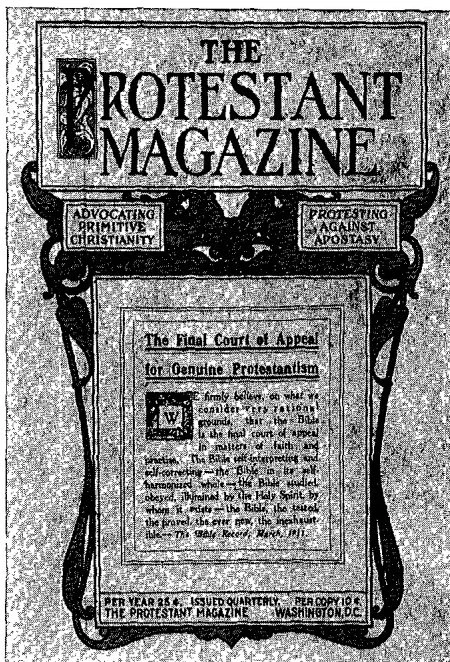
The Protestant Magazine

For the Second Quarter of 1911

JUST ISSUED

Is a very arsenal of timely facts for the use of every Christian soldier. Like the preceding eight numbers issued since May, 1909, it will serve the double purpose of helping to make good Protestants, and also of furnishing the Christian controversialist with good weapons of offense and defense.

SPECIAL OFFER

Ten or more copies, one year to one address or to different addresses, cash with order, only 15 cents each. Regular price 25 cents.
Our agents and friends are sending in all the way from ten to two hundred yearly subscriptions at one time; $6 pays for 40 yearly subscriptions, $3 for 20, and $1.50 for 10. Send in your lists of names and addresses of clergymen, business men, attorneys, judges, legislators, mayors, university and college professors, or other leading thinkers. If you are short of names, ask your conference tract society or us to furnish you more.

PARTIAL CONTENTS

COVER PAGES.—Final Court of Appeal for Protestantism—Our Theses—Recognizing the Authority of God—A Usurpation of Divine and Human Authority.
EDITORIALS.—Positive Protestantism—One Mediator—Contradictory Statements Regarding Persecution by Roman Catholics—A Live Issue (Episcopalians on Romanism)—Typical and Antitypical Babylon (explains Babylon of to-day)—Comparing Spiritual With Worldly (review of a Paulist sermon)—Need of Gospel Among Catholics in South America—A Horrible Thing (Anglicans and Cardinal Gibbons on proposed changes in decalogue).
GENERAL ARTICLES.—What Think Ye of Christ?—The “Privilege” of Peter—The Bible’s Appeal to “Private Judgment”—A Remarkable Document (Catholic Confession of Faith prescribed to Protestant Converts—in parallel columns of Latin and English)—Rome’s Teaching About Protestants (who are heretics, etc.)—Bible and Modern Criticism.
NOTES AND EXTRACTS.—Boycotting Italy’s Celebration—Rome Versus Portugal—Mixed Marriages—Protestantism as “Anarchist Church”—Catholic Chief Justice—A Catholic Attack Upon the Y. M. C. A.

Are You Aware

1. That Rome plans to rule the world through the United States, according to Bible predictions? That she calls America “the church’s land of promise”?
2. That Rome seeks to control national, State, and city elections in America? That she also largely controls the politics of Germany, England, and Canada through her “center” or “balance of power” party?
3. That the United States Census Bureau reports show that the membership of the Catholic Church in this country had increased 93.5 per cent, while that of the Protestant bodies increased only 44.8 per cent during the years 1890 to 1906?
4. That at its ninth convention, held in New Orleans, La., Nov. 13-16, 1910, the American Federation of Catholic Societies passed the following resolution, aimed at anti-Catholic publications: “Resolved, That the Congress of the United States be earnestly requested to amend Section 3893 of the revised statutes . . . so that the same may include the mailing of books, papers, writings, and prints which outrage religious convictions of our citizens, and contain scurrilous and slanderous attacks upon Faith”?
5. That the chief justice and one associate justice of the United States Supreme Court are Roman Catholics? That an ex-president has predicted the election of a Roman Catholic for President of the United States?
6. That the plans of the Papacy with reference to our country are, as expressed in a letter from the Vatican (New York “Sun,” July 11, 1892): “What the church has done in the past for others she will now do for the United States”?

Sold to Catholics and Protestants Alike

The articles in the “Protestant Magazine” are in no sense attacks upon Roman Catholics. The principles of the Roman Catholic Church system are strongly opposed and refuted in every number. And the evidences published are gleaned from authentic sources only—in most cases Catholic sources. This accounts for the sale of the magazine to both Catholics and Protestants. Agents wanted wherever the English language is spoken.

PRICES

Per copy, 10 cents; yearly subscription, 25 cents; 5 to 40 copies, 5 cents each; 50 or more copies, 4 cents each.
Bound Volumes, Vols. I and II in one, manila paper cover, $1.00; full cloth, $1.50.
Address Your Conference Tract Society, or
The Protestant Magazine : : Takoma Park Washington, D. C.

The Indwelling Christ

In unto me, O Christ, divine One, come! I'll open wide the door. Make me thy temple home. Cleanse thou each hidden chamber of my soul; Cure secret sickness, make me perfect, whole; Cast out, to stay cast out, all love of sin; Adorn with thine own hand the dwelling-place within; Let me thy presence feel, mine eyes thy glory see. My guest, abiding guest, O, wilt thou be? Spread thou the table; let me sup with thee—
Come unto me! Come unto me!
My heart I'll open wide. There's not a room So high or low but to it thou shalt come. From attic high to cellar dark and drear, Where oft I've sought for peace or fled in fear, Where e'en my dearest friend has ne'er been bid, Where all my secret motives have been hid,— All, all, I open wide; the house is thine Within to dwell, to feast, and evermore to shine. Let me belong to thee! and be thou mine; Be thou my only guest, my Deity.
Come unto me! O, come to me!
Henceforth I feast, but at no cost of mine; Henceforth I drink life-giving, heavenly wine; Henceforth with flowers is crowned my every cup; Henceforth with Jesus as my guest I sup; Henceforth my mind, my heart, my being whole, Is made a glorious palace for my soul; And at its table, most divinely spread, I feast, and feast again, on living bread. Nothing to hide—there is no future dread; Here, with my Friend, my Brother, Priest, and King. Joy fills my every sense. His praises now I sing, And day by day new beauties do I see; For he has come to me, Come even unto me. —From "The Shadow of the Cross."

The True Relationship of Workers for Christ

CHAS. P. WHITFORD
The great Captain of our salvation, under whose instructions and directions we labor, has said, “All ye are brethren.” Upon a knowledge of the true meaning of this relationship will in a measure depend our success as workers for Christ. Another term for brethren is brothers. The term is suggestive of the family relation: we are all members of the same family, and Christ is brother to us all; for has he not said that he is not ashamed to call us brethren? Christ, then, is my Elder Brother.
The same relation exists between me and my fellow laborers that exists between me and my Elder Brother in heaven. We are all in the same family; we are all one flesh; we are all engaged in the same work. We are “workers together,” not separate and apart from Christ, but workers together with him. We can not appreciate the relation existing between us as individuals until we fully recognize this truth as a fact. Since through Jesus Christ I have brothers on a higher and holier plane than the flesh, in that they belong to the same family with which Christ, my Elder Brother, is connected, it is clear that as I treat one of these brothers on the earth, so I treat my Elder Brother in heaven. I am sure this is true, for he says: “Inasmuch as ye have done it unto one of the least of these my brethren, ye have done it unto me.” And as I would not speak against my Elder Brother, nor carry an evil report against him, I should exercise the same care not to speak one word that will in any way tend to reflect upon the integrity of character and sincerity of purpose of my younger brother.
When this relationship is hallowed by the touch of that love which causes our Elder Brother to bear with us in our sins, we shall regard this relationship as so sacred that we shall gladly bear with our brothers in their sins. We should never forget that our Elder Brother bore “our sins in his own body on the tree.”
When one of our natural brothers in the flesh is overtaken by some physical infirmity, how solicitous we are for his recovery, and how quickly we hasten for a physician! Why?—Ah, it is because of our love for him. But when one of our brothers in Christ gives evidence of spiritual infirmity, are we as solicitous for his recovery as we are when our natural brother is sick? Do we hasten to the Great Physician in earnest prayer, never resting until our brother in Christ is restored to a condition of spiritual health and strength?
When the glad day comes that the true relationship of workers in all departments of the cause is recognized and lived out in the life, then the earth will be lightened with the glory of God.
It would be well for each one to adopt the method of David, who said: “Evening, and morning, and at noon, will I pray, and cry aloud.” When several are laboring together, it is a good plan to mention each member of the company by name while communing with God alone in prayer. Remember that prayer is the soul’s sincere desire. Every day meet for prayer, and read the Word of God together. At this family meeting, present both your encouraging and your discouraging experiences, and talk them over together. If a brother or a sister becomes discouraged, let every member of the company seek to stimulate faith and courage. Kind words have their effect upon saddened hearts. Let there be no seeking for preeminence; avoid it as a viper ready to sting your soul. Do not seek an easy place in the Lord’s work, but let each manifest a willingness to take the hard and trying places. In this will be found the greatest, richest, and sweetest blessing. Let there be no lord in the company except the Lord Jesus Christ. Let him who stands at the head of the company show himself to be a father, not a lord over God’s heritage. Never counsel with one member of the company to the exclusion of the other members; all are supposed to be equally interested in the success of the meeting, and there should be careful and full counsel concerning every part of the work.
When one stands before the public, let all pray for him as earnestly as they would wish him to pray for them if they were standing in his place. Let all have the same burden for the audience, that they may see and accept the truth, that they would have if they themselves were speaking. As early as possible, become acquainted with those who attend. Learn their names, and mention themin prayer for the Spirit’s blessing. If evil is spoken to you concerning a member of the company, let your first thought be, ‘He is my brother.’ Then be sure to examine your own heart well before you consider the report concerning this brother. Have as your motto, “All we are brethren, and Christ is our Elder Brother.” Spend much time with the people, and be sure that the Lord is with you when you go to visit them at their homes.
I believe that if these suggestions are accepted, acted upon, and become a part of our lives, our united prayers and labors will bring satisfactory results, and God will establish the work of our hands.
Orlando, Fla.

Its Discipline

Tracings of the Prophetic Gift — No. 4

Its Discipline

J. O. CORLISS
Another distinctive difference between priests and prophets was that of their warrant of authority. Priests, and even kings, were required to be consecrated to their work by the imposition of hands, before entering fully upon their appointed tasks. The same is required of elders and deacons in New Testament discipline. But so intimate was the relation between the prophets and their divine call that no outward nor formal consecration was required. There appears no account in the Old Testament of a prophet being anointed for his calling. The nearest step toward this was the command for Elijah to anoint Elisha to be prophet in his stead. 1 Kings 19:16. The record does not state that any more was done toward this than that Elijah, in passing by the place where Elisha was plowing in the field, threw his mantle upon the newly called prophet. Verse 19. The prophetic call, it seems, was therefore dependent upon the inward movement of the Spirit of God. In other words, the prophetic office depended entirely on the personal relation of the prophet to his divine Instructor.
There were two (some might say three) ways through which the prophet received his instruction. The first was through visions, which gave to the one receiving them the title of “seer.” Although not calling himself by this Old Testament title, the apostle Paul, in communicating the Lord’s will to the church, strengthens his teaching by the significant appeal: “Have I not seen Jesus Christ our Lord?” 1 Cor. 9:1. See also Acts 9:3, 17; 18:9; 2 Cor. 12:1-4. These visions were at times presented in images, which conveyed lofty conceptions of the divine nature. See Isa. 6:1; Eze. 1:15, 27, 28; 1 Kings 19:11, 12.
To Moses, who ranked higher than the ordinary prophet, God talked “mouth to mouth,” apparently; that is, with but a dimming veil of cloud between them. This seems to have been more than a mere vision impressed by the Spirit; it appears to have been an actual, direct conversation. Other prophets were to be enlightened through visions and dreams. Num. 12:6. As before said, visions were experiences wherein the prophet was given exalted views of Jehovah’s being, and these were received in the prophet’s waking hours as well as in the quiet of nocturnal darkness. Dan. 10:4-7; 7:1, 2.
Often in dreams of the night, God opened to prophets the future of both nations and individuals. In the case of the latter, existing hidden motives were revealed, so that the prophet might speak accurately concerning the moral standing of the person who was the object of reproof. This was the case in Daniel’s message to the Babylonian king, Nebuchadnezzar (Dan. 2:28, 29; 4:13, 18), and also in Nathan’s reproof to David, the king of Israel. 2 Sam. 12:9-12.
Another method by which prophets received “the word of the Lord,” seems to have been through a divine instinct conferred upon the prophet’s own intellect. In such cases there is no recorded appearance of an external form, or of an audible voice; and so the message given was expressed in the natural, characteristic mode of speech of the prophet.
This peculiarity is quite marked in the quiet decisions of Samuel, when choosing from among the sons of Jesse a future king of Israel. From the account of this incident one sees how suddenly the prophet’s mind was changed after his first impression of the oldest son’s fitness for the position. 1 Sam. 16:6, 7. The prophet in that case first judged the matter from a human standpoint; but a divine impression immediately interposed, and brought a sudden change of decision, probably to the consternation of the father of the rejected first-born, whose education and the traditions of whose race had prepared him to expect the oldest son to receive the greatest good in store for the family.
This same close connection between the divine mind and the personality of the prophetic messenger is recognized in the utterances of the great Prophet of all prophets — Jesus Christ himself. In the language of another: “In him the divine is so closely united with the human that the passage from the one to the other is imperceptible.” He himself is “the Word” of the living God. He ever speaks that which he knows, and testifies that which he has seen. John 3:11. Yet he freely acknowledges that the words he speaks are not merely his, but the Father’s. John 12:49.
It is also clear that this means of communication between God and man was designed to be perpetuated throughout the gospel age. Indeed, the Saviour said that for him to leave the earth would be an advantage to his people, because then the Comforter would come to them. John 16:7. The perpetual presence of this Intercessor was to be the medium of intercourse between heaven and earth, to teach the way of life, and to bring to men’s minds all the things before spoken by the Lord himself. John 14:16, 26. It was thus to guide men into all truth, and also to show them “things to come.” John 16:13.
The prophetic office was not at first confined to any particular class or calling of men. Some, as Jeremiah, Ezekiel, Samuel, and John the Baptist, were priests (see Jer. 1:1; Eze. 1:3; 1 Sam. 1:24; Luke 7:27, 28); David and Saul were kings; Amos was a herdsman (Amos 1:1); and Elijah was a Tishbite nomad. 1 Kings 17:1. Women as well as men were called to fill the position. Among these are mentioned Miriam, Deborah, Huldah, Anna, and the four daughters of Philip. Without doubt the wide dissemination of this gift was to destroy the caste spirit, to which the Hebrews, in common with all Eastern tribes, were predisposed. From the history of Israel, it is clear that God chose whomsoever he would honor with the prophetic gift, from among those who would consecrate every power to divine leading, without regard to birth or family name. Num. 11:29. The counsel of God was confined to no tribe, family, sex, nor station in life. It was as freely given to Miriam and Deborah as to Barak and Samuel; to the tribes of Judah and Ephraim as to Levi; in the land of Tekoa and Gilead as well as at Carmel; and in Nazareth as well as in Jerusalem.
The calls to this highly exalted station came to men under various circumstances. To Samuel the voice of God was heard amid the silence of night, while in the priestly quarters at Shiloh. To Elisha the commission was given when he was plowing in the field. Amos was called from his lowly occupation of herdsman and wild-fig collector at Tekoa. Whenever the Lord called, the ready answer was: “Speak, Lord; for thy servant heareth.” 1 Sam. 3:9.
Through the medium of the prophetic gift a true theocracy, or God-government, was designed to be perpetually maintained on earth. Through this means, God and Christ were to manifest themselves to all who keep the heavenly law, which is the copy of the divine mind. John 14:21-23. Moses was made the head of that ancient theocracy, and was made a prophet to stand above every other prophet of Old Testament times. Num. 12:6-8. His countenance was relighted over and over again by the divine illumination, in order that men might fear to talk against his utterances, because to do so would be at their peril. As he stood at the head of that prophetic era, so God was to raise up another prophet like himself, from among the people. “Unto him,” said Moses, “ye shall hearken.” Deut. 18:15. Peter, like Moses, maintained that this divinely predicted prophet was none other than the Lord Jesus Christ. Acts 3:20-22. To be just what was predicted of him, Christ must therefore be the Prophet over all other prophets in the New Testament dispensation. His voice is that which is to be heard through those whoare led by, or through, his Spirit; for the spirit of prophecy is the testimony of Jesus. The admonition of the apostle, “Despise not prophesyings,” is as worthy of consideration now as when it was first given. Review, Cal.

The True Christian

CLARENCE SANTEE
To be a Christian is to be Christlike, or like Christ. We often hear it said, “The name is nothing;” “What’s in a name?” etc.; but when rightly considered, the name is truly of great importance. Those who regard the name so lightly, making great display of being and doing, are not marked by the name, neither are they upon the high plane to which, in words, they aspire. God says of his representative, “My name is in him.” Ex. 23: 21, last part. If the name is not there, the presence is also absent.
The reason the name Christian has come to be so lightly regarded is that many have borne the name of Christ while not bearing his yoke. Without the name we are nothing. With the name, and the fact that calls for it in the life, the man or woman who bears it will be a strong factor in calling the beholder to the Lamb of God. This again brings us to the heart experience as the basis of all Christian attainment. Church duties and privileges may become a form, family prayer may become a mere habit, but personal seeking of God alone can never become a form. As long as it lives in the experience, it is genuine. It will so fill the worship in the home and in the church that the members thereof will be saved from deadness and formality. Without it they can not be kept from these plagues, which are so fatal to the one who only professes, but does not live, the Christ life.
The experience of the soul alone with God is the experience written in the books of heaven. A recognition of his companionship, and a proper appreciation of it, will hold a man in the course of true obedience under all circumstances.
While traveling, a minister entered an eating-house, and sat down at the table. His order was not in accord with the light he had received in regard to diet. To excuse himself, he reasoned in this way: “I do not usually order this kind of food, but I feel the need of a change, and think I will have it. I am careful when in the presence of weak church-members, as I would not cause them to stumble. I can control my appetite.” The fact that this man was doing as he was, while admitting that others might lose confidence in him, or stumble over his course, proves that while believing that he was master of his appetite, he was still its slave. This is a sad condition, yet one that is often revealed.
The light drinker of wine often rests secure in his power to control his appetite, believing himself safe, while condemning in unsparing terms the weakness of the poor drunkard, who with unsteady feet seeks his poverty-stricken home. A few months, or perhaps years, pass by, and another is saying of him what he now says of the other man.
The life of a slave is pitiable; but when the slave believes himself master, it is doubly so. The reason is obvious. He who recognizes and appreciates the presence of angels of God as constant companions will have such an exalted association that contact with his fellow men will not change his outward life. It has been conformed to that of his angel companions, and the weaker association can not break the golden cords that bind him to heaven. That this companionship is the experience of the true Christian, is made clear by many scriptures.
“Whither shall I go from thy Spirit?” says David; “or whither shall I flee from thy presence? . . . If I say, Surely the darkness shall cover me; even the night shall be light about me. Yea, the darkness hideth not from thee; . . . the darkness and the light are both alike to thee. . . . When I awake, I am still with thee.” Ps. 139: 7-18. There is strong assurance to the Christian in these verses, but they bring no strength to the one who changes his conduct according to the visible company that surrounds him.
Of his protection and care for his people the Lord says: “The angel of the Lord encampeth round about them that fear him, and delivereth them.” Ps. 34: 7. Speaking of his children as a vineyard, he says: “I the Lord do keep it; I will water it every moment: lest any hurt it, I will keep it nightand day.” Isa. 27: 3. “The law of his God is in his heart; none of his steps shall slide.” Ps. 37: 31.
“Thou God seest me,” is the strength of the Christian, holding his steps wherever he may go. Christ endured most severe temptations when alone in the wilderness; but he was true to principle, and gained eternal victory. So to-day, some of the most severe temptations come to men when they consider themselves alone. Satan presents a process of reasoning that seems plausible, and instead of standing true on the unfailing Word, they allow sophistry to take the place of reason and conscience, and fall into the snare that they would not think of considering if some true, loyal church-member was present.
The decisions of conduct when marked or swerved by no human influences will form the basis of the Judgment. With this all must reckon, and beyond it lies the eternal reward.
Loma Linda, Cal.

With Gladness

SERVE the Lord with gladness! I hear the ringing cry As, blown from angel trumpets, It thrills the listening sky. I see the joyous angels, Their ranks in level flight, Who ever do his bidding, And serve him day and night.
No cloud is on their faces, They do not stand apart, But swift obey Jehovah, His gladness in their heart. As one the angels serve him, Though thousandfold they wait, And to and fro in armies They pass through heaven’s gate.
Serve the Lord with gladness! The mandate comes to me, In whatsoever valley Of lowliness I be, In whatsoever homely And lonely lot I stand, I am to take with gladness My service from his hand.
Serve the Lord with gladness! Thou, too, must note the word, For not with mien of sadness Should his servants serve the Lord. Lift up your heads, O comrades; And march with valor on; For heaven is just before you, The prize is almost won.
Serve the Lord with gladness! The service is so sweet; It is so dear and blessed To give him homage meet. As the angels do in heaven, So let the men on earth Serve evermore Jehovah With reverent joy and mirth.
— Margaret E. Sangster.

Together With God

E. BOWEN
In our working for God in helping him, more often he is helping us. It may be that our work is helpful in bringing light and cheer to others, and still in all this God is working out his purpose to protect and rescue the two strangers who visited his city; but in fact, these angel guests protected and rescued him. We are “workers together” with God. He works with us. This is saying that if we desire really to get near the Lord, then we must go to work for some one in need. Here is where God and men meet, working “together.” What a precious privilege! With some persons it is a real joy to be associated in work. There is a companionship in it all that is very helpful. Little joys and sorrows are shared mutually. How much lighter seems the task if we but have a congenial companion in it! So in our spiritual work, Christ Jesus becomes our yokefellow, he working with us. “It is God which worketh in you both to will and to do of his good pleasure.” Phil. 2: 13.
How God works for us may be illustrated by the way a father sometimes works with and for his sons. It often occurs that a father enters a section of unimproved country. He purchases land, and begins to clear it. With him his sons labor as they develop into manhood. They have the benefits and privileges of the father's home, his counsel and instruction, sharing his labors in bringing the land under cultivation. During these years they think that they are working for father. And so it is counted. But time goes by. The father, as his strength wanes, turns the improved farm over to his sons; and they find, after all, that while they supposed they were working for father, in reality he was working for them.
Thus our Father in heaven is helping us in the spiritual realm to work out for ourselves an inheritance for the life to come. And in actual fact, our spiritual inheritance will be the giving back to the saints of this old, sin-cursed earth made over into an Eden home. The love of our Father above is as much greater than that of an earthly father as heaven is higher than the earth. Now is the time for us to share his presence and blessing, by becoming “workers together” with him.
Takoma Park, D. C.

The Fragrance of Forgiveness

“FORGIVENESS is the beautiful perfume the flower gives to bless the one who crushes it.”

Laying up Treasure

W. S. CHAPMAN
As God made the heavens and the earth, his claim to ownership is a just one. His reservation of the heavens (1 Peter 1:4) for himself is made in wisdom, but the free gift of the earth to man (Ps. 115:16) is so remarkable in its munificence as to be beyond the comprehension of a mind not illumined by the Spirit of God.
In giving the earth to man, God gave all in any manner connected with it. He gave not only the earth and all that it contains,—the sea with its life, its mysteries, and its marvels,—but also the elements surrounding the planets. He gave more: he promised that as long as the earth should remain, “seed-time and harvest, and cold and heat, and summer and winter, and day and night shall not cease;” in other words, that God’s power should be over man’s home, preserving it from destruction. To this end God’s mantle of grace encircles it like an atmosphere.
Man was placed upon earth as its lord and keeper, with dominion over all. When man fell, and became a servant, his power and authority were transferred, by his disobedience, into the hands of his master, to whom he had yielded himself to obey. Satan, with his evil ones, took possession of the earth, to remain its masters until the restoration. Acts 3:21.
Before the fall, Satan was without a home after his expulsion from heaven (Luke 10:18; Rev. 12:9), and without any right to use aught on earth to his own advantage. In the acquirement of this world he obtained not only a home, with personal safety for himself and his followers because of God’s grace encircling the earth, but also a kingdom, and subjects with whom to make war against the God who had so mercifully spared his life. He also acquired material of all kinds for equipping and maintaining the great army with which he hopes finally to capture the city of God.
To this end Satan has bent every energy to utilize to the utmost every resource at his command to prepare, train, and fit men, as his servants, for the work he hopes, through their cooperation, to accomplish.
His first and most important effort has been to compass the complete degradation of man. Realizing that unless the law of sin could be placed in supreme control, there would always be the possibility of a yielding of the mind to the gentle influence of the Spirit of God, and a consequent reformation, Satan has striven to develop selfishness, and to such a degree as to darken the mind beyond all hope of enlightenment. Greed and covetousness have been engendered and fostered, so that men have become, indeed, lovers of self, covetous, and unprincipled, fit tools for the hands of their master.
From this lost condition the goodness of God is calling men to repent, to turn and serve the true and living God. Those who heed the call renounce all allegiance to the prince of this world. They abandon all claim to the so-called rights and privileges of Satan’s dominions, announcing themselves as pilgrims and strangers here, citizens of a heavenly country and kingdom, looking for a city.
As their Master is the Creator of the heavens and the earth, and as Satan is only a usurper, they have a right, as servants of the King, passing through the disputed territory, to use the goods of their Lord for their own sustenance, and for the furtherance of the work entrusted to them by God; but they can not safely or honestly use the wealth, or “fulness,” of this world, in which they are simply strangers and pilgrims, for their own profit or to their own advantage. Only as they use money, property, and other advantages to God’s honor and glory, and to the advancement of his work in the earth, can they expect to meet his approval, and avoid final condemnation.
For a Christian selfishly to appropriate the things of this world to his personal advantage is wrong. To gather together these things into “possessions,” is to enlist under the banner of Satan, to choose this present world for a “home,” to withdraw from under the protecting power of God, and to come short of the glory of God at last.

Evangelistic Effort

WILLIAM COVERT
God weighed a lost soul’s possible worth in the balance of his love, and then gave the life of his Son to ransom that soul from guilt and the power of sin and the grave. The whiteness of that soul when washed from the stain of sin was seen by the infinite eye, and the greatest price that Heaven could command was freely paid for its cleansing and release. God saw what the marvelous worth of that soul would be in the limitless times of eternity, and so the purchase was made.
Now, since God has done what he has for that soul, the question may well be asked, “How much is man willing to do for it?” Will he do what he can to help that lost soul for whom the price has been paid? Will the soul who has been found, help to find some other soul that is lost? The Son of God came down from heaven to save lost souls. He knew what was involved in coming, yet he came. Is the reader willing to work diligently, and sacrifice ease, that he may assist in the work of soul-saving?
Who will do as Paul did after he found salvation through Christ? He said he did not count his life too dear to give to the cause which had given so much for him. The days were not too long, nor the nights too dark, to check his labor for souls. When he entered a field to work, he did not wait for weeks or even days to pass, but began immediately to search out the lost. He prayed for sinners without ceasing, and sought them day and night to the extent of his strength, because he was engaged in soul-winning. He preached of redemption from sin through Christ the Saviour, with such earnestness that those who heard him seemed to behold the crucifixion enacted before their eyes while they listened to his fervent appeals. Though a man of unusual ability and wideness of learning, yet he determined to know only Jesus Christ and him crucified. Why should we be less earnest in our labors than was Paul? Greater reasons for strenuous work exist now than caused the apostle’s ardor to glow with such brightness; for the days of probation are now nearly gone, and the time for labor is almost ended. Our field covers more inhabited territory, and contains more souls in need of salvation, than ever before. These conditions call for reapers who will labor with unflagging zeal while gathering in the grain which otherwise would be wasting in the fields.
What will the Lord of the harvest say to those who pose as laborers, but who do not or can not gather sheaves into the garner?
Since our Lord died to redeem sinners, and we have accepted the salvation purchased by his blood, how much should we do to show them the way of this salvation? Can we still retain the blessed hope we have accepted, and maintain the fervor and the love of it, while making no special effort to save the lost?
Surely an indifferent, listless attitude toward the salvation of sinners is not possible for Christians now. They will show their interest by their labor and their liberality. Their investments in these things will be equal to their appreciation of them. They will labor earnestly, suffer long, and be kind. Their spirit should be a halo of glory wherever they go; and it may be so with all who seek God for the divine illumination.
Chicago, Ill.

A Memory System

FORGET each kindness that you do As soon as you have done it; Forget the praise that falls to you The moment you have won it; Forget the slander that you hear Before you can repeat it; Forget each slight, each spite, each sneer, Wherever you may meet it.
Remember every kindness done To you, whate’er its measure; Remember praise by others won, And pass it on with pleasure; Remember every promise made, And keep it to the letter; Remember those who lend you aid, And be a grateful debtor.
Remember all the happiness That comes your way in living; Forget each worry and distress, Be hopeful and forgiving; Remember good, remember truth, Forget the clouds above you; And you will find, through age and youth, True joys, and hearts to love you.
— Priscilla Leonard.
Continue reading: The Minister in the Home