Australiasian Signs of the Times, Vol. 35, No. 28.

A Bishop and the Second Coming

Australiasian Signs of the Times

Jul 12, 1920

Signs Publishing Co. · Melbourne, Victoria · Jul 12, 1920

A Bishop and the Second Coming
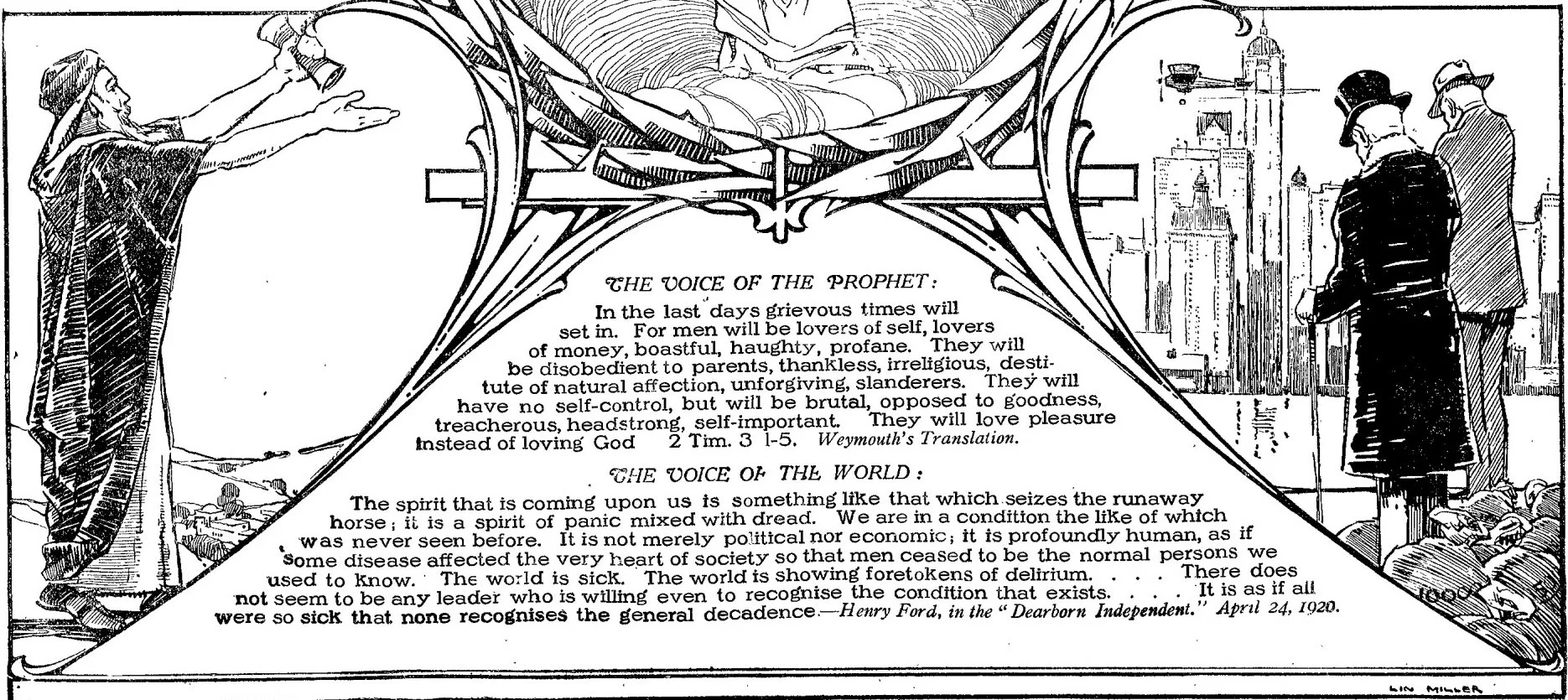
DR. MOULE, Bishop of Durham, may have been incorrectly interpreted in his statements concerning the second coming of Christ, so far as specific dates are concerned; but as to his belief in the nearness of the event there is no question. “We shall expect,” says Dr. Moule, “with a hope humble but deep-founded to see soon the hour when death shall die and the grave be buried; for ‘they that sleep in Jesus will God bring with Him,’ when He comes again, and we are looking for His coming soon. Then shall we ‘together with them’ ‘be forever with the Lord.’”
Some have sought to make the bishop say that the “end of the world” would take place in 1920. This he categorically denies. He separates the cataclysmic dissolution of the world from the appearance of the Lord in the clouds of heaven; and while he does not believe that the earth is coming to its long-foretold destruction within the next few months, he does claim that the appearance of the Saviour and the resurrection are events very near at hand. He draws his conclusions from his study of the Apocalypse and other scriptures, and while we cannot accept all the bishop’s prophetical exegeses, we are certain that his belief in the nearness of the great event is founded upon the immutable Word. Concerning the bishop’s address in which his belief was set forth, the Expository Times has this to say:—
No one can read the address without perceiving that it is the address of a good man. The language throbs with devotion to the Redeemer; it meets the demands of a disciplined conscience for the closest approximation to truth. And the scholarship is just as apparent. It is under the heaviest sense of responsibility that Dr. Moule has come to his conclusion.
Many another has come to the same conclusion, arriving at that conclusion from the study both of Scripture and the daily doings of the world. Every great modern event bears witness to the accuracy of prophetic scripture. The developments in the industrial world point a reverent finger backward to the scriptures in both the Old and New Testament which foretold them in detail. Such scriptures are found in James 5: 1-9; Isa. 2:7-21; and Heb. 2: 6-8. In the days there depicted the gold and the silver are unable to protect the wealthy against those who would make them a spoil. Habakkuk 2:6-8 reads: “Woe to him that increaseth that which is not his! how long? and to him that ladeth himself with thick clay [mortgages and notes of hand inscribed on clay tablets]. Shall they not rise up suddenly that shall bite thee, and awake that shall vex thee, and thou shalt be for booties unto them? Because thou hast spoiled many nations, all the remnant of the people shall spoil thee.” There is Bolshevism as plainly as it need be depicted making war upon the capitalistic class. But when that condition would be found in the world, the day of our Lord’s return would be near at hand, according to James 5:7-9.
The Bishop of Peterborough sensed the seriousness of the situation and set it before his hearers in his presidential address at the Church Congress. He was dealing with the Labour situation in the following utterances:
It is not the kingdom of God that has failed, but men and women who, while professing allegiance to its ideals, never believed that they were practical. With the almost limitless destructiveness of aerial warfare, the choice before us now lies between hell and Utopia. The alternative to destruction, annihilation, desolation, is a new spirit in international relationships, and the adoption of the ideals of the kingdom of God. . . . The workers must have a real share in management, and the employers a real guarantee of whole-hearted co-operation. The curse of the age is that its principles are material and its outlook selfish.
This clerical leader sees one of two things for the near future—either a Utopia, in which men and women forget and abandon materialism and selfishness, or a complete dislocation of all the functions of civilisation; and this latter condition he terms “hell.”
What warrant have we for building our hopes upon any such expectation as that men and women, in this materialistic and selfish and covetous age, will be suddenly transformed into paragons of self-sacrifice, spirituality, and benevolence? The whole trend of the age is in the other direction. Those who have wealth are hoarding their holdings with hearts that are ever more greedy and hands that are more and more grasping. We may as well expect to see the mighty glaciers of the Alps, the Andes, and the Rockies forcing their ponderous weights of flowing ice up again to the pinnacles of the hills whence they descended as to expect to see the tremendous tidal wave of selfishness and materialism and covetousness fall back spent into the bosom of a converted humanity. It will never be. The condition which the Bishop of Peterborough sees, and acknowledges, points its finger also to the scripture which said it was to be. This is the scripture:—
This know also, that in the last days perilous times shall come. For men shall be lovers of their own selves, covetous, boasters, proud, blasphemers, disobedient to parents, unthankful, unholy, without natural affection, truce-breakers, false accusers, incontinent, fierce, despisers of those that are good, traitors, heady, highminded, lovers of pleasures more than lovers of God. 2 Tim. 3:1-4.
This, the prophet declares, was to be the characteristic of “the last days.” It is a perfect picture of our day, and the bishop recognises it. While he recognises the condition, he is looking and hoping for a remedy which will guarantee a complete change. The prophet predicts the condition, and says it portends “the last days.” That is the difference between God’s Word and man’s plans. The bishop declares:—
The curse of the age is that its principles are material and its outlook selfish.
What will alter it? The popular Church admits that it has lost its grip on the multitude. Will some organisation apart from the Church step in now and do the Church’s work, bringing the world to the feet of Christ? It is nowhere so written in the purpose of the Almighty. The Word warns us that we are in the last days. Surely it is incumbent upon every soul to set his house in order before the great Judge decrees “It is finished.”

The Christ that Walked with Men

Is Coming Again, and Coming Soon

ROBERT HARE
He is coming as the King of the Golden Age in fulfilment of divine promises and prophetic visions. At time’s death-line He comes, heralded by Heaven’s angelic messengers and in all the majesty and glory of the celestial realm.
KINGS many and lords many have ruled over men. But among these, few have been rightful masters of the possessions they claimed, or ruled as God designed they should rule. Self has too often stood behind the sceptre and justice has been forgotten. But the time is near when He shall rule—“whose right it is.” “He shall be great, and shall be called the Son of the Highest; and the Lord God shall give unto Him the throne of His father David; . . . and of His kingdom there shall be no end.”
More illustrious than Augustus Cæsar, more just and kind than Cyrus the Great; with a dominion wider than that of Charlemagne, and with more subjects than Alexander, He shall rule from sea to sea in that kingdom over which the sun shall no more go down.

A World’s Crisis

GREATEST of all historic events, the second coming of Christ rightfully takes its place on the last and most eventful page of human history. It is the world’s crisis hour, and forms the dividing line between time and eternity. Round it there cluster all the great prophecies in the Book of God, and from it the “Year of the Redeemed” will measure—the long, glad year that measures with the life of God.
The first prediction, that concerning the first advent, was made by Jehovah Himself in the promise: “The Seed of the woman shall bruise the serpent’s head.” Gen. 3:15. And “when the fulness of the time was come, God sent forth His Son, made of a woman.” Gal. 4:4. True, Eve misunderstood that promise, and when Cain was born declared, “I have gotten the Man Jehovah,” but her misunderstanding did not change or hinder God’s plan.
Christ came as the Seed of the woman. Had He come as the Seed of Adam, or at another time, He would have been but a human substitute, and not the Christ of God.
The first prediction concerning the second advent was given to the first prophet among men—the first man who walked with God—“Enoch, the seventh from Adam.” One of the inspired writers has preserved his prophecy: “Behold, the Lord cometh with ten thousands of His saints.” Jude 14.
These two greatest events in Bible history naturally claim the attention of all Bible writers, and round them most of the prophecies and all of the promises centre. Adam the first man—the man who lost all—heard both these predictions, for the first was given in Eden, and the other by Enoch who was contemporary with Adam for more than 300 years. So, then, the first man who lost all heard promise of the second man who regains all.

Not a New Doctrine

THE gospel of the second coming of Christ is not a new doctrine, neither is it a modern fad. Since the prophetic tongue first began to speak in the name of the Lord this great theme has claimed the unquestioned attention of the prophetic mind.
The Book of Job, probably the first Biblical composition, tells of a living Redeemer standing on the earth in the “latter day.” Job 19:25–27. David, the king and shepherd of Israel, tells of the great voice, the fire, and the whirlwind that will accompany His coming. Ps. 50:3, 4. Isaiah, the royal prophet, writes of the redeemed waiting for the “salvation” which the Lord’s coming must bring. Isa. 25:9. Daniel, the “greatly beloved” among the prophets, pictures the “One like the Son of man” receiving the kingdom over which He is to reign forever. Dan. 8:13, 14. Ezekiel tells of Israel’s kingdom being overturned until “He come whose right it is” (Eze. 21:27); while the New Testament is flooded with promises, predictions, and warnings that cluster round this beacon of hope.

The Divine Purpose in His Coming Fulfilling a Promise

WITH man a promise or a pledge should be a sacred thing. But it must be much more so with God. Jehovah “cannot lie,” while Christ is termed the “faithful and true Witness.” Therefore all promises made must be fulfilled. Just before His departure Christ gave the promise to the disciples: “I will come again.” John 14:3. This is a definite pledge, and He must come again in its positive fulfilment, as failure to do this would prove Him to be an unfaithful witness. But the One who knew no sin could not thus speak falsely. He must come again in answer to His own promise.
CHILDREN'S DAY ON THE “RENOWN”
A War-engine of our day fulfilling prophecy
CHILDREN'S DAY ON THE “RENOWN” A War-engine of our day fulfilling prophecy

To Complete Salvation

BUT Christ came first as a Saviour from sin. He must come again as a Saviour from the consequences of sin—“without sin unto salvation.” Heb. 9:28. All sin may be forgiven, but tears, pain, sorrow, and death still follow the child of mortality. When salvation is finally completed all these things will be removed forever. Of that time it is written, “God shall wipe away all tears, . . . neither can they die any more.” Rev. 21:4.

To Bring Rewards

JUDGMENT decisions are now pending in the court of heaven, and when they are determined rewards must be given. But rewards cannot be given to the righteous till Christ comes. Their bestowal is definitely linked with His appearing. “Behold, I come quickly; and My reward is with Me, to give every man according as his work shall be.” Rev. 22:12. Rewards have not yet been given. Christ must deliver them in person, for this is the right of the King.

To Waken the Loved Ones

THE resurrection, with all its hallowed memories, depends very definitely on the second coming of Christ. The dead are to “hear His voice and come forth.” The resurrection trumpet and the voice of Michael—the One like God—are both to be heard simultaneously: “For the Lord Himself shall descend from heaven with a shout, with the voice of the Archangel, and with the trump of God: and the dead in Christ shall rise first.” I Thess. 4:16.
How we long to behold the veiled faces; how we long to hear the voice that was hushed; how we long to clasp hands with the loved of memory’s vision. But love in the transport of all its sweetest anticipations must wait till the Lord Himself shall descend from heaven. Beyond His coming death has no power over the redeemed: “Because I live ye shall live also.”

A Personal Appearing

MAN must have a personal Saviour from sin, and just as surely must he have a personal Saviour from the consequences of sin. A myth or shadow cannot save from sin; it must be a reality or there can be no real salvation. Hence the second advent must be just as real and personal as the first coming. The Christ of history, man’s Saviour from sin, was the greatest personal reality that history has known. The B.C. and A.D. of historic reckoning recognises Him as such, and to and from His coming men and kingdoms, the world over, are willing to date their eras and ages.
Just as the recognition of His coming and a faith in His atonement for sin may rescue from sin and the power of sin now, so His coming again must rescue from all that sin has done, and guarantee against all tears and pain. On this side of that event we feel the darkness and the sorrow. Beyond it there bursts forth the eternal fountain of every joy. But it must be a personal coming, for the record reads: “This same Jesus.” Acts 1:11. A personal Saviour coming again! So real that “every eye shall see Him”; so real that He will be the “same Jesus”; so real that the unholy will call for the rocks and mountains to hide them from the revelation; so real that in His holy presence the redeemed of earth shall forget to sorrow, and they shall weep no more!
Blessed reality,—fitting landmark for the termination of all human uncertainty and trial, and fitting milestone to mark the beginning of the long glad years of the long eternity of peace!

Preceding Demonstration

NO great crisis has ever come, and no great epoch has appeared in human history, without some demonstration, special signs, and a warning message preceding it. Noah preached of the Deluge overthrow for 120 years. For many years the building of that huge ark testified to the faith of its builder, and to the certainty of the coming destruction.
Sodom and Gomorrah must go down because of their corruption. But first angel messengers carry a warning, and then Lot is seen departing from the doomed city before the thunderbolt of ruin fell.
Jerusalem, having filled the cup of her iniquity, must be sold into the hand of the fierce Roman to go down in fire and blood. But long before that fateful event, prophetic voices had pleaded with her people, and warnings had floated over valley and temple and hill. Even the voice of the Son of God was heard in tearful lamentation declaring: “Your house is left unto you desolate.” Strange sights appeared in the heavens, and a strange form walked her walls and streets crying night and day: “Woe, woe, woe, to Jerusalem!”
Remember, too, that Noah’s Deluge came upon “a vast population” in that antediluvian age. The fire of Sodom fell upon the luxurious, sensual, and crowded cities of the plain. The destruction of Jerusalem fell upon a nation and obliterated all their national boundaries. But the coming crisis will be a world event, and Jehovah could not allow this to fall without proportionate and appropriate signs, and a warning message. It is written: “Surely the Lord God will do nothing, but He revealeth His secret unto His servants the prophets.”

Signs—Where and What?

THE ark was a sign to the antediluvian world. The two angels appearing at even should have been a sign to the people of Sodom; while to the people of Jerusalem the Roman armies surrounding their city should have told in thunder-tones that the time had come to escape.
But what signs are to tell of Christ’s coming and where will they appear? Jehovah has already anticipated our question and the answer is given: “There shall be signs in the sun, and in the moon, and in the stars,” while there will be seen “upon the earth distress of nations, with perplexity; the sea and the waves roaring; men’s hearts failing them for fear.” Luke 21:25, 26.

The Darkened Sun

MAN has written upon the earth, tunnelled the everlasting hills, sent his wireless through the atmosphere, and flashed his heliographs from mountain to mountain. But he has not been able to disarrange the stars or shadow the sun. All he can do with the sun is to look at it through a darkened glass. What, then, if the Creator, willing to teach man a lesson, and to make its elaboration more perfect, should darken the sun and in that way write over it and upon it His memoranda of coming events?
Man cannot reach the stars. He can neither retard nor accelerate their movements. He can only gaze and wonder at the stability of their multitude. What then, if the Creator, willing to preach man a sermon, should loosen these immortalities of light and cast them earthward as a fig tree would cast its unripe and unwilling fruit to the ground? Would not man remember these things?
Yet it is even so. The sun has been darkened and the stars, like unripe figs, have been made to forget their stability: “In those days, after that tribulation, the sun shall be darkened, and the moon shall not give her light, and the stars of heaven shall fall.” Mark 13:24.
The “days of tribulation” here referred to must evidently be the last and greatest of the tribulations that have fallen upon the Church of God. John of the Revelation gives its measure as “a thousand two hundred and threescore days.” Rev. 12:6. These prophetic days would represent years, and in them we have the 1260 years of papal usurpation and persecution, commencing in A.D. 538, when by virtue of Justinian’s decree the Papacy assumed control of all the churches, with the civil power to do its bidding. The “days” ended in 1798, when Pope Pius VI was taken prisoner and the “deadly wound” was given to that power.
The persecution terminated about 1776, the order of Jesuits having been abolished by Pope Clement XIV, in 1773. Here there remained twenty-two years of the specified time, and by these years the days were shortened so that all the righteous might not be destroyed. Matt. 24:22. Hence it is seen that the darkening of the sun, to which Christ referred, must be found in these twenty-two years coming after that persecution.
Thus writes the historian in 1883:—
One of the most noted instances of the obscuration of the sun from meteorological causes was the famous dark day in New England, May 19, 1780. The gloom was most intense in New Hampshire and Maine. It was necessary to light the candles in the houses throughout New England. The Connecticut Legislature adjourned on account of the darkness.
The famous “Dry Fog” of 1783, when through the whole of Europe the light of the sun was partially shut out by a bluish haze for many days, gave rise to more scientific discussion and theorising than all the other dark days together.—“American Cyclopædia,” page 823.
Just before making these statements, the writer has referred to several minor obscurations of the sun, but only to leave these two obscurations—one in the West and one in the East—more prominent by the contrast.
Again we quote:—
A dark day occurred in New England, May 19, 1780, during the session of the Connecticut Legislature at Hartford, which occasioned a proposition to adjourn.—“People’s Cyclopedia,” Vol. 1, page 532.
Under the term “Dark Days,” the “New International Encyclopædia,” Vol. 6, page 502, states:—
In New England the term is specifically applied to May 19, 1780, also known as “Black Friday.”
After speaking of several solar eclipses and obscurations, Wm. S. Walsh, author of “Handbook of Curious Information,” writes on page 275:— If we come nearer to our own time, to May 19, 1780, history and tradition assert the occurrence of a remarkable day prevailing over New England, and, to some extent, in some other places. Darkness came on between 10 and 11 a.m. and continued until midnight, growing gradually denser and denser, even till 11 at night. Candles and lamps were lighted for the people to see to dine and to perform work about the house. These became requisite before 12 a.m. In the evening so dense was it that farmers could scarcely, even with the aid of a lantern, grope their way to the barn to take care of the cattle. The birds returned to their roosts at 11 a.m., and the day was converted into night.
Many authors and historians could be quoted in continued testimony of the facts here mentioned. Not a few of them refer to the darkness as being of a “supernatural character,” and several state that the full moon, as it rose in the darkness, had the appearance of blood. The whole scene corresponds perfectly with the prophetic description of the event; the time is also correct, for it came “in those days” but “after that tribulation.”
Pathe Photo.
THE “IRON-HORSE” WHICH BORE THE PRINCE
ACROSS VICTORIA
Pathe Photo. THE “IRON-HORSE” WHICH BORE THE PRINCE ACROSS VICTORIA

The Falling Stars

AMONG the many signs given by Christ as premonitory of the second advent we find the “falling of the stars.” Matt. 24:29.
Prophecy has been true to its great Author. After centuries of waiting the falling stars have appeared, with both their promise and their warning.
In the year following the termination of papal rule, when Pope Pius VI was taken prisoner in 1798—the year when he died in captivity, “an exile from his country and his friends,”—there appeared a most remarkable shower of falling stars. The phenomenon is thus referred to by Thomas Milner, M.A.:—
The first grand phenomenon of a meteoric shower which attracted attention in modern times was witnessed by the Moravian missionaries at their settlements in Greenland. For several hours the hemisphere presented a magnificent and astonishing spectacle, that of fiery particles, thick as hail, crowding the concave of the sky, as though some magazine of combustion in celestial space was discharging its contents towards the earth. This was observed over a wide extent of territory. . . . Humboldt speaks of it: “Toward the morning of November 13, 1799, we witnessed a most extraordinary scene of shooting meteors. Thousands of bodies and shooting stars succeeded each other during four hours. . . . There was not a space in the firmament equal in extent to three diameters of the moon that was not filled every instant with bodies of falling stars.” . . . This shower of asteroids appears to have been visible, more or less, over an area of several thousand miles, from Greenland to the equator, and from the lonely deserts of South America to Weimar in Germany.—“Gallery of Nature,” page 138.
Another shower, the most awe-inspiring ever witnessed by the eyes of man, fell in 1833. Of it the same author writes:—
We now come to by far the most splendid display on record. . . . The chief scene of the exhibition was included within the limits of the longitude 61° in the Atlantic Ocean and that of 100° in Central Mexico, and from the North American lakes to the West Indies. Over this wide area an appearance presented itself, far surpassing in grandeur the most imposing artificial fireworks . . . . In many districts the masses of the population were terror-struck, and the more enlightened were awed at contemplating so vivid a picture of the apocalyptic image—that of the stars falling to earth even as a fig tree casteth her untimely figs when she is shaken of a mighty wind.—“Gallery of Nature,” page 140.
Again, in 1866, over England, in the Eastern Hemisphere, the same phenomenon was witnessed. Galleman thus writes of that shower: “In 1866, the November meteors attracted an unusual degree of attention on account of the wonderful display they presented on the morning of November 13 in that year.”—“The Heavens,” page 169. Lockyer speaks of this display as “the exquisitely beautiful star-shower.”—“Elementary Lessons in Astronomy,” page 131.
From a supposition that falling stars were merely a natural phenomenon, and occurred once in each thirty-three years, the astronomers of the world made great preparations to view the expected shower of 1899. But, lo! it did not appear, and their expectations failed.
But God has borne witness, and the stars have three times told their story since the darkening of the sun in 1780. Yet men will not believe. Nevertheless, Jehovah has not left Himself without witnesses. He has made the earthquake His preacher, the darkened sun His messenger, and the falling stars have twice over and again uttered the proclamation, “He is coming.” Why, then, will not the heart of man believe?

The Many Signs of His Coming

ONLY to the careless and unbelieving will Christ appear unexpectedly. Only to the man who shuts his eyes and persistently refuses to see the evidence of His coming will He “come as a thief.”
With a kindness unexampled and a patience that is wonderful Jehovah has outlined, over and over again, the course of events leading up to that supreme event. With great plainness He has foretold the conditions that would obtain in the social, political, religious, and financial world. So the nations are without excuse.
In addition to all that should touch national life, Jehovah has sent to many classes of men special warnings and signs telling of the approaching crisis that must finally fix the human destiny. It would almost seem that no class among men had been forgotten or overlooked.
Scientists and educationalists may read their message in Dan. 12:4. But this is the age of all that is rapid in movement, scientific in character, and skilled in knowledge. But it is also the “time of the end.” The demonstration of “running to and fro” is too evident even for enquiry.
The great army of engineers and traffic men have a special page with its “iron-horse” of the last period running like the lightning. Its cars are jostling one against another. It is the day of the “thunderbolt,” the “eclipse,” and the lightning express, but it is also the “day of His preparation.” Nahum 2:2–5.
For the mariners and the sea voyagers Christ points to tidal waves and ocean disturbances as the immediate evidence of the coming of the Son of man. Luke 21:25–27.
Indeed, all classes may know, if they will, concerning this greatest of all events—an event that must thrill heaven and earth with its grandeur and overwhelming splendour.
But for all that Jehovah has done in order that men may be prepared for this great finality of history, millions and tens of millions will be wakened from their dreams of pleasure and self-seeking only to find that “the harvest is past and the summer ended,” yet they are not saved.
But to those who are prepared for His glorious appearing it will be an event of joy unspeakable. “Lo, this is our God, we have waited for Him,” will be the glad declaration. Isa. 25:9.
Sometime, just when I cannot tell, Some dawning after night of pain, Amid the glory yet unseen, My absent Lord will come again.
Sometime, I cannot tell just how, When earth’s deep shading brings the night, His hand will lift my tired feet To walk the glory-streets of light.
Sometime, I cannot tell just why, His power will fashion into grace The fading form this life has given, That I may rise and see His face.
Sometime, and though I cannot see The transformation love has planned, I wait for His “sometime,” and toil on The “little while” at His command.

Around the World

Serbia has decided to reopen diplomatic relations with Germany.
Only one book may be bought at a time in Russia owing to the shortage of paper.
King Alfonso of Spain has offered the Palace of the Prado to house 500 Viennese children.
Last year Canada obtained from the United States 21,000,000 tons of coal at a cost of £14,000,000.
Arrangements have been made by the French Touring Club for 35,000 new road signs to be set up throughout France.
British Guiana’s war memorial is to take the form of an obelisk, which will be erected in Georgetown, the capital.
Up to the present the Belgian Government has distributed 1,141,000,000 francs (nominally £45,640,000) in payment of war damages.
Bills have been passed by the New York State Legislature providing that landlords shall not be permitted to increase last year’s rents by more than twenty-five per cent.
Within the next few years the Government of Jamaica proposes to expend £100,000 on the erection of additional Government school buildings and teachers’ cottages in the colony.
A reserve on Kangaroo Island, South Australia, is to be set aside as a sanctuary for flora and fauna. Numerous types of native animals, likely to become extinct, will now be preserved.
A contract has been concluded between the Belgian and British Governments by which Belgium will receive from Australia 240,000 tons of raw zinc to be delivered within a maximum period of two years.
Experiments carried out on the canal at Saint Denis, France, recently with a heavily laden barge fitted with a ten horse power motor driving a six-bladed aerial propeller, proved the practicability of this method of propulsion.
The Japanese estimates for 1920 have recently been published, and the Navy vote is 185,500,000 yen—nominally £18,550,000. The United States Navy estimate for the current year is 542,000,000 dollars, nominally £108,400,000.
Great dams have been built during recent years, but the highest in the world is planned on the Sutlej River, in Northern India. A wall is to be thrown across a deep gorge, more than one thousand feet wide. The dam will be 395 feet high, and as it is built on the rock, the water impounded during the summer floods will reach nearly that depth.
A new scheme for the arrangement of guns has been adopted on the latest American submarines. These are large craft, with a submerged displacement of 1,500 tons. They have a cruising radius of 5,000 miles, and are over 230 feet long. The big guns, instead of having to be lowered into hatches when the craft submerges, remain in position, and are ready for instant use when the boat comes to the surface.
To keep milk at the required low temperature, when in transit, an American dairy company uses a huge glass lined steel tank, built like a vacuum bottle, and mounted on a powerful motor truck. The tank, which holds 900 gallons, is filled with milk, which is hauled from the collecting station to the factory, ten miles away. The motor truck makes two, and sometimes three, trips daily, and the milk remains cool in the hottest weather.
A novel idea for watering the road has been adopted for the wooden floor of the bridge over the Mississippi, near St. Louis, which must be kept wet during the summer, but on which the use of water-carts interferes with the ordinary traffic. A four-inch pipe has been laid along the side of each roadway, and jets of water are squirted across the road, so that every bit of the floor surface is covered. The bridge is seven thousand feet long.
Aeroplane manufacturers have found the X-ray exceedingly useful in their work. With a special apparatus they examine all timber used, the X-ray penetrating through wood as much as eighteen inches thick. Internal knots, resin pockets, cracks, and grub holes can be easily detected. The X-ray is useful also in ascertaining the purity of insulating materials for electrical use—small metallic specks in fibre or mica can be readily detected.
During the German retreat in 1918, the Chief Command often had much difficulty in communicating with the different units after the front lines had been broken. A novel device was adopted of firing messages from guns. The message shell, on alighting in the supposed vicinity of German troops, announced its presence by emitting a dense cloud of smoke. Directed in this way to the spot, and protected by the miniature smoke screen, the German soldier identified the shell by its brilliant colours, picked it up, removed the bottom, and pulled out the message container, which occupied the space usually filled by the explosive charge.—Stead’s.
Poland is confronted with “the worst typhus fever epidemic in the history of the world,” according to a cable message received by the American Relief Administration from Colonel Gilchrist, United States Army Medical Corps, head of the American antityphus expedition.
“Unless blotted out at once,” he stated, “the present epidemic will threaten all Europe. The Polish Government is doing its best to meet the emergency, but it is crippled by lack of money and sanitary supplies.”
Upon receipt of this information the joint distribution committee for all American Jewish relief funds instructed its representatives in Warsaw to expend $100,000 for coal to be used in starting disinfecting plants in the typhus zone.
It is interesting to read the views of the medical men of Ontario upon the influence of alcohol. Mr. George B. Wilson sends the following significant figures: Three hundred and ninety-eight think a total abstainer has an advantage over a moderate drinker in immunity to disease, 72 differ on the point; 88 think he has an advantage in better chance of recovery in sickness or accident, 45 think otherwise; 25 think the regular use of beer is conducive to health, 420 disagree; 51 think beer drinking harmless, 371 think otherwise; 391 think beer injurious, 38 disagree; 387 are of opinion that Prohibition, under the Ontario Temperance Act, has been beneficial to the health of the community, and 59 think otherwise.
“Burbank it was who said that the greatest benefactor to the human race would be the man who could make one grain more grow on every ear of wheat. Although he has not yet accomplished that feat, Burbank has done much to increase the yield of American wheat fields; so, too, have others the world over. The recent plant breeding work done by Biffen at Cambridge, in England, for instance, promises to have far-reaching effects. The new wheats developed have been grown over extensive areas in Eastern England, yielding crops of fifty, sixty, and even seventy-seven bushels per acre. The average yield in England is thirty-two bushels. The new wheats are less liable to disease, and make better flour than the ordinary English wheats. It is estimated that the Pusa wheats developed by the Howards will soon be grown over an area of 5,000,000 acres in India, and are expected to increase the value of the wheat crop in that country by £5,000,000 annually.”
The once-powerful Ottoman Empire has been greatly reduced by the Allied Supreme Council through its decision so to restrict Turkey’s future frontiers that they will contain a population of only 6,000,000—less than the population of Greater New York—as compared with Turkey’s pre-war population of 30,000,000. Territorially, the Turkish sway, formerly extending from the Danube to the Red Sea, is now limited to a small corner of Anatolia. At the same time the Sultan, titular successor to Mohammed the prophet, will exercise his caliphate from a circumscribed area in and around Constantinople, under the perpetual menace of British, French, and Italian naval guns. The warships that are left to the Ottomans will either be scrapped or apportioned among the Allies. Only a few revenue cutters will be allowed to fly the crescent. Turkey’s monetary indemnity has not yet been fixed. A commission will investigate the Ottoman finances, and its report will be made the basis of financial reparation.
Continue reading: A World Convulsed