Your ShelfYour Projects

Signs of the Times, Vol. 24, No. 44.

CLEANSING THE TEMPLE

Signs of the Times

Nov 3, 1898

Pacific Press Publishing Company · Oakland, California · Nov 3, 1898

CLEANSING THE TEMPLE.
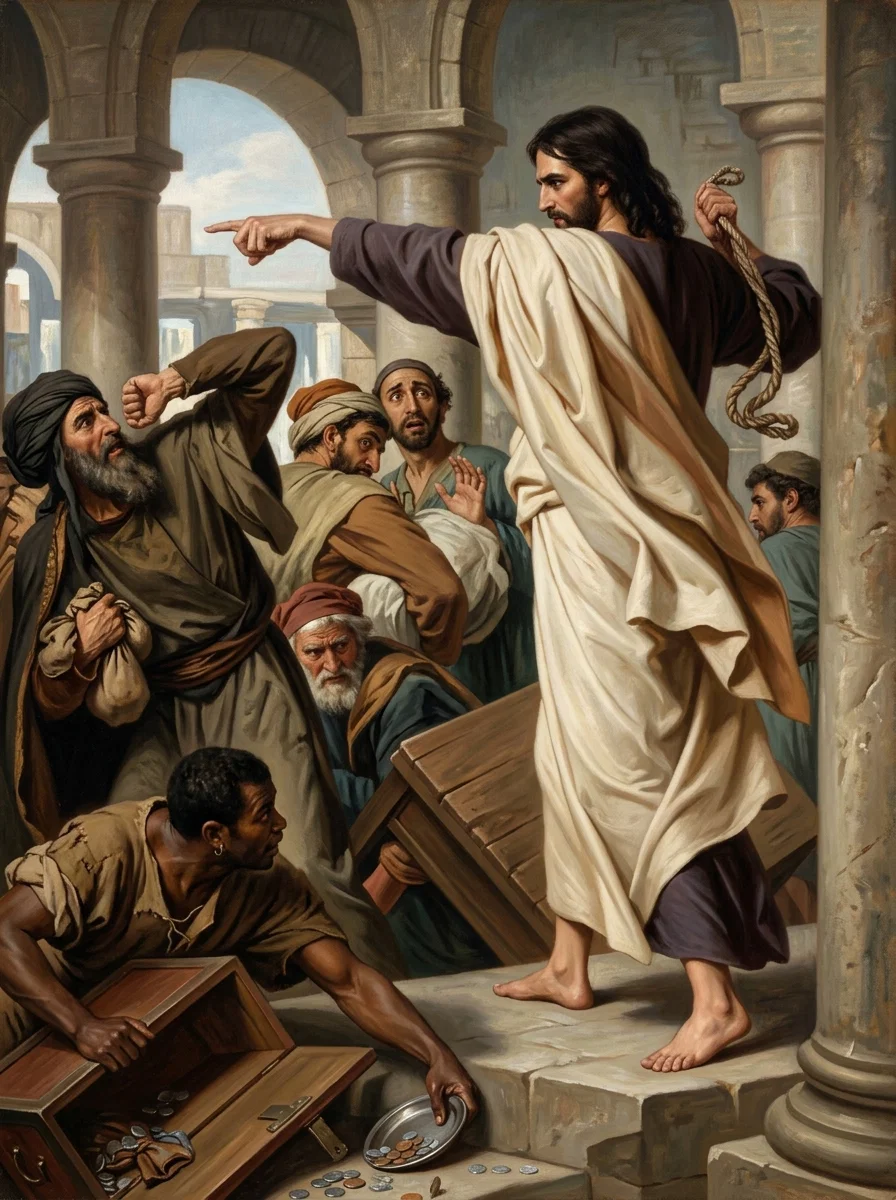
The invitation of God is for all mankind to come to Him. But in order that any, or all, may come into His presence, a mighty transformation must be effected in the human heart.
“And Jesus went up to Jerusalem, and found in the temple those that sold oxen and sheep and doves, and the changers of money sitting; and when He had made a scourge of small cords, He drove them all out of the temple, and the sheep, and the oxen; and poured out the changers’ money, and overthrew the tables; and said unto them that sold doves, Take these things hence; make not My Father’s house a house of merchandise.” John 2:13-16.
“Blessed are the pure in heart; for they shall see God,” are the words that define the character of those who shall stand before the great white throne, and look upon the spotless purity and ineffable glory of Him who sits thereon. In contemplating the majesty of the Lord, the question is forced from the lips of the inspired psalmist, “Who shall ascend into the hill of the Lord? or who shall stand in His holy place?” And the answer is, “He that hath clean hands, and a pure heart.” Ps. 24:3, 4.
Solemn words are these, for they are the knell of despair to the majority of the human race. Nevertheless, it need not be so, for there is a way whereby the natural heart can be cleansed of all its indwelling and natural wickedness.
Not long after the beginning of His ministry, Jesus, clad with zeal for His work, and with heart filled with love for a lost world, came up to Jerusalem, and to the temple. About this sacred spot clustered the memories of a thousand years. The sight of its magnificence recalled the glory of Israel in her better days, when God marched forth gloriously and gave victory to her armies, and when were brought to her feet the splendor and the wealth of all lands. Within its sacred precincts, hidden from curious gaze, were the mysterious rooms fashioned after that sanctuary whose pattern Moses saw in the mount, and where had dwelt, and still dwelt, tho trembling on the verge of departure, the holy symbol of the Divine Presence.
This was God’s house, His dwelling-place among the chosen people. Contemplating its great design, the mind of the Saviour sped back through a decade and a half of centuries, to a time when was uttered the promise that where His name should be recorded, there would God bless His people. Foremost in the thrilling history of those earlier days were the divine lessons teaching the sacred character of every appointment in His worship. The awe-striking manifestations at Sinai, the carefulness of conduct in and about the sanctuary enjoined upon all who approached it, and the swift and fearful judgments that came upon its desecrators, proclaimed in no uncertain manner in those days that the place where God met with His people was to be free from all pollution, a place whose courts were made holy by His presence.
But now, what a change! From those courts, dedicated to prayer and praise, there rolled the confused clatter and clangor of traffic. Upon the ear fell the sound of lowing of cattle and bleating of sheep, the shouts of buyers and sellers, the disputings and wranglings at the tables of money-changers,—in brief, the din of a city’s market in the courts of prayer. The occasion demanded a lesson. And Jesus drove them all out.
Never in all His work on earth did our Saviour perform an act devoid of special significance. So in this instance; failure on the part of those who professed to be bearers of light, to let that light into their own souls, had developed in them only darkness, and sacred things lost their sacredness, and were treated by them as common and profane. His act was first of all a rebuke, because of the use to which they had put the house where God had chosen to place His name. Thus it was a direct implication that they were not right in the sight of a holy God, and was designed to lead them to consider their spiritual barrenness and need of a Saviour.
With a convincing power more forcible than words of argument, it also showed them that the One whose power was sufficient to cleanse a temple of stone, was almighty to cleanse the soul temple of its pollutions and defilements, and that He yearned with the yearnings of infinite love to do the work for them. Not a new truth this, but one eternal as the ages, and the one great lesson for all time.
With a love as strong and as broad, and with power as infinite as in other days, the blessed Saviour stands to-day at the gates of each human soul temple and asks permission to enter and cleanse its courts of every abomination and unnamable defilement. He claims the temple as His, and would place there His name, and the name of the Father, and they two would dwell there, enthroned in the innermost chamber. “We will come unto him, and make Our abode with him.” John 14:23. “Whose house are we, if we hold fast the confidence and the rejoicing of the hope firm unto the end.” Heb. 3:6. “Know ye not that your body is the temple of the HolyGhost which is in you, which ye have of God, and ye are not your own? for ye are bought with a price; therefore glorify God in your body, and in your spirit, which are God’s.” 1 Cor. 6:19, 20.
Yes, indeed, despair would claim us if we were left to our own resources to reach the state of purity and holiness that must be reached to stand in the presence of a holy God. But be it known in all places of all His dominion, even in the darkest and most secret places, that the Lord of heaven and earth expects no one to do the work by himself, because there is absolutely no power in any creature to do the work himself; but “the blood of Jesus Christ His Son cleanseth us from all sin.” 1 John 1:7.
“Who may abide the day of His coming? and who shall stand when He appeareth? for He is like a refiner’s fire, and like fuller’s soap; and He shall sit as a refiner and purifier of silver; and He shall purify the sons of Levi, and purge them as gold and silver, that they may offer unto the Lord an offering in righteousness.” Mal. 3:2, 3. “Create in me a clean heart, O God; and renew a constant spirit [margin] within me.” Ps. 51:10. “Now ye are clean through the word which I have spoken unto you.” John 15:3.
Let Him do it now, for the cleansing and purifying of that day will be thorough, so thorough that with the sin will pass away all the dross,—everything upon or in which sin shall be found. And the glad part of it is that by His power He does the work in a moment, so that freedom and a new creation are only a moment away for any one, for you if you have it not now. Believe in the mighty power of God. O, believe! L. A. PHIPPENY.

“THE JEWS REQUIRE A SIGN.”

“The Jews require a sign, and the Greeks seek after wisdom; but we preach Christ crucified, unto the Jews a stumbling-block, and unto the Greeks foolishness; but unto them which are called, both Jews and Greeks, Christ the power of God, and the wisdom of God.”
The Jews and the Greeks represent the two great classes who receive or reject the Gospel. Those who treat indifferently the light which the Lord has given them for their souls’ salvation, who resist the convictions of the truth because it is unpopular and involves self-denial, will justify themselves, as did the disciples when Christ declared Himself to be the Bread of life. “As the living Father hath sent Me,” He said, “and I live by the Father, so he that eateth Me, even he shall live by Me. This is that bread which came down from heaven.”
Christ stated plainly that it was not because these disciples were convinced of His divinity, not because they saw in Him the great Teacher sent from God, that they sought Him. He knew that they did not seek evidence as a means of establishing their faith in Him as the Sent of God. He said, “Verily I say unto you, Ye seek Me, not because ye saw the miracles, but because ye did eat of the loaves, and were filled.” If Christ could furnish bread to satisfy their temporal wants, they thought it would be profitable for them to unite with Him. But Christ said, “Labor not for the meat which perisheth, but for that meat which endureth unto everlasting life, which the Son of man shall give unto you; for Him hath God the Father sealed. Then said they unto Him, What shall we do, that we might work the works of God? Jesus answered and said unto them, This is the work of God, that ye believe on Him whom He hath sent.” In accepting Christ as their personal Saviour, they would have everything. In this gift of God, all heaven, with its inexhaustible treasure, was at their command.
But there came the unbelieving question, “What sign showest Thou then, that we may see, and believe Thee? what dost Thou work?” Had not the Jews just had fresh evidence in the feeding of the five thousand? What work, what sign, could Christ present before them to increase their faith? If evidence should be piled upon evidence, it would not, could not, do more for them than had the evidence which had already been given. It was not evidence that they wanted; it was an excuse to avoid the cross involved in the acceptance of the Gospel.
The cross is erected where two ways diverge. One of these is the path of obedience, leading to heaven. The other is the broad road, where man can easily go with his burden of sin and corruption; but it leads to perdition. In His Sermon on the Mount, Christ exhorted His hearers, “Enter ye in at the strait gate; for wide is the gate, and broad is the way, that leadeth to destruction, and many there be which go in thereat; because strait is the gate, and narrow is the way, which leadeth unto life, and few there be that find it.” On another occasion one came to Christ and said, “Lord, are there few that be saved?” And He said, “Strive to enter in at the strait gate; for many, I say unto you, will seek to enter in, and shall not be able.”
“If any man will come after Me,” said Christ, “let him deny himself, and take up his cross, and follow Me.” Will the convicted man take the path of obedience to God’s commandments? Will he, with the whole heart, with undivided purpose, seek after that life which is eternal? If so, he will obtain the riches that are imperishable, a life that measures with the life of God. All the heavenly universe is looking on to see which path he will take. Is it the way that is narrow? is it the strait gate that he is aiming to enter? Then he has taken the way of the cross, the path that leads to heaven. This decision will cut directly across his human inclination, his selfish, worldly considerations, his natural bias of character; but it will place him among the company whom Daniel saw in vision, those who are purified, made white, and tried.
This is the experience which all should gain. Our work is to accept the truth, to “believe on Him whom God hath sent.” In this age fables and errors are preached as truth, and the tendencies of the natural heart are misdirected. But those who believe the truth, the Word of the living God, will be determined to secure those mansions which Christ has gone to prepare, and that life which runs parallel with the life of Jehovah. If the man who is convinced of the truth draws back from the cross that points to the narrow way, and chooses instead the broad road, because he can there indulge his natural and cultivated tendencies to evil, he will never reach heaven. He will never be numbered among those who are purified, made white, and tried. Those who reject the truth because they fear that it will exact too much from them, that it will cut across their selfish propensities, and will hedge up their way to worldly advancement, are accounting themselves unworthy of eternal life.
Through His servant Isaiah, the Lord declares: “Stay yourselves, and wonder; cry ye out, and cry; they are drunken, but not with wine; they stagger, but not with strong drink. For the Lord hath poured out upon you the spirit of deep sleep, and hath closed your eyes; the prophets and your rulers, the seers hath He covered. And the vision of all is become unto you as the words of a book that is sealed, which men deliver to one that is learned, saying, Read this, I pray thee; and he saith, I can not; for it is sealed; and the book is delivered to him that is not learned, saying, Read this, I pray thee; and he saith, I am not learned. Wherefore the Lord saith, Forasmuch as this people draw near Me with their mouth, and their lips do honor Me, but have removed their heart far from Me, and their fear toward Me is taught by the precept of men; therefore, behold, I will proceed to do a marvelous work among this people, even a marvelous work and a wonder; for the wisdom of their wise men shall perish, and the understanding of their prudent men shall be hid.”
How verily have these words been fulfilled by the Jewish nation, and by every nation that has followed the same course, turning away from the truth unto fables! The Lord Jesus was the foundation of the whole Jewish economy. Its imposing rites were of divine appointment. They were designed to make the worship of God impressive, and to teach the people that at the time appointed One would come to whom these ceremonies pointed. But the Jews exalted the forms and ceremonies, and lost sight of their object. The traditions and maxims and enactments of men hid from them the spiritual lessons that God intended to convey. These maxims and traditions became an obstacle to their understanding and practise of true religion. And when the reality came, in the person of Christ, they did not recognize in Him the fulfilment of all their types, the substance of all their shadows. They rejected the Antitype, and clung to their types and useless ceremonies. The sum was proved, the Son of God had come, but they continued to ask for the proof. The message brought to them from heaven, “Repent ye; for the kingdom of heaven is at hand,” they answered by demands for a miracle. Their demand for a sign from Christ and the apostles was not for the purpose of obtaining a clearer understanding of the truth of the Gospel. All the evidence that Christ would give them would not satisfy them. And to this day the Jewish nation require a sign, and look for the Messiah to come,—one adapted to all their inventive imaginations,—to place them again in possession of the Holy Land.
The Gospel of Christ was a stumbling-block to the Jews, because they required signs instead of a Saviour; but the Lord would not have His people rest in signs and outward forms. He would not have them wait until every seeming objection is removed before they believe. God will never remove all seeming difficulties from our path. Those who wish to doubt may find opportunity; those who wish to believe will find plenty of evidence on which to base their faith.
The plan of salvation is such that those who are wise in their own estimation, who are puffed up by the teachings of vain philosophy, can not see the beauty and power and mystery of the Gospel. But to those who are of a humble heart the Word is revealed as the power of God to their salvation. The operation of the Spirit of God is foolishness to the unrenewed man. The apostle Paul says, “If our Gospel be hid, it is hid to them that are lost; in whom the god of this world hath blinded the eyes of them which believe not, lest the light of the glorious Gospel of Christ, who is the image of God, should shine unto them.”
MRS. E. G. WHITE.

A Saint’s Burden and Blessing

A SAINT is not free from sin, that is his burden; a saint is not free to sin, that is his blessing. Sin is in him, that is his lamentation; his soul is not in sin, that is his consolation.—William Secker.

WHEN WE SEE THE DAY APPROACHING.

“Not forsaking the assembling of ourselves together, as the manner of some is; but exhorting one another; and so much the more, as ye see the day approaching.” Heb. 10:25. The time here referred to is no doubt the “day of the Lord,” which the Scriptures tell us “will come.” What day could more appropriately be called “the day” than that day in which the Son of man will be seen coming on a cloud, with all the angels in heaven with Him; coming in His own glory, and that of His Father and of the holy angels; when the wicked living on the earth will be slain, and all the living righteous will be changed in a moment; when the graves of God’s people will be opened, and they will come forth, and be caught up to meet the Lord in the air?
This day, we are frequently told, even by professed watchmen, will come on us as a thief, that it is impossible to know anything concerning this great event. But let it be noted that the text says that some will “see” this day coming, will see it “approaching,” not after it has actually come. To illustrate: The other day the writer had occasion to take the train for another city. He went to the station, and, after purchasing a ticket, stepped out on the platform and looked down the track; but he could not see the train. He consulted the timetable and the clock in the waiting-room, and by comparing them found that the train was about due, that the last station, in all probability, had been passed. He was ready to go, was waiting, and anxious to be off; for he was on his way home. He kept looking and waiting, and presently a rumbling sound was heard, and, with lightning rapidity, the ponderous engine, drawing its long train of living freight, rounded a curve, and he saw the train approaching.
So with the day of the Lord. God’s people have, in all ages, been looking forward to this great event as the consummation of their hopes. Enoch prophesied of it. Jude 14. Job, in the midst of his affliction, was sustained by the thought that his Redeemer would stand at the latter day upon the earth. Job 19:25, 26. The sweet singer in Israel sung of the time when Christ would come, and gather His children from the earth. Ps. 50: 3–5. Isaiah exhorted that the weary soldiers of the cross, bivouacked on the battle-field of life, be strengthened by the thought that “our God will come.” Isa. 35: 3, 4. And Paul, from the midst of a Roman dungeon, under sentence of death by Nero, wrote these cheering words: “I am now ready to be offered, and the time of my departure is at hand. I have fought a good fight, I have finished my course, I have kept the faith; henceforth there is laid up for me a crown of righteousness, which the Lord, the righteous Judge, shall give me at that day; and not to me only, but unto all them also that love His appearing.” 2 Tim. 4: 6–8. In a little while after this, Paul was led from his dungeon to the place of execution. But as he stood where the earth in a moment was to drink his blood, he did not quail before the block, nor the gleaming sword of the executioner, but, looking toward heaven, one writer tells us, he exclaimed: “O Lord, when shall I embrace Thee? When shall I see Thee for myself without a dimming vail between?” His last words were a hope of the second coming of Christ.
Since this faithful martyr went down in death, eighteen centuries have rolled by, and we find ourselves far down the stream of time. And as we scan the great divine time-table,—the long, unerring prophecies of the Word,—we find that, with the speed of lightning, the last station on the way to the celestial city is being passed. We can truly “see the day approaching.”
Reader, are you ready, waiting? Can you say, “Lo, this is our God; we have waited for Him” (Isa. 25:9)? Can you respond immediately when the Lord comes and knocks (Luke 12:36)? Have you said farewell to the last earthly thing (Luke 9:61)? The struggle is almost over. Signs everywhere reveal that the end is near. The consuming glory of this day already mantles the horizon. Be ready, “for in such an hour as ye think not the Son of man cometh.” Matt. 24: 44.
G. B. THOMPSON.
Rome, N. Y.

“BEHOLD, HE COMETH!”

STARTLING announcement! It is the coming of Him whose advent has long been foretold, and it is no illusion. It is no false alarm, for “every eye shall see Him;” not only His friends, who will hail His advent with delight, but His enemies also, who will “wail because of Him.” Not the living only, but those whose eyes have been closed in death, will awake to behold Him. Not a mortal hero, warrior, potentate, or king, but the Son of God, who was once “wounded for our transgressions” and “bruised for our iniquities.” He comes in royal majesty, not as a silent lamb, led to the slaughter, but in kingly power and glory. We shall see Him in all His royalty. “Thine eyes shall see the King in His beauty; they shall behold a far-stretching land,” or land of very wide extent. Such scenes no mortal eyes ever beheld before; only a picture of these glories had passed before the vision of the loving disciples; but this is the reality. It is the very Christ, His real glory, the broad plains and beautiful scenery of the renewed earth, and the gathered hosts of the glorified saints. All this for His admirers; but what a scene for those who have despised and rejected Him! The solemn mandate is heard, “Depart from Me, ye cursed, into everlasting fire, prepared for the devil and his angels.” No marvel that they should wail when they see Him coming.
Dear reader, that event is impending. The coming of the Lord “draweth nigh.” The day will come suddenly, as the gleaming lightning flashes athwart the sky. Startling will be the cry, “Behold, He cometh!” Are you ready to meet Him? That He is your friend we do not question, for He laid down His life for you, but are you His friend? Are you striving to honor Him in all things? Are His demands upon you a pleasure, or do you revolt from them? He said, “Ye are my friends, if ye do whatsoever I command you.” If we are thus submissive to His will, we can then say, “This is the Lord; we have waited for Him, we will be glad and rejoice in His salvation.”—E. A. Stockman.

“WHISPER WORDS.”

A BEAUTIFUL thought, and one of wonderful significance, is found in the twenty-sixth chapter of that remarkable Biblical poem, the book of Job. After speaking of some of the wonderful works of God, Job exclaims: “Lo, these are parts of His ways; but how little a portion is heard of Him? But the thunder of His power, who can understand?” Well may he ask this question; for it is not in the power of finite mind to comprehend the things of the infinite. “As the heavens are higher than the earth,” so are His thoughts higher than our thoughts.
How little do we understand even of the things of earth! How wonderful they appear to us! We may sail day after day upon the mighty deep, and catch no glimpse of land, on and on, till our souls are subdued by the thought of its vastness. It seems the expression of the infinity of eternity, and we can scarce grasp the thought of Him who “hath compassed the waters with bounds.”
We gaze upon the snow-capped mountains, towering miles above the surrounding plain, piercing the clouds, standing like sentinels watching while nations rise and fall. Who can comprehend their vastness? who so ancient as to remember when they were not? We pause for answer, and the Spirit of God breaks the stillness, saying, “Before the mountains were brought forth, or ever Thou hadst formed the earth and the world, even from everlasting to everlasting, Thou art God.”
Let us compute the number of the inhabitants of the world. We think of the cities with their thousands and ten thousands, of the nations with their millions upon millions; and as we try to mass them into one vast company and comprehend them all, we realize the inability of our finite minds to grasp such numbers. Who is He who numbers them all?
Let us survey the earth and ascertain its weight. We pass over land and sea, from one vast continent to another; we go down into the bowels of the earth. The mind is wearied with the thought of computing the weight of estimating the power that upholds such enormous volume. But He “hangeth the earth upon nothing.”
We behold the sun in his strength, or the moon in her beauty, or consider the number or magnitude of the stars, and we exclaim with thepsalmist, “The heavens declare the glory of God.” These, we say, must be the result of the utmost exertion of His power. Who can understand it? How vast! how mighty! how incomprehensible are all these things! But the inspired poet says, “Lo, these are parts of His ways.” These but parts, but small portions? What, then, must be the greatness of all His works?
The oceans are nothing. He holdeth them “in the hollow of His hand.” What are the mountains to Him? He weigheth “the mountains in scales, and the hills in a balance.” What are the millions, yea, billions of inhabitants of earth?—“The nations are as a drop of a bucket, . . . as the small dust of the balance.” The power that upholds the earth is but little to Him. “The pillars of heaven tremble . . . at His reproof.” The stars are but few and small in His sight. He “bringeth out their hosts by number; He calleth them all by names.” They are “the work of His fingers.”
In the original of Job 26:14 the thought is intensified. The idea is that in these mighty works we have heard but the faint sounds, the whisper words, and who can comprehend the “thunder of His power”?
We shall be better able to get the thought if we can once hear these faint sounds—these “whisper words.”
'Tis the holy Sabbath. The sacred hush, like sweet perfume, seems to pervade all nature. Our souls are drinking in the atmosphere of heaven. With sweet meditations we wend our way to a temple of the Most High; and as we enter its sacred precincts, our hearts say, “The Lord is in His holy temple; let all the earth keep silence before Him.” All is worshipful. Reverently we pass down the aisle, no sound falling upon our ears except the rustle of our own garments. We bow our heads, and breathe a prayer that the Lord of the Sabbath will grant His blessing upon the service, and touch our hearts by His Spirit. Our prayer ended, we wait for the Lord to speak to us. Almost imperceptibly there floats into our souls, music so faint, so beautiful, that involuntarily we hold our breath and incline our ears to catch the strains which seem to come from the realms of infinite bliss.
Is it the sound of angel choirs Around the throne above, Of golden harps—celestial lyres— The symphony of love?
Our souls are enraptured by the sound, as faint as tho whispered, as delicate, as ethereal—
As tho the rose of Sharon And the lily of the vale Into the sweetest music Their fragrance did exhale.
These are the “whisper words.” What is the power? Listen! The music, like a rill, soon becomes a brook. Increasing in power, it flows on. Now ’tis a stream, ever widening and deepening. On, swiftly on, till it becomes a river. Now like a mighty Niagara it pours forth in wondrous power. The very earth is shaken, as ten thousand voices unite with the powerful organ to swell the chorus, “Great are Thy works, Jehovah;” “Great and marvelous are Thy works, . . . Thou King of Ages.” Rev. 15:3. But what is the music of earth to the “thunder of His power”? Listen! The river, with ever-increasing volume, now reaches the sea; and as the tidal wave comes in, we hear the “angels that excel in strength” singing, in the fulness of power, “The heavens declare the glory of God.”
But hark! Once more the scene is changed. Now ’tis the ocean, with waves rolling mountain high. Heaven and earth unite as “every creature which is in heaven, and on earth, and under the earth, and such as are in the sea, and all that are in them, heard I saying, Blessing, and honor, and glory, and power.” “I heard as it were the voice of a great multitude, and as the voice of many waters, and as the voice of mighty thunderings, saying, Alleluiah; for the Lord God Omnipotent reigneth.”
But what are the mighty works of God apart from His love? What is the lesson in all this?
Little by little has God expressed His thoughts to us. His love, so matchless, so wonderful, so infinite, has been but whispered. He has not spoken in the fulness of power, but as it were in faint echoes—in whispers.
“Angels, descending, bring from above Echoes of mercy, whispers of love.”
God’s countenance—the picture of His love—is now vailed. It has not shone upon us in the fulness of power, but in gentle beams. We see as in a mirror the dim outlines, a faint representation, of His face. “Now we see through a glass, darkly,” and yet what gentleness, what kindness, what beneficence do we see in that image!
But there will be a day when this mortal shall put on immortality; when this mind shall be no longer trammeled with corruptibility; when we shall be so strengthened and perfected in love that we may hear His voice and see His face; when we shall see Him face to face—that face the picture of infinite love—when we shall hear His voice as He speaks His love to us,—“thoughts of peace, and not of evil, to give [us] an end and expectation.” O, the height, the depth, the length, the breadth of the love of Christ, which passeth knowledge!
Well may the poet sing of the infinitude of love pictured in that face, and the boundlessness of love uttered in that voice:—
“He looks, and ten thousands of angels rejoice, And myriads wait for His word; He speaks, and eternity, filled with His voice, Re-echoes the praise of the Lord.”
J. G. EXCELL.

MY BIBLE.

A PRECIOUS relic, oft I clasp within my hands and hold The Bible, with its written page, and edges bound in gold. It was a treasure of my mother's, blessed gift to me. With joy I read the precious Word, and all about the sea, The crystal sea, the growing fruit, the song by seraph sung, And I long to praise my Saviour with an immortal tongue. As all the joys of Paradise are pictured to my view, I long to join the heavenly choir, and bid old earth adieu.
I love the Book; the charming Book is stored with heavenly love. I love to read its teachings, and its precepts o'er and o'er. When wearied with the cares of life, I take the treasured Book, And often as I study it the pages fairer look. To me it is a comfort, and I prize it for its worth. And often when I'm tired with the vexing cares of earth, Then I go and take my Bible, and pray with all my heart, And find, as often as I do, the cares of earth depart.
I love the Book, the grand old Book; sweet peace it doth afford. I'll hold it fondly to my heart, and ever seek the Lord, And pray its blessed truths may be a lamp unto my feet, That, through each heaving billowy tide, therein I find retreat. Through every bitter trial then, through tempests dark and drear, With all its charming poetry, this Book I most revere. Then may I never read the Book, the wondrous Book, in vain, But ever from its sacred page new truth and light obtain.
Alice M. Avery-Harper.
Laingsburg, Mich.

LOVE IN MISSIONARY WORK.

“He that loveth not knoweth not God; for God is love.” 1 John 4:8. No trait that adorns the Christian character is more to be admired, or to be prized by its possessor, than the power to love. Love is the living fountain from which issues the stream that flows out to all mankind, distributing cheer and comfort to hearts bowed beneath loads of sorrow. Love is the foundation principle of missionary work. By general use, the term “missionary” is restricted in its meaning to many; the word carriesthe thoughts to other lands, to missions in the dark corners of the world. But the idea of missionary work is broader than this. “One who does good to others,” is entitled to the name missionary. The workers may not be gifted with eloquence; but they may have what is better, a warm, sympathetic heart that can be touched with others’ needs and sorrows.
Christ says, “Ye are the light of the world.” The sun, as it goes forth on its errand of love, floods the earth with its warm rays and dispels the darkness. So we, gathering divine rays from the Sun of Righteousness, should go on our mission of love, and let the light shine forth in good works to others. Christ is our example. We find Him ever searching out the unloved and the wretched, longing to be the close companion of the friendless.
There is nothing but love in the heart of the Christian. “Love is of God;” “for God is love.” There are many little deeds of thoughtful kindness by which we can prove our love to God and our neighbor. May we all so imitate our Lord that all our words may breathe out melody and love, and inspire hope and comfort in the hearts of all. CARRIE KNIGHT.
Fairfield, Cal.

THE ONE CHANGELESS CONDITION OF SALVATION.

[By H. F. Carpenter, in Messiah’s Advocate.]
Is it a fact that God’s way of saving men can not be learned from the Old Testament, can not be learned from the four Gospels of Matthew, Mark, Luke, and John, and can not be learned even from Jesus Christ Himself, because He lived under the old dispensation, and came to fulfil the law, and did not teach the way of life Himself, but left that to His apostles to do in the book of Acts, to which book we should go to know how to be saved?
I see my readers look up astonished at the sacrilegious and almost blasphemous thought that our blessed Jesus did not teach us Himself how to be saved; yet such utterances are reported from the pulpit of these times, so prolific in erratic thought.
We always supposed that it was Jesus Himself who said, “This is the work of God, that ye believe on Him whom He hath sent.” John 6:29. “He that believeth on the Son hath everlasting life.” John 3:36. “This is the will of Him that sent Me, that every one which seeth the Son, and believeth on Him, may have everlasting life; and I will raise him up at the last day.” John 6:40. “Except a man be born again, he can not see the kingdom of God.” “He that believeth on Me, . . . out of his belly shall flow rivers of living water.” “For the Father Himself loveth you, because ye have loved Me, and have believed that I came out from God.” “He that believeth and is baptized shall be saved.”
Was it not Jesus Himself who said all these things? And are they not all recorded in the Gospels? And do they not teach the way of life truly?
He that can not see the way of life in the teachings of Christ, must be dull of seeing. Indeed, Christ’s great commission to the apostles enjoined them to teach nothing which He had not already taught. “Go ye therefore, and teach all nations, baptizing them in the name of the Father, and of the Son, and of the Holy Ghost; teaching them to observe all things [not, whatsoever I shall command you but] whatsoever I have commanded you.” He Himself had taught the way of life and salvation, and they were but to repeat His words already spoken.
God did not say, “Hear the apostles,” altho that is duty, but, “Hear Him.” Moses likewise prophesied, saying, “Him shall ye hear.” He is declared to be the “Author of eternal salvation to all them that obey Him.”
Since Adam sinned, God has had but one way of salvation. In all dispensations men have been saved in the same way, whether in the antediluvian age, the Jewish age, or Gospel age. By living faith in Christ, all who have been saved at all have been saved; as it is written, “It is one God, which shall justify the circumcision by faith, and uncircumcision through faith.”
Under the law he who did not see beyond the typical, and grasp by living faith the anti-typical sin-offering, remained still in his sins. Abel was saved by living faith, and so was Abraham. By living faith we mean breathing faith, or faith that breathes. The life-perpetuating breath of faith is obedience. Acts of obedience do not give life to faith any more than breathing gives life to a new-born child—life must precede the breathing, but breathing perpetuates the life. Saving faith has life, which inspires conformity to every requirement of God. This conformity neither begins nor ends with baptism, altho it now includes that. Whenever a faith which surrenders the will entirely to God takes possession of a heart, that moment that soul is a saved soul. “His servants ye are to whom ye yield yourselves servants to obey.” This has been the one condition of salvation under all dispensations. The things required of a saved soul have varied in different dispensations, some things being required of one when saved in one age, not required in another, but the way of entering a saved state has never changed since Adam was required to believe heartily in the promised “Seed.”
First of all, dear souls, get saved by a living faith in the Crucified One, and there will be no difficulty in keeping the requirements of God—you will love to do so; you are then created unto good works; but if you offer your obedient acts as a price or a part price for salvation, your barren heart will never shout the praises of His salvation.
“Have you been [not to the apostles but] to Jesus for the cleansing power?”
Continue reading: MAKING SAINTS