Your ShelfYour Projects

Review and Herald, Vol. 92, No. 54.

The Loom of Life
Earlier text: Glimpses of Sabbath Keeping After New Testament Times

W. E. HANCOCK

The Motives of Service — No. 2

W. E. HANCOCK

Theories and Doctrines Inadequate Motives

ORTHODOX theories and doctrines may be adequate for sunny weather experiences; but when disaster, sorrow, and disappointment come, something more than theory and doctrines is needed. Job's friends tried to defend a well-established belief that calamity and sorrow were visited upon men because of their sins. They failed to consider the facts of experience which proved the falsity of this theory. But Job refused to belie the manifestations of God to him through personal experience, or to accept an idea of God which denies the plainest facts of life, even if that led to the rejection of an accepted belief. He said to his friends, “Will ye speak unrighteously for God, and talk deceitfully for him?” To prop up a cherished theory by denying God's providences in the world of life and experience is not an evidence of faith, but rather the attitude of a fearful mind.
If we find our cherished ideas in contradiction to the plainest manifestations of God's providences, we need not lose faith in God nor in his revealed truth. It is best to revise our ideas. It is never necessary to deny facts in order to defend truth, nor to sustain truth by questionable means. To doubt a supposed truth which requires such an attitude to defend it, does not imply a lack of faith. It may be the beginning of a deeper and larger faith.

The Absence of Doubt Not an Evidence of Faith

The absence of doubt is not always an evidence of genuine faith. Job's friends seemed to have implicit confidence in their theories; but they certainly had not true faith. True faith does not fear intellectual criticism or the trials of human experience. The man of faith is he who, in sorrow, darkness, disappointment, and seeming abandonment of heaven and earth, holds fast to the God whom he can no longer see, feel, nor understand. It is he who, like Job, can see the beliefs of his early days and of his present friends shattered, and still rely upon the eternal fundamentals, as shown when he said, “Though he slay me, yet will I trust in him.” “The foundation of God standeth sure, having this seal, The Lord knoweth them that are his.” He whose experience is founded upon the eternal truth need not be disturbed by the intellectual agitations of any time. Knowing God, and gaining the faith which is the strongest motive of Christian service, is not accomplished by intellectuality, but by an inner experience of truth.

The Time to Examine Our Motives

There are no people who need more to have the deepest and most enduring motives of service than do Seventh-day Adventists. We believe and teach the most extensive and explicit system of doctrines found among Christians today. We believe that God has called us to evangelize the world in a very short time by teaching these doctrines. We feel invincible against polemic attacks upon our doctrines, and are astonishing the world with our missionary propaganda. But we need to take heed. Invincible doctrines and missionary enthusiasm cannot be substitutes for personal experiences. We have not yet passed through Gethsemane nor mounted Calvary in our experience. It is time for us to test the motives of our great zeal, of our unparalleled sacrifices in modern times for the propagation of the doctrines we teach, and of our great missionary undertaking. Whether we do it now at the height of our prosperity or later under trials and disillusionments, our motives are sure to be tried before we experience a second Pentecost and see our hopes realized.

The Danger of Trusting Appearances

On what do our faith and confidence rest? Is it on the invincible doctrines we teach? on the hope of the speedy termination of our work by Christ's return to earth? on our unprecedented missionary operations? We need to inquire whether our willingness to give for world-wide evangelization and the support of missionaries at home and in the foreign field is the result of a temporary inspiration attending large and successful operations, or whether it is based on a deep consciousness of the nature of sin, from which the world is suffering.
If our hopes, our experiences, our zeal, and our profession rest merely upon the interpretation of doctrines, however beautiful, they will be found wanting in the testing time before us. A trust and confidence that go no deeper may be followed by a collapse of faith in God and his truth.

The Value of True Friendship

“TRUE friendship is like sound health, the value of it is seldom known until it is lost.”

Notes of Progress From Szechuan

F. A. ALLUM
OUR friends in the homeland will be glad to know that we now have the deeds for the land for which we have been negotiating, and that they have been duly stamped by the magistrate. This may not seem of great importance to those unacquainted with China, but it is often a long-drawn-out process, owing to the great objection that the Chinese have to foreigners’ securing property in their country. Sometimes two or three years pass before the matter is finally settled to the satisfaction of both parties. Now we can truly say that we have our stakes set in Chung-king, never to be removed till the Lord comes, for we believe that this place is undoubtedly the best center for our headquarters in western China. We have perhaps the best available site on the Chung-king side of the river, the land being outside the city, only between twenty-five and thirty minutes’ walk from our chapel. It is a beautiful site, surrounded by bamboo groves. Dr. MacCartney, the senior missionary of Chung-king, who has a hospital and equipment in that place worth over $100,000 gold, said that he had this site in mind for a sanitarium. The survey for the I-chang, Chung-king, and Cheng-tu Railway passes within a stone’s throw of our property. We feel very thankful to our Heavenly Father for giving us this beautiful place, and feel fully satisfied that it was his special leading that directed our steps to this site. We also feel very thankful to our brethren and sisters in the homeland who have so generously supplied the money to secure this land.
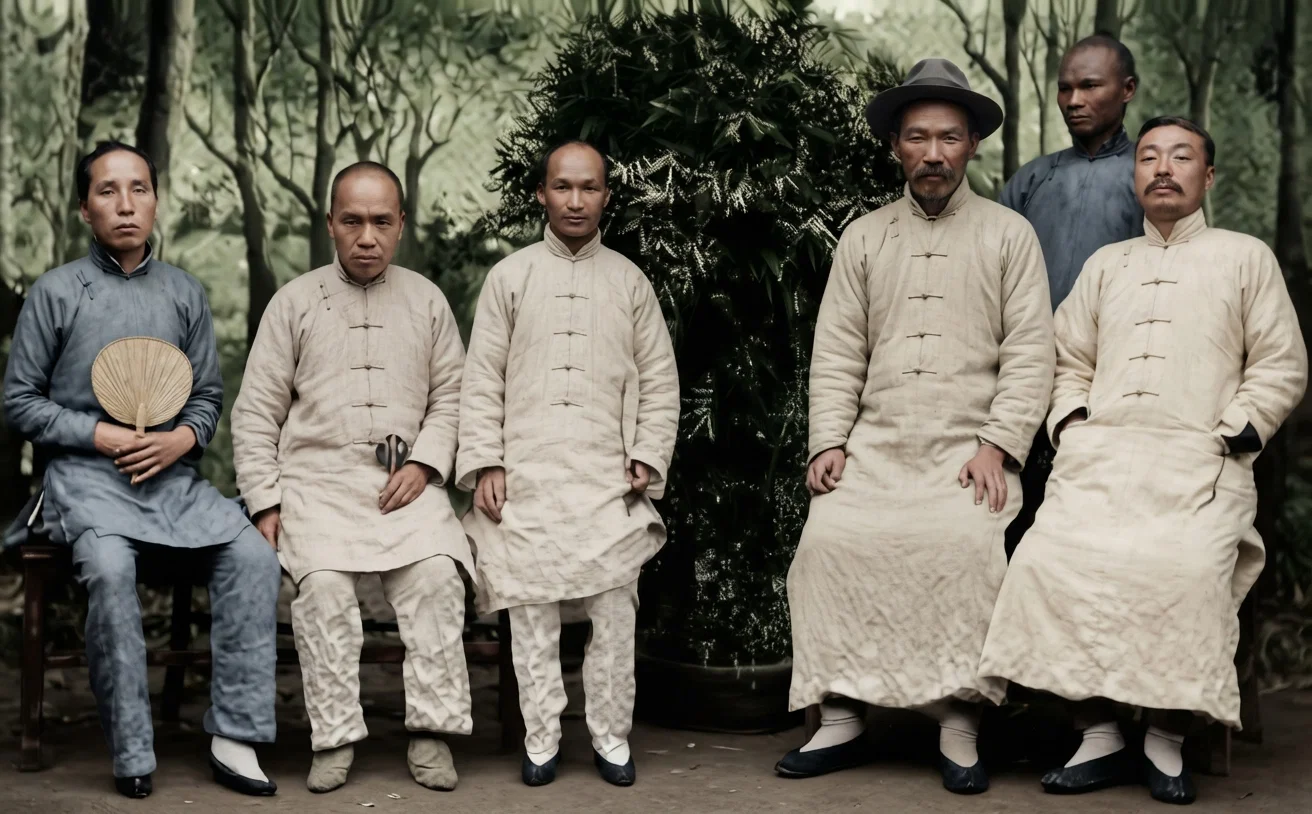
THE FIRST FRUITS IN SZECHUAN, WEST CHINA
Building operations have now begun on our bungalows; the first house will not be completed till the middle of December. It is impossible to hustle the East, for, as Kipling has said,—
“’Tis not wise for the Christian’s health To hustle the Aryan brown, For the Christian rifles, and the Aryan smiles. And weareth the Christian down. And the end of the fight is a tombstone white With the name of the late deceased, And the epitaph drear, ‘A fool lies here Who tried to hustle the East.’”
Our bungalows are to have ample cellar room, all the living rooms being on the first floor, which is raised six feet from the ground. We have a large attic, with a sleeping porch opening off it. The basement is to be of stone, and the rest of the building of brick, with native tile for roofing.
Our two canvassers are having remarkable success in taking subscriptions and selling single copies of our monthly Signs of the Times. In six weeks’ canvassing of the cities between Wan-hsien and Chung-king, they took over four hundred yearly subscriptions, thus securing, including their single copy sales, over $148 Mexican. They faithfully turned over to the mission fifty per cent of their sales, together with their tithe, which amounted in all to $81.42 Mexican. This is perhaps the best piece of real self-supporting canvassing work that the writer has seen in China. We are planning to line the cities that are located on the Yang-tze-kiang with our truth-laden literature, all the way from I-chang to Cheng-tu, a distance of over one thousand miles. That this can be done, the experience of these two canvassers amply proves. And it will be largely through the self-sacrificing work of the native colporteurs that the loud cry of the third angel’s message will be given in these heathen lands. These men are a great source of strength to our work.
I am sure all will rejoice to know that we have reaped our first fruits in Szechuan. Four precious souls on July 3 were buried with their Lord in baptism. These had all been keeping the Sabbath for nearly a year, and the baptism took place just about one year from the time we opened our chapel in Chung-king. Before administering baptism, we give them a two weeks’ course of special instruction on the fundamental principles of the faith. There were others who requested baptism, but they were asked to wait until they had further opportunity for instruction.
A new chapel has been opened in Lao Chang, a busy market town located twenty li [about seven miles] out from Chung-king on the main paved highway from Chung-king to Kui-chau. We have organized a Sabbath school here with a membership of about twenty. On market days we often have as many as one hundred attentive listeners in our chapel. This is our second company in Szechuan.
We have also received calls from Wan-hsien, which is the next important town below Chung-king, asking us to open a chapel there. These calls come as a result of the work of our canvassers. The opening of this chapel at Wan-hsien will probably be our next step in the development of the work in this province, but it will have to wait some time yet, until we are through with our building operations here at Chung-king.
Our rented home on the mountain has enabled us all to keep well and strong during the summer, and is situated between our city chapel and the chapel at Lao Chang, so that we have been able to carry the regular Sabbath service all through the summer. Brother Warren, sometimes accompanied by his wife, went to one chapel, while Mrs. Allum and I went to the other.
In looking back over the past year we can see how our Father has led us, when we compare our present favorable situation with that of Brother Warren and myself when we arrived at this great city a little over a year ago, and were forced to spend the first three weeks in a house boat outside the walls of the city, being unable to find a place where we could lay our heads. But now we can rejoice that we were permitted to experience these inconveniences in order that we might have the privilege of opening up the work in this great western field.
In conclusion, we can say that we were never of better courage, and never had greater confidence that the Lord is going to bless his work in this field. This field is not an easy one, and what we especially need just now is to pray earnestly that reenforcements may be sent to us in order to strengthen the work and enable us to begin work in or near the capital, Cheng-tu, and from there press on until we have missionaries located in Tachienlu, the great doorway to Tibet. Will you not join us in the earnest prayer that these developments may quickly take place, in order that the Tibetans, who have waited so long for the message, may receive the light of the truth. Thus that glad day which will reveal our Saviour coming in the clouds of heaven will be hastened.
Chung-king, Szechwan.

“All’s Well!”

The lingering twilight leaves the sea, The darkling billows heave and swell; So deep, so dark They roll! But hark — “All’s well!”
The great ship speeds upon her track; Where dangers lurk, we may not tell; Yet none shall fear While we can hear “All’s well!”
Down through the dark the message comes, All dread of danger to dispel Through all the night, Till morning light — “All’s well!”
So voyagers o’er life’s mighty main, When black its billows toss and swell, Listening, may hear A voice of cheer — “All’s well!”
— Minnie L. Upton, in Sunday School Times.

Relief From the Heat of India’s Plains

MRS. MYRTLE LEECH
[From the continued heat of the plains in India, our workers can find no reprieve other than a trip to the mountains. This is really necessary to preserve their health. The following is a letter written home by Sister Myrtle Leech, describing a camping expedition she and her husband, in company with other workers from Bengal, recently made into Kashmir, the northernmost province of India. So far as we know, this visit is the first made by our workers into this part of India. Very likely some seeds of truth were sown along the way by literature left with the people. As this is a personal letter to friends, we leave it in the familiar style, which the reader will appreciate and enjoy.]
Now about our trip. No need to say it was grand. We left home September 6, and were joined at Madhupur by Elder French and family. As there were four of us, we got missionary concessions and went second class. Our first stop was at Cawnpore, where we visited Sister Sheen. That same night we went on to Agra. Arriving there at midnight, we spent the remainder of the night in the station. After breakfast the next morning we took gharries and went out to see the city and visit the Taj Mehal [the noted tomb built by one of the kings for his wife]. It was grand. I’ll try to describe it, but I cannot do it justice, it must be seen. The grounds around it are beautiful. There are two or three hundred fountains playing along the path leading up to it. It is made of marble, and presents a grand and imposing sight glistening in the sun. At the stairs we were met by a keeper who wiped the dust from our shoes before we were allowed to enter. The tombs are in the center, and are surrounded by great marble screens cut and carved with the most exquisite flowers and designs, as if they were of some soft stone instead of marble. I had never seen anything so beautiful. The staves themselves are beautiful pieces of work. At one time these were set in all manner of precious stones, and the screens surrounding them were of solid gold, but those have been carried away, and these marble ones were made to take their place. The walls are also beautifully carved in marble. We enjoyed hearing the echoes as they sounded and resounded through the great dome.
We then went through a long, narrow, dark passage down to the real graves. They also are beautifully inlaid, and incense is kept burning day and night; offerings of sweetmeats and flowers are made daily, and beautiful big lamps made of gold and silver are kept burning constantly.
On account of the war the fort was closed, so we could not see the pearl mosque. But we drove out ten miles into the country and saw another famous mosque, surrounded by beautiful big grounds. The mosque itself is overlaid in white and black marble on the outside. At one time this, too, was overlaid with gold inside. But the gold has been carried away. The English have done over one of the wall panels in gold and silver gilt, so visitors can get an idea of the grandeur of the original work. It gave us a faint idea of what Solomon’s temple must have been.
We went to the top and saw the marble pillars carved in beautiful designs at the head of one of the graves. From this pillar was taken the famous diamond, half of which now rests in the crown of King George and the other in that of Queen Mary. When we were in London, we saw them in the tower with the other jewels.
We surely enjoyed our visit at Agra, and reluctantly turned our steps back to the station. We should have enjoyed spending hours among those grand old mosques, but our watches reminded us that we must hasten, for Elder and Mrs. Pettit were due on the three o’clock train from Bombay to join us. We certainly were glad to meet Brother and Sister Pettit, whom we had not seen for two years.
The next day found us at Delhi, and here we spent several more interesting hours viewing the sights of the new capital and the ruins of the old. It is really a beautiful place, and we were charmed with it.
That evening found us again on the train, bound for Lahore, where we were to meet Dr. Mann and Professor Salisbury for a committee meeting. We reached there the next morning at eight o’clock, in a drizzling rain, and were met by Dr. Mann, who took us at once to the mission house and made us welcome. Professor Salisbury came a little later from Lucknow, and the men all hurried off to attend to some business and to look over the work in general.
Friday was spent in seeing the city and in holding committee meetings. We enjoyed the Sabbath together; but as soon as it was over, we had to rush to get our things together to catch the nine-thirty train. Professor Salisbury left at eight o’clock.
Sunday at eleven-thirty found us at Rawalpindi, where we left the train and procured two gharries for the next part of the trip. These gharries were four-wheeled and accommodated four each. We had our dinner at the station, and started out about three o’clock. It was a beautiful drive right through the valley. About five o’clock we came to the foothills, and from there it was a steady climb. The road wound in and out, and was very steep. We had procured a little one-horse cart to take the luggage we could not put on our big gharries. As it was growing dark, we began to inquire where the other gharri was, and were told that it would catch up soon. So we told the men to stop at the next good camping place for the night; but each one at which we wished to stop was not good enough, there was a better just ahead. They kept on this way until after nine o’clock, when we told them it was time to stop, and it didn’t make any difference what kind of place it was. So they stopped: They had started late, and their horses were fresh, so they wanted to go as far as possible. Well, to make a long story short, that gharri didn’t come up, and the men knew it wouldn’t all the time. Our folding cots and most of our bedding were on the missing gharri, and the night was cold. We pitched the tent, spread the fly on the ground, and slept in our clothes, getting along fairly well, though some of us took cold.
The next day we were up and off early. It was grand, for we soon began to get up among the firs and the maples. They looked like old friends. How we did enjoy this drive, although it was a steady climb most of the way, and we walked a good part of the time. At twelve o’clock we came to the divide. Oh, it was grand! On one side we could look away down and see the Jumna River flowing through such a pretty valley, and could see our road winding in and out far down the mountain side; on the other side we could see away down the valley, and could just make out Rawalpindi in the distance. Here is situated the pretty little hill station of Murree; we passed through just the outskirts of it. Sitting on the summit, a little over 9,000 feet high, we ate our dinner. After dinner the men tied on logs for brakes, and we started down. The roads were fine, and our horses just flew as we went down that mountain. It was one of the most delightful rides I had ever had. The scenery was grand, for all the mountain sides are cultivated, and the low little rockhouses dotting them look so pretty.
We camped in a small village that night, and were up and off good and early the next morning, although it was raining. I forgot to say that when we reached the divide, what was our surprise to find our cart waiting for us. It had passed us in the night. From here on it kept up with us. We hadn’t gone far when we had a breakdown, and were detained about an hour. We had to go carefully, too, for there were a great many landslides. By noon we reached the foot of the mountain and followed the Jumna River on up to Srinagar. This river is the dividing line between Kashmir and the Punjab,—the two northern provinces of India,—and is crossed by a bridge. We camped in Kashmir for dinner. From here our road was for the most part cut out of the mountain side, and was a gradual ascent. The Jumna River is a very swift and treacherous stream. We followed it all the way, now hundreds of feet above it, then again almost on a level. The scenery is grand and wild, and here we saw the Kashmir goats. They are beauties—large, and of different colors. We did not tire of watching them. Wednesday and Thursday were about the same, if anything the scenery growing more wild, with many pretty little waterfalls, and beautiful ferns, grasses, and flowers. We passed through great groves of walnut trees, and how we enjoyed the walnuts, gathering them right from the trees! We never tired of looking at those fir-clad hills, and first one and then another of us would exclaim, as we suddenly turned a curve and came upon some beautiful scene, “Oh, look! That’s just like home!” We could almost imagine we were back in old Oregon again.
Thursday night we camped at the head of Kashmir Valley, thirty-five miles from Srinagar, the capital. As we were anxious to get in and get settled before the Sabbath, we started early.
We reached Srinagar at twelve-thirty, and went at once to look for house boats. Such a time we had! On account of the war there were many idle boats, as the army people did not go up this year as usual. We were surrounded by a crowd, each one clamoring for us to go to see his boat, and shouting its merits. We looked at a number, but did not decide on any then, but went back to our gharries and drove out to a nice camping place and put off our stuff. The women cooked dinner while the men went again to see about a boat. Just as we had dinner ready, they came back and said they had secured a nice boat with four rooms and two bathrooms at a very reasonable rental. It was at the landing, and we could move in at once. So while we ate our dinner, the boat crew and our boys took things down and put them on the boat. We were not long in eating, as we were anxious to get settled before the Sabbath, for it was now getting late, and we were dusty, tired, and dirty after our long journey.
(Concluded next week)

Guarding the Avenues to the Mind of the Child

LAURETTA KRESS, M. D.
“He that hath an ear, let him hear what the Spirit saith.” The ear is one of the chief avenues to the mind, and with the mind man serves God.
The mind may be compared to the cylinder of a phonograph. As we speak into the receiver of a phonograph, and revolve the cylinder, impressions of what we say are made upon the delicate wax. All that is necessary after this is to put on the funnel and turn the cylinder, and the very words that were spoken into the receiver will be reproduced, with the same expression that the speaker put into them.
Had Eve always allowed God to speak to her, and listened only to his voice, she would never have been deceived; no ill could have befallen her. But she made the mistake of listening to the words of the evil one. “Now the serpent was more subtil than any beast of the field which the Lord God had made. And he said unto the woman, Yea, hath God said, Ye shall not eat of every tree of the garden? And the woman said unto the serpent, We may eat of the fruit of the trees of the garden: but of the fruit of the tree which is in the midst of the garden, God hath said, Ye shall not eat of it, neither shall ye touch it, lest ye die. And the serpent said unto the woman, Ye shall not surely die: for God doth know that in the day ye eat thereof, then your eyes shall be opened, and ye shall be as gods, knowing good and evil.”
Satan does not now use the serpent as a medium. He could not accomplish his ends through it; for every one keeps as far away from a serpent as possible. But he uses things just as subtle. The modern phonograph, or graphophone, for instance, is a very harmless-looking thing; yet the songs and sayings of wicked and dissolute men are often reproduced by it. We would not go to a theater to listen to these men, but we welcome them to our homes, and allow them to amuse our innocent children with their songs and talks through the phonograph.
Impressions are made upon the minds of young and old. The words and the very spirit of the one uttering them are indelibly impressed upon the mind, often to be reproduced later in life. Evil seeds are thus sown, which later spring up and bring forth a sad harvest. The moving picture show is another feature of our modern life which is sure to develop a crop of criminals.
[A case in point was cited in the Literary Digest of October 16. A boy “doing time” at the House of Refuge on Randall’s Island wrote to the secretary of the Big Brother Movement of New York City, asking for help to secure a position. Among other things he said, “It was the movey that got me to steal & I hope that hear after I can live straight & earn an honest living as I hope I can.” The secretary responded with a kind letter of inquiry, asking the lad if he would tell him just how the movies taught him to steal. Following is a verbatim copy of the boy’s reply:— “DEAR SIR: Just got your letter & was glad to hear from you. I will tell you how it was once I went to a show and saw a picture named working in a office & he stealis money from a safe & is not blamed a young cleark is accused & sent to jail & and at last they discover the theif and he has one more chance & and when I saw that I thought it would be easy for me so I took a chance & was not caught & so I kept it up & at last was caught & discharged so I think If I got a chance I would live stright as I have no more to say I remain” etc.This is only one case—of an ignorant, untaught lad of the streets of a great city. No doubt the same picture that proved his undoing was exhibited before the eyes of thousands of boys from refined, Christian homes, on whom it will have a tendency to break down the walls that have been so carefully and prayerfully builded to shield them from temptation.—Ed.]
Ever it is the same old, old story: “While men slept, his enemy came and sowed tares among the wheat, and went his way. But when the blade was sprung up, and brought forth fruit, then appeared the tares also. So the servants of the householder came and said unto him, Sir, didst not thou sow good seed in thy field? from whence then hath it tares? He said unto them, An enemy hath done this.”
Parents are asleep to the dangers of their children. While they are trying to sow good seed in their fertile minds on the Sabbath day, through some of these apparently innocent things Satan is sowing tares that will some day be reproduced in the life of the young man or young woman.
The daily paper, filled with records of crime, murder, theft, etc., is another medium through which impressions are made upon youthful minds.
The reading of novels, love stories, fiction, and light literature is another medium. Young people who feed the mind on such literature live in an unreal and fanciful world; their imaginations become diseased. Many of them in later life become walking novels, known and read of all men. How important therefore it is to keep the heart “with all diligence,” ever remembering that “out of it are the issues of life,” and to take heed what we hear and what we see.
The Word of God is the golden oil that is to flow through the golden tubes into the golden vessel. “Thy word,” said David, “have I hid in mine heart, that I might not sin against thee.” Again we read: “My son, attend to my words; incline thine ear unto my sayings. Let them not depart from thine eyes; keep them in the midst of thine heart. For they are life unto those that find them, and health to all their flesh.” “It is the Spirit that quickeneth; . . . the words that I speak unto you, they are spirit,” said Jesus; and “the fruit of the Spirit is love, joy, peace, long-suffering, gentleness, goodness, faith, meekness, temperance.” These fruits appear in the children in whose minds God’s Word has been planted.
And the promise is, “Because thou hast kept the word of my patience, I also will keep thee.”
Takoma Park, D. C.

Things I Love

MRS. L. D. AVERY-STUTTLE
I LOVE October’s hazy skies, The sunset with its brilliant dyes; The feathery plumes of goldenrod, That in the autumn breezes nod; The muffled thunder’s sullen roar, The waves that beat the rocky shore; The pearly-tinted shell which gleams Where golden light in beauty streams.
I love the mountain, stretching high Like hoary giant toward the sky; The fields, the hills, the rocks, the plains, The winter’s snow, the summer rains,— All these I love; in each I see The loving hand of Deity.
But more, far more than all the rest, I love the little children best. ’Tis sweet to hear their voices ring Like merry warblers in the spring. I love to see their eyes so bright, That shine like stars in summer night. Made in God’s image, sweet and mild, What’s fairer than a little child?
Lansing, Mich.

Conducted by Mrs. I. H. Evans, Takoma Park, Washington D. C

Assisted by Miss Lora E. Clement
Through the columns of this department, hints will be given on all matters pertaining to the home life. Short articles and letters are solicited from home makers, telling of their everyday experiences,—their joys and sorrows, their failures and successes.

Front Porch Visits

MARTHA E. WARNER
“I’VE talked so much today, my throat aches,” sighed Mrs. Bowen, as she took a seat beside me on the front porch.
“Why so much talking?” I inquired.
“Oh, it is Harold! He has lost another cap, and we cannot afford to buy him a new cap every week,” she answered. “But you are seeing things? Is it a boy and a cap? Please tell me.”
“No,” I replied, “it is not a boy and a cap, but a boy and a silk handkerchief. You see, Lawrence never knew where to find his cap. If lost at play, he never knew where to find it. When it came time for a walk or an errand, he would be capless. Often I had him stay at home and hunt for his cap.
“One day when I told him I was sorry to leave him at home, he answered, cheerfully, ‘Never mind, mamma, I’ll find something to do.’ That answer set me to thinking. Staying at home was no punishment to Lawrence. Some other course must be followed. When I reached home, I found a silk handkerchief, and calling Lawrence to me, I told him that in the future, if his cap was missing, he would wear the handkerchief wherever he went. I would tie it on, so he could not lose it; and when we reached home, I would take charge of it.
“A week later, we were all going to the city. That to the children was a treat, and how they scampered to get ready! At the last moment, Lawrence came saying, ‘I can’t find my cap, mamma. I’ve hunted everywhere.’
“If your cap is gone, you know what you will have to wear,” I quietly replied.
“‘O mamma,’ he cried, ‘I’d rather stay home.’
“‘But it wouldn’t be right for you to miss the trip,’ I answered. ‘I can fix the handkerchief so it will look like a bandage for the earache. It is the best I can do as long as you have no cap.’
“When we reached the city, Lawrence said if I was willing, he should rather stay in the surrey. Even the museum held no attraction for him.
“Well, we did our shopping, and the children looked around to their heart’s content. Finally I said, ‘Which shall it be, boys, home or the museum?’ After a moment’s silence, one of the boys said, ‘Home. Let’s leave the museum until another trip, so Lawrence can go.’ As the others seemed to agree, home we went. As soon as we arrived, Lawrence began to hunt. The next day he invited me to go to his room. There he showed me how nicely he had arranged his clothes in the dresser. Then he opened the door to the closet. Everything was in order there. And right in its proper place was his cap. ‘Why, Lawrence,’ I exclaimed, ‘your cap in plain sight, and you not able to find it! What was the trouble with your eyes?’
“‘My eyes were all right, mamma,’ he said, ‘but the honest truth is, my cap was on the floor under a coat. From now on, I am going to take care of my clothes.’
“He was true to his word. Of course many times he would forget, but we could see improvement every day.”
Clintonville, Conn.

The Sinister Influence of Worry

“God keep us through the common days, The level stretches white with dust, When thought is tired, and hands upraise Their burdens feebly, since they must. In days of slowly fretting care, Then, most, we need the strength of prayer.”
To worry is the inevitable habit of the man or woman who has not learned the great lesson of living one day at a time.
Usually we can bear the ills and troubles we have. Somehow we struggle through them, even against odds.
Women at home are tempted to the sin of worry by many little things which in the total make a large amount. They worry because they fear the husband and father is breaking in health. When he comes home at nightfall, weary, perhaps cross, they notice that his shoulders are rounding, and his hair that was as black as the raven’s wing is turning gray, and his temper is less cheery than it used to be. To his worry they immediately add their own, and the atmosphere grows heavy, and the home is dull. No wonder the young people fly from it. The wife may have good reason to look after her husband’s health and strength, but there are better ways than the way of worry to do this. Worry never yet cured a single human ill, it never soothed an ache or a pain, or made lighter an irksome load, or easier a daily duty.
The true relief for most ills is in greater simplicity of living. Added to this, as inestimable, let there be courage and a serene faith.
“Look up and not down, Look out and not in, Look forward and not back, And lend a hand.”
Mothers worry because their sons are drifting into dangerous associations.Worrying first, they nag next, and nothing so kills filial confidence and accelerates a young man’s downward fall as nagging and faultfinding. If you want people to be good, you must make them happy.
Girls worry lest they did not say the right thing, lest they made a wrong impression. The oversensitive nature is sure that it blundered, and worries lest it did some harm in deed or word. People who are in comfortable circumstances worry lest they shall end in poverty. Rich people worry because they are not richer. Poor people worry about the rent and the coal bill and tomorrow’s loaf. Deep lines are graven on haggard faces by worry.
Ages before “Don’t Worry” clubs were organized for the help of women beleaguered on every side by timid and baleful thoughts, by suspicions of lurking foes ready to pounce upon them, there was One in old Judea who said: “Be not anxious for your life, what ye shall eat, or what ye shall drink; nor yet for your body, what ye shall put on. Is not the life more than the food, and the body than the raiment? Behold the birds of the heaven, that they sow not, neither do they reap, nor gather into barns; and your Heavenly Father feedeth them. Are not ye of much more value than they?
“And which of you by being anxious can add one cubit unto the measure of his life? And why are ye anxious concerning raiment? Consider the lilies of the field, how they grow; they toil not, neither do they spin: yet I say unto you, that even Solomon in all his glory was not arrayed like one of these. But if God doth so clothe the grass of the field, which today is, and tomorrow is cast into the oven, shall he not much more clothe you, O ye of little faith?
“Be not therefore anxious, saying, What shall we eat? or, What shall we drink? or, Wherewithal shall we be clothed? For after all these things do the Gentiles seek; for your Heavenly Father knoweth that ye have need of all these things.
“But seek ye first his kingdom, and his righteousness; and all these things shall be added unto you. Be not therefore anxious for the morrow: for the morrow will be anxious for itself. Sufficient unto the day is the evil thereof.”
This sublime passage from the Sermon on the Mount is the chart by which, if we sail, we shall not worry. The constant thought that we are in God’s care, that his benignant love is over us, the realization that if we follow a noble ideal, God will aid us in the daily needs, will enable us to walk valiantly and joyously on the road, not cringingly and servilely, as those who fear an attack they cannot foil.—Margaret L. Sangster.

Folks Need a Lot of Loving

Folks need a lot of loving in the morning; The day is all before, with cares beset — The cares we know, and they that give no warning; For love is God's own antidote for fret.
Folks need a heap of loving at the noon-time,— In the battle lull, the moment snatched from strife,— Halfway between the waking and the croontime, While bickering and worriment are rife.
Folks hunger so for loving at the night-time, When wearily they take them home to rest, At slumber-song and turning-out-the-light time — Of all the times for loving, that's the best!
Folks want a lot of loving every minute, The sympathy of others and their smile; Till life's end, from the moment they begin it, Folks need a lot of loving all the while.
— Strickland Gillilan.

Growth Through Difficult Experience

“THERE is no hope of being a polished, smooth pillar without the experience of the rough quarry.”
Continue reading: In the Cumberland Conference