O, THERE is no harm in young people meeting together to spend a pleasant evening in singing, games, and having refreshments! How often we hear this said by old and young. I do not think it impossible for the young to spend an evening together profitably, but it is highly improbable. I have seen many such gatherings; have consented to go to some in order not to appear peculiar, but invariably I have left, saying, This is the last time I shall ever go to a place of this kind, even though the gathering should be made up of the sons of God, who meet together with the best of motives. One thing we can always be sure of: Satan comes also among them. Sometimes he acts an important part in getting up and arranging the program. Even though the motives of those who get up these gatherings should be pure, this is not the case as a rule with those who attend. It is necessary for each to analyze his motives carefully. We might with profit ask ourselves the following questions:—
“Do these gatherings increase my love for God? Do they give me a greater relish for religious themes and truths? Do they tend to build up the new man which I am to put on daily, or the old man with his affections and lusts? What motives prompt me to attend these gatherings? Am I in search of pleasure, or am I seeking the kingdom of God and his righteousness in these places? Am I trying to seek pleasure under the garb of godliness? “This know also, that in the last days perilous times shall come. For men shall be lovers of . . . pleasures more than lovers of God; having a form of godliness, but denying the power thereof.”
Naught but Christ can satisfy the cravings of the child of God who has tasted and seen that the Lord is good. “Unto you . . . which believe he is precious,” “the chiefest among ten thousand,” the One “altogether lovely.” What is the chaff to the wheat? We are living in perilous times indeed, in the last days. It is dangerous in these days to be found anywhere but in the path of duty and right. It is dangerous to camp for one moment on the enemy’s ground. He is going about seeking whom he may devour. Heretofore, he has been restrained from devouring even pleasure seekers.
God has shown favor to the inhabitants of this world, hoping that his long-suffering and goodness would lead them to repentance. It has been demonstrated that the prediction is true: “Let favor be showed to the wicked, yet will he not learn righteousness.” Now a change is to take place in his dealings with men. Heretofore his restraining influence has been felt everywhere and in everything. But this restraint will be removed, then Satan, the prince of the power of the air, will be permitted to exercise his power in destruction. This will be witnessed by tidal waves, winds, cyclones, hail storms, volcanic eruptions, earthquakes, etc. “There shall be . . . distress of nations, with perplexity; the sea and the waves roaring; men’s hearts failing them for fear, and for looking after those things which are coming on the earth: for the powers of heaven shall be shaken. And then shall they see the Son of man coming in a cloud with power and great glory.”
But even in this God makes the wrath of Satan to praise him. “When thy judgments are in the earth, the inhabitants of the world will learn righteousness.” What his favor failed to accomplish, his judgments will accomplish. Many will reflect and see how wonderfully God has protected them. This will lead them to seek shelter and trust under the shadow of the Almighty. Not fear, but love, drives them there for security. They realize that there is no security anywhere else.
Children of godly parents, forsake not their counsel and advice. “Obey your parents, in all things: for this is well pleasing unto the Lord.” Especially should these words be heeded in the last days. “For the Lord shall rise up as in Mount Perazim, he shall be wroth as in the valley of Gibeon, that he may do his work, his strange work; and bring to pass his act, his strange act. Now therefore be ye not mockers, lest your bands be made strong: for I have heard from the Lord God of hosts a consumption, even determined upon the whole earth. Give ye ear, and hear my voice; hearken, and hear my speech.” Heretofore, God’s mercy has been mingled with Satan’s wrath. We have all been dealt with better than we deserved. But when the angel of mercy is folding her wings ready to depart from the earth, its inhabitants that have not found refuge in Christ, will taste of the wine of the wrath of God unmingled with mercy.
Why spend time in searching out of Christ that which can be found only in him? Do you long for pleasure? My Saviour has pleasures to give. “In thy presence is fullness of joy; at thy right hand there are pleasures forevermore.”
A Letter
By Mrs. F. Malster
DEAR SISTERS: Are we not often more ready to pray for deliverance from trying circumstances than we are to ask grace and strength to turn these circumstances to the best account? We have need to pray that in the bonds of sickness, of daily drudgery, or of uncongenial association, we may still live Christlike lives. We forget that our experiences are needed to bring us into the light of a stronger faith. He chastens us for our good. We learn that God’s love for us may choose out ways of blessing that seem to us the very essence of sorrow, but he thus leads us into grief that he may lead us out into a fuller faith in him, and into a richer experience.
There are lessons we must learn. How can we know his power and wisdom unless we get into situations from which his power and wisdom must rescue us? The afflictions that come sooner or later into every life are sent that we may know ourselves. Nothing short of them could have loosed the moorings that held us to the world, and impelled us to reach out for the hand of our Heavenly Father. Then let us trust him more simply and implicitly. He makes no mistakes, and with tender, individual guidance leads us up into new power for his service, into new gladness in his fellowship.
“He who hath led will lead
All through the wilderness.
He loveth always, faileth never,
So rest on him to-day, forever.”
MRS. F. MALSTER.
Use What You Have
If you have a happy voice,
Sing that others may rejoice,
Till it soothes the mourner’s woe,
Peace and hope on him bestow,
Breathing pathos in each word.
Frozen fountains may be stirred;
Slumbering souls may wake again
At some long-forgotten strain.
If you have a precious thought
That to you has gladness brought,
Shrine it not within your breast:
Write it, and make others blest!
Oft some written thought will reach
Hearts grown loath of human speech —
Hearts by faithless promise grieved —
Hearts by lying lips deceived.
If you have a loving word,
Speak it where it can be heard:
Souls are languishing to-day
For the words that you might say.
Earthly burdens sorely press,
Loving words can make them less,
And no soul can suffer loss
Thus who lifts a brother’s cross.
— Selected.
My Safety
By G. D. Gelwicks
WHY should I fear lest coming days
May bring me loss or gain?
I have my Lord's assurance that
His love will still sustain.
However dark the clouds may be,
They need not cause alarm.
If I but cling for safety to
His everlasting arm.
— G. D. Gelwicks, in N. Y. Observer.
Every Child's Right to a Sound Constitution
It is the right of every child to inherit from its parents a sound physical constitution.
Making Home Comfortable for the Family
“According to Addison, the woman who does not make her family comfortable will herself never be happy at home, and she who is not happy at home will never be happy anywhere.”
Rangoon, Burma
By J. L. Shaw
J. L. SHAW
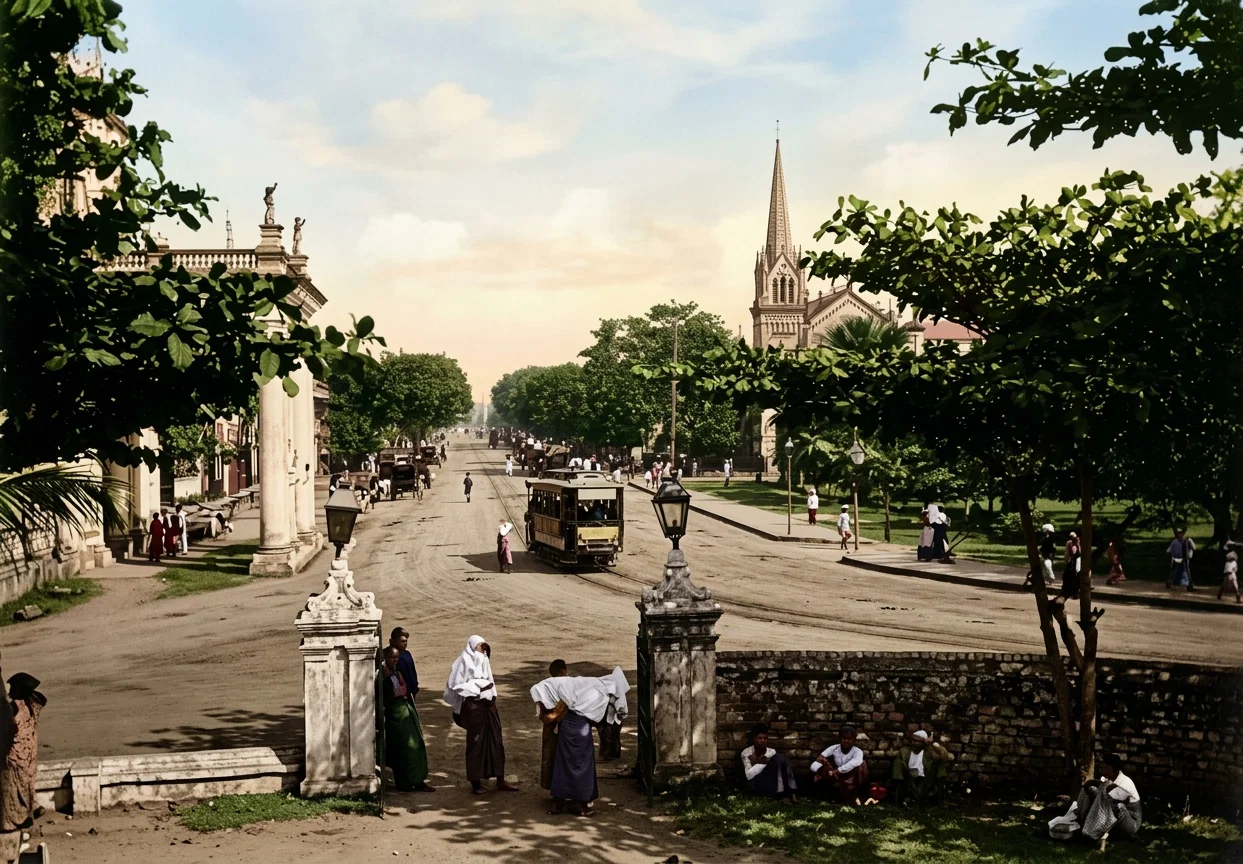
After a three days’ voyage across the Bay of Bengal, I reached Rangoon, Burma, eight hundred miles from Calcutta. In pleasant weather this is an enjoyable trip, and the mild sea breeze offers a welcome change from the stifling heat of the Indian plains. Rangoon, the largest city of Burma, has a population of about two hundred and fifty thousand, and is situated twenty-one miles from the sea, on the left bank of the Rangoon River. The Burmese claim that it was founded in 585 B. C., or during the Babylonish captivity, but have no proof save a legend for their assumption. Up to 1852 it was very small, but since that time it has been in British possession, and has grown rapidly. The streets differ from most Oriental roadways, being broad, and running at right angles. The houses are mostly made of teak, a wood resembling walnut, which grows in abundance in Burma, and forms one of the chief exports of the country.
The awful plague of India has never obtained a foothold in Rangoon, owing to the stringent regulations enforced. Upon the arrival of our boat in the river, a gentleman and a lady doctor came on board and examined every passenger. All natives of India, of whom there were about seven hundred, were sent to a segregation camp to remain ten days. I, with other European passengers, was allowed to land, but was required to report for examination daily for ten days, at the Municipal Health Office. It affords a source of relief to be outside of the area infected by plague.
The Burmese differ from the Indians in race, religion, language, and color, belonging as they do to the Mongolian race. They have a slight Chinese resemblance, though they differ from them in habits and customs. The caste prejudice, so strong in India, is far less perceptible in Burma. The people are open-hearted and very liberal. It is said on good authority that a traveler can go from one end of Burma to the other without a pice (a half cent). They gladly share with others, thinking little of the morrow. Generosity is a part of their religion, and to turn a hungry stranger from their door is thought by them a great sin. The Buddhist priests, of whom there are many, receive all their food from the people. Every morning dressed in their yellow robes, and with their bowls for food strapped in front of them, the priests may be seen passing by the houses. They do not ask for food, but are supposed to confer a great favor upon the giver by allowing him to give them food. Buildings called monasteries are also built for the priests and for others who need shelter.
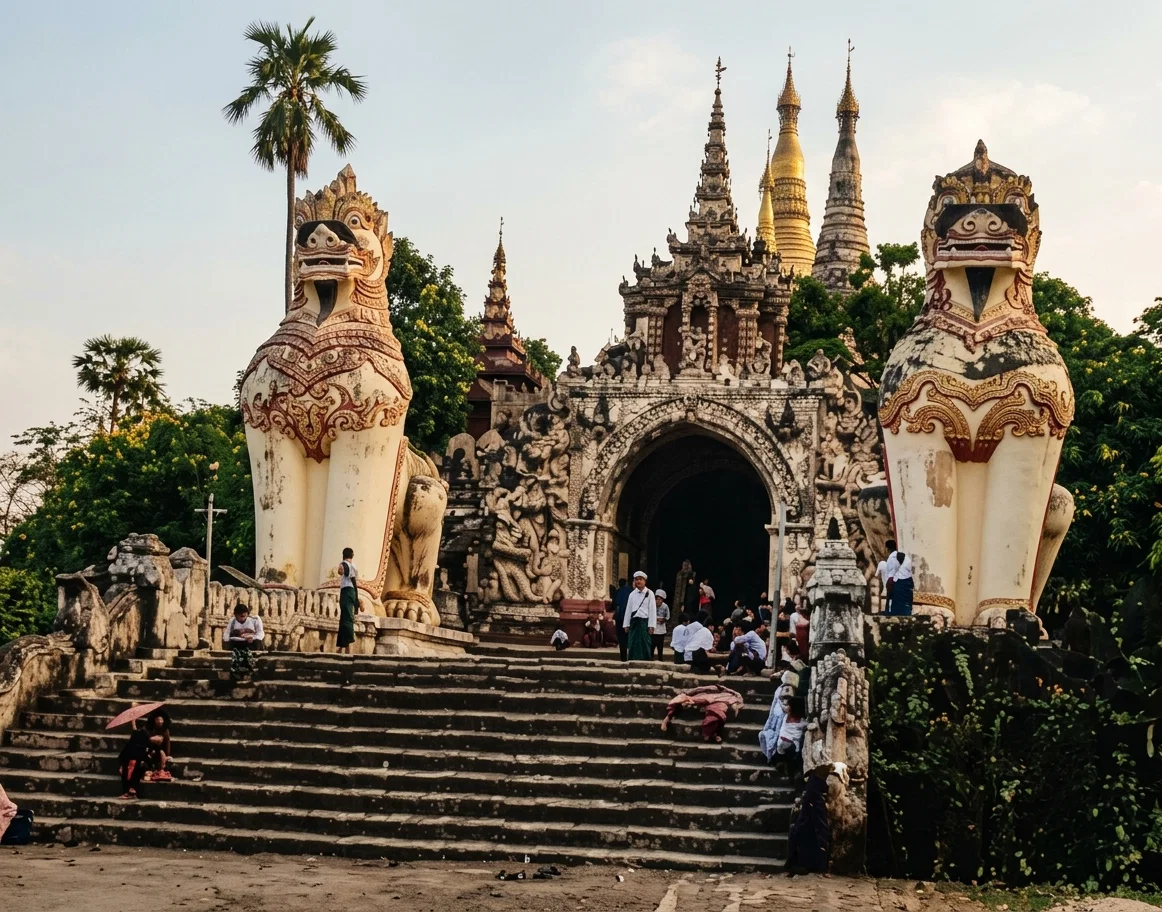
In different parts of the city are high spire-shaped monuments called pagodas. To these the Burmese go to worship Buddha. Some of these are over three hundred feet in height, and are covered wholly or in part with gold leaf, which glistens in the sunlight. It is said that every village in Burma has one or more large or small pagodas. In the foundation of each, some of the personal remains of Buddha are supposed to be buried; and like the popish relics of the cross, there are probably enough so-called remnants from Buddha to make many Buddhas. I visited one of these shrines called Shway Dagohn Payah, the largest in Burma, being three hundred and seventy feet in height, a little higher than St. Paul’s Cathedral in London, with a perimeter at the base of thirteen hundred and fifty-five feet. In the massive foundations are said to be one tooth and a few of Buddha’s hairs, placed there at the time of its erection, which took place in 588 B. C., according to the claims of Buddhists. The larger part of this structure is covered with gold leaf. One of the kings of Burma, toward the end of the eighteenth century, used his own weight in gold toward this purpose. Around the base of the pagoda are many images of Buddha, which mostly represent him in a sitting posture, with legs and arms folded, devoutly meditating. Many of these are covered and recovered with gold. My guide, to show how lavish his people are with their gold upon their god, rubbed from off a gold-be-daubed idol an appreciable amount, and placed it in my hand.
Before these idols are a multitude of people repeating prayers and counting beads, and offering sacrifices, which usually are candles. These are lighted and placed before the image; and being many, the odor and the appearance are very unpleasant. By itself is a large chest to hold gifts. On some occasions it is said that Buddha’s followers fairly rain their gifts of gold into this receptacle. When heathens pour out their offerings with such a lavish hand, what ought Christians to do?
I found Brethren Meyers and Watson of good courage in the work. They have sold a large number of books, and taken a goodly number of subscriptions for The Oriental Watchman. This literature has been having an effect upon the people, and so keen was the interest that meetings were started, and Brother Meyers soon found his time occupied in explaining the truth. I do not know that I ever saw people who were more anxious to study the Bible than were those I met at Rangoon. They never seemed to tire of the Word, and often our studies continued till eleven and twelve o’clock at night.
A STREET IN RANGOON
Among other interesting cases was that of a Burmese sister who has been keeping the Sabbath for two years. She has for years been a Bible student, and because14of the plain instruction found in the Word, began keeping the Sabbath. She tried in vain to get her family and friends to join her in obeying God, but they would not give heed. She told us that she determined to die rather than give up, though she did not know but that she was the only Sabbath keeper in the world. When she learned that we were teaching the same thing, she came to us with glad heart to listen, and drank in the truth eagerly. Though not able to express herself in English, she understands what is said to her; and being familiar with the Bible, she can turn from one place to another, and find words to express her ideas. She asked us whether we gave the servants rest on the Sabbath, and referred to the commandment; and she also wished to know whether we built a fire or did any cooking on the Sabbath, referring us to Ex. 16:23. Her mother was a convert of Judson’s, and she herself was baptized about thirty years ago. Since then she has given most of her time to Bible study and work for others, preferring an unmarried life that she might be entirely free to study the Word and teach it to others. With her knowledge of the Bible, her warm heart of love for others, and the influence she has among those who know her, she may be a great blessing to the Burmese in imparting to them the knowledge of the truth. Thus we see that the Lord is going ahead of us to prepare the way, and is raising up Sabbath keepers before we get into the field.
Burma, with its eight million souls, is open for the third angel’s message. In many respects the outlook is more favorable than in India. The caste prejudice is less; the women are free from the seclusion of the zenanas, and the language is said to be far more simple. A worker should go to this field at once to learn the language and assist the laborers there in pressing forward the work laid down by Judson so many years ago.
ENTRANCE TO SHWAY DAGON PAYAH
Religion in the Philippine Islands
By Curtin G. Roop
Rev. Curtin G. Roop, in The Missionary Review of the World
(Concluded)
WITH four hundred soldiers, Legaspi conquered the Philippines for Spain, 1565-71. The conquest, however, was actually accomplished more by the Augustine missionaries accompanying the expedition than by the military force. The natives being without deep-rooted religion, and the Tagalogs especially being of a tractable disposition, they were easily won by the placid persuasion of the friars and the ceremonial trappings of Spanish Catholicism. A traveler of the time writes that no town resisted conversion, and there were not priests enough available to baptize and shepherd the converts. The Inquisition, having headquarters in Mexico, kept its commissioners in the Philippines, but never found it necessary to exercise severities against the natives. The first preachers were Augustine friars; following them came the Franciscans, Dominicans , Jesuits, and bare-footed Augustines. For thirty or forty years the religious affairs of the islands were under these orders, after which they were placed under the organized administration of secular clergy subject to an archbishop at Manila.
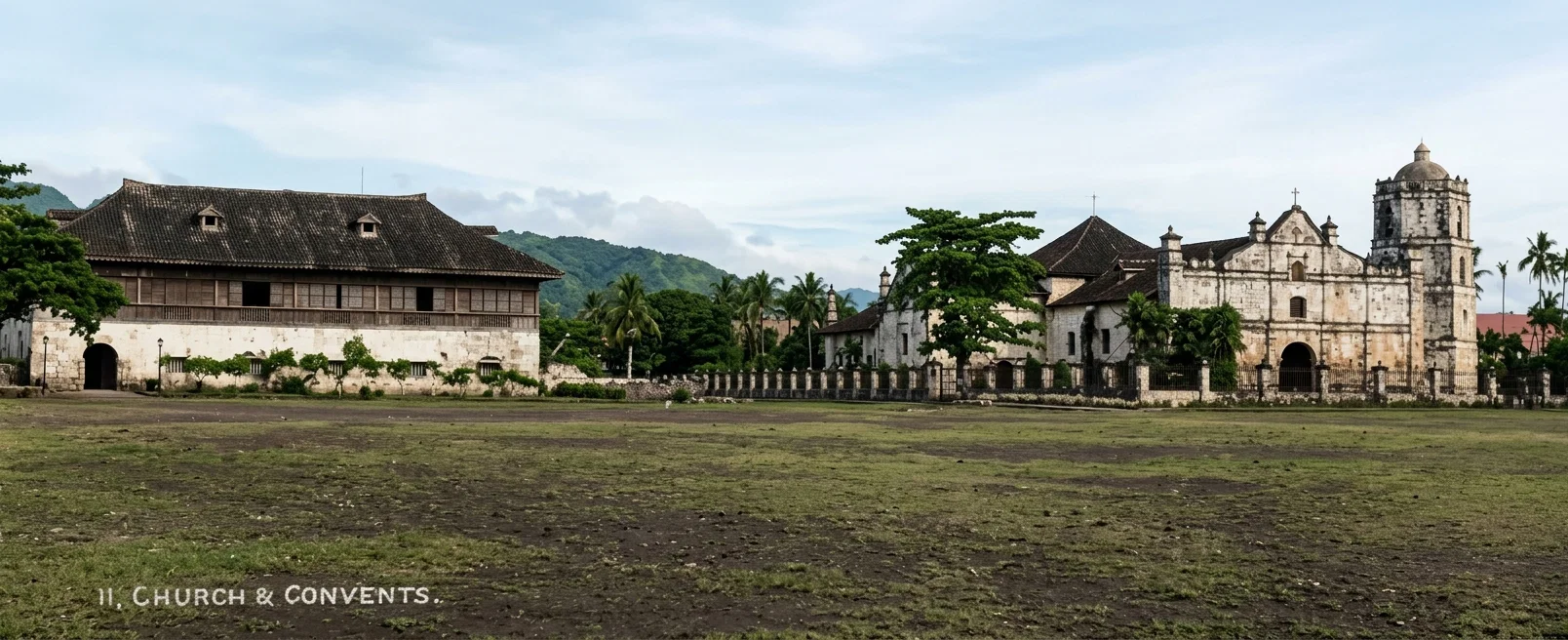
CHURCH AND CONVENTS, CEBU, P. I.
The converts from the first till now have grasped only the form of Christianity, not its substance. They attend church on Sunday; they celebrate religious festivals with music, illuminations, and fairs, exploiting relics and trinkets for sale. Outward observance they exaggerate. For instance, on some of the days of the week preceding Easter not a vehicle is allowed to appear on the streets of Manila. They confess; they take sacrament once a year at least; and some, especially women, spend one half of their time between Mariolatry and the confessional. But, withal, in matters relating to the spiritual and ethical substance of Christianity they are but children. For instance, a milkman was accused by one of his customers with having watered the milk brought; when hard pressed, he confessed, but pleaded that he had diluted it with holy water. Thus he felt guilty in the act, but strangely confused Christianity and ethics. So do the people in general fail to absorb the spiritual and ethical essence of Christianity.
Moreover, a deep substratum of primeval superstition underlies their conventional Christianity. Illustrations of this fact abound. For instance, the Tagalogs, the most advanced tribe, believe to this day in an evil divinity, Tic-Balass, dangerous to the man who does not respect him nor carry herbs about himself. Every time an Indian passes beneath one of the large fig trees, believed to be the favorite dwelling place of this divinity, he makes a sign with his hand, and says, “Tavit Po” (By your leave, my Lord). Among them Assuan is another evil divinity still thoroughly and almost if not quite universally believed in. This divinity is believed to affect women unfavorably who are in child labor. At such times the Indian may be seen sitting astride his house, cutting and thrusting in the air, sometimes for hours, to drive away the Assuan. Among the Bicols, Christianized neighbors of the Tagalogs, Calapuitan (Lord of the Bats) is a much-regarded divinity. Bats being found in caves, the natives fear to enter there, and when they do so, are careful to respect Calapuitan by conforming all their movements and talk to this Lord of the Bats. For instance, they would not mention the torch they happened to be carrying except by the formula, “Lord Calapuitan’s torch.” The farther back into the interior, the more rife, of course, is primeval superstition. But even in the metropolis, Manila, it is only the small minority of Spanish and half-castes that are even relatively free from superstition.
As one goes far back into the interior, Christianity shades off into paganism, and some sections will be found where the two are blended. Thus there is not only variety but confusion of religions in the islands. For instance, there is a15small sect of pagan natives living on the slopes of the volcano Yriga, some of whom are criminal exiles from the villages, but more of whom have voluntarily withdrawn thither on account of aversion to the labor and conventionality of village life. These people, though pagans, yet decorate their walls with crucifixes as talismans. They say that if these crucifixes were not of some value, the Spaniards would not use so many of them. Similar confusion of paganism and Christianity is found among the Cimaronese, a tribe found in the central islands, who live not in villages, but independently in the forests. These pagan people have adopted a few Catholic forms. When, for example, according to their primeval custom, they make an offering of rice at each corner of the field after sowing, they use some Catholic prayers, which suit them just as well as their old heathen forms. They also occasionally have children baptized. Otherwise they are pagan. Among the Tinguanes an oath is administered to the head men, in some instances by the Spanish, as follows: “May a pernicious wind touch me, may a flash of lightning kill me, may the alligator catch me asleep, if I fail to fulfill my duty.” Thus paganism is retained, though Christianity is partially accepted. Shall we not say that many of the people, then, are Christian-pagan, and that not in transition, but in a fixed state, about as old as Spanish Christian occupation?
Confining ourselves to the purest general type of Christianity existing in the islands, we find the grossest admixture of superstition. The saints have been largely substituted for the old pagan anitos, or idols. Miraculous images, patron saints, marvelous shrines, etc., abound. The oldest miraculous image is the Holy Child of Cebu, reputed to have been found on the shore of the island of Cebu in 1565. It is said to be an image of the holy child Jesus. It is a wooden image fifteen inches long, with ebon features, and is kept in a strong-room in the Church of the Holy Child, on the island of Cebu. When exposed to view before the populace, it has the honors of field marshal accorded to it. During the annual feast held in its honor, January 20th, pilgrims from the remotest islands and from across the sea come to purify their souls at the shrine of the Holy Child. By far the most popular shrine, however, is that of the Virgin of Antipolo, now in the parish church of Antipolo, not far from Manila. This image was brought from Mexico by a governor-general of the islands. In the month of May thousands repair to this shrine. It is estimated that there is brought hither by devotees about thirty thousand dollars during the season of the pilgrimage. The history of the public celebrations of this image furnishes an extreme picture of superstition, not to say idolatry. The shrine business in general is quite attractive to enterprising priests, for it is about the most lucrative undertaking in the islands.
Patron saints also figure largely. The patron saint of Manila is St. Francis of Tears. Thereby hangs a tale. An image of St. Francis Assisi, kept in the house of a native near Manila, was seen to weep copiously, so that many cloths were moistened with its tears, while with hands outstretched for three hours it asked God’s blessing on Manila. Then, on closing its hands, it grasped a cross and a skull so firmly that these appeared to be one. Vows were straightway made to the saint, who was styled protector of the capitol. Thus the crassest superstition in the name of Christianity itself universally prevails.
The Christian church in the islands is administered by the Archbishop of Manila. He is a metropolitan, having authority over the Ladrones, Carolines, and Pelew Islands, besides the Philippines. The parish priest, however, is the chief factor in administration, both civil and religious. For two hundred years he was about the only tie in sympathetic touch with the people, and begets in them perfect submission to his authority, not to say superstitious reverence for him personally. There are, it has been estimated, about twelve hundred Spanish priests in the islands. Most of them have been educated in Spain, where they generally originate from the lower classes. Besides these there are native priests, who hold subordinate positions, and are very jealous of their Spanish superiors. This jealousy and division of feeling among the priesthood prevents consolidation of power in the islands, a thing which Spain has always guarded against.
Abuses in the religious administration are by no means lacking. Here might be mentioned the sale of indulgences for revenue; the dishonest and corrupting exploitation of shrines; the widespread licentious immorality of the priests; the suppression of intelligence; exorbitant burial and marriage fees, because of which natives must often beg to secure the burial of their dead—indeed, the dead are sometimes disinterred and thrown upon a bone heap because of failure of relatives to continue burial annuities. And large numbers of the people live in marriage relations without having their union solemnized by any rite, because of inability to pay the exorbitant fee of the priest. Much might be said, much has been written, concerning these abuses, and their sum total is perhaps the cause, together with oppressive taxation, of the late Philippine rebellion against Spanish rule.
In the southern islands, as has already been said, we find the Mussulmans in possession. When the Spanish arrived, some of the strongest chiefs here were already Mussulmans. It is supposed that this religion was originally brought to the islands by Arab missionaries. Simultaneous with the arrival of the Spanish in the north there came from Borneo a chief who afterward combined the Mohammedan powers in the south. About thirty or forty years later the Spaniards from Luzon in the north attempted the conquest of these Moslems in the south. The effort failed, and thus was begun a mutual warfare, largely piratical on the Moslem side, which lasted for two hundred and fifty years, or until the middle of the present century. Only within twenty-five years has the sovereignty of Spain been acknowledged in these southern islands, and then with the explicit proviso that the Moslems are not to be disturbed in their religion. The attempts of the Jesuits (who flourish mostly toward the south) to convert them to Christianity have all been futile, for the panditas (Moslem priests) and the Romish priests are equally fanatical. The Spanish from the first have found in these Moros, as they call them, peoples who, unlike the pagan tribes of the north before encountered and easily converted, had a deep-rooted religion of their own, and would not yield to be converted to Christianity. Only on the northern edge of the island, in Mindanao, has the Christian religion any hold at all. Here are found some Jesuit missionaries.
On the other hand, to say that this part of the archipelago is Mohammedan would be true in only a qualified sense. It is Mohammedan in the same sense that the northern part is Christian—namely, the coast and the towns are Mohammedan, but in the interior a variety and confusion of religion prevails, similar to that in the interior of the northern islands.
The customs and administration of the modified Mohammedanism of the Philippines are less clearly outlined by writers than are the practices of the Christianized portions of the islands. We learn, however, that each Friday is dedicated to worship. On this day the faithful are called to the temple by the beating of a box or hollow piece of wood. They here engage in modified forms of Moslem worship. At the beginning of each year and at important events they hold a very solemn ceremonial. The city of Sulu, on the island of the same name, is their Mecca, so to speak. The original Mecca of the Mohammedan world, however, claims their pilgrimages. Strangers are not allowed in the sultan’s mosque at Sulu, and, indeed, strangers are rarely found in the city. The higher clergy are represented by the sheriff, who has temporal as well as religious power. Pandita is the name for priest. He seems to be chief in his district, somewhat as the Spanish parish priests are in the north. He performs all the functions of the priest, receives the vows of the juramentados, and expounds to them the mysteries and glories of that better world whither they will go without delay if they die spilling Christian blood. These juramentados are persons who vow to die killing Christians, and believe that, meeting death thus, they will go to especial bliss. Having thus devoted themselves, they fall upon the first Christian they meet, and slay until slain. Besides the priestly offices already named, the pundita usually exercises the functions of physician in the community. The head of authority, however, in church and state, is the sultan of the Sulu Archipelago, who exercises absolute power. He, in turn, is said to acknowledge the sultan of Turkey as his superior.
A complete treatment of the religion of the Philippines requires the separate mention of the Chinese. They have always been in the islands, but with very few exceptions have not embraced the religion of their adopted soil. They have generally come as traders, bringing along with them their idol images as well as their wares. Indeed, it is thought by some writers that some of the images found on the seashore, and now exploited at Christian shrines, were lost at sea by wrecked Chinamen, and washed ashore.
Summing up the present religious state of the Philippines, we find in the northern three fifths of the archipelago, on the coast and extending inland, superstitious Roman Catholic Christians; in the deep interior, primeval native pagans, and intermediate conglomerates of religion; in the southern two fifths of the archipelago we find Mohammedanism, modified by Malay superstition; and, in the interior of Mindanao especially, aboriginal Malay paganism holds full sway.
Awakening to the Needs of the World
If the needs of the world do not stir you as they once did, you ought to be alarmed.
The Voice of the Stars
By Marion Lumley
THE cares of the day were over, And my spirit, somewhat depressed, In the calm of a summer evening Had sought to find a rest. As I watched the bright stars shining, Rich gems in an arch of blue, They whispered the sweet old story, That is still so strangely new.
Far, far away to the northward, With a clear and radiant light, Shone the star that guides the pilgrim Through the silent hours of the night. An emblem, methought, of Jesus, Who ever remains the same, Whose eye still guides the believer, Who trusts in his holy name.
There, too, hung the great north dipper, And it seemed to say to me, “Come, drink of the living water, That floweth so pure and free; The fountain is Christ, your Redeemer, Who suffered for all mankind, And they who drink of this water, Shall true refreshment find.”
The crown, in its regal beauty, Appeared in the western sky, And told how the Prince of heaven Once left his throne on high, To wear on his brow the thorn-crown, So great was his love for me, That I the crown of the righteous Might wear in eternity.
I looked at the sparkling sickle, And thought of the day to come, When, armed with his sickle, the reaper Should gather the harvest home. You may plant, and I will water, No labor shall be in vain, And the Lord of all the harvest Shall garner the golden grain.
I watched the stately Orion, With gleaming buckler and sword, And thought of the well-armed Christian, Whose sword is the Holy Word, Whose girdle is truth, and whose helmet The hope of salvation, free, Whose shield is faith; ’tis the armor, Dear Christian, prepared for thee.
I searched through all the heavens For an emblem of his love. Would I find it?— Yes, clear shining From the deep-blue arch above Were the seven little sisters, A fitting emblem were these; For seven, the perfect number, I found in the Pleiades.
Above me, belting the heavens, Stretched the beautiful Milky Way, Like the path by the Spirit lighted, That ends in eternal day. They come from the north, from the southland, From the far east, from the west, Who traverse the narrow pathway To the city of the blest,— The city whose hidden glories God’s children shall behold,— The throne, the river, the mansions, The streets of burnished gold. And the hand that leads them thither, A gate of pearl unbars: ’Tis the story breathed in the stillness Of the evening by the stars.
— Marion Lumley, in N. Y. Observer.
Trinidad, British West Indies
By W. G. Kneeland
OVER one year has passed since I was called to take oversight of the work in this island. At that time but little was being done by the canvassers, and the general impression was that the canvassing work was finished. With the assistance of Brother P. Porter, of Jamaica, a class of fourteen was gathered for a ten days’ drill. At the close of this meeting the field was divided systematically, and the canvassers were given their territory for work. From this time the canvassing work began to progress. Not all were successful, but the reports show that about forty-five hundred books and pamphlets containing more or less of the message for this time have been circulated, besides a large number of papers. About fourteen hundred of the books sold were one-dollar books, the financial condition preventing the accomplishment of much with the larger works.
During the past year one church building has been dedicated, and two others are nearing completion. We have also been able to pay for two church lots. One church has been organized, and a second is being developed as a result of the tent effort. Twenty-three persons have received baptism, and nearly as many more have applied for baptism at our next quarterly meeting. Not all of those who were baptized accepted the truth this year, some having kept the Sabbath for a longer time.
Since December, 1901, Brother George F. Enoch has taken charge of the tract society business, doing what church work he could in connection with his other duties. One native worker has been employed since February. The way has just opened for a native East Indian of some experience to devote his time the coming year to labor for his own people in the island. Another native brother, an ordained minister of the A. M. E. Church, has resigned his position, and will canvass for “Thoughts on Daniel and the Revelation” for a while.
Soon after the Martinique disaster our tract society printed a ten-thousand edition of a little tract, entitled “The Voice of the Volcano, or God’s Call to Repentance,” in which we endeavored to call attention to the meaning of these calamities. We also prepared a little tract on the “Coronation.” The sales from these two tracts has more than met the cost of publication.
From September 3–15 we held our second canvassers’ institute here at San Fernando. Thirty-six persons were in attendance regularly, and eighteen were assigned to some place in the field. Two will go to the neighboring island of Tobago.
While we are glad for what has been accomplished, yet we feel that only a small work has been done in comparison with what must be done before the Lord comes. Destruction and pestilence are17in the land, plainly revealing the fact that we have but a short time in which to rescue the perishing. May we be quick to seize the present opportunities before they pass, and give the warning message for this time. W. G. KNEELAND.
Carey's Reply: My Business Is the Kingdom
A CHARACTERISTIC story is told about Dr. Carey, the pioneer missionary in India, who, before he left this country, was a shoemaker, or, rather, as he himself put it, a cobbler. He used to go about from village to village preaching; for his soul was filled with the love of God. One day a friend came to him, and said, “Mr. Carey, I want to speak to you very seriously.” “Well,” said Carey, “what is it?” The friend replied, “By your going about preaching as you do you are neglecting your business. If you only attended to your business more, you would be all right, and would soon get on and prosper; but as it is, you are simply neglecting your business.” “Neglecting my business,” said Carey, looking at him steadily. “My business is to extend the kingdom of God. I only cobble shoes to pay expenses.” — Selected.