Your ShelfYour Projects

Signs of the Times, Vol. 30, No. 37.

The Joy of the Lord

Signs of the Times

Sep 21, 1904

Pacific Press Publishing Company · Mountain View, California · Sep 21, 1904

The Joy of the Lord.

“The fruit of the Spirit is love;” and “joy”—gladness, pleasure, delight, happiness, rejoicing, exultation in triumph—follows love. This is true joy.

Joy of the World.

Many rejoice, or have joy, in the lustful things of this life—some in riches, some in fame, some in pleasure, and all in man or some thing or things that man has done or may do. All this, apart from God, we are assured by the wise man, is “folly,” and “folly is joy to him that is destitute of wisdom.” The prophet declares that such “rejoice in a thing of naught;” hence, at the best, “the joy of the godless [is] but for a moment.” And this the children of earth know to be true. “Man that is born of woman is of few days, and full of trouble.” Pleasure is sought and followed as the little child chases the elusive butterfly, or the benighted traveler is led by the treacherous will-o’-the-wisp. The quest ends in weariness, tears, and utter disappointment, if not in the slough of despair and death.

Why?

Why the vain quests? Why the disappointed hearts? Why the sad, the discouraged, the pitifully drawn, the haggard, the sorrowful faces, which one continually sees, faces which rarely or never are lighted by joy? Is this God’s plan?—Nay; the cause is sin. Joy, true joy, is ever absent where sin reigns. In God’s perfect plan there was no place for sorrow, pain, death, disappointment, despair. All these came in with the usurper, sin. And in sin and through sin, which is the perversion of God’s way, we will never find joy; for sin is slavery, and there is never joy in bondage. Sin is death, and in death itself there is never true joy, but sorrow and despair. And yet, despite the sin, God has joy for the children who are subject to sin and sorrow. He has called them to joy.

Joy in God.

Even as love is from God, so is joy. Love comprehends all good things, and we have joy because we love. Whatever, therefore, brings love to our hearts brings joy. And in whatever love finds exercise there joy is found. First of all we joy in God because of His mercy toward us as sinners. Says the psalmist: “My heart shall rejoice in Thy salvation,” and the reason is, “I have trusted in Thy mercy.” “We also joy in God through our Lord Jesus Christ, by whom we have now received the reconciliation.” Rom. 5:11, margin. Joy comes, therefore through the mercy of God, which reconciles us to the Father.

How Reconciled.

God does not hate the sinner. He loves him in all his weakness, waywardness, and wickedness. God is not at enmity with us, but “the carnal mind is enmity against God; for it is not subject to the law of God, neither indeed can be.” But God in His great mercy and love gave His only-begotten Son to save the sinner, to reconcile the sinner to Himself. Nay, more; He gave Himself in that Son, that He might save man. “Hereby perceive we the love of God, because He laid down His life for us.” “God was in Christ, reconciling the world unto Himself, not imputing their trespasses unto them.” He took upon Himself in giving His Son, and that Son took upon Himself in giving Himself, the sin, the bruises, the wounds, the death, the misery, the sorrow, that we might have the joy. “He was wounded for our transgressions; He was bruised for our iniquities; the chastisement of our peace was upon Him, and with His stripes we are healed.”
It is by such love, such mercy, that God reconciles us to Himself; it is that such love, such mercy, may lead the sinner to renounce the carnal heart, renounce in himself all that is unlike God, and yield himself to the ways of eternal love and joy. For God knows there is no other way by which the sinner may be made to rejoice. The way of sin tends ever to death. God’s way is eternally good and righteous. He has in Christ Jesus forever reconciled all sinners to that way. It is for the sinner to accept the mercy which has thus wrought for him, and rejoice, or reject it and die. O, is it not joy to have sins forgiven? Is it not joy to know that Jesus paid all the debt, bore all the sin? Is it not joy to know that this mercy is “for me, even me?” This is the joy of faith, of simply believing in Jesus, “whom having not seen, ye love; in whom, tho now ye see Him not, yet believing, ye rejoice with joy unspeakable and full of glory.”

Rejoice in What?

In what may the forgiven sinner rejoice?—In the righteousness of God. It is not God’s plan to simply forgive, to make of no account the sins of the past; but to account the believer as righteous, even with the righteousness of God: “He shall pray unto God, and He will be favorable unto him; and he shall see His face with joy; for He will render unto man His righteousness.” Surely to one who comes into God’s presence, knowing that upon him is the righteousness of God, there is reason for joy. Upon him is the beauty of holiness. It is his privilege to say, “I will greatly rejoice in the Lord, my soul shall be joyful in my God; for He hath clothed me with the garments of salvation, He hath covered me with the robe of righteousness.”

Rejoice in Freedom.

The sinner is a slave. “Every one that committeth sin is the bondservant of sin.” R. V. He is bound or “holden with the cords of his sin.” Of all the dread bondage that earth has known, sin is the greatest. It is the blighting, blasting, blinding bondage of death. It oftentimes deceives as it destroys, and its poor dupe believes himself in freedom when he is in the most hopeless bondage. Yet God in mercy does not suffer sin’s deadly opiate to ever bemumb conscience and heart. The sweet and mighty voice of the Spirit in various ways breaks through the hardness of sin and whispers to the soul of his fearful bondage, and points him to the Deliverer, the Son of God. It says: Poor prisoner of sin, your pardon has been purchased by Jesus Christ. Your eternal freedom has been secured in Him: “If the Son therefore shall make you free, ye shall be free indeed.” How the poor slave in many a land has rejoiced to hear at the voice of freedom his fetters break and fall. Shall not we, dear reader, the born bond-slaves of sin, rejoice with joy unspeakable at the freedom which comes through Jesus Christ? We are still mortal, environed by countless limitations, hindrances, difficulties, sickness perhaps, ruled over by tyrants, but the freedom of Jesus Christ lifts us above all these; for “we know that to them that love God, God worketh all things with them for good.” R. V., margin.

Rejoice Always.

“Rejoice in the Lord alway.” “Rejoice evermore.” Reader, in all things rejoice. In common air, in common rain, in common sunshine, in all the blessed common things of life, in the gifts of the great and merciful and kind God of all grace, rejoice. “Count it all joy when ye fall into divers temptations,” because therein ye may “rejoice in His salvation.” In this, as with Jehoshaphat of old, praise will glorify God, will bring back to you the power of God, and you will find, as has ever been found, that the “joy of the Lord is your strength.” In searching His word you will say with Jeremiah, “Thy word was unto me the joy and rejoicing of mine heart; for I am called by thy name; O Lord.” As you obey that word with all your heart, you will find that “it is joy to the just to do judgment;” and you will find verified the scripture: “Thou meetest Him that rejoiceth and worketh righteousness, those that remember Thee in Thy ways.” If persecutions come, therein “rejoice, inasmuch as ye are partakers of Christ’s sufferings.” If you are poor, let meekness and teachableness reign in your heart; for “the meek shall increase their joy in the Lord, and the poor among men shall rejoice in the Holy One of Israel.” The poor, the outcast, the despised of men may rejoice. Yea, “let all those that put their trust in Thee rejoice; let them ever shout for joy, because Thou defendest them; let them also that love Thy name be joyful in Thee.” And whatever may come, the Christian may say:—

The Nature of True Joy.

But the truest, highest joy never comes from seeking the joy. God could not have it thus, because the very seeking would develop sin. If we could get joy by seeking it, it would make us selfish. The joy of God comes because we forget self, and labor for others. “Joy shall be in heaven over one sinner that repenteth.” “The joy that was set before” Christ, which cheered Him in all His labor, was the joy of souls saved in His kingdom, upon which He will then look, and “be satisfied.” This is the joy of the people of God, to turn from self and “declare His works with rejoicing;” for “the voice of rejoicing and salvation is in the tabernacles of the righteous.” The righteous will love God’s law; for “Thy testimonies have I taken as an heritage forever; for they are the rejoicing of my heart.” John the Baptist saw his own prestige and popularity waning before the presence of Christ, yet he could say as he saw Christ’s glory, “This my joy therefore is fulfilled.” Laboring for Christ’s sake, for the purchase of His blood, laboring in His way, in His truth, this is joy. And yet the servant of God will find cause of weeping. Sorrowing hearts, wounded hearts, cold hearts, hard hearts set against the message that would save, the whelming sin and evil of the world, the backsliding of God’s professed people, are all a cause of sadness and sorrow; yet God is faithful; in Him he can rejoice. “Sorrowful, yet always rejoicing.” “Poor, yet making many rich.” This is his work, even as it was Christ’s. The child of God can not compel faith on the part of others; for faith is voluntary. He will not, therefore, rejoice in a political or coercive religion. “Not that we have dominion over your faith, but are helpers of your joy; for by faith ye stand.”

There is joy in God,

joy that man can not give nor take away,—joy unspeakable and full of glory. And so, believing, praying, seeking, trusting, laboring, yea, weeping, in the joy of our Lord, the Christian pursues the path of Christ. He drinks of fountains of joy of which the world never tasted. His heart is lighted with a radiance which the eye of earth-life never knew. He holds a sweeter communion with the King of kings than lover’s most precious tryst. In darkness there is light; in sorrow, joy. And thus he goes on in ever-increasing joy at finding greater and more abundant proofs of God’s wonderful love, until, at last, the work is over, the children all come home, sorrow and pain and death and sin are banished by the presence of the Lord, where is “fulness of joy,” and at whose “right hand are pleasures forevermore.” O reader, this is the joy which God offers you. Will you not be among “the ransomed of the Lord,” who will “come to Zion with songs and everlasting joy upon their heads”? Thus doing, we may commend you “unto Him that is able to keep you from falling, and to present you faultless before the presence of His glory with exceeding joy.”

DOUBT NOT GOD'S PARDONING LOVE.

BY MRS. E. G. WHITE.
"BE ye therefore perfect, even as your Father which is in heaven is perfect." As our heavenly Father is perfect in His sphere, so also those for whom Christ died are to be perfect in their sphere. "For God so loved the world, that He gave His only-begotten Son, that whosoever believeth in Him should not perish, but have everlasting life." We are to believe in salvation through Christ, and make manifest that faith in our life, not by our own strength, but by trusting in the strength and efficiency of Christ. "In this was manifested the love of God toward us, because that God sent His only-begotten Son into the world, that we might live through Him." "Who hath saved us, and called us with an holy calling, not according to our works, but according to His own purpose and grace, which was given us in Christ Jesus before the world began; but is now made manifest by the appearing of our Saviour Jesus Christ, who hath abolished death, and hath brought life and immortality to light through the Gospel."
The Lord wills not the death of any sinner, but that all should come to repentance. His mercies are without number, and He will not leave those for whom He has given the ransom of His life to become the sport of Satan's temptations. All heaven is given to those who believe in Jesus Christ as their personal Saviour. No soul can more dishonor God than by professing to believe in Christ, and yet go in mourning and sorrow to present to the world the aspect of orphans. "The Son of Man is come to save that which was lost. How think ye? if a man have a hundred sheep, and one of them be gone astray, doth he not leave the ninety and nine, and goeth into the mountains, and seeketh that which is gone astray? And if so be that he find it, verily I say unto you, he rejoiceth more of that sheep, than of the ninety and nine which went not astray. Even so it is not the will of your Father which is in heaven, that one of these little ones should perish."
The Lord does not leave His wounded and bruised sheep to the power of Satan to be torn to pieces. He is ever strengthening His own in their weakness. He delivers those who are tried and tempted from the power of Satan. The Lord never forsakes the soul that puts his trust in Him. Those who claim to be the sons and daughters of God must trust always in Jesus. To do otherwise is to disown the fact that He loves us. When we go mourning and full of depression, covering ourselves with the garments of heaviness, we represent Christ to the world as a hard, tyrannical Master. But this is untrue. This is misrepresenting the One who gave His own life for us, that He might make it possible for us to believe in Him, and trust in His interest and love for sinful man. "He shall deliver the needy when he crieth; the poor also, and him that hath no helper." Speaking of His watchful care over us, He says, "I the Lord do keep it; I will water it every moment; lest any hurt it, I will keep it night and day."
What great injustice is done to the Saviour, who gave His life for us, when those who profess to believe in Him walk in the shadow of darkness, Jesus has said, "He that followeth Me shall not walk in darkness, but shall havethe light of life." If you have been walking in darkness, you have been following another leader than Jesus, and it is time for you to turn about and follow Jesus, the Truth, the Life, the Way, and the Light of the world. Is the Lord pleased to have you tossed about as the restless waves of the sea?—No, no. I tell you He wants you to be strengthened, stablished, rooted, and grounded in the truth, and built up in the most holy faith. You are not your own; you are bought with a price, which can not be estimated. You belong to God, the mighty God, bought with the price that was paid for you on Calvary's cross. Then when you keep yourself in a state of fluctuating fear and doubt, you grieve the heart of Christ, who has given you unmistakable evidence of His love, and of His desire to have you with Him in His kingdom. He says, "Ye have not chosen Me, but I have chosen you, and ordained you, that ye should go and bring forth fruit, and that your fruit should remain; that whatsoever ye shall ask of the Father in My name, He may give it you."
Do not lose sight of Jesus, and separate from His companionship, and keep company with the prince of darkness, entertaining his suggestions, and heeding his directions, and acting out his plans. Cling to Him who has promised, "I will never leave thee, nor forsake thee." That you should take up with Satan, the apostate and traitor, and do after his works, after you have had a knowledge of Jesus Christ, is a mystery to the universe of heaven.
Let no Christian seek to excuse himself in sin on the ground that others who have claimed to follow Jesus have committed the same errors. Your sin is none the less heinous because others have been guilty, and your manifest duty is to confess your sin to Jesus Christ, your Intercessor. Take the weight of your wo to no human being. You have one Mediator, Jesus Christ, the Righteous. In contrition of soul go to Him and tell all your sins. The promise is sure, "If we confess our sins, He is faithful and just to forgive us our sins, and to cleanse us from all unrighteousness." John says: "My little children, these things write I unto you, that ye sin not. And if any man sin, we have an Advocate with the Father, Jesus Christ the righteous." "That ye sin not"—here is where you bring yourself into condemnation when you continue to sin. But in the strength of Christ cease to sin. Every provision has been made that grace should abide with you, and that sin may appear to you the hateful thing it is. But if any man sin, he is not to give himself up to despair, and talk like a man who is lost to Christ. "If any man sin, we have an Advocate with the Father, Jesus Christ the Righteous. And He is the propitiation for our sins; and not for ours only, but also for the sins of the whole world."
The temptations of the enemy will come, but shall we give him the advantage to break down all the barriers, by yielding one iota from the strictest principles of integrity? If we yield in the least, he will follow one temptation with another, until we shall go directly contrary to the plainest statements of the word of God, and follow the mind and will of Satan. Satan and his confederacy of evil angels are ever on the alert to see by what means they may ensnare and ruin souls who have enlisted under the blood-stained banner of Prince Emmanuel. You did run well for a season, you did taste and see that the Lord is good, but when you fell into sin you walked in darkness. When you yielded to temptation, you must have ceased to look unto Jesus, the Author and Finisher of your faith. But, having confessed your sins, believe that the Word of God can not fail, but that He is faithful that hath promised. It is just as much your duty to believe that God will fulfil His word, and forgive your sins, as it is your duty to confess your sins. You must exercise faith in God as in one who will do exactly as He has promised to do in His Word, and pardon all your transgressions.
How may we know that the Lord is indeed our sin-pardoning Redeemer, and prove what is the blessedness, the grace, the love there is in Him for us? O, we must believe His Word implicitly, with contrite and submissive spirit. There is no need to go mourning and ever repenting, and under a cloud of continual condemnation. Believe the word of God, keep looking unto Jesus, dwelling upon His virtues and mercies, and there will be created in the heart an utter abhorrence of that which is evil. You will be among those who hunger and thirst after righteousness. But the more closely we discern Jesus, the more clearly we shall see our own defects of character. As we see our failings, let us confess them to Jesus, and, with true contrition of soul, co-operate with the divine power of the Holy Spirit to overcome all evil. If we confess our sins, we must believe that they are pardoned, because the promise is positive: "If we confess our sins, He is faithful and just to forgive us our sins, and to cleanse us from all unrighteousness." Let us no more dishonor God by doubting His pardoning love.

Rejoicing in the Lord

"For tho the fig tree shall not blossom, Neither shall fruit be in the vines; The labor of the olive shall fail, And the fields shall yield no meat; The flock shall be cut off from the fold, And there shall be no herd in the stalls; Yet I will rejoice in the Lord, I will joy in the God of my salvation. Jehovah, the Lord, is my strength."

"I HAVE GONE ASTRAY."

BY T. E. BOWEN.
As David viewed the perfectness of God and His wonderful law, which is also perfect, being the transcript of its Author’s perfect character, he bursts forth with the exclamation concerning himself, "I have gone astray like a lost sheep; seek Thy servant; for I do not forget Thy commandments." Ps. 119: 176. With the psalmist, we all have strayed like lost sheep. Thinking some other path better, or seeming not content with the quiet of the fold, we have wandered away, and in the thicket of sin become bewildered and lost.
The comparison is an apt one. "Astray like a lost sheep." When a sheep gets lost, it is difficult to find a more helpless creature. Perfectly bewildered, it is as liable to go in the opposite direction from that it should go, as to go toward its home. Then it keeps up a continual bleating, calling attention to itself that it is lost, and thus only increasing its own danger by making of itself an easy prey for some lurking foe thirsting for its life-blood. And, further, a sheep has no means of self-defense.
Thus helpless and lost is every soul outside of the fold—Jesus Christ. The first ray of hope is found in the realization by the lost one that he is lost. Sensing this terrible fact, he is then ready to call out for help. He is ready then to put up the earnest plea toward heaven, "Seek Thy servant." To Him who has known all the time the wretched, lost condition, this cry for help comes like sweetest music. "Does God hear?" queries some trembling heart. "Will He care for me?" Ah! dear soul, He that has been longing after thee with longings only faintly illustrated by the yearnings of a precious, faithful mother over the wandering son of her love, doubt not but that He hears your first faint cry for help. In His wisdom He may test you. He may prove for your own good the sincerity and earnestness of your desire to be delivered, but be assured He hears you, and will deliver you if you but yield yourself to Him.
How may one know He hears, and will provide deliverance? In the thicket of sin we have simply lost the path of God’s commandments. Disobedience perhaps at one time seemed a trifling matter. But when you awake to the realization that you are left to perish by yourself, alone, then disobedience does not seem so sweet, and you long for the right way. Then, like David, you "do not forget" God’s commandments. If you do not forget them, they are in your mind, you remember them. Perhaps those dear mother lips that taught you these blessed commandments have been stilled in death. Anyhow, you remember these words of life, and, through these, that gentle Hand that for your sake was pierced by the thorns, guides you tenderly back to His fold.
Reader, have you strayed away from Christ in the hope of enjoying the "pleasures of sin for a season"? Have you realized all that for which you have sought? Are you beginning to sense the bitter thought that you are lost? Already your feet may be upon the very brinkof certain death—yes, that awful chasm of eternal death—and would it not be well to pause a moment and listen for the loving call of One who loves you so much that "He gave His only-begotten Son" for you that you "might not perish but have everlasting life"? May eternity reveal that you have put up the earnest prayer to God, Lord, "seek thy servant," and have been rescued.

LIGHT IN THE DARKNESS.

BY J. L. SHULER.
THE Apostle Peter says we should give heed to prophecy as unto a light shining in a dark place. The effect of light is to banish darkness. If one were traveling in a dark place, it would be necessary in order to see the path more clearly to have a light shining at his feet. In the Scriptures, the present age of this world is represented as night or darkness. Says Paul, "The night is far spent, the day is at hand; let us therefore cast off the works of darkness, and let us put on the armor of light." Rom. 13:12. "For, behold, the darkness shall cover the earth, and gross darkness the people." Isa. 60:2.
The present age is night, because the darkness of sin covers the people. Just before the end the darkness will be intense, as the Scripture says, "Evil men and seducers shall wax worse and worse, deceiving, and being deceived." 2 Tim. 3:13. In the last days scoffers are to arise (2 Peter 3:3-5), perilous times to come (2 Tim. 3:1-5), iniquity to abound (Matt. 24:12), and false christs, false prophets etc., are to appear (Matt. 24:23-27).
The world never was in more gross darkness than at the present time. Now, as never before, the prophetic Word is as "a lamp unto my feet, and a light unto my path." It is our only guide in the darkness, discovering to us the correct path. The study of prophecy should by no means be neglected; for whosoever takes heed to the sure word, his path will be "as a shining light, that shineth more and more unto the perfect day." Prov. 4:18.
Thus it is seen that the Bible, especially its prophetic portions, will be made more and more manifest, as we pass along, showing to the student that he is in the path that leads to the eternal day. David says, "The entrance of Thy Word giveth light." To reject or neglect to study the prophecies will leave us in darkness. Christ says, "Walk while ye have the light, lest darkness come upon you; for he that walketh in darkness knoweth not whither he goeth." John 12:35. Then how true are the words of the Apostle Peter, that we "do well" to "take heed" unto the "sure word of prophecy," as "unto a light that shineth in a dark place, until the day dawn, and the day-star arise in your hearts."

THE OCEAN OF LIFE.

BY KATHRINA BLOSSOM WILCOX.
WE stood that beautiful June afternoon on the long beach of the broad Pacific, whose ever-restless waves, crowned with white foam, break with never-ceasing fury upon the cold, gray stones of the rugged cliffs, then, kissed by sunbeams, leap into the air, reflecting in their sparkling spray the seven colors of the rainbow.
Such a scene filled us with awe and admiration, and we were led to exclaim, Roll on majestic ocean! Roll on, thou mighty deep, ever bespeaking in thy unsurpassed grandeur the glory and majesty of thy Creator!
As we gaze upon the surging billows, a white speck appears on the horizon. Nearer and nearer it comes until we recognize a large and beautiful ship with her white sails all spread to catch the merry breeze which gently bears her over the rippling waves to her desired haven.
She has come from a far-distant port, and has encountered fierce winds and heavy storms. Her passengers are weary with their long and perilous voyage, and long to place their feet on solid ground once more. But now the storms are all past, the journey will soon be over, and the storm-tossed vessel, with decks drenched and bulwarks beaten, will soon be safely anchored in the peaceful harbor.Ah! what a fitting symbol of the journey of life! As our frail barks are launched upon life's ocean, already strewn with many a shipwreck, to battle with howling winds and fearful tempests, how will it fare with us? Will we be stranded on the shoals of error and delusion? Will our captain prove false, our compass fail, or our guidebook disappear?
O beware, of the rocks and shoals. Beware of the artful siren, who seeks, by her most enchanting strains of enticing music to lure the passers-by from their course! Beware, O beware!
But, if we are led astray, is there no hope? Must we be tossed hither and thither in the tempest, by the cruel waves, or sink beneath the deep, dark waters, a prey to that hideous monster, Death?—Ah, no! Not so with the Christian. His Father is at the helm. No matter how fiercely the storm is raging, His "peace be still," quiets the surging billows and allays his fears. The great Guidebook—God's holy Word—a beacon light to the wandering mariner—guides his frail bark safely past the dangerous rocks, away from the enchanting siren's notes, on and on, through storm and calm, until he drives safely into port.
O friend, commit your bark into the care of the great Helmsman. Look out over the stormy waters and see the Pilate of Galilee stretching out to you a welcoming hand—"then your vessel shall in safety outride the storm, and enter in triumph the haven of eternal rest."
SEARCH THE SCRIPTURE

JOB.

THIS, the first of the so-called poetical books of the Bible, has a special and peculiar interest for the student of Holy Writ. It seems to have been written in the patriarchal age, probably by Moses. That Job was a real person, and that the history we have concerning him is not, as some consider it to be, a fiction, but a truthful account, we have proof in both the Old and New Testaments. In Eze. 14:14, 20, he is mentioned as being as veritably an actual person as were Noah and Daniel. “Tho these three men, Noah, Daniel, and Job, were in it, they should deliver but their own souls by their righteousness, saith the Lord.” So, as surely as there was a Noah who built an ark, and a Daniel who was in the lion’s den, just so surely there was a man in the land of Uz whose name was Job.
The testimony of James is no less positive. “Ye have heard of the patience of Job, and have seen the end of the Lord; that the Lord is very pitiful, and of tender mercy.” James 5:11. We see by this that not only did such a man as Job live, but also that the history concerning him is correct. We see also the purpose of the book. It is to show the mercy of God, and the patience of His servant Job, a noted example indeed.
In the study of this book we have one of the best of opportunities for putting in practise the directions, found in 2 Tim. 2:15, “rightly dividing the Word of truth.” Serious errors are sometimes adopted, because persons fail to observe this rule. We want to divide the Word along the line of authorship. There are over a half dozen different speakers whose words are recorded in this book. These speakers are the Lord Himself, Job, Eliphaz, Zophar, Bildad, Elihu, Job’s wife, and Satan. Consequently the statements found in the book will be of different degrees of reliability. If we should indiscriminately take passages from this book, without regard to the author or speaker, we might make some serious blunders. This book is not one homogenous mass of utterances, but a compilation of statements from different sources. But the Lord has not left us in ignorance in the matter, so that we need make any mistake. In his reproof administered to Eliphaz and his two friends, the Lord said: “Ye have not spoken of Me the thing that is right, as My servant Job hath. . . . My servant Job shall pray for you; for him will I accept; lest I deal with you after your folly, in that ye have not spoken of Me the thing which is right, like My servant Job.” Ch. 42:7, 8.
The Septuagint reads in verse 8, “Ye have not spoken the truth against My servant Job.” So those men failed to tell the truth about God, and also about Job. Shall we then take their words as reliable, when God has told us they are not reliable, not the truth? If they did not come any nearer telling the truth about God than they did about Job, they must have missed the mark very far. Notice what they say about this perfect man in ch. 22:5-9: “Is not thy wickedness great? and thine iniquities infinite? For thou hast taken a pledge from thy brother for nought, and stripped the naked of their clothing. Thou hast not given water to the weary to drink, and thou hast withholden bread from the hungry. . . . Thou hast sent widows away empty, and the arms of the fatherless have been broken.” As a rejoinder to this calumny, the accused patriarch feels compelled to vindicate his character in the following words, which set forth the real truth in the matter: “I delivered the poor that cried, and the fatherless, and him that had none to help him. The blessing of him that was ready to perish came upon me; and I caused the widow’s heart to sing for joy. . . . I was eyes to the blind, and feet was I to the lame. I was a father to the poor; and the cause which I knew not I searched out.” Ch. 29:12-16.
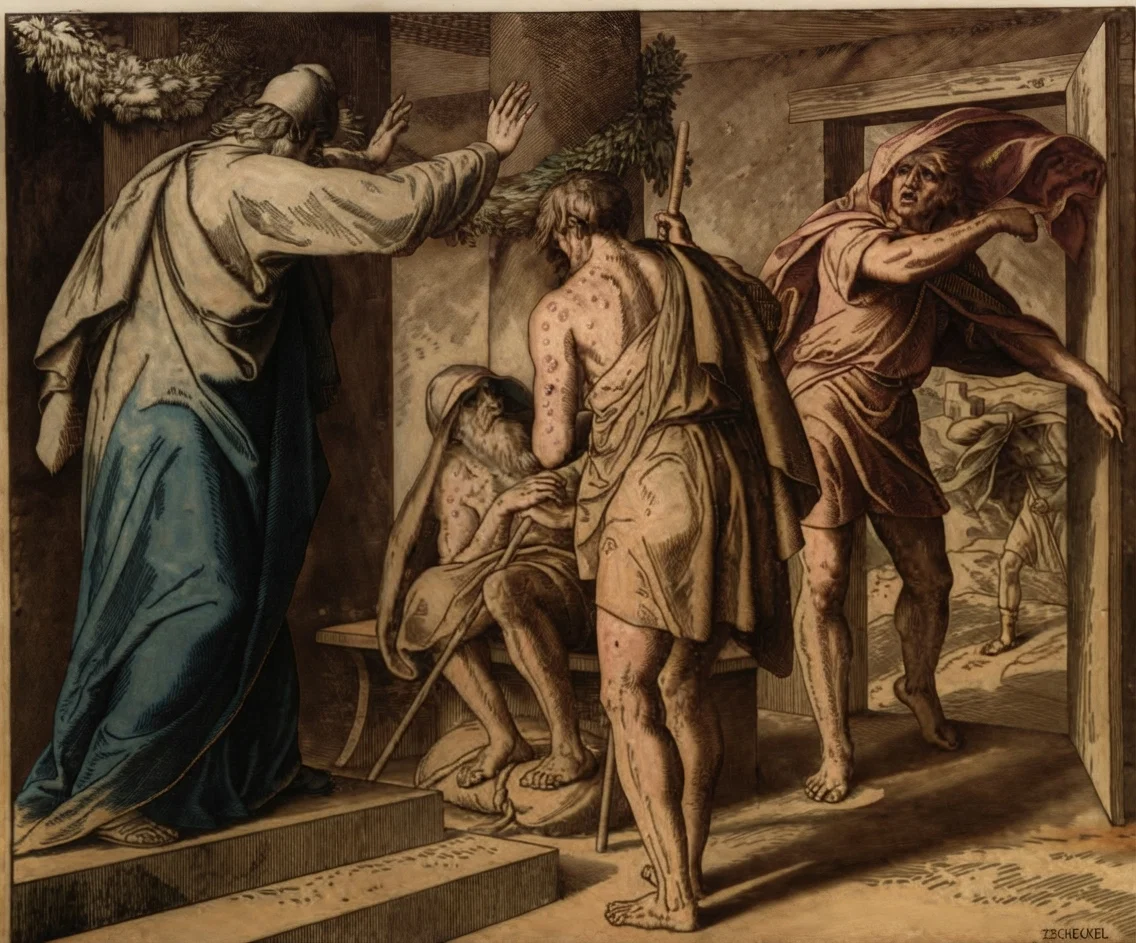
Job and His Three Comforters.
Thus does this upright man vindicate himself against the base misrepresentations of his so-called friends. For one to take the statements of Eliphaz concerning Job and treat them as being correct and reliable, would not be rightly dividing the Word. Neither would it be any more correct for one to take the statements he made concerning God as being correct, unless we find them sustained by inspired declarations given through God’s servants. For instance, one takes the words following close after Eliphaz’s libel on Job, in which he sets forth the results of a change in Job’s conduct, and these words are considered as being a correct representation of the case in hand: “Then shalt thou lay up gold as dust, and the gold of Ophir as the stones of the brooks. Yea, the Almighty shall be thy defense, and thou shalt have plenty of silver.” Who is the author of this pharisaical doctrine that the result of God’s favor is increase in worldly goods, and plenty of gold and silver? It seems that Peter and John had not found it out when Peter said, “Silver and gold have I none.” The long list of the faithful brought to view in Hebrews 11, seem to have been strangers to this experience; for many of them “wandered about in sheepskins and goatskins; being destitute, afflicted, tormented.” The chapters in which are found the declamations of these misguided men are 4, 5, 8, 11, 15, 18, 20, 22, and 25. As the Lord has told us that they had not spoken the truth about Him or about Job, we will need to take heed to rightly divide the book in this respect. They, of course, said some very good things, but these are to be compared with other portions of the Bible to see if they are sustained.
As Elihu seems to have taken very much the same line of argument as the other three speakers, we are to consider carefully the statements he has made also to ascertain if they are correct. It was by inspiration that their words were put on record, tho, like Satan’s first lie in Eden, “Thou shalt not surely die” the words of these so-called wise men are not to be considered as verity and truth when they contradict the teachings of the Scriptures.
The subject of the resurrection is beautifully treated by Job in this book. “I know that my Redeemer liveth,” is the key-note of the book. “He shall stand at the latter day [now soon to come] upon the earth.” How many of us will be prepared to unite with Job when he is called forth from his dusty bed?
The use of the term tartaro, a form of which is rendered “hell” in 2 Peter 2:4, may be seen by a reference to Job 40:20, where the same word occurs in the Septuagint, and is rendered “field” in our version. It means a level or low place, and is located here on earth.
Continue reading: THE BREATH OF LIFE