Signs of the Times, Vol. 57, No. 39.

The* PERUVIAN *Revolution

Signs of the Times

Oct 7, 1930

Pacific Press Publishing Association · Mountain View, California · Oct 7, 1930

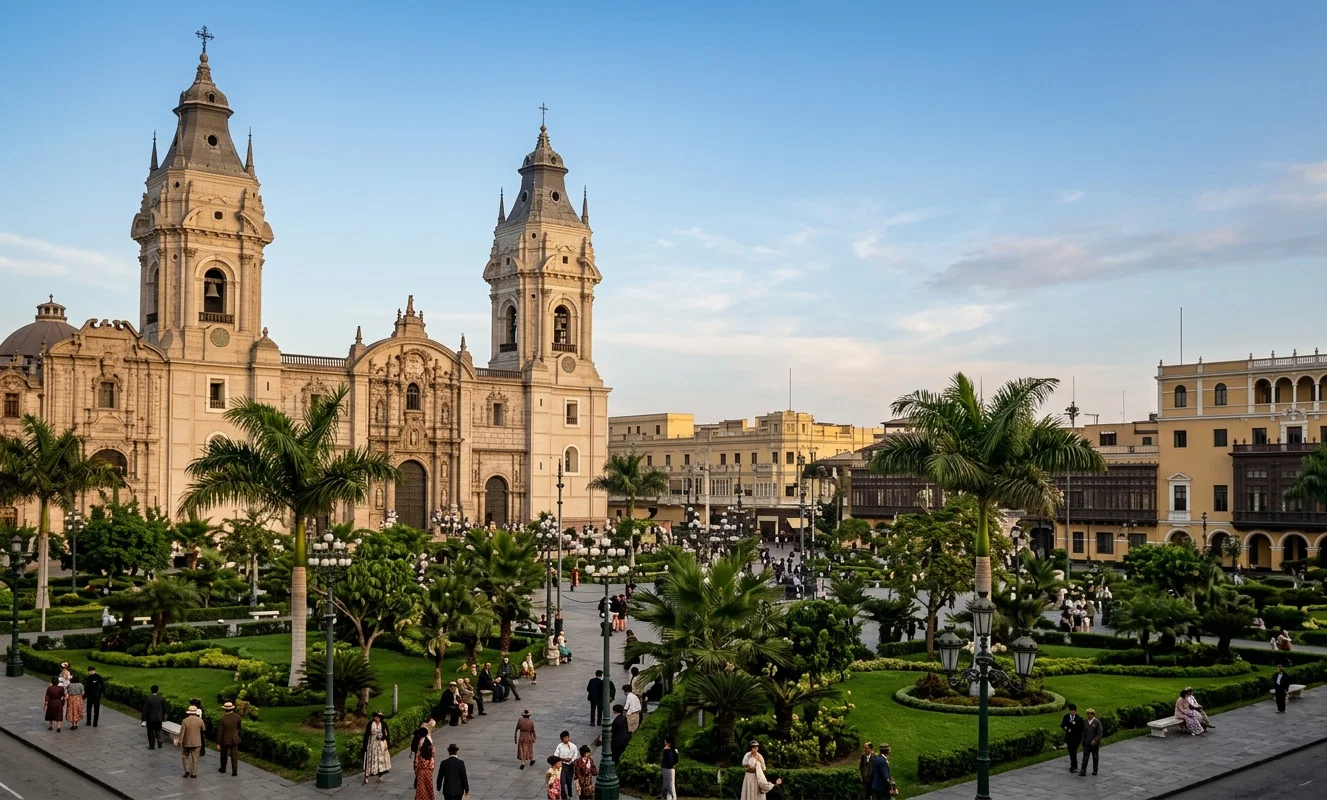
The famous cathedral
of Lima, Peru, facing
the Plaza de Armas,
the center of the city.
The old cathedral was
started in 1535, conse-
crated in 1625, practi-
cally razed by a great
earthquake in 1746. It
was rebuilt in 1758. It
has double aisles and
ten richly decorated
chapels, in one of
which rests the remains
of Francisco Pizarro,
conqueror of Peru.
The famous cathedral of Lima, Peru, facing the Plaza de Armas, the center of the city. The old cathedral was started in 1535, conse- crated in 1625, practi- cally razed by a great earthquake in 1746. It was rebuilt in 1758. It has double aisles and ten richly decorated chapels, in one of which rests the remains of Francisco Pizarro, conqueror of Peru.

The PERUVIAN Revolution

By an eyewitness
JAMES T. THOMPSON, Lima, Peru
Latin America has had five major revolutions this year, wherein the presidents of the Dominican Republic, Haiti, Bolivia, Peru, and Argentina have been forced out of their chairs.
A most interesting commentary on the increased speed of communication in this world of ours is furnished by the fact that Mr. Thompson wrote this article in Lima on Thursday, August 28, and the next Wednesday, September 3, it arrived on the editor’s desk, thanks to the air mail.
“Down with Leguia! Death to the tyrant and tyranny!” Hoarse shouts from many overstrained throats rent the air that sunny morning of August 25 as a dense mass of people crowded the Plaza de Armas in front of the government house. What had brought about this apparently sudden reversal of feeling? Only yesterday, when the president appeared at the Sunday races, he was cheered and acclaimed by the multitude. To-day they clamor for his blood. What has happened to the hero of 1919? Legally elected at that time by an overwhelming majority, when the government in power attempted to prevent his assuming the presidency, the people rose in his defense and placed him there. For eleven years he had occupied the throne of the Peruvian Republic, giving to it greater material progress than any other man in its history. Great improvements in the city of Lima had placed it in the front rank of the capitals of the South American countries; extensive irrigation projects were promoted in the coast country; a network of roads in the mountainous regions was begun; the construction of a port terminal in Callao, and many other projects for the improvement and betterment of the country might be mentioned.
What means it, then, that this man whom they had fêted and applauded, banqueted, and be-medaled until it would seem that the weight of gold medals would have crushed him had he been compelled to wear them all at one time, has fallen from public favor? As much as might be said in favor of Leguia’s government and the progress the country has made during this time, in order to maintain his position and carry out his plans, certainpolicies were thought necessary that produced many enemies who only awaited the time to wreak revenge.
From the first he would brook no opposition; a word of dissent sufficed to send one to prison or exile. Many of Peru’s brightest intellects and most able men have spent years in foreign countries. The press has been muzzled; not a word of criticism has been permitted. Elections were a farce, with only one candidate for each office. Votes could be cast only for the man he had designated, and a rival was not permitted to appear on the ballots.
The national debt increased from eighty million to six hundred million sols. Strikes by the laborers were suppressed with a strong hand; ultraliberal ideas of the university students were sternly repressed and the university put under government control. That which especially aroused the hatred of these two classes was his almost complete surrender to the clergy. Reputed to be a high degree Mason, his permitting the educational system to be controlled to a large extent by clericals caused great indignation, and his frequent participation in religious ceremonies was considered by many as highly hypocritical.
All this and more that might be mentioned had been accumulating during the years, causing a pent-up feeling that some day had to burst forth. Undoubtedly the evil day might have been postponed had it not been that the universal financial depression struck Peru as well. The sol began to toboggan, business to slacken, unemployment to increase, and then naturally the whole country began to blame the president. He who had been instrumental in bringing prosperity was now the victim for its reverses. However, right-thinking men do not blame him so much for mistakes and policies as they do those that surrounded him. He was ambitious, but patriotic. There is no doubt that he had the welfare of Peru at heart, but it was a task that one man cannot carry through alone; and he was surrounded by men that sought only their own selfish interests and dragged him to his ruin.
On Friday, the twenty-second of August, the army garrisoned at Arequipa revolted and ousted the civil government in that region. The central government issued a manifest, denouncing it as unjustifiable treachery, and decreed the blockade of the port of Mollendo and the city of Arequipa. At first the uprising was not taken seriously, but by Sunday the reports evidently spread alarm through government circles. In an interview with an army officer that was present when the president signed his abdication, the statement was made that the president had decided at noon Sunday to resign, but to do it in such a way that he still would retain his power, namely, by appointing a military committee, or cabinet, to take charge of affairs. These men, naturally, were but to carry out his bidding.

DEMAND PRESIDENT TO RESIGN

While the naming of this cabinet was being discussed, military officers in another part of the city were at work and, when they heard of what was to be done, hurriedly appointed a revolutionary committee and presented themselves before the president, demanding him to sign his abdication. He at first protested, but was soon convinced of the futility of further opposition, and yielded at three o’clock in the morning. Soon afterwards he was hurried by automobile to the port, and placed aboard the cruiser “Almirante Grau,” where he is still supposed to be held at the time of this writing.
So quickly and quietly was this done that the public was wholly unaware of the change effected during the night. Not until the morning papers appeared on the streets did it become generally known. Then excitement spread, and men began to rush wildly throughthe streets.
(Continued on page 5)

The Peruvian Revolution

(Continued from page 2)
Business houses that had opened hurriedly shut their doors and drew down the iron shutters over the windows. A crowd gathered before the government palace, clamoring for information. Soon members of the junta, or revolutionary committee, composed of army officers, appeared on a balcony. The leader attempted to address the multitude, but could not make himself heard for the tumult. For more than an hour he strove in vain until university students and labor leaders in the crowd had unburdened themselves. He gave the usual assurances that their requests would be considered, political prisoners freed, and, to please his hearers, added a few denunciations of the former régime.

MOB WREAK VENGEANCE

Then the crowd with one accord took up the cry, “Down with Leguia,” and like baying wolves rushed to the work of destruction. The first house to be sacked was that of a former cabinet minister that had made himself especially obnoxious to the public. Furniture was smashed, piled in the street, and set on fire. Barely had the work of destruction begun before others rushed to Leguia’s house, battered down the door and began their vandalistic work. Costly furniture, valuable paintings, and works of art were reduced to bits and carried away as relics. Fire was started in one of the rooms, and only the timely arrival of the fire department saved the whole house from flames. The police were powerless before the mob, and so quickly was it done that the army arrived too late to do more than to stop the looting and sacking from becoming general. The houses of several other prominent government officials suffered a like fate before the army gained control.
At the present moment all is quiet, but an unsettled feeling still prevails. The future is fraught with possibilities. The suppressed labor element has to be considered; dissensions among the army officers would produce a counter-revolution; political aspirants can cause untold trouble if led by selfish motives; insubordination in the army would turn it into a dangerous mob; and an innumerable number of things might furnish food for a pessimist. Our highest hopes are that true patriotism may inspire the hearts of those upon whom the responsibilities of government shall fall, and that a liberal, democratic rule may be granted us in the future.

The Wild Man of Gadara

E. RAY CORDER
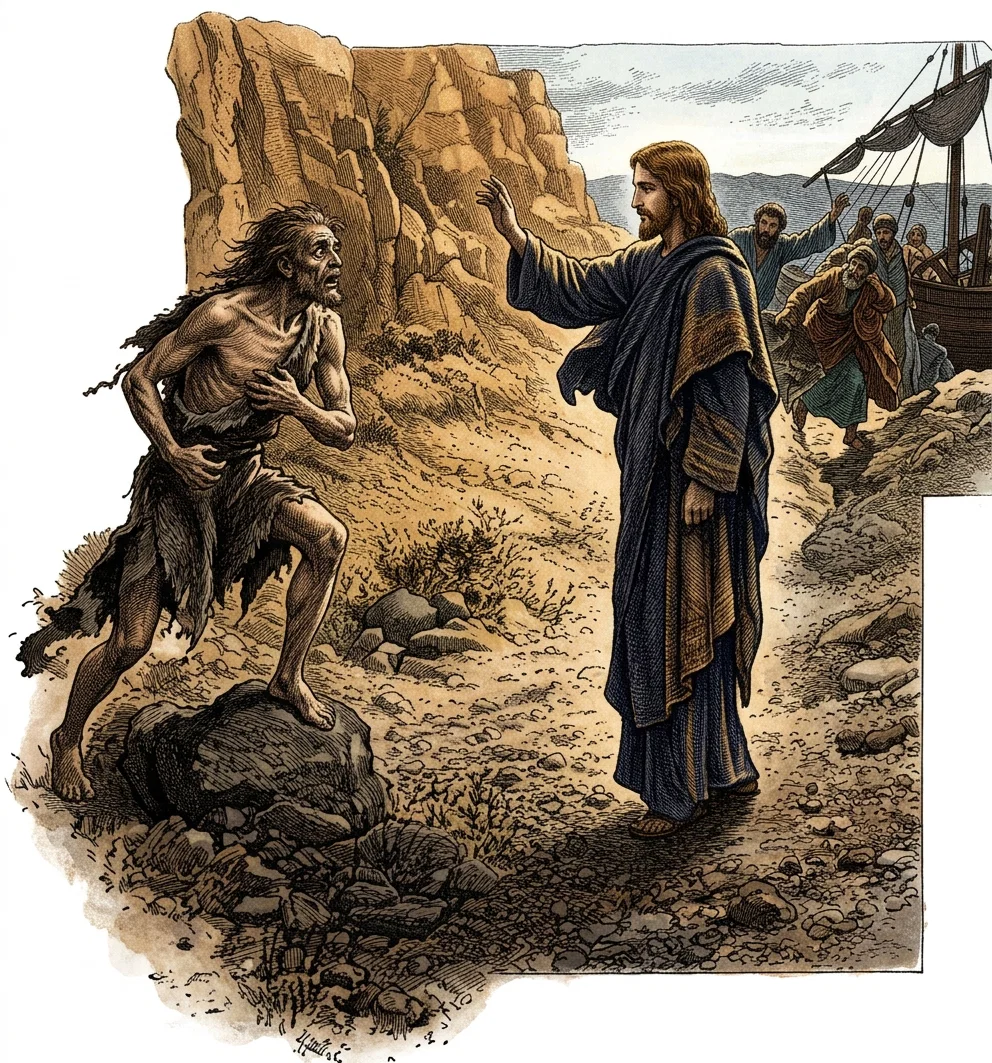
Jesus and His disciples stepped out of their storm-tossed boat of the night before upon the land of the Gadarenes. As they did so, their eyes met a sight that would strike terror to the bravest of hearts. Rushing toward them in fiendish madness, his features distorted and his hair disheveled, was the notorious wild man of the Gadarene mountains and wilderness.
When the demon-possessed man came near, Jesus commanded the evil spirits to leave their victim and to enter into a herd of swine feeding close at hand. These rushed down the mountain side, and were drowned in the blue waters of the Sea of Galilee.
Soon the entire countryside was aroused, and the inhabitants hurried to the scene of this extraordinary occurrence. There, sitting at the feet of the miracle-working Stranger, they saw the dreaded wild man, now clothed and in his right mind. Trembling with fear, the people begged Jesus to leave their country. This He did, for neither then nor now does the Saviour stay long where He is not wanted.

GO HOME TO THY FRIENDS

The restored demoniac, however, had an entirely different request to make of Jesus. He “besought Him that he might be with Him.” “But Jesus sent him away saying, Go home to thy friends, and tell them how great things the Lord hath done for thee, and hath had compassion on thee. And he departed, and began to publish in Decapolis how great things Jesus had done for him: and all men did marvel.” Luke 8:38; Mark 5:19, 20.
The healed Gadarene loved Jesus, and he extolled Him as his great benefactor and Saviour. He yearned for His continual companionship. But Jesus had a work for him to do in his own neighborhood. There relatives and friends and all others could see his marvelously transformed life. They feared Jesus, and He could not work among them in person. But the man who had been so blessed by Him could freely represent Him.
And what a touching story the newly made missionary had to tell to his own people! For years his life had been a blank, in bondage to Satan. Now all was changed. Jesus, whom the Gadarene’s own countrymen would not permit to stay in their land, had restored his body and soul. A miracle had been wrought in his devil-controlled life, and he greatly rejoiced in sounding the praises of his wonderful Saviour.

EFFECTS OF A SIMPLE TESTIMONY

One of the first two missionaries sent by Jesus into the region of Decapolis was this Gadarene convert. And although this man had been in the Great Teacher’s presence for only a few moments, and had never heard a sermon from His lips, yet his testimony mightily convinced the Gadarenes of Jesus’ love for them. As this simple witness told them the sweet story of what he had seen and heard and felt of the power of God, a great longing arose in their hearts to see Jesus. So much so “that, when Jesus was returned, the people gladly received Him: for they were all waiting for Him.” Luke 8:40.
What a great change had taken place in the Gadarenes’ attitude toward Jesus! At His first coming they had repulsed Him with a frigid indifference. But at His return they were all waiting for Him with outstretched arms. What the Saviour of the world could not do in person, He had quietly, but effectively, accomplished through His ardent representative,—the untutored, healed demoniac. Had he failed to go home and serve at Jesus’ command, what a blessing the Gadarene and his people would have missed!

BE A MISSIONARY AT HOME

Many of Christ’s people to-day yearn to be with Him in Paradise, and to “follow the Lamb whithersoever He goeth.” Revelation 14:4. But Jesus says to these, “The first great business of your life is to be a missionary at home.” In other words: There are people living near you who have a wrong conception of Me and of My work. Like the Gadarenes, they misconstrue My loving intentions and saving ministry. They do not know that I care more for sinful man, and am better able to help him, than anyone else in the world. But as you, My followers, go home and tell your neighbors and friends that I have forgiven your sins and saved your souls, many will repent and turn, and live eternally. And then, when I return the second time, with all My holy angels, to claim My precious jewels, many who have been fearful and unbelieving, will look up and say, because of your faithful service, “Lo, this is . . . the Lord: we have waited for Him, we will be glad and rejoice in His salvation.” Isaiah 25:9.

Are POLITICS and RELIGION In the Same SPHERE?

LEON A. SMITH
They are not; otherwise the founders of this nation would not have provided for a separation so vital to the maintenance of religious freedom.
It is fundamental in the American system of government that there shall be no union of church and state. This principle, however, while approved in theory, is often denied in practice. Hazy ideas prevail as to its application. Preaching of religion is mixed with preaching of politics, sin is confused with crime, and in a great degree the distinction is obliterated between the kingdom of heaven and the kingdoms of this world.
The example of an influential clergyman of a California metropolis furnishes an illustration. This prominent representative of a great Protestant denomination has habitually, for a long period, been giving attention from his pulpit to the affairs of the city government, indulging in much denunciation and demands for reform. This was carried to the point where the charge was made that the city government was virtually being administered from his pulpit, and a mass meeting of citizens was called to consider the situation. Never a doubt was felt by this pastor or his congregation that such an attitude on the part of a clergyman was not in full harmony with American principles of government and the precepts of Christianity.

A MISUNDERSTOOD CALLING

Did not Christ scathingly rebuke the scribes and Pharisees? Did He not denounce the wicked cities of Galilee? Are not the Christian clergy, therefore, called upon to denounce corruption in civic affairs? Are they not fully justified in so doing? If not, how are American principles of government to be understood?
Separation of church and state does not mean that there must be separate classes of society, one class standing for the church and the other for the state. The best American citizens are members of a church. The same individuals represent both the church and the state; those composing the one also compose the other.
Church and state occupy, however, distinct and separate spheres, and separation of the two is a proper recognition of this fact. That is why the founders of this nation, themselves Christian men and church members, provided for such separation in the government. This does not imply any antagonism between the two, or forbid co-operation between them for the promotion of human welfare.
The sphere of the church is that of man's relation to God; the sphere of the state is that of man's relation to man. These are covered by two separate and distinct governments, one being the divine government, the other being human government in its various forms.
Transgression of the law of the divine government is sin; transgression of human law is crime. A sinful act may be and often is also a crime; but the law of God is vastly more comprehensive than man's law. It has jurisdiction over the heart. Evil thoughts and desires—covetousness, hatred, lust—are sins; they are not crimes until they blossom into overt acts.

GREAT DIFFERENCES

The purpose of the divine government, as represented by Christianity, is to save people from sin—their own sin, be it noted; the purpose of human government, so far as it concerns crime, is to save people from the wrongdoing of others. There is a vast difference between the proper dealing with an act as a sin and the dealing with the same act as a crime; and this difference should be clearly understood and kept in mind.
The divine government, in dealing with sin, seeks to save the offender from the penalty of his deed; human government, in dealing with crime, seeks to inflict the penalty upon the offender. Civil government cannot therefore deal with an act as sin; and when it undertakes to do so, it works directly against the divine government. When a sin is also a crime, the state punishes the transgressor for the act because he violated a law made to safeguard human rights, and not because the individual failed in his duty toward God.
The Almighty is able to run His government without the assistance of any man.
The divine government can and must provide forgiveness for the transgressor; for civil government to do likewise would be suicidal. To inflict the penalty of sin would defeat the purpose of Christianity; not to inflict the penalty of crime would defeat the purpose of civil government. God, who alone has authority to fix the penalty of transgression against Him, will in His own time and way inflict the penalty of sin. The best civil government, on the other hand, is that which most quickly, as well as surely and adequately, punishes the criminal for his crime.
The divine government operates by faith and love; civil government operates by force. Christianity entreats, the state commands. The divine government employs divine agencies—God, angels, the Holy Spirit; the state has none of these at its command, but operates through legislation, the courts, and the police.
Without these facts and distinctions before him, an individual may easily confuse the nature, purpose, and methods of the divine government with those of civil government, and have a union of church and state within himself. He is then prepared to believe that the cause of Christianity can and should be advanced by legislation.

THE CLERGY AS AMBASSADORS

As a citizen, a clergyman stands on a level with all other citizens in being entitled to his opinions regarding civic affairs, and to the liberty of expressing them; but he should not forget that as a clergyman he is an ambassador of the kingdom of God, and that as such, he is concerned not with civil government but with the divine government, not with crime but with sin.
From the standpoint of Christianity, the clergyman sees in sin a far greater menace to the welfare of humanity than exists in bad government. Believing that Christians are “the salt of the earth,” as Christ declared, he sees in them the only means by which the world is saved from destruction, as Sodom would have been saved by the presence in it of ten righteous persons. Believing them to be also “the light of the world,” he sees in the Christian church the only agency through which the way of escape from divine wrath is revealed to those yet in their sins. Hence he is far more concerned for the extension of Christ’s kingdom in the earth than for the reformation of earthly governments, more concerned for the cleansing of human hearts than for the purification of politics.
From the standpoint of Christianity also, the clergyman sees the deadly menace to humanity of sin in its “respectable” forms. He does not believe that his flock are about right in the sight of God because they rank high in society. He has in mind what the Bible says about such sins as pride and covetousness as exemplified in the lives ofBalaam and Judas. Christ denounced the scribes and Pharisees, not as criminals, but as sinners; He rebuked their pride and hypocrisy. He denounced Chorazin, Bethsaida, and Capernaum, not because their city government was bad, but because of their unbelief and rejection of light. These sins were not crimes, and did not detract at all from the respectability and good standing of their inhabitants in society; yet as surely as the words of Christ are true, these sins brought upon them, and will bring upon all who practice them to-day, a worse fate than overtook Sodom when brimstone and fire were rained upon it from heaven.

REPRESENTATIVES OF CHRIST

Neither Christ nor His apostles spent any time preaching against crime as such, or in promoting reformation in civil government, although they lived under as corrupt a government, probably, as any that ever existed. They were dealing not with temporal matters but with the things of eternity, and were intensely concerned, not for the salvation of human institutions, but of human souls. Significant of this is the fact that while Christ never denounced political offenders nor made any move for a reformation in civil government, He did on two occasions cleanse the temple of God, using a whip of small cords to drive out the unrighteous characters found within it. Christ’s representatives to-day cannot do better than to follow His example. If the temple of God—the church—can be kept pure, and the gospel of salvation from sin proclaimed in the world as widely and earnestly as the situation demands, the Christian clergy will have all their energies called into service, all their time occupied, and every legitimate ambition satisfied with the result.

Are You READY to Appear in Court?

VARNER J. JOHNS
We must all appear before the judgment seat of Christ; that every one may receive the things done in his body, according to that he hath done, whether it be good or bad.” 2 Corinthians 5:10.
“We must all appear.” Men may ridicule the Bible and reject its message of salvation; they may scorn the divine pardon and scoff at redeeming love; but they must render an account of their evil deeds and their idle words before the judgment bar of God.
“We must all appear.” There are no exemption clauses in the Bible record. Rich and poor, black and white, bond and free—all are included in the summons to the great court session. There are no court favorites; there are no special privileges. All men everywhere are included in the roll call of the judgment.
“We must all appear.” Your wife, Mr. Man-of-the-world, may keep the home fires of religion burning for you and for the children, but her faith in Christ cannot cover your sinful record. You must appear to give account of your riotous living; you must pay the penalty for your reckless abandonment. Your dear old mother may spend her days in sorrow and her nights in prayer. With bleeding heart, with blasted hopes, she may go down to her grave praying for the boy who went astray, but her prayers cannot wipe the foul stains from your page in the books of record.

JUST REWARDS

“According to that he hath done.” It is not our intentions, nor our promises, nor our pledges, nor our resolutions that are given consideration in the judgment. “The Judge of all the earth” penetrates the inner recesses of the heart. Hidden sins are laid bare, secret thoughts are exposed, dark deeds are brought to light. Of no avail are the words, “I intended to do right.” The selfish heart cannot commit itself to unselfish deeds. Thoughts of hate and revenge never lead to deeds of love and kindness. Hidden sin is not linked with deeds of righteousness. Thoughts are sown in the springtime of life. Deeds are the harvest from the seeds of thought. You may carelessly sow the seeds of sin, but you will have to do the reaping. Let me read you a law of life that is as certain as the law of gravitation. It is found in James 1:15: “Sin, when it is finished, bringeth forth death.”

COMMANDMENTS STILL STAND

Death—eternal death—is the end of that impure thought, that unholy imagination, that poisonous suggestion, that is formed in your mind. Sin is the most expensive thing in all the universe. Pardoned or unpardoned, its cost is infinite. Pardoned, the penalty is paid in the blood of the innocent substitute, the Son of God. Unpardoned, its penalty is the life of the guilty sinner. Sin pays its wages in full. The first installment is sorrow and suffering; the last installment is despair and death. “The wages of sin is death.”
Sin is declared to be the violation of an infinitely important law. In 1 John 3:4 is the inspired definition: “Whosoever committeth sin transgresseth also the law: for sin is the transgression of the law.” All through the ages the Ten Commandments have stood as the fundamental code of morality. They were ordered of God because they reflect the character of God. They are the perfect standard of righteousness, and their violation is called “sin.”
Nothing so dishonors God as a disregard of His law. Nothing is so destructive of Christianity as antinomianism. Either the penalty of the broken law must be paid or the whole government of God would crumble. That is why Jesus came into this world of sin. He came to vindicate God’s justice. He came to demonstrate before the universe that it was possible, while living in the midst of corruption, to live without the stain of sin. He came to uphold the majesty of God’s law. He came to pay the penalty for the transgression of that law. He came to die in our stead, that we might live through Him.
The life of Christ was a living expression of the law of God. Jesus put the law in practice. His was a life of perfect obedience. And, friends, if we expect to walk with Him in that land of wondrous beauty, we must learn to walk with Him now in the path of sacred duty. There is no excuse for disobedience. Jesus came to make it possible for us to keep the Ten Commandments. If He is enthroned in our hearts, His life of obedience will be lived out in us.
Let me tell you plainly, disobedience is sin. And it is only the carnal nature that cries out against the law of God and chafes under the binding restrictions of the Ten Commandments. “The carnal mind . . . is not subject to the law of God, neither indeed can be.” Some people find fault with the Ten Commandments. For them Christian liberty means “license,” and righteousness means to do what they please. People of the world break the Ten Commandments, and we call them sinners. But some “Christians” think they can trample underfoot one or more of the commands of God, and excuse themselves by saying, “We are not under the law, we are under grace.” Sin has ever been the transgression of the Ten Commandments. It was so in the days of Cain, and it is so to-day. Morality is not a sliding scale. Truth is eternal and unchangeable. The same Ten-Commandment law that was binding upon patriarchs, prophets, and apostles is binding upon us to-day. But it is a law of bondage only to the sinner. It is a law of liberty to those who walk with Jesus.

THE STANDARD OF JUDGMENT

That law, the law of Ten Commandments, is the standard in the judgment. You will be judged by that law; I will be judged by it. Let me read it to you right out of the New Testament. In James 2:10-12, I read, “Whosoever shall keep the whole law, and yet offend in one point, he is guilty of all. For He that said, Do not commit adultery, said also, Do not kill. Now if thou commit no adultery, yet if thou kill, thou art become a transgressor of the law. So speak ye, and so do, as they that shall be judged by the law of liberty.” Two of the Ten Commandments are named in these verses. Thus does Inspiration identify the law that is called “the law of liberty.” It is indeed a “law of liberty” to those who live victorious lives. When a man calls the Ten Commandments a “law of bondage,” I know that he himself is in bondage to sin; he would not find fault with the divine “looking-glass” if there were no stains of sin reflected in that mirror of righteousness. But he would do well to remember that it is by that law that he is judged.
The “whole duty” of man is summed up in the Ten Commandments, and in the judgment the record of man is compared with this rule of righteousness. Let us read thelast two verses in the book of Ecclesiastes: “Let us hear the conclusion of the whole matter: Fear God, and keep His commandments: for this is the whole duty of man. For God shall bring every work into judgment, with every secret thing, whether it be good, or whether it be evil.” “Every work” into judgment; faith in Christ is the touchstone of righteousness, but abiding faith is evidenced in good works. Those who talk of “faith” while trampling upon the law, those who speak of “grace” while giving evidence in their words and deeds that they do not have the “fruit of the Spirit,” may deceive themselves, but they cannot deceive the Lord.

GET RID OF SIN NOW

“Behold, I come quickly; and My reward is with Me, to give every man according as his work shall be.” Revelation 22:12.
“Like lightning’s flash will that instant show Things hidden long from both friend and foe; Just what we are will each neighbor know, When the King comes in.”
Now is the appointed time for heart preparation. Now is the appointed time to get rid of sin. Now is the appointed time to square our lives with the divine rule. In the judgment it will be too late to change our characters, and
“Endless the sad separation then, Bitter the cry of deluded men, Awful that moment of anguish when Christ the King comes in.”
A remarkable pen picture of the judgment is given to us in Daniel, chapter 7. The books of record are opened,—the book of life, wherein are the names of those who have accepted Jesus as their Saviour; the book of remembrance, with its record of the righteous deeds of those that love the Lord; and the other books. The judgment begins with the name of Adam and passes along through the many generations of men. Finally it reaches the names of the living. Finally it reaches your name and my name. Is your record clear before God, or are you waiting for some more favorable season of salvation?
One morning about two o’clock I received a telephone call from a boy whose mother had been a member of our church. His father was dying. Would I come? Of course I was ready to help in that hour of need. I stood by the side of the dying man, talked with him about the eternal realities, then, at his request, kneeled in prayer. Then he prayed—and such a prayer it was! Never had I heard a more perfect prayer. Somehow the man passed through this sudden attack and lived for several months. The next day I called upon him and referred to the events of the night before. He did not remember anything of the experience. “But don’t you remember my praying, and your praying?” I asked.
“No,” he replied, “I certainly do not remember praying last night.”
So it is with the majority of “deathbed” repentances. The mind is weakened, the strength is gone, the character is fixed. The prayer of anguish at the eleventh hour is indeed a strange climax to the life of a scoffing, jeering, reckless sinner. Character building is the work of to-day, not of to-morrow. Delay has ever been dangerous, but it is doubly so at the present time; for we are living in the days of the investigative judgment. The apostle Paul could reason before Felix of “righteousness, temperance, and judgment to come.” But our message for these last days is, “The hour of His judgment is come.”

PROBATION WILL SOON CLOSE

For a generation we have been living in the time of the judgment. The great threefold message of Revelation 14, the message that is heralded to the world just before Jesus comes, is now being proclaimed. An integral part of that message of mercy is, “The hour of His judgment is come.” Bible prophecy locates the very year of the beginning of the investigative judgment. We do not know when probation’s hour will close, nor do we know when your name and my name will come before the heavenly tribunal. In such an hour as we think not probation will close for us. In such an hour as we think not the decree will go forth: “He that is unjust, let him be unjust still: and he which is filthy, let him be filthy still: and he that is righteous, let him be righteous still: and he that is holy, let him be holy still.” Revelation 22:11.
While the door of probation stands ajar, while mercy lingers for fallen men, let us open our hearts to Jesus. Let us do it to-day. To-morrow may be one day too late.

Your Case Before the Judgment Bar

One of these days your case is going to come before the judgment bar of God. Is your record clean, so you can face the Great Judge?
Continue reading: Scintillating Sentences