The murders reported in St. Louis, Mo., on July 4, are as follows:—
“Fred Loos, a huckster, was stabbed to death, and a companion, named Coombs, so seriously cut he can not live. A party of men were shooting clay pigeons on his premises; he remonstrated with the sportsmen, and a fight ensued, with the above results.
“S. W. Mann, a street-car conductor, was shot and killed while on his car by an unknown person, who escaped.
“Frank T. Sasse, a bicycle rider, was shot through the heart and killed instantly while wheeling on Locust Street. The man who fired the shot escaped.
“Ed Middleton was shot in the neck and will die. The shooting was the result of an old grudge.”
Such records as the foregoing can be gleaned from the papers almost any day in the year. We are rapidly reaching the point where life is not more secure than it was in the most savage districts of medieval barbarism. These bloody occurrences bring forcibly to mind the words of Scripture: “For I have heard a voice as of a woman in travail, and the anguish as of her that bringeth forth her first child, the voice of the daughter of Zion, that bewaileth herself, that spreadeth her hands, saying, Wo is me now! for my soul is wearied because of murderers.” Jer. 4: 31.
Here is the cry of justice as well as mercy against the work of the cruel murderer. And when the time is fully come that the just man’s “soul is wearied because of murderers,” eternal judgment can not long be delayed. Your mind has been perplexed and distressed because of the prevalence of murder and crime in general; have you ever thought to seek in the Word of God for a knowledge of what it portends? Do so, and you will be rejoiced to learn that Jesus is coming soon in person to put an end to all this evil.
T.
UNNATURAL AND SENSELESS AFFECTION FOR ANIMALS.
By T.
The Illustrated London News says: “A lady has written an eloquent letter about her Siamese cat, recently deceased. This accomplished animal always slept at night with its owner’s left ear in its mouth. The lady tried to make her right ear an acceptable sleeping draught, but in vain. The cat would have the left ear or none. . . . If, as I suspect, the singular affection of the lamented puss from Siam was due to a rare gift of sympathy in the disconsolate owner, why doesn’t she now bestow it on the brotherhood of man, which is none too rich in that quality?”
Everybody should be kind to animals, and their comfort should be carefully looked after. And to the humane man or woman one of the most enjoyable pleasures of life is to care for these domestic creatures that God has so wisely placed under the charge and supervision of man. But there is nothing more unendurably disgusting than the gross, sentimental caressing that some people lavish on cats and dogs. When innocent children are starving for food, and with no one to show them sympathy or tenderness, it is a poor time to waste one’s energies by bestowing labored affection on brutes that do not have sense enough to appreciate it. Let some of these sentimental women take an orphan boy or girl and give the same kindness and care to the child that she has been giving to the cat or dog, and she will find it a far greater joy, and then she can know, too, that she is doing some good in the world. T.
Two Old Men
Two old men, inmates of a San Francisco almshouse, and both past 73 years of age, had a fight a few days since, resulting in one of them killing the other. One of the men was very peaceable in his nature, while the other was more or less quarrelsome. The quarrelsome man had had a grudge against the other, and, overpowering him in the fight, killed him in a most barbarously brutal manner. It would seem that men at such an advanced age would keep from so gross crimes. But there is “violence” in the land now as in the days of Noah, and it is one of the sure signs that we are near the end of time. The great millennial peace and reign of righteousness that has been so much talked about is all a delusion. The Bible says that “evil men and seducers shall wax worse and worse,” and we see that the facts are in harmony with the Word of God.
Living for Christ
By Rev. John McQuoid
The man who lives for Christ is known to be a Christian, even tho his lips are unable to articulate the profession of his faith.—Rev. John McQuoid.
It Seems Incredible
It seems incredible, but nevertheless as trustworthy a paper as the New York World informs us that Michael Hart, of that city, was recently brought before the police court charged with attempting to pawn his three-year-old baby for liquor. The record states that he was an industrious and well-behaved man till he took to drinking. This is only one of the many examples of the appalling depths to which mankind has fallen. And he who is not blind to glaring facts knows that depraved humanity is rapidly growing worse.
ONE OF THE DORCASES.
By Fannie E. Bolton
THERE was once a poor woman
Who lived all alone,
She had little to come to her,
Little to own;
But bravely she struggled,
As do the spring crocuses,
And thought that she ought to be
One of the Dorcases.
God bless the Dorcases.
She went to the mission,
And worked for the poor,
She helped to distribute
Kind gifts at the door,
And never she uttered
A word to the caucuses
About any poverty;
She was one of the Dorcases.
God bless the Dorcases.
And many a sorrow
Was brought to her ear,
And sweet was the comfort
She offered to cheer.
When sad tales of poverty
Brought such a shock to us,
She’d point out the privilege
Of being a Dorcas.
God bless the Dorcases.
One day at the mission
She didn’t appear.
The sisters all thought it was
Marvelously queer;
For of all faithful creatures
That came to their caucuses,
’Twas the bright little woman,
Who prayed for the Dorcases.
God bless the Dorcases.
They talked of her sunshine,
They talked of her dress;
Where she lived, or who kept her,
They never could guess.
She was poor, that was certain;
But yet what a stock she was,
Never speaking of trouble,
But all of the Dorcases.
God bless the Dorcases.
They searched up her dwelling,
They found her in bed;
No fire on the hearthstone,
In the larder no bread.
They warmed her and fed her,
And made a tremendous fuss;
For she whispered a blessing
On all of the Dorcases.
God bless the Dorcases.
She raved about India,
And the famine field there;
She thought all her garments
To Hindus to spare;
She thought Matabeleland
Ought to make work for us,
But said no attention
Should be sought for a Dorcas.
God bless the Dorcases.
In brain-weary ravings
She told of her need,
As with the great Father
She often would plead.
But ever she murmured,
“Not for me, Lord, but work for us
In blessing the charity
Done by the Dorcases.
God bless the Dorcases.”
In spite of the sisters
She sank into rest;
She pillowed her head
On the Saviour’s kind breast.
And the poor came in crowds,
Crying, “O, how she worked for us!
She was one of the holy ones,
One of the Dorcases.
God bless the Dorcases.””
And, O, when the dead arise
Out of the dust,
There’ll be many a Dorcas
Who’s lived on a crust,
Who out of her poverty
Gave and ne’er made a fuss,
Whom the angels will crown
As a genuine Dorcas.
God bless the Dorcases.
In the back of the temple
There’s sometimes a room
That nobody hears of,
That’s filled with perfume,
Where sisters unheard of
Practise all that is prayed for us,
Yet few are the preachers
That speak aught of the Dorcases.
God bless the Dorcases.
FANNIE E. BOLTON.
HIDE ME FROM PAPA.
“Please take me home with you and hide me so papa can’t find me.”
The speaker of the above touching words was a little child just two years of age. She was endowed with unusual sprightliness and loveliness, both of person and disposition.
CALIFORNIA SCENERY, No. 20.—Sacramento, the now capital of California, situated in the midst of a wonderfully fertile valley, is about fifty miles northeast of San Francisco, on the Sacramento River. It is noted for its early connection with the gold discoveries of the State. Sutter's Fort, where the city now stands, was the interior point from which the northern mines were reached, being accessible to San Francisco by boat. It was laid out as a town in 1848 for General Sutter, by Lieutenant William H. Warner. Where the main part of the city now stands was then a swamp. Our illustration is a view of the “town” in 1849.
We had been visiting her mother, and on leaving had taken the dear little one to ride a short distance.
We said, “Now, Mary, kiss us good-by; it is too cold to take you any further.” The little darling looked up with the most piteous expression, and, clinging to me, said in her baby words, “O Lenny, p’ease take me home with you, and hide me so papa can’t find me!”
O darling, precious Mary, how my heart ached for you as I pressed you to my bosom! What visions of sorrow and cruelty your words called up! How terrible it seemed that one so young and innocent should know so much of fear!
As I rode homeward, the thought would again and again recur to me: O, that all who have helped in any way to make her father a drunkard could have heard that piteous appeal, could have seen those baby hands raised in entreaty, and her lips quivering with suppressed emotion! Surely the heart of the most hardened whisky dealer would have been reached, and his slumbering conscience would have been awakened to a true sense of the terrible amount of wretchedness caused by the use of ardent spirits. O, think of it, barkeepers and whisky sellers of every grade! Think of your sad, sad work.
Here was a man who, when sober, was a kind and devoted parent, yet from the use of this curse of our land, had become so cruel and unkind as to inspire abject fear in his only child.
May all who read these lines, and have encouraged the use of ardent spirits in any way, be warned in time, lest in the last day many women and little children shall say to them, “To you we owe the untold wretchedness and agony of our lives; our blood be upon your skirts.”—Richmond Advocate.
ARCHIE’S LESSON.
By Kate S. Gates
PAPA was away, and the baby was sick. Mama could not leave him to go to church, so there was no one to go with Archie.
“Mayn’t I just go by myself?” he pleaded. “I’ll be ever and ever so good, and remember the text for you, and maybe some of the sermon. Mayn’t I go?”
Mama hesitated a minute, then she consented.
“I am sure I can trust my little boy,” she said, and Archie went off very happy and proud. He sat in papa’s seat, and felt quite important. He had found the text, after considerable hunting, and now he was wondering if the sermon was not almost done.
He had said his Golden Text once to himself to be sure he had not forgotten it, and then he put his hand in his pocket to satisfy himself he had not lost his pennies.
And then, I am sure I do not know how it happened, but he thought of the candy in Mrs. Draper’s window. Archie was very fond of candy, but mama did not like him to eat it, so he seldom had any.
“Tommy Baker has some ’most every day,” he thought, in an aggrieved way, “and he isn’t sick, either. I don’t see why I can’t have some once in a while. Maybe if I did, and it didn’t make me sick, mama wouldn’t care any more, and let me have all I want. I wonder if there would be any harm in keeping one of my pennies and getting a chocolate stick to-morrow.”
Now Archie knew very well that there would be a great deal of harm in doing so, but he just shut his eyes to that view of the case, and would not see it.
“Of course, if I supposed mama didn’t want me to have it,” he reasoned, “it would be different; but you see all she cares is she is afraid it would make me sick, and I’m ever so sure it wouldn’t. I can tell her all about it afterward.”10
Well, you know how it was, Archie kept thinking how much he wanted the candy, and he would not let himself think how wrong it would be to get it in this way. So when Miss Dayton passed the box in Sunday-school, Archie only put in one penny.
But after the box had passed him, do you know it seemed to him that everybody could see that penny down there in his pocket, and would know how he had kept it back? On the whole, he felt very uncomfortable, and the worst of it was, he dreaded to see mama.
He went the longest way home, and walked as slowly as he possibly could, and he sat down on the piazza quite a while, in fact, until he heard the dinner bell ring. He was not very hungry, and asked to be excused before dessert was over.
“I just wish I hadn’t never thought of that old candy,” he said impatiently to himself, as he swung in the hammock. “I’ve a good mind not to get it; there’s no fun doing a thing when you feel so mean. I can save my penny and put it in the box next Sunday, and it will be all right, and nobody will know anything about it.”
Archie slipped his hand into his pocket, and an instant later took it out empty; for there was no penny there.
He turned his pockets inside out; he felt in them all, but there was no penny to be found; he had lost it. And now what was to be done?
He could not get the candy certainly, and he did not care much for that, but why need he say anything about it to any one?
“I don’t see what good it will do to go and tell mama now; it won’t bring back the penny, and it will just make her feel sorry. She says you shouldn’t make folks feel bad if you can help it, so I don’t think I ought to tell. There needn’t any one know about it, and I’ll never do so again, I know.”
Just then mama called.
“Come and tell me the text now, Archie,” she said.
So he went and sat down beside her and found the place in her Bible.
“Man looketh on the outward appearance, but the Lord looketh on the heart,” she read aloud. “Do you know what that means, dear?”
Poor little Archie! a great lump came up in his throat, and it seemed to him that he could not look up into mama’s face.
He hated to have mama know he would be so mean as to steal; it was very much like stealing; for it was not his money. He dreaded to tell her; but God knew; there was no hiding it from Him.
It made him so ashamed and afraid!
“Tell me all about it, dear,” said mama; for, of course, she had known all the time that something was wrong.
So Archie confessed.
“I’m so sorry, mama,” he sobbed. “I s’pose I knew all the time that I was doing wrong, only I just wouldn’t listen when something tried to tell me so. I wanted the candy, and I thought nobody would ever know. I forgot about God’s seeing everything. But I’ll never forget again—at least, I don’t believe I will.”
The next day Archie weeded in the garden for papa two hours, and, tho he was very tired, he felt happier because he had earned a penny in place of the one he had lost.
“And I shall remember always,” he said gravely.
And to help him mama gave him a pretty card to hang in his room, with these words on it, “Thou God seest me.”—Kate S. Gates, in Christian Work.
FARMING IN JAPAN.
By W. C. Grainger
Farming in this country is conducted under very different conditions and in a manner very unlike that in America. The chief reason for this is that the leading products of the two countries are different. Vegetables and the common grains are cultivated in a way similar to American methods, save that grain is planted in drills and cultivated with the hoe, as we do root plants.
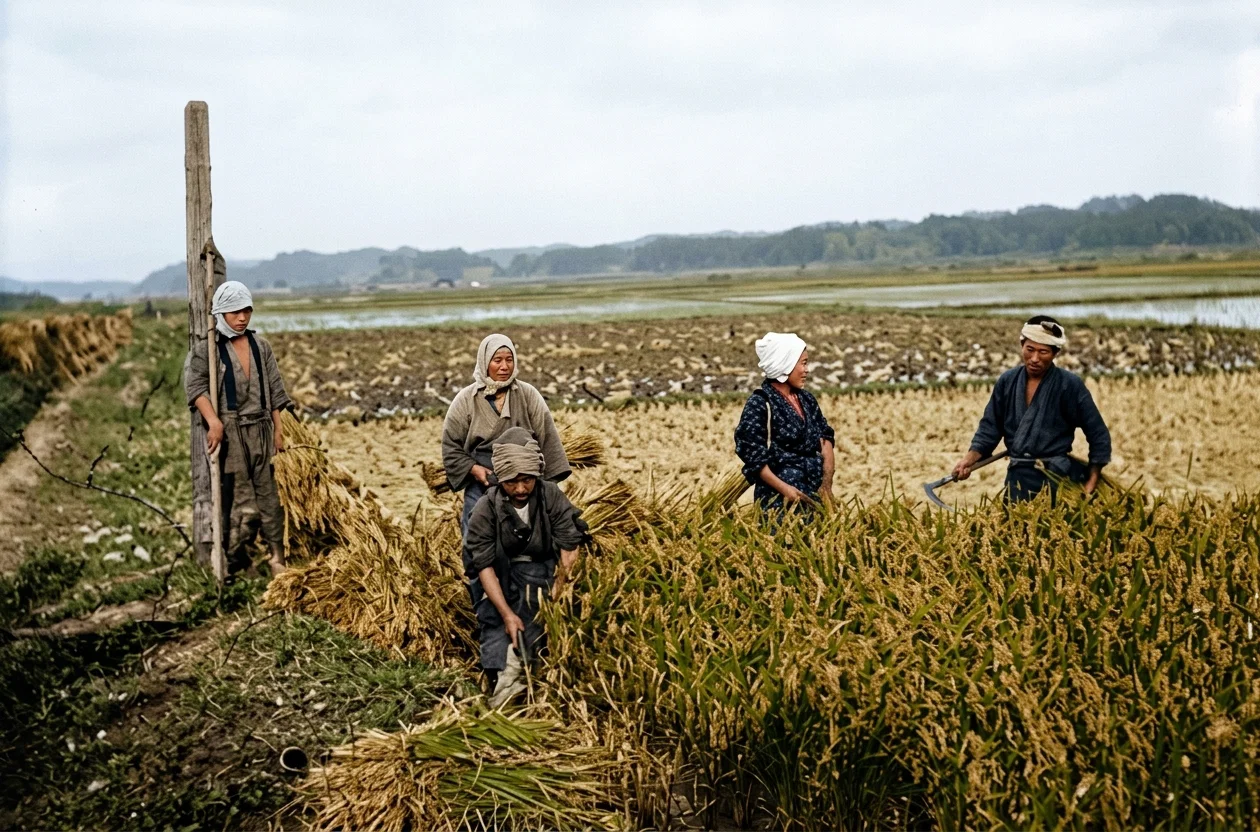
The principal food crop is rice, to which all lands are devoted that can be flooded with water. Rice is a marsh grass that will not thrive without an abundance of water. The fields are divided into sections a few rods square by means of levees. Each section is graded to a perfect level. The soil is then stirred to the depth of one foot or more with spades, or a kind of mattock with a blade very much like a spade. Water is then turned in, and the loose soil is worked into the consistency of thick gravel by men and women, with rakes, who wade around in this mud from morning till night, week in and week out. This is the work of preparing the ground for planting.
The rice plants are propagated in beds very much as we produce cabbage plants. About the middle of June the work of transplanting begins and usually continues about two weeks. The plants are about six inches tall, and are set about four or five inches apart in drills separated eight or ten inches in this soft mud. This is the farmer’s busiest season, and every member of the family who is able to assist must lend a hand, except one to care for the smaller children. This duty usually falls to the grandmother.
After the rice is planted, there is but little further to do to it except to keep the surface well under water until harvest-time. At the time of harvest, which is about November 1, men go into the paddies with reap hook in hand and proceed to gather in the crop. The ground is frequently as soft as it was when the crop was planted. In that case a piece of straw matting is thrown down on the mud to receive the grain, which is carried out usually by women assistants, and spread in the levee.11
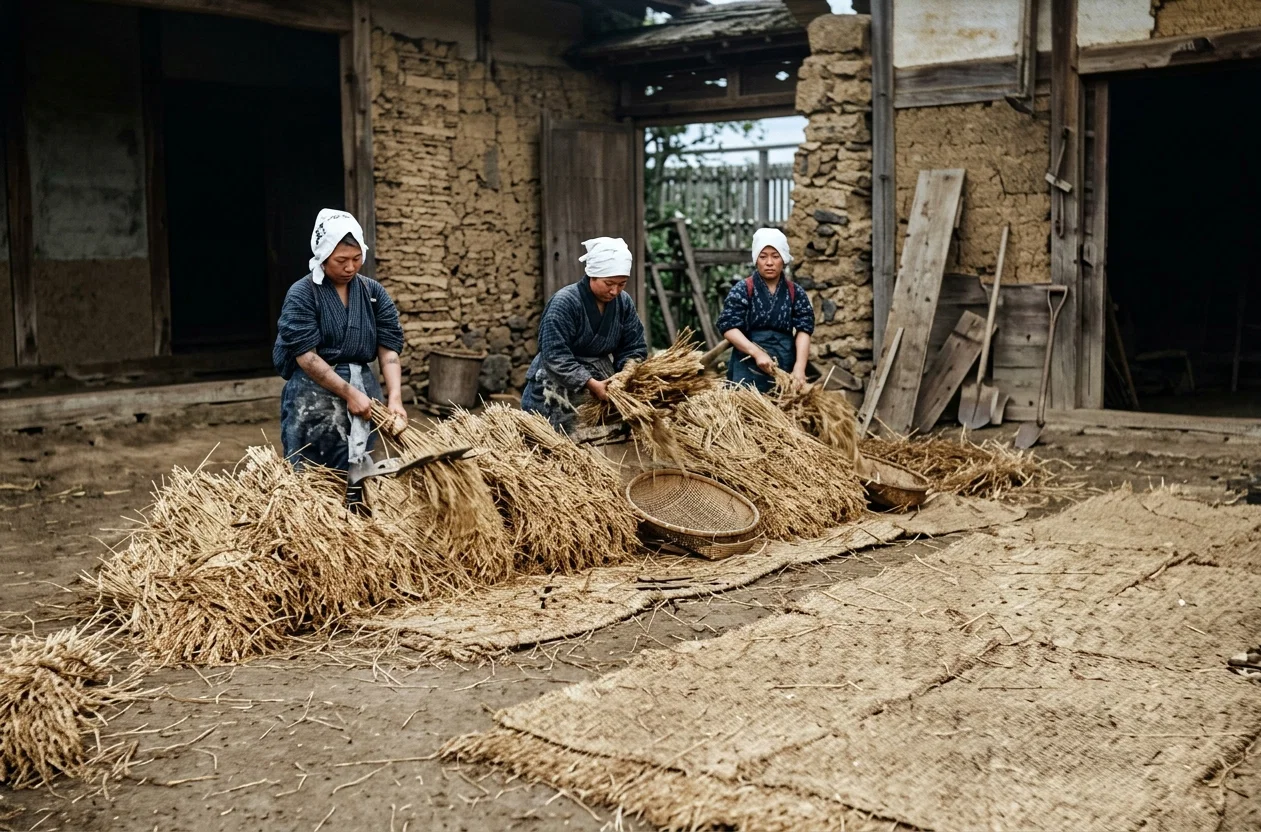
As far as I have observed, the threshing is done chiefly by women and girls, who draw the grain end of the sheaves through an instrument similar to a hackle. The winnowing is done by tossing the grain up, for the wind to blow the chaff away. When sufficiently cleaned, it is put up in straw bags containing nearly one hundred pounds each, when it is ready for the market.
TRANSPLANTING RICE.
GATHERING RICE.
Every farmer endeavors to have two pieces of land—one for rice and another of upland for vegetables and other grains; otherwise he would have difficulty in finding employment during the growing season.
After the rice crop has been harvested, many farmers, especially tenant farmers, drain their rice fields and cultivate a crop of winter vegetables. If tenants should not do so, they would have great difficulty in supporting their families, for the landlord takes his rental out of the rice crop, amounting to from three-fourths to seven-eighths of the whole. Under favorable circumstances the tenant farmer realizes about two hundred yen for his year’s labor, which is equivalent to one hundred dollars of our money. Out of this must be taken house rent, seed, and fertilizers before allowance can be made for food and clothing for his family.
Certainly the condition of the Japanese farmer is not one to be envied. And yet his condition is not considered the worst in the country. The lot of the common coolie is harder than that of the farmer. He works for forty sen a day, or less, at whatever he can get to do. Just think of a man working for twenty cents a day. That means that he pays rent, feeds and clothes his family, and sends his children to school on an income of seventy dollars a year. “How does he do it?” you ask. I do not know. His life to all appearances is without a ray of hope for any improvement in his condition. It is a constant battle for existence; yet he appears to be happy and contented. This seeming happiness is chiefly artificial, the result of education, or I would better say of training. You never see the least manifestation of grief among any Japanese except small children. It is very difficult to ascertain their true feelings, or to get access to their inner selves. They are by no means a confidential people. At any rate, it is hard for foreigners to get into their confidence.
I have somewhat digressed from the subject I started out to write about, and will resume by considering other products of agriculture, the chief of which is tea and mulberry trees. The tea plant is an evergreen shrub that grows three or four feet high and is cultivated on uplands very much as vineyards are cultivated in California. The time of harvest is in the spring—the tea of commerce being the new leaves which are gathered and dried in a certain manner. The different kinds of tea depend on the condition of the leaf when gathered or in the difference of manipulation in the process of curing, mainly the former. Tea-farming is a much more agreeable occupation than rice farming; for wading almost up to the knees in mud for several months of the year would be to me a very disagreeable business.
The mulberry tree is cultivated for feeding silkworms. This industry during the last few years has increased very rapidly, and I understand is fairly profitable—more so than tea culture, which of late years has not been so remunerative as formerly.
The silkworms are kept and fed in a house constructed for that purpose, or if the business is small, in one room of the farmer’s residence. The mulberry trees are cut down as needed, and the leaves are stripped off and fed to the worms. The suckers that grow around the stump this year will be cut off next year, and so on. Consequently a mulberry orchard is not a thing of beauty, especially during the feeding season. This is a very pleasant business for old men, women, and children, to whom this work is usually allotted. The young and strong men of the family devote their time to other and more severe labor. When the cocoons are finished, they are sold to the manufacturer, who rolls off the silk and prepares it for the weaver.
THRESHING RICE.
Farms are as a rule very small when compared with American farms. The method of cultivating the soil is so primitive that it is impossible for a family to cultivate more than a few acres. Modern machinery is almost unknown. The mattock, the rake, and the hoe are the chief implements of agriculture. In my ramblings one day last summer I saw an Oliver plow, the only thing of the kind I have seen in the country, and it was not in use. The sight of it made me feel as if I had met an old friend.
Almost all kinds of vegetables are produced here in great abundance, but aside from oranges, strawberries, and persimmons, fruits are very scarce and inferior in quality. There is nothing here except the above mentioned that is worthy of being compared to California fruit. A few apples are brought down from the northern island which look nice but are inferior in quality and dear in price—the best ones selling for eighteen or twenty sen a pound (9 or 10 cents.) W. C. GRAINGER.
June 2, 1898.
GOD AND THE BOY IN KNEE-PANTS.
“Why, that was thousands of years ago,” exclaimed Fred in amazement.
“Well, the sun shone thousands of years ago, and the same sun is shining to-day,” replied his mother.
“But see here; I’m just a boy in knee-pants.”
“That is nothing dreadful. There are probably a hundred million of you in the world, and knee-pants are no further from God than long pants.”
Fred went out of the room, and pretty soon his father found him staring straight up into the sky.
“Hunting for stars?” he asked laughingly.
“No, sir,” Fred stammered, confused. And then he, too, laughed and asked, “How much nearer to heaven are you than I, papa?”
“If you mean the blue heavens above, the top of my head is probably two feet nearer than yours. But if you mean the heart of God, there is not even that much difference, I am sure; for He loves a boy as well as a man.”
“That’s what mother said, but I couldn’t understand what He could want with a boy in knee-pants, yet.”
Fred’s father pointed him to where the workmen were building the stone walls of a house, and said: “You see the mason is just fitting a small stone in the wall. A large stone would not fit there. So there are hundreds of places where a boy fits into God’s plan of the world, but a man would not. Time and again he has used boys, thousands of whom we have never heard. So if you see any good that a boy can do—making another boy see the meanness of a mean act or the glory of an unselfish one, protecting a dog or other creature, lightening life’s burdens a little here and there for wearied ones, and getting ready for the work of a man by and by—remember that is one of God’s calls to you to serve Him, and that He wants all the boys in knee-pants to stand in close to Him, ready for His commands.”—Christian Endeavor World.
CAN’T RUB IT OUT.
“DON’T write there,” said a father to his son, who was writing on the window.
“Why not?”
“Because you can’t rub it out.”
Did it ever occur to you, child, that you are daily writing that which you can’t rub out? You made a cruel speech to your mother the other day. It wrote itself on her loving heart, and gave her great pain. It is there now, and hurts her every time she thinks of it. You can’t rub it out. You whispered a wicked thought one day in the ear of your playmate. It wrote itself on your mind, and led him to do a wicked act. It is there now; you can’t rub it out.—Anon.
Rice in Oil.
By Mrs. A. C. Bainbridge
Heat one teaspoonful of olive oil to the boiling point in a granite or porcelain kettle. Put into it one cupful of rice that has been well washed and dried. Shake and stir over a hot fire, until the whole is a good straw color. Add one quart of boiling water, and let the rice simmer gently until done, about forty minutes.
It will need no dressing, and will be delicious eaten with crisps or hard crackers.
A good way to get rice ready quickly is to wash it in a sieve, and spread it out in the sieve on the shelf of the oven to dry.
Some may like to add one cup of strained tomato and less boiling water—or any pleasant fruit juice may be substituted for a change.
Others may want to use salt, sage, or lemon juice—but “the plainer we cook the food we eat, the clearer our thoughts will be.”
Mrs. A. C. Bainbridge.
THE TRULY NOBLE.
It is not that they never knew
Weakness or fear who are the brave;
Those are the proud, the knightly few
Whose joy is still to serve and save.
But they who, in the weary night,
Amid the darkness and the stress,
Have struggled with disease and blight,
With pitiful world-weariness;
They who have yearned to stand among
The free and mighty of the earth,
Whose sad, aspiring souls are wrung
With starless hope and hollow mirth,
Who die with every day, yet live
Through merciless, unbrightened years,
Whose sweetest right is to forgive
And smile divinely through their tears,
They are the noble, they the strong,
They are the tried, the trusted ones,
And tho their way is hard and long,
Straight to the pitying God it runs.
—Harper’s Weekly.
Our Work and Workers.
There are now eight tent companies at work in Michigan.
The next school year of Healdsburg (Cal.) College will begin September 7.
Brother C. J. Herrman reports the baptism of seven candidates at West Superior, Wis.
Brother O. Soule reports the baptism of six persons at Colfax, Mich., and one at Mesick.
The date of the camp-meeting at San Diego, Cal., has been changed from August 18-28 to August 4-14.
The report of the Paterson, N. J., church for the past quarter shows an addition of sixteen members.
Brother B. W. Marsh notes the baptism of one candidate at Crawford, and one at Montrose, Colo.
A new house of worship has been erected and dedicated by the church at Onawa, Iowa. Brother J. S. Hart and B. E. Fullmer were in attendance.
Brother L. F. Trubey reports to Echoes from the Field that ten persons have been added to our ranks at Cripple Creek, Colo.
A series of meetings is being held in the new house of worship at Stanley, Wis., by Brother J. B. Scott.
On the occasion of the last quarterly meeting at Nevada, Iowa, seven members were added to the church.
At Levi, Texas, Brother J. B. Beckner baptized three persons, one other candidate being prevented by sickness.
Four meetings a week are being held in Brooklyn, N. Y., for the benefit of the Scandinavian people, by Brethren J. F. Hansen and J. F. Olsen.
The clerk of the church in Jersey City, N. J., reports to the Atlantic News that during the past quarter “eleven souls have acknowledged their Saviour.”
After the German camp-meeting recently held at Endicott, Wash., thirteen candidates were baptized by Brother G. F. Haffner in the Palouse River.
Brother W. H. Smith reports to the Keystone Gleaner the baptism of six candidates at Pittston, Pa., and the addition of four members to the church at Harrisburg.
Brother D. C. Babcock, president of Virginia Conference, writes that he is in the midst of an important interest in Portsmouth, with an average attendance of about four hundred.
Elder J. N. Loughborough is spending a few weeks among the churches in Atlantic Conference. He spent a short time in Washington recently, going to Baltimore on the 7th inst., where he remained a week, and then moved on toward the northern part of the conference.12
Brother O. Glass, who is holding meetings in a schoolhouse at Mansfield, Texas, reports the baptism of three candidates, with others deeply interested.
Brother W. H. Saxby, under date of June 28, notes the addition of three to the church at Louisville, Ky. Eleven had been added some three months previous. The outlook there is encouraging.
We have received the “Calendar Number” of the Keene Academy News, of Keene, Texas, and would commend its perusal to all of our brethren in the district to which the academy looks for support. It contains full information regarding the academy, and presents a neat appearance. All communications should be addressed to Keene Industrial Academy, Keene, Johnson County, Texas.
Brother W. T. Millman, who was recently called from Missouri to the Dakota field, reports to the Workers’ Record that at the North Dakota camp-meeting eighteen found the Saviour and were baptized. At the South Dakota meeting forty-two were baptized. Returning to Missouri temporarily, he attended the quarterly meeting at Winston, and reports an addition of ten to the church.
The officers of Pennsylvania Conference have decided to enter the most prominent places in the State with tents. Brethren W. H. Smith and E. H. Rees have pitched in Harrisburg, the capital; Brother E. A. Merrell, in Philadelphia; Brother L. S. Wheeler, in Pittsburg, and Brethren C. F. McVagh and Chas. Baierle, at Lake Ariel, Wayne County, a summer resort, where many visitors gather during the warm weather.
Scatter the periodicals in public places, brethren; they reach people that would otherwise be overlooked or passed by. A minister who resides in a Pennsylvania town never had seen the American Sentinel until he incidentally found one at the railroad station in Fairfield, Iowa. On perusing it his interest was aroused, and he sent for it to the office of publication. Such incidents are of frequent occurrence, and the periodicals are the means by which alone the attention of many will be called to the important fact that we are living in the last days.
Another of our well-known and efficient laborers, Brother Chas. L. Boyd, has laid down the armor. He died at Asheville, N. C., July 1, of malarial fever. Brother Boyd was a native of New Hampshire, but his labors in connection with the cause we advocate carried him across the continent to the presidency of Nebraska Conference, and, later, North Pacific Conference. Then he was one of the first ministers sent to the South African field, whither he went in 1887. After laboring there some years, he returned, and has since been engaged in Tennessee, Kentucky, and North Carolina.