Your ShelfYour Projects

Signs of the Times, Vol. 24, No. 29.

CONVERSING WITH CHRIST

Signs of the Times

Jul 21, 1898

Pacific Press Publishing Company · Oakland, California · Jul 21, 1898

CONVERSING WITH CHRIST.
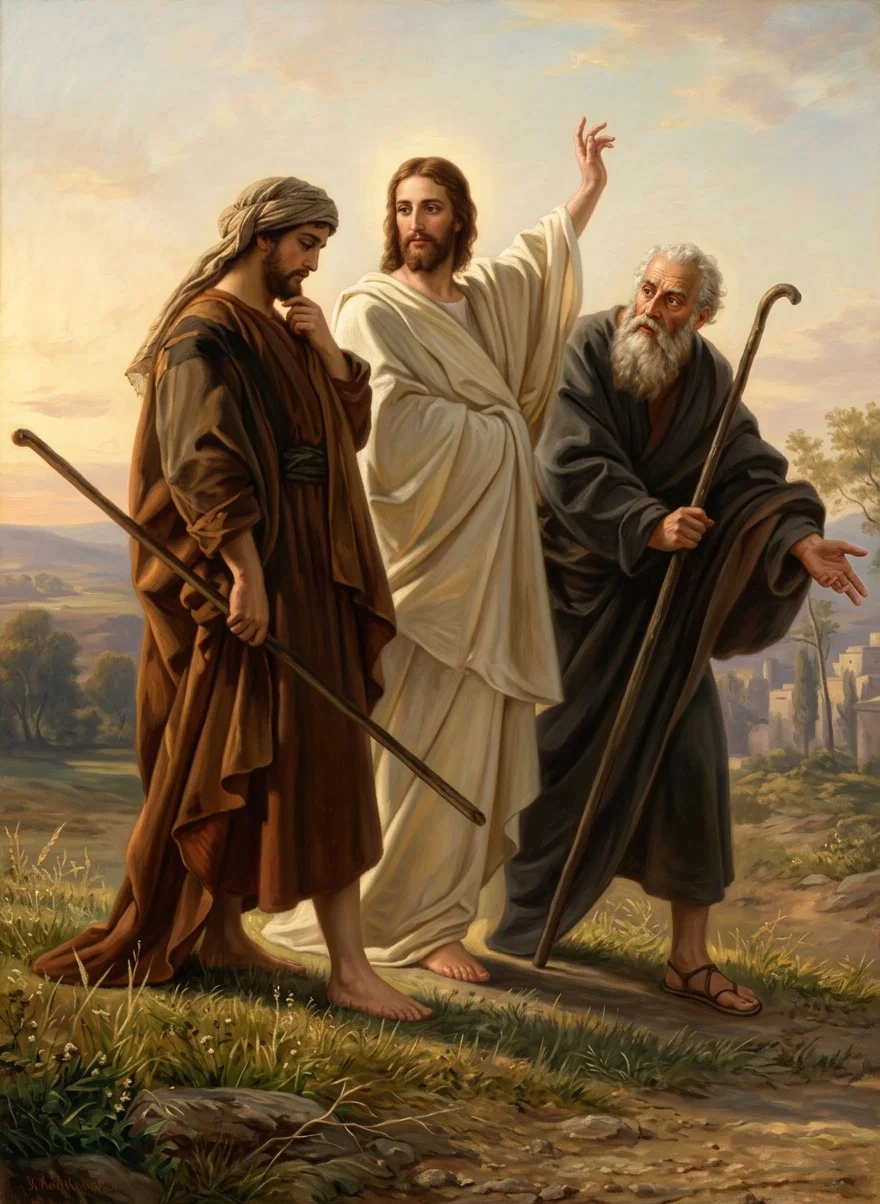
“Did not our heart burn within us, while He talked with us by the way, and while He opened to us the Scriptures?” Luke 24:32.
Reader, go back nearly nineteen centuries to that wonderful land of Judea, at the time when the “Desire of all Nations” walked upon earth a man. But He spake as never man before had spoken. He wrought works such as man never before had wrought. He revealed an unselfishness, a love for humanity, a gentleness, a tenderness, a mercifulness of disposition, such as had never before been seen. Surely He was the long-promised Messiah, the King to sit upon the throne of David.
JESUS AND THE DISCIPLES ON THE WAY TO EMMAUS.
AND all this was true. He was the Messiah; He was the King. But He was now even the divinely appointed Man, Example, Sacrifice. But this a people wrongly educated could not see. They wanted a temporal king, triumphant over the hated Roman power. They wanted a temporal kingdom, rivaling in court splendor the glory and magnificence of Solomon’s reign. The disciples of Jesus believed Him to be the king, and earthly Jerusalem His capital city, and Mount Zion His throne; and each of the twelve, at least, wanted the highest place in that kingdom.
POOR men; they were doomed to disappointment. They could not believe, much less realize, that entrance to that kingdom , both as king and subjects, was by the way of the cross. He had said: “If any man will come after Me, let him deny himself, and take up his cross daily, and follow Me,” and “whosoever will be chief among you, let him be your servant; even as the Son of man came not to be ministered unto, but to minister, and to give His life a ransom for many.” This and much more they had heard of the lowly way, and the crucifixion; but eyes blinded with national prejudices could not see; ears stopped by selfish schemes could not hear. Their imagined ideas of the splendor of Christ’s reign eclipsed all else, and they passed blindly on to disappointment, the lessons given to save them from it unheeded. Thus it was till the arrest and passive submission of Jesus came. Even then they hoped He would assert His power and conquer His enemies, until the rebuff of Peter and His announcement that He must drink the cup. Then “all forsook Him and fled,” and He was left to tread the winepress of humiliation, of anguish, of suffering, alone.
NONE, save perhaps the disciples who looked for Christ to come in 1843 and 1844, can appreciate the disappointment of the disciples in 31. They saw their Lord taken captive; returning and following again, they saw Him humiliated, beaten, scourged, mocked, falsely condemned to die, stretched upon the cruel cross, yielding up his life as a malefactor, laid in the grave. Disconsolate and disheartened, they were despairingly mourning over that which was their salvation. Two of them go from Jerusalem to Emmaus, a distance of seven and one-half miles. On the way a Stranger overtakes them. He asks the sorrowful men the subject of their conversation. They tell Him of Jesus, and of their blighted hopes: “We trusted that it had been He which should have redeemed Israel; and beside all this, to-day is the third day since these things were done.” Their minds were as dull to comprehend the Scriptures as their eyes were to discern the form of the Master by their side.
But He does not leave them in stupidity and sorrow. He turns their thoughts to the only source of comfort and strength, the Scriptures of truth. The Stranger knew naught of the “higher criticism,” tho He did of higher thought, higher life, higher hopes. “From Moses and from all the prophets, He interpreted to them in all the Scriptures the things concerning Himself.” He went with them to Emmaus, talking as they went. They urged Him to tarry. He ate with them; blessed andbrake their bread; and, more blessed than all, opened their blind eyes so that they recognized Him. And then He vanished.
BUT He left them not in despair. Hope reigned in their hearts once more. It gave them a message to those in Jerusalem. They rose that same hour and started on their return. The Master is risen. They say to themselves, “Did not our hearts burn within us, while He talked with us by the way, and while He opened to us the Scriptures?” They find the other disciples saying, “The Lord is risen indeed, and hath appeared unto Simon.” Together they rejoice, and again with burning hearts the two tell of the journey with the Master, and His opening of the Scriptures.
DEAR soul, Christ is risen indeed. He is a living Saviour, a living Teacher. He left an unchangeable message to all His disciples: “Lo; I am with you alway, even unto the end of the age.” He comes to you in various strange and mysterious providences. He walks by your side, striving to help you when you are cast down. He would by His blessed Spirit of truth open to your mind and heart the Scriptures, the Word of life, if you are longing to know them, that you may do them. He will tarry with you to break and bless to you the bread of life if you really desire Him. No path He calls upon you to tread will be trackless of His stone-bruised feet. No trial so fierce but that its thorns have pierced Him. In the mightiest storms He has stood unsheltered and alone. He pities all; He would help all. He wishes to talk with you, to help you, to make truth plain to you, as truly as He did to the disciples at Emmaus, nineteen centuries ago. Will you let Him?
“Talk with us, Lord; Thyself reveal While here o’er earth we rove; Speak to our hearts, and let us feel The kindlings of Thy love.
“With Thee conversing we forget All time and toil and care. Labor is rest and pain is sweet If Thou, my God, art here.”
X.

COUNTING THE COST.

“If any man come to Me, and hate not his father, and mother, and wife, and children, and brethren, and sisters, yea, and his own life also, he can not be My disciple. And whosoever doth not bear his cross, and come after Me, can not be My disciple.”
Great multitudes followed Christ, and He welcomed with joy all who came to Him for instruction; but the Searcher of hearts knew who in the throngs that daily pressed about Him were really disposed to own Him as the promised Messiah. Many who witnessed His miracles thought that the power which could heal the sick, feed five thousand men with five barley loaves and two small fishes, and raise the dead, would be a great help to them in their temporal necessities. They had followed Christ in the hope that He would be exalted to David’s throne. They wanted the highest place. But Christ would not have men count upon ease and earthly advantages in connecting themselves with Him. In His lesson He taught them that self-denial and the most difficult sacrifice must be expected of all who would become His disciples. Those who engage in His service must be ready to give up their dearest friends and relatives, to be despised as fanatics and fools, and to suffer bodily harm for His name’s sake. If they should become discouraged by what the world might say or do; if they should not endure the test of their love and loyalty; if they refused to keep God’s commandments because their neighbors made sport of them, they could not perfect that faith which works by love, and purifies the soul.
That Christ should at their feasts presume to speak words of reproof to them, and that He should devote so much time to instructing those whom they regarded as sinners, greatly offended the Pharisees; but Christ saw it necessary to give, in His own life, an example to His followers. He acted out His own teaching. In the synagog at Nazareth He had declared: “The Spirit of the Lord is upon Me, because He hath anointed Me to preach the Gospel to the poor; He hath sent Me to heal the broken-hearted, to preach deliverance to the captives, and recovering of sight to the blind, to set at liberty them that are bruised, to preach the acceptable year of the Lord.”
Christ met with the greatest success among the needy and the unfortunate, and these received the richest blessings of His grace and ministry. His work was to do good to those whom the Pharisees despised. The needy, the broken-hearted, were the objects of His special attention. His words to them were words of truth and light. He did not tell them that they should become exalted, honored, and wealthy, by believing in Him. He showed them the worthlessness of all human greatness. And through His words, the Spirit of God, quick and powerful, spoke to those poor, weary, dispirited souls in their fruitless search after happiness. “He that taketh not his cross, and followeth after Me,” He said, “can not be My disciple.” “If any man will come after Me, let him deny himself, and take up his cross, and follow Me.” “So shall he be My disciple.” The cross one lifts and bears after Jesus, is the pledge to him of a crown of glory in the kingdom of God.
In His infinite mercy God took into His hands the salvation of all who would believe in Him. Because of the rebellion in the heavenly courts, the love of God was to be vindicated, not only before all heaven, but before all the worlds that He had made. Everything would be done to keep the first human beings loyal, but if they should be overcome by temptation, Christ engaged to become man’s Sacrifice, his Substitute and Surety. “God so loved the world, that He gave His only-begotten Son, that whosoever believeth in Him should not perish, but have everlasting life.”
To Thomas Jesus said, “I am the Way, the Truth, and the Life; no man cometh unto the Father, but by Me.” John declares of Him, “He is the propitiation for our sins; and not for ours only, but also for the sins of the whole world.” Yet how often is Christ insulted and made ashamed by those who, while claiming godliness, place out of sight Him in whom their hopes of eternal life are centered! How is the attractive loveliness of Him who should ever be uplifted, obscured by the deceptive faith of His professed people! How is His beauty veiled, His honor withheld! God is revealed in Christ, and those who would be benefited by His salvation must center their faith in the Substitute and Surety, the Substance—the glory and power of all who believe in Him.
Those who believe in Christ must be willing, if necessary, to forsake father and mother, sisters and brothers, and, if need be, sacrifice their own lives, in order to be doers of the Word. Those who refuse to do this, who refuse to lift the cross, can not be Christ’s disciples.
“For which of you,” said Christ, “intending to build a tower, sitteth not down first, and counteth the cost, whether he have sufficient to finish it? Lest haply, after he hath laid the foundation, and is not able to finish, all that behold him begin to mock him, saying, This man began to build, and was not able to finish.”
If they would, the scribes and Pharisees could have comprehended the lesson. In the sacrifices that prefigured Christ, the Jewish nation had been laying the foundation of their religious faith, and they had come to the place where they could advance no farther. That which was to complete the building was to them a stone of stumbling, and a rock of offense. All the irreligious service was represented by the unfinished tower, because they refused to receive Christ. Type had reached antitype in Christ, but the one prefigured in all their sacrificial services, He who alone could make atonement for their sins, was among them acknowledged. He who alone could give efficiency to their faith was refused. And their refusal to receive the world’s Redeemer left them with their salvation incomplete; without Christ they were a ruin.
Christ continued: “Or what king, going to make war against another king, sitteth not down first, and consulteth whether he be able with ten thousand to meet him that cometh against him with twenty thousand? or else, while the other is yet a great way off, he sendeth an ambassage, and desireth conditions of peace. So likewise, whosoever he be of you that forsaketh not all that he hath, he can not be My disciple.”
The only hope for the Jewish nation was in their acceptance of Christ, in forsaking their sins, and being reconciled to God. United to Christ, they would indeed become a great nation. He would work for them as He had worked for them in the past. If they were obedient, He would lead them to the heavenly Canaan as He had planted them in the earthly Canaan. Had they accepted Christ, His death would have been brought about by other people. But tho they had the Word of God to instruct them in regard to these things, the Jews marched steadily on to do unto Christ as the prophecies had foretold. They continued their course of pride and religious bigotry, ostentatiously boasting of their superiority, without thought as to the result. The world was against them, yet they were pursuing their own course, blindly playing into the enemy’s hands. How much better would it be for them to desire conditions of peace from the only One who could create peace!
“So likewise, whosoever he be of you that forsaketh not all that he hath, he can not be My disciple.” To the young ruler who declared that he had kept the commandments from his youth up, and with self-assurance asked, “What lack I yet?” Christ said, “If thou wilt be perfect, go and sell that thou hast, and give to the poor, and thou shalt have treasure in heaven; and come and follow Me.” But when the young man heard that saying, he went away sorrowful, for he had great possessions. His lack was plainly revealed. His earthly possessions were his idol. If the young ruler had appreciated Christ, he would have heeded His instruction. But the love of the world was not overcome, and the love of God could find no room in his heart. He did not receive Christ and believe in Him.
All who follow Christ will hear His words, and appreciate them. They will distinguish between truth and error. And the truth received into the mind will change the heart and give new character to the life.
MRS. E. G. WHITE.

WHAT MUST BE DONE WITH THE SINNER?

A writer greatly concerned over the welfare of all mankind inquires in a serious manner, “If the righteous scarcely be saved, where shall the ungodly and the sinner appear?” This query can not lightly be thrown aside. It surely needs to be considered well.
As all things were created for God’s glory, think of what should be done with him who will not glorify God. What shall be done with the person who refuses to fulfil the purpose for which he was created? As man was by creation placed in perfect harmony with all his environments, that he might be happy, what must be done for him now to give him happiness? Is it not necessary still for him to accord with his own interests, and that eternally? Can he be happy until he does this? If he utterly refuses to do these necessary things, then what should be done with him?
By sin, man opposed himself and his Creator. He put himself against himself. He broke away from his own life, and made a covenant with death. He was bartering for the wages of sin, which the apostle says “is death.” “He that sinneth against Me,” says the Lord, “wrongeth his own soul; all they that hate Me love death.” Prov. 8:36.
The Lord has a great interest in, and love for, man, and, therefore, when man destroys himself, he is failing to glorify God. Man is destroying that which belongs to his Creator, when he works out his own destruction.
When man, by transgression, severed the cord of life, God interposed before the Adamic life had run its course, and gave him a chance to unite with eternal life in Christ. If, under these considerations, man refuses to lay hold on the life provided for him at great cost, what then can he hope for? If he refuses to receive life, must not he then inevitably take death? He can not complain at receiving that which he has chosen for himself.
The sinner is told that a wicked man treasures up “wrath against the day of wrath.” Rom. 2:5. He is, therefore, gathering up great stores of punishment, which must some day fall upon his own head.

The Sinner Can Not Be Happy.

In support of the above proposition, recollect that the wicked are in pain all their days (Job 15:20), and that they are like the troubled sea, which can not rest (Isa. 57:20, 21).
Now it is quite plain that such a life is not one of satisfaction. It does not, when thus used, glorify God, who gave it. It does not bring fulness of joy to man, who has it. Under these circumstances, it can not give the Creator pleasure to extend it even as it is. Certainly He could not then take more pleasure in making it infinitely and eternally worse. The sinner himself is not made happy by it; what, therefore, can be done in such a case?
There can be but one solution to the problem, and it is this: Take his life away, and let him not be accounted as among the living. The Lord has given him a fair trial, and he has only used life to make himself and others unhappy. He constantly chooses the wrong things, and if he should be compelled to do that which he will not choose to do, he would be unhappy still. It seems plain that such a person must eventually be counted as wholly out of harmony with the purpose of God. He is certainly negative to that which is for his own good. He should, therefore, become negative as to quantity. The prophet says that such “shall be as tho they had not been.” Obadiah 16. Surely none could in reason complain of this.
He that makes the thing which was designed for a blessing, to be only an occasion for sorrow, is not injured by having it taken away. The man who does not rightly use life, and who can not be made happy, has no proper interest in God’s purpose concerning life, and, therefore, he is counted as tho he had not been.
WM. COVERT.

CHRIST A SABBATH REFORMER.

The professed people of God in the days of Judah and Jerusalem passed through some varied and trying experiences. With the history of the Lord’s mighty dealings before them in bringing them out of the land of their captivity, and in spite of the wonderful deliverances wrought for them, they forgot the Source of their strength and turned to the worship of heathen idols and deities. Had they obeyed the Lord, He would have made them a beacon-light to all the nations of the world. It evidently was His purpose forever to send forth from Jerusalem His law, and make it the center of the world’s evangelization. He says through His prophet that if His professed people had obeyed His voice, and refrained from polluting His Sabbath, the city would have stood forever. Jer. 17:24, 25. But He further threatened that if this was not done, He would destroy the city of David and carry away the people into captivity. The people forgot the Lord, and the wo pronounced was poured out. The city was besieged and laid waste. The wretched inhabitants were carried into bondage.
It seems that in the captivity and in the eventful years following they learned some severe though imperfect lessons. It is natural for the mind of man, if not balanced by sanctified judgment, to go to extremes. And the man who takes one extreme to-day will quite likely be found advocating the opposite extreme to-morrow. Thus it was with the Jewish nation. From the laxity and looseness pervading their observance of the Lord’s Sabbath under the life of their own government, they had swung in the days of Christ clear around to the other extreme, and had surrounded the Sabbath with such exacting requirements and superstitious mummery and self-righteous regard as to wrest it from the place appointed of God quite as much as when they pursued the opposite course.
In the observance of the Jewish ritual, the Lord’s day had ceased to be a day of delight. Its requirements were burdensome and exacting. Christ, the world’s Teacher, began His work. His efforts for reform were thorough and far-reaching. He finds the day made and set apart by His own divine hand at the creation of the world torn from its holy setting, and instead of fulfilling its holy purpose of lightening the burdens of men and bringing them joy and blessing, proving a curse in making the service of God distasteful and oppressive. Regardless of the opposition He would encounter from the rabbis, He does not hesitate to reform the practise of the people regarding Sabbath observance. By precept and example, by acts of charity and mercy, He proves that the Sabbath was designed as a boon to the human family, a day in which mankind should seek good and do good, a day for unloosing the bands of sin, undoing the heavy burdens, and letting the oppressed go free. The lame man, by the exercise of His power on the Sabbath day, was enabled to take up his bed and walk. The man with a withered hand on that same day felt new life and vigor coursing through the fibers of his disabled member.
The Jewish teachers stood aghast. In their misconception of the requirements of the law of God, they thought this course of action on the part of the Saviour was a violation of the divine precepts, and that it was a stroke made against God’s sovereignty and authority. But the Saviour refutes this teaching. He shows them that the law of humanity implanted in their natures would lead them to loose an ox and lead it away to water, or to lift a sheep from the pit where it had fallen. And if the law of nature would lead them to do this, how much more would the demands of this same law lead them to go to the succor and relief of those made in the image of their Maker. And in conclusion He adds, “Wherefore it is lawful to do well on the Sabbath days.” See Matt. 12:1–12.
Thus did He, the same as they, recognize the existence of the law of God in all of its binding obligation, and taught that His observance of the Sabbath day, in making it a day of blessing, was in keeping with the truest and highest requirements of that law.
Even previous to this conflict with the Jewish teachers, in the memorable sermon given on the mount, Christ had declared emphatically the relation of His mission to the law of God, divining doubtless that there were in the multitude assembled on that occasion those who thought that His attack on Jewish customs and prejudices was antagonistic to the divine requirements. “Think not that I am come to destroy the law, or the prophets; I am not come to destroy, but to fulfil. For verily I say unto you, Till heaven and earth pass, one jot or one tittle shall in nowise pass from the law, till all be fulfilled.” Matt. 5:17, 18.
Thus Jesus Christ, the world’s Creator and Redeemer, the man who spake as no other man spake, before nor since, the Teacher of all divine truth, recognized the existence of the divine law, and the existence of the Sabbath commandment as a part of that law, and gave His own example and practise as a model of true and proper Sabbath observance.
Before closing this paper we can not forbear contrasting the methods of Christ in His work of Sabbath reform with the methods of so-called Sabbath reformers of the present day. Christ sought no political alliances, invoked no aid of sword or spear, but depended alone on thepower of the Spirit of God to send the arrows of truth home to the hearts of the listeners. He enjoined the observance of the one true Sabbath made by Himself at creation, the token of His sanctifying work, as the day above all others to be a delight, a joy, and a blessing to the children of men.
In the work of false sabbath reform to-day the methods of Christ have been revised. The arm of the civil power is invoked. The power of the civil law is called into requisition. The policy is to compel men to do what the Spirit of God does not prompt, nor their desires lead them to perform. And instead of the one true Sabbath being held out to men as a sign of Christ in creation and redemption, a false sabbath, a usurper and counterfeit, is urged upon men’s regard, and too often backed up by civil requirement.
Which is the true Sabbath, the one enjoined by Christ, or the one commanded by men? And which are the better methods, those employed by the great Teacher, or those prompted by worldly policy and political measures? “What is the chaff to the wheat? saith the Lord.” F. M. W.

LIFE

Gone are my infant days, Going from mother's cares; Come are my boyhood plays, Coming more youthful snares.
Gone are my days of glee, Going my youth's sweet days; Come are more cares to me, Coming are manhood's ways.
Gone are life's pleasures rare, Going, young manhood's days; Come are more days of care, Coming to hopes a haze.
Gone are my youthful days, Gone are my days of glee, Gone are life's pleasant ways, Gone is life's best from me.
Going from me my strength, Going from me my life, Going to rest at length, Going to rest from strife.
Comes soon the day of doom, Comes now the time to rest, Comes now the silent tomb, Coming the summons blest.
Coming the Saviour mine, Coming the endless days; Coming the life divine, Coming eternal praise.
Jimmy Sycamore.

Babylon the Third

THE THREE BABYLONS. No. 12.

Babylon the Third.

We have already learned what Babylon is, and how it is developed. We have seen why it was that Satan did not have the second great apostasy renounce churchly allegiance. We will in this see that his experience has taught him to develop his plans sooner and with more skill to-day than ever before.
In the sixteenth century God led Luther away from the heathen darkness that had settled on the church during the Dark Ages. But the Lutheran Church wrote out its creed and said, “This is what we believe.” There was danger in that step; for it turned men's minds from the Source of truth to the truth revealed to Luther. This naturally clogged all the wheels of progress; God could not well reveal more to the adherents to that creed. For if God led another into more light, and Luther's followers accepted it, they had either to alter their creed or to go outside of the Lutheran Church to accept it.
This fact, then, of writing out a creed and saying, “This is the true belief,” placed the church where God had to seek some other agency through which to reveal more truth. Thus the creed made them reject truth, and so they became Babylon. So it happened that God had to call out one church after another; for each wrote out its creed and refused to go farther. So God called the Presbyterians, Baptists, Methodists, and others.
In the early part of the nineteenth century God had a message to give to the world. It was the announcement, “The hour of God's judgment is come.” He chose as a herald in this country a man named William Miller. In other countries others were chosen, so that each country heard it. But, strange to say, those of one country often did not know that the others were receiving the Word as well as they. So it happened that men were telling the same story in different countries independent of outside influence.
The knowledge of the fact that the hour of God's judgment was to come in 1844 was received from the book of Daniel. The time was made so plain that no one could gainsay it. But while the different denominations did not find any means to prove the falsity of the argument, yet they rejected the message andcast those who did accept it out of the churches. Now note: if the churches could not disprove the claims made from the Bible, they were bound to accept it, or at least to let others; and when they set themselves against it without being able to disprove the time, they were rejecting the Bible. But says one, “The message was not true that the Lord was coming in 1844; for He did not come.” That does not matter; if it was so plain to them that the Bible taught it that they could not say aught against it, they rejected God's Word to them in rejecting it.
More than once has God given a message that was true, tho not true as understood by those who gave it. When Christ rode into Jerusalem, God gave the message that their king was coming unto them. That was true, and so necessary was the message that had the people remained quiet, the stones would have heralded the fact. But the message was far from being true as those who gave it thought. They thought He was coming to sit on a temporal throne. How mistaken, yet how necessary to be given! Just so it was with the 1844 message. The hour of God's judgment did begin, but not as they who gave the message supposed. We have not time to explain here; we are dealing with principle.
When the churches had rejected God's Word in 1844, they took their own ways; that is, they became Babylon and fell. More properly, the lost church that God called out did, while the others showed themselves to be Babylon. Do not misunderstand. Many good Christians still existed in the churches, but the churches as churches fell.
Having taken their own ways, they could but develop what Babylon the first and Babylon the second developed after their fall. The same moral aspect must appear—not in a day, but begin then to develop. I do not mean that bad men would begin to come in; for even the apostolic church had its Ananias. But I mean the churches as churches would begin to drop their standard and reject and accept customs according to their own liking, not according to God's Word, for that is rejected.
But we do not have to speculate about this. Look at the churches of to-day and see them carrying on “grab-bag” and “gambling” and “betting” games to sustain the church. The cards and dice are allowed. The pool tables are thought to be all right for church basements. Dances are given, where immorality is bred, to raise money to pay the preacher. Suppers are given, and the carnal desires of man drawn upon to secure money to preach to him that he must be unselfish. The discourses are such that they do not denounce popular sins. Having itching ears, the people heap to themselves teachers after their own lusts.
The popular minister is not the pious man but the orator; if he is respectable, that is enough. Spiritualistic séances—the council chambers of the devil—are held in church circles. A man who dares to condemn sin in no uncertain way is asked to resign before the following Sunday. The ministers go where they can get the largest salary instead of the largest harvest of souls. There is not one professor of religion in a hundred that loves his neighbor as himself. The Bible lies on the shelf from Sunday to Sunday. The religious world is far from converted. These things are not talk. Every honest, observing man knows this to be the truth. Modern Christianity is as verily a counterpart of old paganism as one could wish to see. But let me say again, there are good Christians in every church. But they are few.
But as the churches have rejected God's Word and His power, they must have something to convert men with. Hence the organization of all sorts of auxiliaries to draw the young into the church. But still the Sunday trains and newspapers are a great annoyance to them. The government must stop them. The power that they have not from God to convert men's souls, they must get from the outside. The government must supply what was lost by leaving God's Word. Not only must all Sunday work be stopped, but “all Christian laws, institutions, and usages of the government” must be placed “on an undeniably legal basis in the fundamental law of the land.” Men must act as tho they were religious by keeping the Sabbath anyway.
Who can not see that this is a living likeness of Babylon the second? As the leaving of the Word caused men to apostatize and lose God's Spirit and power then, so it has now. As they asked other power—governmental—to enforce their apostasy on men then, so now. As when that apostasy received that power, it became the beast, so now it becomes the image of the beast. As persecution arose then, so it has arisen now. As the death penalty was the sentence imposed for refusing to bow to that apostasy, so it will be now. As surely as leaving God's Word there caused the apostasy, and the apostasy became the beast by union with civil power, just so sure this apostasy could develop nothing but the image.
It may be said that those living now, generally speaking, are a later generation than those living in 1844. True, but a church that fell at that time could not teach a later generation better things than it had itself.
But there is a test for every soul in every age to see whether he will receive God's Word. Since 1844 God has been sending a message to mankind that their observances were pagan instead of Christian in one particular at least—the Sabbath. Light has been brought out to show that the Ten Commandments have neither been abolished nor changed, and so must be binding. Also that the change in the Sabbath came about in the days of Babylon the second. These things are shown with such clearness that there is but small effort to contradict it now.
And what do the churches say to these things through their ministers?—All sorts of things. “It doesn't make any difference, just so you keep one day in seven.” That is, it does not make any difference if God did bless the Sabbath day, another day is just as good. As well say, Let us take the bread and wine for communion after it is blessed and give it to the dog, saying, “One piece of bread is as good as another.” Yes, far better, for man blesses the bread, or asks God to, while God of His own accord blessed the day. Yes, all sorts of excuses are given for not obeying God. Babylon is stamped on every such excuse.
What will be the outcome of all this? We are not left in doubt about this, nor about our duty. Babylon is filling up her cup, and will receive double for all she has done. Her plagues shall come in one day,—“death, and mourning, and famine; and she shall be utterly burned with fire; for strong is the Lord God who judgeth her.” Time only lingers that the message may be given, “Come out of her, My people, that ye be not partakers of her sins, and that ye receive not of her plagues.” God doesn't need to wait till she is farther developed. Twice has the picture been placed before her that shows what it means to leave God's Word and follow her own way. With this before the people of this generation, God can in all justice write upon Babylon, and against them, all the sins that ever occurred in the apostasies of old. It is all in embryo in the first step. Note that carefully. As the Jews of Christ's day had all the blood from righteous Abel to the blood of Zacharias, who was slain between the porch and the altar, placed to their account, by rejecting all previous light in Jesus Christ, so this generation have all the apostasy from that of Cain down, written against them, because they have turned from all the light of the past. Soon will great Babylon be thrown down and be no more at all. Apostasy will have ceased, and those who remain will be those who listen for the least word of God, and follow it without hesitation. God will be all in all—all that exists in any who exist.
C. L. EMERSON.
Continue reading: The Popularity of Falsehood