Signs of the Times, Vol. 33, No. 8.

CONTAINED IN THIS ISSUE

Signs of the Times

Feb 20, 1907

Pacific Press Publishing Company · Mountain View, California · Feb 20, 1907

CONTAINED IN THIS ISSUE.

LESSONS FROM CALVARY.
THE MEEK WILL HE GUIDE AND TEACH.
"CALIFORNIA CHRISTIAN ADVOCATE" AGAIN.
QUESTIONS.
1999.—Christmas; 2000.—Begotten not of Blood, John 1: 13; 2001.—The Second Tithe; 2002.—Angels and Wings; 2003.—Salvation of Children; 2004.—The Wicked Dead, Mark 9: 43; 2005.—God's Working, John 5: 17.
CONSCIENCE.
SUBMISSION TO THE SIN-CONDEMNING WORD VERSUS CEREMONIALISM.
THE GREAT SALVATION.
The World to Come.
MISSING THE MARK.
COME.
SEASONABLE HEALTH HINTS.
OUR EYES AND THEIR PERILS.
ANNUAL MEETING OF THE PACIFIC PRESS PUBLISHING COMPANY.
SENATE REPORT ON SUNDAY OPENING.
THE CLOSING OF SALOONS ON SUNDAY.
WHAT CATHOLICS EXPECT.
ASKING IN FAITH.
POETRY.
God Knows.
Peace, Perfect Peace.
Lest We Forget.
Just to Be True.
A Noble Discontent.

FROM THE MAIL.

"Sedalia, Mo., Jan. 20, 1907. "My dear People: "Let me have sample copy of your publications. I have just run across an old paper, SIGNS OF THE TIMES, dated Nov. 29, 1899. I am interested in it. Thanking you for early reply, and oblige."
"Surely the signs of the times are ominous indeed, and I feel that we all 'need to be about our Father's business,' now and on and on. May God bless you all, and the editors especially, who have and need and appreciate His blessings and power. "May this year—1907—be a glorious one for you and for your work. "I read with special interest, this morning, the SIGNS of Jan. 2, 1907, and observe and like the new things indicated, new dress, new type, etc., and 'more is coming,' I see. I have said and hereby repeat that 'The SIGNS is better and better all the time.' I am much pleased with the Thanksgiving number, and took fifty extra thru our tract society. I enjoyed the 1906-1907 number, December 26."
"I am anxious to get hold of a paper devoted to signs indicating the speedy coming of Christ. How is your paper these stirring times?"
"Please send me copy of the SIGNS OF THE TIMES. I just found an old copy of November 1899, and it made me hunger for more."
"By chance I got two or three copies of the SIGNS OF THE TIMES. I am delighted with its teachings, and enclosed I send you P. O. Order for fifty cents. Please send me the paper weekly that I may know more about it, and know whether I can get it or not, and much oblige."

SPECIAL SERIES.

The plans for the SIGNS OF THE TIMES during 1907 include a series of twenty-six special numbers. This series is to soon begin. The value of the connected Bible studies running thru this series can not be overestimated. Here are the titles of studies in the first sixteen numbers in the series:
  1. The Bible.
  2. Prophecy.
  3. Coming of the Lord.
  4. Our Sacrifice and Priest.
  5. The Signs of the Times.
  6. The Law and the Gospel.
  7. Man and His Destiny.
  8. Spiritual Gifts.
  9. Election, Predestination, and Free Will.
  10. The Great Threefold Message.
  11. The Church.
  12. Bible Temperance.
  13. The Sabbath, the Test of the Ages.
  14. The Great Federation Movement.
  15. Religious Liberty.
  16. The Outpouring of the Spirit.
A booklet giving the plans for the year more in detail will be gladly furnished you free. Ask for "Plans for 1907." There is a "Feast of Good Things" in store for the readers of the SIGNS.
SUBSCRIPTION DEPARTMENT.

A Boon to Parents and Teachers

True Education Reader No. 2 has just been published. It is for use in Grade 2, that is, the second school year.
It is also admirably adapted for use in the homes where children do not have church-school privileges.
It will, in connection with Book One of the same series, put the children in possession of a complete key to English reading.
Its lessons are developed from the school-room work of the author, Miss Katharine B. Hale, who has successfully taught primary, public, and church schools, and is now teaching in Walla Walla College.

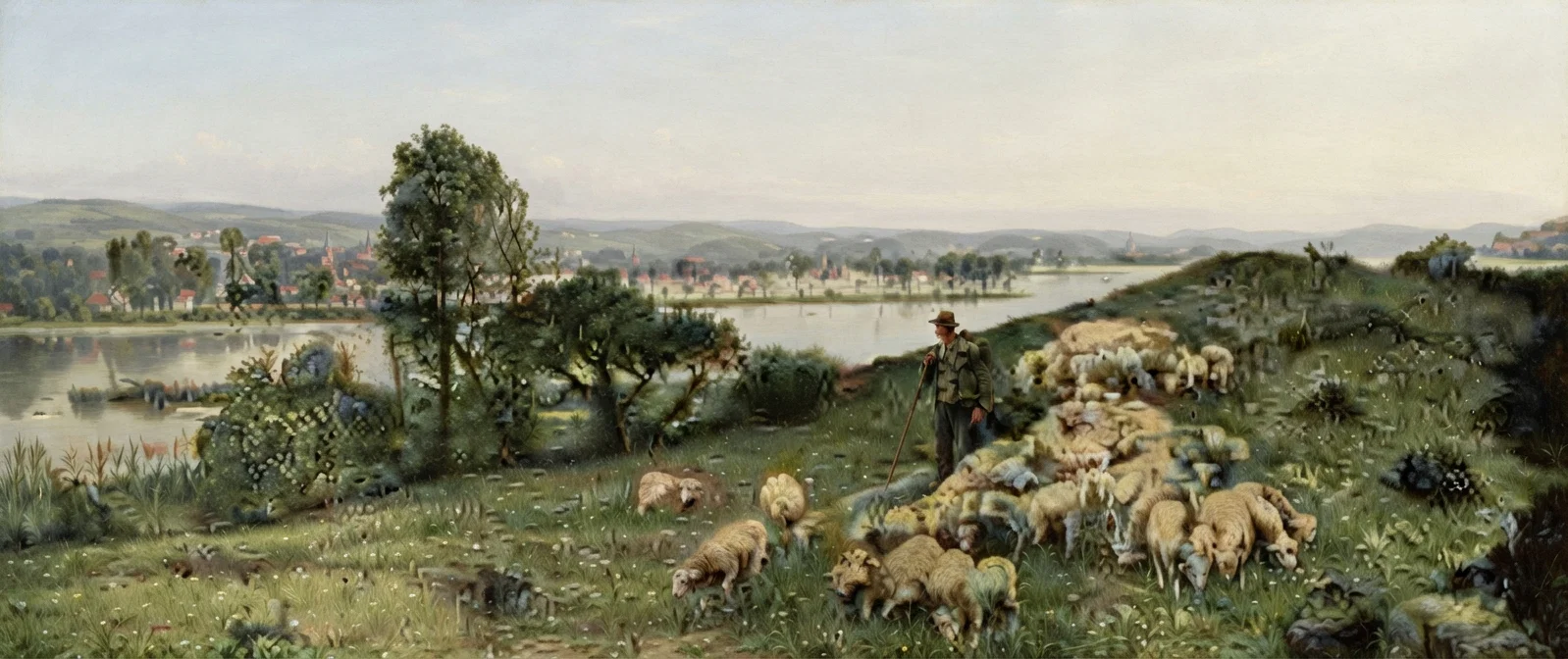
THE GOOD SHEPHERD

NEW PHONOGRAM LESSON BLEND DRILL
eth call' eth put' teth strān' gēr hirē' ling
lēad' eth gō' eth Shēp' hērd thēre' fōrē
tāk' eth flē' eth scāt' tēr eth cătch' eth
lēav' eth sē' eth fōl' low cār' eth
  1. The Good Shepherd calleth His own sheep by name, and leadeth them out.
  2. When He putteth forth His own sheep, He goeth before them. The sheep follow Him, for they know His voice.
  3. A stranger will they not follow, but will flee from him, for they know not the voice of strangers.
  4. Jesus said, "I am the Good Shepherd. The Good Shepherd giveth His life for the sheep.
  5. "An hireling, and not the shepherd, fleeth."
It presents, in connection with Books One and Three of the series, a great panoramic view of God's plan for this earth in the beginning, the successive steps in the wonderful work of creation, something about each of these steps, a sketch of certain selected Bible biographies, including the life of the perfect Child Jesus, His work, His sacrifice, the plan of salvation finished, and the new earth.
It contains 256 pages, is fully illustrated, and is bound in cloth. Price, post-paid, 75 cents.
PACIFIC PRESS PUBLISHING COMPANY MOUNTAIN VIEW, CALIFORNIA 285 Salmon Street, Portland, Ore. 1109 East 12th Street, Kansas City, Mo.

LESSONS FROM CALVARY.

WHAT unpromising places God has chosen for the revelations of great world-molding truths! Not so would men choose. If the Czar of Russia wished to promulgate some far-reaching and important decree, he would do it in all the pomp of sovereignty. If a world-reformer wished to lay before the public some new scheme of reforming the world, he would, if able, secure the best hall in the greatest city; he would gather about him all the influential men whose help he could obtain. Those efforts would seem necessary to insure success. Yet, after the grand display of power and pomp, either or both might fall dead upon the hearts and minds of those who listened or read.
Not so in God’s plan. “The base things of the world, and the things that are despised, did God choose, . . . that no flesh should glory in His presence.” When He would save the race from the waters of the Flood, He used a single boat builded by man to ride upon the tempestuous waters. When He would preserve His truth to the world, He used a nation of slaves. When He would instruct them in the essentials of saving truth, and the fundamental law of His government, He sent them, not to the universities of Babylon or Egypt, but to the bare, dry, desolate heights of Horeb, and illuminated its vast stretches of barren solitude with the glory of His presence.
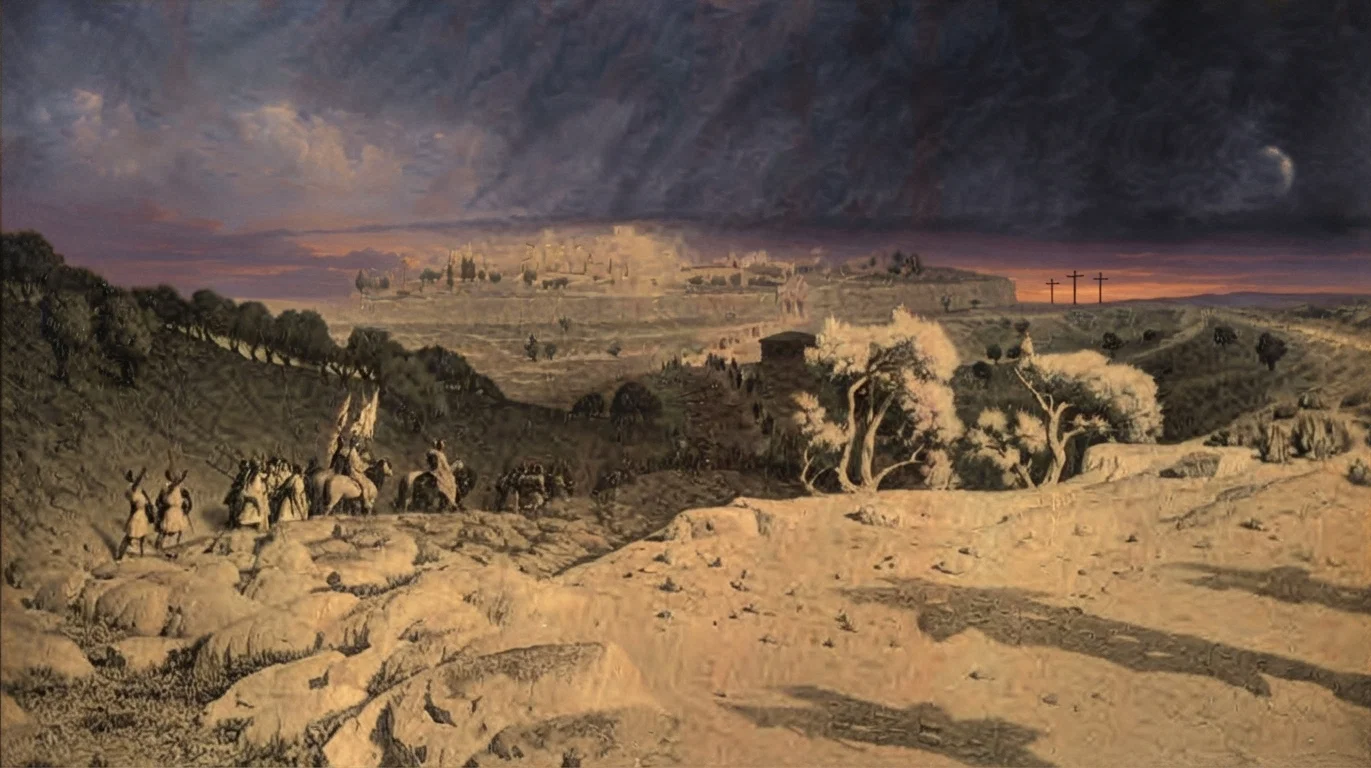
"Calvary," from a painting by J. L. Gerome.
WHEN He would reveal to man the climax of His love, in His providence it was done on some barren knoll outside Jerusalem, called Golgotha in Hebrew, Calvary in Latin, in common English, a skull. There died the Son of God who all His ministry had been saying, “God loves you,” but who in His death on Golgotha proclaimed, “Behold how much God loves you!” The barren, rugged, saw-toothed peak of Sinai met its complement in the barren, rounded knoll of Calvary. On both God revealed His love.
From Sinai blazed forth in glory insupportable the awful purity and holiness of God’s character, in the light of which man’s utter sinfulness, depravity, and hopelessness in himself stand revealed. From the quaking, flaming mount in the desert was revealed that law, the completeness and perfection of which has been the wonder of the centuries. “The law of Jehovah is perfect.” From its gleaming heights, handed down thru Moses, came the law of types and symbols, greatly elaborated, pointing to Christ, the complete Sacrifice. Those who there confessed their sins and manifested by appointed offerings their faith in the saving, healing mercy of God, stepped into the shadow of the cross and were shielded from the burning glory of God which ever consumes sin.
THE shadow of that cross reached back to lost Eden and comforted the souls who fled from Paradise, fearful of the burning glory of the visible cherubim. Christ was the Lamb slain from the foundation of the world. Calvary marks no new degrees in God’s love, no new impulse in the divineHeart. “I have loved thee with an everlasting love” was as true when Sinai blazed with His visible presence and Jeremiah sobbed his pleadings with apostate, broken Israel, as it was when Jesus Christ died upon the cross. It was only another step in the cumulative evidence of God’s love to man. It was the complete pledge of fulness of love to which poor, weak, and sinful man could ever turn with hope, and know that the very Being against whom he had sinned loved even him with a love beyond all human expression. For “He that spared not His own Son, but delivered Him up for us all, how shall He not also with Him freely give us all things.” Rom. 8:32.
BUT Calvary excuses no cherished sin. Mighty as is the love, it will not, can not, possess the heart that cherishes among its dwellers the enemy of Christ. O soul, do you know that transgression of God’s law put Christ to death—your transgression, our transgression? for He died to save us from our sins, to “redeem us from all iniquity.” Unavailing is that love to us if it do not win us away from all transgression of God’s law, the very Personification of which died upon the cross. Will you not let Love remove the sin, and place within your heart the spirit of love, so that you can say forevermore, “This is the love of God that we keep His commandments, and His commandments are not grievous”?

THE MEEK WILL HE GUIDE AND TEACH.

SUCH is His promise: “The meek will He guide in judgment; and the meek will He teach His way.” Ps. 25:9.
This scripture is not only a blessed assurance, but it is an implied definition of meekness. Nay, more, it is a test to reveal to the froward heart when the grace of meekness is wanting.
The meek man is the man willing to be guided. If he knows humanity, if he knows himself, he will say with the prophet: “O Jehovah, I know that the way of man is not in himself; it is not in man that walketh to direct his steps.” Jer. 10:23.
Believing that God’s revelation of His own ways is correct, he will also believe the divine testimony concerning God’s ways: “Jehovah is righteous in all His ways, and gracious in all His works. Jehovah is nigh unto all them that call upon Him, to all that call upon Him in truth.” Ps. 145:17, 18.
Believing this, the meek man will not seek to justify His ways, will not seek to compromise ways with God, will not seek to shape God’s ways after the human, but will seek God’s ways. He knows they are right; he knows all other ways are wrong.
Such a man as this God will guide; for he is a teachable man. He delights in the word of God. “Thy word,” declares he, “have I hid in mine heart, that I might not sin against Thee.” Ps. 119:11.
Such a man, the teachable and guided of God, is not swayed by man from the right path. Humble and yielding before God, he will stand immovable as a rock when the tempter seeks to turn him from the right way, when he would induce him to compromise principle.
Such a one was “Moses the man of God.” Even so was Jesus Christ, the “meek and lowly of heart.” Pride, haughtiness, self-sufficiency, is sure to meet with disaster and defeat, and prove an effectual bar to progress in the right knowledge of God.

CALIFORNIA CHRISTIAN ADVOCATE AGAIN.

A Comedy of Errors.

We are very sorry that our hitherto seemingly friendly contemporary in the university town of Berkeley is so deeply stirred, so manifestly tantalized and embittered, so much so, in fact, that it seems willing to make statements that have neither a semblance of truth nor fact in them. For instance, in its issue of January 24, it begins an editorial this way:
“The marvelous activity of the Seventh-day Adventists in opposing the enactment of any sort of a Sabbath day is only natural. Their working principle, working contention, is the declaration that Saturday is Sunday.”
We want the Advocate to explain that second sentence. Seventh-day Adventists do believe in a Sabbath day, most thoroly; they believe in the Sabbath day instituted of God, commanded of God, and kept by the Lord Jesus Christ. They believe that for the same reason that they believe in Jesus Christ; they get their information and authority from the same Book which tells of Jesus Christ and His salvation. They there read that He is all-sufficient to His church, that all power is His, and that that power is given to His church, and that He would be with her to the end; while, on the other hand, His church should be, not the fulness of the civil law, but the fulness of Him who filleth all in all. Therefore they believe that to ask civil power either to embody in statute law that which He has Himself commanded or to place a substitute in its place is contrary to Christianity. Why should they not be active in opposing such a monstrosity as that? Why should not the Advocate stand with them in this?
We have been asked many times by those ignorant of the Bible, “So you believe that Saturday is Sunday do you?” Of course we explain to them just as kindly and simply as we can that such a thing as that is an utter impossibility. No Seventh-day Adventist ever made such a declaration, or ever used it, only as repeating it after some one ignorant of the simple Biblical and historical facts. We are astonished at an intelligent editor of a Christian paper making any such statement as that. Why he should do it is something that we can not understand. Does he regard Sunday as a holy thing? a divine institution apart from any day of the week? Such a declaration could be made sensibly only on such a supposition, but if he has read anything of Seventh-day Adventist literature or claims, he knows that they make no such declarations nor believe any such thing. Saturday is Saturday. Sunday is Sunday.
They do not believe Sunday to be the Sabbath, neither do they believe that Saturday, the civil day, is the Sabbath, but that the Bible Sabbath begins just where the Bible places its beginning, at sunset Friday night, and ends at sunset Saturday night; consequently covers a part of two days. Surely, if they supposed that, it would be an absurd supposition, but, dear editor, they suppose no such thing.
Again the Advocate declares:
“You can not argue with an Adventist. He is impenetrable. It is safe to say that when any person falls into that logical trap he can not be extricated by any process of reasoning.”
But if it be “logical” what kind of a process of right arguing would extricate him from it? We have this proposition to make to Dr. Bovard: If he will come down here and visit us, or tell us when we can find him at home, we shall be glad to meet him and argue this question just as kindly and Christianly as it is possible for men to argue, on our side. We are not challenging to a debate. We are willing to do it alone in the privacy of his own office.
The editor further says:
“If the contention [that is, against Sunday] had any ground in ethics or in propriety or common sense, we might be willing to come to Saturday or Monday, or any day of the week, in order to have one day of rest, but to come to Saturday would be to rehabilitate a sheer mercantile religious despotism.”
No, Seventh-day Adventists would not have one single soul come to the seventh day unless he so desires. Above all things else we ask everybody to “be fully persuaded in his own mind.” If it were in our power to compel every soul in California or in this broad earth to keep the seventh day, by the turn of a hand or the signature of a pen, we would not do it. God’s Sabbath can be kept acceptably only by freeborn spirits, and we could not even think of a law compelling seventh-day observance. We would oppose it just as strenuously as we oppose first-day observance. We do not believe in the religious despotism that seeks to bind anybody’s conscience by any laws whatsoever. God’s “law is spiritual,” and only the spiritual can keep it, and no civil enactment whatsoever can in any wise help it or enforce it. It has within it the life of God Himself, and tho all men should rebel against it, yet it will live. Has not the editor a Sunday established in his own heart? Does he need a California law to do that? Is not that true of every one who loves Sunday, and who believes and observes Sunday? Then why a law to compel somebody else to act just as he and his friends are acting when he does not believe it?
As regards saloons and race-tracks, gamblers and drunkards, sometime, according to God’s prophecies and in the logic of events, the editor of the Advocate will find himself with all of them, seeking only selfish aims. When the Sunday-law regime gets strong enough they will swing to that side of the question. Just now their desire for freedom is opposition to religious tyranny. But not knowing true Christian liberty the same selfish motive will lead them to the wrongside of the question, just where the Advocate now stands. We most earnestly hope by that time the editor of the Advocate will see enough of Christ and Christianity in the simple word of God and the power of the Gospel to come over on the right side, even tho he has helped to pass a law to persecute him when he does.

1999.—Christmas.

Is Christmas not the birthday of Christ? Will you tell me why you do not observe it?
It is admitted by all Christians, even Catholic authorities, that December 25 is not the birthday of Jesus. This is also shown from the Scripture record itself, which tells us that at the time Christ was born, shepherds were keeping their flocks by night in the fields. Yet we know that the winters are too cold for this purpose in Palestine, so that in the last of December the flocks are folded. For a time, a day in the early part of January was kept as the birthday of Christ. December 25 was evidently adopted because it was a great day among the heathen. As a clipping in the "Woman's National Daily" says, that day was celebrated as the birthday of Saturn, Theseus, Bacchus, and Buddha, who, it is said, were born on that day, and the half-converted Christians thought it would be easier to win the heathen by bringing Christ's birthday on the same day as these other gods and heroes of antiquity. The evidence seems very clear to us that Jesus was born in the autumn. He was baptized in the spring just before the spring Passover. He was thirty years old at the time when He entered on His ministry. He began His ministry about six months before that Passover. That would bring His birthday about September or October. But of this we have not Scriptural authority, no scripture mentions the making of any day His birthday. The Lord never designed that one single day should be observed to celebrate the birth of Christ, any more than He did that any single day should be celebrated in honor of the resurrection. The whole life of a Christian ought to be a celebration of both events.

2000.—Begotten not of Blood, etc. John 1: 13.

What good reason can you give why the "Word," Jesus Christ, is not the antecedent of the word "which" in the expression, "which were born," or as the new translation gives it "begotten," in John 1:13? In other words, may we not place the noun in the place of the pronoun and read, "Jesus Christ was born, not of blood, nor of the will of the flesh, nor of the will of man, but of God"? Why should "His own" be taken as the antecedent, rather than the Word whom John is introducing and giving a biography of? If John does not here refer to the immaculate conception of Jesus, then he does not mention it? And why should he omit so important a matter? If those that believe on His name were begotten of God, then how is Jesus the "only-begotten of the Father"?
The very text seems to us to demand the translation that is here given. "His own" is not taken as the antecedent of "which" of verse 13 (R.V.), but "THEM THAT BELIEVE on His name" is the antecedent. He was God's Son; "as many as received Him, to them gave He the right [or power or privilege] to become the children of God." He THE SON of God, they SONS of God; that is, those who believe on His name are born or begotten "not of blood, nor of the will of the flesh, nor of the will of man, but of God." That is the very climax of Christ's coming into the world. He came into the world to bring God into human flesh in all its perfect power to overcome sin. To those who believe on Him, He gives the same power. The very language itself demands the construction that is placed upon it; in fact, it seems to us so plain that it admits of no construction whatever. Whether John mentions the miraculous conception of Jesus would have nothing to do with the reading of the text. We may not ask why the Lord did this or that, because He never stops to satisfy our curiosity; and yet it seems very clear to us that the fourteenth verse shows the very truth that our inquirer feels is omitted, "the Word became flesh, and dwelt among us." The aim of the book of John is not to give the nativity of Christ, but to give the power of His life in humanity. Christ was not begotten in just the way in which men are. He Himself declares, "I proceeded forth and came from God." John 8: 42. Just how this all is we do not know, but we do know this, that He was THE Son of God in a sense that no other was, because He was God; and yet just as truly are those who believe in Him begotten of God and become His children. 1 John 3: 1.

2001.—The Second Tithe.

Is the second tithe, as a part of the tithing system, obligatory upon the remnant church? Please give proof from the Bible.
We do not know of any Bible proof that is satisfactory to us that the second tithe as a part of the tithing system is obligatory upon the remnant church. Many have thought that there is an advantage in the use of the second tithe to support the various funds and necessities of the church, using that for all these various purposes, such as church schools, missionary offerings, etc.

2002.—Angels and Wings.

Why do you in picturing angels represent them with wings?
We do not make the pictures ourselves or many times we would make them very differently. We get the best that we can, those which will in some way teach some lesson. Like all human work, there is more or less imperfection in them. Sometimes angels appeared in the form of men, generally so. Isaiah 6, however, would seem to indicate that the seraphim, an order of angels, had wings, "Above Him stood the seraphim; each one had six wings; with twain he covered his face, and with twain he covered his feet, and with twain he did fly." See verses 2 and 6. There are also other passages which would seem to indicate the same thing.

2003.—Salvation of Children.

Does the scripture, "Suffer the little children to come unto Me, and forbid them not," include children who have not yet reached the age of understanding? What of children who live to be but a year old?
The Bible is not written to satisfy our curiosity. Its precepts, its warnings, its proffers of mercy and forgiveness, come to responsible men and women. Those who are not responsible we may leave with God. Children that are not old enough to believe or repent, innocent little ones, we may leave with Him, and may know that it will be all well with them. Christ died to redeem man from the consequences of Adam's sin. Children die because they are children of Adam, but having no conscious sin of their own, we do not know why they will not be saved. There are precious promises that come to parents, such as Deut. 30: 19: "Therefore choose life, that both thou and thy seed may live." The bereaved and believing parents can safely leave all those things with God and know that it shall be well.

2004.—The Wicked Dead. Mark 9: 43.

Do the wicked dead sleep? If not, in what condition are they? Please explain Mark 9: 43, "Where their worm dieth not, and the fire is not quenched."
Of the dead we read in Ps. 146: 4, "His breath goeth forth, he returneth to his earth; in that very day his thoughts perish." And again in Eccl. 9: 5, "For the living know that they shall die; but the dead know not anything, neither have they any more a reward; for the memory of them is forgotten. As well their love, as their hatred and their envy, is perished long ago; neither have they any more a portion forever in anything that is done under the sun." And in Job 14: 21, "His sons come to honor, and he knoweth it not; and they are brought low; but he perceiveth it not of them." So thruout the fifteenth chapter of First Corinthians, death is spoken of as a sleep. See also Dan. 12: 2. The passage in Mark above quoted does not refer to immediately after death, but to the judgment. The word rendered "hell" in Mark 9: 42, 45, 47 is from the word "Gehenna," which is the Greek form of the Valley of Hinnom. The Valley of Hinnom was just outside of Jerusalem, celebrated anciently, according to Jeremiah, for the sacrifices which were there offered to Moloch. The altars in it were afterward destroyed and it was made a place of refuse for the city of Jerusalem, the Valley of Tophet, where were cast bodies of malefactors and the offal of the city. Constantly, worms preyed upon this pestilential mass, and to consume the remainder of it constant fires were kept burning. Therefore the Valley of Hinnom became a symbol for absolute and utter destruction of all that was cast into it. "Where their worm dieth not" simply means that the thing cast under its power would not escape; "where the fire is not quenched" is that the fire would be unquenched till it burned up what was cast into it. See Isa. 51: 8, where it is said of man that "the moth shall eat them up like a garment, and the worm shall eat them like wool," that is, utterly destroy them. Compare 2 Chron. 36: 19-21 with Jer. 17: 27. These scriptures show that Jeremiah's fire which should not be quenched was the fire that was not quenched until it burned the house of God in Jerusalem. Of course, then it went out. The same thought is clearly expressed in Matt. 3: 12, where the wicked are likened unto chaff. It is declared, "He will burn up the chaff with unquenchable fire." The whole thought of the entire figure is absolute and utter destruction, and the inability of man to stay these destructive agencies until they have done their work.

2005.—God's Working. John 5: 17.

Jesus said to the Jews, "My Father worketh hitherto, and I work." There are those who say that God Himself worked. How is this?
Did not Jesus say that "God worketh hitherto"? Is it possible for life to do anything else than work? God is continually pouring out His life for the inhabitants of the universe, caring for them by His infinite power, nurturing them by His love. Many things, of course, the father does thru others. For instance, He created the world thru Christ. He sends messages of love and power and sympathy and help thru His holy angels. He works thru men that are consecrated to Him. And yet it is the power of the Godhead by which Christ wrought, and it is by the power of His Spirit that the deed is wrought by angels or men. Surely, the great God of heaven works for all His creatures and thru all His creatures, and all those who truly acknowledge Him will work with Him.
Continue reading: CONSCIENCE AND ITS PLACE