ONE of the strangest spectacles in the moral field which confronts the world to-day is the attitude of professed believers in God's word, professed followers of Jesus Christ, toward the law of God, the Decalogue. It is counted to-day an obsolete thing. Its authority is utterly repudiated. Professed priests of God and ministers of Jesus Christ trample its authority, its integrity, under their feet, and often ridicule and denounce those who plead for its recognition. Here is the law, just as it was spoken by Jehovah, recorded in Exodus 20, and translated by the latest and best modern scholarship of the world, in the American Standard Revised Version:
"I am Jehovah thy God, who brought thee out of the land of Egypt, out of the house of bondage. Thou shalt have no other gods before Me.
"Thou shalt not make unto thee a graven image, nor any likeness of anything that is in heaven above, or that is in the earth beneath, or that is in the water under the earth: thou shalt not bow down thyself unto them nor serve them; for I Jehovah thy God am a jealous God, visiting the iniquity of the fathers upon the children, upon the third and upon the fourth generation of them that hate Me, and showing loving-kindness unto thousands of them that love Me and keep My commandments.
"Thou shalt not take the Name of Jehovah thy God in vain; for Jehovah will not hold him guiltless that taketh His Name in vain.
"Remember the Sabbath day, to keep it holy. Six days shalt thou labor, and do all thy work; but the seventh day is a Sabbath unto Jehovah thy God: in it thou shalt not do any work, thou, nor thy son, nor thy daughter, thy man servant, nor thy maid servant, nor thy cattle, nor thy stranger that is within thy gates: for in six days Jehovah made heaven and earth, the sea, and all that in them is, and rested the seventh day. Wherefore Jehovah blessed the Sabbath day, and hallowed it.
"Honor thy father and thy mother, that thy days may be long in the land which Jehovah thy God giveth thee.
"Thou shalt not kill.
"Thou shalt not commit adultery.
"Thou shalt not steal.
"Thou shalt not bear false witness against thy neighbor.
"Thou shalt not covet thy neighbor's house, thou shalt not covet thy neighbor's11wife, nor his man servant, nor his maid servant, nor his ox, nor his ass, nor anything that is thy neighbor's."
BAPTIST CHUCH, AMITE LA.
There it is, the whole of it. Read it; learn it. It has been taught in many catechisms of many creeds. Creed after creed of the stanchest sects in Christendom have honored it as the summa summorum of all morality. Some of the greatest teachers in Christendom, as Wesley and Barnes and Spurgeon, have taught it and preached it as the compendium of all righteousness, the eternal, unchangeable law of God. Its principles cover every moral relationship between God and man, and man and man. There are certain things in and about that law which must strike the unprejudiced reader:
1. ITS REASONABLENESS.—The Lawgiver requires nothing of His children which they should not render to Him and their fellows.
2. ITS BENEFITS IF OBSERVED.—What a blessed country would that be where every one of its precepts were kept! No exaltation or worship of men; no idol-worship; no profanity or hypocrisy; no Sabbath-breaking, but holy, helpful worship; no disobedience and despising of parents; no murder, theft, adultery, false swearing or dealing; no coveting; no courts, constables, police, jails, or bolted doors. Such a land could be truly called "God's Country." What a delightful place it would be in which to live!
3. ITS UNCHANGEABLE NATURE.—Why should men wish to change it? Surely the things prohibited by it are always evil; and the things either positively or inferentially enjoined are always good, verifying the words of the psalmist, "the law of Jehovah is perfect," and the words of the apostle, "the law is holy, and the commandment holy, and righteous, and good." Such a law admits of no change.
If the unprejudiced reader be a Bible student, he will learn among many other confirmatory things:
1. That that law was honored above all others by being spoken by God's own voice from heaven. Ex. 20:1; Deut. 5:22.
2. That it was separated from all other laws by being written with God's finger upon tables of enduring stone, and placed in an ark prepared for it. Ex. 24:12; 31:18; 32:15, 16; Deut. 10:1-5.
3. That the very giving of the law was under more sublimely impressive circumstances than earth had ever before witnessed, paralleled later only by those attending the Crucifixion. Ex. 19:16-20; 20:18-21.
POST OFFICE, AMITE, LA. METHODIST CHURCH, AMITE, LA.
7. That His death upon the cross confirmed that law in its every particular. "Sin is the transgression of the law." "The wages of sin is death." The law could not be abolished to free the sinner. Its abolition would be a reflection upon God's government. Christ must die in the sinner's stead, "the Just for the unjust," to bring us to God, and at the same time to vindicate the law. Nowhere is the divinity and integrity and immutability of the law given at Sinai taught in stronger, more indelible characters than it was written in the blood of the Son of God on Calvary. 1 Peter 2:24; 2 Cor. 5:21.
8. Faith in Christ then does not abolish or make void the law of God; it establishes it forever. Rom. 3:31; 8:4; James 2:8-12.
10. While men in the shadow of apostasy have lost sight of that law in part, the Bible teaches that the last reform in the Christian world will develop a people of whom it is said: "Here is the patience of the saints; here are they that keep the commandments of God, and the faith of Jesus." Rev. 14:12; 12:17.
Why then should not this law be honored after the precepts of God and the example of Jesus Christ? Why should men wish to abolish so good a law? The answer may be found in an article upon this topic next week.
The Fearful Cyclone of the South.
By Editor
WE have already acquainted our readers with a note in the SIGNS of the fearful cyclone which swept thru five states of the South the night of April 23. Arkansas, Mississippi, Louisiana, Alabama, and Georgia felt its fury. It did not confine itself to localities, as such storms usually do, it was remarkably wide in extent. Science now names these tremendous storms cyclones, and the whirling local winds which are developed out of them tornadoes. Many tornadoes were developed out of this cyclone.
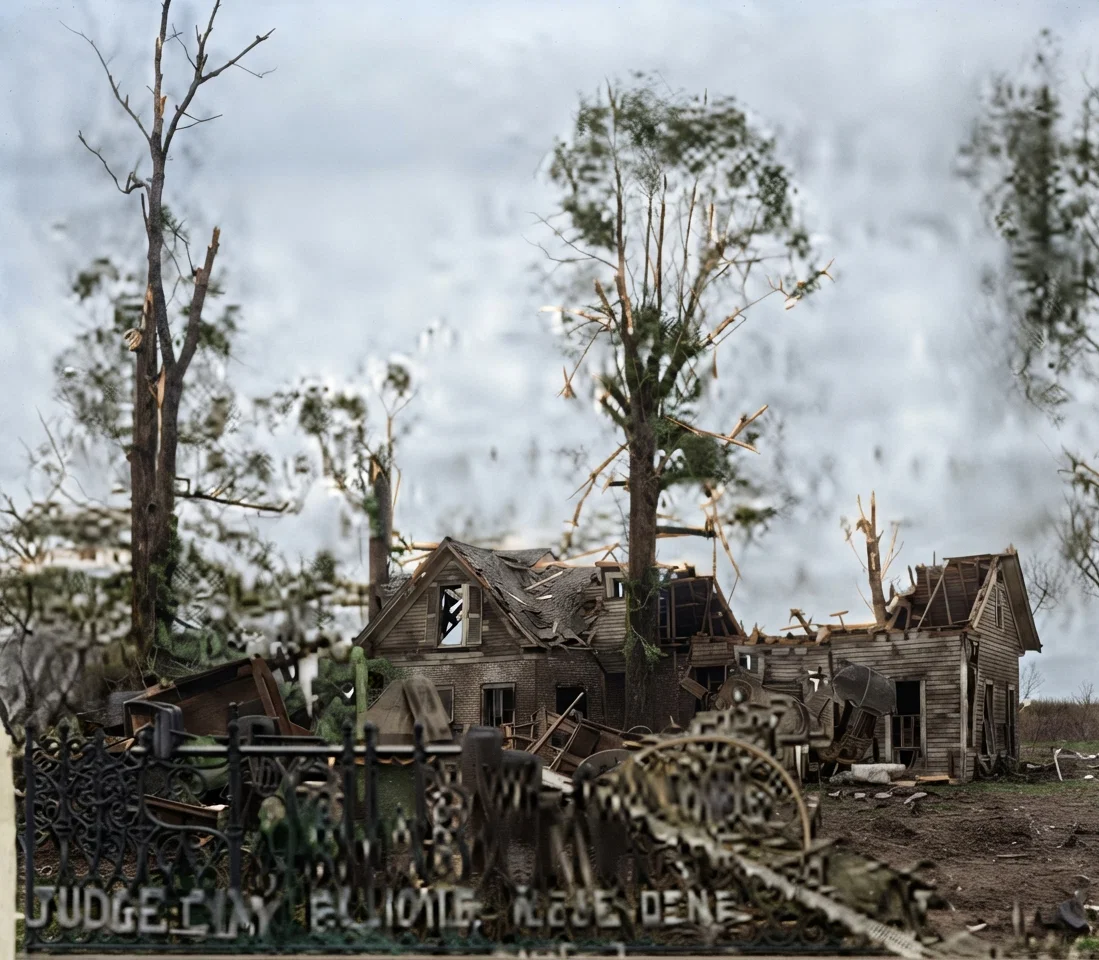
Immediately on the receipt of the telegraphic news of the storm, we wired Elder E. L. Maxwell, president of Louisiana Conference, dwelling at Hammond, La., right near the stricken district, asking him to furnish us news as well as photographs. He was unable at the time of writing us, April 30, to furnish anything outside of Amite, a thriving little city in the central part of Louisiana. But these scenes of destruction are typical of many, many others.
The three states which suffered most are Mississippi, Louisiana, and Alabama. The loss of life in the Natchez district, on both sides of the river, reached a total of 110. Fearful pranks were cut by the storm. For instance, it is stated that in one place a large tree was broken in the middle and the top carried 250 feet away. Sheet iron was carried more than twenty miles outside the tornado's track. Many tree trunks were left standing in the path of the storm in Concordia parish across the river from Natchez in Louisiana, but not a leaf was to be seen on any of them. Buildings everywhere were wrecked. Governor Noel of Mississippi states that the section immediately adjacent to Hattiesburg suffered most in that state. The steamer "Miriam," near Helena, Ark., was struck by the storm and went down with about seventy-five on board. Report declares that the wind picked up the craft clear of the water, whirled her round, and dropped her again in the midst of the troubled waters below. When she struck the water, she capsized. Thirteen of the seventy-five perished before help could reach them, and many others were injured by bruises and scalds. The "Miriam" was a sixty-five ton boat.
The condition of the little city of Amite is indicated by the photo reproductions on these pages; and all around the city it is stated that a terrible situation is revealed. At State Line, Miss., in the lumber woods, nineteen are reported dead, and over fifty injured. In many places in the country everything was swept away that was movable,—fences, buildings, live stock. Large loss of life occurred at Cave Springs, Ga., twenty-five persons being reported dead. At least one hundred were killed in a dozen towns which were afflicted in the state. There is not a house left standing in the storm-swept area. Twelve were killed at Chipley. Many houses were unroofed in the southeastern section of Atlanta. The storm then jumped nearly a mile where three houses standing close together were demolished, while houses on the opposite side of the street were left untouched. Vivid electrical displays accompanied the torrents of rain, and many houses were struck by lightning.
JUDGE CLAY ELIOTT'S RESIDENCE
The New Orleans "Picayune" of the 28th states, "The figures of the storm of Friday will reach 400 killed and 500 injured," and that belated reports add to these death lists. Elder Maxwell, however, writes two days later that "property loss will reach over a million, and 500 is the death list so far, with bodies still being found far out in the woods; and deaths are occurring every day from injuries." It is impossible even to note the names of the places and the various terrible incidents which occurred in different localities, but the storm has indeed been a serious one for the South. Officials and people are doing all they can and have come with large generosity of heart to the relief of those who have suffered, but many are beyond their sufferings, and many others probably will never be reached because their need will never be known.
EPISCOPAL CHURCH
A few years ago such a storm as this would have aroused the feelings, interests, and sympathies of people thruout the whole country; now, outside of the locality where it occurs, little mention is made of it, and reports are minimized as much as possible. All these things ought to assure the readers of God's word that the earth is "waxed old like a garment." It is nearing its end, and these fearful storms that sweep its surface, occurring more and more frequently, are omens of its early dissolution. Just beyond that lies the new heavens and the new earth, and the reign of earth's eternal King, Christ Jesus.
The Cigaret’s Fatal Power
The power of the cigaret to bind its slaves was strikingly illustrated the other day by an incident in San Francisco. A man had stripped himself of his clothing and anointed himself with turpentine for rheumatism; but he seemingly could not wait for the body to absorb the turpentine or until he was dressed until he lighted a cigaret to smoke. The turpentine caught fire, converting him at once into a living torch. He was fatally burned before help could save him.
Selling Girls
Selling Girls.—Selling girls for a financial consideration before they are hardly old enough to don long skirts is a traffic engaged in by mothers in Alaska, so says Mrs. C. R. Reynolds in a recent interview in Tacoma, Wash. Mrs. Reynolds has spent a number of years in Juneau, Sitka, and Douglas, and the sight of this evil has led her to press the leading men at Washington to adopt measures speedily to suppress the unnatural crime. Some of her own words are these:
“Conditions are simply horrible in parts of Alaska which I visited. Women unblushingly sell their daughters just as they would a nugget of gold or a team of dogs. The traffic has reached such proportions that the moral phase of it is lost sight of. Bargains are made openly and under the very noses of the officers. It is amazing to me that nothing has been done to guarantee protection to these unfortunate children.
“Education is so lacking that the little ones can not see in the shameful bargain made by their mothers any particular evil, and they, as a rule, become a willing party to the crime. This is more especially so among the Russians, who seem to have no conception of the moral phase of the matter.”
Cost of the Battle-Ships
It may be of interest to know that the least expensive of the fleet of sixteen battle-ships in Admiral Evan's fleet cost $4,621,000 and the most expensive $7,677,000. Not a small sum of money is locked up in the battle-ships alone.
Perils Facing the Fleet
An Eastern magazine speaks of the entertainments and receptions on the Pacific Coast as the greatest perils the fleet will have to encounter. The magazine is probably right.
Roman Catholics in Holland’s Cabinet
In the recently formed Holland Cabinet, the minister of justice, the minister of finance, and the minister of public works are Roman Catholics.
Porto Rico.
By B. E. Connerly
Its People.
ONE thing can be said of the Porto Ricans,—whether it is to their credit or discredit the reader can judge,—that of Spain's large number of colonial possessions, Porto Rico was one of the very few that never revolted from the mother country.
Soon after the discovery of the island by Columbus, the Spanish colonists came to make settlements under the leadership of Ponce de Leon. At first they gave no attention to the cultivation of the fertile soil, but went in search of gold,—gold for the king, and gold for the church,—and with this object in view they put the Indians to work excavating in the mountains and washing the shining sands of its numerous streams. This vigorous work was too much for the poor, indolent Indians who had never known anything but idleness, and many died from the exertions, some committed suicide, and others escaped to the adjacent islands.
The Plaza and Statue of Columbus, San Juan, Porto Rico.
"In twenty years the struggle for gold ceased, its limitations were soon known, and the culture of sugar-cane was started. Sections of land were distributed among the Spaniards, and allotments of Indians assigned to every proprietor to work his land. To the king's vast estate 500 Indians were allotted and from 40 to 200 given to others in proportion to their prominence in the island. In this way the sovereignty of Spain was extended to Porto Rico. From the very beginning it was based on human wrongs, and human rights cut no figure. The king and the church approved the course. Ponce de Leon had 200 Indians for his share, and Bishop Munse 100. Thus the Indian, the free, gentle, hospitable owner of the soil, was robbed of his home and reduced to servitude so wretched and cruel that in fifty years it blotted from existence the aboriginal race of Porto Rico."
As the mining seemed to fail, it became evident that Porto Rico was to become an agricultural country, so negroes were procured in place of the vanquished Indians to work the estates, and the people gradually settled themselves down to existing conditions. Farming was carried on, and that until very recently, by the most primitive methods, the farmer using a forked stick for a plow, his only other implements being the hoe and machete.
There were no roads, hence but little communication; each estate had its own slaves, and the owner was master of all. The products for exportation were carried to the ports on mules, thence in Spanish ships to Spain, and exchanged for Spanish goods. A trip to the capital required as much time and almost as much money as a trip to Spain would now.
Thus two hundred and fifty years passed with but little change. The peace was guaranteed by the insular police force and one thousand Spanish soldiers.
In 1815 Porto Rico was invited by Simon Bolivar to unite with New Granada and Venezuela in a revolt against the mother country, but the Porto Ricans preferred to remain loyal.
In 1870 the slaves were freed, but they were afterward employed by the owners of the estates at so low a wage that the difference was very slight.
Porto Rico Women on the Way to Market.
In 1830 the population is given at 319,000, about sixty per cent of which were white and the remainder black. I think the proportion stands about the same now. About that time there was a large emigration of South Americans to Porto Rico and this gave impetus to her industries which continued until the change of government.
To-day Porto Rico has a population of a million, and the government is administered by a governor, and an executive council of eleven appointed by the President of the United States, and the House of Delegates of thirty-five members elected by the people. The government expenses are met by the custom-house and internal revenue collections.
The mail service is good, at present there are eighty-six post-offices, and the insular police force numbers 700 men.
There are 250 miles of railroad on the island, and the company is doing a good business and each year extending its lines. There are also 600 miles of macadam road with an increase of mileage each year. These roads are a wonderful blessing to the people as mediums of communication from the interior towns to the coast, and immense freight traffic from these towns is transported in large wagons, instead of on pack-mules.
Our foreign communications are carried on by three American steamship lines between the island and New York; one to New Orleans, and one to South America. There are also German, Spanish, French, and Italian lines that make regular visits from other points.
The people of Porto Rico as a rule are quite well satisfied, wages are more than double what they were five years ago, and there is work for all who desire it. As yet the people do not enjoy the privilege of self-government, but the majority appreciate what the American government has done for the island.
From moral, intellectual, and sanitary standpoints there has been great improvement. Houses and streets are much cleaner, and the dread disease anemia, which at one time threatened to depopulate the island, is practically eradicated.
There are 75,000 children in the government schools and 25,000 more in parochial and private schools.
In our next article we will notice the progress made in religious lines.
New Bible out in China.
By Baptist Argus
OUR China Baptist Publication Society will soon have out an edition of the Revised Mandarin New Testament in which the word "immerse" is "immerse," and not merely the colorless "wash" which is all that the two great Bible Societies are willing to give us. You have no idea how determined, how perverse, are the efforts of the13societies and translators in general to obscure and, if possible, keep from the Chinese the original meaning of the symbol left us by the Lord. One can't charge such honorable brethren with being unconscientious, but it does seem sometimes as if there had been a perversion of conscience somewhere. It is simply holding down the truth with error. The frantic desire for "union" has made consciences elastic on many points, but not on this!—Baptist Argus.
My Daily Prayer.
By William Ward Simpson
(By the Late Evangelist Wm. Ward Simpson.)
SEND me anywhere,
Only go with me;
Lay any burden upon me,
Only sustain me.
Sever any tie
Save the one that binds me
To Thy service and Thy love.
BOOKS
For Home Workers
The following books are ready sellers at this time of the year. The discount to those who canvass for them is forty per cent. For additional information address your tract society.
Our Little Folks' Bible Nature
This book contains simple lessons on nature, taking up the subjects in the order of creation. It is designed as a beginner's book in reading, and at the same time to teach beautiful lessons from nature, based on the Bible.
128 pages. Price, board, 25 cents; cloth, 50 cents.
Christ Our Saviour
A graphic account of the birth, death, resurrection, and ascension of Christ, interwoven with many interesting incidents in His life. The story is simply, yet beautifully told, and the lessons taught, inspiring and helpful.
The book is written in a style that will hold the interest of the children, and will so acquaint them with the life and character of the Saviour as to lead them to make Him their personal friend and to desire to be more like Him.
182 pages. Price, board, 50 cents; cloth, 75 cents.
Also in German, Danish, Spanish, and Swedish.
Uncle Ben's Cobblestones
Familiar talks with boys and girls about the common articles of every-day use, such as air, water, sunshine, fire, smoke, glass, coal, salt, paper, matches, etc.
Uncle Ben has a very pleasing way of telling about the origin and use of these various things. There is a ray of sunshine streaming thruout the whole book, and yet it does not touch the fickle as prevalent in books for children.
The purpose of the book, aside from the useful information given, seems to be soul culture, for we observe on every page a moral fragrance that will impress young minds in the right way.
Uncle Ben tells about more than one hundred different things in all, and intersperses with happy thoughts that bring good cheer to young and old.
221 pages. Price, $1.00.
Story of Daniel the Prophet
A biography of this wonderful prophet of God. Entirely new in its conceptions and designs. The Scriptures narrating the story are printed in parallel columns with the author's delineations and interpretations. This one feature of the book alone renders it very serviceable and desirable.
In connection with the story of this remarkable life, a clear and forcible exposition of the prophecies is also given. The author has endeavored, not to arouse controversy, but to suggest thoughts, both in story and side references, that will create religious interest and further study in the things of God.
The book contains both a scriptural and general index of subjects, has eighteen chapters, and 369 pages. Price, $1.25.
The Vegetarian Cook Book
This book contains about four hundred very carefully prepared recipes of healthful, hygienic dishes, suitable to every taste, and every condition in life. There is also one chapter on the Hygiene of Cooking, explaining the various methods, such as boiling, steaming, stewing, baking, braising, and broiling.
The author has had a broad experience in restaurant work, and has given the results of his experiments and observation in this practical work. We believe the good, wholesome foods, hygienically prepared, will appeal to many who are suffering from the effects of bad foods and wrong combinations.
The classification of foods is so arranged, and the work so thoroly indexed, that any recipe may be referred to instantly.
266 pages. Price, 75 cents.
Steps to Christ
This little work by Mrs. E. G. White presents in a simple and attractive manner the steps by which the sinner may find Christ and be made complete in Him.
While the book is an excellent guide to inquirers and young converts, it also contains a wealth of counsel and encouragement for those older in the way, who are experiencing difficulties.
The all-pervading spirituality and wholesome counsel blended thruout its pages, cause the book to meet with general acceptance. Once read, it is often re-read and studied as a guide-book in the way of salvation.
200 pages; 44 chapters. Price, paper, 25 cents; cloth, 50 cents.
Story of the Seer of Patmos
By S. N. Haskell. The author's latest book is on the thrilling prophecies of the book of Revelation. It presents no vague, new theories, but in simple, narrative style portrays the story of the prophet John's life, and traces his prophecies and their wonderful fulfilment.
Illustrated with original engravings made especially for this work. The text of the entire book of Revelation is printed in the margins, and accompanying it are thousands of Scripture references elucidating the text; and besides all this, the explanatory comment of the author on each chapter. It is a companion volume to "Story of Daniel the Prophet," by the same author, and is written in the same style.
The two books are uniform in size and style, and treat two of the most important and least understood books of the Bible.
Fully illustrated. Contains 424 pages. Half cloth, marbled edges, $1.25. Full cloth, marbled edges, $1.50.
Our Work and Workers.
By Editor
A CHURCH of seventeen has been organized at Nortonville, Kan.
THREE were recently baptized at Omaha, Neb., by Brother Carl Svenson.
SEVEN members were added to the little company at Port Jervis, N. Y., during the month of March.
BROTHER J. W. WATT reports that recently six united with the church at Indiana, Pa., three by baptism.
As a result of meetings held by Brother Wm. B. Knott at Hill City, Kan., four have accepted present truth.
SABBATH, March 21, a little company of six was organized at Conway Springs, Kan., three more being added the following Sabbath.
BROTHER M. W. DELHORBE, Niagara Falls, Ont., reports a good interest at that place, four having stepped out into the light.
THE church at Union City, Mich., is rejoicing over four additions to its numbers thru the labors of Sister Cleora Green and others.
"AT Axton, Va., where I held some meetings, five took their stand for the truth, and are ready to be organized into a church."—Jane Wooding.
FIVE precious souls have identified themselves with the commandment-keeping people of God at Essex, Kan., is the report of Brother H. R. Godfrey.
BROTHER H. J. SCHNEPPER reports progress among the German settlers about Farmington, Edwall, and Wilcox, Wash., he having baptized six on a recent visit to these places.
SPEAKING of a new recruit to the cause at Velva, N. D., Brother and Sister N. M. Jorgensen write: "This makes eight persons who have stepped out, and others are still interested."
THE Lord has done a good work at Iron River, Wis., thru Brethren S. T. Shadel and Peter Hanson. As a result of their labors, nine have been baptized and a company of twelve has been organized.
"SABBATH, March 28, was a day of great rejoicing for us all in this part of the Master's vineyard, as it was my privilege to bury fourteen dear souls with their Lord in baptism."—J. H. Carrill, Paterson, N. J.
THE Swedish church of New York City has grown in the last year from thirteen members to fifty. Ten were baptized during the first quarter of the present year. Brother G. E. Nord has charge of the work.
"SABBATH, April 25, eight adults, three men and five women, were baptized by the writer at Tremont Temple, Boston. It was a happy feature of the occasion to see men and their wives go down into the water together." Lee S. Wheeler.
"AT Arouca, Trinidad, as the result of the meetings held, twelve have given in their names for baptism. The interest still continues good, and a number of others are on the point of deciding for the truth." The Caribbean Watchman.
Sanitarium Cook and Assistant Wanted
First-class sanitarium cook and assistant wanted. Correspondence solicited. Good place. Good pay. Address Dr. Maxson, 470 28th St., Oakland, Cal.