Your ShelfYour Projects

The American Sentinel, Vol. 6, No. 15

REFERRING to a large foreign element in this country and the relation to Sunday
Earlier text: REFERRING to a large foreign element in this country and the relation to Sunday

The Sabbath Question.

For the Bulletin:
THE discussion of the Sabbath question now so vigorously carried on throughout the country was specially sprung in 1888, when the American Sabbath Union was organized. Auxiliary societies have been established in nearly all the States, and the friends of the Union are pushing its purpose with great zeal. Wisely or unwisely opened, the battle is on. The issues are in the hands of God and the patriotic citizens of the United States.
There is, perhaps, no graver or greater question—certainly none which so directly concerns the liberties of our people—because involved in the outcome is the interference or non-interference of the State with religious institutions. The American Sabbath Union is working to secure the legal recognition and protection of a specific and religious day, called Sunday, regardless of the moral rights and consciences of vast numbers of God-fearing and loyal citizens of our country. The Union is not willing that the Jew shall have a Sunday or Sabbath, nor that the large number of Seventh-day Adventists and Baptists shall be regarded with respect. As many crimes have been committed in the name of liberty so have many curses come upon the people in the name of religion. Great majorities on any subject are apt to become unpatriotic and tyrannic. The duty of the people is to watch principles, not majorities, and learn that vigilance and personal action and independence are often absolutely necessary to the perpetuation of pure religion and pure civil government.
We have come to that sort of a crisis in the history of our religious institutions. We are now compelled to say whether or not we want the State to legislate on religious subjects, and fix by law our religious institutions. The American Sabbath Union declares its wish that the State shall declare itself in favor of one specific day as the Sabbath of America, and thereby force thousands of its own citizens either to disregard its behests or the behests of their own moral and religious conscience. We must face the issue. The labors of a life-time ought to protect one from the charge of foreignism on this subject. It is for the good of our free institutions and for the good of religion that we give our voice against the purpose of the American Sabbath Union. Nor are we able for a moment to believe that the objects sought by the Union are other than sincerely desired and religiously entertained. We think, however, the movement a blunder. The zeal of the Lord’s house has eaten them up. They seem blind to everything on this subject other than majority notions of religion. They seem to forget that to oppress one sincere conscience in religion is ungodly. They also seem to forget that the national Constitution forbids Congress, and therefore the State, legislating in the interests of religion or fixing any moral status by statute.
We feel sure that the purpose of the Union, so far as legislation is concerned, will fail. The grounds of opposition to the legislative phase of the Union’s work will be stated in a few brief papers which, by courtesy of the editor will be published in the Sunday Bulletin. The opposition in no way touches the great fact that we do sorely need, in these reckless times, some higher regard for the office of a sacred rest day. Our people ought to love and practice the privileges of a worshipful rest day. But to attempt to secure this good by law—to force the conscience of any of our fellow-citizens—is both unpatriotic and unreligious. I am heartily in favor of the movement looking toward the better observance of the Christian Sunday by Christians themselves. And just as heartily do I desire to see among the general mass of non-professional or non-religious citizens a more respectful behavior toward the worshipful rest day that custom has established in our country. But there is a lawful and an impartial way to reach this desired end. That way does not come through legislation.
In the paper to appear next Sunday, thequestion, “What is the Sabbath?” will be discussed, and in the light of the answer given we hope to find the true grounds of reform.—Lux Benigna, in Bloomington (Ill.) Bulletin.

Burdensome Laws.

It is apparent that, taken as a Nation, our statute books, are burdened with many uncalled-for laws. And the spirit of the age is in this line, taxing its ingenuity to discover new paths in which to legislate, each enactment forging another link in the restricting chain of personal liberty. It is the spirit of “paternalism.” Were all these laws strictly enforced nearly every man in the country would be behind prison bars. Attention needs to be given to the enforcement of existing law and the repealing of one thousand and one unnecessary enactments.—Moral and Scientific Companion.

On Sunday Laws.

It is very strange indeed, that in this day of progress and general enlightenment, any person, or sect of persons, should be so narrow-minded as to set forth and teach doctrines and principles that characterized the Dark Ages. To compel people to do a thing on the first day of the week, and in which they do not believe, is but one form of tyranny. Is this synonymous with the American boast of free Government? We think not. Although we were brought up to revere and keep the first day of the week, we feel it would be wrong to force our views upon those who might differ with us in a religious point of view, or holding to contrary convictions.
George Washington declared that the United States were not founded on the Christian religion. The American Republic has never claimed the right or privilege to inquire into the religious views of its citizens any more than it has to punish any one of them for exercising his elective franchise. What our neighbors may think, can not affect us, so long as their actions are confined within the common rules or regulations of rights and morality.
An attempt to legislate on the Sunday law would be the first step toward the union of Church and State, a union that has done more to sacrifice and destroy the lives of innocent men and women, than the political blunders of all the world combined. For our part we shall oppose such measures as undemocratic, and shall aim with a direct purpose to defeat the thrust at American liberty with all our power.—Yolo (Cal.) Democrat.

Religious Persecution.

R. M. KING, of Obion county, Tennessee, was arrested in March, 1890, and fined seventy-five dollars for working in his own field on Sunday. The Judge and the prosecuting attorneys, as well as the neighbors, have declared that if Mr. King and his brethren continue to labor on Sunday, they will have to leave the State. Mr. King was arrested the third time last June; he says, “I went out in the morning and hoed six rows of potatoes, working just about one hour, then went to hear the Methodist minister preach, was arrested Monday, and fined five dollars and costs.” In the same neighborhood on the same day, there was a man cutting grain with a binder, working the necessary hands to shock it, but there was no complaint made of his breaking the Sabbath. Mr. King can see from the jail windows men working on Sunday, but there is nothing said about it; of all the prosecutions for Sunday breaking in Dyer County, of which there have been a considerable number in the past eighteen months, not one arrest has been made outside the number of those who are acknowledged conscientious Christian men. If it is true that the price of liberty is eternal vigilance, is it not equally true, if we would preserve our own liberties, we must respect the rights of others? If Christians as Christians would leave the civil laws alone, and take the Bible for their creed, the conflict with sin would be shorter, sharper, more conclusive, and glorious.—J. H. Sargeant, in Leader, Long Prairie. Minn.

In Russia.

OFFICIAL.— You cannot stay in this country, sir.
Traveler.— Then I'll leave it.
Official.—Have you a permit to leave?
Traveler.—No, sir.
Official.—Then you can not go. I give you twenty-four hours to make up your mind as to what you shall do.— New York Sun.

The Reason Why.

THERE are several reasons why, in our judgment, the clergy should not take an active part in political organization; even if it be dubbed non-partisan. They are not often skillful organizers of practical movements. Their function is to teach truth, not to conduct affairs; and while occasionally the same man is equally good at both, more frequently the man who drops the first function to undertake the second, drops a higher for a lower office, and he who undertakes to fulfill both fulfills neither. The American people are jealous of the interference of the clergy in political administration. The attempt to carry on the State by the Church has been very thoroughly tried in the Old World, and the success of the experiment has not been such as to encourage a repetition of it in the New World. Cardinals have not purified statecraft in France, nor have bishops sanctified the House of Lords in England. Ministers are but men, and when they drop the vantage ground which their profession gives them for quiet and unselfish reflection and enter the environment of other men, they become much like them. If the minister goes into politics, he is certain to take concern for his church with him, and then the question often stares him in the face between service of the Church or the State, the two not infrequently seeming to present conflicting claims upon him.—Christian Union.
INTOLERANCE is the shadow which dogs the footsteps of faith, and in many cases more than obscures its benefits.—Laing.

A Sunday Question.

REV. THOMAS C. EASTON is apparently not above begging the question when he wants to make a point. “We are confessedly a Christian people,” he said yesterday, and then he proceeded to argue that therefore the Columbian Exposition should be closed on Sunday. We do not see why, even were this confessedly a Christian Nation, the Exposition should be closed on Sunday, for we fail to understand how such a display would dishonor the day. We are certain that all over the land places that dishonor week days as well as Sundays are allowed to keep open all the year round. But this is not a confessedly Christian people, and Dr. Easton will find no such statement or confession in our Constitution. The fact is that the clergymen of Chicago want to gather the crowds of visitors into their churches every Sunday, and receive on their collection plates the money that would otherwise be spent at the Exposition. So, of course, the clergy all over the country lend them a fraternal helping hand. We do not blame them either. But they should debate the question fairly.—San Francisco Daily Report.
A CITY has clearly the right to see that no disorderly conduct is indulged in within the corporate limits on Sunday or any other day. Whether it has the right to stop an orderly game of baseball, or of any other kind that is not in itself immoral, is another question.—Gilpin County Observer.
The law can compel no man or congregation of men to observe Sunday as a religious day. The right to worship is left with the individual, as well as the object which he desires to worship. A town has a perfect right to maintain peace and quietude within its corporate limits. If baseball playing on Sunday is indulged to the annoyance of the citizens it can be abated as a nuisance, after the nuisance is proven. Such testimony, however, must necessarily be direct, positive, and from persons living in the immediate vicinity of the place where the game is played. The same evidence would suspend baseball playing in the same location on any other day of the week. In other words, a nuisance on Sunday is as much a nuisance on Monday.—Colorado Graphic.
STRANGE as it may appear, in this age of enlightenment, and this land of freedom, there are some who seem not yet to have broken through the shell of error and superstition of the past, and learned that it is not the business of the Church to dictate the policy of the State, nor of the State to say by whom, or by what means, men are to be saved in a kingdom not of this world.—Western Herald.

AGENT WANTED

AGENTS are making FROM $75 to $150 PER MONTH.
FARMERS MAKE $200 TO $500 DURING THE WINTER.
LADIES have great success selling this Washer. Retail price only $5. Sample to those desiring an agency $2. Also the Celebrated KEYSTONE WRINGERS at manufacturers' lowest prices. We invite the strictest investigation. Send your address on a postal card for further particulars.
LOVELL WASHER CO. 251 Huron St. ERIE, PA.

Illustrated Curiosity List

With box of Ornamental Minerals, Indian Relics, Curiosities, 10c. “Companion,” Illustrated, describing curiosities, 25c. year; Advertisements, 1c. a word. [Mention this paper.]
E. A. BROWNE, FLORENCE, ARIZONA.

DO YOU USE A FOUNTAIN PEN?

Then you need the COMBINED INK BOTTLE AND PEN FILLER, consisting of a bottle holding ink sufficient to fill a pen 8 or 10 times, with a Patent Rubber Cork and Filler, all inclosed in a neat wooden case with a screw top, making the safest, most complete, compact, and convenient article for the use of traveling men and others now extant. Weighs when filled with ink less than three ounces.
Imitation Rose-wood case, 25c. Real Box-wood,  50c.
Sent post-paid on receipt of price.
Address,
PACIFIC PRESS PUB. CO., 43 BOND STREET, NEW YORK.
OR OAKLAND, CAL.

DO YOU WANT THE BEST ATLAS PUBLISHED?

IF SO, SEND TO US FOR
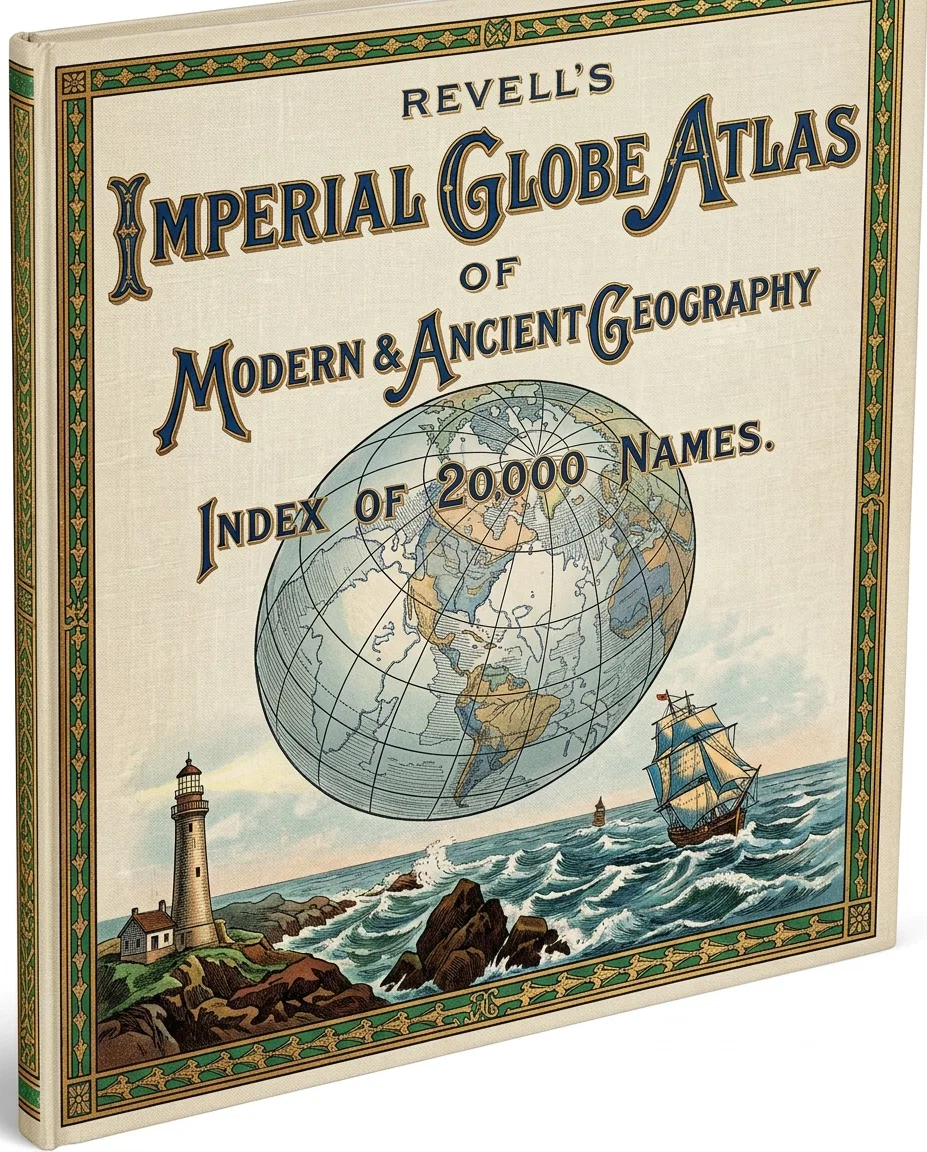
This Atlas contains thirty-three imperial quarto maps, 12 x 14 inches, and an index of 20,000 geographical names, so arranged as to show the latitude and longitude of each place named and the number of the map on which it will be found.
This Atlas is a most attractive volume, and is by far the cheapest fine Atlas ever published. Dr. A. T. Pierson, in Missionary Review, says of it:—
“In convenient folio form at the amazingly low price of one dollar. We recommend all students to procure a copy to place on their tables for constant reference. We have found it invaluable. It has a copious index by which easily and rapidly to find any city or town or district.”
We will send this Atlas prepaid to any address in the United States or Canada for $1.25.
Address, PACIFIC PRESS, 43 BOND STREET, NEW YORK.

THE NEW WEBSTER.

Just Published.
Cost $300,000.

SUCCESSOR OF THE UNABRIDGED.

Re-edited and Reset from Cover to Cover:
Sold by all Booksellers. Illustrated pamphlet free.
Caution!—Cheap books called “Webster's Big Dictionary,” “Webster's Encyclopedic Dictionary,” etc., are being advertised. The body of these from A to Z is printed from plates made by photographing the anticipated 1847 edition. The authentic “Unabridged” (still copyrighted) and the new “International” both bear the imprint of G. & C. MERRIAM & CO., Pub'rs, Springfield, Mass.

PROPHETIC LIGHTS

By E. J. Waggoner.
—0·0—
THIS IS THE TITLE OF A NEW WORK JUST ISSUED BY THE PACIFIC PRESS PUBLISHING CO., OAKLAND, CAL.
As its title indicates, it treats of some of the leading prophecies of both the Old and New Testaments, showing the exact fulfillment of the predictions of the Bible, concerning Egypt, Tyre, Babylon, Medo-Persia, Greece, and Rome, also of the prophecies concerning the first advent of Christ, which prove the inspiration of the Bible, and give assurance that other prophecies which are noted will as surely and exactly be fulfilled.

ELEGANTLY ILLUSTRATED.

All the illustrations in this book, except one, were designed and engraved especially for this work, at great expense, and are a study in themselves. Nothing like them has ever appeared in our publications before, and they are sure to attract general attention. Every one who has seen the illustrations pronounces them superb.
PROPHETIC LIGHTS contains nearly 200 large octavo pages, and is printed on an extra quality of heavy calendered paper. The special object of the publishers in issuing this book is to furnish it as a premium with the Signs of the Times. It is also designed for general circulation, therefore it will be issued in two styles of binding, as follows:—
Heavy Paper Covers, 75 Cents. Fine English Cloth, Jet and Gold Title, $1.25.
COMBINATION OFFER to Both Old and New Subscribers.—PROPHETIC LIGHTS (paper cover) with AMERICAN SENTINEL, One Year. . . . . $1.50.
The foregoing will give the reader an idea of the style and character of the book.
Address orders to
PACIFIC PRESS PUBLISHING CO., 43 Bond Street, New York.

SIBERIA AND THE NIHILISTS

WHY KENNAN WENT TO SIBERIA.

By William Jackson Armstrong,
(Late Inspector General of United States Consulates.)
This is one of the most intensely interesting and thoroughly reliable contributions to literature on Russia and the Nihilists ever published. It comprises Mr. Armstrong's famous lecture on “Siberia and the Nihilists” (delivered first in Cooper Union, New York, and afterwards by special request of many eminent men in Lincoln Hall, Washington,) together with some exceedingly interesting letters and newspaper criticisms from the pens of the author and George Kennan, the Siberian traveller.

EVERYBODY SHOULD READ THIS BOOK,

because no one can be intelligent upon the subject of which it treats without familiarity with its contents. Besides, the book is a powerful stimulus to that love of liberty so essential to the maintenance of free Government.
It contains some pointed and caustic criticisms upon Mr. Kennan's defense of the Russian Government after his first visit to that country, and explains

WHY KENNAN WENT TO SIBERIA

the second time. The Century articles which were the result of that visit fully justify the position taken, and the statements made by Mr. Armstrong in 1883. 160 PAGES, PAPER COVERS, PRICE 25 cents.
Or, Oakland, Cal.                 Address, PACIFIC PRESS, New York,

The Nonsuch Professor,

IN HIS MERIDIAN SPLENDOR.

By WILLIAM SECKER (Puritan).
With an introduction by THEO. L. CUYLER, D. D. Price, post-paid, $1.00.

TESTIMONIALS.

“It is a mine of sparkling gems.”—Presbyterian Observer.
“A sheaf of golden grain, ripened by grace, and sweet with the flavor of rare simplicity and holy wisdom.”—New York Observer.
“It is a searching book.”—Christian Intelligencer.
“This is a wonderful book. At whatever page you open it, your eye lights upon pithy aphorisms that combine the sententiousness of Benjamin Franklin, with the sweet, holy savor of Samuel Rutherford. It contains hundreds of bright seed thoughts.”—Rev. T. L. Cuyler, D. D.
Address, PACIFIC PRESS PUBLISHING CO., 43 BOND STREET, NEW YORK CITY.

Sacred Chronology.

BY SYLVESTER BLISS.
This work treats of the Elements of Chronology, the different systems, and the various eras, and gives the chronology of the principal events recorded in Sacred History from the Creation till the death of St. John. It also contains a vindication of the numbers of the Hebrew Scriptures. As an aid to investigation it is invaluable. The book has been thoroughly revised, and an entire chapter added, on the

PEOPLING OF THE EARTH.

This chapter is an exposition of the tenth chapter of Genesis, and gives an outline of the beginning of History and

THE ORIGIN OF NATIONS.

New and valuable notes have been added to the original text of the book, making it the most valuable work on the subject of sacred chronology extant. No student of history can well do without it. It contains a vast amount of information in small space, and so far from being dry it is as interesting as a story, which it really is. 300 pages, cloth binding, with side stamp, $1.00.
Address,
PACIFIC PRESS PUBLISHING CO.,
43 BOND STREET, NEW YORK.
OR, OAKLAND, CAL.

IS THE PAPACY IN PROPHECY?

BY THE
Rev. Thomas W. Haskins, M. A.,
Rector Christ Church, Los Angeles, Cal.
The above is the title of a treatise written by the author at the request of the Ministerial Union of Los Angeles, California. It grew out of a discussion upon the present aspect and aims of the Roman Catholic Church in the United States, the author taking the ground that the rise, progress, present and future condition of the temporal power known as the Papacy, or Vaticanism, is outlined in the prophecies of Holy Scriptures with sufficient accuracy to determine what the “Papacy” is, and what is to be its future development and ultimate end.
PAPER COVERS. . . . . . . . . . . 25 CENTS.
CLOTH COVERS. . . . . . . . . . . 60 CENTS.
Mailed, post-paid, on receipt of price.
Address,
Pacific Press Publishing Co.,
43 BOND STREET, NEW YORK;
12TH & CASTRO STS., OAKLAND, CAL.,
Or, LOS ANGELES CHURCHMAN, 25 California
Bank Building, Los Angeles, Cal.
THE Christian Nation brings against us a railing accusation because we wished success to a paper in San Francisco which is issued seven times a week. We would be glad to see everybody, including our critic, keeping the Sabbath of the Lord our God, but we have no disposition to dictate to those who do not see this matter as we do; and we must certainly decline to wish ill of those who, for reasons satisfactory to themselves, refuse to follow our example in the matter of Sabbath-keeping. But we are not surprised at this outburst of our contemporary, since it has many times shown itself to be governed by a spirit other than that of Michael, who when under not an imaginary but a real provocation durst not bring against even the devil, a railing accusation, but said, “The Lord rebuke thee.” (Jude 9.) However, the attitude of the Nation is only what we might expect, since, as we have many times shown, the whole National Reform scheme, to which it is wedded, is not only non-Christian but essentially anti-Christian. The truth of the Scripture (2 Cor. 11:13, 14), which our contemporary applies to us, is well exemplified in the fact that a paper advocating so-called National Reform, calls itself “Christian.” To what base uses are noble names oft applied!

A GENTLEMAN writes us:—

I am sure you do not wish to do the Baptists any wrong. They emphatically deny being Protestants—they never came out of the Romish Church.
From this it seems that we must have alluded to Baptists as “Protestants,” and even now it does not appear to us that our error was a serious one. Webster defines Protestant thus:—
1. One who protests;—originally applied to those who adhered to Luther at the Reformation in 1529, and protested against, or made solemn declaration of dissent from, a decree of the Emperor Charles V. and the Diet of Spires, and appealed to a general council.
2. Especially, a Christian who protests against the doctrines and practices of the Roman Catholic Church; one who adheres to the doctrines of the Reformation.
Of course in the first sense Baptists are not Protestants, but in the second sense we trust that we make no mistake in applying the term to them. We are not prepared to think that the Baptists have ceased to protest against the doctrines and practices of the Roman Catholic Church, nor do we think that our correspondent wishes to be so understood. Doubtless in this sense he will agree with us that Baptists are Protestants.
PENNSYLVANIA has decided to retain the Sunday law of 1794.
TENNESSEE has passed a law against the running of freight trains on Sunday.
FORTY thousand ministers were appealed to during the month of February to assist in the work of securing signatures for the Sunday closing of the World's Fair in 1893.
“THEY do some very queer things indeed in England,” says the Recorder, “for instance, at Birkenhead, the Brooklyn of Liverpool, the municipal authorities have carried their no-Sunday-labor zeal so far that they have prohibited interments in the cemeteries on the one day in the week when workingmen can attend a funeral without sacrificing valuable time.” And yet this whole Sunday business is, we are told, a movement in the interests of the “poor workingman.”
GEN. T. J. MORGAN, United States Commissioner of Indian Affairs, in a recent address in Chicago, expressed the opinion that the Indians should be taught the English language, that they should be given a knowledge of the use of machinery and tools, and that they should be induced to become Christians. He made it clear to his auditors, however, that schools supported by the Government had no right to teach religion. His idea was that missionaries should give the needed religious instruction.
It is stated that Rabbi Marcus, a Jewish physician and chassamovitch, living in Grodno, Russia, has been arrested and exiled for two years, for sending to the Government a Jewish petition demanding redress for an outrage committed by a Russian doctor Granolosk, who is charged with having branded the word “thief” in three languages upon the forehead of a Jewish boy who was accused of having stolen a small quantity of fruit. The petition sent said this would excite the indignation of the civilized world. Russia is a thorough-going National Reform country; its rulers pose as Christians, and tolerate those who don’t if they “ do not rave,” that is, if they carefully conceal their religious beliefs.
It is thought in Ottawa that the Parliament to assemble there May 1, will be the stormiest the Dominion has ever witnessed. Cardinal Taschereau and the Canadian bishops of the Catholic Church are demanding the disallowance of the Manitoba act abolishing separate schools in that Province. This demand has fallen like a thunderbolt upon the Government. It places the Government in a very perilous position. One of the first acts of the Liberal party when Parliament assembles, it is said, will be to move a vote of censure against the Government for not interfering to prevent the abolition of separate schools, which is a vested right of the Catholic Church in the several Provinces. The Government, it is thought, stands a much greater chance of defeat on this than upon the trade question.
APROPOS of our note of last week, in which it was stated that owing to persecutions about one hundred thousand of the poorest class of Russian Jews had embraced the Russian faith, is the following item from the Recorder, of this city:—
‘The Russian Government gives a reward of fifteen roubles to every Jew who becomes a Christian, and conversion is becoming as common an employment as peddling. One Jew who has been converted seven times, and has consequently absorbed one hundred and five roubles’ worth of Christianity, is in prison; but his fate does not deter his fellows from rallying round the Cross for an appropriation.
Is there not in this a suggestion for National Reformers? Could they not after all buy the infidels more easily and even more cheaply than they can hope to coerce them? True, the fagot and the rack may be necessary to the conversion of such men as Ingersoll, who is already well to do in the things of this-world, but for the “common herd” is not the commercial plan the better one? is it not at least more in harmony with the spirit of the age than imprisonment, whipping, etc., to say nothing of the still more coarse and even brutal methods of the Inquisition? Certainly our National Reform friends could study Russian methods of evangelism with profit. The Russian methods differ in degree but not in kind from those advocated in this country.
ONE of the most interesting religious publications that comes to our table is The Gospel in All Lands. It is a publication that should be in every home, as it will certainly stimulate interest in Christian missions, wherever read. Fifteen cents sent to Hunt & Eaton, Fifth Avenue and 20th Street, this city, will secure you a copy.

You have reached the end of this edition.

The American Sentinel · April 9, 1891