AND if ye offer the blind for sacrifice, is it not evil? and if ye offer the lame and sick, is it not evil? offer it now unto thy governor; will he be pleased with thee, or accept thy person? saith the Lord of hosts.” “Ye brought that which was torn, and the lame, and the sick; thus ye brought an offering: should I accept this of your hand? saith the Lord.” Mal. 1: 8, 13.
In the days when the Lord’s people offered sacrifices from their flocks to demonstrate their faith in the Lamb to whom all the offerings pointed, it was demanded of them that only animals without blemish could be brought. Often, in the days when Israel had wandered far from the Lord, they became careless and brought that which was torn, and the lame, and the sick. Through His prophet the Lord asked them, “Is it not evil?” And to place the matter before them as it really was, He challenged them, “Offer it now to thy governor; will he be pleased with thee, or accept thy person?”
Not a one of them would so much as dare think of offering a blemished gift to his governor; still they brought just such gifts to the Lord. “Should I accept this of your hand?” He questions of the unfaithful ones. They were guilty of deception and could not excuse their action.
We in these latter days do not bring an offering from our flocks for a sacrifice; but the Christian of to-day has no less a duty in the matter of giving than had the children of ancient Israel. Neither dare we offer a gift which is not fit for the purpose. The Lord has said, “My son, give Me thine heart.” That includes all. Will any one think that less will satisfy? Can one serve God and still cling to the world? — Not at all. “Ye can not serve two masters.” Would any one offer a half-hearted service to an employer, or to a ruler? Pride would demand the best service to the earthly master; pride and loyalty should demand as much in the service of the heavenly King.
How Christianity Is Spreading in Japan.
By Editor
A DESPATCH from Tokyo, dated November 28, states that the general election in Japan resulted in the choice of fourteen Christians as members of the House of Representatives, twice as many as before the dissolution. The Church Missionary Society has it on the authority of an influential Japanese Christian newspaper, that while the number of nominally enrolled Christians is only about 150,000 out of 50,000,000, or three out of 1,000; or while the Christian community may be roughly estimated at about 300,000 out of 50,000,000, or six out of 1,000, the fourteen Christians out of three hundred and eighty members in the House of Representatives are almost four out of one hundred. Japan is becoming Christianized to a far more rapid extent than is generally recognized.
We would like to suggest, however, to our readers that this should be taken with a grain of salt. The Christianization of a country is not to be measured by its manifestations in politics. “By their fruits ye shall know them.” If Japan becomes thoroly Christianized it will not be in the greater political prestige or power of its adherents, but in its more faithful devotion to what Christianity demands. In all probability Japan will become nominally Christian, as also will China; it will be, however, but a veneer of political Christianity with only enough of the true nature of Christianity to make it a perversion.
The Federal Council of the Churches of Christ, and the Sabbath
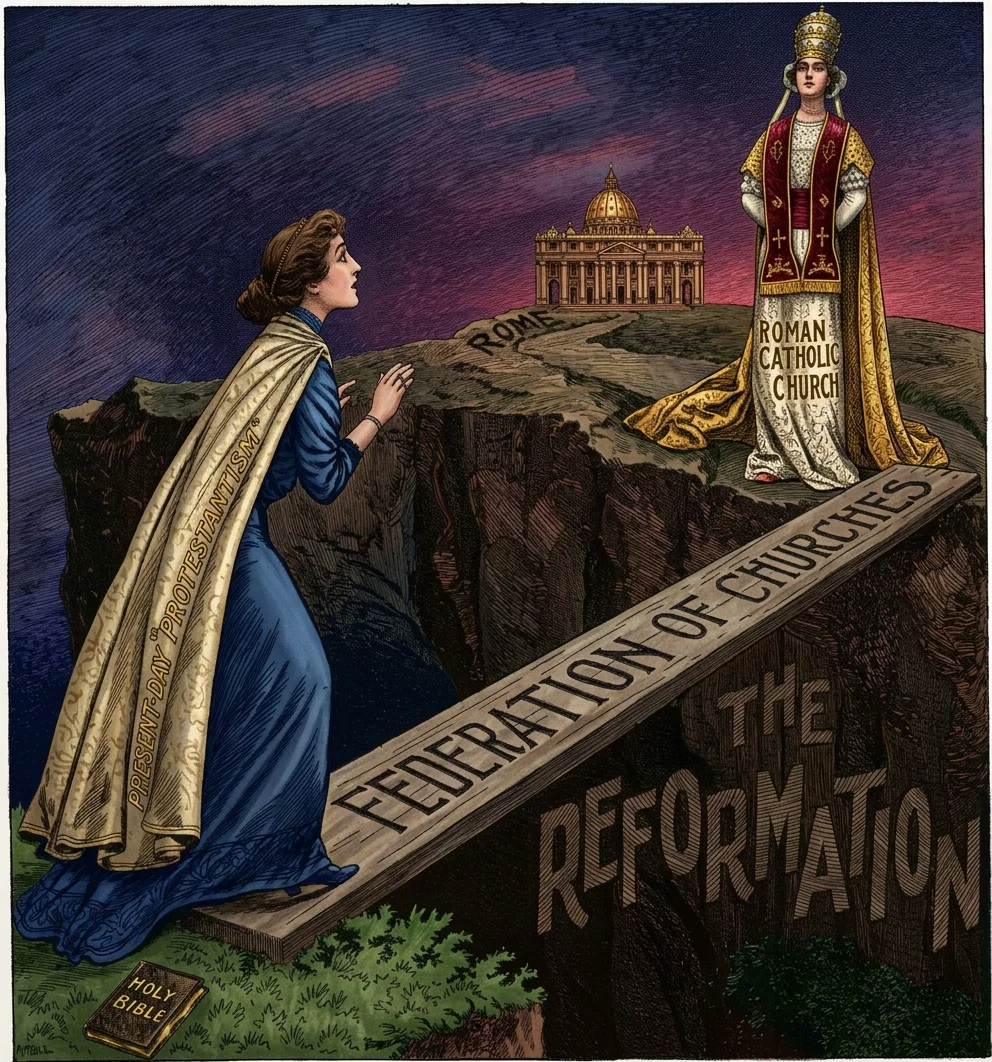
Will Protestantism Cross the Reformation Gulf to the Papacy by the Federation Plank?
ONE of the important things which came before the great Federal Council of Protestant Churches in Philadelphia, Dec. 2-8, 1908, was the matter of a Sunday law, “the first day of the week,” for “the Lord’s day, as a day of rest and worship.” A constituent body of the Federal Council is the Seventh-day Baptist denomination. In behalf of them, their own members, recognized and accepted as evangelical Christians, Dr. Wayland Hoyt offered the following resolution, and plead for its adoption:
“It is not our intention that anything shall be done to interfere with the convictions of those brethren represented with us in this council, who conscientiously observe the seventh instead of the first day of the week as a day for rest and worship.”
Fair and decent from the Sunday-law standpoint, wasn’t it? Surely, there could be no opposition to it.
But there was. Bishop Thomas Benjamin Neely, of the M. E. Church, opposed it. He said:
“Emphasize that phrase ‘The Lord’s day.’ Some people do not believe in the Lord’s day, but some other day, as the Sabbath. If we do not take a stand upon which day we believe we should observe as a day set apart for the worship of God, and of rest, this will give a wrong impression to the people. Is it the Lord’s day or some other day that we are standing for? If it is the Lord’s day, we should take the resolution by the committee and nothing more, and I trust that the resolution as proposed [by Dr. Hoyt], be not accepted. We believe in the Lord’s day and must stand for it.”
Dr. Wayland Hoyt said:
“Let us remember that the brethren of the Seventh-day Baptist denomination are members of this council as are any other bodies. If we are going to observe brotherhood and Christian love, we are not going to clash because of the religious and conscientious convictions of brethren associated with us in this council of churches. I do not myself sympathize with these brethren in their belief. I respect their convictions; I do respect them for the fact that they are willing to sacrifice; I respect them for their willingness to stand firm and true to what they believe. While I fully sympathize with the spirit of the resolution already submitted [for a Sunday law], it does seem to me that we ought never in this council of the churches adopt such statements as shall seem to conflict without due explanation, and I fully believe that our brethren are equally united in this.”
“This federation of churches shall be more and more acknowledged throughout the churches, and it is absolutely necessary that we be thoroughly fair with one another, that we be thoroughly brotherly with each other in all our relations.”
“I believe that God looks smilingly upon this desire to be absolutely fair and just and brotherly to all represented in this federation of churches. I earnestly hope that this resolution [above printed] will pass.”
Then the Rev. Arthur Mains of the Seventh-day Baptists spoke. He referred to the fact that his denomination was the smallest body in the council, thanked the council for their recognition of his people’s evangelical standing, and made an eloquent plea for religious liberty in that “city where the Continental Congress met, and where a Seventh-day Baptist presided,” who “would have been one of the signers of the Declaration of Independence,” but who was taken ill and died shortly before that great document was signed. He asked, “Shall it be that this council refuses to say that we shall not be interfered with in the exercise of our religious convictions?”
Others declared that they must not even admit that there is another day which is the Sabbath; that the Seventh-day Baptists were not the only ones involved, but the Jews and Seventh-day Adventists would use the resolution against them, and it would not do to recognize their own members. “We must take a stand as a body united in the belief that the Lord’s day is a day of rest and worship.” And so Dr. Hoyt’s resolution not to interfere with the faith and practise of Seventh-day Baptists was voted down by a large majority.
Will Seventh-day Baptists still remain a member of a federation which stands for religious legislation and emphatically expressed intolerant religious legislation?
The true Lord’s day, it may be remarked, is emphatically the day which the Lord gave, which has been revealed in the Lord’s Book, which was hallowed by the Lord Himself. That day is the seventh day.
The Federal Council of Churches may endeavor to legislate themselves into the belief that Sunday is the Lord’s day and Sabbath, yet God’s Book speaks the same unchangeable truth, “The seventh day is the Sabbath of Jehovah thy God,” and Christ by His Spirit calls it, “My holy day.” They are not fighting against men, but God.
Protestantism in Church and State.
WHAT was the true attitude of Protestantism to the doctrine of church and state? Were our Catholic friends to give the answer they would probably tell us that the type of Protestantism was that of Henry VIII. It is thus that “The Western Watchman” refers to Protestantism and its relation to church and state in its issue of Nov. 19, 1908:
“The very name ‘Protestantism’ means a union of church and state in its most brutal and repulsive form. Who were the original Protestants, and why did they call themselves so? It was because they denied and denounced the separation of church and state, when the state was Protestant; and admitted it only when the state was Catholic. In those days it was a political dogma that the religion of the prince must be the religion of the people. That was the war-cry of the Reformers. Was ever union of church and state more bestial?”
But by Protestantism we do not mean the perversion of either Christianity on the one side, or Roman Catholicism on the other. Henry VIII did not know the first principles of Protestantism. He was simply a papist, with himself as pope rather than with the man in the Vatican. The Protestantism of the 16th century did not originate with Henry VIII. It receives its name from the Protest presented by the German princes at the Diet of Spires, 1529. And it is thus stated by the great Protestant historian D’Aubigne:
“The principles contained in this celebrated Protest of the 19th of April, 1529, constitute the very essence of Protestantism. Now this Protest opposes two abuses of men in matters of faith: The first is the intrusion of the civil magistrate, and the second is the arbitrary authority of the church. Instead of these two abuses, Protestantism sets up above the magistrate the power of conscience, and above the visible church the authority of the word of God. It declines, in the first place, the civil power in divine things, and says with the prophets and apostles, We must obey God rather than man. In presence of the crown of Charles V it uplifts the crown of Jesus Christ. But it goes further, it lays down the principle that all human teaching should be subservient to the oracles of God.”11
As stated again: “The Gospel of the Reformers had nothing to do with the world and with politics.” And again, “The Reformation was accomplished in the name of the spiritual principle. It had proclaimed for its TEACHER the WORD OF GOD; for SALVATION, FAITH; for KING, JESUS CHRIST; for ARMS, the HOLY GHOST; and had by these very means REJECTED ALL WORLDLY ALLIANCE.”
And very much more might be quoted from that time. When offered the help of the Elector of Saxony, Luther himself repudiated his help. The Elector was told that the cause of God needed not the power of earthly kings to support it. It is true that some of the Reformers thought otherwise; they had not yet gotten away from the teaching of the Roman Catholic Church. Zwingli, therefore, perished with the sword to which he appealed. All these perversions of the true Gospel in the times of the Reformation were not because men adhered to the principles of Protestantism, but because they either did not see clearly what those principles meant, not yet having come out fully from the Roman Catholic Church; or they departed from those principles and sought worldly power. True Protestantism utterly repudiates all union of church and state; it matters not what that church may be, nor what the state may be; and in that principle alone lies the safety and liberty of all religious sects.
It was a woful day for Protestantism when she sought to crystallize God’s truth into a creed; and it was a still more woful day when behind that creed was placed the power of the state.
The remnant church of God must slough off every excrescence which has grown out of the perversions of truth since apostolic days, and stand free and clear from all worldly influences and entanglements whatsoever.
Prosperity.
Since the election, business matters have settled down to something more like stability, and news comes from various parts of the country that there will be work for idle hands to do. It is said that $240,000,000 will be spent on railroad equipment in the next year or so. This, of course, will reach steel industries, railroad shops, and other trades. Mr. W. C. Brown, vice-president of the New York Central, is reported as saying that railroad supplies were ordered the morning after election aggregating $31,000,000 for the New York Central alone.
The National Association of Manufacturers declares that one half of its three thousand members will reengage an aggregate of two hundred thousand workmen. And another estimate is that there will be thirteen thousand manufacturers who will put to work at least 650,000 men. Pittsburg has work for many thousands; Baldwin Locomotive Works expects to put back 19,000 men within a year. All this is encouraging, and it ought to mean earnest work for those who are engaged in winning and saving souls, and scattering Gospel seed.
In the Great World.
Among the Nations.—December 1 the United States Government made public an agreement between Japan and the United States containing five articles, encouraging free and peaceful development of commerce on the Pacific Ocean, maintaining the existing conditions in the Pacific respecting the territorial possessions of each other, preserving the common interest of all powers in China, communicating with each other if any difficulty arises. This is hailed with joy in China and England. As indicating the friendship existing between the two powers, millions of cartridges and thousands of revolvers and other arms have been shipped to Manila by a Japanese steamer.—Conditions in India are still serious. The indications are that there has been conspiracy and plotting for a long time on the part of the people in East Bengal. England has taken hold of it with a strong hand.—In Turkey the Sultan has opened the Parliament. The Turks cheered him heartily along the five miles of his route to the meeting-place. The populace generally throughout the Turkish realms have gone wild so to speak over the new regime. Now is the time for missionaries to do their work.—In Rome, Italian Catholics are striving to obtain from the pope a permission to form an Italian Catholic Parliamentary party, fashioned more or less on the Catholic center in Germany, but as Leo XIII absolutely prohibited this, the present pope intends to continue the policy of his predecessor. The Vatican does not wish to admit that they recognize a united Italy with Rome as capital.—The preparation for war among the nations still continues. This is especially manifest in the race between England and Germany. England’s last big ship is the “Collingwood,” keel plates of which were laid in February of last year; and the vessel launched nine months later, a record in battle-ship building. When completed, it will have cost $10,000,000. Her displacement is 19,250 tons, heavier than the “Dreadnaught” by 2,000 tons. Of the 45 battle-ships or battle-ship cruisers of the new type which have been, or are being built for the world’s navies, 19 have been launched, and 11 of them fly the British flag. As between the present North Sea fleets of Germany and England, the advantage is with the English in both speed and production. One of the most terrible guns in existence has been recently built by Great Britain, which is able to sink the largest battle-ship afloat with a single shot. The “Collingwood” and her sister ships, “St. Vincent” and “Vanguard,” will be armed with the new gun, 51½ feet long, weighing nearly 66 tons, the projectile of which will weigh 850 pounds, with a muzzle velocity of 3,010 foot seconds, and a muzzle energy of 534,000 foot tons. It will penetrate 33 inches of wrought iron at a distance of 3,000 yards, while the most powerful gun possessed by any other navy will be able to go through only 16 inches of iron. It is very rapid fire also for such a large gun. In the meantime, these preparations for war are increasing the burden of debt, and making the great mass of people more and more unsatisfied.—Matters have quieted down between Germany and England on account of the published interview in the London Telegraph of October 28, and it has recently been said that the German Emperor is not really responsible for his utterances; one eminent physician declaring that he is suffering from a disease in his head which will eventually dethrone reason, and for which there is absolutely no help. In connection with this an Italian statesman relates a conversation which he had with the Kaiser in which the Kaiser declared that he had been entrusted with a divine mission, that of saving humanity from the horrors of war, and he looked at the triple alliance as a means of help to him “to execute the will of God.” All of which shows upon how slender a thread hangs the peace of the world.
Financial and Industrial.—According to the former deputy controller of New York City, Editor J. Levy, we are told that New York City owes now eight hundred million dollars. This is beyond comprehension.—Speaking of the power of the trusts, Attorney-general Bonaparte at a recent banquet in New York showed the conditions necessitating the anti-trust laws. The free American citizen, he tells us, must get out of business because the trust wanted his trade. If he bought of another, he dared not sell to him because the trust forbade it. The little dealer found himself charged twice or three times what the railroads ask of the trust, and when his goods reached the market the trust undersold him by half of its rebate. In short, Americans found their liberties were endangered. In fact, the trusts were controlling the entire business. Doubtless the anti-trust laws were needed, but what is equally needed is the enforcement of those laws.—December 10 there was held in New York what is called “The Billion-Dollar Banquet,” that is, the men who sat down at that banquet represented more than a billion dollars in private fortunes. Some of the men who there sat down, it is said, would quickly exhaust their fingers in counting their millions. Thirty-four men alone represented corporate interests which are capitalized at $1,508,241,770. Ex-Judge E. H. Greeley, the chairman of the United States Steel Corporation, made a speech which was thoroly appreciated, in which he justified the existence of the trusts. It is such banquets as these in the face of hard times which stir up class hatred. In London there are thousands and thousands of men out of work who parade the street daily with their ragged clothes, unkempt appearance, bearing banners and crying out, “Give us work.” In the city of Berlin alone it is said that 60,000 are out of work, 20,000 thrown out in six weeks.—Professor12Johnson, Dean of the School of Commerce and Finance of New York University, and professor of Economics in the University of Pennsylvania, tells us that the cost of living, which has risen 44 per cent in the past nine years, is going to keep on going up for nine years more. He says that in 1918 we shall see the average prices of the necessaries of life advance to 80 per cent of the rates quoted in 1897; but he further says that the wages of the working man will not rise in the same proportion. Last year the shrinkage in wages, measured by the price of commodities, amounted to one half of one per cent, or five dollars in a thousand. What wonder is it that thousands of people are willing to try Socialism, while knowing very little about it? They feel that the outlook under the present regime is bad and only bad, and that any change that may come will not make it worse.
Relief for Earthquake Sufferers
The latest news from the earthquake is that thousands are dying from pneumonia, meningitis, injuries, and starvation. Many were killed by a tidal wave, thirty feet high, which washed over Messina and Reggio. Twenty cities, at least, are reported to have burned after the earthquake. All wagon roads and railroads were destroyed, and access to the stricken districts was by water. Chilling rain-storms followed the earthquake. There is a splendid response from all parts of the civilized world to the needs of the sufferers, and one of the great difficulties is that it will not reach there soon enough. The United States Government appropriated eight hundred thousand dollars.
Justice and the Coming of Christ
Mr. Taft is reported to have said recently: “Speaking generally, I believe the greatest question now before the American public is the improvement of the administration of justice, civil and criminal, both in the matter of its prompt despatch and the cheapening of its use.”
There seems to be a general sentiment among leading men that one of the prevailing evils of the age is the difficulty of securing justice in the courts. It has been discussed for a number of years, and pointed out by our ablest thinkers again and again, but the evil seems not only to hold on, but to get worse. The grasping selfishness of this time is one of the ingredients that has been worked in to make this difficulty of securing justice before the law. Money is altogether too freely used to “influence justice;” grafting and bribery are on the increase, particularly in the cities, and this whole evil condition is so firmly rooted that there is no power short of the second coming of Christ that can stop it. Good and honorable men are doing much to check it, and every effort they put forth should be supported. But the enforcement of law is becoming more and more difficult. As Mr. Taft says, it is now one of the greatest questions before the American people. In view of this condition of things, how bright are the promises that the Lord’s coming is very near at hand. This is the great star of hope and rejoicing. A knowledge that the event is near shields the believer from the distress of the problems which are filling men with fear.
In Religious Circles
By Editor
In Religious Circles.—According to the Chicago Tribune, at a recent meeting in New York of the Congregational ministers, Dr. Robert McDonald, of the Washington Avenue Baptist church, said that the New Psychology’s Religious Movement is leading the Christian church to get hold of the imminent and near-by God, while that “Protestantism as Protestantism is a dying thing;” and both of these remarks were applauded. He declared that the preaching and practise of the New Psychology doctrines were bringing back former parishioners of his church who had long been indifferent. He also said that Christian Science and Psychology “do not contain full Christianity,” and are “intensely irrational,” but “they are answering the most vital, personal, spiritual issue. They are filling their believers with consciousness of God of which early Christian mystics were so vitally conscious.” “The New Thought Movement has taken 1,500,000 persons away from the orthodox Christian church. These people have felt strongly the need of getting divine help in weak moments. They saw that they were not getting it in Christianity, so they deserted it.” Let it be known that the New Psychology and the doctrine of the imminent God, so to speak, is Pantheism pure and simple. It is endeavoring to bolster up people by making them believe that they have God within themselves, utterly regardless of His word or plan of saving men. Doubtless it helps, or seems to help, over little difficulties and nervous troubles. It certainly does not make for the righteousness of the Bible. It is an utter perversion of Christianity. It is not to be wondered at with such doctrines taught in religious circles that Protestantism is where Roman Catholics themselves declare it is, without any religion whatsoever. As The Western Watchman expresses it: “Outside of the Catholic Church to-day everything is doubt and idle speculation.” “Outside the Catholic Church there is a feeling of uncertainty, of unrest, of soul torture, that begets universal discontent, and what will the poor people do? What refuge can they find? They must have some shelter.” Of course The Western Watchman thinks that the only shelter and refuge is the Roman Catholic Church. Many souls who are ministered to by just such pastors as applauded the remarks above quoted, turn to Christian Science and the New Psychology; still others turn to Socialism, others to Catholicism; yet there is one refuge above all these, and that is the refuge of the everlasting Gospel of the Lord Jesus Christ. Roman Catholics may ignore that word for tradition, Higher Critics, among Protestants, may dissect it till nothing but its bare bones lie before their congregations, yet it still lives, and like its divine Author has within it the life born of righteousness; a life which is eternal to all those who will believe in its divine truths.—The discussion is still proceeding between the Roman Catholics and their opponents in the Protestant churches, raised by Mr. Roosevelt, and the protest of the Lutherans against his ideas on religious liberty.—A Catholic priest, the Rev. Thomas F. Burke, of the Paulist fathers, in a sermon in New York recently, declares that “the Catholic Church has always taught that the state is of itself an independent and perfect society. Leo XIII insisted clearly upon this point: there are two powers that govern mankind, ecclesiastical and civil. These have their distinct spheres and their distinct limits. No matter how much the church may advocate the union of church and state where ideal conditions prevail; no matter how much she has insisted upon such a union in other lands, and in other times, she has never advocated a union of church and state in America.”—Mr. Taft, the President elect, is a Unitarian, and yet we are told that the pope has blessed him and his family. The despatch from Rome is quoted as saying: “The blessing was given in the presence of Archbishop J. J. Glennon, of St. Louis. . . . Archbishop Glennon told the pope that he had received a letter from Mr. Taft in which the President elect expressed his cordial friendship for the Catholics.” The pope received the news with unfeigned delight, and The Western Watchman tells us that Mr. Taft is “one of the best friends” that the Catholics have; and yet that is not the real question as to his worth as a President; but will he abide by the Constitution of the United States? If so, he will render justice to all. Of the question under discussion between the Lutherans and Catholics we shall have more to say hereafter.—The Emmanuel Church Movement is growing, and other churches are taking it up, endeavoring to heal certain classes of disease by suggestion, turning the others over to the doctors. Some physicians are warning the people against this by saying that Christian Science and the Emmanuel Movement deal but with a very small percentage of invalids, those who are troubled nervously, and who live long anyway; that they are likely to lead people to believe that work will be done that can not be done, and consequently many will be deceived. It is the danger of a little knowledge. On the other hand the religious hypnotism will doubtless grow and spread, leading to a faith in humanity that will sooner or later be doomed to disappointment. There is such a thing as healing by faith, but it does not come through faith in humanity, but faith in Him who is able to heal.—The freedom granted religious sects outside of the orthodox faith in Russia has been to a certain extent on paper; the governors in many parts of the empire having closed Baptist chapels and meeting-houses. Premier Stolypin has informed them that the Baptist chapels and meeting-houses must not be molested. It will probably take some time, however, to put his order into effect.
Opium and Kindred Drugs.
Recently people have been congratulating themselves that opium has been shut out of China. It is a cause of rejoicing; it would be a cause of still greater rejoicing if all the other substitutes which are taken for opium could be shut out likewise. As it is, American and English cigaret manufacturers are reaping the profit of the perverted appetite. The Chinese have turned to the cigaret, and following that will come whisky. One writer declares there are only two kinds of American business which will thrive in China; tobacco and Standard Oil. China could fence herself against the marauding Tartars two thousand years ago by the great wall. It can not keep out what is worse than all the Tartars—the American cigaret. They come into China in one unending stream and they will, too, have their effect. A long use of opium has prepared the appetite for inordinate consumption of tobacco. The effect will be seen upon the race. We are also told that American drugs, patent medicines by the ton, are going to China, and in many of these things they will get the opium as truly as they did in the pure drug itself; and it will have the same degenerating effect. Right in connection with this comes the statement by a woman as prominent as Mrs. Ophelia Amigh, head of the State Training-school for Girls, at Geneva, Ill., who declares that “the American woman of the fashionable set lives in a whirl of unhealthful stress and excitement, sleeps too little, and keeps her nerves constantly on the qui vive. She tipples and drugs for headache and insomnia, due to her unhygienic mode of life; she is often a degenerate and the mother of a degenerate, if indeed she is a mother at all. This drinking among women is getting to be more common than we are willing to believe, and it is one of the greatest dangers with which we are confronted to-day. The hurry and fret of American life are turning out degenerates at a rate that will one day stagger the world.” “We have received more than 1,400 girls into our school, and with few exceptions they have been children of alcohol inheritance.” “The number of moral imbeciles that come to us is simply appalling, and you have object-lessons enough right here in Chicago, New York, and other cities. Degenerate theatricals have much to do with it.” It is people of this class who are multiplying the insane and unbalanced. For instance, the annual report of the State Board of Insanity in Massachusetts notes an increase in that state from 1906 to 1908 of 1,679; a total in the state of 12,050. New commitments are constantly increasing. The Springfield Republican truly says, “This is not an encouraging view.” It is these increasingly unbalanced ones, many of whom are outside of asylums, that furnish the class of whom Senator Lodge speaks in a recent speech: “To-day,” he says, “we seem almost to have reached the point where the sympathy is so strictly confined to the criminal, that there is none left for the victim of the crime.”
Alarming Decrease of Population.—
Reports from Paris state that the depopulation of France is proceeding at an amazing rate. In 1907 there were over 32,000 less births than in the preceding year, and more than 13,000 more deaths. There were 19,920 more deaths than births. In 1906 the ratio of births was 215 to 10,000 population. Last year it fell to 207. In fifty-five departments there is an excess of deaths; in Paris alone the greatest, of 3,316. These statistics do not give us the cause of this. Sometimes it is intimated that unnamable crimes are the cause of the falling off of the birth-rate. It certainly points to an unhealthful, unnatural condition. Wherever people have been living temperately, righteously,—truly living,—there has always been a large increase of population; and yet these are among the things which we may expect as we near the end of the earth’s career in sin.
Crime and Violence in Greater New York
In Greater New York, during the first nine months of the year, 9,364 years imprisonment in the aggregate were imposed upon criminals. Fines were inflicted to the amount of more than $212,000, and property recovered to the amount of $421,000. One of the serious things, however, connected with the city crime is the many murders. A writer in Harper’s Weekly says the city is “surfeited with murder. It is a commonplace of the day’s news; it has ceased to attract attention. Men are stabbed or shot down or blackjacked, not secretly, but in the open, crowded streets at midday, for little or no cause. Life has become cheaper in New York than in the wildest of Western mining-camps. Gangs hold undisputed sway in their separate territories, outraging, blackmailing, murdering peaceable citizens, when they are not engaged in fighting each other.” It seems to us that such conditions as these ought to help us to see the fulfilment of prophecy and to lead thousands of people to flee to the great, open, inviting country which awaits them in the far West and Canada.
Russia’s Burglars’ Gazette
Among the trades papers published in Russia is a burglars' gazette. That is not its open name. It is called The Barefooted Gazette, an allusion to the stealthy ways, perhaps, of its readers. It contains full reports of the latest thefts, burglaries, all kinds of things to incite to burglary and help those who would pursue the craft. It is published in secrecy, and the police have not yet found the office from which it is issued.
Earthquake Shocks in Virginia City
In a few days, up to December 27, Virginia City, Mont., had had thirty earthquake shocks. The last one put the electric light plant out of commission, shook dishes from shelves and tables, and cracked buildings.
Change in Firm Name.
By Milton C. Wilcox; H. H. Hall
To Whom It May Concern:
By the common consent of over two thirds of the stockholders, and with the approval of the Superior Court of Santa Clara County, California, the Pacific Press Publishing Company has been merged into the Pacific Press Publishing Association, a membership corporation; and beginning Jan. 1, 1909, the business will be conducted by the new organization which has purchased the plant and assumed all the liabilities and obligations of the old company. This change has been made for the purpose of enlarging the constituency and placing the institution on a broader foundation.
The membership of the corporation, apart from the original incorporators, is composed of the following:
“Secondly: The executive committee of the Pacific Union Conference of Seventh-day Adventists, of the Central Union Conference of Seventh-day Adventists, of the North Pacific Union Conference of Seventh-day Adventists, of the Northern Union Conference of Seventh-day Adventists, and of the local conferences of Seventh-day Adventists within the bounds of the above-mentioned Union Conferences.
“Thirdly: Such of the stockholders of the Pacific Press Publishing Company as assign their stock to this Association, and who make written application for membership in accordance with these By-laws of this Association.
“Fourthly: And such of the said Seventh-day Adventists who shall be elected to membership in accordance with these By-laws.”
Mr. C. H. Jones has been elected General Manager, and the management will remain practically the same as that of the old company, and the same policy will be pursued, only on a larger scale.
Hereafter all bills should be made out and correspondence addressed to the Pacific Press Publishing Association instead of the Pacific Press Publishing Company.
This change affects the branch offices at Kansas City, Mo.; Portland, Ore.; Regina, Saskatchewan, Canada, as well as the main office at Mountain View, Cal.