BLESSED is the man in whose heart are the highways to Zion, for he has the secret of perpetual, immortal youth. “They go from strength to strength.” In other journeys, the longer you travel, the more tired you become. We read in history that in long marches men sometimes fall by the way, utterly unable to stir another step. When they begin in the cool of the morning, they march briskly enough; but marching mile after mile, in the blazing sun, they become tired, and they drop out, worn out, panting, utterly exhausted.
You notice all that is reversed in the case of the pilgrim in whose heart are the ways to Zion. He never falls out of the march. The nearer he is to the end, the more eager and vigorous he is. He gathers new energy and fresh power with every mile he travels. He goes on “from strength to strength,” and that is not poetry but blessed fact. The pilgrim at the beginning of the march finds it toilsome and painful enough, and he is only able to drag himself painfully along. But talk to the old pilgrim who has been fifty years on the road, and he is going on “from strength to strength,” and is stepping out very briskly and vigorously now.
That is the history of every man in whose heart are the highways to Zion, he goes on from “strength to strength,” as the years pass. What a contrast to ordinary old age, when the powers decay, the senses fail, the strength disappears, so that old age is often little more than a living death. The pilgrim who has the secret of perpetual joy, immortal youth, the older he gets the younger he becomes. His hair is white, but his soul knows no touch of decrepitude or decay. He brings forth fruit in old age, his soul is fat and flourishing. Though the outer man decay, the inner man is renewed day by day, and he goes on from strength to strength. He can say, “Of his fulness have we all received, and grace for grace.”
“We all,” said Paul, “are changed into the same image.” How?—“From glory to glory,” “from strength to strength.” That is the spiritual history of the man in whose heart are the highways to Zion. “The righteous also shall hold on his way, and he that hath clean hands shall be stronger and stronger.”— Rev. J. D. Jones.
Large Price for “Experience”
A FAMILY of ignorant Siberian peasants recently arrived on foot, after traveling three thousand miles in six months, at Tomsk, Siberia, with a supposed fortune in gold. They found, on arrival at the mint, that the value of the treasure was ten dollars. There are millions of people making a longer journey which will end with their lives, and they will find the treasure which they are carrying worth even less than that. Such are all they that obtain riches or public place or reputation in the church by violation of the law of God—not by right or pleasure. “What shall it profit a man, if he shall gain the whole world, and lose his own soul?”—New York Christian Advocate.
Beautiful Faces and Lives
“Beautiful faces are those that wear—
It matters little if dark or fair—
Whole-souled honesty printed there.
“Beautiful lives are those that bless—
Silent rivers of happiness,
Whose hidden fountains but few may
guess.”
A Christian Home
By Edith Bartlett
EDITH BARTLETT
In the great plan of salvation the place of the true home is of vast importance. Instituted in Eden by God himself, he designed that through it mankind should learn of the kingdom of heaven, and enjoy, even here, a foretaste of the love, joy, and peace of which that kingdom consists.
Jesus said, “Except ye be converted, and become as little children, ye shall not enter into the kingdom of heaven.” When this great truth is realized, parents will see that their children are gifts from God, by which he seeks to link them to himself. The teachableness and simplicity, the love and absolute trust of childhood, are object-lessons, helping us to understand the true nature of faith, and what Jesus means when he says, “Blessed are the poor in spirit: for theirs is the kingdom of heaven.”
And the child, trained from infancy to see in father and mother its best friends, learning continually lessons of obedience and reverence, will not, when the claims of the great Father are presented, find it hard to respond.
God’s words, “Like as a father pitieth his children, so the Lord pitieth them that fear him,” and, “As one whom his mother comforteth, so will I comfort you,” will not be empty sounds in the ears of one to whom father and mother have been truly pitiful and truly comforting.
The commandment, “Honor thy father and thy mother: that thy days may be long upon the land which the Lord thy God giveth thee,” shows that God has placed mutual obligations upon parents and children—children honoring, and parents proving worthy of honor—that they may help each other to become partakers of the inheritance of the saints in light.
But the tie between Christ and his people is closer even than that of parent and child. “For this cause shall a man leave his father and mother, and shall cleave to his wife; and the two shall become one flesh.” This is a great mystery: but I speak concerning Christ and the church.
It is evident, then, that through the home where Christ reigns, is given a practical illustration of the outworking of God’s plans.
What a refuge in time of temptation! What a bulwark against sin! For the Christian home is the home where love reigns, and finds expression in words and acts of thoughtful kindness and gentle courtesy. “In the fear of the Lord is strong confidence: and his children shall have a place of refuge.”
Here are welcomed the downcast and afflicted, to whom are given help and cheer, that the call of Jesus, “Come unto me, all ye that labor and are heavy laden, and I will give you rest,” may reach their hearts. Says the Lord, “Is not this the fast that I have chosen? to loose the bands of wickedness, to undo the heavy burdens, and to let the oppressed go free, and that ye break every yoke? Is it not to deal thy bread to the hungry, and that thou bring the poor that are cast out to thy house? when thou seest the naked, that thou cover him: and that thou hide not thyself from thine own flesh?”
Can we wonder that against this mighty influence for good, Satan has directed his most determined efforts? So well has he succeeded in tearing down this great bulwark against evil, that among the deadly sins of the present day are disobedience to parents, and a sad lack of natural affection. 2 Tim. 3: 1-5.
But God’s kingdom will triumph, and already is going to the world that great message which he promised: “Behold, I will send you Elijah the prophet before the coming of the great and dreadful day of the Lord: and he shall turn the heart of the fathers to the children, and the heart of the children to their fathers, lest I come and smite the earth with a curse.” And, amid the perils of the last days, his people triumphantly exclaim, “Behold, I and the children whom the Lord hath given me are for signs and for wonders in Israel from the Lord of hosts, which dwelleth in Mount Zion.”
Get Out
I MEAN it. Get out into the open air these glorious, summer days, every housewife in the land!
“O, yes!” responds some overworked woman, “it’s easy enough to advise us to get out into the open air; but after having been on my feet all the forenoon and half the afternoon, I’m too tired to go out anywhere, even if I didn’t have to sit down and sew every minute till time to get supper!”
Very true; and the sewing you have to do is no fancy work, but coarse trousers to patch, little garments to mend, and13endless stocking-darning. But don’t sit down in the kitchen to do it. It is the bounden duty of every practical housewife to stay out of that apartment all she can. You need a change from the atmosphere of work which must inhere even in the most well-ordered kitchen. Take your mending basket and sewing chair and go out into the yard, somewhere under God’s blue heaven, and let the fresh air and sunshine, and all the soothing influences of nature, charm and rest you, and make you forget for a while the indoor cares. Outdoor air is at once a tonic and a nervine. It acts on both mind and body.—Good Housekeeping.
Trust Him
By Amelia M. Starkweather
Let no troubled care attend thee;
Bid thy days be free from strife;
Heed the precepts of the Master:
“Take no anxious thought for life.
Ye are better than the raiment,
And the life is more than meat.”
Work and wait, but never worry,
And thy joys shall be complete.
For behold the fowls of heaven,
How they sow not, neither reap;
Yet your Heavenly Father feedeth;
Trust him, trust him,
Trust him now thy life to keep.
Or consider how the lilies
Toil not, neither do they spin;
Yet with all thy wit and wisdom,
Thou canst not such glory win.
If our Father feeds the sparrow,
Clothes the lily of the field,
Why not for thine own to-morrow
Trust it will a blessing yield?
For behold the fowls of heaven,
How they sow not, neither reap;
Yet your Heavenly Father feedeth;
Trust him, trust him,
Trust him now thy life to keep.
O what gain to trust the Master;
What reward thy faith insures;
What a blessed peace and comfort,
That forevermore endures!
Cast, then, all thy burdens on him,
For he surely cares for thee;
And he’ll bear thee in his bosom
Safely o’er life’s mystic sea.
For behold the fowls of heaven,
How they sow not, neither reap;
Yet your Heavenly Father feedeth;
Trust him, trust him,
Trust him now thy life to keep.
— Amelia M. Starkweather, in Pittsburg Christian Advocate.
Try a Little Oil
By A FATHER
A FATHER
In our haste often many little things which contribute to comfort are omitted. One morning on reaching the office, it was desirable to keep quiet, that a sick person in apartments above might not be disturbed. On opening a door, behold it answered by giving a long-drawn-out squeak, which broke the stillness in a terrible fashion. Then on opening the safe door, there was another noise which rivaled the ear-jarring sound that had just subsided. The next move was to shove the desk chair to one side a little, and it had a reply ready, and as if this was not enough, a small stand with four rollers on the floor broke in ill concert when moved along a little.
This was too much. We knew there was an oil-can on the premises, with oil therein, and at once everything else stopped, and an oiling process began. The office door, the safe door, the office chair, and the stand all seemed to be highly delighted with the oil, and responded quietly thereafter as their services were needed at the hands of the workers.
Yes, use a little oil. There are squeaky joints in the home some mornings. Everything seems touchy. It does not need nervous jerking at such times, nor a torrent of cross words; no, all that is needed is a little oil. But the oil must be applied on the worn, squeaky spot, or no cure will be effected. It needs only a drop, just a little, of the oil of kindness to set the good wife singing all day, to send a thrill of joy into the heart of every child, causing it to bound with gladness perhaps the whole day long.
Many a happy day is lost, all for the want of a little oil. Brother, be sure to keep an oil-can with some oil in it. If out, a suggestion for a supply is found in Zech. 4: 12.
_Immunity From Consumption_
By C. L. Topliff
PULMONARY tuberculosis, or consumption, is the most common and dangerous of all diseases, in fact, the public statistics show that more than one tenth of all deaths in the United States result from this disease, while between the ages of fifteen and forty-five the proportion is increased to thirty-three per cent, which means that one death in every three between these ages results from tuberculosis. Dr. Alfred Hillier, secretary of the British National Association for the Prevention of Consumption, has for many years made a close study of this malady. In his new book, he states that “deaths from tuberculosis in England and Wales are estimated to amount yearly to sixty thousand, and in the rest of Europe to a million. In England one half the deaths between the ages of twenty-five and thirty-five are caused by this disease.”
It is a well-known fact that tuberculosis is due to the tubercle bacillus, a vegetable micro-organism which is motionless and helpless, but under the proper conditions can grow and reproduce itself very rapidly. It has been estimated that in some cases, two or three thousand millions of tubercle bacilli are discharged in the expectoration from a single case of consumption in the course of twenty-four hours. If such sputum lodges in places where it afterward dries and becomes pulverized, as on the street, floors, carpets, clothing, or handkerchiefs, these germs are liable to float in the air as an invisible dust, making it an easy matter for one to inhale them into his lungs. Every one does inhale them more or less often, but if the lungs are fully developed and in a healthy condition, the germs will not prove harmful.
The tubercle bacillus requires an unhealthy tissue and a certain amount of moisture to favor its development, and the lungs are most frequently infected because they are seldom fully developed in the human being, and especially in women. This is due to the fact that the apex or top of the lung is seldom filled with air, and consequently the tissue in that part of the lung becomes weak and unhealthy, for want of use, and makes the best kind of a place for the rapid development of this dangerous germ.
For many years the medical profession of the entire world have devoted their thoughts and energies to the discovery of some cure for tuberculosis; but all efforts to cure the disease by drugs have utterly failed, and they now admit that the only thing that can be done is to give the patient plenty of fresh air, and adopt such strict sanitary measures as will prevent the spread of the disease to others. As pulmonary tuberculosis—consumption—is the most common form of this disease, and is due to imperfect development or unhealthy condition of the lungs, why not make all children, and others, immune from the disease, by teaching them how to breathe properly, thus developing every part of their lungs, and making it impossible for the tubercle bacillus to live there?
When the disease is once established, it is difficult to cure it, because the patient's vital force is so low that he does not have sufficient power of resistance to repel the disease. Small or unused lung capacity means low vital energy; but when the capacity is increased, the vital force also is increased, as well as the power of endurance, giving the person greater power to resist diseases of any kind.
The common nervous breakdown among children, as a result of overwork or too much mental strain, would seldom occur if the lungs were used as nature intended them. The matter of developing the lungs is very simple, and can be accomplished without any extra expense to the city or community. If all physicians would instruct their patients how to breathe properly, and if the boards of health and boards of education would compel all the schools to have their students rise in their seats and practise breathing exercises for a few minutes every morning, at the opening of the school, and at the same time tell them to practise these exercises on rising in the morning and at other times during the day, the result would be that their lungs would soon be in a healthy condition, and they would probably breathe properly during the rest of their lives.
If this rule was strictly carried out, the new cases of tuberculosis would soon be greatly reduced, and, in a comparatively short time, tuberculosis would be substantially eradicated from our community. In the incipient stage of the disease, these breathing exercises will assist greatly in effecting a cure.
No elaborate breathing exercises or gymnastic movements are necessary to properly develop the lungs, in fact, one simple breathing exercise would be sufficient—the double-breath. This exercise is taken as follows: stand erect, with the hands at the side, in line with the legs; take one long, full breath, hold it for a second, then take another quick, short breath on top of the other breath, and hold all for a second longer, then gradually exhale the air through the nose. All inhalations and exhalations should be through the nose, and not by the mouth.
There are a number of breathing exercises which will develop the lungs, but I mention this one as the best of all. Persons who are suffering from this disease, in an advanced stage, should practise the long, deep single breath for some time —several days or weeks—before attempting the double-breath, as the latter is only intended to develop the lungs of those who are not seriously ill. If you will try this double-breath exercise, even once, the extreme top of your lungs will no doubt experience, for the first time, the agreeable sensation of a “breath of fresh air.” It is impossible for any one to contract consumption who will completely fill the air-cells in his lungs with fresh air several times a day.—C. L. Topliff, in Scientific American.
Made It a Matter of Prayer
The following incident is told concerning a good, old farmer who had become the happy inventor of an improved plow. Queen Victoria, on seeing the new invention, inquired of the farmer how he thought of it, whereupon he replied:—
“Well, Your Majesty, I had it in my head for a long time before it would become straight. I saw what was wanted plain enough, but I could not make out how to get at it. So at last I made it a matter of prayer; and one morning the whole thing came into my mind like a flash.”
“Why, Mr. Smith,” interrupted his royal listener, “do you pray about your plow?”
“Why, Your Majesty, why shouldn’t I? My Father in heaven, he knew I was in trouble about it, and why shouldn’t I go and tell him? I mind of one of my boys when he was a teeny little mite. I bought him a whip, and very pleased he was with it. Well, he came to me one day, crying as if his little heart would break. He’d broken the whip, and he brought it to me. So I took him on my knee, and I wiped his tears, and I kissed him and comforted him. ‘Now, don’t you cry, my boy,’ says I, ‘I’ll mend the whip, I will, so that it’ll crack as loud as ever.’ Well, now, don’t you think our Father in heaven cares as much for me as I for my boy? My plow didn’t much matter to him, but I know quite well my trouble did.”—
Ram’s Horn.
No Short Cut
THERE is no royal road to anything that is worth having in this life. I saw not long ago in a newspaper a little advertisement to this effect: “Violin playing taught perfectly in twelve lessons.” I immediately called to mind the reply of Giardini, the great violinist, to some one who asked him how long it would take to learn to play the violin: “Twelve hours a day for twenty years together,” was the instant reply.
There is no “short cut” to perfection in music, art, literature, or in anything else of real worth. To labor is “the common lot of all.” Patience and perseverance, combined with unfailing industry, have made all great men what they are. They lost no time in seeking for the “royal road” that exists only in the imagination of the idle and the characterless.—Selected.
The Need in the Dark Continent
By W. S. Hyatt
W. S. HYATT
I HAVE long felt that the needs of the African field are not realized by our brethren in America, and I do not wonder at this; for they have known but little about the great work there is to be done here before the message closes. At present we have five little missions started in Africa, and some of these are scarcely in running order, hence able to accomplish but very little. The facts are that we have scarcely made a beginning, even in South Africa, and the millions of Africa are still beyond, and nothing is being done to give them the last warning message. Thank God, he has sent godly men into these fields who are giving the Bible to the people, and preparing the way before us.
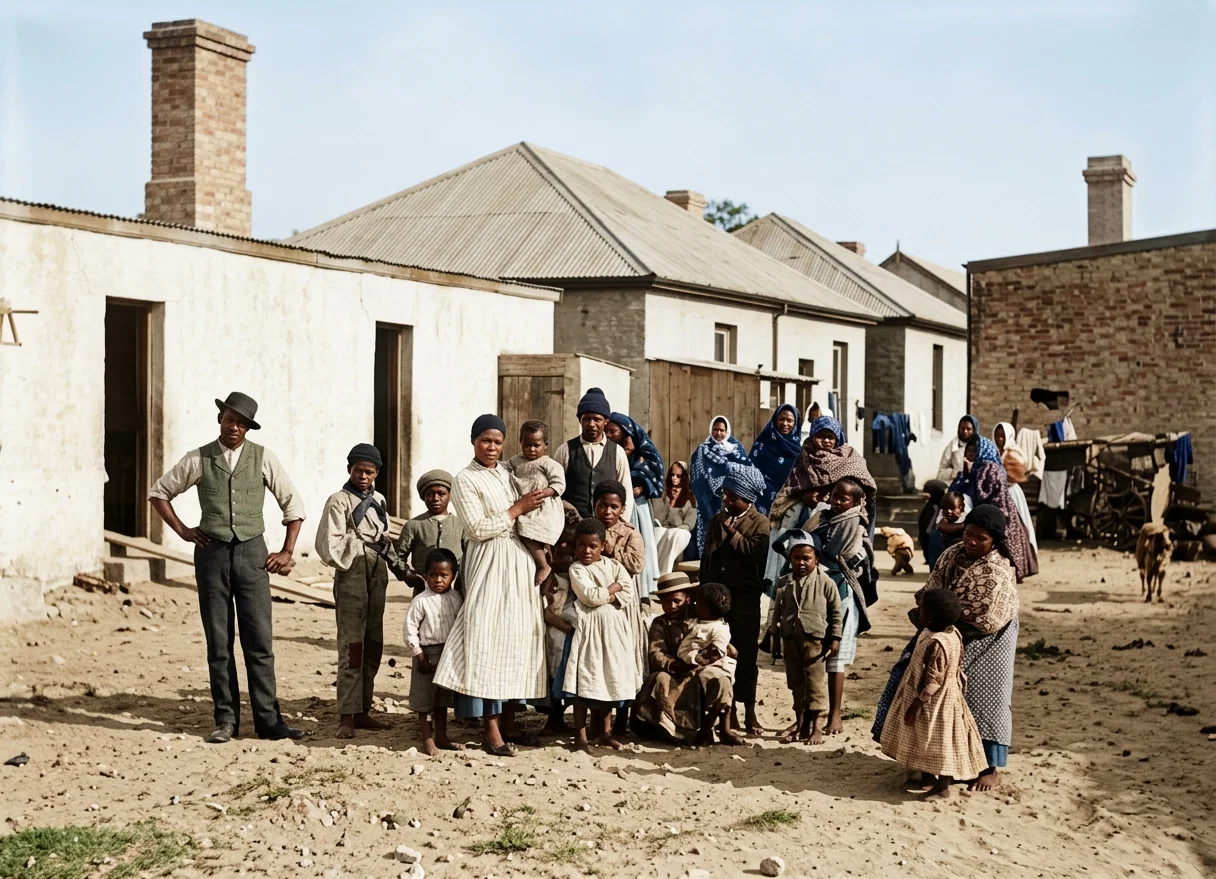
NATIVES IN CAPE TOWN
We are constantly saying, “There shall be delay no longer.” I firmly believe that the time has come for the last message to go to the world with power; but one question constantly arises in my mind, and that is, Are we going forward with the message? I wonder how it is that more people do not have a burden to work for souls, and to enter these benighted fields. O, how very few seem to think that God wants them to take up this work! Even here in Africa, where men speak the language and know the native and his needs, very few can be found who will labor for the souls of the people who are in such great blindness. May the Lord awaken his people.
Let us consider the needs that are staring us in the face to-day. It is nearly fourteen hundred miles to the mission farm from Cape Town. There is absolutely nothing being done for the natives between here and there. Bechuanaland has stood with open doors, inviting us to enter, ever since we began work in Matabeleland, but it remains untouched. It was in this country that Dr. Livingstone began his work for Africa. Kahma's country is a portion of this section, and we have talked of entering it, but it remains untouched. The Transvaal and Orange River colonies have their thousands of natives, for whom we have never lifted our finger. Natal and Zululand teem with natives who are partly civilized and Christianized, for whom we have done nothing.
But let us come a little nearer home. The Kaffir tribe, or more properly the Amaxosa people, are found in this colony, especially in the eastern portion. Perhaps there are no natives in South Africa who are better educated, and have had more done for them, but we have not yet opened work among them. The country in which they live is healthy, and is largely settled by white people, hence almost every convenience can be had. The land is generally good. Fruit and vegetables of all kinds can be grown. Other denominations have opened missions among this people, and have educated natives whom they have sent into the interior to labor for their own people, the white missionary visiting them only in the winter seasons, when there is but little danger of the fever. In this way they have saved the lives of their men of experience, and the work has advanced equally as fast.
But I want to bring you to Cape Town, and see what a field we have at the very doors of our work. Go where you will, it is hard to find a more healthy spot, and one that offers more advantages and comforts than Cape Town. There is a location in one of the suburbs of this city where there are thousands of natives living. These men are those who perform the work in the city and at the docks. Labor has brought these people right to our doors, where we can work for them and have every comfort, but nothing has been done. We have not a dollar for this work. Others have opened a little school and mission, and are working as best they can, but we are doing nothing. How long are we to pass by on the other side, and leave these people in darkness?
I feel that we must plan for the work in Africa. We need men of education to enter this field to master these languages, and be able to teach and translate our books into these tongues. We need medical missionaries, men who love God and souls for Christ's sake, who will come to Africa and take up work for these people. There is no man who has so many advantages as the medical missionary, if he is a man of God. The natives need help physically, and this opens the way to reach their hearts. We began the work this way, but it has been dropped. Is it possible that of all the medical missionaries among this people there are none who feel a real burden to labor for these their more unfortunate brothers and sisters?
We have some things for which to thank the Lord. One of our brethren here gave us two lots of land in Johannesburg, which are to be sold, and the proceeds devoted to the native work. These are worth about two thousand dollars. But we must remember that the purchasing value of money in Africa is but about half what it is in the United States. Two thousand dollars builds a very modest house. But the Lord has money with which to start the work in Africa. We need from two hundred and fifty dollars to five hundred dollars with which to start the work in Cape Town. Then a missionary must be supported. We should enter Kafraria and open a mission, and this will require at least twenty-five hundred dollars. Brother Moko, an educated native, is now working for his people, and would be good help to a man who might take up this work. These are healthy fields, where work can be done, and at the same time the benefits of civilization may be enjoyed. I ask, Is it not time that we begin work in this field?
The hearts of all are sad at the dreadful news of the death of Elder Watson, our missionary to Nyassaland. Once more the banner has dropped from the hands of a brave Christian man, and now who is the one to pick it up and bear it onward? The message must go, and God has the men to bear it along. Because a warrior drops in the field, the work of God will not stop. The burden rests upon some heart who will take up the work and go forward till Father sees that his work is finished. Then he may as well drop in Africa as in any other part of the world.
Shall we as a people rally around our standard, “The commandments of God15and the faith of Jesus,” and bear it onward to every land? Shall we by word and deed say, “There shall be delay no longer?” Shall we give our lives and our all to the promulgation of this message? I know it will triumph gloriously, and there will be a people who will go through to victory with it. From the shores of Africa, God will have a people whom he will gather into the kingdom, to join in the song of redeeming love. There will be a people to whom he will say, Well done, good and faithful servants, because they have been faithful to him. May the Lord awaken his people and arouse them to act while the day lasts, for soon the time will come when no man can work.
The West German Conference
By Guy Dail
GUY DAIL
In Hagen, Westphalia, we have just finished the midwinter session of the West German Conference, January 6-10. This city contains about eighty thousand inhabitants. It is located in the extreme southwestern part of the territory of the West German field. The conference was held here because there seemed to be a good outside interest, developed by the conference president and a number of young workers. The delegation from the various churches in the east, north, and west was not so large as we might have wished; but still about one hundred and fifty or one hundred and sixty of our own people were present; and, best of all, God was in our midst: union was shown in the transaction of all the business that came up for consideration. The workers manifested a good spirit. The lay members were enthusiastic. The subjects treated upon in the meetings for the brethren were present truth. They were presented in the demonstration of the Spirit. That which created the greatest interest was the German East African Mission, but nothing was dealt with in a stiff, lifeless manner. The education of more workers; the enlargement of our school facilities at Friedensau, and the provision of money for this purpose, through the sale of “Christ’s Object Lessons” and the flow of means into the Material fund; the necessity of absolute faithfulness in our relationship to God and his work; the need of liberality and unselfishness in our efforts to carry to the world this last message of warning in our generation; and the value of our temperance and gospel literature, were presented in the demonstration of people clearly.
The evening audiences were about twice as large as the regular daily sessions, there being one hundred or one hundred and fifty interested listeners not of our faith each night. The hall was large and comfortable. It was well filled. The Bible, and the Bible alone, as the only guide for our religious life; the nearness of Christ’s second coming; unbelief as a sign of the end; the inheritance of Abraham and his children; the three angels’ messages, and the other prophecies of Daniel and the Revelation, created much interest among the hearers. Elder Erzenberger spoke on “Our Relation to Christ,” Elder H. F. Schuberth on “The Prophetic Books for Our Days,” Elder Conradi on “A Christian’s Glance into the Near Future” and “The Sick Man of the East,” Elder Luepke on “What Wish the Adventists—A Clear Answer to a Timely Topic,” and Elder G. Schubert on the text, “Who will be able to abide the day of his coming?” Health talks by Dr. Hoenes were well attended.
The city has been, and continues to be, stirred. Opposition is manifested. This opposition comes from the world; it also comes from those who were formerly our brethren, but have fallen away from the faith. The weapons of both classes are practically the same,—they find fault with the tithing system, the Sabbath, and the spirit of prophecy; they seek to scatter lies and misrepresentations. Some are very bold in speaking against the truth. Satan, the accuser of the brethren, finds many allies in his evil work. False doctrines, forged writings, deceit,—these are methods which are in vogue against the cause of God now, as in former days, “to seduce, if it were possible, the very elect.” Still it remains true, “If any man will do his will, he shall know of the doctrine.” . . . Men perish “because they received not the love of the truth, that they might be saved.” In Hagen itself we now have a church of twenty-four members. Nine were baptized at this meeting.
Every living thing manifests growth. The West German Conference is a living thing, for it grows. The believers in Lübeck, Neumünster, Osnabrück, Halberstadt, Hagen, and Königslutter were received into the West German sisterhood of churches and companies. The tithe of this field in 1902, before the Rhenish Conference had been cut off, was $10,000; its membership, 1,093; for the year ending Dec. 31, 1903, it had more than made up for the loss of the Rhenish Conference, as its membership was 1,111 and its tithe about $11,000; its First-day offerings were $312, instead of $162; its annual offerings, $588, whereas for 1902 the annual offerings were only $440; the Sabbath-school gifts lacked thirty-six dollars of being as large as for 1902. These figures are given for the encouragement of others; they tell those who hear, that God is working.
Some money was raised at the time of the meeting,—one hundred and twenty-five dollars for the Material fund on “Christ’s Object Lessons;” twenty-five dollars First-day offerings, for the German East African Mission; ten dollars Sabbath-school donations, and fifteen dollars to the conference poor fund.
Nothing seemed to take such a firm hold of our brethren as the newly established mission in East Africa. Sunday morning a letter recently received from Brother Ehlers was read in the meeting. It was a missionary letter written by a man who is a missionary about his first experiences in attempting missionary work among the heathen of German East Africa. It had an effect. It touched people’s hearts; it reached their pocket-books; we believe its power will be felt in the West German Conference every first day of the week during the year; for the First-day offerings here, also, were dedicated to the work in Africa. After having paid two tithes to the German Union, this conference voted seven hundred and fifty dollars of their one thousand seven hundred dollars surplus tithe to this mission.
The need of more workers is apparent. A field so large as this, with nineteen million people, can not be said to be properly supplied when it has only twenty-six workers,—three ministers, three licentiates, and twenty Bible workers. This field is the best supplied of any in the German Union. It contains within its territory two union institutions—the Hamburg house and the Friedensau plant. God is certainly with his work in the West German Conference, and we hope that the year 1904 will see still greater revelations of his power. To this end let all friends of the spread of the message remember this field in their prayers.
A Nickel for the Lord in the Missionary Collection
Yesterday he wore a rose on the lapel of his coat, but when the plate was passed to-day, he gave a nickel to the Lord. He had several bills in his pocket, and sundry change, perhaps a dollar’s worth, but he hunted about, and finding this poor little nickel, he laid it on the plate to aid the church militant in its fight against the world, the flesh, and the devil. His silk hat was beneath the seat, and his gloves and cane were beside it, and the nickel was on the plate—a whole nickel.
On the previous afternoon he met a friend, and together they had some refreshments. The cash register stamped thirty-five cents on the slip the boy presented to him. Peeling off a bill, he handed it to the lad, and gave him a nickel tip when he brought back the change. A nickel for the Lord and a nickel for the waiter!
And the man had his shoes polished that same afternoon, and handed out a dime without a murmur. He had a shave, and paid fifteen cents with equal alacrity. He took a box of candies home to his wife, and paid forty cents for them, and the box was tied with a dainty bit of ribbon. Yes, and he also gave a nickel to the Lord.
Who is this Lord?
Who is he? Why, the man worships him as Creator of the universe, the one who put the stars in order, and by whose immutable decree the heavens stand. Yes, he does, and he dropped a nickel in to support the church militant.
And what is the church militant?
The church militant is the church that represents upon earth the triumphant church of the great God.
And the man knew that he was but an atom in space, and he knew that the Almighty was without limitations, and knowing this, he put his hand in his pocket, and picked out the nickel, and gave it to the Lord.16
And the Lord, being gracious, and slow to anger, and knowing our frame, did not slay the man for the meanness of his offering, but gives him this day his daily bread.
But the nickel was ashamed, if the man was not.
The nickel hid beneath a quarter that was given by a poor woman who washes for a living.—Selected.