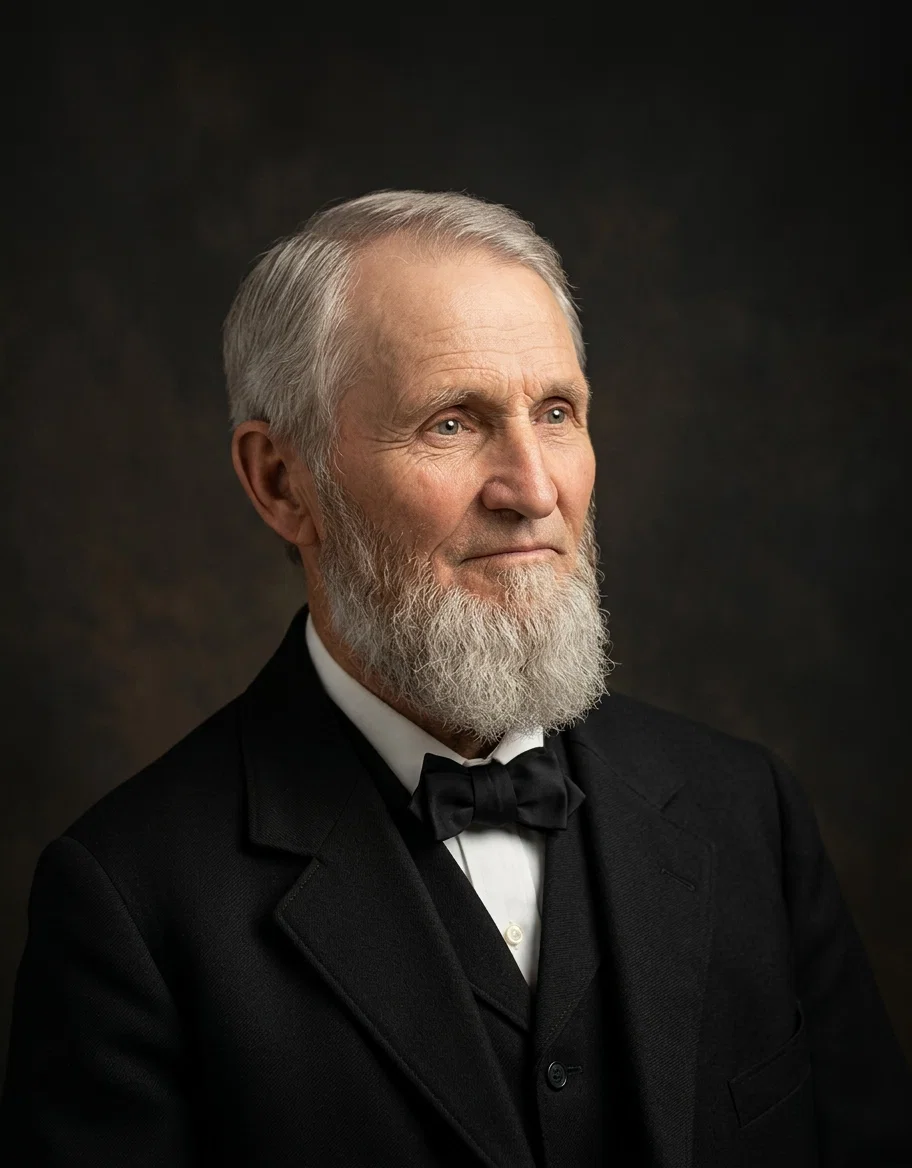
I was born in the south of Norway in the country west from Christiansand, May 2, 1816. My early days were spent in the rural district among the rocks and hills of that mountainous country, where hard work with economy and frugality is the usual lot of the people.
In 1844 I was married to Bertha Olsen. We continued to reside in our home district in Norway until the spring of 1850, when we with many others emigrated to the United States of America. The journey occupied the long period of thirteen weeks,—nine weeks in crossing the ocean in a sailing ship, and four weeks in making the journey from New York by steamboat up the Hudson River, then by the Erie Canal to Buffalo, and from thence by steamer to Milwaukee, Wis., finishing with bullock wagon seventy miles westward, where we located in the township of Oakland, Jefferson Co., in the State of Wisconsin, which was then a frontier State and but sparsely settled.
Our union was blessed with a family of twelve children. Three we laid away in death in their infancy; while nine, five sons and four daughters, grew up to manhood and womanhood.
From childhood we were instructed in the Lutheran doctrines (the state religion of Norway). Later our religious interest was somewhat awakened under the labors of the Quakers and other lay-sister preachers, some of whom were very earnest and devoted, and quite familiar with the Bible. These services were generally held in private houses, and might be called cottage meetings.
It was in one of these meetings that the question of the Sabbath of the fourth commandment was first mentioned to us. After the close of one of the services, a number of us were together conversing on scripture subjects. During the conversation, the minister being present, made a statement like this, “If we should strictly follow the Scriptures, we would keep Saturday and not Sunday; for there is no scripture evidence for keeping Sunday.”
This statement by the minister was a great surprise to those present; and from that time the question became a general subject of discussion and investigation.
ANDREW OLSEN
Some little time after settling in America, the Norwegian Methodists began a series of meetings in the village of Cambridge, five miles from our home. These meetings we attended, and here began our Christian experience. Now we took up the study of the Scriptures anew, and with increased interest, and it was not long before the question of the Sabbath began seriously to exercise our minds. At first we tried to console ourselves with the thought that these ministers who seemed to be so greatly blessed and in possession of the Holy Spirit’s power, must know. If the keeping of Sunday was not right, they surely would understand it. Neither were we alone in this feeling. Our neighbor, who in Norway had had part in the Sabbath agitation there, was wrestling with the same convictions.
The outcome of this was that we together decided to give the question as thorough an examination as was in our power, thus to assure ourselves as to what was the right in the matter. We began this investigation in the autumn of 1854, and continued all the winter. The result was that we became fully convinced of the truth that there is but one Sabbath ordained of God, and that is the seventh day. Then arose the question as to what we should do. The conclusion of this was, “We must obey God rather than man,” and this decided us in keeping the Sabbath.
It should be noted that at this time we were not acquainted with the Seventh-day Adventists, neither had we the assistance of papers or publications bearing on the subject. We had the Bible; that was all, and that was enough. It was about Easter time in 1855 when we decided to keep the Sabbath, and the first meeting was attended by four adults, myself and my wife, and my brother-in-law, Soren Loe, and his wife.
The ball was now fairly set rolling. The newfound truth was precious; it could not be kept in the background. We talked it to our former associates in the Methodist Episcopal Church, and one after another accepted the light, until we became a goodly number. Our meetings were blessed of the Lord. Opposition also came. Ministers visited us from the Methodist Episcopal Church, and tried to show us our error, but their efforts only confirmed us the more in the truth; for we saw that they could produce no evidence from the Scriptures that the keeping of Sunday was ordained of the Lord. The real effect of this preaching was to make the truth more plain, and lead more to keep the Lord’s Sabbath, the seventh day. The more the subject was agitated, the more the truth shone forth.
The good work continued until eight large families were united in the observance of the Lord’s Sabbath. But as yet we had no connection with the Seventh-day Adventists.
In the early part of 1858, some of the younger members of our company, who could understand English, attended a meeting where the minister spoke on the subject of baptism, and clearly proved that the immersion of believers, and not sprinkling of infants, was Scriptural baptism. This incident opened the way for the present truth to be preached in the community. Up to this point, our belief and experience were in common with the Methodist Episcopal Church with the exception of the Sabbath, and people began to call us Seventh-day Methodists.
The subject of baptism by immersion awakened a lively discussion; and for a while it was very difficult for a number of the older people to see this truth, they having been so thoroughly indoctrinated in the teaching of the Lutherans, who make so much of infant christening, as they call baptism. But little by little the truth gained the day, and with a few exceptions, all the Sabbath-keepers accepted it.
The first one to preach the third angel’s message in our community was Elder Waterman Phelps, now deceased. The first baptism took place in the month of May, 1858, where it was my privilege, and also that of my wife, to be buried with our Lord in the sacred rite. It was a blessed occasion.24
From that time the truth steadily advanced. In 1861 the subject of organization was agitated, and in the latter part of that year the church of Seventh-day Adventists was organized with Brother S. A. Bragg as elder. A little later, the brethren called me to this responsible position, and for some twenty years I served the church in the capacity of elder until my age prevented my doing justice to that important position.
The truth as it is brought to us in the threefold message of Revelation 14 has continued to be most precious to myself and all our family. I have had the joy of seeing all our children converted to the Lord, and all firm believers in the present truth. All our sons are engaged in the work. Four have been called to the ministry (one now deceased), and the fifth is also in the work.
In the spring of 1879 I was called to part with the companion of my life. It was a sad blow. But she rests in hope of a part in the first resurrection, and the blessed reunion is not far distant. I am having this little sketch of my life prepared at the age of ninety-two. My days can not be many hereafter, but I am full of hope and joy in the glorious salvation that is soon to be realized.
I might add that, as far as I know, our acceptance of the Sabbath, and the truth of the third angel’s message, was the beginning of this work among the Scandinavian people. Those who accepted the truth at Oakland, Wis., were all Norwegians, and only the young people at that time could understand the English. We were very anxious for some one to teach us the truth in our own tongue, and for this we prayed earnestly that God would raise up a man to preach the truth in the Scandinavian tongue, so that our own nationality both in America and Europe might hear the message.
This prayer was answered in the person of Elder John G. Matteson, who some years later accepted the truth, and became the pioneer laborer in the Scandinavian tongue. Now as we look back, and see what the Lord has wrought, and how that little beginning in Norway and later in Oakland, Wis., has grown into a mighty work, my soul is filled with profound gratitude. The Lord has blessed the labors of Elder Matteson in a very marked manner, and though he is sleeping in hope, the work is rapidly going forward with greater rapidity and power than ever in the past. But the glorious consummation is at hand. That it may be ours then to stand in our lot, is my earnest prayer.