God's Message for Today

2%

Review and Herald Publishing Association · Takoma Park Station, Washington, D.C. · Nov 16, 1914

FromReview and Herald, Vol. 91, No. 48 Extra

Read the full edition

God's Message for Today

By F. M. Wilcox
We have reached the closing days of earth's history. The kingdoms of this world are soon to become the kingdom of our Lord and of his Christ. The exact time we may not know. No man by the prophetic periods can figure out the day of the Master's coming, but we may know that his coming is nigh, even at the doors. And we may know it as assuredly as we may know that summer is nigh when the trees begin to put forth their leaves. Matthew 24: 32, 33.
The heralds of the morning are even now present. God would leave the world without excuse. So in the heavens above; in the earth beneath; in wind and wave and ocean's roar; in the physical, social, industrial, religious, and political worlds; in the false religious movements; in the great prophetic forecasts of the history of nations,—in many and varied ways do the Scriptures reveal that the time of the Lord's return is near.

Prophecies Pointing to Christ's Coming

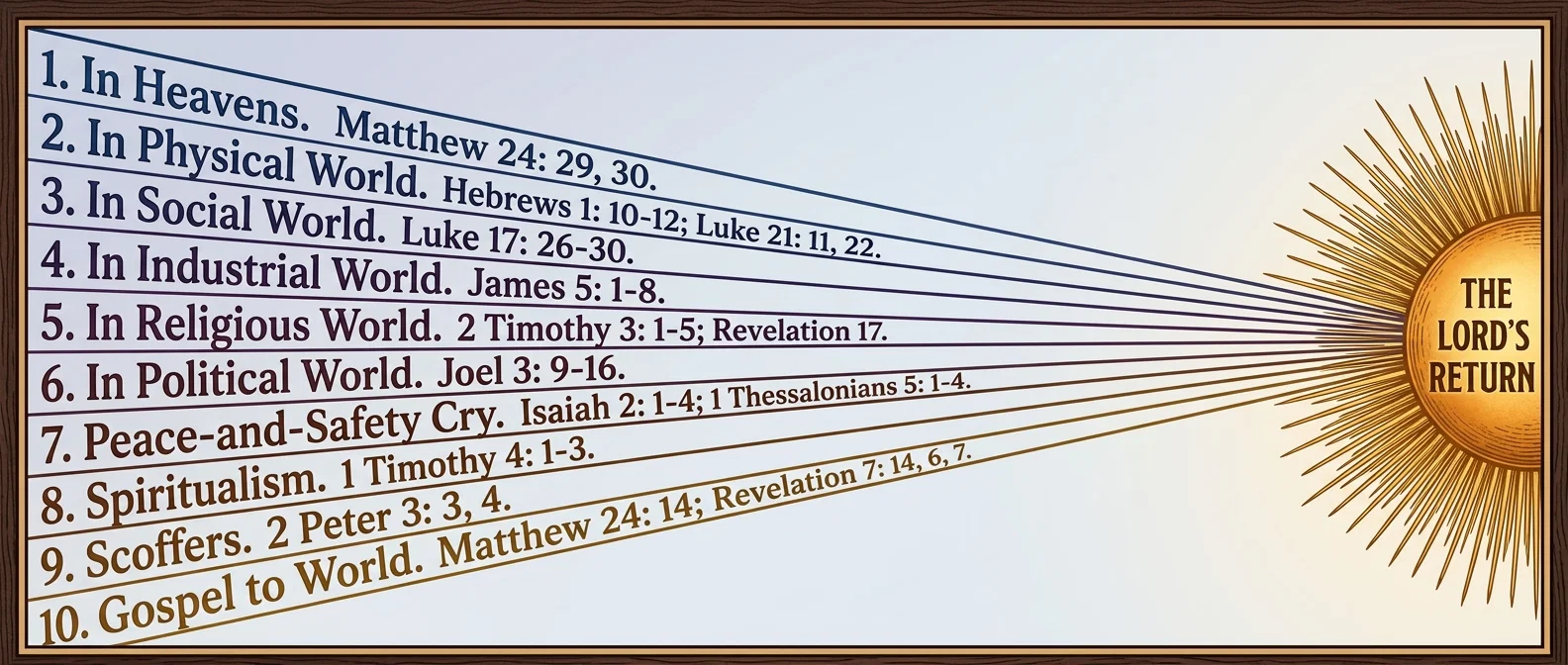
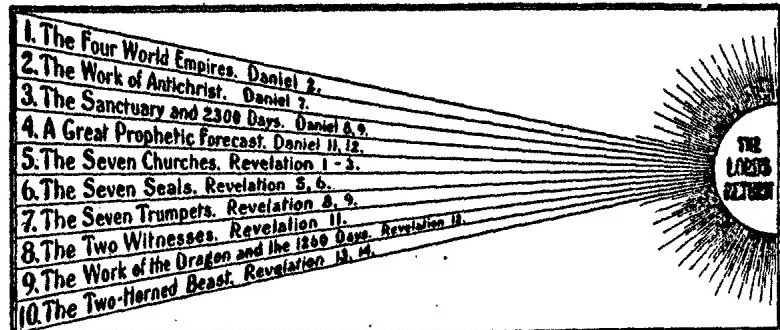
Consider the evidences presented in the two diagrams accompanying this article. The first diagram presents ten great prophetic forecasts of a series of events which were to take place among the nations of men and in connection with the church of God. Every prophecy cited directs attention to the same focal point, and that is the return to this earth of the Lord Jesus Christ. They all indicate that we are living down in the comparatively little space just preceding the coming of the Lord, and that but little more remains to the complete fulfillment of the prophetic period bringing us to the coming of Christ.
The second outline presents the sign prophecies of the Lord's return,—prophecies of conditions which would exist in the world just preceding the second coming of Christ. These signs are in process of fulfillment today. They speak with one voice, “The coming of the Lord draweth nigh.”
The Lord in his infinite mercy does not leave the world in ignorance of this great event. He gave to Noah for his generation a message of the coming flood. He warned Nineveh, through Jonah, of the coming destruction. He sent John the Baptist as a herald of the first advent of Christ. He will apprise the world of the Master's return. Says the prophet Joel:—
“Blow ye the trumpet in Zion, and sound an alarm in my holy mountain: let all the inhabitants of the land tremble: for the day of the Lord cometh, for it is nigh at hand.” Joel 3: 1.

“The Hour of His Judgment Is Come”

This message of the Lord's coming is a judgment message. It proclaims that the hour of God's judgment is come, and calls upon men to turn away from the worship of sin and self and to give their allegiance to the Creator of the heavens and the earth. Says the revelator:—
“And I saw another angel fly in the midst of heaven, having the everlasting gospel to preach unto them that dwell on the earth, and to every nation, and kindred, and tongue, and people, saying with a loud voice, Fear God, and give glory to him; for the hour of his judgment is come; and worship him that made heaven, and earth; and the sea, and the fountains of waters.” Revelation 14: 6, 7.
The warlike attitude of the nations will be one of the conditions associated with the judgment hour. Says the Word of divine revelation:—
“And the nations were angry, and thy wrath is come, and the time of the dead, that they should be judged, and that thou shouldst give reward unto thy servants the prophets, and to the saints, and them that fear thy name, small and great; and shouldest destroy them which destroy the earth.” Revelation 11: 18.
The great rule of judgment by which God will determine the destinies of men is the law of ten commandments. Says the apostle:—
“So speak ye, and so do, as they that shall be judged by the law of liberty.” James 2: 12.

“The Seventh Day Is the Sabbath of the Lord Thy God”

Every principle of this law of the great King must be upheld by the divine government. But the study of this holy law reveals the fact that the majority of professed Christians have been unwittingly trampling underfoot one of its divine precepts. In place of the Sabbath of the Lord enjoined by the fourth commandment, another day has been substituted, and the great Christian church has accepted for ages this substitution. God, however, has never recognized it. He established the Sabbath in the beginning as a memorial of his creative work. Says the divine record:—
“On the seventh day God ended his work which he had made; and he rested on the seventh day from all his work which he had made. And God blessed the seventh day, and sanctified it, because that in it he had rested from all his work which God created and made.” Genesis 2: 2, 3.
By three distinct acts the Creator set apart the seventh day as the Sabbath: 1. “He rested on the seventh day.” This constituted it his own rest day. 2. He “blessed the seventh day.” This constituted the seventh day holy time. 3. He “sanctified it;” that is, set it apart for a holy and sacred use, for the use of mankind.

Christ the Author of the Sabbath

Jesus Christ was the creator of all things. Colossians 1: 15-18; John 1: 1-3. As Creator he is the author and Lord of the Sabbath. Mark 2: 27, 28. The Sabbath stands not only as a memorial of his great power in the creation of the material world, but he has made it also a sign of his recreative power in the work of redemption. He declares:—
“Verily my Sabbaths ye shall keep: for it is a sign between me and you throughout your generations: that ye may know that I am the Lord that doth sanctify you.” Exodus 31: 12-17.

The Sabbath a Part of the Moral Law

When the Majesty of heaven descended on the blazing peaks of Sinai, and from the midst of the celestial glory spoke with an audible voice his divine law, writing it afterward with his own finger upon the enduring stone, he placed in the very bosom of this decalogue the Sabbath commandment. That commandment solemnly enjoins the observance of the seventh day of the week:—
“Remember the Sabbath day, to keep it holy. Six days shalt thou labor, and do all thy work: but the seventh day is the Sabbath of the Lord thy God: in it thou shalt not do any work, thou, nor thy son, nor thy daughter, thy manservant, nor thy maidservant, nor thy cattle, nor thy stranger that is within thy gates: for in six days the Lord made heaven and earth, the sea, and all that in them is, and rested the seventh day: wherefore the Lord blessed the Sabbath day, and hallowed it.” Exodus 20: 8-11.

Christ an Observer of the True Sabbath

When the Lord came to earth two thousand years ago, he made no change in the Sabbath commandment. He declares with reference to the law and the prophets:—
“Think not that I am come to destroy the law, or the prophets: I am not come to destroy, but to fulfill. For verily I say unto you, Till heaven and earth pass, one jot or one tittle shall in no wise pass from the law, till all be fulfilled.” Matthew 5: 17-19.
Christ himself observed the Sabbath. Luke 4: 16. He took particular care to instruct the people as to the true manner of its observance. Matthew 12: 1-12. And the Master's example in the observance of his holy day was carefully followed by his most intimate disciples, who, after Christ's death, “rested the Sabbath day according to the commandment.” Luke 23: 56; 24: 1.
In the same manner the great apostle to the Gentiles observed the Sabbath of the Lord. It was customary for him to worship in the synagogue on the seventh day. Acts 17: 1-3. For a whole year and a half at Corinth he preached Christ in the synagogue every Sabbath, persuading both Jews and Gentiles. Acts 18: 4, 11. And as he practiced regarding the Sabbath of the Lord, so he taught. He inquires, “Do we then make void the law through faith?” Answering his own question, he emphatically states: “God forbid: yea, we establish the law.” Romans 3: 31.
By keeping the law no man can earn salvation, which is the free gift of God through Christ Jesus.
“For by grace are ye saved through faith; and that not of yourselves: it is the gift of God; not of works, lest any man should boast.” Ephesians 2: 8, 9.
Obedience to Christ's requirements is the highest exercise of love on the part of the believer.
THE PROPHECIES OF THE LORD JESUS CHRIST

When and How the Sabbath Was Changed

The apostle Paul taught that in his day the mystery of iniquity was already at work in the church. At a later period we find this mystery developing into a great ecclesiastical system which, ignoring the precepts of the Master, laid ruthless hands upon the law of God, and tore from it the holy rest day, substituting in its place a sabbath of its own creation.
SIGNS PROPHETIC OF THE LORD'S RETURN
These changes were brought about slowly. During the early centuries both the seventh and the first day of the week were observed by the Christian church. Sunday was celebrated at first as an ordinary church festival, the same as Good Friday, Christmas, etc., making appeal for support to ecclesiastical authority, and not to Scriptural injunction. Indeed, to Scriptural authority it could not appeal, for nowhere in the Bible is the first day of the week called a sabbath or a holy day, or its observance enjoined by precept or example. “Opposition to Judaism,” says the historian, a desire to gain favor with their heathen neighbors, with motives of expediency and patriotism, led to the exaltation of the festival dedicated by the heathen world to the veneration of the sun, in the place of the true Sabbath.
The decree of Constantine, in A. D. 321,
requiring its observance on the part of “judges and townspeople, and the occupation of all trades,” and the decree of the Council of Laodicea, in A. D. 364, ordering that “Christians shall not Judaize and be idle on Saturday, but shall work on that day; but the Lord's Day they shall especially honor,” gave increased impetus to first-day observance. But “down even to the fifth century the observance of the Jewish Sabbath was continued in the Christian church, but with a rigor and solemnity gradually diminishing until it was wholly discontinued.”—Ancient Christianity Exemplified by Lyman Coleman, chapter 26. But God left not his truth without witness in the earth, for some in every age have observed the true rest day.

The Final Issue and Test

When we come down to the closing days of earth's history, where fulfilling prophecies clearly show that we are now living, the Scriptures of Truth indicate that there will go to the world a great reform message regarding the law of God, and particularly that part of the law relating to the Sabbath commandment. That message is now going by voice and pen to earth's remotest bounds. The attention of the world is being called to the downtrodden Sabbath of the Lord, which the prophecy represents as the seal of the living God. Revelation 7: 1-4; Isaiah 56: 1-8.
At the same time the Scriptures of Truth clearly show that in the last days of earth's history an earnest effort will be made through legal enactment to force Sunday observance upon the consciences of men. Revelation 13: 11-18. We see a literal fulfillment of that prophecy in the efforts which are now being made to secure the enactment of a Sunday law by the Congress of the United States, and by the agitation attending this question in other parts of the world. But the Word of God gives positive warning that those who, after knowing the teaching of the Scriptures, ruthlessly reject the Sabbath of the Lord, disregarding its holy requirements and giving their allegiance to the counterfeit sabbath, shall receive God's everlasting displeasure. Revelation 14: 6-14.

Walking as Christ Walked

This controversy over the Sabbath of the Lord will prove a test of character
to every believer. Dear reader, on which side of this controversy will you stand? Will you obey the law of the Lord Jesus Christ by following his example in keeping holy the day which he has ordained, or will you give your allegiance to the counterfeit sabbath which has been set up in the place of the Sabbath of the Lord? How will you stand when your case is called in the great judgment, and your life is compared with the divine law? Read Ecclesiastes 12: 13, 14. This is not a question merely of theological difference and discussion. It is a question of obedience to our Lord and Master. He says, “If ye love me, keep my commandments.” John 14: 15.
“He that saith he abideth in him ought himself also so to walk, even as he walked.” 1 John 2: 6. Let us show our love for the Lord Christ, who died that we might live, by following in his footsteps and doing as he did when he lived among men. To us as to his disciples of old he says, “Follow me.”