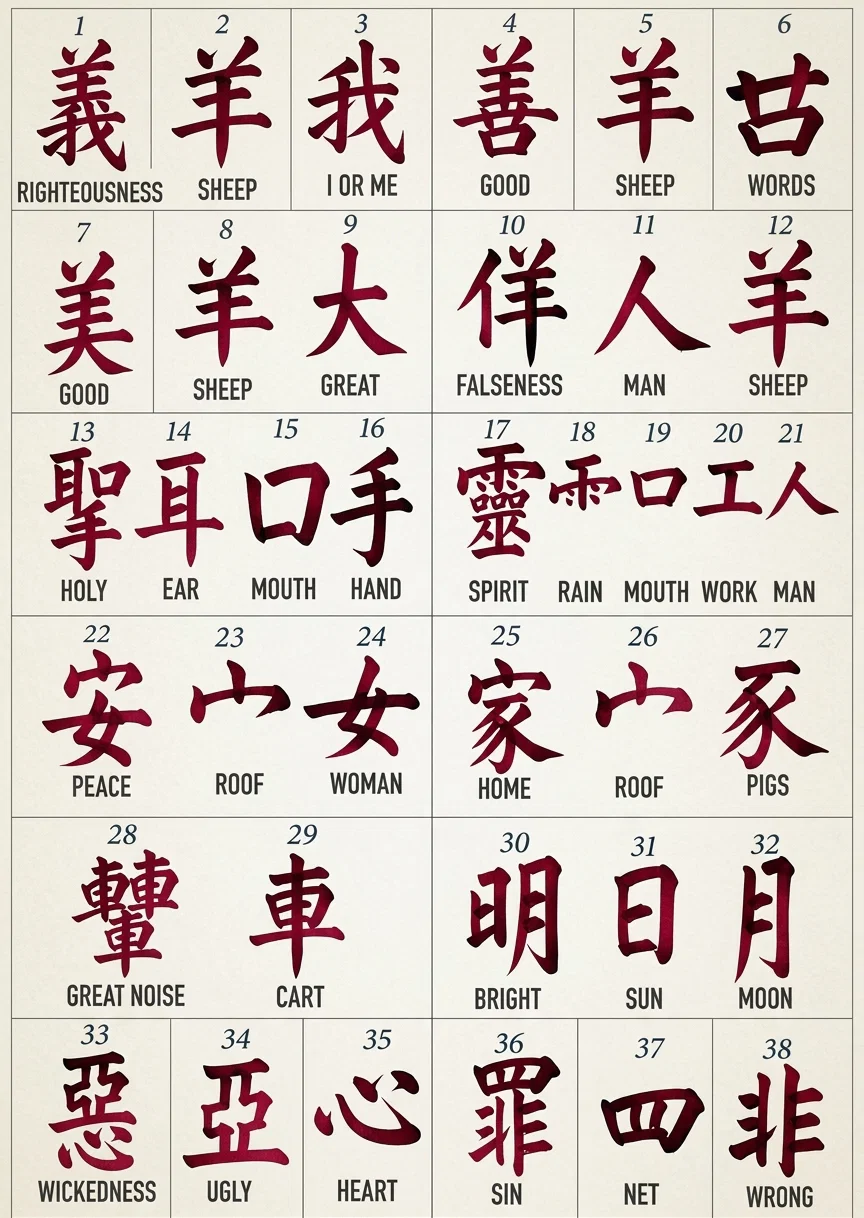
The characters of the Chinese language are ideographic, that is, they are pictures of the thought they are intended to convey. There are said to be six classes of characters. One of these is called “nwei ih dy dzi,” which literally means “think of the thought characters.” It is with this class of characters that the present article deals.
A character is usually made up of two parts. The more important part is called the radical, and gives a clue to the meaning; the other part is called the phonetic, and gives a clue to the sound.
Some one has said that “the Chinese language was invented by the devil to prevent the easy spread of the gospel.” However, it will be seen from the characters used in this article that this is not so, but that, on the contrary, the ancient Chinese characters can be used to teach in a forceful way the fundamental truths of the gospel.
From Fu Hsi, the first of the “Five Monarchs,” whose date, according to Chinese records, goes back to 2953 B. C., the Chinese date the ceremony of marriage, the slaying of animals for clothing, writing, and the commencement of learning, also music. It is also stated on good authority that at that time the Chinese did not worship idols, but that they worshiped the one true God, idol worship being introduced at a much later period. Certain it is that the Chinese characters12give abundant evidence that they are not of satanic origin, but, on the other hand, give conclusive evidence that God has not left himself without a witness even in this most ancient language.
With these thoughts in mind, let us now proceed to examine that wonderful word, righteousness. Righteousness by faith is the fundamental thought of the gospel; for without it no man can see God. The Chinese character for “righteousness” (see Fig. 1) is made up of two characters. The first of these is the radical of the character, and is the word for “sheep” (see Fig. 2). The second word is placed under the “sheep” character, and is the character for the pronoun I or me (see Fig. 3). Thus righteousness in the Chinese language literally means “I under the sheep or lamb” (see Fig. 1). This thought readily suggests that beautiful text, “Behold the Lamb of God, which taketh away the sin of the world” (or, personally, my sin). John 1:29. See also Isa. 53:7.
A further lesson can be learned from the position that these two words, which make up the character “righteousness,” occupy. The precise order must be maintained; for if the pronoun I were placed on top of the word sheep, no Chinaman would read that word as “righteousness;” in fact, to him it would have no meaning at all. In like manner no Christian will ever be taken, or read (for we are the only Bibles some people will ever read), for a true Christian, who does not exalt the Lamb of God, putting “I” or “self” out of sight, or under the “Lamb.” In other words, “He must increase, but I must decrease” (John 3:30), and then “I [Christ], if I be lifted up, . . . will draw all men unto me.” John 12:32.
Another character that shows that the word sheep, when associated with other characters, usually has a good meaning is the word for “good” (see Fig. 4). This word is made up of two characters. The top one is “sheep” (see Fig. 5), and under the “sheep” character is the character for “words” (see Fig. 6). Thus a good man is one who is lamblike in his bearing, and his words in harmony with his lamblike character. This is in distinct contrast to the figure used in Rev. 13:11, which is understood to represent apostasy, and is a sheep speaking with the voice of the dragon.
THE GOSPEL IN THE CHINESE WORD-CHARACTERS
Those who understand the prophecy of Rev. 13:11 as applying in a particular way to the United States of America will be surprised to know that the character that has been selected to represent that country in Chinese is the character “mei,” which means “good” (Fig. 7). This is made up of two characters. One is the word sheep (see Fig. 8), and the other, which is placed under the word sheep, is the character for “great” (see Fig. 9). Thus the character that stands for America in Chinese means literally “a great sheep,” and thus truly reveals the peaceful nature of the principles upon which the American Republic was founded. It does seem too bad that the time will come when it will speak with the voice of a dragon.
To represent the idea of “falseness” (see Fig. 10), the Chinese use a character which has on one side the word for “man” (see Fig. 11), and on the other side the figure for “sheep” (see Fig. 12). Thus, for a man to pretend to be a “sheep” when he is not really so harmless, is the Chinese idea of falseness or pretense. It makes one think of the Saviour’s words about the wolf in sheep’s clothing.
Let us now examine the words for “Holy Spirit.” These are important words; for it is only through the mighty agency of the Holy Spirit that sin can be overcome and the sinful man become righteous.
The word holy (see Fig. 13) is made up of three distinct characters. The first is the word for “ear” (see Fig. 14); the second the word for “mouth” (see Fig. 15); and the third, according to the ancient form of writing, is the character for “hand” (see Fig. 16). An intelligent Chinese teacher who is not a Christian told me that the meaning of this combination of characters is that a man who is truly “holy” is one whose ear hears only that which is good, whose mouth speaks only that which is good, and whose hand does only that which is good. What better definition of holiness can be found anywhere? To listen to truth is not enough, to preach truth is not enough; we must be doers of the Word.
The word spirit (see Fig. 17) has for its radical the character for “rain” (see Fig. 18), and under the “rain” character the word for “mouth” (see Fig. 19) is written thrice; under these three mouths the word work (see Fig. 20) is written; and finally, to complete the word, the character for “man” (see Fig. 21) is used twice. Thus the word spirit in the Chinese contains a stirring lesson to those who are acquainted with the Bible and understand the operations of the Holy Spirit. According to the Bible, the people of God are to look for a special outpouring of the Holy Spirit to be given, before the end of the world comes, to ripen the harvest. This is termed the “latter rain.” The radical of the character, being “rain,” can be used to indicate the source and the abundance of the supply. The three mouths also indicate the abundance of the gift, and also suggest the receptive attitude that the Christian should maintain. The word work indicates that when the Spirit is received in all its fullness, it will do its work. And the object of the work it does is clearly shown in the word for “man,” which is repeated twice, thus suggesting that it will do its work not only upon the outer man, but also upon the inner man, and the whole man will become holy in the sense given above.
The character for “peace” is a very suggestive character (see Fig. 22). The radical is the word for “roof” (see Fig. 23). Under the “roof” is the word for “woman” (see Fig. 24). Thus according to the Chinese idea, peace can be maintained only when the woman attends strictly to home duties. This is in keeping with Paul’s advice that the young women be “discreet, chaste, keepers at home, good, . . . that the word of God be not blasphemed.” Titus 2:5. It also suggests that woman amid the many duties of the home can have the peace of God abiding in her heart, and thus keep the peace of the home.
The word home (see Fig. 25) is very dear to the heart of the Occidental. In the Chinese the top part of this character is “roof” (see Fig. 26), and under the “roof” character is the word for “pigs” (see Fig. 27), the idea being that the home that is well supplied with pigs is the ideal home. The writer has seen as many as a dozen pigs quartered in the same house with the family.
The character “hung,” which means a “great noise” (see Fig. 28), is made up of the character for “cart” (see Fig. 29) used thrice. Three Chinese carts on a Chinese road do indeed make a dreadful noise, for they have no springs.13
The idea of “brightness” (see Fig. 30) is made clear by first writing the character for “sun” (see Fig. 31), and then placing the word for “moon” (see Fig. 32) alongside it, the inference being that if the sun and moon were both shining at the same time, it would be very bright indeed.
Turning from such words as “righteousness,” “Holy Spirit,” etc., let us examine the words for “wickedness” and “sin.”
The word wickedness (see Fig. 33) has for its radical the word heart (see Fig. 35), thus clearly indicating the source of all wickedness. Above the word heart is written the character ya, which is defined in the dictionary as ugly, inferior, secondary (see Fig. 34). Thus wickedness is literally an “ugly heart.”
In conclusion, let us now examine the word sin (see Fig. 36). This word is composed of two very significant characters. The radical is the word for “net” (see Fig. 37). Under the net is written another character, which is defined as “wrong” (see Fig. 38). Thus we learn that by continuing in “wrong,” we fall into Satan’s “net” and are bound. What a warning of the power of sin is contained in this character!