A BIBLE STUDY

1%

Review and Herald Publishing Association · Takoma Park, Washington, D. C. · Jan 10, 1916

FromReview and Herald, Vol. 93, No. 2.

Read the full edition

A BIBLE STUDY

The Law of God

1. When God brought his people out of Egypt, how did he republish his law? “And the Lord spake unto you out of the midst of the fire: ye heard the voice of the words, but saw no similitude; only ye heard a voice. And he declared unto you his covenant, which he commanded you to perform, even ten commandments; and he wrote them upon two tables of stone.” Deut. 4: 12, 13. See also Neh. 9: 13, 14.
2. Where are the ten commandments recorded? In Ex. 20: 2-17.
3. How comprehensive are these commandments? “Fear God, and keep his commandments: for this is the whole duty of man.” Eccl. 12: 13.
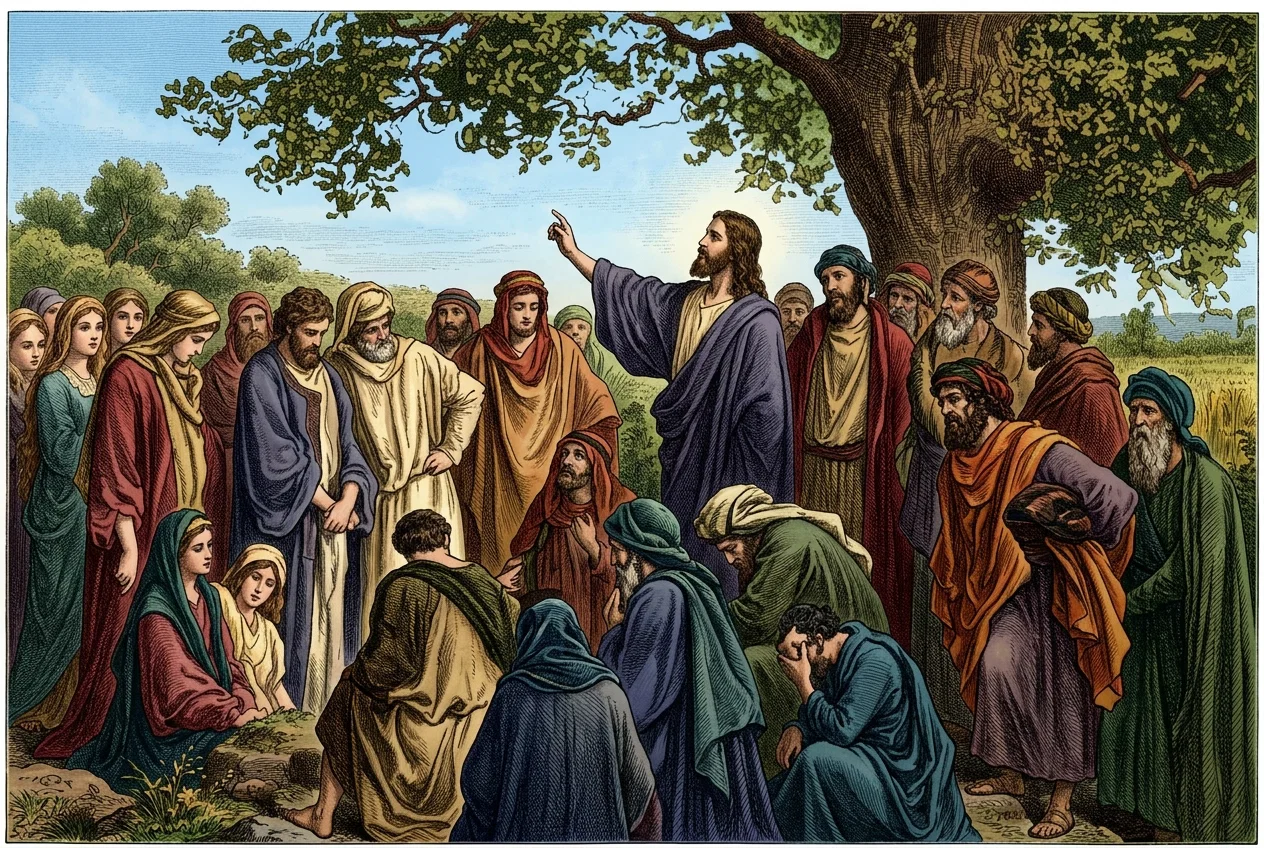
“THINK NOT THAT I AM COME TO DESTROY THE LAW OR THE PROPHETS.”—JESUS
4. What inspired tribute is paid to the law of God? “The law of the Lord is perfect, converting the soul: the testimony of the Lord is sure, making wise the simple. The statutes of the Lord are right, rejoicing the heart: the commandment of the Lord is pure, enlightening the eyes.” Ps. 19: 7, 8.
5. What blessing does the psalmist say attends the keeping of God’s commandments? “Moreover by them is thy servant warned; and in keeping of them there is great reward.” Verse 11.

Christ’s Teaching Concerning the Law

6. What did Christ state as a condition of entering into life? “If thou wilt enter into life, keep the commandments.” Matt. 19: 17.
7. When Christ came to this earth, what was his attitude toward God’s will, or law? “Then said I, Lo, I come: in the volume of the book it is written of me, I delight to do thy will, O my God: yea, thy law is within my heart.” Ps. 40: 7, 8. See Heb. 10: 5, 7.
8. Who did he say would enter the kingdom of heaven? “Not every one that saith unto me, Lord, Lord, shall enter into the kingdom of heaven; but he that doeth the will of my Father which is in heaven.” Matt. 7: 21.
9. What did he say of those who should break one of God’s commandments, or should teach men to do so? “Whosoever therefore shall break one of these least commandments, and shall teach men so, he shall be called the least in the kingdom of heaven.” Matt. 5: 19, first part.
10. Who did he say would be called great in the kingdom? “But whosoever shall do and teach them, the same shall be called great in the kingdom.” Same verse, last part.
11. For what did Christ reprove the Pharisees? “But he answered and said unto them, Why do ye also transgress the commandment of God by your tradition?” Matt. 15: 3.
12. In consequence of this, what value did Christ place upon their worship? “But in vain they do worship me, teaching for doctrine the commandments of men.” Verse 9.

The Apostles’ Teaching

13. What is sin declared to be? “Whosoever committeth sin transgresseth also the law: for sin is the transgression of the law.” 1 John 3: 4.
14. By what is the knowledge of sin? “For by the law is the knowledge of sin.” Rom. 3: 20. See Rom. 7: 7.
15. How many of the commandments is it necessary to break in order to become a transgressor of the law? “For whosoever shall keep the whole law, and yet offend in one point, he is guilty of all. For he that said, Do not commit adultery, said also, Do not kill. Now if thou commit no adultery, yet if thou kill, thou art become a transgressor of the law.” James 2: 10, 11. NOTE.—This shows that the ten commandments are a complete whole, and together constitute but one law. Like a chain of ten links, all are inseparably connected. If one link is broken, the chain is broken.
16. What will be the standard in the judgment? “So speak ye, and so do, as they that shall be judged by the law of liberty.” Verse 12.
17. How do those with renewed hearts and minds regard the commandments of God? “For this is the love of God, that we keep his commandments; and his commandments are not grievous.” 1 John 5: 3.
18. What is said of one who professes to know the Lord, but does not keep his commandments? “He that saith, I know him, and keepeth not his commandments, is a liar, and the truth is not in him.” 1 John 2: 4.
19. What promise is made to the willing and obedient? “If ye be willing and obedient, ye shall eat the good of the land.” Isa. 1: 19.

The Testimony of the Psalmist

20. What is said of those who love God’s law? “Great peace have they which love thy law: and nothing shall offend them.” Ps. 119: 165.
21. What is another blessing attending the keeping of God’s commandments? “The fear of the Lord is the beginning of wisdom: a good understanding have all they that do his commandments.” Ps. 111: 10.
22. In what does the man delight whom the psalmist describes as blessed? “Blessed is the man that walketh not in the counsel of the ungodly, nor standeth in the way of sinners, nor sitteth in the seat of the scornful. But his delight is in the law of the Lord; and in his law doth he meditate day and night.” Ps. 1: 1, 2. See Rom. 7: 22.

The Perpetuity of the Law

23. What is said of the stability of God’s character? “For I am the Lord, I change not.” Mal. 3: 6.
24. How enduring are his commandments? “The works of his hands are verity and judgment; all his commandments are sure. They stand fast for ever and ever, and are done in truth and uprightness.” Ps. 111: 7, 8.
25. Did Christ come to abolish or to destroy the law? “Think not that I am come to destroy the law, or the prophets: I am not come to destroy, but to fulfill.” Matt. 5: 17. NOTE.—“The moral law contained in the ten commandments, and enforced by the prophets, did not take its design from the gospel. It was not the design of Christ’s coming to revoke any part of this. . . . Every part of the law must remain in force upon all mankind and in all ages, as not depending either on time or place, or any other circumstance liable to change, but on the nature of God, and the nature of man, and their unchangeable relation to each other.”—John Wesley, in his “Sermons,” Vol. I, No. 25, pages 221, 222.
*26. When used with reference to prophecy, what does the word fulfill mean?* To fill up; to accomplish; to bring to pass; as, “that it might be fulfilled which was spoken by Esaias the prophet.” Matt. 4: 14.
27. What does it mean when used with reference to law? To perform, to keep, or to act in accordance with; as, “Bear ye one another’s burdens, and so fulfill the law of Christ.” Gal. 6: 2. See also Matt. 3: 15; James 2: 8, 9.
28. How did Christ treat his Father’s commandments? “I have kept my Father’s commandments, and abide in his love.” John 15: 10.

The Relation of Faith to Commandment Keeping

29. Does faith in God make void the law? “Do we then make void the law through faith? God forbid: yea, we establish the law.” Rom. 3: 31.
30. What, more than all else, proves the perpetuity and immutability of the law of God? “For God so loved the world, that he gave his only begotten Son, that whosoever believeth in him should not perish, but have everlasting life.” John 3: 16. “Christ died for our sins.” 1 Cor. 15: 3. NOTE.—Could the law have been abolished, and thus been disposed of in this way, Christ need not have come and died for our sins. The gift of Christ, therefore, more than all else, proves the immutability of the law of God. Christ must come and die, and satisfy the claims of the law, or the world must perish. The law could not give way. Says Spurgeon in his sermon on “The Perpetuity of the Law of God,” “Our Lord Jesus Christ gave a greater vindication of the law by giving himself because it had been broken, than all the lost can ever give by their miseries.” The fact that the law is to be the standard in the judgment is another proof of its enduring nature. See Eccl. 12: 13, 14; James 2: 8-12.
31. What relation does a justified person sustain to the law? “For not the hearers of the law are just before God, but the doers of the law shall be justified.” Rom. 2: 13.
32. By what may we know that we have passed from death unto life? “We know that we have passed from death unto life, because we love the brethren.” 1 John 3: 14.
33. And how may we know that we love the brethren? “By this we know that we love the children of God, when we love God, and keep his commandments.” 1 John 5: 2.
34. What is the love of God? “For this is the love of God, that we keep his commandments.” Verse 3.
35. How are those described who will be prepared for the coming of Christ? “Here is the patience of the saints: here are they that keep the commandments of God, and the faith of Jesus.” Rev. 14: 12.

The Moral and Ceremonial Laws

36. By whom was the ten-commandment law proclaimed? “And the Lord spake unto you out of the midst of the fire: ye heard the voice of the words, but saw no similitude; only ye heard a voice. And he declared unto you his covenant, which he commanded you to perform, even ten commandments; and he wrote them upon two tables of stone.” Deut. 4: 12, 13.
37. How was the ceremonial law made known to Israel? “And the Lord called unto Moses, and spake unto him out of the tabernacle of the congregation, saying, Speak unto the children of Israel, and say unto them, If any man of you bring an offering unto the Lord, ye shall bring your offering of the cattle, even of the herd, and of the flock. . . . This is the law of the burnt offering, of the meat offering, and of the sin offering, and of the trespass offering, and of the consecrations, and of the sacrifice of the peace offerings; which the Lord commanded Moses in mount Sinai, in the day that he commanded the children of Israel to offer their oblations unto the Lord, in the wilderness of Sinai.” Lev. 1: 1, 2; 7: 37, 38.
38. Were the ten commandments a distinct and complete law by themselves? “These words the Lord spake unto all your assembly in the mount out of the midst of the fire, of the cloud, and of the thick darkness, with a great voice: and he added no more. And he wrote them in two tables of stone, and delivered them unto me.” Deut. 5: 22. “And the Lord said unto Moses, Come up to me into the mount, and be there: and I will give thee tables of stone, and a law, and commandments which I have written.” Ex. 24: 12.
39. Was the ceremonial law a complete law in itself? “The law of commandments contained in ordinances.” Eph. 2: 15.
40. On what did God write the ten commandments? “And he declared unto you his covenant, which he commanded you to perform, even ten commandments; and he wrote them upon two tables of stone.” Deut. 4: 13.
41. In what were the laws or commandments respecting sacrifices and burnt offerings written? “And they removed the burnt offerings, that they might give according to the divisions of the families of the people, to offer unto the Lord, as it is written in the book of Moses.” 2 Chron. 35: 12.
42. Where were the ten commandments placed? “And he took and put the testimony into the ark, and put the mercy seat above upon the ark.” Ex. 40: 20.
43. Where did Moses command the Levites to put the book of the law which he had written? “Moses commanded the Levites, which bare the ark of the covenant of the Lord, saying, Take this book of the law, and put it in the side of the ark of the covenant of the Lord your God.” Deut. 31: 25, 26.
44. What is the nature of the moral law? “The law of the Lord is perfect, converting the soul.” Ps. 19: 7. “For we know that the law is spiritual.” Rom. 7: 14.
45. Could the offerings commanded by the ceremonial law satisfy or make perfect the conscience of the believer? “Which was a figure for the time then present, in which were offered both gifts and sacrifices, that could not make him that did the service perfect, as pertaining to the conscience.” Heb. 9: 9.

The Ceremonial Law Abolished by Christ

46. How did Christ’s death affect the ceremonial law? “Blotting out the handwriting of ordinances that was against us, which was contrary to us, and took it out of the way, nailing it to his cross.” Col. 2: 14. “Having abolished in his flesh the enmity, even the law of commandments contained in ordinances.” Eph. 2: 15.
47. Why was the ceremonial law taken away? “For there is a disannulling of a foregoing commandment because of the weakness and unprofitableness thereof (for the law made nothing perfect), and a bringing in thereupon of a better hope, through which we draw nigh unto God.” Heb. 7: 18, 19, R. V.
48. What miraculous event occurred at the death of Christ signifying that the sacrificial system was forever at an end? “Jesus, when he had cried again with a loud voice, yielded up the ghost. And, behold, the veil of the temple was rent in twain from the top to the bottom.” Matt. 27: 50, 51.
49. In what words had the prophet Daniel foretold this? “And he shall confirm the covenant with many for one week: and in the midst of the week he shall cause the sacrifice and the oblation to cease.” Dan. 9: 27.
50. How enduring is the moral law? “Concerning thy testimonies, I have known of old that thou hast founded them forever.” Ps. 119: 152.

The Relation of the Law to the Gospel

51. What is one of the uses of the law? “Therefore by the deeds of the law there shall no flesh be justified in his sight: for by the law is the knowledge of sin.” Rom. 3: 20.
52. In thus making known sin, and the consequent need of a Saviour, what part does the law act? “Wherefore the law was our schoolmaster to bring us unto Christ, that we might be justified by faith.” Gal. 3: 24.
53. What is the gospel declared to be? “For I am not ashamed of the gospel of Christ: for it is the power of God unto salvation to every one that believeth; to the Jew first, and also to the Greek.” Rom. 1: 16.
54. What is the significance of the name bestowed by the angel upon the Saviour before his birth? “And she shall bring forth a son, and thou shalt call his name Jesus: for he shall save his people from their sins.” Matt. 1: 21.
55. In whom is this power to save from sin revealed? “But we preach Christ crucified, unto the Jews a stumblingblock, and unto the Greeks foolishness; but unto them which are called, both Jews and Greeks, Christ the power of God, and the wisdom of God.” 1 Cor. 1: 23, 24.
56. What was foretold concerning Christ’s attitude toward the law of God? “Then said I, Lo, I come: in the volume of the book it is written of me, I delight to do thy will, O my God: yea, thy law is within my heart.” Ps. 40: 7, 8.

Faith and the Law

57. Does the faith which brings righteousness abolish the law? “Do we then make void the law through faith? God forbid: yea, we establish the law.” Rom. 3: 31. NOTE.—The law reveals the perfection of character required, and so gives a knowledge of sin; but it is powerless to confer the character demanded. In the gospel, the law, first written in the heart of Christ, becomes “the law of the Spirit of life in Christ Jesus,” and is thus transferred to the heart of the believer, in whose heart Christ dwells by faith. Thus the new-covenant promise is fulfilled that the law shall be written in the heart. This is the genuine experience of righteousness by faith,—a righteousness which is expressed by the law, and revealed in the life in harmony with the law. The gospel is thus seen to be the provision for restoring the law to its place in the heart and life of the one who believes on Christ and accepts his mediatorial work. Such faith, instead of making void the law, establishes it in the heart of the believer. The gospel is not against the law, therefore, but upholds, maintains, and presents the law to us in Christ.
58. What did Christ take away when he died upon the cross? “The next day John seeth Jesus coming unto him, and saith, Behold the Lamb of God, which taketh away the sin of the world.” John 1: 29.
59. What has Christ abolished by his death and resurrection? “But is now made manifest by the appearing of our Saviour Jesus Christ, who hath abolished death, and hath brought life and immortality to light through the gospel.” 2 Tim. 1: 10.
60. What scripture shows that God’s remnant people will have a right conception of the proper relation between the law of God and the gospel of Jesus Christ? “Here is the patience of the saints: here are they that keep the commandments of God, and the faith of Jesus.” Rev. 14: 12. ✧ ✧ ✧ ✧