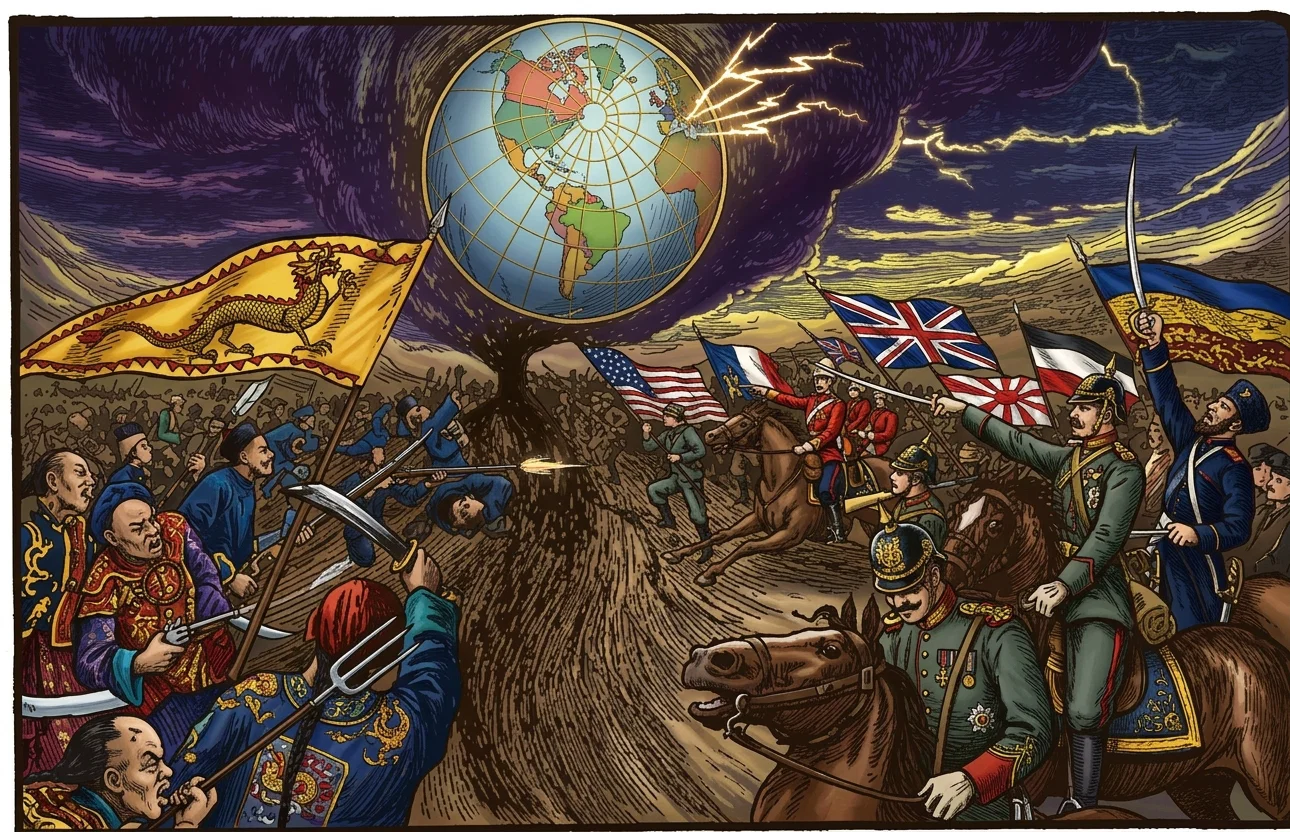
Armageddon

4%

Review and Herald Publishing Association · Takoma Park, Washington, D. C. · Dec 11, 1916

FromReview and Herald, Vol. 93, No. 61

Read the full edition

Armageddon

The Last Conflict of the Nations
For years the growing armaments of the nations have caused deepest concern to statesmen and all thoughtful observers. Queen Alexandra of England, once said of all this war preparation: “I was educated in the school of a king who was, before all things, just, and I have tried, like him, always to preach love and charity. I have always mistrusted warlike preparations, of which nations seem never to tire. Some day this accumulated material of soldiers and guns will burst into flames in a frightful war that will throw humanity into mourning on earth, and grieve our universal Father in heaven.”
It has been seen that the rivalries of the nations, and the distrust, on which these preparations were based, were bound, sooner or later, to bring conflict on a vast scale. Some years ago the London Contemporary Review said:— “Odd things are happening everywhere. . . . Russia, Germany, England—these are great names; they palpitate with great ideas; they have vast destinies before them, and millions of armed men in their pay, all awaiting Armageddon.”
In a speech in 1909, Lord Rosebery, of England, deplored the race of armaments, declaring the unprecedented preparations for war in Europe to be “as if for some great Armageddon—and that in a time of the profoundest peace.”
Thus, in the years of general peace, but of almost universal preparations for war, statesmen and writers used the Scriptural phrase to describe the clash of nations which they saw impending. While there was outward peace, there was ever-increasing rivalry and antagonism of interests. In 1911, an article in the London Nineteenth Century and After, declared:— “Never was national and racial feeling stronger upon earth than it is now. Never was preparation for war so tremendous and so sustained. Never was striking power so swift and so terribly formidable. . . . The shadow of conflict and of displacement greater than any which mankind has known since Attila and his Huns were stayed at Châlons, is visibly impending over the world. Almost can the ear of imagination hear the gathering of the legions for the fiery trial of peoples, a sound as vast as the trumpets of the Lord of hosts.”—Quoted in the Literary Digest, May 6, 1911. All through these recent years, observers have seen the sure signs of a coming storm.

The Scriptures Forewarned Us

Many have thought that surely the modern world had learned a better way than the old-time method of force in the settlement of disputes and rivalries. Happy would we all be if
such were the case. But the Scriptures have warned us plainly that the latter days were to be days of unusual display of the war spirit. True, many people were to be talking of peace and safety, the prophecy tells us. They were to be saying of the nations:— “They shall beat their swords into plowshares, and their spears into pruning hooks; nation shall not lift up sword against nation, neither shall they learn war any more.” Isa. 2: 4. Just such talk of peace and safety we have heard. But while “many people” were to be saying this in the last days, the prophecy declared that the actual conditions would be the very reverse:— “Proclaim ye this among the Gentiles [the nations]; Prepare war, wake up the mighty men, let all the men of war draw near; let them come up; beat your plowshares into swords, and your pruning hooks into spears; let the weak say, I am strong. Assemble yourselves, and come, all ye heathen.” Joel 3: 9-11. This was to be the spirit of the world in the last days; for the context shows that the prophecy applies just before the coming of “the day of the Lord.” And no argument is needed now to convince any that this prophecy pictures the world as it is. The product of the plowshare is being turned into swords—or weapons of war—as never before in human history.

Ancient Prophets and Modern Statesmen

The writings of the ancient prophets describe conditions in our times in terms strikingly parallel to those used by modern statesmen. “I have declared the former things from the beginning,” the Lord says; “before it came to pass I showed it thee.” Isa. 48: 3, 5. This is in order that as soon as men see the events of the prophecy coming to pass, they may know that the Most High is speaking to their souls, and may turn to him and find refuge and salvation. One of the last speeches that the late Lord Salisbury made in the House of Lords, as British premier, was in defense of increased army and navy appropriations. He said:— “For years public opinion was in favor of a pacific policy, but now that some of that opinion has passed away. The tide has turned, and who am I, and who are we, that we should attempt to stem the tide? If the tide has turned, we shall have to go with it. We are in the presence of forces far larger than we can wield.” What are these forces before which the aged statesmen said cabinets were powerless,—forces stirring the peoples out of their former pacific attitude, and sweeping the nations on toward war? The ancient prophet answers.
“THE NATIONS WERE ANGRY,” REV. 11: 18
The Lord opened before the prophet John, in vision, the scenes of the last days. As he looked, he saw the supernatural agencies of Satan, “the spirits of devils,” going forth “unto the kings of the earth and of the whole world, to gather them to the battle of that great day of God Almighty.” Rev. 16: 14. These are the agencies that have been sowing hatreds and stirring up strifes. Sir Edward Grey, British foreign secretary, speaking in the House of Commons, Nov. 27, 1911, described the workings of these forces most accurately. He said:— “It is really as if in the atmosphere of the world there were some mischievous influence at work, which troubles and excites every part of it.” What the ancient prophet saw in vision, and described on the sacred page nearly two thousand years ago, the modern statesman describes as a condition actually to be faced.
The prophet saw these evil spirits stirring up “the whole world” for the last great conflict. In his speech at Cleveland, Jan. 29, 1916, President Wilson told how the spirit of war was abroad in all the world:— “What are the elements of the case? In the first place, and most obviously, two thirds of the world are at war. It is not merely a European struggle; nations in the Orient have become involved, as well as nations in the West, and everywhere there seems to be creeping even upon the nations disengaged the spirit and the threat of war.”—Washington Post, Jan. 30, 1916. Who cannot see that what the prophet saw in vision so long ago, is in process of fulfillment before our eyes?

The Prelude to Armageddon

The final clash of the nations, however, does not come until Turkey falls. The great Moslem power occupies the pivotal point between East and West. In the prophet’s vision of the gathering of “the whole world” to the last great conflict, he first saw this Moslem power by the Euphrates come to its end:— “The sixth angel poured out his vial upon the great river Euphrates; and the water thereof was dried up, that the way of the kings of the east might be prepared.” Rev. 16: 12. The spirit of war, as we have seen, is already stirring up the East, against the time when all the world, literally, will gather for battle. The London Nineteenth Century and After, said several years ago:— “A new spirit is abroad in the East. It arose on the shores of the Pacific when Japan proved that the great powers of Europe are not invulnerable. North and south and west it has spread, rousing China out of centuries of slumber, stirring India into ominous questioning, reviving memories of past glory in Persia, breeding discontent in Egypt, and luring Turkey on to the rocks.”—May, 1913. In some manner which we need not presume to forecast, the fall of the Turkish power by the river Euphrates will prepare the way for these forces of the East to come up to join in the last great struggle.

Armageddon

In the prophet’s vision he next saw the powers of evil actually gathering the nations for the battle of that great day of God Almighty:— “He gathered them together into a place called in the Hebrew tongue Armageddon.” Rev. 16: 16.
Here is where speakers and writers get the word Armageddon. It means the hill or mount of Megiddo, which marks the historic battle plain of the Near East. Cormack says:— “Megiddo was the military key of Syria; it commanded at once the highway northward to Phoenicia and Coele-Syria and the road across Galilee to Damascus and the valley of the Euphrates. . . . The vale of Kishon and the region of Megiddo were inevitable battle fields. Through all history they retained that qualification; there many of the great contests of Southeastern Asia have been decided.”—“Pre-Biblical Syria and Palestine,” p. 82. It is not that all the forces in the final battle of the nations must find space immediately about Megiddo itself, when already we hear of battle fronts in Europe of hundreds of miles; but Megiddo, as the “military key of Syria,” marks
the Near East as the field of the last great struggle of the nations. The prophet, in vision, saw the gathering of the forces in the last day around this ancient meeting place of nations; and in modern times this same region is indeed counted the great international storm center, the pivotal point around which contests involving Asia and Europe must naturally revolve.
Speaking of the political importance of this region, the London Fortnightly Review said some years ago:— “Palestine is the great center, the meeting of the roads. Whoever holds Palestine, commands the great lines of communication, not only by land, but also by sea.” The ancient prophet described this region as the great storm center; the modern observer sees it even so. What Armageddon is, is plainly stated. It is the final clash of earth’s warring nations, the “battle of that great day of God Almighty.” East and West and all the world are to be represented in it.

When Armageddon Comes

Already human probation has closed when Armageddon comes, and the ministry of Christ for sin has been finished in the heavenly temple. Rev. 15: 8. As the nations gather for the conflict, the voice from heaven cries, “It is done.” There comes the mightiest quaking this earth
has ever felt, the “cities of the nations” fall, and great Babylon comes in remembrance before God. Every island flees away, and the mountains are not found. Rev. 16: 16-21. Armageddon is the signal of the end of the world. It is plain that the world is hastening on toward Armageddon. And surely this prophecy concerning it is given in order that as the
world fills with strife and the great day is seen to be hastening, men may be warned of the coming end, and prepare to meet the Lord. In the midst of this very prophecy of Armageddon, the Lord interjects the solemn call:— “Behold, I come as a thief. Blessed is he that watcheth, and keepeth his garments, lest he walk naked, and they see his shame.” Rev. 16: 15. Above the din of angry armies strong, We hear a song, a song of hope and trust, The Battle Hymn of the redeemed. They sing Of crumbling kingdoms and a melting earth; They sing of desolations far and near; But through the song, a note of triumph peals; “We will not fear—not fear, though earth shall quake, And mountains fall into the sea. The God Of Jacob is our refuge and our strength, A present help in God, the Lord of hosts.” ELIZA H. MORTON.