The Scriptures plainly teach that there will be a judgment hour, and a judgment-hour message. The apostle Paul declared, “God . . . hath appointed a day, in the which he will judge the world.” Acts 17:30, 31. This same apostle, in preaching the gospel to Felix, “reasoned of righteousness, temperance, and judgment to come.” Acts 24:25. Nor has this belief been confined alone to the church. The people of nearly every race and nationality throughout the ages have looked forward to a time when all would be called to an account for their conduct in this present world.
The Time of the Judgment
When will the judgment take place? It does not occur, as some teach, at death, but it does take place in connection with the closing events of this earth’s history. Immediately prior to the return of Christ to this earth, where he will establish his everlasting reign, the cases of earth’s inhabitants will be brought before the heavenly tribunal, to determine whether or not they have availed themselves of the provisions of the gospel, and are thus entitled to become subjects of the kingdom of peace. This is clearly taught by the prophet Daniel:—
“I beheld till the thrones were cast down [placed],” R. V., “and the Ancient of days did sit, whose garment was white as snow, and the hair of his head like the pure wool; his throne was like the fiery flame, and his wheels as burning fire. A fiery stream issued and came forth from before him: thousand thousands ministered unto him, and ten thousand times ten thousand stood before him: the judgment was set, and the books were opened.” Dan. 7:9, 10.
When this review of the cases of all who have ever lived is finished, and the destiny of all fixed, the heavenly court confers upon Christ the kingdom. The prophet was shown the scene:—
“I saw in the night visions, and, behold, one like the Son of man came with the clouds of heaven, and came to the Ancient of days, and they brought him near before him. And there was given him dominion, and glory, and a kingdom, that all people, nations, and languages, should serve him: his dominion is an everlasting dominion, which shall not pass away, and his kingdom that which shall not be destroyed.” Verses 13, 14.
Then Jesus comes as King to take the kingdom. The judgment has determined who shall be subjects of Christ’s everlasting kingdom. This work of the investigative judgment in heaven must not be confounded with the execution of the judgment later upon the wicked, as described in the twentieth chapter of Revelation.
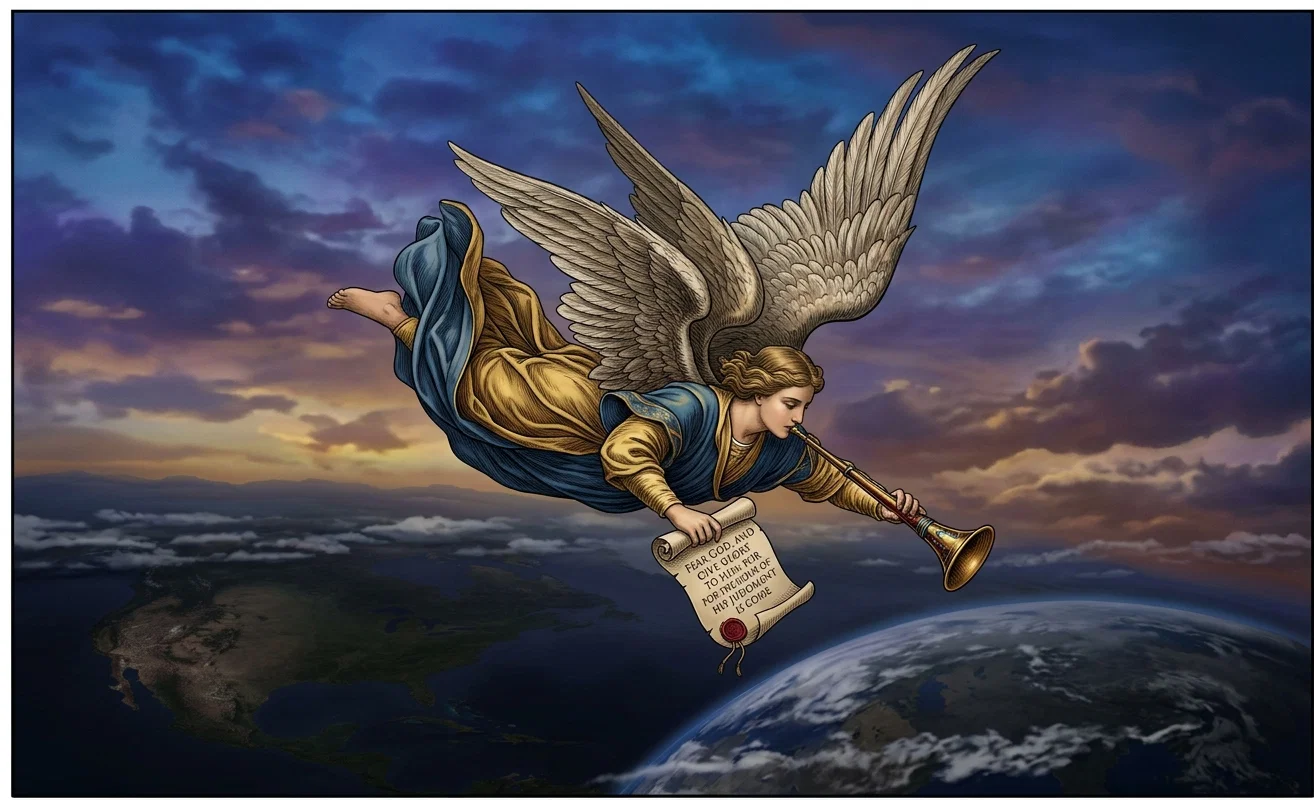
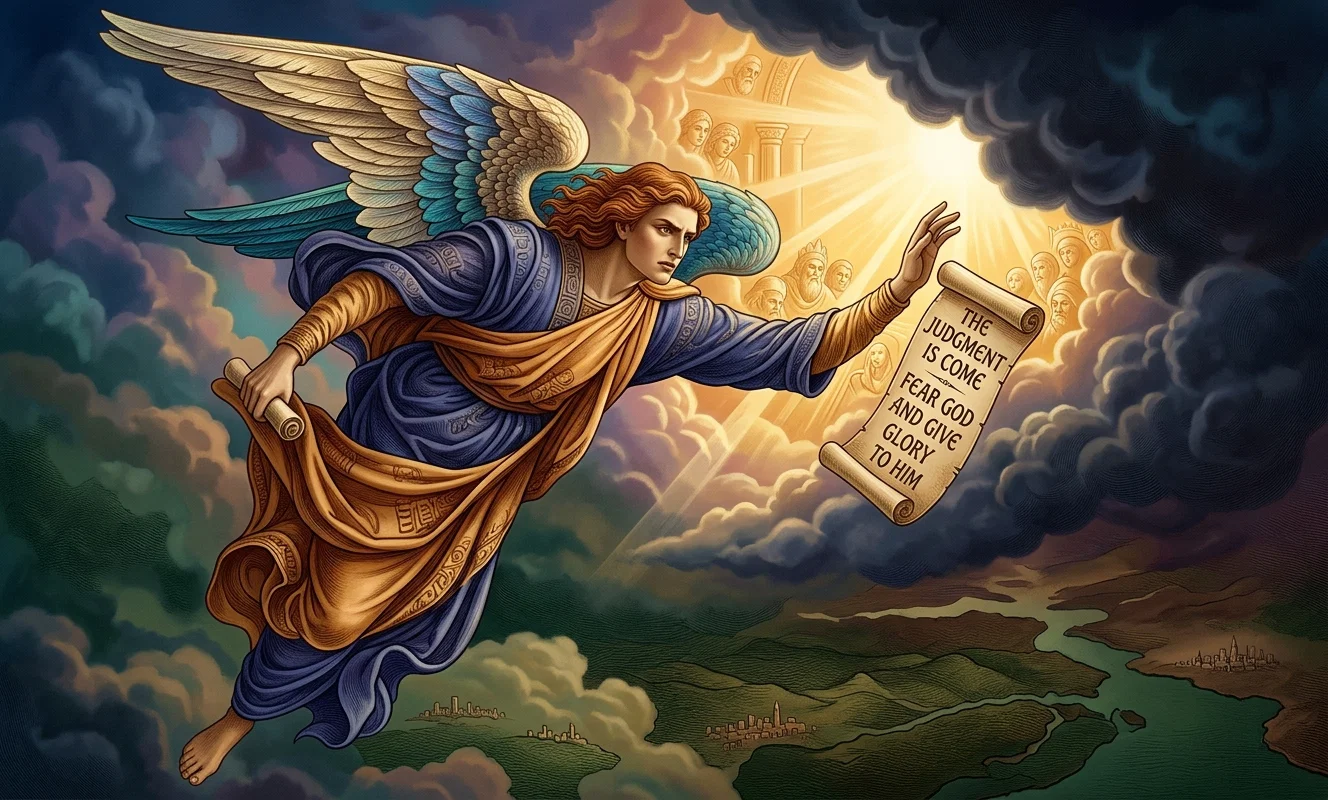
THE FIRST ANGEL'S MESSAGE—“FEAR GOD, AND GIVE GLORY TO HIM; FOR THE HOUR OF HIS JUDGMENT IS COME”
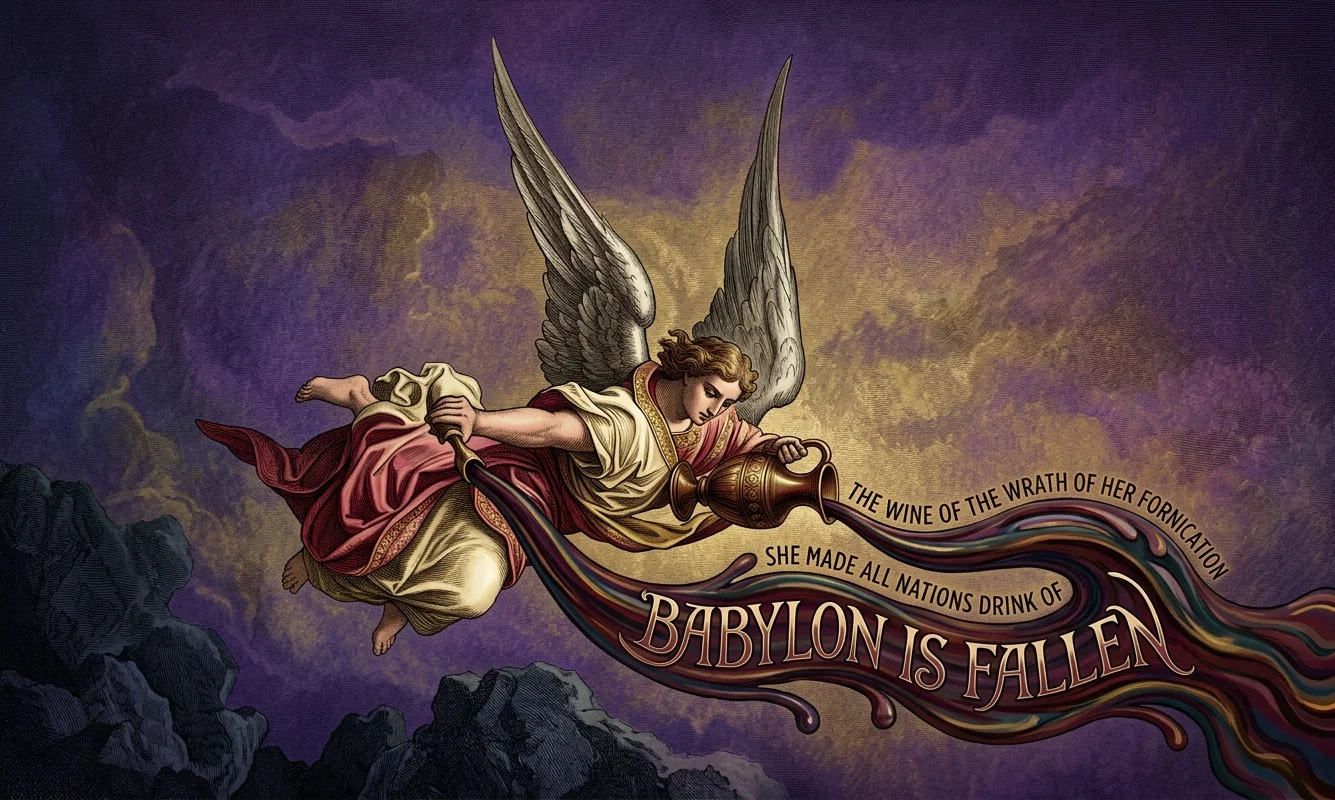
THE SECOND ANGEL'S MESSAGE—"BABYLON IS FALLEN," . . . BECAUSE SHE MADE ALL NATIONS DRINK OF THE WINE OF THE WRATH OF HER FORNICATION"
Divine Warnings of Impending Judgments
The prophet declares, “Surely the Lord God will do nothing, but he revealeth his secret unto his servants the prophets.” Amos 3:7. In all the history of God’s dealing with this world, whenever he was about to bring judgments upon the children of men, he has first sent them messages of mercy, through heeding which they might escape the visitation of his wrath, and be prepared for the impending crisis.
Through Noah, a preacher of righteousness, God sent to the antediluvian world a warning of the coming flood; through Lot he warned the wicked cities of the plain of their overthrow; through Jonah he warned Nineveh of its threatened destruction. It is but reasonable to conclude that if God would warn even a single city of impending evil, he would surely warn the inhabitants of earth of a judgment which involves not alone the people of one city or one age, but every man, woman, and child who has ever lived.
The Signs of the Judgment Hour
The judgment message will be based upon specific signs of the impending judgment. In the heavens above, in the earth beneath, in the physical, social, industrial, political, and religious worlds, the unerring pen of inspiration points out conditions by which we may know when the end of all things is at hand, and when the great judgment day is near. These conditions already exist. Signs on every hand reveal that we are living in the closing days of earth’s history. Based upon these signs, a message is now due the world. The prophet Joel says:—
“Blow ye the trumpet in Zion, and sound an alarm in my holy mountain; let all the inhabitants of the land tremble: for the day of the Lord cometh, for it is nigh at hand.” Joel 2:1.
The Judgment-Hour Message
The solemn character, the significant import, and the world-wide extent of this last-day message are clearly indicated in the Sacred Record. The message is represented under the symbol of flying angels, proclaiming the everlasting gospel to every nation, kindred, tongue, and people. It is threefold in character. The first angel sounds the great keynote; a little later a second angel adds his voice to that of the first; and then these two are joined by a third, the chorus constituting a mighty threefold warning message. This message is recorded in Rev. 14:6-14:—
“I saw another angel fly in the midst of heaven, having the everlasting gospel to preach unto them that dwell on the earth, and to every nation, and kindred, and tongue, and people, saying with a loud voice, Fear God, and give glory to him; for the hour of his judgment is come; and worship him that made heaven, and earth, and the sea, and the fountains of waters.
“And there followed another angel, saying, Babylon is fallen, is fallen, that great city, because she made all nations drink of the wine of the wrath of her fornication.
“And the third angel followed them, saying with a loud voice, If any man worship the beast and his image, and receive his mark in his forehead, or in his hand, the same shall drink of the wine of the wrath of God, which is poured out without mixture into the cup of his indignation; and he shall be tormented with fire and brimstone in the presence of the holy angels, and in the presence of the Lamb; and the smoke of their torment ascendeth up forever and ever; and they have no rest day nor night, who worship the beast and his image, and whosoever receiveth the mark of his name.
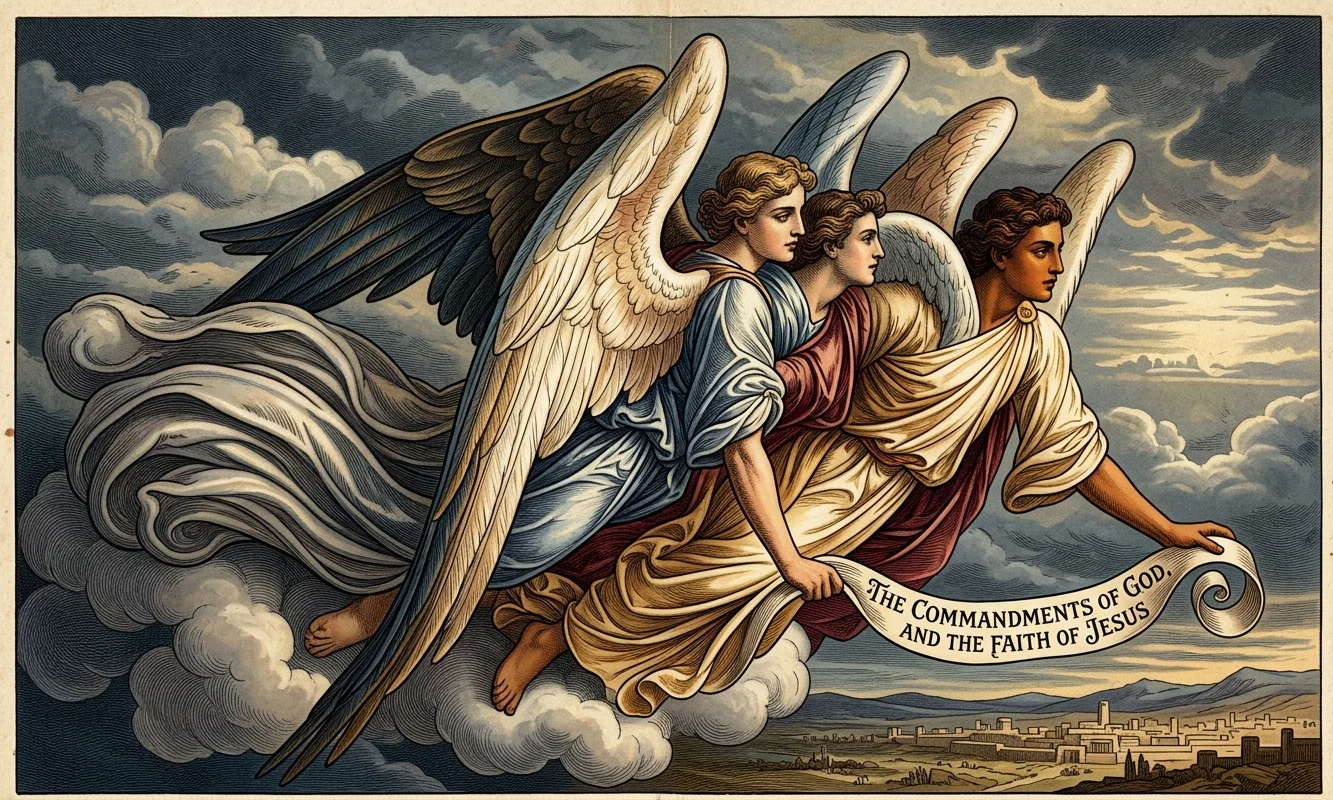
“Here is the patience of the saints: here are they that keep the commandments of God, and the faith of Jesus. And I heard a voice from heaven saying unto me, Write, Blessed are the dead which die in the Lord from henceforth: Yea, saith the Spirit, that they may rest from their labors; and their works do follow them.
“And I looked, and behold a white cloud, and upon the cloud one sat like unto the Son of man, having on his head a golden crown, and in his hand a sharp sickle.”
Chief Characteristics of the Message
Observe carefully the chief characteristics of this mighty and merciful call to repentance:—
1. The solemn declaration is made that the hour of God’s judgment has been reached.
2. In view of this stupendous fact, man is called upon to turn from the worship of false gods, from the glorification of self, from the veneration of human ideals and standards and man-made dogmas and doctrines, to the worship of the one true God, the Creator of the heavens and the earth, to whom alone belong all glory and honor.
3. Babylon is represented as fallen, or separated, from God because of her false doctrines and evil practices.
4. A solemn warning is sounded against the beast and his image and the reception of his mark.
5. There is developed a class of believers who keep the commandments of God and the faith of Jesus, and who are prepared to welcome the Saviour on his return.
Important Considerations
Important questions grow out of the consideration of this prophecy. To these the limits of this article will not permit an extended answer. We must content ourselves with simple statements of fact, referring the interested reader to larger books for argument and proof.
1. When does the hour of God’s judgment begin?
The hour of God’s judgment was reached at the close of the great prophetic period brought to view in Dan. 8:14: “Unto two thousand and three hundred days, then shall the sanctuary be cleansed.” These prophetic days, so many literal years, began at the going forth of the commandment to restore and build Jerusalem, in B. C. 457 (Dan. 9:24, 26; Ezra 7), and ended in A. D. 1844. At that time Christ entered upon his priestly ministry in the holy of holies in the heavenly temple. This work of judgment involves an examination of the heavenly records to determine who of earth’s millions, from the days of Adam to the close of time, have accepted Christ Jesus as their Saviour, and are thus entitled to a part with Christ at his second coming.
2. What constitutes the standard of judgment?
The standard of God’s judgment is the law of ten commandments. In that great instrument of moral precepts is comprehended the whole duty of man. It constitutes the gauge of human character and conduct. Said Solomon,—
“Let us hear the conclusion of the whole matter: Fear God, and keep his commandments: for this is the whole duty of man. For God shall bring every work into judgment, with every secret thing, whether it be good, or whether it be evil.” Eccl. 12:13, 14.
This law the apostle James calls the “royal law” and the “law of liberty,” and admonishes the believers, “So speak ye, and so do, as they that shall be judged” by it. See James 2:8-12.
3. What is involved in giving glory to God and in the worship of the Creator?
Obedience is the highest honor a child can give his parents. The highest loyalty a subject can show his king is obedience to the royal mandates. In the same way the child of God gives to him honor and glory and sincere worship by obedience to his righteous requirements. To his disciples Christ says, “If ye love me, keep my commandments,” and to this the beloved disciple adds, “This is the love of God, that we keep his commandments; and his commandments are not grievous.”
It is not by the keeping of the law that one can earn the favor of God. Says the apostle Paul, “By grace are ye saved through faith; and that not of yourselves: it is the gift of God; not of works, lest any man should boast.” Eph. 2:8, 9. The law points out sin, “Sin is the transgression of the law.”
1 John 3:4. The apostle Paul says, “I had not known sin, but by the law.” Rom. 7:7.
Jesus Christ came into the world to save man from sin. “Thou shalt call his name Jesus: for he shall save his people from their sins.” Matt. 1:21. Salvation from sin, from the penalty of a transgressed law, does not give liberty to continue in transgression. “Shall we continue in sin, that grace may abound?” the apostle asks. Then he replies, “God forbid. How shall we, that are dead to sin, live any longer therein?” Rom. 6:1, 2. In the new-covenant relationship, Christ writes the law of God on the heart of the believer. Heb. 8:10. By the power of the indwelling Christ, the believer is then enabled to observe these holy precepts. See Gal. 2:20.
The power of God as Creator is his great distinguishing characteristic. It is this attribute which distinguishes him from the false gods of heathen worship. See Acts 17:22-31. The one commandment in the decalogue which reveals this distinguishing characteristic and points out the author of the divine law, is the fourth commandment. This precept enjoins the observance of the Sabbath of the Lord as a memorial of his creative power.
4. What is embraced in the “everlasting gospel”?
The gospel is the good news to the human family of deliverance from the bondage of sin. “It is the power of God unto salvation to every one that believeth; to the Jew first, and also to the Greek.” Rom. 1:16. It holds up before lost man God’s great sin detector, “the law of liberty” (James 1:25), and presents Christ as the deliverer from sin. 1 John 3:4, 5. The gospel plan embraces the ministry of Christ as our sac-2rificial offering and priestly advocate, the judgment of the last day, the law of his government as the standard of the judgment, the establishment of his kingdom of peace and righteousness. The declaration, “Fear God, and give glory to him; for the hour of his judgment is come,” etc., is proclaimed by an angel as the everlasting gospel.
5. What is “Babylon”?
Babylon is the term which inspiration applies to the great worldly religious system which has forsaken Christ, the lawful spouse of the church, and joined affinity with the world. This is clearly shown in Rev. 17:1-5.
6. What is represented by the “beast”?
The beast represents the working of that evil principle and the operation of that false system of worship which Paul called in his day “the mystery of iniquity,” and which he declared should later develop into the man of sin. 2 Thess. 2:1-7. In the great papal system we see this principle exemplified:
7. What is the “image” of the beast?
An image of the beast would be a religious system or organization resembling the papal system in principle, in character, in operation. The beast represented the principle of church-and-state union—a church clothed with civil power and working through such power to carry out her own designs, oppressing and persecuting all who opposed her purposes. An image of the beast would be a church or a federation of churches—outside of the papal system—using the power of the civil arm for the furtherance of religious aims. Such an image to the papal beast the prophecy clearly indicates will be established. See Rev. 13:11-18.
8. What constitutes the “mark” of the beast?
The mark of the beast is some distinguishing token of its authority. As the beast is antichrist, the mark of its power would consist of some doctrine or institution, some attempted change in the law of God, whereby it would seek to set itself above Christ or in opposition to his authority. Such a mark or token of authority the papal church claims as its own to possess. The following we quote from one of its representative works:—
“Question.—Have you any other way of proving that the church has power to institute festivals of precept?
“Answer.—Had she not such power she could not have done that in which all modern religionists agree with her,—she could not have substituted the observance of Sunday, the first day of the week, for the observance of Saturday, the seventh day, a change for which there is no Scriptural authority.”—Keenan’s Doctrinal Catechism, p. 170.
Church-and-State Movement
We must conclude from this prophecy that there will arise in this country, the land of Protestantism, a movement which will have for one of its objects the enforcement by legal enactment of the mark of Rome’s authority. This is clearly indicated by the prophecies of Revelation 13 and 14. Even now we see this movement developing. Through the efforts of the National Reform Association, various Lord’s Day Alliances, Christian Citizenship Leagues, and kindred organizations, a strong movement is gathering force, ostensibly with the object of bringing about the enactment of laws by federal and State governments which shall compel the first day of the week to be observed as a day of rest. This is demonstrated by the increasing number of Sunday-rest bills introduced into Congress and into many of the State legislatures.
Many connected with these organizations are honorable men, and some of the objects for which they are laboring—such, for instance, as the suppression of the liquor traffic, the elimination of vice, the betterment of social conditions, the curtailing of the great divorce evil—are worthy of the hearty support of every citizen. But intermingled with these good purposes is an effort to commit the government to religious legislation, a course which has been attended in every age with the most evil consequences both to the church and to the state. We must remember that it was the honorable women in Paul’s day who were used by the enemies of the cross to carry on a persecution against the apostle. See Acts 13:50.
A Message of Warning and Reform
Opposed to this movement for so-called civic righteousness—this effort to save men, not by the gospel, but by civil enactment—stands the warning of the judgment-hour message. Christendom has drifted away from the New Testament standards. The purpose of the judgment-hour message is to call men back to the simplicity of Bible faith and holy living. It proclaims the everlasting gospel in its fulness, setting forth Christ as the only means of salvation, his ministry in the heavens above as the only effectual service for sin, his coming in glory as the end and object of the Christian hope. The judgment-hour message calls upon a backslidden church to return in faith and practice to the old paths.
In contradistinction to the counterfeit sabbath, the observance of which men are seeking to enforce upon their fellows, the message of God demands obedience to God’s mark or sign of authority as found in his holy institution, the seventh-day Sabbath. As the counterfeit sabbath constitutes the mark of loyalty to earthly powers, so the Sabbath of the Lord constitutes his seal or sign, the distinguishing mark of true Israel. See Rev. 14:1-4; Ex. 31:13-18.
The Sabbath a Memorial of Creation
In the Sacred Record the Sabbath of the Lord is set forth as the great memorial of God’s creative work. The inspired historian declares:—
“Thus the heavens and the earth were finished, and all the host of them. And on the seventh day God ended his work which he had made; and he rested on the seventh day from all his work which he had made. And God blessed the seventh day, and sanctified it: because that in it he had rested from all his work which God created and made.” Gen. 2:1-3.
By three divine acts God instituted this memorial: (1) He first used the seventh day as his own rest day, making it indeed the Sabbath of the Lord; (2) he pronounced upon it his divine blessing, constituting it for all ages holy time; (3) he sanctified it, bestowing it upon Adam, the father of the human family, and through him on his posterity as a day of sacred worship.
THE THIRD ANGEL'S MESSAGE — A WARNING AGAINST APOSTASY AND FALSE WORSHIP
The Sabbath a Part of the Moral Law
When he brought his chosen people out of Egypt, the Lord delivered to them in written form from Mt. Sinai his law of great moral precepts. This law had been observed by the people of God in preceding ages. It was kept by Abraham, the father of the faithful. Gen. 26:5. In the bosom of this decalogue, revealing its moral character and its enduring nature, was placed the Sabbath commandment. This commandment reads as follows:—
“Remember the Sabbath day, to keep it holy. Six days shalt thou labor, and do all thy work; but the seventh day is the Sabbath of the Lord thy God: in it thou shalt not do any work, thou, nor thy son, nor thy daughter, thy manservant, nor thy maidservant, nor thy cattle, nor thy stranger that is within thy gates: for in six days the Lord made heaven and earth, the sea, and all that in them is, and rested the seventh day: wherefore the Lord blessed the Sabbath day, and hallowed it.” Ex. 20:8-11.
Christ and the Apostles Kept the Sabbath
When Christ came to earth as man’s Saviour and Example, he observed the seventh-day Sabbath, and used it as his customary day of public worship. See Matt. 12:1-12; Luke 4:16. After his death his most intimate friends and disciples regarded the Sabbath as too sacred to use for the anointing of his body, but deferred their preparations till after the Sabbath was passed, and then performed on the first day of the week labor which they would not do on the seventh. Luke 23:56; 24:1.
The apostle Paul, following the example of his Master, used the seventh-day Sabbath as a day for religious assembly and worship, not only holding meetings for the Jews, but for the Gentiles also. Acts 13:42, 44; 17:1, 2; 18:1-11.
No Bible Authority for Sunday Observance
In contrast with this particular regard for the Sabbath of the Lord, we find no record in the Sacred Word of any special regard given to the first day of the week. It is nowhere called holy or sacred. It was not regarded by Christ or his apostles in any sense as a sabbath day or as a day for religious assembly. Says Cardinal Gibbons:—
“You may read the Bible from Genesis to Revelation, and you will not find a single line authorizing the sanctification of Sunday. The Scriptures enforce the religious observance of Saturday, a day which we never sanctify.”—Faith of Our Fathers, 1893, p. 111. Baltimore: John Murphy & Co.
How the Sabbath was Changed
It was the working of the “mystery of iniquity” which brought about the change in the observance of the church from the seventh to the first day of the week.
The change was brought about slowly. During the early centuries both the seventh and the first day of the week were observed by the Christian church. Sunday was celebrated at first as an ordinary church festival, the same as Good Friday, Christmas, etc., making appeal for support to ecclesiastical authority, and not to Scriptural injunction. “Opposition to Judaism,” says the historian, “a desire to gain favor with their heathen neighbors, with motives of expediency and patriotism, led to the exaltation of the festival dedicated by the heathen world to the veneration of the sun, in the place of the true Sabbath.”
Says Morer, a Church of England writer:—“It is not to be denied that we borrow the name of this day from the ancient Greeks and Romans, and we allow that the old Egyptians worshiped the sun, and as a standing memorial of their veneration, dedicated this day to him. And we find by the influence even of their examples, other nations, and among them the Jews themselves, doing him homage; yet these abuses did not hinder the Fathers of the Christian church simply to repeal, or altogether lay by, the day or its name, but only to sanctify and improve both, as they did also the pagan temples pointed before with idolatrous services, and other instances wherein those good men were always tender to work any other change than what was evidently necessary, and in such things as were plainly inconsistent with the Christian religion; so that Sunday being the day on which the Gentiles solemnly adored that planet, and called it Sunday, partly from its influence on that day especially, and partly in respect to its divine body (as they conceived it), the Christians thought to keep the same day and the same name of it, that they might not appear causelessly peevish, and by that means hinder the conversion of the Gentiles, and bring a greater prejudice than might be otherwise taken against the gospel.”—Dialogues on the Lord’s Day, pp. 22, 23.
THE GREAT THREEFOLD MESSAGE—“THE COMMANDMENTS OF GOD, AND THE FAITH OF JESUS”
The decree of Constantine, in A. D. 321, requiring its observance on the part of “judges and townspeople, and the occupation of all trades,” and the decree of the Council of Laodicea, in A. D. 364, ordering that “Christians shall not Judaize and be idle on Saturday, but shall work on that day; but the Lord’s day they shall especially honor,” gave increased impetus to first-day observance. But “down even to the fifth century the observance of the Jewish Sabbath was continued in the Christian church, but with a rigor and solemnity gradually diminishing until it was wholly discontinued.”—Ancient Christianity Exemplified, by Lyman Coleman, chap. 26.
But God left not his truth without witness in the earth, for some in every age have observed the true rest day.
Walking in the Light
Through the ages of the past, many devout men and women have lived and died observing the first day of the week as the Sabbath of the Lord. They lived up to all the light they possessed, and God accepted their service. We have now reached the hour of God’s judgment, and his judgment-hour message is going to the world. That message he designs shall call the church of God back to its first love, to the old paths of obedience, to the Sabbath of the Lord, which has so long been covered by the dust of tradition and superstition.
The Last Great Conflict
We are in the midst of the last great conflict between truth and error. Between these opposing principles the line of demarcation will be drawn. The worship of God, or the worship of earthly ecclesiastical powers; loyalty to Christ, or allegiance to Antichrist; obedience to the law of God, or obedience to the commands of men; the reception of God’s seal in the observance of his holy day, or the reception of the mark of the power opposed to God in the observance of a false and counterfeit sabbath; the keeping of the faith of Jesus and the obtaining of righteousness through faith in his atoning blood and in the reception of his indwelling life, or the seeking of human righteousness by outward conformance to legal enactment;—these are the issues facing the church. These issues involve the eternal destiny of the children of men. For that reason Heaven is sending to the world today the great judgment-hour message. We cannot gainsay its clear, incisive teaching, or minimize its solemn importance. The manner in which we relate ourselves to its requirements will determine our destiny for weal or for woe.