“From the going forth of the commandment to restore and to build Jerusalem.” Dan. 9:25.
This was to be the starting-point of the long prophetic measuring line of the 70 weeks (or 490 years) and of the 2300 years. Events of such eternal import are marked out by the time prophecies depending upon this date, that what otherwise might seem a tedious review of facts and figures becomes a study of deepest interest. Once the starting-point is fixed, the events foretold must be seen following one another, scheduled exactly to the great time-table of divine prophecy.
There were successive decrees concerning Jerusalem, issued by Cyrus, and Darius, and Artaxerxes Longimanus. Which one does the scripture contemplate as “the commandment”? The decree of Artaxerxes to Ezra (Ezra 7) is the one we would naturally look upon as the most comprehensive; for it authorized Ezra to restore the full ecclesiastical and civil administration of Jerusalem and Judah. And the scripture clearly indicates10this as “the commandment to restore and to build.”
In a single passage, Inspiration notes the decrees of Cyrus and Darius, and sums up both with this decree of Artaxerxes to Ezra, as constituting “the commandment”:—
“And they builded, and finished it [the temple], according to the commandment of the God of Israel, and according to the commandment of Cyrus, and Darius, and Artaxerxes king of Persia.” Ezra 6:14.
Thus it is spoken of as one threefold commandment, completed in the sweeping and inclusive commission to Ezra. Here, then, was the “going forth of the commandment to restore and to build.” And this decree to Ezra was put into execution in the seventh year of Artaxerxes. Ezra 7:7-9. This was in the year 457 B. C., as must now be shown.
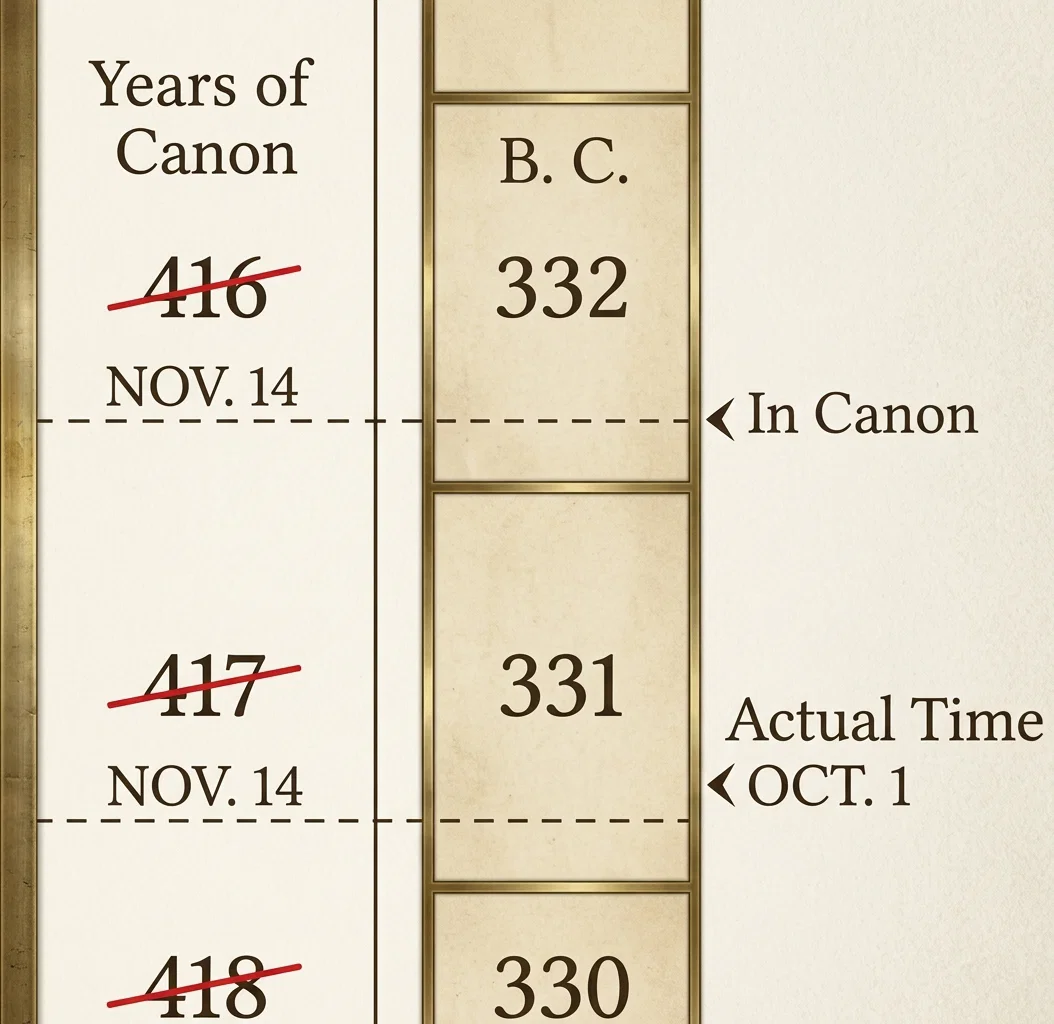
Fig. 1 Alexander's Succession
This date of the seventh year—so important to ascertain—is fixed by the combined record of sacred and profane history with uncommon accuracy.
One witness is the canon of Ptolemy, the great authority on the chronology of ancient kings. Claudius Ptolemy, mathematician, astronomer, and geographer, dwelt in Alexandria, Egypt. He was born in the first century of our era, and died about the year 151 A. D. Alexandria was the great educational center, the home of wonderful library collections. From the records of ancient times Ptolemy compiled a chronological list of the kings of the great universal empires.
Thus his list of kings is a canon (rule, or standard) of ancient chronology, of the greatest value. He began with Nabonassar, of the Assyro-Babylonian line, 747 B. C., and continued the list of his successors to the fall of Babylon; then followed the Persian, Grecian, and Roman lists, to the second century after Christ, when Ptolemy died and his record ceased.
That line of kings in Ptolemy’s list—Babylon, Persia, Greece, Rome—is a striking comment, as a number of writers remark, on Nebuchadnezzar’s dream of the great metallic image, representing the four universal kingdoms.
When Ptolemy, in his quarters in the temple of Serapis, made up his list of empires and their kingly line, in the second century of our era, he unconsciously bore witness to the fulfilment of the prophecy uttered by Daniel, in Babylon, in the sixth century before Christ, when the prophet said to the king, “There is a God in heaven that revealeth secrets, and maketh known to the King Nebuchadnezzar what shall be in the latter days.” Dan. 2:28.
Along with his list of kings, Ptolemy compiled also a record of ancient astronomical observations, called the “Almagest” (an Arabic word meaning “great composition”). This “contains most of what is known of the astronomical observations and theories of the ancients.” —Webster’s Dictionary, “Almagest.” When it is recorded that in such and such a year of a certain king, at such a place, an eclipse of the sun or moon occurred, the modern astronomer and mathematician can verify the chronological record.
Thus the canon and the “Almagest” go together. Dr. Wm. Hales, the chronologist, said of the canon:—
From its great use as an astronomical era, confirmed by unerring characters of eclipses, this canon justly obtained the highest authority among historians also. It has most deservedly been esteemed an invaluable treasure, . . . and of the greatest use in chronology, without which, as Marsham observes, there could scarcely be any transition from sacred to profane history.—“Chronology,” Vol. I, page 280.
So we thank God for the work of Ptolemy, as a help in tracing the fulfilling word of prophecy. Speaking of the providences of God in the preservation of historical records, the late Dr. H. Grattan Guinness, of London, wrote of Ptolemy’s work as follows:—
In the existence of this invaluable work, and in its preservation as a precious remnant of antiquity, the hand of Providence can clearly be traced. The same divine care which raised up Herodotus and other Greek historians to carry on the records of the past from the point to which they had been brought by the writings of the prophets at the close of the Babylonish captivity,—the Providence which raised up Josephus, the Jewish historian, at the termination of the New Testament history, to record the fulfilment of prophecy in the destruction of Jerusalem,—raised up also Ptolemy in the important interval which extended from Titus to Hadrian, that of the completion of the Jewish desolation, to record the chronology of the previous nine centuries, and to associate it in such a way with the revolutions of the solar system as to permit of the most searching demonstration of its truth.—“Creation Centered in Christ,” Vol. I, page 292.
Now, what is the testimony of the canon to the seventh year of Artaxerxes Longimanus, when the decree to Ezra was issued. That day was the Egyptian thoth, or New-year. It begins the year one of Ptolemy’s Canon, which thenceforward numbers off the years, one, two, three, etc., straight on through history, telling in what year of Nabonassar’s era each king began to reign, always counting from New-year to New-year. The canon does not deal with parts of years. It is like a rigid measuring rule, just three hundred sixty-five days long, laid down over history, marking the years and numbering them from that first New-year. Knowing the starting-point, Feb. 26, 747 B. C., it is but a matter of computation, or measuring, to tell in what year of our reckoning a given year of the canon falls.
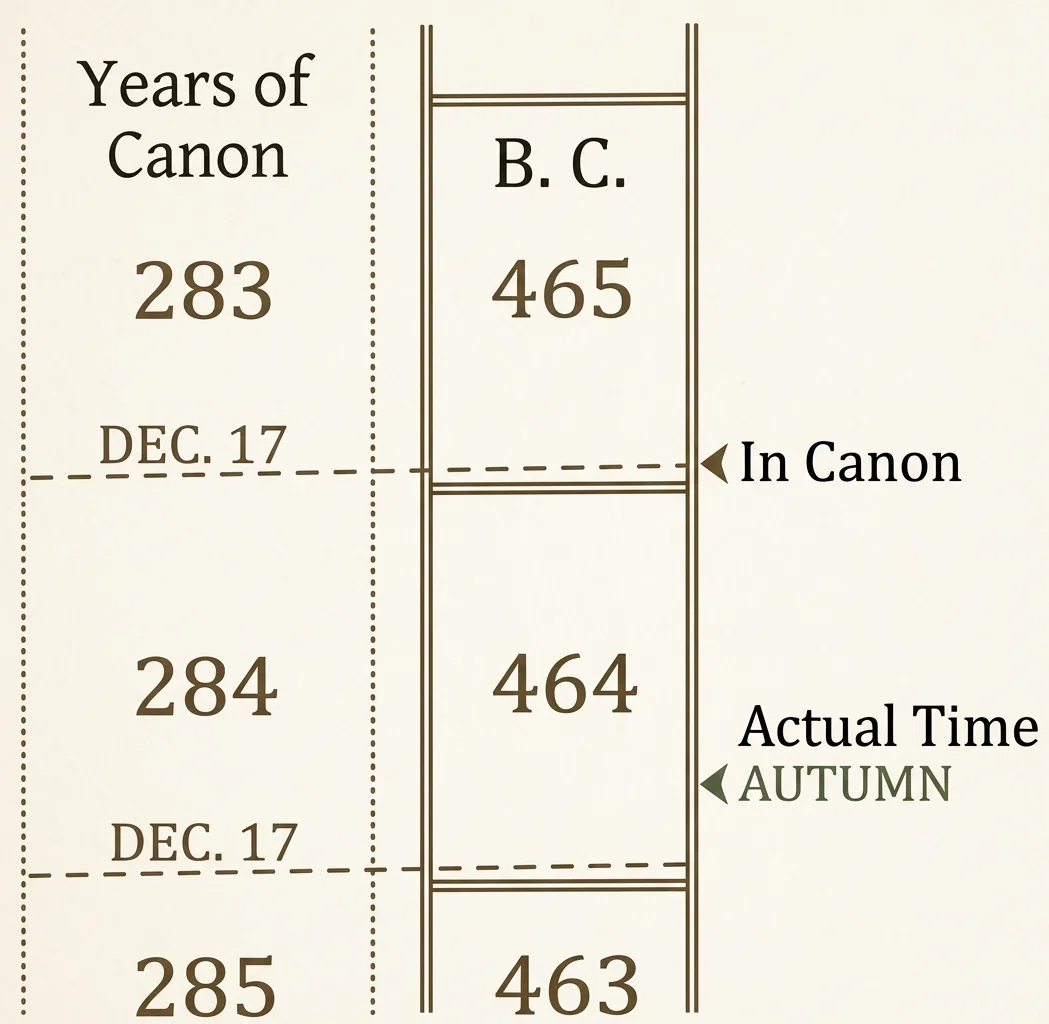
According to Ptolemy, the year in which Artaxerxes began to reign was the 284th year of the canon. This year 284, according to our calendar, began Dec. 17, 465 B. C.
But according to the rule of the canon, this means only that somewhere between Dec. 17, 465, and Dec. 17, 464, the king came to the throne. At whatever time in the year a king came to the throne, his reign was counted from the New-year preceding. To illustrate: If we were following that plan now of recording the reigns of kings,—by years only, not counting parts of years,—and a king should come to the throne in July, 1912, the year of his accession would be set down as beginning with the New-year, Jan. 1, 1912, for in the year then opening he began to reign.
That was Ptolemy’s method. Dr. Hales states the rule:—
Each king’s reign begins at the Thoth, or New-year’s day, before his accession, and all the odd months of his last year are included in the first year of his successor.—“Chronology,” Vol. I, page 285.
He cites the following proofs of the rule (which we will illustrate by diagrams):—
Thus, the actual accession of Alexander the Great was at the decisive victory of Arbela, Oct. 1, B. C. 331; but his reign in the canon began the preceding New-year’s day of the same current Nabonassean year, Nov. 14, B. C. 332. [See Fig. 1.]
The death of Alexander the Great was in the 114th Olympiad, according to Josephus, May 22, B. C. 323; but the era of his successor, Philip Arrhidæus, began in the canon the preceding New-year’s day, Nov. 12, B. C. 324. [See Fig. 2.]
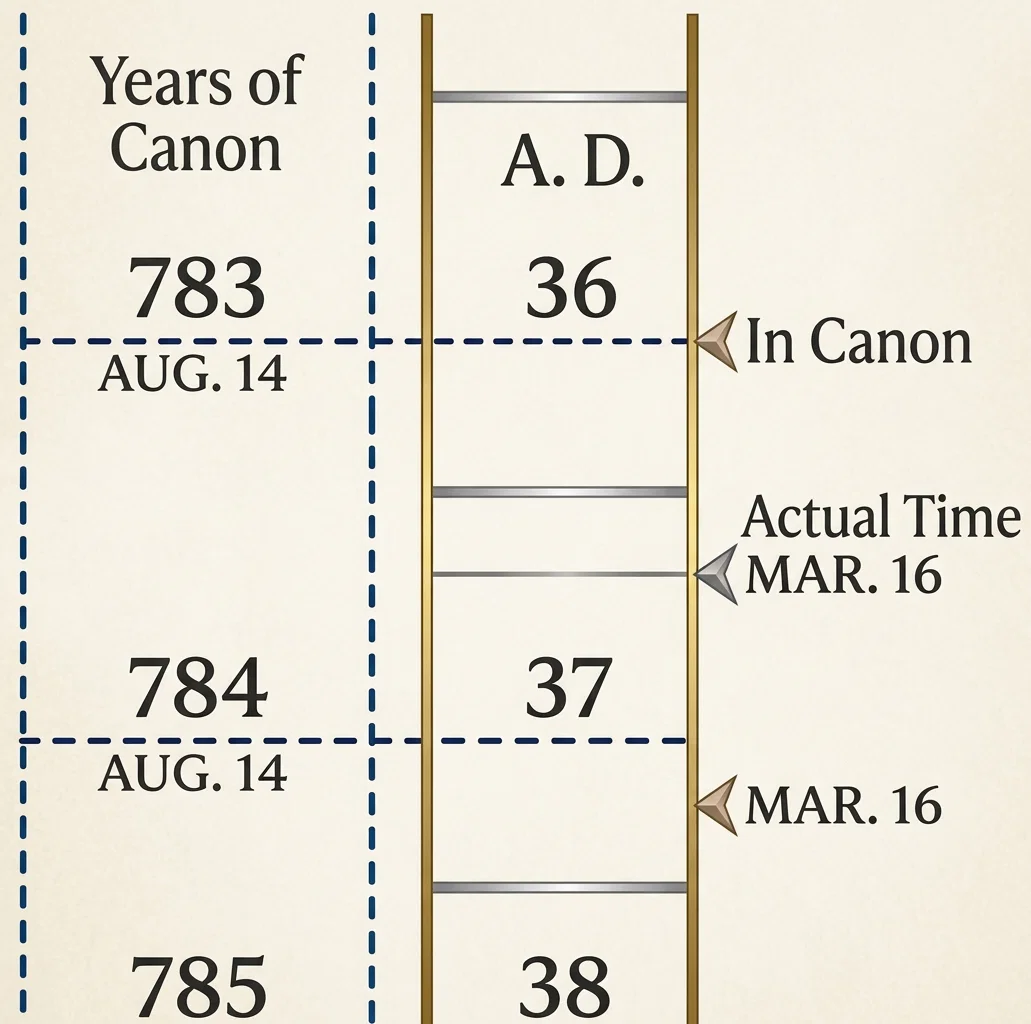
Tiberius died March 16, A. D. 37, but the reign of his successor, Caius Caligula, began in the canon from the preceding New-year’s day, Aug. 14, A. D. 36. [See Fig. 3.]
Therefore, inasmuch as the canon shows only that Artaxerxes began his reign sometime in the Nabonassean year beginning Dec. 17, 465 B. C., and ending Dec. 17, 464, the question is, At what time of the year did he come to the throne?
With this answered, we can readily determine the seventh year of Artaxerxes, as the scripture would reckon it from the time when he actually began to reign. And here Inspiration itself gives the answer.
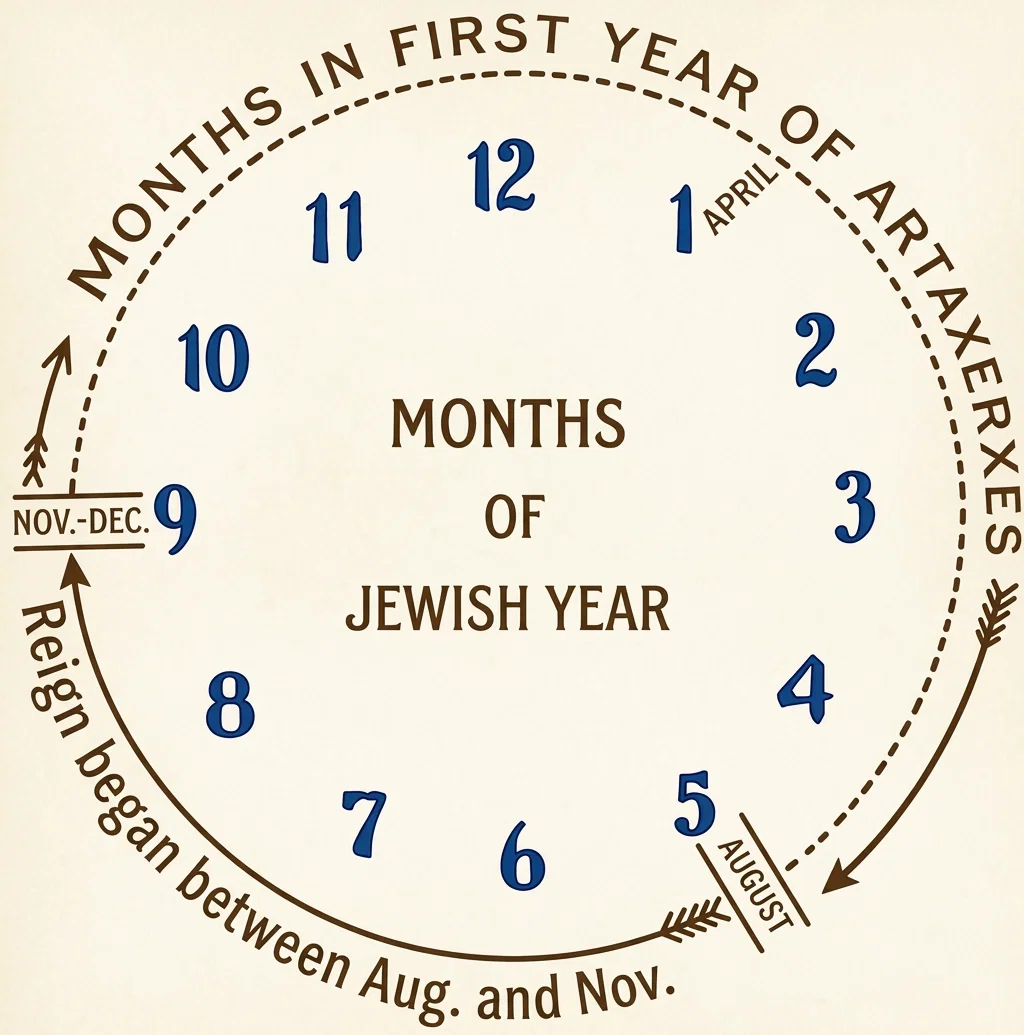
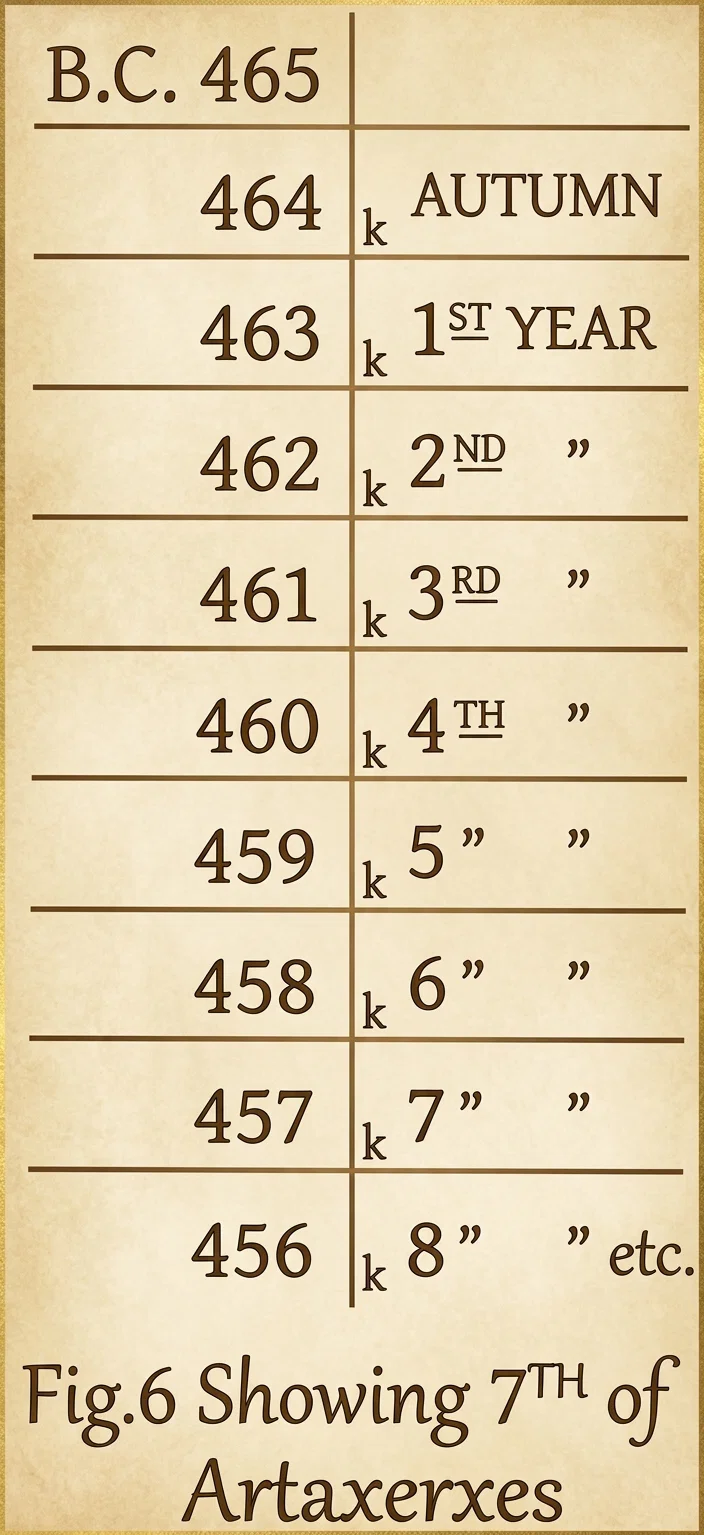
The record of Nehemiah and Ezra fully establishes the fact that Artaxerxes began his reign at the end of the summer, or in the autumn. Neh. 1:1; 2:1; Ezra 7:7-9. His first year, therefore, was from the autumn of 464 B. C. to the autumn of 463 B. C. (Fig. 4), and his seventh year was from the autumn of 458 B. C. to the autumn of 457 B. C. (Fig. 6.)
Under Ezra’s commission the people began to go up to Jerusalem in the spring of that year, 457 B. C. (in the first month, or April), and they “came to Jerusalem in the fifth month” (August). Ezra 7:8, 9. Ezra and his associates soon thereafter “delivered the king’s commissions unto the king’s lieutenants, and to the governors on this side the river: and they furthered the people, and the house of God.” Ezra 8:36.
With this delivery of the commissions to the king’s officers, the commandment to restore and to build had fully gone forth.
And from this date, 457 B. C., extends the 70 weeks, or 490 years, allotted to the Jewish people. “Seventy weeks are determined [cut off] upon thy people and upon thy holy city . . . from the going forth of the commandment to restore and to build Jerusalem.” Dan. 9:24, 25.
This 490-year period, measuring from 457 B. C. to A. D. 34, touches at its close the years of the public ministry and crucifixion of Christ, and the turning of the apostles to the Gentiles.
Fig. 3 Caligula's Succession
At the same date, 457 B. C., necessarily began the longer period of 2300 years, from which the shorter period was “determined,” or cut off. And this long prophetic period was to reach to “the time of the end,” to “the cleansing of the sanctuary,” the beginning of the closing ministry of Christ in the heavenly sanctuary, preparatory to his second coming in glory.
That year 457 B. C., therefore, is a date of profound importance. It stands like the golden mile-stone by the ancient arch of Severus at Rome, from which ran out all the measurements of distance to the ends of the empire. From this date, 457 B. C., run out the golden threads of time prophecy that touch the events in the earthly life and the heavenly ministry of Jesus that are of deepest eternal interest to all mankind to-day.
W. A. S.
Fig. 4 Artaxerxes's Succession
Fig. 5 Showing time of year of Artaxerxes's Accession