The Russian Union Conference

2%

Review and Herald Publishing Association · Tacoma Park Station, Washington, D. C. · Jun 16, 1910

FromReview and Herald, Vol. 87, No. 24.

Read the full edition

The Russian Union Conference

(Including the conferences and missions in European Russia, Siberia, Turkestan, and the Caucasus.)
With one sixth of the earth’s surface in the territory of this union conference, and one hundred fifty millions of people of many races and tongues, we can well understand that there are difficulties in organizing and pressing forward the work. Yet the 3,668 Seventh-day Adventists in all this field are earnestly bearing the witness.

DIFFICULTIES TO CONTEND WITH

“Only those in the field,” writes Elder J. T. Boettcher, of Riga, the union conference president, “know under what difficulties the message is making such progress in Russia.” He lists some of these difficulties:—
1. The more widely separated conferences are thousands of miles apart, making it difficult for the workers to meet together in council.
2. The multiplicity of languages for which we have neither literature nor preachers.
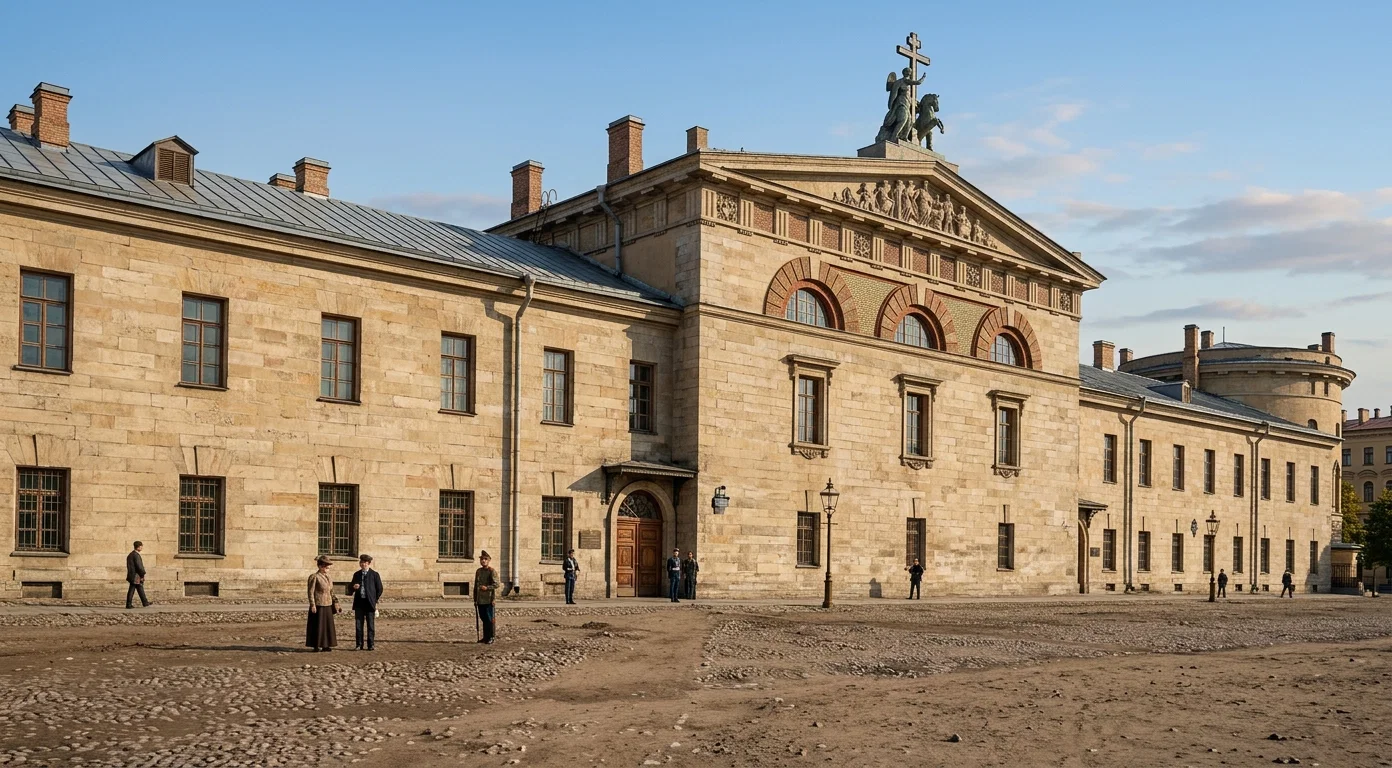
PRISON IN ST. PETERSBURG WHERE TWO OF OUR BRETHREN ARE IMPRISONED FOR REFUSAL TO WORK ON THE SABBATH
3. Eighty per cent of the population neither read nor write. Think of it, only twenty out of every one hundred able to read the Bible! The gospel, therefore, must be given to most
them by word of mouth. We are endeavoring, so far as possible, to have all our members learn to read.
On account of this inability to read, the people have become great debaters. The priests take advantage of this love of debate, attend the meetings of the so-called sects, and get up during the services, trying to force a debate, and denouncing the preacher. The priest usually brings a number of his sort with him. He knows, too, that he has the civil law on his side, and that he can say what he pleases, while the preacher must stand and listen to it all with Christian grace, and afterward go ahead and preach the word.

WORKING IN THE CITIES

The worker rents a large compartment, in which he lives. He circulates our literature among the people. Having in this way created an interest, he invites the people to his home, where, in a quiet way, he can labor with them until enough are brought into the truth to organize a company. This company then asks permission from the governor and police to unite with our church. After this, at times, the worker can hold public lectures, but is not allowed to take up collections, nor is he allowed to advertise his meetings. Nevertheless, the people come until our halls are filled to overflowing. As there are hardly any societies in Russia, there are very few public halls. This forces us to buildmeeting-houses. Our people are exerting themselves to the utmost to put our work upon a firm footing.

Little Russian, Siberian, and Central Asian Missions

At the beginning of the year three new mission fields were organized: the Little Russian, in Europe, the Siberian, and the Central Asian. We have held a general meeting in only one of these fields, the Central Asian, or Turkestan.

Turkestan

It is wonderful how the work in Turkestan has opened up. A number of German Sabbath-keepers moved there, and are working as hard as they can, not only with their hands, but also for the cause. One little church had an addition of twenty-one new members. They live right in among the Sartes and Kirghizes, all of whom are Mohammedans. Our young people have learned to speak these languages, and are reading the New Testament with some of the natives.
The truth is going from this field into Persia, as some of our Russian brethren live near Aschabad, which is only three and one-half miles from the Persian border. They have rented large tracts of land from the Persians, and thus come in direct contact with that people. Indeed, an interest has already been awakened. So we are entering Persia from the north.

Siberia

Siberia is a very promising field. In many respects it resembles Canada. Encouraged by the Russian government, there has been a great influx of people from European Russia into Siberia since the war with Japan. For this great field we have only one minister and one Bible worker. Most urgent calls come to us for help. Also from Manchuria calls still come from the believers in Harbin, who have never been visited.
A few months after Elder H. K. Loebsack, superintendent of the Siberian Mission, settled in Omsk, his faithful wife died, following a surgical operation, and with his motherless children in far Siberia, our brother has gone forward, seeking out inquirers and preaching the message.

“Little Russia”

The district known as “Little Russia” lies in the heart of Russia, Kief being the chief city of the territory. The agricultural peasantry in this region are of the poorest, the farmer being the only man who pays taxes. Our brethren barely make a living. Yet it is astonishing what a desire they have to spread the truth. They are willing to suffer banishment or any kind of persecution for the truth’s sake. In the village of — we have a church with two hundred members. This has outgrown any private dwelling, and holds its meetings in the open air. A friend of the cause donated a building lot; from a general fund we have sent one hundred fifty dollars with which to begin a building, which is now in process of erection, the believers to raise the balance needed.

The Baltic Conference

The work in the Baltic Conference, Elder Boettcher says, has advanced more rapidly than elsewhere, owing to the greater educational advancement of the people. With a population of over six millions, the conference has two ordained and two unordained ministers, and six Bible workers, representing, in nationality, Russians, Letts, Esthonians, and Germans. But they are a united band of workers.

IN ST. PETERSBURG

We have a church building in St. Petersburg, the capital, but it is too small for public meetings. The worker there, Brother J. Wilson, reported in a recent letter:—
The Lord has kept his promise of Matt. 28:19, 20. You know that halls are not cheap in St. Petersburg, but through the grace of the Lord we now have, for Sunday nights, a hall seating about five hundred persons, furnished with electric lights, an electric ventilator, and an organ. And this all free of charge. About six hundred attended the opening meetings. After the second meeting, about a hundred men, called “The Black Hundred,” who had been stirred up by priests, made disturbance, intending to flog me. But in the turmoil they got hold of another man. As matters began to look serious, the janitor of the hall fired a revolver in the air, whereupon the men fled.
Photo by E. Gnedjen
Photo by E. Gnedjen
We learned from this experience to issue tickets to our meetings, thus keeping out the disorderly. The mayor gave permission for this on our petition. At the next meeting everything passed off quietly. The police force was strengthened, the chief of police also being present. I could but think of how times have changed. A few years ago we feared the police, and now they come to protect us!
In this great city of nearly two millions, we have two workers, one Russian and the other Lettish, the latter speaking German also.

OTHER CITIES TO BE WORKED

In the city of Libau, on the Baltic, Brother J. Schneider reported crowded meetings in a hall, six hundred people gathering night after night. He has preached practically the same discourse three evenings in succession to accommodate those who could not get in to hear the first night’s presentation.
In Riga, the headquarters of our union conference, is the book depository.
Formerly there was a Lettish church here of one hundred members. Now there are two churches, a Lettish and a German, 160 new members having been added in the last two and one-half years. No special public effort is being put forth, as there is no evangelist for the city. The canvassers are scattering the literature, and when Elder Boettcher is in from his almost constant trips throughout the union conference, he holds evening meetings.

Middle Russian Mission

Moscow, the first capital, a city of about a million inhabitants, is in our Middle Russian Mission, and contains our one church in that mission. Elder O. Wildgrube, the mission director, and F. Gaidischar, a Bible worker, have been working in Moscow. Elder Boettcher says:—
It seems as if the enemy is doing his best to keep us from gaining a foothold in this city. We have been driven out of our place of meeting a numberof times. The priests come and make disturbance in almost every meeting. If any trouble arises, we are blamed for it. The priests have even gone so far as to rent a hall opposite our hall on the same street. They station people at our doors with literature and distribute it free of charge. Brother Wildgrube writes: “A few days ago a Baptist minister had his meeting closed, and I tremble when I think of my own case. We are having fine meetings.”
The Middle Russian territory contains a population of fifty millions, and the mission has three evangelistic workers.

West Russian Mission

This is said to be the most difficult portion of the union conference:—
However, within the last year permission has been granted to hold meetings in the city of Warsaw, and we now have a little company there, with two workers, a German and a Pole. The Roman Catholics have complete control of the city, and the work moves slowly and under great opposition. Wilna, the city where Elder H. J. Loebsack, the director of this mission field, now lives, is the center of the Jewish population of Russia. A hall has been secured, but it is difficult to persuade the Jews to attend a Protestant meeting.

The Caucasian Conference

This conference includes the Trans-Caucasus, touching the Persian border.
During the year 1909 two new churches were taken into the conference—Tiflis, with twenty-three members, and Novorossiisk, with nine members. Tiflis is a stronghold in the Caucasus, and we are glad to have a start there, after many difficulties. At the conference meeting this year Brother E. Gnedjin, a Russian, was ordained to the ministry, the second of our native Russian ministers.

South Russian Conference

This conference has many important cities in its territory. Elder Daniel Isaak, the president, says:—
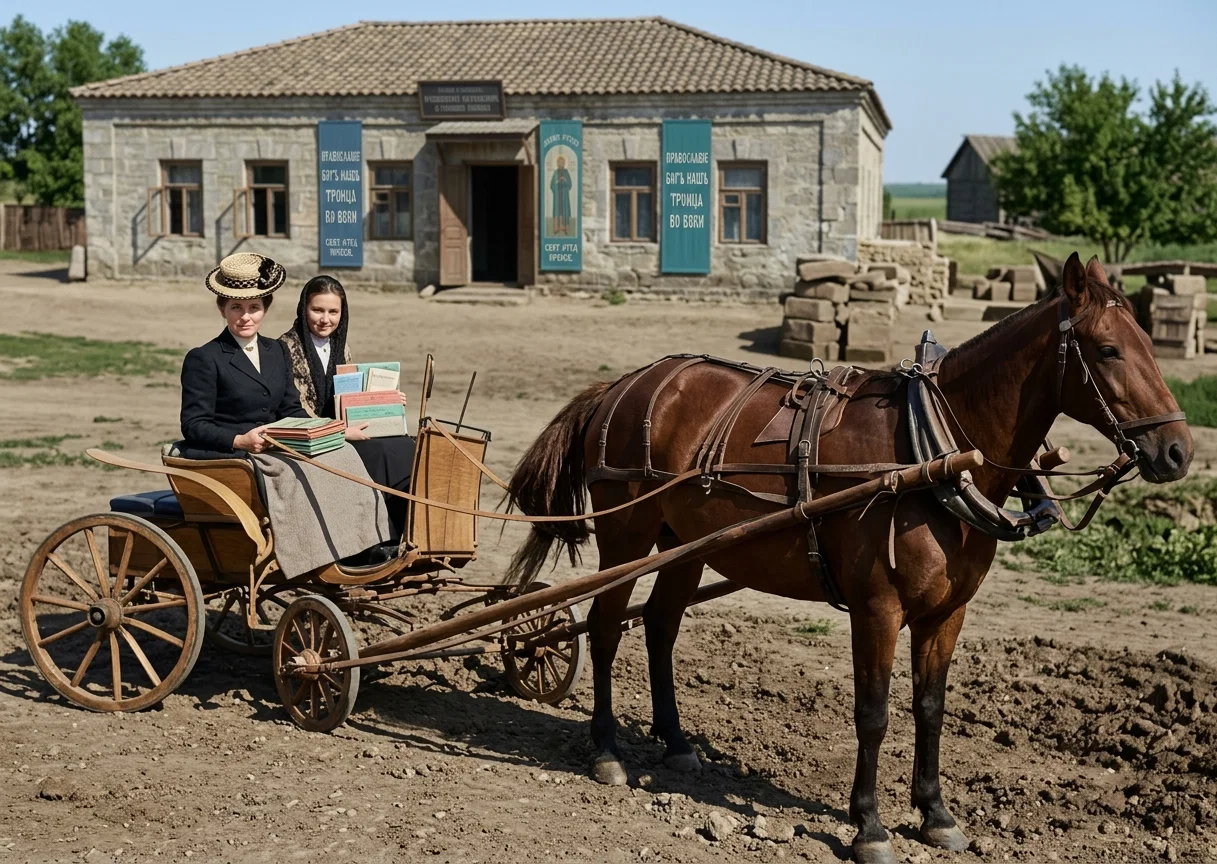
BERTHA OSWALD AND A. PREIKSCHAT, CANVASSING IN SOUTH RUSSIA
Work has been done during the year in the cities of Rostof, Sevastopol, Odessa, Alexandrovsk, and Ekaterinoslaf, besides some work in a number of villages. We have at present two Russian, four German-Russian laborers, and the writer (from America). Besides these we have in the canvassing fieldtwo Russian men, and two German-Russian women. It is quite an unheard-of thing here for women to go canvassing, especially driving from village to village, or even walking with their loads of books. The people seem greatly astonished. Some well-meaning ones said: “O, this shows that the gospel is now being preached everywhere; so that even women have to go to do such work.” Others, who do not like to see our work increase, said: “Well, what is coming next out of that Adventist movement?” These two sisters have many experiences to relate after coming in from a two-months’ trip. They labor entirely in the German villages, where the people in general rejoice to be able to buy such good literature.
One of the great cities is the Black Sea port of Odessa. A native Russian worker tried long and suffered much to get meetings started here. He had been accused of leading some out of the orthodox church; but while judgment on this charge was pending, he applied for permission to hold meetings in a hall. Just here, says Elder Isaak, deliverance came:—
Our worker had just finished two weeks in prison for that former accusation, when there came not only permission to conduct his meeting in his new hall, but also permission to hold our coming conference for 1910 there. Is this not good? We now have also a German laborer and a nurse stationed in Odessa. The interest there is encouraging, and we hope soon to reap as good a harvest at Odessa as we had the year before at Sevastopol, where an entire Russian church of sixty members was organized. Five new churches and companies have been added during the year.
We must close the report of the splendid year in the Russian Union Conference with these words from its president:—
The Russian Union Conference has added about six hundred to its membership during 1909, and it has been a year full of rich experiences for the cause. In 1910 we hope to see our Russian training-school established.
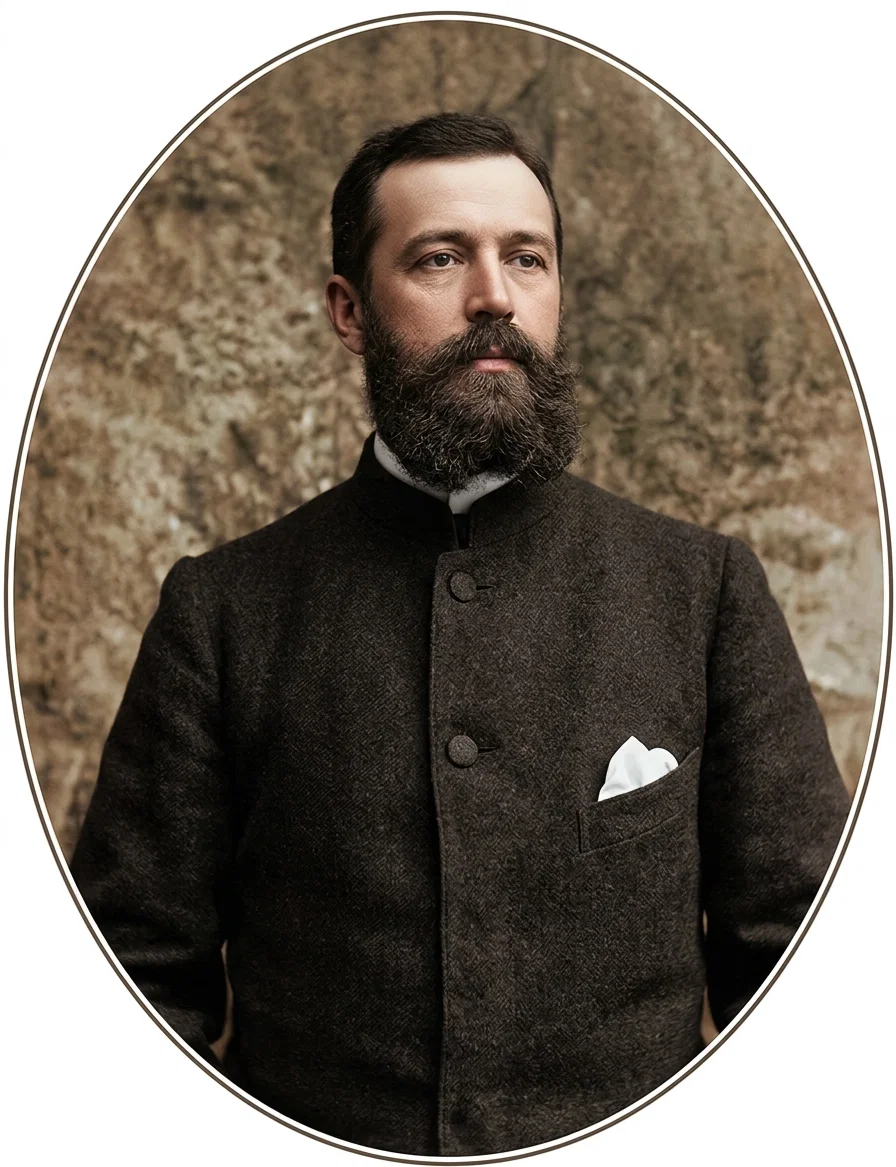
E. GNEDJEN, NATIVE RUSSIAN MINISTER