The Printing-Press and the Gospel

6%

Review and Herald Publishing Association · Takoma Park Station, Washington, D. C. · Nov 4, 1909

FromReview and Herald, Vol. 86, No. 44.

Read the full edition

The Printing-Press and the Gospel

Time was when the gospel was preached only by word of mouth. The message of salvation was impressed upon the minds of men through the hearing of the ears. In those days the precious truths of God's Word were literally passed from mouth to mouth. The Christian pulpit was, in fact, the center from which radiated nine tenths of all Bible knowledge.

The Gospel Chained

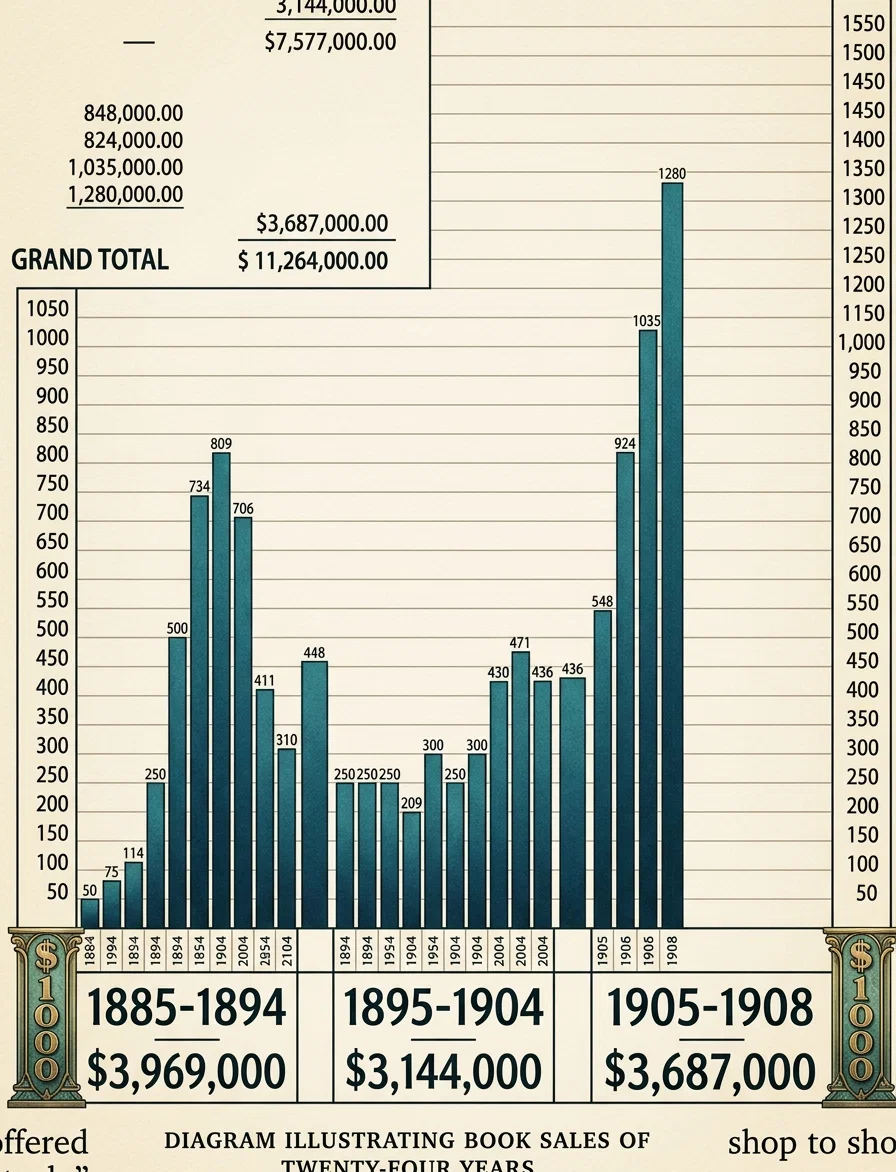
DIAGRAM ILLUSTRATING BOOK SALES OF TWENTY-FOUR YEARS
It is said that in the thirteenth century it took an expert copyist about ten months to transcribe a single copy of the Bible, at a cost of between two hundred and three hundred dollars. And the purchasing power of money then was twelve times greater than now.
These Bible manuscripts, we are also informed, were “so scarce and dear that they were frequently sold for double and treble their weight in gold,” and “so precious that they were conveyed by deed, like landed estate.” The common people were thus barred from purchasing and reading them. Most of the Bibles were chained to the pulpits of the churches or monasteries. And being written in a language unknown to the poorer classes, the truths they contained were also chained.

“Knowledge Shall Be Increased”

The times were now ripe for a change. In the year 534 B. C., God, speaking through his prophet Daniel, had foretold (Dan. 12:4) that “knowledge shall be increased” in “the time of the end,” and that “many shall run to and fro.” The beginning of the fulfilment of that divine prophecy took place in the year 1423 A. D., or over nineteen and a half centuries after the prediction; for in that year the art of printing was discovered by Laurence Coster, a Dutchman living in the old town of Haarlem, Holland. His types were of wood. Upon the death of Coster, John Gutenberg, one of his apprentices, improved upon wooden types by carving metal ones.

First Bible Printed

It seemed decreed by Providence that the very first book to be printed by John Gutenberg (in 1450) should be the Bible, also that it should thereafter be the most popular book with the printers and booksellers. A copy of this first Bible, containing six hundred seven vellum leaves, was sold by Gutenberg's partner, John Faust, to Charles VII, king of France, for the sum of seven hundred fifty crowns, or eight hundred twenty-five dollars. When we consider that it took Gutenberg and his associates nearly eight years to carve the metal letters, and print the edition, the price seems reasonable enough.
The printing-press was now to give wings to the gospel. Scholars of renown translated the Word into the common languages, fleeing from one country to another to escape the persecutions of the Papacy.
“The demand for these books,” says the historian, “could never be sufficiently supplied.” “There was an eager struggle for Luther's smallest pamphlets. Of his catechism one hundred thousand were sold. The sheets of his tracts, often wet from the press, were hidden under the purchasers' cloaks and passed from shop to shop.”

“Book-Hawkers”

Associated with the preachers and printers of the gospel during Reformation times were the humble Bible-sellers, or colporteurs, sent forth by Luther, Calvin, and other Protestant publishers. “The book-hawkers or colporteurs,” says Samuel Smiles, “were among the most active agents of the Reformation.” And De Felicé, in his “Protestants of France,” says: “They were called bale-bearers, basket or literary carriers. . . . Staff in hand, basket on back, through heat and cold, by lonely ways, through the mountain ravines and dreary morasses, they went from door to door, often ill-received, always at the hazard of their lives, and not knowing in the morning where to lay their head at night.” Thus the science of modern book salesmanship should be credited to these and earlier heroes of gospel Protestantism.
A. J. S. BOURDEAU, Missionary Secretary General Publishing Department.