The Birth of the Black Republic

8%

Review and Herald Publishing Association · Tacoma Park Station, Washington, D. C. · Jul 25, 1907

FromReview and Herald, Vol. 84, No. 30.

Read the full edition

The Birth of the Black Republic

W. JAY TANNER
The origin of the Haytien republic should be interesting to Adventists, from the fact that its birth was one of the results of the French Revolution, which was itself a fulfilment of the prophecies of Dan. 11:36-40 and Rev. 11:7-13. Of that time, the historian says: “From 1788 Saint Domingue (Hayti) was as much prepared for a revolution as France herself. In the colony, as in the metropolis, all minds aspired to a new order of things.”
The population of the colony was then made up of two principal classes,—the colonists, or French, comprising the official class and army, the planters, the merchants, etc.; and the slaves. The latter, as might be supposed, far outnumbered all other classes. Their lot was an unusually hard one; and as is generally the case under such circumstances, they were kept in abject ignorance of the “evangile” or any learning that would lead up to it. Besides these, there was also a small class of hommes de couleur, as the free-born sons of the colonists by their female slaves were called. These mulattoes were not restricted in the matter of acquiring an education, and in many cases were sent by their fathers to Europe for this purpose. But no matter how enlightened they might be, or how great or varied their talents, they were allowed none of the usual privileges of citizenship. This naturally engendered bitterness on the part of the free colored people toward their white fathers; and here is, in reality, the beginning of France’s colonial troubles, which finally led to the Haytien republic. Although the white population at thattime was not nearly so great as that of African descent, yet the fact that the former controlled the army, the wealth, and all the natural advantages, made them the most powerful, as long as they remained united among themselves. But unity and harmony had for some time been banished from St. Domingue. Factions, revolts, and anarchy had taken their place, and the colonists found themselves divided into hostile camps, that exhausted their strength in a senseless warfare upon one another.
In May, 1791, the French Assembly passed a decree permitting all free-born colored people the rights of citizenship that they had been demanding for some time. This decree the officials of the colonial government refused to have anything to do with, and the home government was either unable or too fickle to force it into operation. This led to organization, on the part of the mulattoes to obtain their rights. They first addressed a very temperate, but firm letter to the governor, asking that they be granted the privileges accorded them by the home government. The governor refused their request, and ordered them to discontinue their conference that was then in session at Mirebalais. This they did, but only to take up arms against the colonial government. In this latter step they were more successful; for the next year the mulattoes not only voted, but held as many seats in the Colonial Assembly as were occupied by the French themselves.
This victory naturally led to much bitterness. But still it was not a sufficient cause to bring the two principal factions of colonists together for the purpose of opposing the growing power of the free colored people. Indeed, the rioting and discord continued until the governor, finding that his party was losing power, called in the aid of the slaves to help him crush his opponents. The government party thereby gained the day, but at the same time the way was paved for the slave uprisings which soon followed, and which brought a veritable “reign of terror” into the colony, that the emancipation act two years later (1793) far from terminated.
But another result that grew out of this use of the slaves for political and military purposes, and which was far more disastrous to French sovereignty in St. Domingue, was the fact that it called forth Toussaint Breda, better known as Toussaint Louverture. This man, who was destined to become one of the greatest of his race, had up to this time faithfully served his French master as a coachman on a property near Cape Haytien. By some means he had acquired a fair education; and, being a leader among the slaves, the government saw fit to use him as an intermediary in its dealings with them. The result of this is well known. Toussaint proved himself a more able man in politics and in generalship than any of the French in the island in those days. It would be impossible in these articles to go into the details of this remarkable African’s rise and power. But it will be sufficient to say that in less than nine years he rose from the state of a slave to that of governor-general of the entire island. Nor does he seem to have been unworthy of this eminence; for under his régime the colony enjoyed a greater degree of peace and prosperity than for years, his administration of justice and of finances being much better than that of his predecessors.
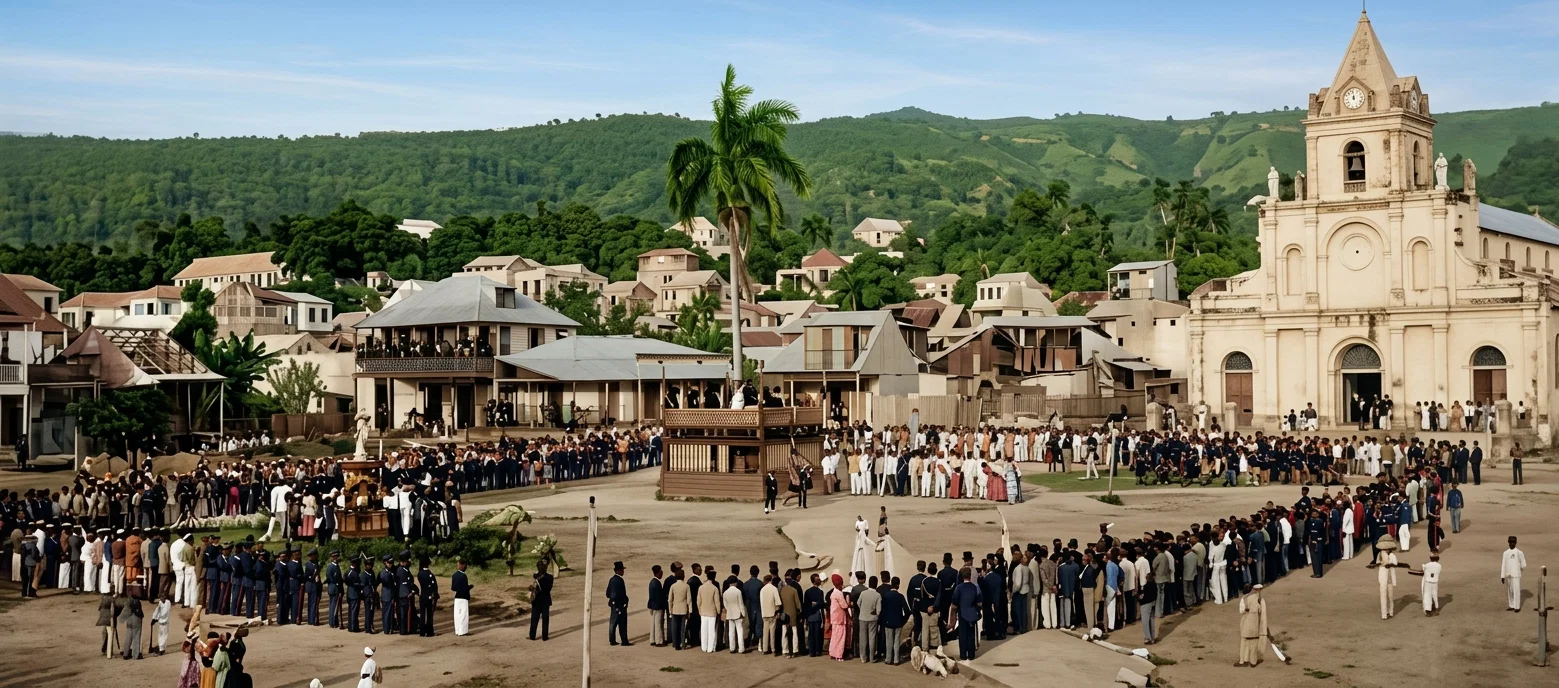
A FESTIVAL DAY. PORT AU PRINCE, HAYTI
Nor was Toussaint’s popularity confined to the humble homes of the recently liberated black people. The white colonists, high and low, seem to have manifested a respect and a confidence toward the ex-slave that is truly remarkable, when one considers their antipathy of a few years before. This conversion of feeling was, however, because it was plainly manifest to all that Toussaint was the only man among them with sufficient genius to weld together the discordant factions in the colony, and to bring a return of that prosperity that had made St. Domingue famous in the early part of the century.
But this happy state of affairs was not permitted to last long. Napoleon, fearing the power and popularity of Toussaint, determined upon his fall. Finding a suitable pretext, the “First Consul” sent a large military expedition out to St. Domingue, for the double purpose of unseating the governor-general, and to re-enslave the negroes. Toussaint offered resistance, but was finally overcome by superior numbers, taken prisoner, and sent to France, where he died the following year (1803), as the result of the inhuman privations to which he was subjected in prison in the Château-de-Joux.
Only thus far did the plans of Napoleon succeed. It was not in God’s purpose that any backward step should be taken toward reshackling the souls and bodies of the African people. God’s final message must be proclaimed to this down-trodden race, and the emancipation which began in Hayti must continue until the black man should be as free to accept it as his white brother. About the time of the deportation of Toussaint, yellow fever broke out among the French soldiers, slaying thousands in a day. The ex-slaves, realizing now that French success would mean a return to their former chains, arose and fought with that desperation which is prompted by the prospect of the loss of liberty.
The war was sanguinary and barbarous, but the extermination of the white colonists, which took place at this time, was suggested to the ex-slaves by acts of equal cruelty on the part of General Rochambeau, the French commander. The war, as is well known, resulted disastrously to the French, and they were compelled to leave the colony the latter part of 1803. The first day of the following year, Gen. J. J. Dessalines proclaimed the independence of the French part of the island, an independence which these people have been able to preserve, with certain variations, for more than a century.
Cape Haytien.