OUR FAITH AND HOPE;

2%

Seventh-day Adventist Publishing Association · Battle Creek, Mich. · Feb 1, 1870

FromReview and Herald, Vol. 35, No. 6.

Read the full edition

OUR FAITH AND HOPE;

Or, Reasons Why We Believe as We Do.

NUMBER TEN.—THE KINGDOM.

“And in the days of these kings shall the God of Heaven set up a kingdom which shall never be destroyed; and the kingdom shall not be left to other people, but it shall break in pieces and consume all these kingdoms, and it shall stand forever.” Dan. 2: 44.
The text introduces two leading ideas, both of lively interest to all who are looking for the appearing and kingdom of their Lord; first, the period of the setting up of the kingdom; and second, the nature of the kingdom to be set up.
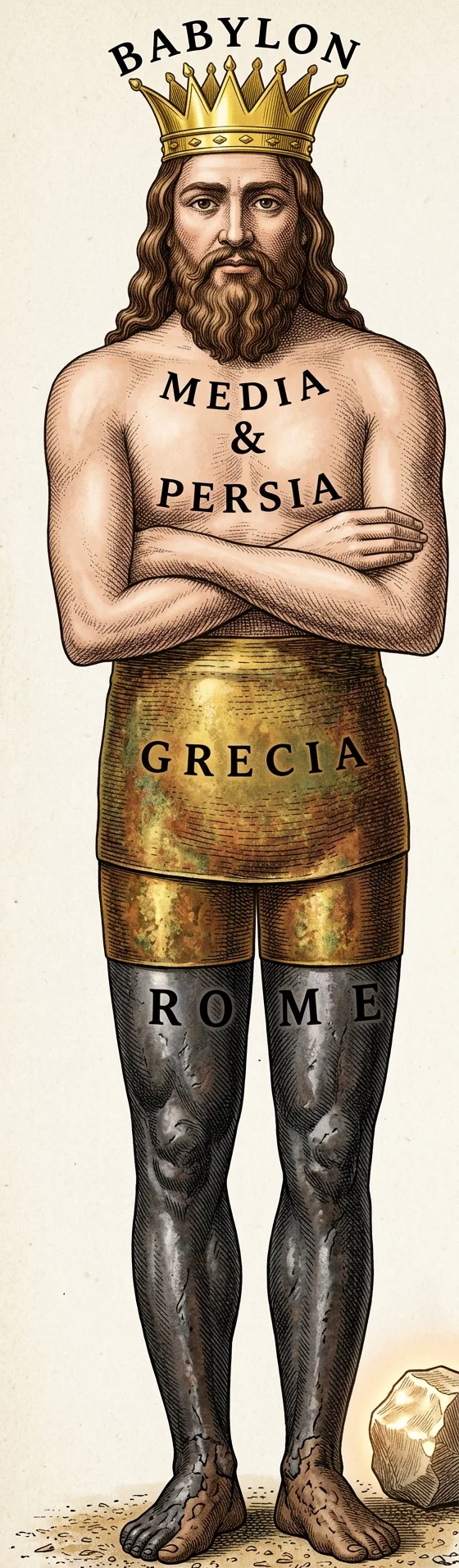
The second chapter of Daniel presents five universal kingdoms, four of them under the symbol of the great metallic image, the several divisions of which are composed of gold, silver, brass, and iron and clay. When these shall be destroyed and entirely removed, the kingdom of the God of Heaven will fill the earth, never to be superseded. We will now call attention to some of the leading features of Dan. 2: 31 and onward, sufficient, however, to show the period when the everlasting kingdom of God shall be set up.
Verses 31–36. “Thou, O king, sawest, and behold, a great image. This great image, whose brightness was excellent, stood before thee, and the form thereof was terrible. This image’s head was of fine gold, his breast and his arms of silver, his belly and his thighs of brass, his legs of iron, his feet part of iron and part of clay. Thou sawest till that a stone was cut out, without hands, which smote the image upon his feet that were of iron and clay, and brake them to pieces; then was the iron, the clay, the brass, the silver, and the gold, broken to pieces together, and became like the chaff of the summer threshing-floors, and the wind carried them away, that no place was found for them; and the stone that smote the image became a great mountain, and filled the whole earth. This is the dream, and we will tell the interpretation thereof before the king.”
We wish here to call attention to the fact that the stone smote the image upon his feet. We shall have occasion to refer to this fact again.
Verses 37, 38: “Thou, O king, art a king of kings; for the God of Heaven hath given thee a kingdom, power, and strength, and glory. And wheresoever the children of men dwell, the beasts of the field and the fowls of the heaven hath he given into thine hand, and hath made thee ruler over them all. Then art thou [or, thy kingdom is] this head of gold.”
Babylon was the first kingdom of universal empire. It was founded by Nimrod, the great grandson of Noah. See Gen. 10: 8–10. It lasted nearly seventeen hundred years, though under different names; sometimes called Babylon, sometimes Assyria, and sometimes Chaldea. It continued from the time of Nimrod, to that of Belshazzar, who was its last king.
Verse 39: (First part:) “And after thee shall arise another kingdom inferior to thee.”
The Medo-Persian kingdom succeeded Babylon. See chap. 5: 28. “Thy kingdom [Babylon] is divided, and given to the Medes and Persians.” The Medo-Persian was the second universal kingdom represented by the breast and arms of silver.
Verse 39: (Last part:) “And another third kingdom of brass, which shall bear rule over all the earth.”
In chap. 8: 5–7, 21, we learn that Grecia conquered the Medo-Persian kingdom, and became a kingdom of universal empire. This took place under Alexander. Here, then, we have the third kingdom, which is represented by the brass of the image.
Verse 40: “And the fourth kingdom shall be strong as iron; forasmuch as iron breaketh in pieces and subdueth all things; and as iron that breaketh all these, shall it break in pieces and bruise.”
The fourth kingdom is generally admitted to be Rome. It is a universal kingdom that is to break in pieces all that went before it. Rome alone answers the description. That did have universal empire. See Luke 2: 1. “And it came to pass in those days, that there went out a decree from Cæsar Augustus, that all the world should be taxed.” Cæsar Augustus was a Roman emperor. Here we have the fourth kingdom, represented by the legs of iron.
Verse 41: (First part:) “And whereas thou sawest the feet and toes, part of potter’s clay and part of iron, the kingdom shall be divided.”
The Western empire of Rome, between the years, A. D. 356 and 483, was divided into ten divisions, or kingdoms: 1. The Huns, in Hungary, A. D. 356; 2. The Ostrogoths, in Mysia, 377; 3. The Visigoths, in Pannonia, 378; 4. The Franks, in France, 407; 5. The Vandals, in Africa, 407; 6. The Sueves and Alans, in Gascoigne and Spain, 407; 7. The Burgundians, in Burgundy, 407; 8. The Heruli and Rugii, in Italy, 476; 9. The Saxons and Angles, in Britain, 476; 10. The Lombards, in Germany, 483. Thus the kingdom was divided, as designated by the ten toes.
Verses 41–43: (Beginning with last part of verse 41:) “But there shall be in it of the strength of the iron, forasmuch as thou sawest the iron mixed with miry clay. And as the toes of the feet were part of iron and part of clay, so the kingdom shall be partly strong and partly broken. And whereas thou sawest iron mixed with miry clay, they shall mingle themselves with the seed of men; but they shall not cleave one to another, even as iron is not mixed with clay.”
This language is descriptive of the state of the kingdoms into which the fourth empire should be broken up. Some of them should be strong as iron, and some feeble as clay. Yet as iron cannot be permanently united to clay, so the stronger kingdoms shall not be able to annex the weaker to themselves in a permanent union. Nor shall the intermarriage of the reigning families succeed in causing these kingdoms to cleave together.
Next come the words of the text which distinctly point to the period of the setting up of God’s imperishable kingdom:
Verse 44: “And in the days of these kings shall the God of Heaven set up a kingdom which shall never be destroyed; and the kingdom shall not be left to other people, but it shall break in pieces and consume all these kingdoms, and it shall stand forever.”
The kings mentioned in the text are most certainly the ten kings, or ten kingdoms of the divided fourth kingdom; for they are the subject of discourse. The phrase, “In the days of these kings,” does not refer to the days of the kingdom of Babylon, of Media and Persia, of Grecia, nor to the days of Rome before it was divided into ten kingdoms, represented by the ten toes of the image. But the phrase does refer to Rome after it had been divided into ten kingdoms. Therefore the kingdom of the God of Heaven was not set up at the time of the first advent of Christ. Neither could it be set up, according to the text, until the Roman kingdom should be divided into the ten kingdoms, which division took place between the years, A. D. 356 and 483.
Before the immortal kingdom can be complete, all earthly kingdoms must be destroyed. Says the prophet: “Thou sawest till that a stone was cut out without hands, which smote the image upon his feet that were of iron and clay, and brake them to pieces. Then was the iron, the clay, the brass, the silver, and the gold, broken to pieces together, and became like the chaff of the summer threshing-floors; and the wind carried them away, that no place was found for them; and the stone that smote the image became a great mountain, and filled the whole earth.” Chap. 2: 34, 35. Mark well the events here stated. The stone breaks the image, and it becomes like the chaff of the summer threshing-floors, and the wind carries it away so that no place is found for it. All earthly kingdoms are first broken, and cease to exist; then, and not till then, does the stone fill the whole earth. The stone did not smite the image on the head, Babylon; nor on the breast, Media and Persia; nor on the sides, Grecia; nor yet on the legs, Rome Pagan. The stonedid smite the image on his feet. But it could not smite the feet before they existed, and they were not in being till several hundred years after the first advent of Jesus Christ. We still wait for the dashing of the image, or the destruction of all earthly governments, before the stone becomes a great mountain and fills the whole earth, or the kingdom of the God of Heaven is fully established in the earth.
We do not hesitate to say that the kingdom of Heaven, or the kingdom of God, was not set up at the period of the first advent, in any sense of these phrases whatever. If it be said that the kingdom of grace was set up by our Lord Jesus Christ at his first advent, then we inquire, Had God no kingdom of grace before that time? If not, then Enoch, Noah, Lot, Abraham, Isaac, Jacob, Moses and the prophets, have perished without hope, for certainly no man can be saved without grace.
The terms, “kingdom of Heaven,” “kingdom of God,” “the kingdom,” and like expressions, do not always refer to the future immortal kingdom. The Scriptures employ the word kingdom to express God’s arrangements relative to his people in two conditions of things: first, his plan to save men by grace through Jesus Christ, which plan reaches back to a time immediately succeeding the fall; and, second, God’s arrangements in the future glory and eternal reward of the saved. We see no good reasons to object to the terms, “kingdom of grace” and “kingdom of glory,” in expressing these two states. It is true that the distinction is not thus expressed in the Scriptures. The Holy Spirit employs the terms, “kingdom of Heaven” and “kingdom of God,” sometimes applicable to the period of God’s grace in the salvation of sinners, and at other times as applicable only to the future condition of the saved. The connections, and plain facts in each case, must decide to which state these terms apply.
If it be urged that the parable of the wheat and tares, Matt. 13: 24–30, 37–43, illustrates the kingdom of grace, because our Lord says that the kingdom of Heaven is likened unto a man that sowed good seed in his field, we see no valid reasons to object, provided our opponents commence the application of the parable in the days of the patriarchs, as early as grace was manifested in the pardon of sin.
The parable of the leaven hid in three measures of meal, till the whole was leavened, must be understood in harmony with other parables. If it be applied to all men, and thus forced to prove the salvation of all men, then it is brought in direct conflict with the parable of the wheat and tares, which proves that the children of the wicked one, and the children of the kingdom, will both remain such till the end of the world. The parable of the leaven well illustrates the work of grace in the hearts of those who love and serve God. If this application be correct, then why may not this parable apply as early as the first manifestations of grace in the hearts of the patriarchs?
And may not the parable of the mustard seed, the least of all seeds, represent the work of grace commenced with the few in the days of Adam and Abel? This seed when grown “becometh a tree, so that the birds of the air came and lodged in the branches thereof,” fitly representing the final results of the grace of God through Jesus Christ, in the salvation of the unnumbered hosts of the redeemed.
And while parables already noticed may have an application as far back as the first manifestations of the grace of God through Jesus Christ to save men, the parable of the ten virgins, Matt. 25: 1–13, evidently applies to a movement among believers just prior to the last judgment. “Then shall the kingdom of heaven be likened unto ten virgins, which took their lamps, and went forth to meet the bridegroom.” The gracious means for the salvation of men were manifested in the great second-advent movement of 1840–1844, to call out a people who should love the appearing of the Lord. And this manifestation of the truth of God, and the work and power of God, is called the kingdom of heaven. And the facts connected with the great movement are likened to an eastern marriage.
It will appear evident that the word kingdom in many cases refers to the future immortal kingdom, and cannot be applied to the means of grace. For example: “Thy kingdom come.” Matt. 6: 9. “Fear not, little flock; for it is your Father’s good pleasure to give you the kingdom.” Luke 12: 32. “Who shall judge the quick and the dead at his appearing and his kingdom?” 2 Tim. 4: 1. “Come, ye blessed of my Father, inherit the kingdom.” Matt. 25: 34. “Till I drink it new in my Father’s kingdom.” Matt. 26: 29. “Heirs of the kingdom which he hath promised.” James 2: 5. “Ye shall see Abraham, and Isaac, and Jacob, and all the prophets, in the kingdom of God.” Luke 13: 28. “Know ye that the kingdom of God is nigh at hand.” Luke 21: 31. “Through much tribulation enter into the kingdom of God.” Acts 14: 22. “Flesh and blood cannot inherit the kingdom of God.” 1 Cor. 15: 50.
It is also evident that in many instances the word kingdom applies to the means of grace, and has no reference to the future kingdom. For instance: In the parables of the mustard seed, Matt. 13: 31, the leaven hid in three measures of meal, verse 33, the treasure hid in a field, verse 44, the pearl of great price, verses 45, 46, the fisher’s net, verse 47, and the ten virgins, Matt. 25: 1–13.
In the parable of the wheat and tares the word kingdom refers both to the means of grace necessary to prepare men for the future life, and to the future kingdom itself. These are so closely related, that in the same connection the word kingdom, occurring several times, may apply to both.
We repeat: In no sense whatever can it properly be said that the kingdom of Heaven was set up at the time of the first advent. That the immortal kingdom was not set up at certain periods spoken of in the New Testament, will appear from the examination of a few passages. It was not set up when our Lord taught his followers to pray, “Thy kingdom come.” It must have been future then. Again, the mother of Zebedee’s children understood it to be future when she desired our Lord to grant that her two sons might sit, “the one on the right hand, and the other on the left, in thy kingdom.” It was still future when our Lord ate the last passover. See Luke 22: 18: “I say unto you, I will not drink of the fruit of the vine until the kingdom of God shall come.”
But did he not set it up before his ascension to Heaven? See Acts 1: 6: “Lord, wilt thou at this time restore again the kingdom to Israel?” It was not yet set up. See 1 Cor. 15: 50: “Now this I say, brethren, that flesh and blood cannot inherit the kingdom of God.” This settles the question that this kingdom is not set up till the saints put on immortality, or not till they enter the immortal state, which Paul tells us, verse 52, is “at the last trump.” The apostle states, 2 Tim. 4: 1, that “the Lord Jesus Christ shall judge the quick and the dead at his appearing and his kingdom.” Again, he tells us, Acts 14: 22, that “we must through much tribulation enter into the kingdom of God.” This address was made to those who were already Christians, and shows that the kingdom of God was still future.
The kingdom is a matter of promise. “Hearken, my beloved brethren, hath not God chosen the poor of this world, rich in faith, and heirs of the kingdom which he hath promised to them that love him?” James 2: 5. It is yet to come. “Fear not, little flock; it is your Father’s good pleasure to give you the kingdom.”
The miniature exhibition of the kingdom of God at the transfiguration, Matt. 16: 27, 28; 17: 1–5, is designed to show the nature of the kingdom, and when it will be set up. “For the Son of Man shall come in the glory of his Father, with his angels; and then he shall reward every man according to his works. Verily I say unto you, There be some standing here, which shall not taste of death till they see the Son of Man coming in his kingdom.” (“Till they see the kingdom of God.” Luke 9: 27.)
This promise was shortly fulfilled on the mount. “And after six days, Jesus taketh Peter, James, and John his brother, and bringeth them up into an high mountain apart, and was transfigured before them; and his face did shine as the sun, and his raiment was white as the light. And behold, there appeared unto them Moses and Elias talking with him. Then answered Peter, and said unto Jesus, Lord, it is good for us to be here; if thou wilt, let us make here three tabernacles; one for thee, and one for Moses, and one for Elias. While he yet spake, behold, a bright cloud overshadowed them; and behold, a voice out of the cloud, which said, This is my beloved Son, in whom I am well pleased; hear ye him.”
1. Jesus Christ appeared there in his own personal glory. His countenance shone like the sun, and his raiment was white as the light. 2. The glory of the Father was there. It was a “bright cloud” of the divine glory, out of which came the Father’s voice. 3. Moses and Elias appeared; the one, the representative of those saints who shall be raised at Christ’s coming, and clothed with glory; the other, Elias, the representative of those who will be alive and be changed at the appearing of Christ. 4. The use the apostles made of the scene. Peter was one of the witnesses; and in view of the importance of the kingdom of Christ, he, in his second epistle, has given the church of all coming ages instruction how they may insure an abundant entrance “into the everlasting kingdom of our Lord Jesus Christ.” “For we have not followed cunningly-devised fables when we made known to you the power and coming of our Lord Jesus Christ, but were eye-witnesses of his majesty.” This he says was “when we were with him in the holy mount.” 2 Pet. 1: 16–18. This scene was a demonstration of Christ’s second, personal, and glorious coming, and shows that the kingdom will be immortal when set up, and that it will be set up at the period of the second advent and resurrection of the just.
But it is urged as an objection to the view here presented, that our Lord said, “The kingdom of God is within you.” But notice the party addressed. “And when he was demanded of the Pharisees when the kingdom of God should come, he answered them and said, The kingdom of God cometh not with observation. [Margin, outward show.] Neither shall they say, Lo here! or, Lo there! for behold the kingdom of God is within you.” [Margin, among you.] Luke 17: 20, 21. Did our Lord mean to say that the kingdom of God was within the Pharisees? Certainly not. He says of them, Matt. 23: 13, “Ye shut up the kingdom of Heaven against men; for ye neither go in yourselves, neither suffer ye them that are entering to go in.”
We have detained the reader much longer on this part of the subject than we first designed. We would now close by briefly calling attention to the great object of the prophecy; namely, to show the period we occupy in the history of perishable governments. Hence, the inquiry, “Watchman, what of the night?” In what period of prophecy are we now? Are we in the kingdom of Babylon, under the “head of gold”? No; that has passed long ago. Are we in the Medo-Persian empire? Long since, that kingdom was numbered with things past. Are we in Grecia? That, too, was numbered and finished more than two thousand years since. Are we in Rome in its undivided state, or in the “legs of iron”? No; long since, that empire fell. Where are we, then? Answer: Down in the feet and toes. Where does the stone strike the image? “Upon his feet.” Where are we now? In the feet. What takes place when the stone smites the image? It is broken to pieces, and becomes like the chaff of the summer threshing-floors, and the wind carries it away, that no place shall be found for it. Then will the everlasting kingdom of God fill the earth, never to be destroyed.