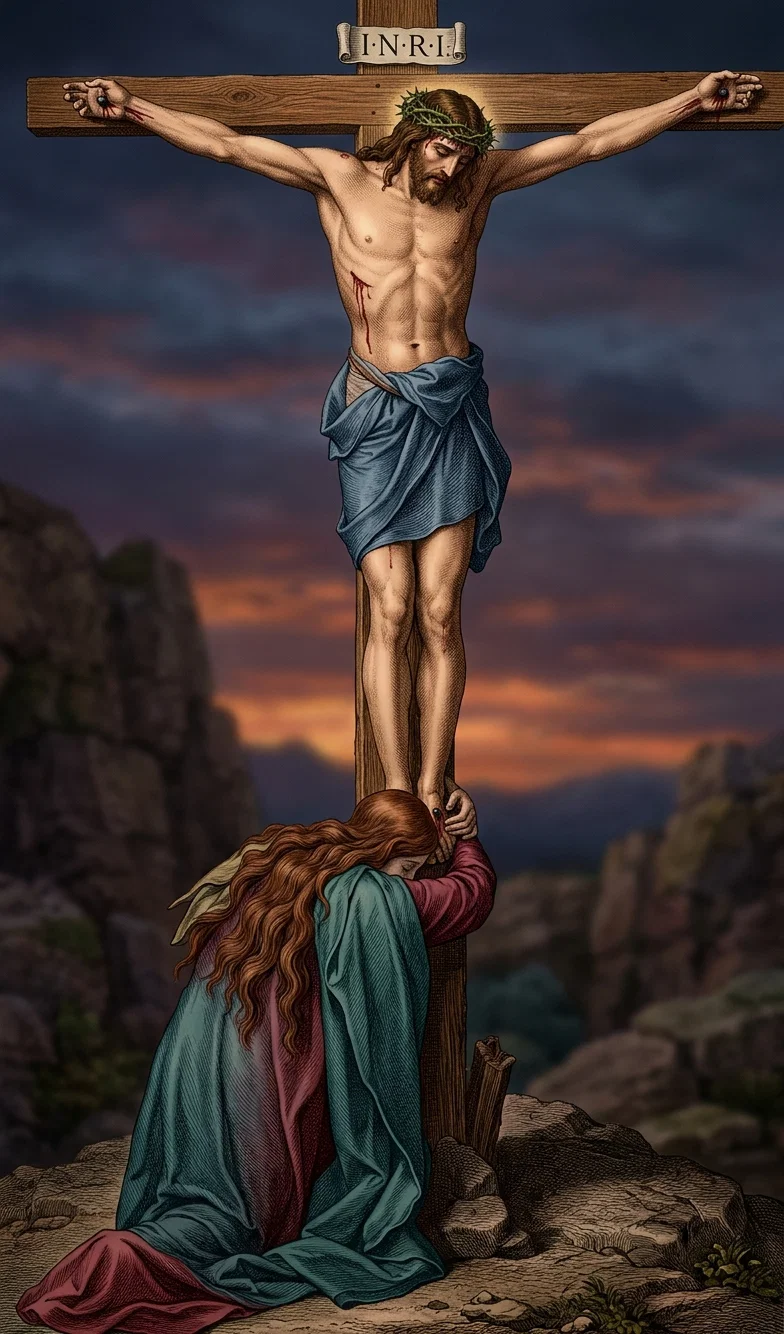
Christ's death on the cross has always been a subject of controversy.
There seems to be a growing tendency to revive an error that never should have had birth. The idea is gaining ground in the minds of a class of religious people that Christ was crucified on Wednesday, the fourth day of the week, and not on Friday, despite the fact that the Bible teaches in simple language that the Saviour died on the sixth day. (Luke 23:52-56.)
One of the chief causes that lead some to reach such an erroneous conclusion is the failure to recognize the difference between the Passover “holydays,” and the Sabbath of the Lord.
THE ORIGINAL PASSOVER
The Passover was given originally to the Israelites, just prior to their liberation from a long servitude in the land of Egypt. See Exodus 12:1-20; 13:3-10.
The Passover sacrifice must be slain before the people left the land of their serfdom; it also must be eaten before they were delivered. Says the scripture: “Thus shall ye eat it; with your loins girded, your shoes on your feet, and your staff in your hand; and ye shall eat it in haste: it is the Lord’s Passover. For I will pass through the land of Egypt this night, and will smite all the first-born in the land of Egypt, both man and beast; and against all the gods of Egypt I will execute judgment: I am the Lord.” Exodus 12:11, 12.
Moreover, the people were exhorted to eat the Passover lamb that very night; they were not permitted to allow any part of it to remain till the morning. (Verses 8-10.)
This instruction clearly states that the first Passover supper was observed before the Israelites were delivered from Egyptian bondage. It is true that the Passover institution was to be a memorial of the deliverance of the Israelites from their Egyptian bondage for future generations; but the first Paschal lamb was killed and eaten before the people departed from the land of Ham.
In the first six verses of this twelfth chapter of Exodus the time is given when the Passover lamb must be taken and slain; from then on till the twenty-seventh verse of this same chapter is further instruction on how the Passover festival should be observed.
The people were commanded to make proper preparation to observe this feast, and a definite time was arranged for this preparatory work.
NO PASSOVER OBSERVED IN DESERT
The year following Israel’s deliverance from Egypt, the Lord commanded Moses to admonish the people to keep the Passover again. (Numbers 9:1-5.) This they did, except that some were found who were defiled, unclean. These were commanded to observe the Passover on the fourteenth day of the second month. Shortly after the observance of the second Passover, the Israelites refused to enter the land of Canaan; then the Lord informed them that they should all die in the wilderness, except Joshua the son of Nun, and Caleb the son of Jephunneh. (Numbers 14:27-30.)
From henceforth, and during the rest of their sojourn in the wilderness, the seed of Abraham kept no Passover. The reason for this is given in Joshua 5:2-9. When the ordinance of circumcision was again performed upon the descendants of the deceased generation, the command was renewed that the people should observe the Passover. (Verse 10.)
SPECIAL HOLYDAYS
In addition to the observance of the Passover, there were given to the Israelites holy, or sacred, days; as for instance: “In the fourteenth day of the first month at even is the Lord’s Passover. And on the fifteenth day of the same month is the Feast of Unleavened Bread unto the Lord: seven days ye must eat unleavened bread. In the first day ye shall have an holy convocation: ye shall do no servile work therein. But ye shall offer an offering made by fire unto the Lord seven days: in the seventh day is an holy convocation: ye shall do no servile work therein.” Leviticus 23:5-8. See also Exodus 12:16; Numbers 28:18, 25.
The first and the last day of the Passover were sacred, holy, days. On these days the people were allowed to do no ordinary, no secular, work. They were permitted to prepare food. (Exodus 12:16.) The same was true of the other feasts of the Lord. See Leviticus 23:23, 24, 31, 35, 36. These holydays, however, were not part of, or identical with, the Sabbath of the Lord, the seventh day of the week. See Leviticus 23:38.
MANY PECULIAR EXPERIENCES
For fifteen centuries the children of Abraham had very peculiar experiences with their observance of these feasts. They were instructed through Moses that these feasts must be observed only in the land that God should choose. (Deuteronomy 16:1-8.) In no other place might the Passover be offered. During the days of their repeated apostasy the people either lost the sacredness of the feasts or the leaders neglected to observe them. There were times when centuries elapsed and the Passover was not observed. The same was true of the other festivals. (2 Chronicles 30:1-5; Nehemiah 8:13-17.)
During the exile in Babylon the Israelites were unable to commemorate these feasts, yet many of the pious people did their best to keep record of those times and seasons.
When Israel was relocated in Palestine, the leaders endeavored to put their house in order, and to again observe the Passover with the other feasts. Some forms of holy service they added; certain customs they omitted. For fear that during their exile they might have lost the accurate counting of the time when the feasts should be observed, the ecclesiastical council originated the following law: “These are the six days on which the Scripture has forbidden the doing of work. The first and seventh day of the Passover; the first and last day of the Feast of Tabernacles; the day of the Feast of Pentecost; and the first day of the seventh month. All these are called holydays. The Sabbatism of all is alike.”—Hilchoth Yom Tov. (A Talmudic volume, entitled “Laws of the Holidays.”)
“But to us who observe two days what is unlawful on the first day is also unlawful on the second day; and he who disregards the latter, is to be excommunicated.”—Orach Chayim. (“The Ways of Life.”)
“Though the second holyday is of the words of the scribes only, everything that is considered unlawful on the first is not permitted on the second. And every one who profanes the second holyday, even though it be the New Year’s, whether it be a matter relating to the Sabbath, or to work, or by going beyond the limit of the Sabbath, he is to be excommunicated, or to be beaten with the flogging of rebellion, provided he be not a Talmudist.”—Hilchoth Yom Tov. (“Laws of the Holidays.”) See “Practical Lessons From the Experience of Israel,” third edition, pages 690, 691.
From the foregoing it is clear that the rabbis added extra days to those given by the command of the Lord. Yet all these sabbatic days were distinct and apart from the Sabbath of the Lord.
THE LAST PASSOVER
When the Saviour was about to observe the last Passover with His disciples, He told them, in answer to their question where they should make ready for the feast: “Go11into the city to such a man, and say unto him, The Master saith, My time is at hand; I will keep the Passover at thy house with My disciples. And the disciples did as Jesus had appointed them; and they made ready the Passover.” Matthew 26:18, 19.
Jesus had already said to His disciples: “Ye know that after two days is the feast of the Passover, and the Son of man is betrayed to be crucified.” Verse 2.
It is evident that the Saviour and the disciples had a clear understanding of when the Passover should begin, and He gave command to make ready for this feast. This preparation, be it remembered, was for the Passover. Jesus made no intimation to His disciples that they should make any preparation for the Sabbath of the Lord.
The reader must not forget that there was a disagreement between the Pharisees and the Sadducees as to the length of time between the Passover and the Feast of Pentecost. The Pharisees expounded the expression, “The morrow after the Sabbath” (Leviticus 23:15, 16) to be the day after the Passover Sabbath, whichever day of the week the Passover Sabbath occurred, whereas the Sadducees claimed that the phrase, “On the morrow after the Sabbath,” meant the first day of the week, the day after the seventh-day Sabbath. The result was that the Sadducees always observed Pentecost on the first day of the week, while the Pharisees observed Pentecost on whatever day it might come after counting forty-nine days from the day the sheaf was waved before the Lord.
However, there is no allusion made of this difference between these two classes in the writings of the New Testament. The disciples, enlightened by the Holy Spirit, considered this discord nonessential to the teaching of the gospel; nor did this dissonance affect the truth of Christianity.
When the disciples were invited by the Saviour to make ready the Last Supper, they were making preparation for the Passover, and not for the seventh-day Sabbath. They sacrificed the Passover; they ate the lamb that evening in harmony with the law of Moses. Jesus fulfilled that law as He fulfilled every other law. (Matthew 5:17, 18; Romans 10:1-4.)
GETHSEMANE AND CALVARY
While Christ is our Passover,—was sacrificed for us,—He ate the Last Supper with the disciples before He died. (1 Corinthians 5:7.) The Paschal lamb was slain, and it was eaten in the evening following. Every part of the type met its fulfillment in Christ, the true Passover. Says an eminent writer: “Christ was standing at the point of transition between two economies and their two great festivals. He, the spotless Lamb of God, was about to present Himself as a sin offering, and He would thus bring to an end the system of types and ceremonies that for four thousand years had pointed to His death. As He ate the Passover with His disciples, He instituted in its place the service that was to be the memorial of His great sacrifice. The national festival of the Jews was to pass away forever. The service which Christ established was to be observed by His followers in all lands and through all ages.”—“The Desire of Ages,” page 652.
Later, the same evening, He entered Gethsemane with His disciples. In this place the sins of a lost world were confessed upon Him. (Isaiah 53:6.) He became the substitute for man. The just took the place of the unjust. The innocent Lamb now had transferred upon Him the transgressions of a guilty race. (Verse 8.) Following these sorrowful hours, He was arrested, denied by the devoted Peter, deserted by His followers and sentenced to scourging and death. These experiences occurred subsequent to the time when Jesus had eaten the Passover with His disciples. The day He was crucified was the day He died.
THE PREPARATION FOR THE SABBATH
After He died, the centurion who stood at the cross was so impressed with what he saw that He proclaimed: “Truly this Man was the Son of God.” Mark 15:39.
Among those who were gathered around the cross were “Mary Magdalene, and Mary the mother of James the Less and of Joses,” and others. (Mark 15:40.) Of these women it is written: “The women also, which came with Him from Galilee, followed after, and beheld the sepulcher, and how His body was laid. And they returned, and prepared spices and ointments; and rested the Sabbath day according to the commandment.” Luke 23:55, 56.
The context of this scripture says: “That day was the preparation, and the Sabbath drew on.” Verse 54.
From the foregoing it is evident that the preparation day here spoken of had nothing to do with the Passover preparation. This day was the day before the Sabbath. But the Sabbath is the seventh day. According to the command of the Saviour, the Passover preparation was made before Jesus ate the Passover. Hence it is clear that the day the Saviour was crucified was the day before the weekly Sabbath,—the sixth day of the week, the day commonly known as Friday, and not the Passover preparation day.
Next week we shall consider the text that troubles so many, which declares that Christ should be, like Jonah, in the heart of the earth “three days and three nights.”