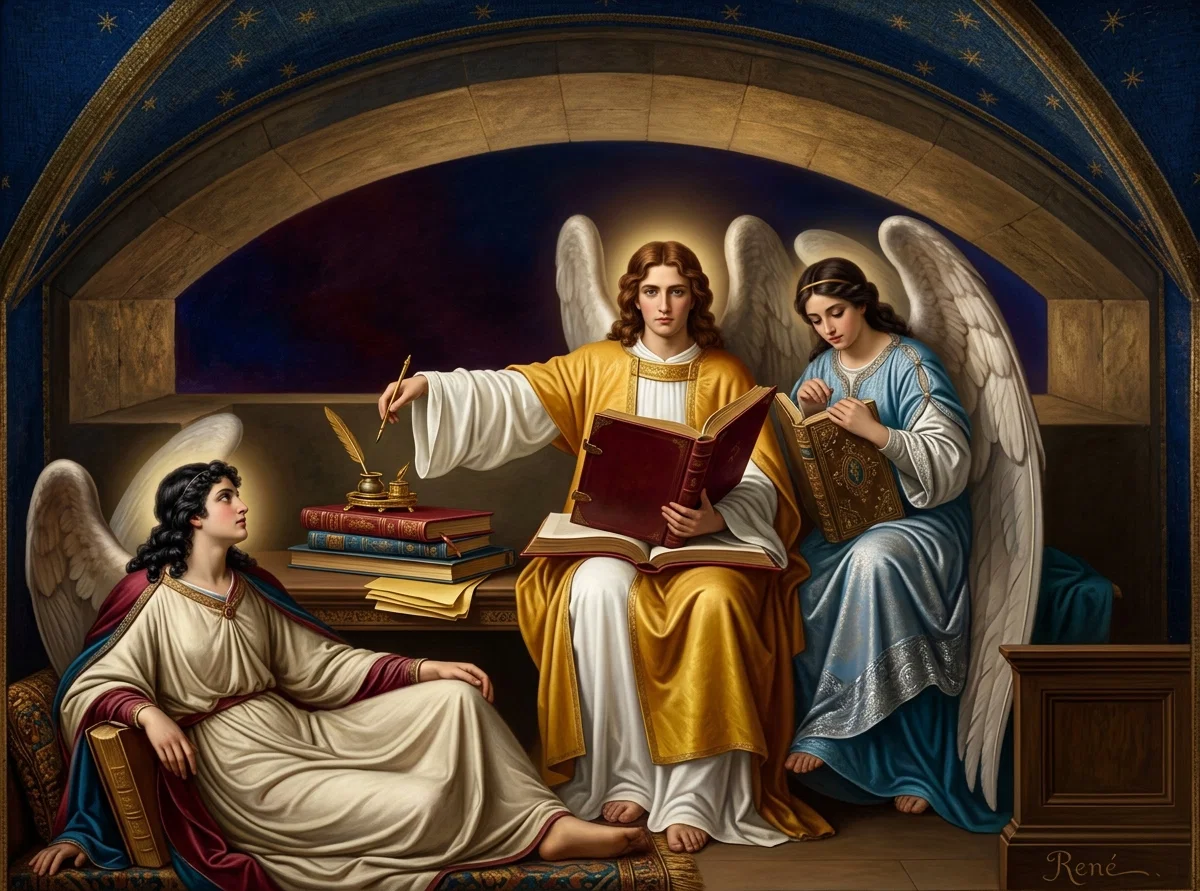
The angels keep an accurate record of every word and action, whether good or bad, and will present that record as evidence in the judgment.
VARNER J. JOHNS
The nations were angry, and Thy wrath is come, and the time of the dead, that they should be judged, and that Thou shouldest give reward unto Thy servants the prophets, and to the saints, and them that fear Thy name, small and great; and shouldest destroy them which destroy the earth. And the temple of God was opened in heaven, and there was seen in His temple the ark of His testament.” Revelation 11:18, 19.
When Jesus comes the second time, His reward is with Him “to give every man according as his work shall be.” The second coming of Christ is a time of awards and punishments. The long-promised inheritance becomes a glorious reality and the crown of immortality a treasured possession in that great day. The destiny of every man is decided for eternity before Jesus comes. The investigative judgment, “the time of the dead, that they should be judged,” must take place before the reward of eternal life can be given to the righteous or the sentence of eternal death be pronounced upon the wicked.
Jesus is coming soon! Great lines of Bible prophecy culminate in this our day and announce with certainty the nearness of the coming of the Christ. And with equal certainty we may know that the heavenly tribunal is now in session, that the records of men are in review before the judgment bar of God, and that the “hour of His judgment is come.” The longest time prophecy of the Bible announces the very year of the beginning of the judgment; and, friends, the hour of God's judgment is come!
TEMPLE OF GOD OPENED
“The temple of God was opened in heaven, and there was seen in His temple the ark of His testament,” is the reading of my text. It is of the sanctuary in the heavens, and of the “holy of holies,” and of the “ark of His testament,” and of the “cleansing of the sanctuary,” and of the day of judgment, that I shall write at this time. In order to visualize the temple in heaven and the ministry of Jesus, our great High Priest, it will be well for us to have a picture of the tabernacle on earth and of its service; for the earthly tabernacle was a miniature of the heavenly temple, and was built according to the pattern of the tabernacle in the heavens.
The tabernacle was a beautiful structure, its framework built of acacia wood overlaid with gold; its covering of fine white linen interwoven with cherubim; its curtains of variegated blue, purple, and crimson; its protective coverings of goats' hair, of sheepskin dyed red, and of badger skin tanned to a light blue; and its articles of furniture reflecting the beauty of finest gold. There were two apartments,—the holy place, with its altar of incense, its table of shewbread, and its golden candlestick, and the most holy place, with its ark of the testament.
The ark was designed primarily for the safe keeping of the tables of the law. The sacredness of the ark was derived from the utmost sacredness of the tables of the testament within. The law of God was the acme of sacredness, the center of sacred things, because it not only gave a testimony of the will of God but also of the character of God. His holiness, His righteousness, His unchangeableness, His all-greatness, were reflected in the law upon which His throne was established. Above the law was the mercy seat, and at either end of the ark, with their wings outstretched over the mercy seat, were the golden cherubim. A bright light, of divine origin, called the Shekinah, or manifest presence of God, rested continually between the cherubim. Here, indeed, was a miniature of the throne of God.
JOHN SAW ARK IN TEMPLE
How significant it is that as John the revelator was given a vision of the temple of God in heaven, he saw within that glorious temple “the ark of His testament”! The original law, of which the Ten Commandments were a transcript, are in heaven above. Dare anyone lay unholy fingers upon that law? Dare anyone minimize its importance, trample underfoot its precepts, ignore its heart-searching message? To attempt to change a jot or a tittle of that law would be an attempt to undermine the foundations of God's throne. I tremble when I think of the judgment, and of that law which is the standard by which men are judged, and of the men who dare to discredit the Ten Commandments.
There were daily ministrations in the court of the tabernacle and in the holy place. There were many offerings, but of the greatest importance was the sin offering. Sin, according to the definition given by Inspiration, is “the transgression of the law.” The broken law demanded the death of the sinner. The broken law demanded the shedding of blood. The guilty sinner brought an innocent animal, confessed his sin upon the head of the offering, and then with his own hand took its life. Some of the blood was then sprinkled by the priest before the broken law. This could not take away sin, but was a manifestation of the sinner’s faith in the coming Redeemer,—Jesus, the Lamb of God.
In this way the sins of the entire encampment accumulated day by day in the sanctuary, being brought in by the blood of the animals that died for their remission. The sins were cleansed from the sanctuary on the tenth day of the seventh month. This was known as the day of atonement. It was a day of affliction of soul, of seeking God in prayer, of confessing of sin. Two goats were brought to the gate of the court, lots were cast upon them, one being chosen for the Lord's goat, the other as the scapegoat. Upon the Lord's goat the high priest laid all the sins that had been accumulating during the year. The blood was then taken and brought in directly before the law in the most holy place and there sprinkled for the remission of all the sins that had been confessed and brought into the sanctuary. Then, bearing the sins of all the people in his own body, and having made an atonement for them, the high priest came out and laid them upon the scapegoat. The scapegoat was led into the wilderness and left there to die; thus the sins of the encampment were separated forever from the people of God.
DAY OF ATONEMENT
The day of atonement was the annual atonement, or covering of sin. The blood was sprinkled in front of the golden cover. The assurance that their sins were covered meant everything to the people of God. At this service the sin was canceled, or blotted out. “Blessed is he,” says the Bible, “whose sin is covered.” Some people seek to cover theirPage Fiveown sins but find out in the end that nothing is hidden from the all-seeing eye of God. Our heavenly Father wants us to confess our sins and forsake them, and He, in His infinite love, has promised to cover them and remember them no more. I have before me a quotation from a Denver paper that shows how, even to-day, the day of atonement is regarded as a day of judgment.
'Jews of Denver cast off their sins in ceremonies of Hebrew New Year. Denver Jewry is celebrating the Hebrew New Year; and Monday, Tashlach, 'the throwing off of sins,' occupied the day in the Jewish sections of the city. . . . The Jewish New Year is known as the day of memorial, or the day of judgment, whereon the pious Jew confesses his sins.'
The new covenant has a sanctuary as well as the old. It is the tabernacle in heaven. The new covenant has a sacrifice for sin,—the Lamb of God, slain 'once for all' on Calvary's cross. The new covenant has a priesthood as well as the old, Jesus being our great high priest, who ministers in our behalf before the throne. The new covenant has a cleansing of the sanctuary as well as the old,—the time of investigative judgment when the sins of men are blotted out from the books of record or their names are blotted out from the book of life.
The entire book of Hebrews pictures for us the importance of the service of the heavenly sanctuary. The first two verses of the eighth chapter summarize the message of the entire book. 'Now of the things which we have spoken this is the sum: We have such an High Priest, who is set on the right hand of the throne of the Majesty in the heavens; a minister of the sanctuary, and of the true tabernacle, which the Lord pitched, and not man.'
Our interest is centered, not so much in the earthly tabernacle as in the heavenly tabernacle, not so much in the ministry of the priests of Israel as in our great High Priest. Jesus is our advocate, our representative, before the throne of God. When the Son of God took upon Himself human flesh, He forever identified Himself with the human family. And the beautiful thought in the temple service is that Jesus is not only the 'Lamb of God,' the sacrificial lamb, but He is also our minister, the great High Priest.
HEAVENLY SANCTUARY CLEANSED
It was necessary that the pattern of things in the heavens, the great original tabernacle, should have its 'cleansing' service, its day of judgment. And the very time of the beginning of this great work was foretold in the prophecy of the book of Daniel, chapter 8, verse 14. 'He said unto me, Unto two thousand and three hundred days; then shall the sanctuary be cleansed.' The prophetic days of the ninth chapter, which locate so definitely the coming of the Messiah in A. D. 27, His crucifixion in A. D. 31, and the beginning of the time of the Gentiles in A. D. 34, began in 457 B. C. These 'days,' it is said, were 'determined,' or 'cut off,' from the longer period of 2300 'days' of chapter 8. The date 457 B. C. marks the beginning, therefore, of the two thousand and three hundred days, the longest time prophecy of the Bible. It is not much of a mathematical problem to add 2300 to the historical date 457 B. C. and to find the year A. D. 1844, which marks the beginning of the 'cleansing' of the heavenly sanctuary, or the beginning of the investigative judgment.
In this year the proclamation of the threefold fold message of Revelation chapter 14 was begun. This is the message that goes to 'every nation, and kindred, and tongue, and people,' and prepares the world for the coming of Jesus. Its result is the gathering together of a people of whom it is said, 'Here is the patience of the saints: here are they that keep the commandments of God, and the faith of Jesus.' The grand finale in theSixproclamation of this message is the appearance of a “white cloud” in the heavens, a cloud of shining angels, and “upon the cloud” one who is called the “Son of man.” It is indeed significant that when the year 1844 came men of God carried forward the soul-stirring message of Revelation 14:7, “The hour of His judgment is come.” That message has swelled into a “loud cry.” Into all the world, in 384 of the tongues of earth, the great threefold message has been proclaimed. When the work is finished, when the warning has been given, when the truth has been proclaimed, Jesus will come to redeem His commandment-keeping people.
Before Jesus comes the second time, He will lay aside His priestly robes; He will leave the heavenly sanctuary; and He will come as a king in His glory. As He leaves the sacred place, the decree will go forth, “He that is unjust, let him be unjust still: . . . and he that is holy, let him be holy still.” The judgment work will have been completed, and the destiny of men settled for eternity. As the typical cleansing of the earthly sanctuary was accomplished by the removal of the sins by which it had been polluted, so the actual cleansing of the heavenly sanctuary is accomplished by the removal, or blotting out, of the sins there recorded. How important it is that we should “hold the beginning of our confidence steadfast unto the end”! Either our sins will be removed from the books of record or our names will be removed from the book of life. Let us so live and so relate ourselves to Jesus and to His word that our “sins may be blotted out, when the times of refreshing shall come from the presence of the Lord.” Then when Jesus comes, we shall welcome Him with joy and be prepared to live with Him eternally.