Bible study had its beginning in the reading of the “book of the law of Moses.” The importance of the study of God’s word was recognized in the earliest instructions given to His chosen people. It was required of the king who might be set over Israel in the land of their inheritance, that he make a copy of the precepts God had given His people, and give diligent heed to their requirements. “And it shall be, when he sitteth upon the throne of his kingdom, that he shall write him a copy of this law in a book out of that which is before the priests, the Levites. And it shall be with him, and he shall read therein all the days of his life: that he may learn to fear the Lord his God, to keep all the words of this law and these statutes, to do them . . . to the end that he may prolong his days in his kingdom, he, and his children, in the midst of Israel.” Deut. 17:18–20.
It is generally believed that the earliest compilation of the sacred writings, comprising the first five books of the Old Testament, was made by Ezra the scribe. A later compilation, enlarging the first by the addition of the “books of the prophets,” is believed to have been made by Nehemiah. Other portions of the Old Testament were compiled at a later date. In the Old Testament writings, however, no importance is attached to the question of authorship. All Hebrew history is anonymous; but in all of it there is revealed the signature of its real Author, the God of Israel.
The word of God was given to His people through the prophets as a word to be preserved and held in constant remembrance. Upon the occasion of important assemblies it was to be brought forth, and read in the hearing of all the people. Moses gave direction to the sons of Levi, that every seven years, at the feast of tabernacles, when all Israel were “come to appear before the Lord thy God in the place which He shall choose,” the priest should “read this law before all Israel in their hearing.” Deut. 31:10–12. Under the leadership of Joshua, the word of the Lord was rehearsed to all the people upon Mount Ebal and Mount Gerizim, as they were about to enter the land of Canaan. Joshua 8:33, 34. When the people gave heed to these instructions, they prospered; but when God’s word was neglected, they became involved in difficulties and disaster. At such times a reformation was inaugurated by bringing out the divine word from its place of obscurity, and rehearsing it in the ears of the rulers and throughout the land. Thus, for example, we read that in the reign of King Josiah, after Israel had apostatized from God through the wickedness of preceding sovereigns, the book of the law was found by Hilkiah the high priest, in the house of the Lord, where it had long remained forgotten, and was delivered to Shaphan the scribe, who brought it in and read it before the king. “And it came to pass, when the king had heard the words of the book of the law, that he rent his clothes, and the king commanded Hilkiah the priest, and Ahikam the son of Shaphan, and Achbor the son of Michaiah, and Shaphan the scribe, and Asahiah a servant of the king’s, saying, Go ye, inquire of the Lord for me, and for the people, and for all Judah, concerning the words of this book that is found; for great is the wrath of the Lord that is kindled against us, because our fathers have not hearkened unto the words of this book, to do according unto all that which is written concerning us.” Then, after an answer had been returned from the Lord, “the king went up into the house of the Lord, and all the men of Judah and all the inhabitants of Jerusalem with him, and the priests, and the prophets, and all the people, both small and great: and he read in their ears all the words of the book of the covenant which was found in the house of the Lord.” So the king and the people made a covenant to perform all the words that were written in the book, and a great reformation was wrought in Israel.
The material upon which these early writings were inscribed is believed to have been the prepared skins of certain animals, such as sheep or179goats. These skins, when written upon, were formed into rolls, which were rolled upon one or two sticks, and fastened with a thread, the ends of which were sealed. The rolls were generally written on one side only, and the writing was divided into columns. The lettering was done with a reed, dipped in ink made of lampblack dissolved in gall juice. Besides these rolls of skins, which were used when the durability of the writing was essential, tablets of wood covered with wax were employed on more common occasions, a pointed style being used to form the characters. Another material which came into use was papyrus paper, made from the papyrus reed, which grew in Egypt and in some parts of Palestine. The original manuscripts of the New Testament were written on papyrus. This material was quite fragile, and manuscripts of this kind did not long endure the wear of ordinary usage. For this reason all the original New Testament manuscripts perished at an early date, and only copies of the original were accessible to those who began the compilation of the books into their modern form.
The Bible of the early Christian Church was the volume of “the law and the prophets.” These writings were known to the early disciples as “the Holy Scriptures,” which were able to make one “wise unto salvation through faith which is in Christ Jesus.” 2 Tim. 3:15. At that time the Old Testament writings had been translated into Greek, and compiled into a volume now called the Septuagint. When the Jews had been brought under the dominance of Greece, they gradually lost command of their ancient Hebrew tongue, and a translation of their sacred books into the Greek was necessary to make them intelligible to both Jews and Gentiles of later times. The Septuagint translation was begun in the third century B. C., at Alexandria, Egypt, which had become a center of Jewish population. The work was done by various learned men, by some supposed to have been seventy in number, whence came the name, Septuagint. It is quite clear, however, that the work was not accomplished by one set of men, or at one time, the date of its completion being about the middle of the second century B. C. The Septuagint was long held in much esteem as of very high authority, and exercised a great influence upon both Jewish and Christian thought.
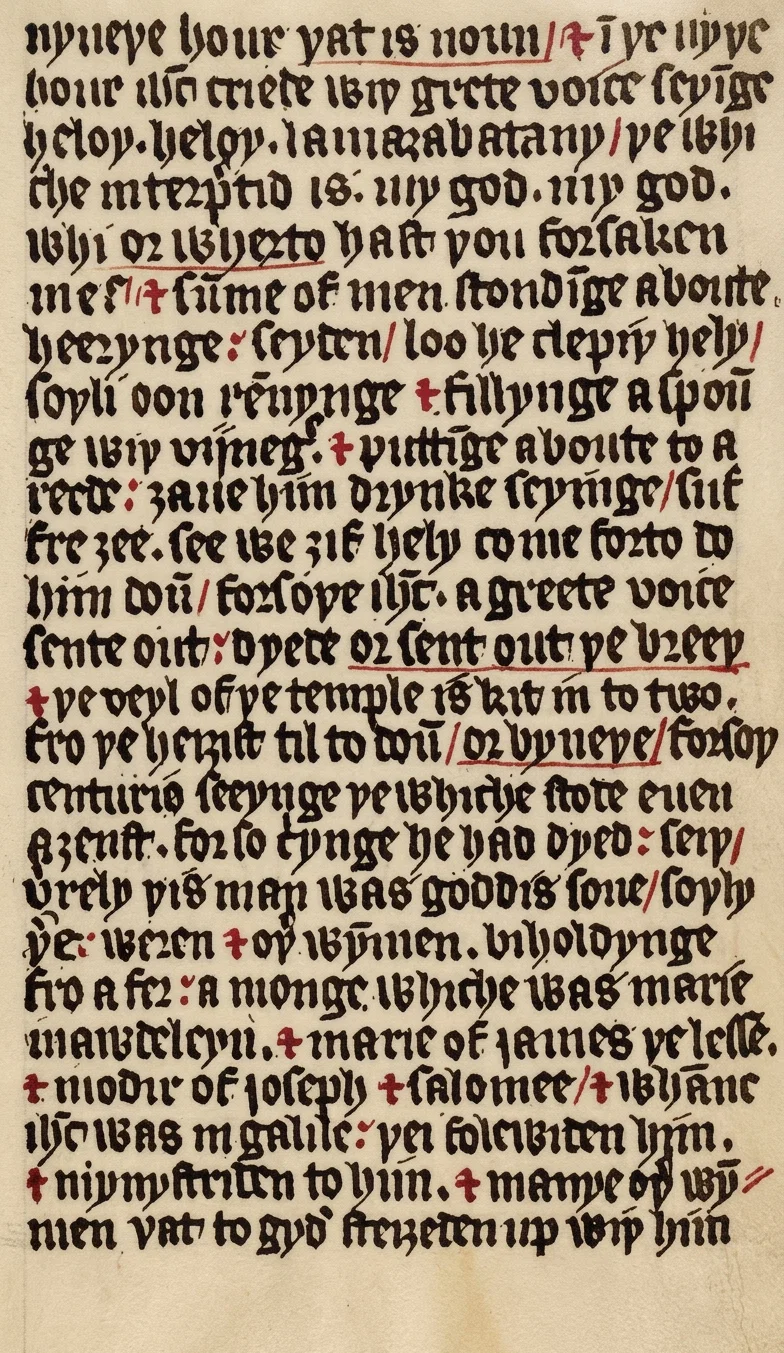
AN EXTRACT FROM WYCLIF'S BIBLE
(Mark 15: 33–41) Late Fourteenth Century
No authoritative collection of the New Testament books was undertaken before the latter half of the second century A. D. A great mass of spurious and apocryphal literature was at that time in circulation, but the men upon whom devolved the task of separating the genuine, or canonical, books, appear to have accomplished it without any serious dispute. No existing New Testament manuscript, however, can be traced further back than the fourth century. The oldest of such manuscripts is thought to be that in the Vatican at Rome, known as the Codex Vaticanus. The earliest division of the New Testament into verses is believed to have been made by Euthalius, deacon of Alexandria, in A. D. 462. He arranged into lines those words that were related to one another by the sense; and subsequently, to save space, these divisions were marked by a colon or point. Out of this grew a complete system of punctuation. The division of the Bible into chapters was not made until the thirteenth century.
Translations of the New Testament
The earliest complete translation of the New Testament was made in 1170, under the direction of Peter Waldo, a distinguished citizen of Lyons, France, and founder of the Waldenses. This translation was in a Provençal dialect, for which reason it never became popular. Still it was an important work, which did much to stimulate a desire for Biblical knowledge, and also to expose the errors of the Church of Rome. Many felt constrained to order their lives by their new-found knowledge of God’s word rather than by the directions of the priests, and to preach the word to those who had it not. It was thus that the missionary tours of the Waldenses had their beginning. This translation was followed in the thirteenth century by several others, the most important being that made under Louis the Pious, in 1227, the Spanish version under Alfonso V, the Bohemian version made by John Huss, and the English version prepared by Wyclif. The invention of the art of printing, in the fifteenth century, gave a great impetus to the circulation of the Scriptures, which were soon published in Bohemian (1448), Italian (1471), French (1477), Dutch (1477), Spanish (1478), and in German, no less than seventeen German translations being published between 1477 and 1518.
Luther’s translation of the New Testament, prepared at the famous Wartburg, appeared in 1522, and twelve years later his translation of the Old Testament was completed. Luther’s translation at once became popular with the common people, and was circulated with wonderful rapidity throughout Germany. We are informed that in the course of forty years a single bookseller of Wittenberg sold one hundred thousand copies, a surprising number considering the price of books in the sixteenth century. Numerous Dutch and Swedish translations were based upon the work of Luther.
England was behind Germany in the work of giving the Bible to the common people. Wyclif’s translation, which was taken from the Vulgate, or Latin Bible, appeared in the latter part of the fourteenth century, but it was not until the sixteenth century that any further translations were undertaken. In 1505 appeared a translation of the “seven penitential psalms.” But about this time the providence of God raised up William Tyndale, who vowed that “if God would spare his life, ere many years he would cause the boy who drive th the plow to know more of the Scriptures than did all the priests.” His translation of the New Testament appeared about the year 1526. It had been prepared and printed on the continent of Europe; and when the volumes appeared in England, they were bought up and burned. This, however, only stimulated the reformer to new exertions. A translation of the Old Testament out of the original Hebrew was undertaken by him soon afterward. In our present King James version a large portion of the New Testament is taken verbatim from the translation made by Tyndale.
The First English Bibles
The first complete English Bible was published by a friend of Tyndale, Miles Coverdale. It is dated 1535, and dedicated to Henry VIII. The next English Bible was a revision of Tyndale’s version by his friend, John Rogers. This was finished in 1537, and soon superseded Coverdale’s. Two years later appeared a large volume for use in churches, to which Archbishop Cranmer had written a preface.
In 1557 the “Geneva Bible” was prepared at Geneva by English reformers who had fled from the persecution of “Bloody Mary.” This was the first Bible printed in Roman letters and divided into verses. In 1582 several English Catholic exiles prepared a version of the New Testament at Rheims, in France, and some years later a translation of the Old Testament at Douay. From this we have the180name “Douay Bible,” which is the standard version of English Roman Catholics. It is taken from the Latin Vulgate.
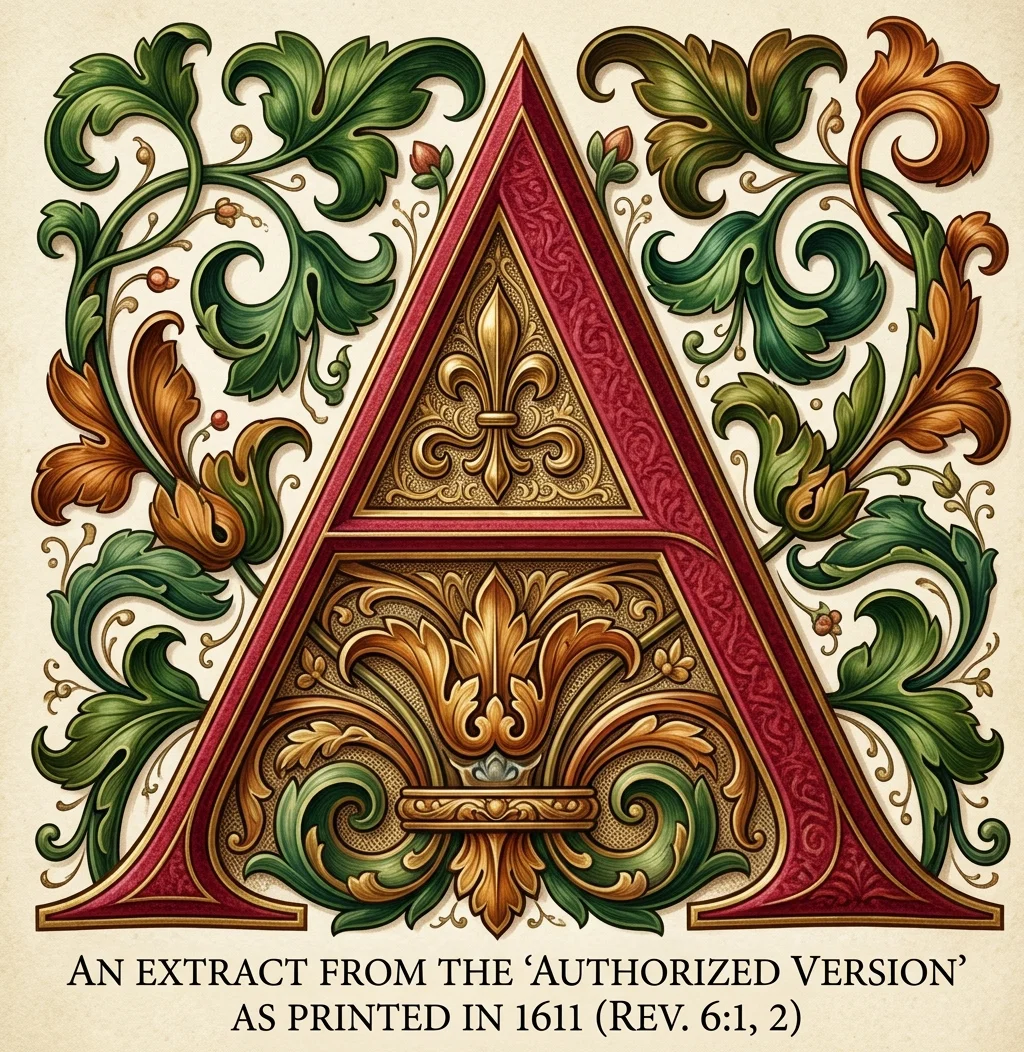
The present English authorized, or King James, version took its origin from a suggestion made by an eminent Puritan at the Hampton court conference in 1604. He felt that a new translation was a great national want, and his suggestion that one be prepared was favorably received by King James, who appointed fifty-four scholars to undertake the work. Of this number forty-seven met and entered upon the translation. They were divided into six companies, some assembling at Westminster, some at Cambridge, and some at Oxford. Portions of the Bible were assigned to each company, and when one portion was finished, it was sent to the other companies for examination and criticism. The whole work was revised in London by two delegates from each of the six companies. The work of translation and revision occupied from 1607 to 1610. This version quickly gained the foremost place as being superior to all other English versions, and in forty years’ time from its publication all others had disappeared from common use. This version has remained ever since, and is to-day the common English Bible, notwithstanding the revised English version completed in 1885.
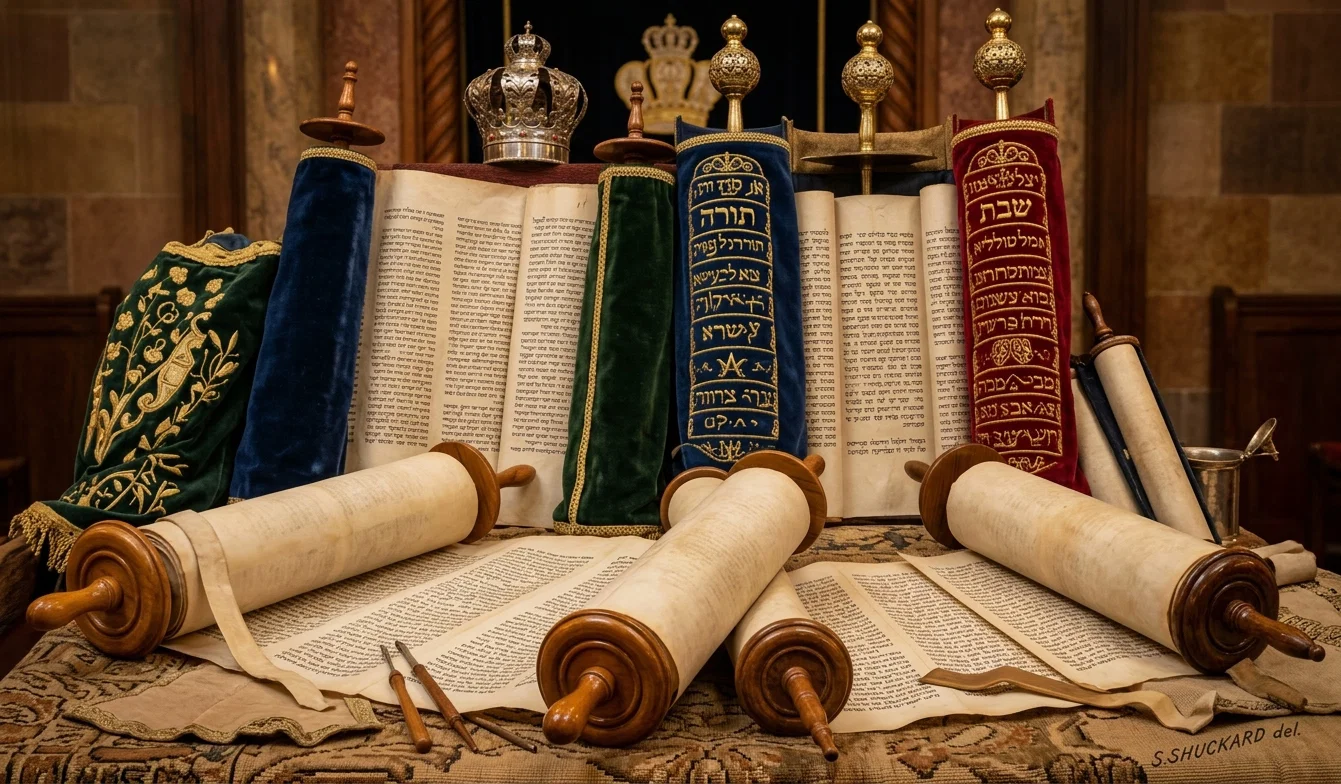
THE ROLLS OF THE LAW AS READ IN THE SYNAGOGUE WORSHIP
The almost universal diffusion of the Scriptures into the languages and dialects of the earth at the present time, represents the work of special Protestant organizations called Bible societies. In this great work England has led. The first English Bible society was formed in 1780, having for its purpose the distribution of Bibles among soldiers and sailors. It is still in existence, and is known as the Naval and Military Bible Society. In 1792 an association was formed in London to promote Bible distribution among the French. In 1802 the first steps were taken in the formation of the British and Foreign Bible Society, which is the parent of a multitude of like organizations now in the field. To-day between five thousand and six thousand branch and auxiliary societies are at work in Great Britain and her colonies. About one hundred and ninety translations of the whole or portions of the Bible, prepared mostly by missionaries, have been printed at the expense of this society. Its annual issue of Bibles is about three million. Next to the British and Foreign Bible Society in the magnitude of its operations is the American Bible Society, founded in New York in 1816. This association has about seven thousand auxiliary societies, in all parts of the United States. It issues annually one million or more Bibles, New Testaments, and other portions of the Scriptures. Numerous Bible societies also exist in Germany, and there are some Protestant societies in Russia; but the Greek Church, like the Roman Catholic, does not favor the circulation of the Bible among the people.
Thus has the providence of God prepared the way for the knowledge of His will and the revelation of His coming and kingdom to go to every nation, kindred, tongue, and people on the earth, in these last days.
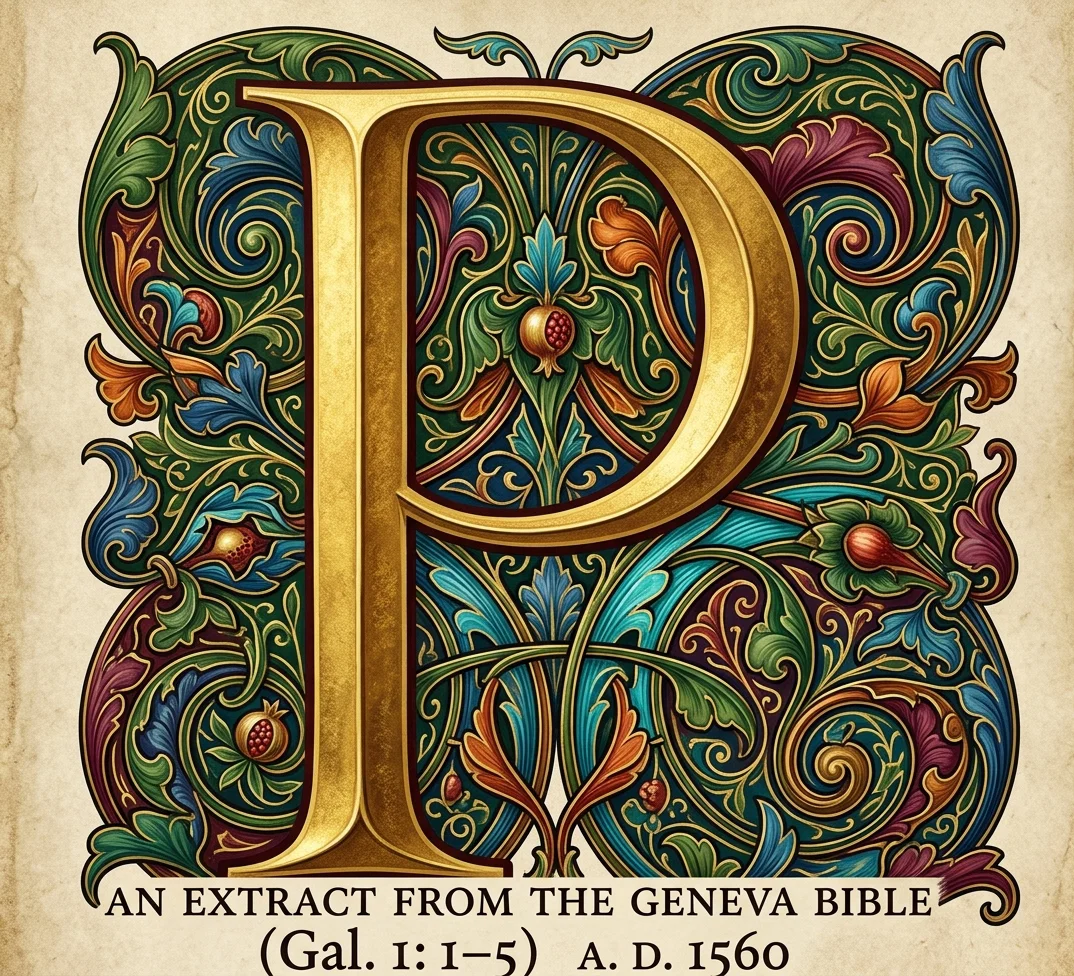
AN EXTRACT FROM THE GENEV A BIBLE
(Gal. 1:1–5) A. D. 1560