Not counting Australia and Greenland, Sumatra ranks fourth in size of all the islands in the world, and contains 167,480 square miles, which is more than thirteen times the size of Holland, and is next to Java in importance among the Dutch possessions in the East Indies. It is twice as large as the state of Minnesota, and about the size of the states of Washington and Oregon together. Although four times the size of Java, it has less than one tenth the population, or 4,029,505 (1905).
A Great Future
It is claimed that Sumatra, “whose soil and subsoil hold their own easily with those of Java in the matter of mineral and agricultural wealth, is only now beginning to attract the attention of the Dutch,” and “might easily contain and support some seventy-five million human beings;” but while “Java is a country of magnificent realization, Sumatra has only a great future.”
Ludovico Di Varthema is said to have been the first European to discover the coast of Sumatra (1505), though it had been known to the Hindus and the Arabs, who brought their beliefs and civilizations there long before. The Portuguese followed in 1509, and the Dutch landed on the coast of Achin in 1599. “Here Cornelius Houtman, one of those who ‘discovered’ for Holland the route to the Indies, was killed by the Achinese (1599), who began, over the body of the representative of the power of Holland in the East, their interminable struggle against that power.” Having expelled the Portuguese, the Dutch struggled throughout the eighteenth century against the rivalry of England. In 1824, by the treaty of London, England abandoned all claims to Billiton and the whole of Sumatra, in return for all the remaining Dutch possessions in the Indian coast and the Malay peninsula, with the island of Singapore.
Volcanoes and Timbers
Ninety volcanoes, a few of which are still active, have been discovered in Sumatra, though it has not yet been fully explored. These are scattered amidst a series of mountainous groups which run the whole length of the island. While on a recent tour through Sumatra, the writer visited a number of hot springs, which were formerly worshiped by the natives. Much of the interior is a high table-land, or series of table-lands, two thousand to four thousand feet above sea level. In these parts, the climate is cool and pleasant the whole year round.
Sumatra has a larger variety of timbers than any other of the East India group, and produces gums and resins of great commercial value. Tobacco is the chief export.
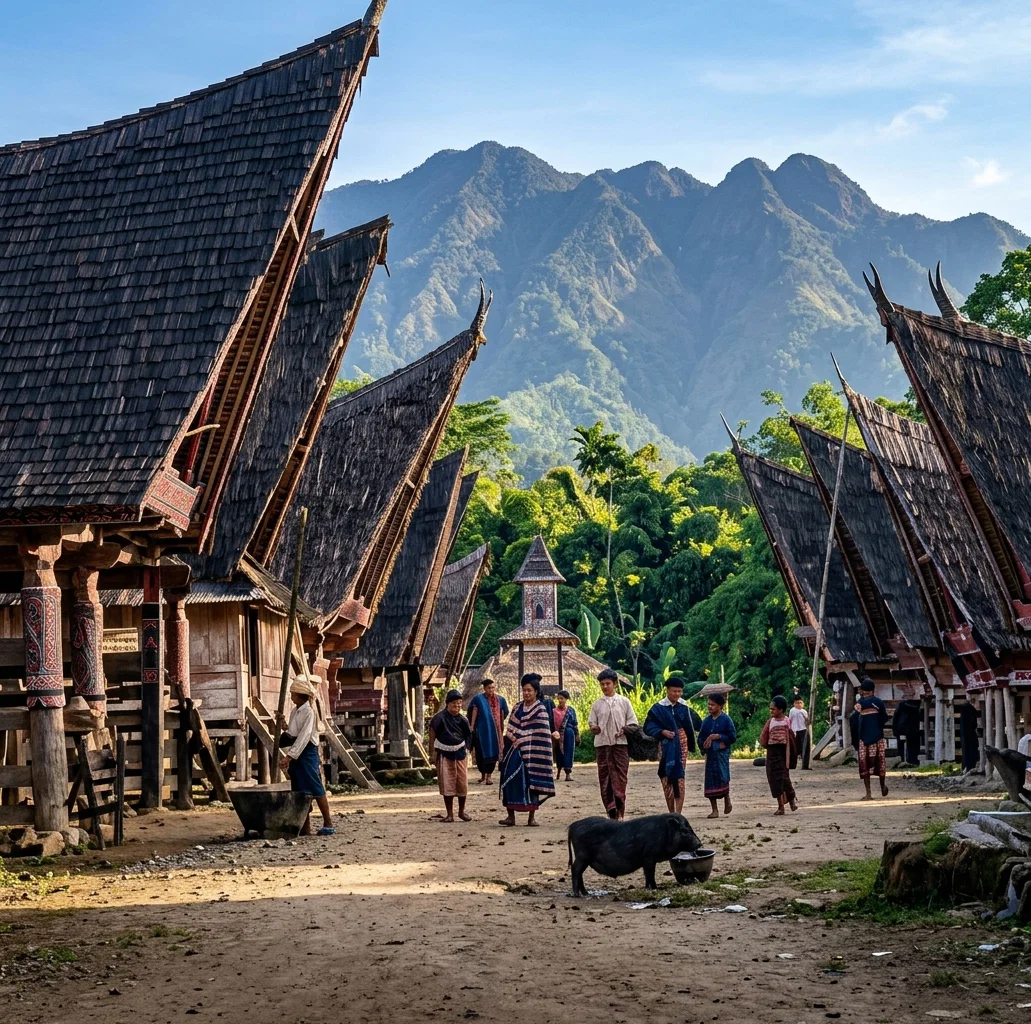
NATIVE HOUSES IN BATTAK-LAND
Other products are gold, silver, petroleum, etc. Among the wild animals there are elephants, rhinoceroses, tigers, panthers, tapirs, and a few orang-utans.
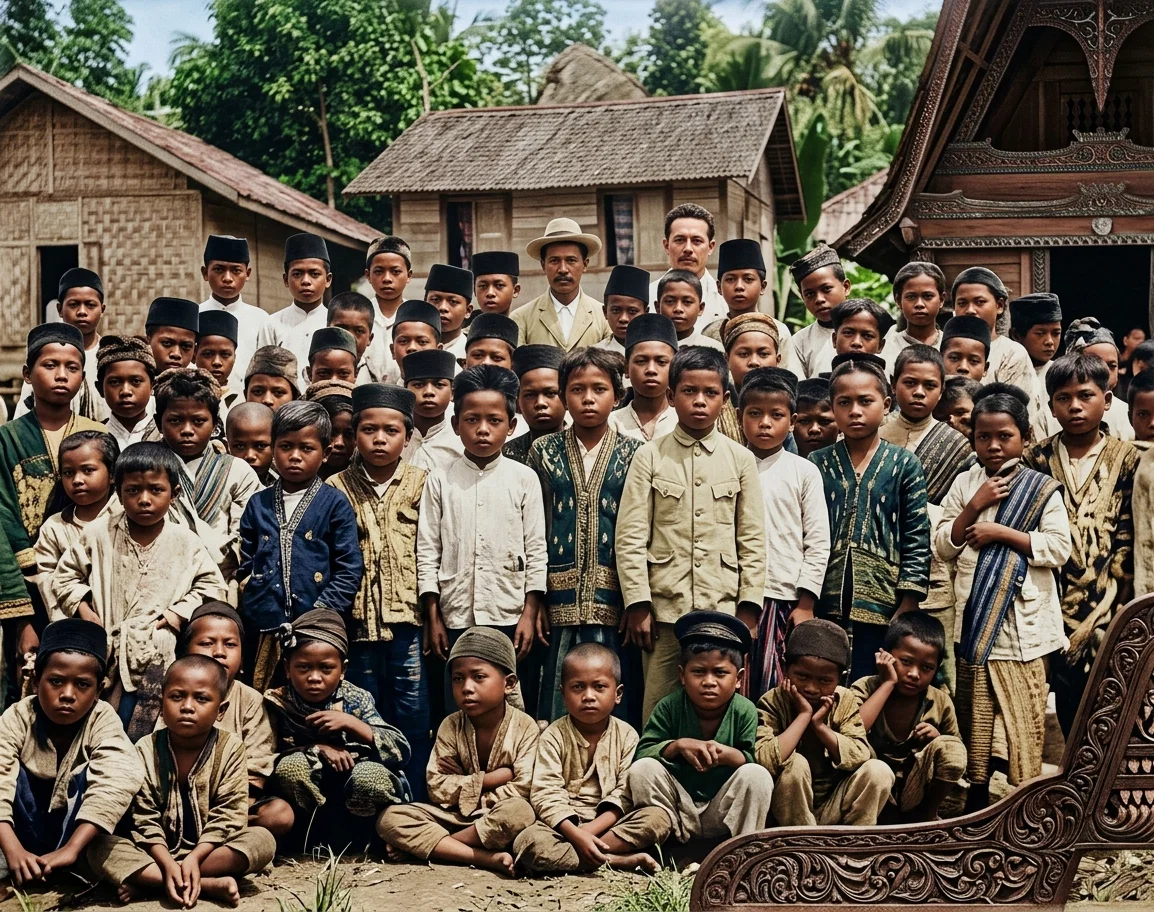
The inhabitants are principally Malays, Battaks, and Achinese. In the coast towns may be found many Chinese, Tamils, Bengalis, Arabs, and mixed races. They are more open to education and civilization than are the natives of the interior, whose condition is still extremely rudimentary.
The Battaks inhabit the residency of Tapanoeli, and are divided into a number of classes, some of whom are Mohammedans, while others have embraced the Christian religion. Our knowledge of the Battaks dates from 1867-1883.
Eat Their Ancestors
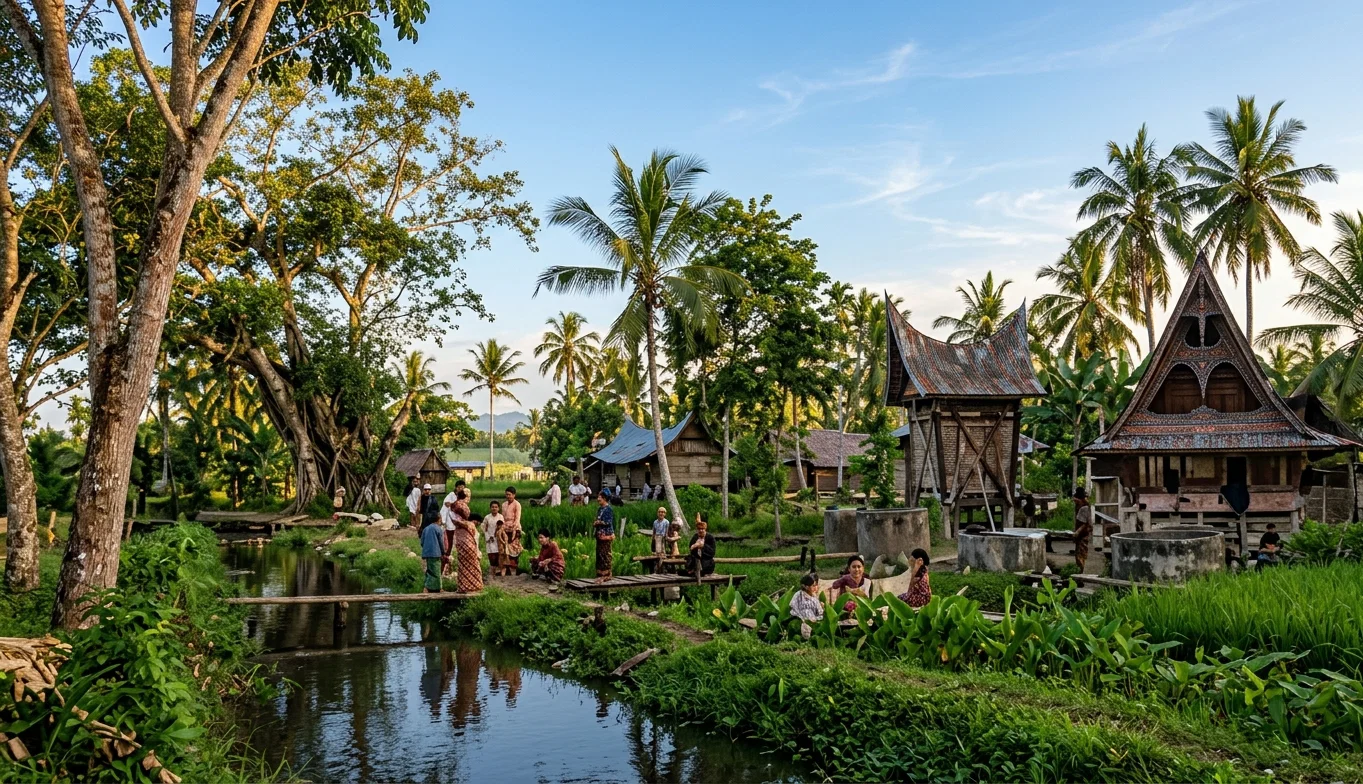
MALAY VILLAGE IN SUMATRA
They have a terrible reputation for cannibalism. It is claimed that they ate their aged relatives, in order to give them a pious sepulcher in their stomachs. At the season when the lemons were ripe, the aged one would climb a tree, and the family would gather and dance below, singing, “Where the fruit is ripe, it falls from the tree.” The victim would then let himself drop from the tree, when he was knocked in the head and killed and eaten. It is said that those savages would have objected to any other form of death; for they hoped to obtain immortality by becoming a very part of those who consumed them. “Consumption by the family . . . might well be accompanied by a conception of immortality. The old, helpless man, with the joys of life failing him, would find a certain attraction in the idea that his body would become part of the strong brown bodies around him. He might even have a dim conception that he would be partly conscious in each of his sepultures.”
Thus the archdeceiver would lead these poor souls far from the Bible teaching that “the dead know not anything.” Eccl. 9: 5. He would hide from their minds the lovely Jesus, who “hath brought life and immortality to light through the gospel.” 2 Tim. 1: 10.
The work of educating and Christianizing these poor people has been going on now for some fifty years, and many of them are intelligently responding to the influence of the gospel.
Our work in Sumatra was started in 1899, at Padang. We now have a church organized there, and a good school in operation. A home has recently been erected for our missionary, together with a comfortable little schoolhouse. Some have become tired of waiting for us to enter their land with the message of Christ’s soon return, and have sold their possessions, and come to Singapore to attend our school.
Multitudes of needy souls surrounded us as we passed through the land, and begged us to come and teach them the Bible and the common branches of education. But for lack of men and means, we are still unable to answer the majority of these earnest pleas for help.
Peter and the Keys
Christ gave no more power or authority to Peter than to the other apostles. The Saviour’s words, “I will give unto thee the keys of the kingdom of heaven,” were not addressed to Peter any more than to the church militant. The keys are the word of God. They are given to the church to be used as directed by Christ. The directions are recorded in the eighteenth chapter of Matthew. If a brother trespasses against his brother, and after being properly approached, refuses to be reconciled, the case is to come before the entire church. “If he neglect to hear the church, let him be unto thee as an heathen man and a publican.”
In other words, let him be expelled from the church. Such a course will be sanctioned in heaven; for we read, “Whatsoever ye [the church] shall bind on earth shall be bound in heaven: and whatsoever ye shall loose on earth shall be loosed in heaven.” Matt. 18: 15-19; 16: 19. If the offender never becomes reconciled, this divine rule, if properly followed, excludes him from heaven.
When the question of circumcision was under consideration in Jerusalem, Peter gave his experience, the same as Barnabas and Paul gave theirs; but the apostle James rendered the decision. He said: “Wherefore my sentence is, that we trouble not them, which from among the gentiles are turned to God: but that we write unto them, that they abstain from pollutions of idols, and from fornication, and from things strangled, and from blood.” See Acts 15: 12-20. According to this record, Peter held a subordinate position, and he held no keys except the Holy Scriptures, which have been in the hands of the church of God for ages.
If Christ had given Peter the keys of the kingdom, and appointed him gatekeeper, that would have settled matters, and their disputation over position would have ceased. But Christ never appointed Peter to any such position. E. HILLIARD.