THE SECOND MESSAGE

2%

Pacific Seventh-day Adventist Publishing Association · Oakland, California · Jun 29, 1876

FromSigns of the Times, Vol. 2, No. 29.

Read the full edition

THE SECOND MESSAGE

BY ELD. J. N. ANDREWS.

THE FALL OF BABYLON.

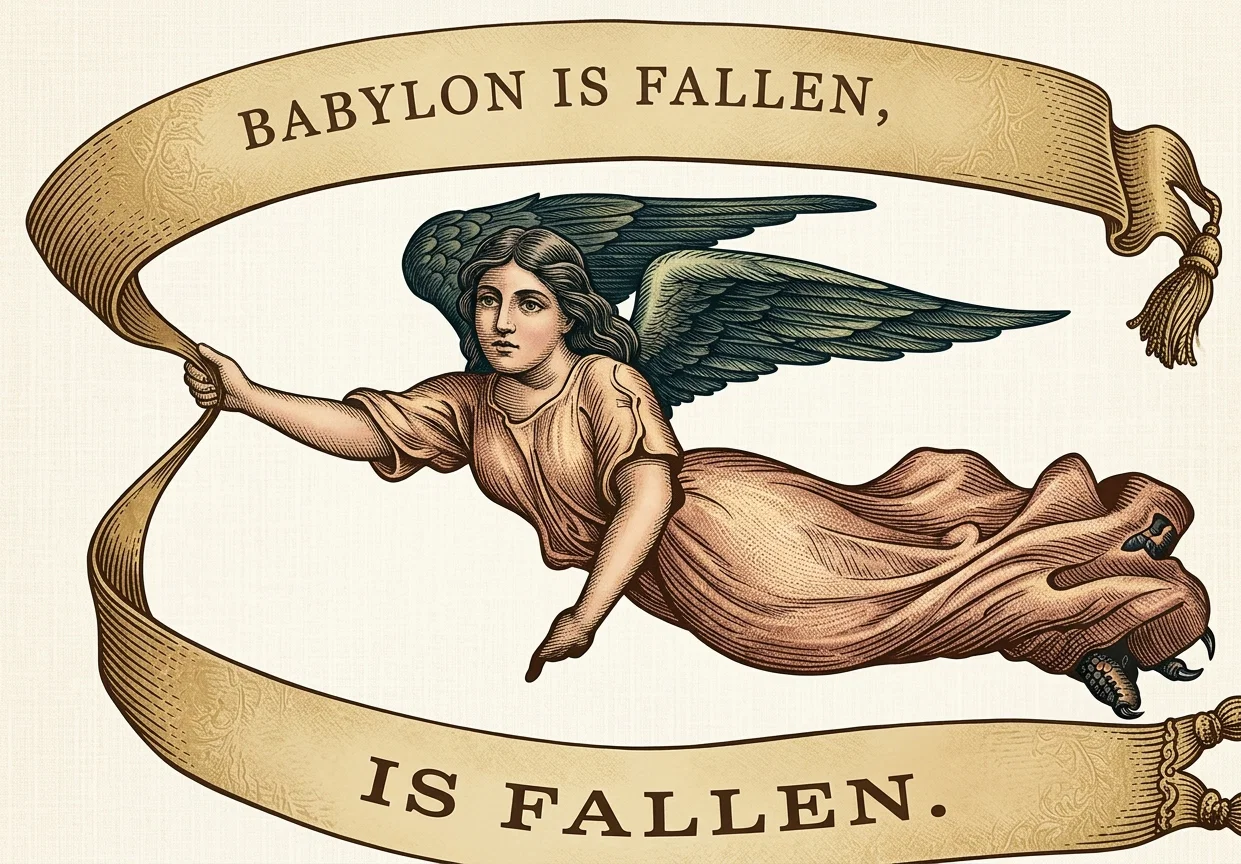
“And there followed another angel, saying, Babylon is fallen, is fallen, that great city, because she made all nations drink of the wine of the wrath of her fornication.” Rev. 14: 8.[[FIGURE]]
The first important inquiry relates to the time when this proclamation is to be made. As this angel follows the one who proclaims the hour of God’s Judgment, it is evident that this proclamation is the next event in order. And as it has been shown that the proclamation of the hour of God’s Judgment is addressed to those who live in the last days, it is certain that the second message belongs to the same time, and that it was not fulfilled centuries in the past. And the fact that at the time when this proclamation of the fall of Babylon is made, the plagues and utter destruction of Babylon, which come under the seventh vial, are then immediately impending, is also conclusive proof that this proclamation belongs to the last days. Rev. 18: 1–10; 16: 17–21. We conclude, therefore, that the generation that shall be alive when the plagues are poured out on Babylon, is the one to which the second angel’s message is addressed.
Our next inquiry relates to the meaning of the term Babylon. What is designated by the word Babylon in the book of Revelation?
The word Babylon signifies confusion, and is derived from Babel, the place where God confounded the inhabitants of the earth in their impious attempt to build a tower to heaven.

BABYLON IS NOT THE WHOLE WICKED WORLD.

Rev. 17, represents Babylon by the symbol of a woman seated on a scarlet-colored beast. If therefore the woman, Babylon, represents the whole of this fallen world, the entire empire of the devil, what does the beast represent upon which the woman is seated? Is it not a fact that the beast represents the fourth empire of our earth in its papal form? And, that being the case, is it not a certainty that Babylon does not include the whole wicked world? That the beast and the woman are two distinct symbols, is evident from verse 7.
When Babylon is destroyed, being thrown down as a millstone is cast into the mighty deep, and utterly burned with fire, the kings of the earth, the merchants, the sailors, etc., are still spared, and mourn, and lament over her. It is plain, therefore, that the utter destruction of Babylon, is not the destruction of those wicked men who have lived in iniquity with her. Hence it follows that Babylon does not comprise the whole wicked world.

BABYLON NOT THE CITY OF ROME.

Some have strongly advocated the view that Rome is the Babylon of the book of Revelation. Their argument stands thus:—
The angel told John that the woman which he had seen was the great city which reigneth over the kings of the earth. And that the seven heads of the beast are seven mountains upon which the woman sitteth. The explanation of “the mystery of the woman” is regarded as decisive testimony that Rome is the Babylon of the book of Revelation. To the foregoing reasons some add the statement that a woman is used in every other instance in the book of Revelation as the symbol of a literal city, and consequently must mean a literal city in this case. But we are compelled to dissent from this view for the following reasons:—
The grand principle assumed by the foregoing view is this: the interpretation of a symbol must always be literal, and can never consist in the substitution of one symbol for another; and hence the interpretation of a woman as a city, and of the heads of the beast as mountains upon which the woman sitteth, must be literal. That there are exceptions to this rule, and that the case in question furnishes a manifest exception, we will now show. In Rev. 11: 3, the two witnesses are introduced. The next verse is an explanation of what is meant by the two witnesses: “These are the two olive-trees and the two candlesticks standing before the God of the earth.” There can be no question that in this case the explanation of the symbol consists in the substitution of other symbols. In other words, the explanation
consists in transferring the meaning to other symbols which are elsewhere clearly explained. That this is the case in Rev. 17, we will now show. The angel introduces his explanation of the heads by saying, “Here is the mind which hath wisdom;” plainly implying that wisdom was needed in order to understand what he was there communicating. With the fact before us that in Rev. 11 the explanation consists in substituting one symbol for another, and with the caution of the angel, as he gives the explanation in this case, let us consider what he utters:—
“The seven heads are seven mountains on which the woman sitteth.” “The woman which thou sawest is that great city, which reigneth over the kings of the earth.” Verses 9, 18. The wisdom which is needed to rightly comprehend the words of the angel would doubtless lead us to compare the different instances in which the same facts are referred to in the book of Revelation. If we do this, the following points will appear:—
1. Chap. 13 informs us that one of these seven heads was wounded unto death, and that this deadly wound was healed. Or, as the same fact is stated again, it had a wound by a sword, and did live. It would be utter folly to assert this of a literal mountain. Hence the heads are not mountains of earth. 2. Each of the seven heads is represented with a crown upon it in chap. 12, even as each of the ten horns are thus represented in chap. 13. Each of the heads must therefore represent a kingdom or government, even as the horns represent governments. 3. It is evident that the seven heads are successive (that is, the beast has but one head at a time) in distinction from the ten horns which are contemporary. But the seven hills of Rome are not successive; for it cannot be said of them, “Five are fallen, and one is, and the other is not yet come; and when he cometh, he must continue a short space.” 4. The beast itself is the eighth, and is of the seven, which proves that the beast is a literal mountain, or that the heads are not. The heads of the beast must, according to Dan. 7: 6, compared with Dan. 8: 22, be explained as kingdoms or governments. Mountains, according to chap. 2: 35, 44; Jer. 51: 25, denote kingdoms. But the version of Prof. Whiting, which is a literal translation of the text, removes all obscurity from Rev. 17: 9, 10. “The seven heads are seven mountains on which the woman sitteth, and they are seven kings.” (The French translations agree with this.) Thus it will be seen that the angel represents the heads as mountains, and then explains the mountains to be seven successive kings. The angel transferred the meaning from one symbol to another, and then gave the explanation of the second symbol.
Having proved that the mountains are not literal but symbolic, it follows that the woman which sitteth upon them cannot represent a literal city; for a literal city cannot sit upon symbolic mountains. Hence it appears that the angel transfers the meaning from one symbol to another, as in verses 9, 10; chap. 11: 4. And it is certain that the woman of chap. 12, represents the church, and not a literal city. Hence it is a mistaken idea that a woman in the book of Revelation, as a symbol, always represents a literal city.

BABYLON A SYMBOL OF THE CHURCH UNITED TO THE WORLD.
Babylon is the name of the symbolic harlot which was seen by John. A woman is the symbol of a church. Rev. 12. A harlot is the symbol of a corrupt church. Eze. 16. It is evident that the woman in Rev. 17, should be interpreted in the same manner as the one in chap. 12. As that symbol undoubtedly represents the true church (though spoken of as a woman and her seed) so the harlot and her daughters are doubtless the entire corrupt church. Rev. 18: 5. We understand, therefore, that Babylon is not limited to a single ecclesiastical body; but that its very name renders it necessary that it should be composed of many.
If the harlot to whom the kings of the earth have unlawfully united themselves, symbolizes only the church of Rome, it follows that many of the wicked powers of the earth are quite free from this sin. The Greek church is the established church of Russia and Greece; the Lutheran church is the established church of Prussia, Holland, Sweden, Norway, and a part of the smaller German States; England has her national church, and other countries have their established religions. Babylon has made all the nations drunken with her wine; it can therefore symbolize nothing less than the universal worldly church. The merchants of Babylon are the great men of the earth. In the fold of the nominal church is to be found a large portion of the lawyers, doctors, politicians, and great men of the world. To succeed in business, to become honorable in society, or to rise to high offices in the nation, it is very important to make a profession of religion, and to have a good and regular standing in the church.
Babylon is represented as trafficking in the souls of men. Look at the Church of England. There the vacant parishes are sometimes set up for sale, and the highest bidder becomes the possessor of its revenues, and the pastor of its people! To come nearer home, let us look at the various religious denominations in every place where they have sufficient wealth and strength to become popular. They must erect a splendid house of worship, and furnish it in the most expensive style; and the members of the church must dress in all the fashion and pride of life. Then they must have an eloquent man to preach smooth things to fashionable ears. The church which can outdo the others in these particulars will succeed in securing the fashionable sinners of the place as permanent members of the congregation.
The word Babylon, as we have seen, signifies confusion, and comes from Babel, the place where men, in their impious attempt to build a tower that should reach unto heaven, had their language confounded. Gen. 11. The church should be one. This was the will of Christ. Witness his intercession with the Father, as recorded in John 17. He prays that his disciples may be one, as he and his Father are one; for this would cause the world to believe in Christ. Since the great apostasy, the majority of his professed followers have busied themselves in attempting to climb up to Heaven some other way. They have been confounded in the attempt, and scattered abroad upon the face of the earth, with creeds as discordant as the languages of those who were dispersed at the ancient tower. The Holy Spirit used the word Babylon on account of its signification, and it is a most appropriate designation for the great city of confusion to which it is applied.
The church was represented as a chaste virgin, espoused to Christ. 1 Cor. 11: 2. She became a harlot by seeking the friendship of the world. James 4: 4. It was this unlawful connection with the kings of the earth that constituted her the great harlot of the Apocalypse. Rev. 17. The Jewish church, represented as espoused to the Lord (Jer. 2, 3; 31: 32), became a harlot in the same manner. Eze. 16. Even the term Sodom, which in Rev. 11 is applied to “the great city,” is in Isa. 1, applied to the Jewish church thus apostatized from God. The fact that Babylon is distinct from, though unlawfully united with, the kings of the earth, is positive proof that Babylon is not the civil power. The fact that the people of God are in her midst just before her overthrow, proves that she is a professedly religious body. We think it must be apparent, therefore, that the Babylon of Rev. 17 symbolizes the professed church unlawfully united to the world.
What shall we understand by the fall of Babylon? It cannot represent her destruction, for the people of God are called out of her after her fall has been announced. Rev. 18: 2, 4. They are called out of Babylon that they receive not of her plagues. These plagues are death, mourning, and famine, and utter destruction by fire. Rev. 18: 8. They are future at the time of her destruction; therefore her fall must precede her destruction.
Her fall must be a moral fall, for it renders her the hold of every foul spirit. It is said that she is fallen “because she made all nations drink of the wine of the wrath of her fornication.” Her fornication is her unlawful union with the kings of the earth. The wine of her fornication must represent false doctrines; for it is with this kind of wine that the nations have been made drunken. Her false doctrines have been the direct result of her unlawful union with the kings of the earth, for it is their union which has caused men to corrupt the pure truths of God. Thus the doctrine which teaches, contrary to the Word of God, that all men will be converted, and that the church shall have a long period of prosperity before the day of Judgment, has encouraged the world to say “Peace and safety.” 1 Thess. 5: 3. The fourth commandment has been changed by the authority of the church, and almost all the Christian world tread the Sabbath of the Bible in the dust. The greater part of the denominations do not celebrate the burial and resurrection of the Saviour by the ordinance of baptism. Rom. 6: 3, 4; Col. 2: 12. Conformity to the world has abased the banner of piety to the dust, and has practically suppressed those portions of the Bible which condemn sins; and men in general have ceased to believe that it is necessary to live by every word that proceedeth out of the mouth of God.
In all places where the proclamation of the first angel concerning the approach of the Judgment has been made, the greater part of the church authorities, whether Catholic or Protestant, have dared to assure the world that it is a false alarm, and that the Judgment is far distant. Thus when the second angel follows with the announcement that Babylon is fallen because she has made the nations drunken with her wine, that is to say, with her false doctrines, it is manifest that the manner in which Babylon has treated the warning of the first angel is one of the most striking instances of her culpability in this respect, and that it presents the crime which caused God to turn his face from her.
If God rejected the Jews as a nation because they did not receive Christ at his first advent, may we not conclude that he will treat the church of the present day in the same manner if they oppose the doctrine of the immediate advent of Christ, when he is actually near at hand? And thus we find that wherever the proclamation of the first angel has been rejected by the churches the most pious persons in those churches have acknowledged that a sad change has taken place.
God appointed the church to be the light of the world, and at the same time ordained that his Word should be the light of the church. But when the church becomes unfaithful to her trust and corrupts the pure doctrine of the gospel, as a natural consequence the world becomes intoxicated with her false doctrine. That the nations of the earth are in such a condition at the present time is too obvious to be denied. The world is intoxicated in the pursuit of riches and honor, but the sin lies at the door of the church; for the church sanctions what the Lord strictly forbade, and she sets the example to the world. If the church had not thus intoxicated the world with the wine of her false doctrines, the plain truths of the Bible would powerfully move the public mind. But the world seems hopelessly drunken with the wine of Babylon.
At the commencement of the first message the people of God are in Babylon; for the announcement of the fall of Babylon, and the cry, “Come out of her, my people,” is made after the first proclamation has been heard. Here also we have a most decisive testimony that Babylon includes Protestant as well as Catholic churches. It is certain that the people of God at the time of the preaching of the hour of his Judgment were in all the popular churches. And this fact is a most striking testimony as to what constitutes the great city of confusion. In a word, Paul has well described the Babylon of the Apocalypse, and the duty of the people of God with reference to it, in 2 Tim. 3: 1–5: “This know also, that in the last days perilous times shall come; for men shall be lovers of their own selves, covetous, boasters, proud, blasphemers, disobedient to parents, unthankful, unholy, without natural affection, truce-breakers, false accusers, incontinent, fierce, despisers of those that are good, traitors, heady, high-minded, lovers of pleasure more than lovers of God; having a form of godliness, but denying the power thereof; from such turn away.” Who would dare to limit this description to the Catholic church?
The preaching of the hour of God’s Judgment and the immediate coming of the Lord, was at once the test of the church, and the means by which she might have been healed. It was the test of the church in that it showed that her heart was with the world, and not with her Lord. For when the evidences of his immediate advent were set before her, she rejected the tidings with scorn, and cleaved still closer unto the world. But it might have been the means of healing her. Had she received it, what a work would it have wrought for her! Her unscriptural hope of a temporal reign, her false view of the second advent, her unrighteous justification of oppression and wickedness, her pride and conformity to the world, would all have been swept away. Alas that this warning from Heaven was rejected! The last means that Heaven had in store to heal Babylon having failed, God gave her up to her own heart’s desire.
This subject is illustrated by the fall of the Jewish church, the harlot of Eze. 16. This fall is clearly described in Rom. 11. The details are given in Matt. 21: 43; 23: 12; 24: 43–45. This fall was her rejection by God. Her destruction was deferred for a considerable period.
The grand proclamation concerning the immediate coming of Christ has been given more extensively in America than in Europe. But the churches in America have found the doctrine too unpopular, and after a time the larger part have refused to hear upon the subject. The state of things which has followed their rejection of this warning from Heaven is well described in their own words, and those words clearly show that the second message was appropriate and truthful. The Christian Palladium for May 15, 1844, speaks in
the following mournful strains: “In every direction we hear the dolorous sound, wafting upon every breeze of heaven, chilling as the blasts from the icebergs of the north—settling like an incubus on the breasts of the timid, and drinking up the energies of the weak; that luke-warmness, division, anarchy, and desolation, are distressing the borders of Zion.”
The Religious Telescope of 1844 uses the following language: “We have never witnessed such a general declension of religion as at the present. Truly the church should awake and search into the cause of this affliction; for an affliction every one that loves Zion must view it. When we call to mind how ‘few and far between’ cases of true conversion are, and the almost unparalleled impenitence and hardness of sinners, we almost involuntarily exclaim, ‘Has God forgotten to be gracious? or is the door of mercy closed?’”
About that time proclamations of fasts and seasons of prayer for the return of the Holy Spirit were sent out in the religious papers. Even the Philadelphia Sun of Nov. 11, 1844, has the following: “The undersigned ministers and members of various denominations in Philadelphia and vicinity, solemnly believing that the present signs of the times—the spiritual dearth in our churches generally, and the extreme evils in the world around us, seem to call loudly on all Christians for a special season of prayer, do therefore, hereby agree by divine permission, to unite in a week of special prayer to Almighty God, for the outpouring of his Holy Spirit on our city, our country, and the world.”
Prof. Finney, editor of the Oberlin Evangelist, Feb., 1844, says: “We have had the fact before our minds, that in general, the Protestant churches of our country, as such, were either apathetic or hostile to nearly all the moral reforms of the age. There are partial exceptions, as yet not enough to render the fact otherwise than general. We have also another corroborated fact: the almost universal absence of revival influence in the churches. The spiritual apathy is almost all-pervading, and is fearfully deep; so the religious press of the whole land testifies. Very extensively church members are becoming devotees of fashion—joining hands with the ungodly in parties of pleasure, in dancing, in festivities, &c. But we need not expand this painful subject. Suffice it that the evidence thickens and rolls heavily upon us, to show that the churches generally are becoming sadly degenerate. They have gone very far from the Lord, and he has withdrawn himself from them.”
The moral fall of the Protestant churches in general brings us to the point where we are able to say in the language of the second message, “Babylon is fallen, is fallen, that great city.” This was not true of all Babylon before this moral fall had been witnessed, and consequently the second message would not have been appropriate if it had been preached before 1844. Only two divisions of Babylon had fallen before this time.
The Bible presents a testimony of the most solemn character concerning Babylon. It must be the duty of the servants of God at the proper time to give this testimony even as God has given it in his Word. This testimony comes from God, and is not dependent upon the will of man, and therefore no person should be offended when it is presented. If that which is said of Babylon is true of a particular denomination, then that people should receive the light with gratitude and bring forth the fruits of repentance. But if any person is found concerning whom this testimony is not applicable, let them be grateful that they do not belong to this great city, and let them not complain that this most solemn message is preached for the benefit of the vast numbers for whom it is appropriate. The servants of God are called to announce the principles of truth with faithfulness, and each one must apply them to himself in the fear of God.
Now lest the doctrine that the Greek and Protestant churches, as well as the Roman, are included in Babylon should seem unreasonable to any, we invite attention to the following facts: It is evident from the terms of this prophecy, that Babylon is composed of individuals who profess to be Christians. It is also evident that a great part of the true people of God are found in Babylon even in the last days. But Babylon is a harlot because of her union with the kings of the earth; and because of this unlawful union she has corrupted the truth of God. Now we will prove that the Greek church is one of the three grand divisions of Babylon. The Catholic church became a harlot at an epoch at least as early as the time of Constantine. History records the acts of no other civil ruler who has wrought so great changes in the church as did Constantine. He gave a new form to the government of the church, having for his model the government of the empire. He created in the church officers unknown to the New Testament, and he corrupted the doctrines and practices of the church. In his time the Greek church and the Roman church formed one so-called Catholic church.
This great church continued to corrupt itself more and more from century to century. Its history is full of examples of unlawful union with the kings of the earth. But in the eleventh century, as the result of a long quarrel between the bishop of Rome and that of Constantinople concerning the supremacy, the Catholic church was divided into two churches: the Roman Catholic church, and the Greek Catholic church. After this separation the Greek Cath-
olic church continued to be what the general Catholic church had been before the division. The separation did not cause the Greek church to renounce a single error of the great Catholic church, nor to cease her unlawful connection with the kings of the earth. If the Catholic church was Babylon before it was thus divided, then the Greek church was, before that separation from Rome, a very considerable part of the great city Babylon. The principal difference between the Roman and the Greek churches since the separation is that the Greek church has simply retained the errors held by all in common before the separation, without making much addition to those errors, and without taking a very active part to persecute others, while the Roman church has added several other errors to her system of doctrine, particularly such as have respect to the power of the pope, and she has been very active to persecute those who do not submit to her authority. The Greek church is less guilty than is the church of Rome, but to deny that she forms an important division of Babylon would be to deny that Babylon existed before the great schism of the eleventh century.
Five hundred years after the separation of the Greek and Roman churches brings us to the reformation of the sixteenth century which separated several great nations from the communion of the church of Rome. This is the second grand separation from Rome. Since that time the religious world has existed in three grand divisions: the Greek Catholics, the Roman Catholics, and the Protestants. The separation of the Greeks from Rome was not characterized by a reformation. It is therefore certain that the Greeks continue to be a part of Babylon. But the separation of the Protestants from Rome was characterized by the renunciation of several great errors. It is therefore worthy of our attention to determine carefully whether the Protestants made such reform as would cause them to cease to be a part of Babylon. They rejected the authority of the pope and of the church of Rome; they appealed to the Bible as the supreme rule of faith, they exposed many errors and sins of the church of Rome, and they taught justification by faith.
But to leave Babylon it is not enough to separate from the communion of those who sustain its errors. It is necessary to renounce these errors by receiving the truth of God, and it is necessary also to renounce the sins of Babylon by true repentance. If the Protestants returned to the purity and simplicity of the New Testament then they cease to be a part of Babylon. But if they retained a considerable number of the essential errors and sins of Babylon and contented themselves to preserve their part of the old city, after a partial purification, instead of building anew after the divine model, then they have never ceased to be a part of Babylon. The churches of the New Testament were composed of those only who repented of their sins, believed on the Lord Jesus Christ, and were buried with him in baptism. But the churches which compose the Romish apostasy are organized on a plan essentially different from the apostolic plan. By means of infant baptism the entire population is brought into the church; the church and the world are no longer distinct, and the church becomes an assemblage of unconverted men. This confusion of the world and the church is one of the essential errors which rendered the Catholic church Babylon. Now it is a painful fact that the reformers did not see it necessary to commence at the foundation and form churches of converted persons only; on the contrary they positively refused to do this, and they not only retained infant baptism, but their first churches were simply Romish churches which had accepted the doctrines of the reformation, but which were composed of persons admitted by infant baptism, the larger part of whom were unacquainted with Christian experience; and the churches raised afterward by them were of a similar character because formed on the same model.
To be Continued.