The result of the daily service in the earthly sanctuary was that the burden of sin was in figure removed from the sinner and transferred to the sanctuary. The broken law in the ark demanded the blood, or life, of the transgressor, and in the sanctuary was provided the “blood of others” that was accepted at the typical throne of grace in place of the sinner’s life.
After he had received the atonement and forgiveness of sins, the question was, would he continue in his sins? If the sinner chose to go back into sin, he might; but could he carry his atonement and forgiveness back into sin with him? — No, indeed! If the forgiven and cleansed sinner, the righteous man, turned away from his righteousness, that is, from the forgiveness and cleansing he had received, these were not to be mentioned or reckoned to him longer, but he must die for his iniquity. Ezek. 18: 26.
Many, however, continued steadfast in the blessings they had received. Many who had left their first love renewed their hope, and received atonement and forgiveness anew. When individuals came to the last great day of the sanctuary services that they would ever participate in, completing the type, these cases were in figure forever sealed. Those who had lost the righteousness they had obtained through the provisions of the gospel as then summed up and presented to them through the sanctuary services, and all those who did not on the day of atonement cease from their works and afflict their souls, were cut off from the people.
The record of this “day of atonement” is found in Leviticus, chapters 16 and 23. This day was the day of final cleansing and remission of sins for the sanctuary and the people.
Two Kids Were Taken
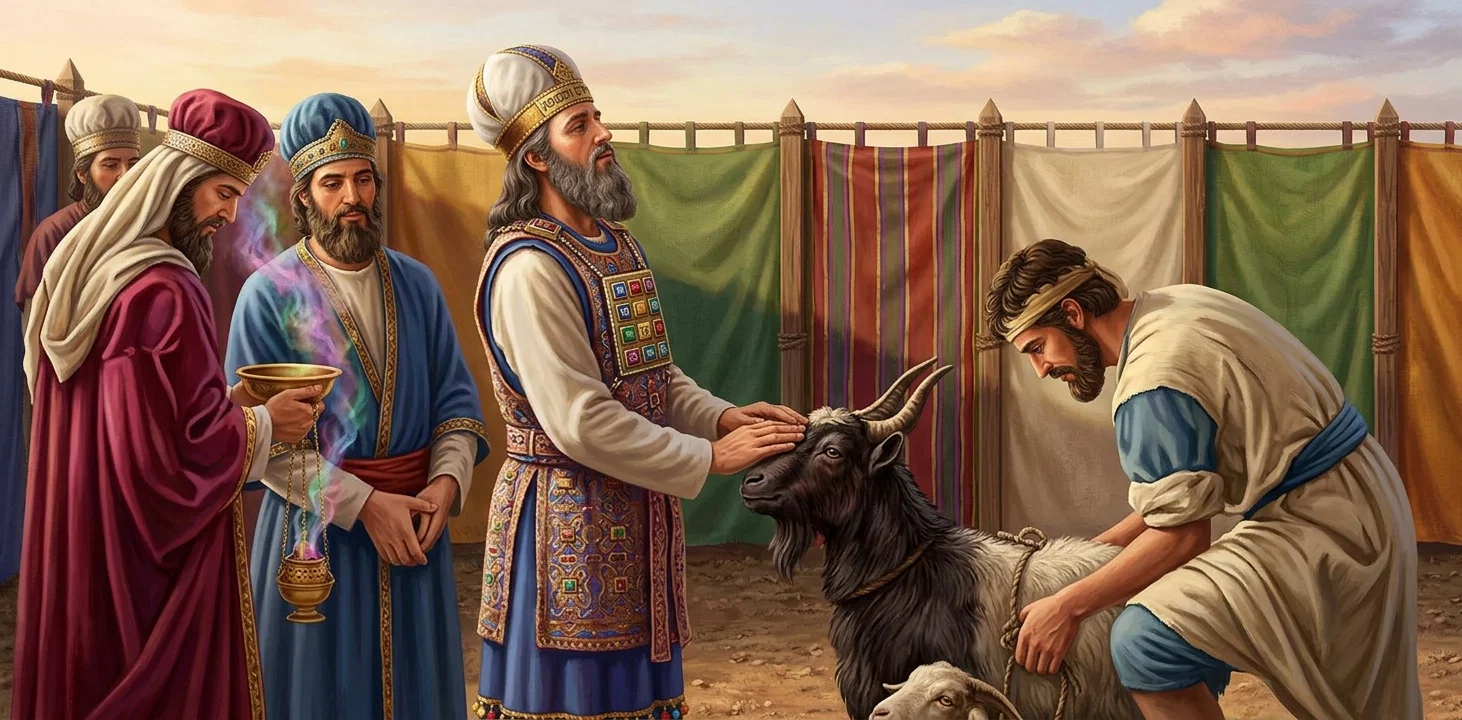
On this typical day of atonement, the high priest took two kids of the goats for a sin offering. By lot, one was chosen to be the Lord’s, or the sin offering for the people, while the other was to be the scapegoat. When everything was ready, the high priest took the goat on which the Lord’s lot fell, and killed it. He then took of its blood, and passing alone within the second veil, sprinkled it before the mercy seat.
He thus made “an atonement for the holy place, because of the uncleanness of the children of Israel, and because of their transgressions in all their sins.” Then he did the same “for the tabernacle of the congregation” and for “the altar that is before the Lord.” Lev. 16: 16-18. When he had so done, he had made an end of reconciling or cleansing the sanctuary.
The object lesson by which God taught men in those days the way of salvation was complete. Yet one thing more needed to be done to insure finally the blessedness of the people. By this last act, sin was in type removed from their presence. The typical accuser of our brethren was rebuked. See Rev. 12: 10 and Zech. 3: 1, 2, etc.
Every reminder of their past sinfulness was banished, nevermore to annoy and vex them with its presence. This last act was the placing of the iniquities of the children of Israel upon the head of the scapegoat and sending him away into the wilderness, or land of separation, a land not inhabited.
Disposing Completely of Sin
The service with the slain goat revealed the divine plan for disposing completely of the sins of those who, by confession, repentance, and faith in God, had placed the burden of their sins upon the sanctuary and its atoning blood. They had maintained the beginning of their confidence steadfast unto the end, and their enjoyment of the blessings of the sanctuary was sealed to them beyond the possibility of loss.
Thus the service with the slain goat represents the final blotting out of confessed sins. The service with the scapegoat represents the disposal of unconfessed sins. These were outwardly the same as the confessed sins whose burden was assumed by the sanctuary; but they pertained to a different individual altogether.
The placing of sins upon the head of the scapegoat was simply a declaration that he was guilty, without confession and without the benefits of the sanctuary, of the very sins which Israel had committed and confessed; for the scapegoat represents Satan, the instigator and author of all sin. Not till the scapegoat was banished, with all sin yet unatoned for upon him, did the people of God feel themselves free from its hated presence. This was the atonement with the scapegoat. The antitype of the atonement with the slain goat, or the sin offering that was for the people, is brought to view in Hebrews 9. The antitype of the atonement with the live goat is shown in Revelation 20, Malachi 4, and Matthew 25. In Hebrews 9, the apostle Paul gives a brief but comprehensive outline of the sanctuary on earth and the sanctuary in heaven, and the cleansing of each. In verses 22, 23, he says it was necessary that the patterns of things in the heavens should be purified by the blood of calves and goats, for “without shedding of blood is no remission.” “But the heavenly things themselves,” he continues, must be purified “with better sacrifices than these.” By “better sacrifices,” the context shows that he means Christ, who once in the end of the world appeared to put away sin from the heavenly sanctuary, and thus cleanse it, “by the sacrifice of Himself.” Heb. 9: 26.
Satan the Scapegoat
The antitype of the scapegoat is Satan. The atonement made with the scapegoat had no connection with the atonement for the people of Israel; for it was not introduced until after the sanctuary had been reconciled, and the people of God had been made clean from all their sins before the Lord by the blood of the slain goat, the sin offering for the people, whose antitype is Christ. Consequently for the antitype of this sin offering and atonement, we must look for one which has no value for others, which avails only so far as to pay in full the penalty for the sins of those who die. This is found in the final sin offering in the lake of fire prepared for the devil and his angels. Matt. 25: 41. Then will come the day described by Malachi, which shall burn as an oven, when the proud, and all that do wickedly, shall be stubble, and shall be burned up root and branch. Read Mal. 4: 1. This will be a thousand years after the people of God have been taken to heaven, a thousand years after they have been declared clean in God’s sight, and their sins, as far as they are concerned, blotted out and destroyed.
Thus all sin will come to an end, wiped out in the lifeblood of those who have committed it, and the universe will be eternally free from its presence. Thus the record in Leviticus 16 reveals in figure not only the closing of the work in the heavenly sanctuary for the blotting out of confessed and forgiven sins, but the final blotting out of sin and sinners from the universe, root and branch. Then will appear the new heavens and the new earth, “wherein dwelleth righteousness.”
Why Needed in Heaven?
It is an interesting question how anything in the heavens can need purifying, reconciling, or cleansing. As stated before, the daily service resulted in figuratively transferring the burden of sin from the sinner to the sanctuary and the priest, with the atoning blood; and there it would remain so long, and only so long, as the repentant sinner chose to keep it there. His sin was there as a matter to be disposed of, a court case to be decided only after the last bit of evidence was presented. On the last day of the ritual year, every case reached a final decision, and every individual was sealed unalterably for life or death. Thus the sanctuary was defiled, and thus it was cleansed. For the people having been made free from all their sins, or else cut off from among the people, every case that had been before the tribunal of the sanctuary was thereby disposed of, and it was no longer necessary to make remembrance of sins there, and defile it with their consideration. So it is with the true sanctuary. Sin is not literally and bodily transported from earth to heaven. The abode of sin is in the heart and conscience of those who sin; and there is where the real cleansing takes place, which results in the cleansing of the sanctuary above. Heb. 9: 14; 10: 22.
The thing that is literally and really transferred to heaven is the burden of sin. In 1 John 2: 1, we read: “My little children, these things write I unto you, that ye sin not. And if any man sin, we have an Advocate with the Father, Jesus Christ the righteous.” We have One who “maketh intercession for us” “at the right hand of God.” Rom. 8: 34. But this intercession is made only for those who come to God by Him. Heb. 7: 25. The lesson for us is clear. When the Holy Spirit, that strives with all flesh, has convicted us of sin, it is our privilege to go boldly to the throne of grace, and place that sin in the hands of our Advocate. The burden of that sin, the burden of our guilt or innocence in regard to it, now rests upon the sanctuary. No longer should we struggle to free ourselves from its defilement, or try to cover it with the filthy rags of our own works of penance and atonement; for our Advocate is mighty to save. All He asks is that we keep our cases in His hands, and He will bring forth our righteousness as the light, and our judgment as the noonday. Ps. 37: 5, 6. (Continued on page 6)6
When the Atonement Is Completed
(Continued from page 5)
Said the patriarch Job, “Who can bring a clean thing out of an unclean?” Looking to ourselves, our only answer is to say with him, “Not one.” But looking to the sanctuary on high, we can say, “Thank God there is One.” “For there is none other name under heaven given among men, whereby we must be saved.” Acts 4: 12.
Christ can bring a clean thing out of an unclean, because He has creative power. And though equal with the Father, “He humbled Himself, and became obedient unto death, even the death of the cross.” The world was not with Him as He went into the tomb. He died alone, and left us an example, that we should follow His steps. He died to our sins once, and arose again, free, justified from those sins. And now, since for Himself He needs no such justification, and since “the Father judgeth no man, but hath committed all judgment unto the Son,” He has the infinite merits of His sacrifice to bestow on whomsoever He will. His death on the cross, under the imputed sins of the whole world, is acceptable before the law in place of the sinner’s death. And that death is imputed to all who will claim it by faith; and then they may reckon themselves “dead indeed unto sin, but alive unto God through Jesus Christ” their Lord. Rom. 6: 11. This Jesus “hath God exalted with His right hand to be a Prince and a Saviour, for to give repentance to Israel, and forgiveness of sins.” Acts 5: 31. And He is able to save to the uttermost all that come unto God through Him, no matter how unclean they are. He is the Author of eternal salvation to all that obey Him, “the Author and Finisher of our faith.”