1. When was the papal head of the first beast of Revelation 13 wounded?
February 10, 1798.
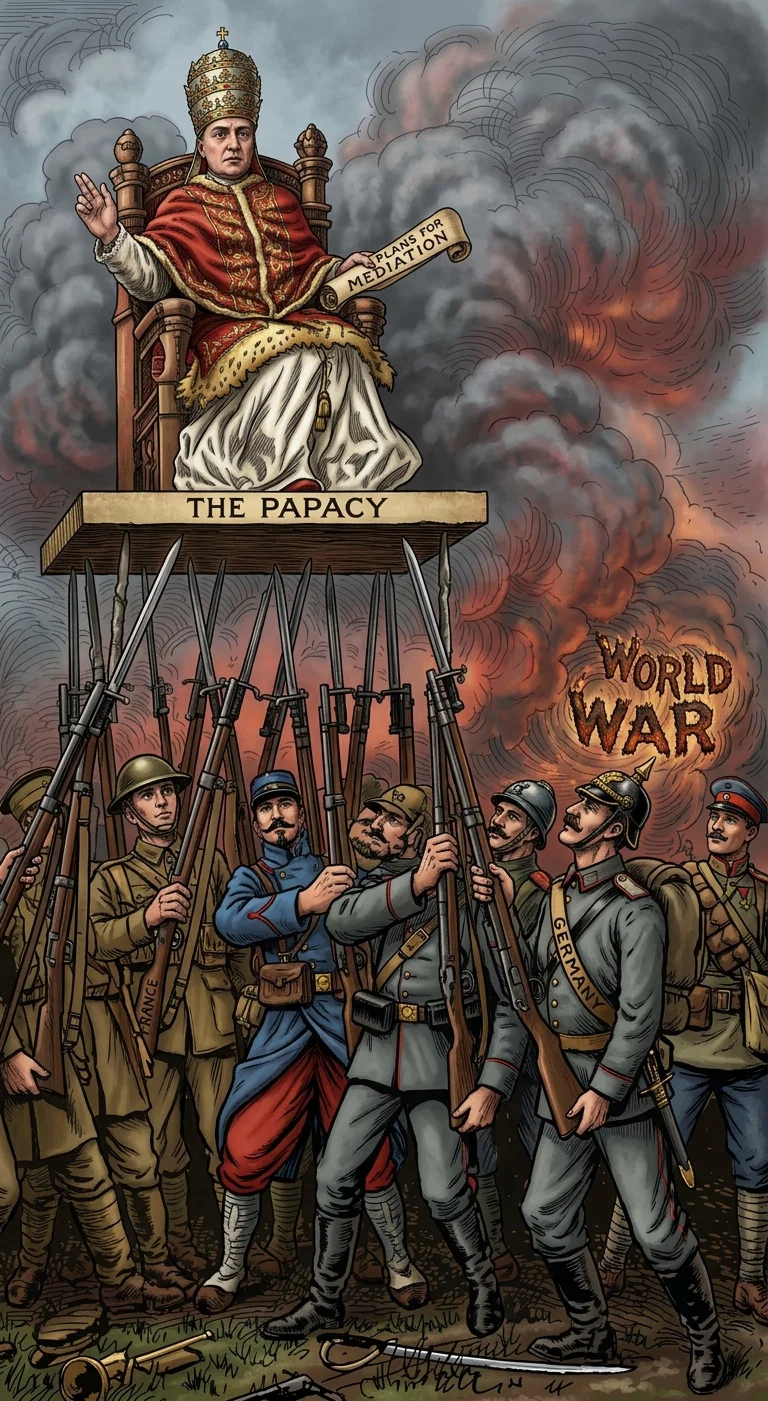
NOTE.—This wound was inflicted upon the papal head of this beast when the French, in 1798, entered Rome and took the Pope prisoner, and for a time, it seemed, abolished the Papacy. But in 1800 another Pope was placed upon the papal throne, and the deadly wound began to be healed. Temporal dominion was taken away from the Papacy in 1870, but its power and influence among the nations have been increasing since then, nevertheless. "In that year," says Mr. Guinness, "the Papacy assumed the highest exaltation to which it could aspire, that of infallibility."—"Romanism and the Reformation," p. 156. To such a position of influence over the nations is the Papacy finally to attain, that just before her complete overthrow and destruction she will say, "I sit a queen, and am no widow, and shall see no sorrow." Rev. 18:7. See Isa. 47:7-15; Rev. 17:18.
Another Beast Seen Coming Up
2. What did the prophet see coming up at this time?
"I beheld another beast coming up out of the earth; and he had two horns like a lamb, and he spake as a dragon." Rev. 13:11.
NOTE.—Mr. Wesley, in his notes on Revelation 13, written in 1754, says of the two-horned beast, "He is not yet come, though he cannot be far off; for he is to appear at the end of the forty-two months of the first beast."
The previous beast came up out of the "sea," which indicates its rise among the peoples and nations of the world then in existence (Rev. 17:15); while this one comes up out of the "earth." This would indicate that the latter beast would arise where there had not before been "peoples, and multitudes, and nations, and tongues." In 1798, when the papal power received its deadly wound, the government of the United States, located in the Western continent, was the only great and independent nation then coming into prominence in territory not previously occupied by peoples, multitudes, and nations. Only nine years preceding this (1789), the United States adopted its national Constitution.
To what extent the United States has "come up" since its rise as a nation may be seen from the following facts: The conceded domain of the United States, in 1776, at the time of the adoption of the Declaration of Independence, was only half a million square miles; in 1913 its area, including all its possessions, amounted to 3,742,155 square miles. Its population then was only three million; now it is over one hundred million. Its total wealth is now estimated to be $130,000,000,000, making it the richest nation in the world; its commerce is world-wide; and as a military power it has for years been ranked among the "great powers" of the world.
3. What do the "two horns like a lamb" represent?
Republicanism and Protestantism: civil and religious liberty.
NOTE.—A horn represents a kingdom, or a component part of a kingdom. Dan. 7:7, 8, 23, 24. Lamblike horns indicate youthfulness, innocence, gentleness. A lamb is a symbol of Christ or of Christian principles. John 1:29.
Making an Image to the Beast
4. Notwithstanding the lamblike pretensions of this power, what is it ultimately to do?
"He spake as a dragon." Rev. 13:11.
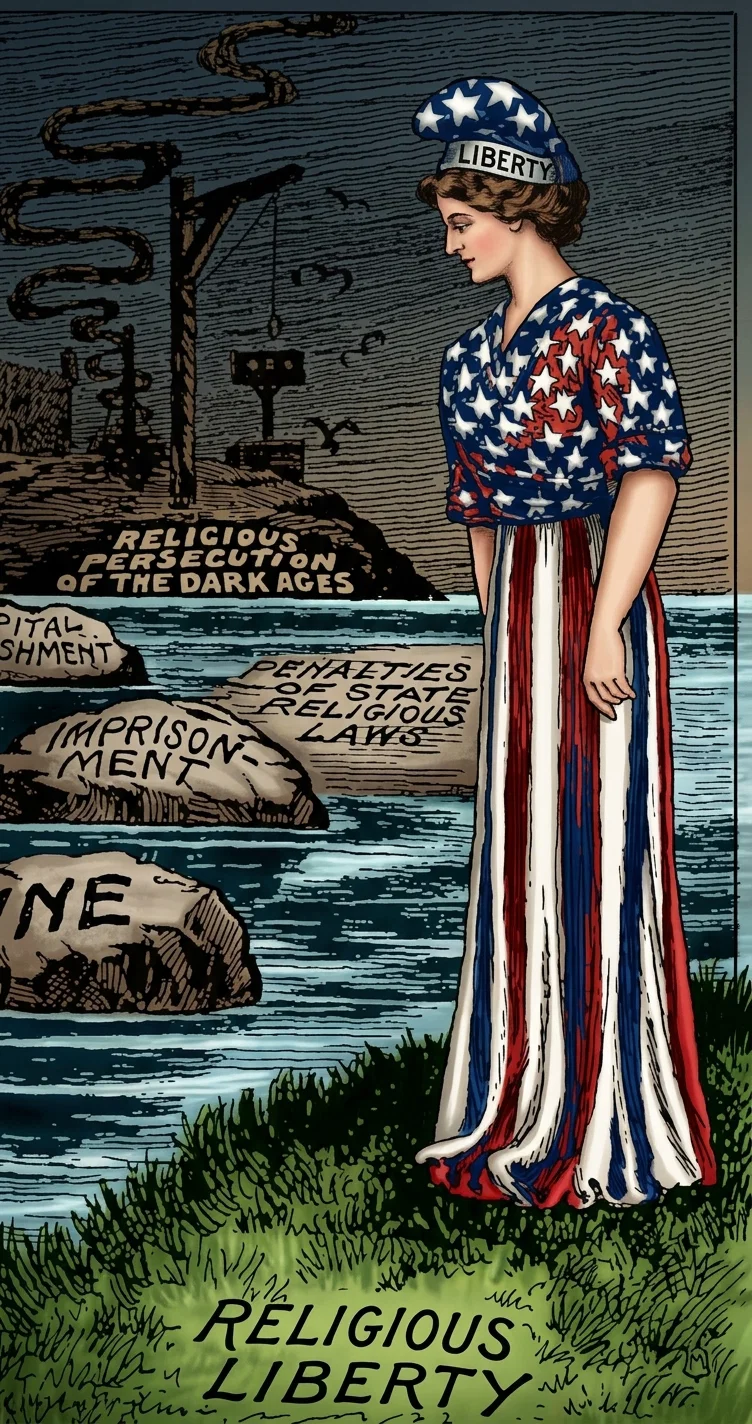
NOTE.—The voice of the dragon is the voice of intolerance and persecution. This indicates that this nation, which for more than a century has stood as a beacon light of liberty to all the world, will repudiate its mild and lamblike professions of civil and religious liberty. This is why, in Rev. 19:20, it is called the "false prophet." Though, as Bancroft says, "chief heir of the Reformation in its purest form," it will repudiate Reformation principles.
5. How much power will this beast exercise?
"He exerciseth all the power of the first beast before him, and causeth the earth and them which dwell therein to worship the first beast, whose deadly wound was healed." Rev. 13:12.
NOTE.—The "first beast before him" (papal Rome) exercised the power of persecuting and putting to death all who differed from it in religious matters. The only way the earth can be made to worship is by causing work to cease on it through voluntary
A CHURCH HELD BY CIVIL POWER
or enforced rest, or sabbath keeping. "As long as she [the land] lay desolate she kept sabbath." 2 Chron. 36:21. Since, as has been shown, the keeping of a counterfeit sabbath is the great mark of apostasy, the service by which the beast is worshiped, it seems clear that it is by enforced Sunday rest that even the inanimate earth is made to join in that worship.
6. What means will be employed to lead the people back into this false worship?
He "deceiveth them that dwell on the
earth by the means of those miracles which he had power to do in the sight of the beast." Rev. 13:14, first part.
7. What will this power propose that the people shall do?
"Saying to them that dwell on the earth, that they should make an image to the beast, which had the wound by a sword, and did live." Verse 14, latter part.
NOTE.—The beast "which had the wound by a sword, and did live," is the Papacy. That was a church clothed with the civil power. In other words, it was a union of church and state, and enforced its religious dogmas by the civil power, under pain of confiscation of goods, imprisonment, and death. An image to this beast would be another ecclesiastical organization clothed with civil power—another union of church and state—to enforce religious dogmas by law.
Organized Efforts in Fulfilment of This Prophecy
8. Is there any evidence that such an image will be made?
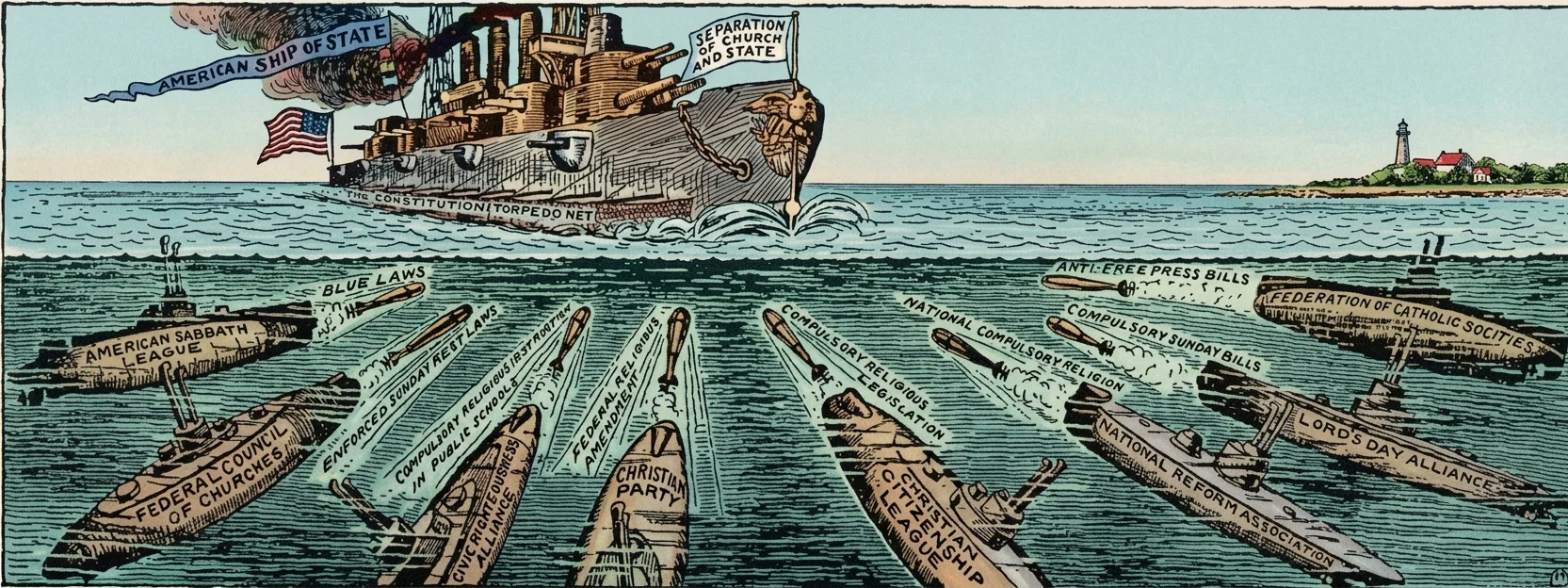
Large and influential organizations, such as the National Reform Association, the International Reform Bureau, the Lord's Day Alliance of the United States, and the Federal Council of the Churches of Christ in America, have been formed by professed Protestants, and for years have been persistently working to that end. Many Roman Catholic societies recently formed in the United States, such as the Knights of Columbus and the American Federation of Catholic Societies, are looking to a like end,—that of making America Catholic.
The National Reform Association
9. What, according to its constitution, is the avowed object of the National Reform Association?
"To secure such an amendment to the Constitution of the United States as will . . . indicate that this is a Christian nation, and place all the Christian laws, institutions, and usages of our government on an undeniable legal basis in the fundamental law of the land."—Article II of Constitution.
NOTE.—Upon the question of making this a "Christian nation," Bishop Earl Cranston, D. D., of the Methodist Episcopal Church, in an address delivered in Foundry Methodist Episcopal Church, Washington, D. C., March 13, 1910, made the following observation:—
"Suppose this were to be declared a Christian nation by a Constitutional interpretation to that effect. What would this mean? Which of the two contending definitions of Christianity would the word 'Christian' indicate?—The Protestant idea, of course, for under our system majorities rule, and the majority of Americans are Protestants. Very well. But suppose that by the addition of certain contiguous territory with twelve or more millions of Roman Catholics, the annexation of a few more islands with half as many more, and the same rate of immigration as now, the majority some years hence should be Roman Catholics,—who doubts for a moment that the reigning Pope would assume control of legislation and government? He would say, with all confidence and consistency, 'This is a Christian nation. It was so claimed from the beginning and so declared many years ago. A majority defined then what Christianity was, the majority will define now what Christianity now is and is to be.' That 'majority' would be the Pope."—"The Church and the Government," p. 7.
It is a fact worthy of note that in a decision rendered in 1892, the Supreme Court of the United States did declare this to be "a Christian nation," and that much use has been made of this declaration by the National Reformers and by the advocates of a union of religion and the state and of religious legislation in this country generally.
In a sermon at the centenary of the establishment of the Roman Catholic hierarchy in the United States, in 1889, Archbishop Ireland said, "Our work is to make America Catholic . . . Our cry shall be, 'God wills it,' and our hearts shall leap with crusader enthusiasm."
The theory of the National Reformers is thus expressed: "Every government by equitable laws is a government of God; a republic thus governed is of him, and is as truly and really a theocracy as the commonwealth of Israel."—Report of Cincinnati National Reform Convention, p. 28.
The Roman Catholic Church
10. How does this association regard the Catholic Church on this point?
"We cordially, gladly recognize the fact that in South American republics, in France and other European countries, the Roman Catholics are the recognized advocates of national Christianity, and stand opposed to all the proposals of secularism. . . Whenever they are willing to cooperate in resisting the
progress of political atheism, we will gladly join hands with them in a world's conference for the promotion of national Christianity, which ought to be held at no distant day. Many countries could be represented only by Roman Catholics."—Christian Statesman (official organ of the National Reform Association), Dec. 11, 1884.
11. What has the Pope commanded all Catholics to do?
"All Catholics should do all in their power to cause the constitutions of states and legislation to be modeled on the principles of the true church, and all Catholic writers and journalists should never lose sight, for an instant, of the view of the above prescription."—Encyclical of Pope Leo XIII, 1885.
NOTE.—The prophecy says that this power will make an image to the Papacy. In the days of Constantine and his successors, the church made use of the civil power to carry out her aims: through this means the Papacy was developed. In our own day the same theory is advocated, and prominent men in the nation, in both church and state, are doing all they can to bring about the same result, which, when their work is completed, cannot fail to fulfil the specifications of the prophecy. The climax will be an image of the Papacy.
THE FOOTSTEPS OF ROSIE
The International Reform Bureau
12. What is the object of the International Reform Bureau?
"The Reform Bureau is the first 'Christian lobby' established at our national capital to speak to government in behalf of all denominations."—"History of the International Reform Bureau," by its founder and superintendent, Rev. W. F. Crafts, p. 2.
NOTE.—The securing of compulsory Sunday legislation is one of the chief objects of this and other like organizations. See pages 61 and 65 of the work just mentioned.
The Lord's Day Alliance
13. What are the objects of the Lord's Day Alliance of the United States?
"(1) To preserve the Lord's day [Sunday] for America; (2) to secure an active Alliance in every State not yet organized; (3) to induce the general government as far as possible to set the example of Sabbath observance; (4) to press the rest-day feature of the fourth commandment until every toiler in the land has guaranteed unto him fifty-two full rest days a year."—From leaflet published by the Alliance.
NOTE.—By all this is meant the securing, as far as possible, of compulsory State and national Sunday legislation,—the very means by which the church gained control of the state and by which church and state were united in the fourth and fifth centuries of the Christian era.
The Federal Council of the Churches
14. What is the purpose of the Federal Council of the Churches of Christ in America?
"That the great Christian bodies of our country should stand together" in dealing with "questions like those of marriage and divorce, Sabbath desecration, social evils," etc.—Report of Federal Council (1908), pp. 5, 6.
15. How does it propose that the matter of "Sabbath desecration" shall be dealt with?
"That all encroachments upon the claims and the sanctities of the Lord's day should be stoutly resisted through the press, the Lord's day associations and alliances, and by such legislation as may be secured to protect and preserve this bulwark of our American Christianity."—Id., p. 103.4
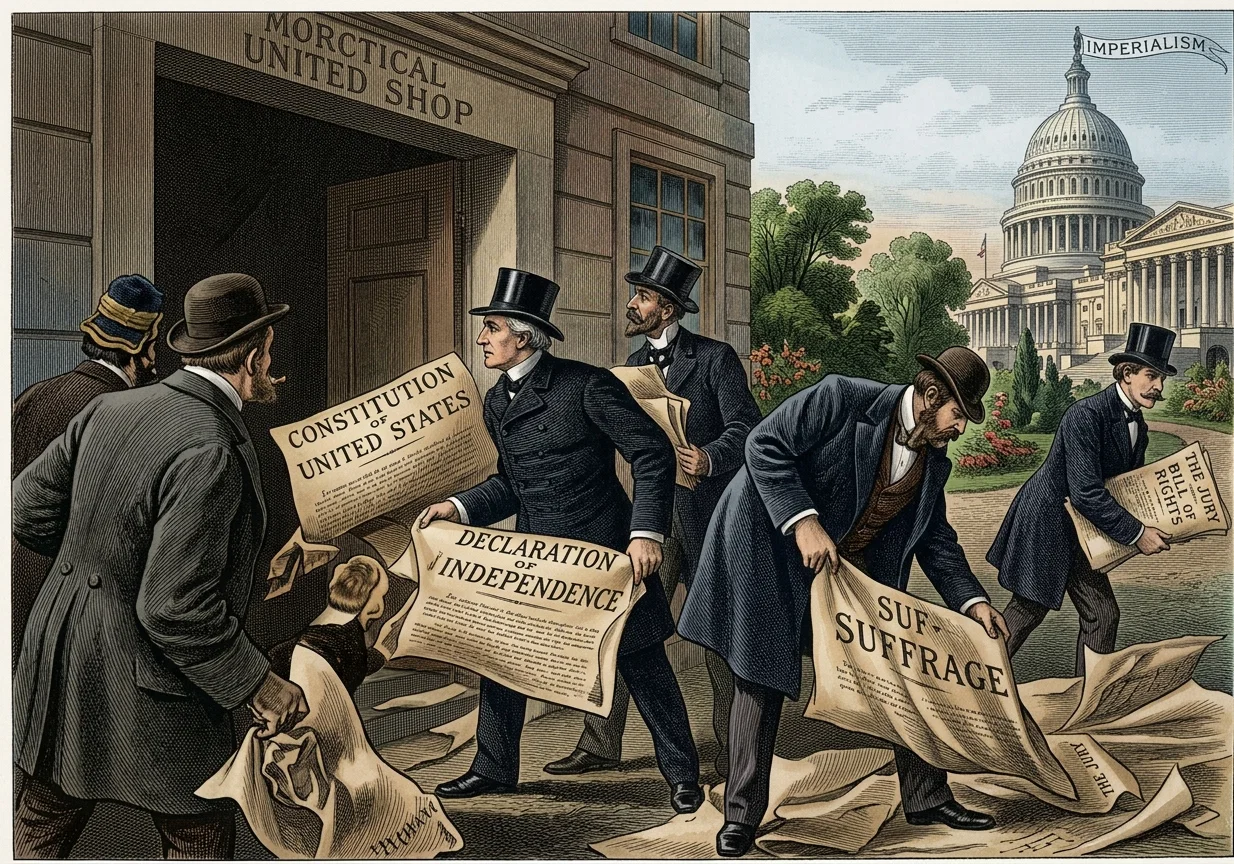
NOTE.—Thus it will be seen that the securing of laws for the enforcement of Sunday observance is a prominent feature in all these organizations in their efforts to "Christianize" the nation. In doing this many fail to see that they are repudiating the principles of Christianity, of Protestantism, and of the United States government, and playing directly into the hand of that power which originated the Sunday sabbath, and gained control of the civil power through Sunday legislation—the Papacy.
American Federation of Catholic Societies
16. What action of the American Federation of Catholic Societies indicates that Catholics will gladly "join hands" with Protestants in enforcing Sunday observance by law?
"Our societies in the various parts of the United States have been urging the abolition of Sunday labor, and have indorsed and assisted the movement of closing the post office on Sunday."—Report of Tenth Annual Convention of American Federation of Catholic Societies, Columbus, Ohio, Aug. 20-24, 1911.
NOTES.—The movement to close the post offices in the United States on Sunday by law was inaugurated by the Lord's Day Alliance of the United States, a Protestant organization. A national law closing all first- and second-class post offices on Sunday was secured Aug. 24, 1912.
The following resolution was adopted by the Boston Archdiocesan Federation of Catholic Societies:—
"We are unalterably opposed to any relaxation of the Sunday laws. Sunday is a day of rest to be devoted to the praise and service of God. We hold the safest public policy at present is to adhere to the rigid observance of the laws now safeguarding the sanctity of the Lord's day."—Boston Pilot (official organ of Cardinal O'Connell), March 16, 1912.
Laws to Enforce the Observance of Sunday
17. What complaint is made against Sunday trains and Sunday newspapers?
"They get a great many passengers, and so break up a great many congregations." "The laboring classes are apt to rise late on Sunday morning, read the Sunday papers, and allow the hour of worship to go by unheeded."—Report of Elgin (Ill.) Sunday-Law Convention, November, 1887.
NOTES.—In the fourth century, Sunday games and Sunday theaters, it was complained, "hindered" the "devotion" of the "faithful," because many of the members attended them in preference to the church services. The church, therefore, demanded that the state should interfere, and enforce Sunday observance by law. "In this way," says Neander, "the church received help from the state for the furtherance of her ends." In this way church and state were united, and the Papacy was placed in power. The same course pursued now will produce the same results.
It is proper and right for the church to teach Sabbath observance, and to decry Sabbath desecration; but it should not attempt to secure Sabbath observance through compulsory legislation; nor should it seek to fasten upon the people by any means the observance of a day which God has never enjoined, and for which, as is admitted by all, there is no Scriptural command.
DESTROYING OUR CHARTERS OF LIBERTY
The Mark of the Beast
18. What does the prophet say the two-horned beast will attempt to enforce upon all the people?
"He causeth all, both small and great, rich and poor, free and bond, to receive a mark in their right hand, or in their foreheads." Rev. 13:16.
NOTES.—This mark is the mark of the beast, or the false sabbath. See Rev. 14:9, 10. The hand is the symbol of labor; the forehead of the mind, or that with which we worship. See Eccl. 9:10; Rom. 7:25. To
enforce the observance of Sunday as a "civil sabbath," by requiring only the cessation of labor, business, and trade on that day, would be to enforce the mark in the hand; to enforce it as a religious institution, or day of worship, would be to place the mark in the forehead.
Let the reader note this twofold aspect of the Sunday sabbath, as expressed by one of the most ardent and active Sunday-law advocates in the United States: "We, the Sabbath Union, W. C. T. U., all the churches, and the Y. M. C. A., are laboring with all our might to carry the religious sabbath with
our right arm, and the civil sabbath with our left. Hundreds of thousands will receive it as a religious institution, and all the rest will receive it as a civil institution, and thus we will sweep in the whole nation."—Rev. W. F. Crafts, in the Sunday Union Convention, Wichita, Kans., Sept. 20, 1889.
19. What means will be employed to compel all to receive this mark?
"That no man might buy or sell, save he that had the mark, or the name of the beast, or the number of his name." Rev. 13:17.
NOTE.—That is, all who refuse to receive this mark will be boycotted, or denied the rights and privileges of business and trade, or the ordinary means of gaining a livelihood. Already this spirit has begun to manifest itself in the movement to enforce Sunday observance. In a sermon preached in Burlington, Kans., Sunday, Jan. 31, 1904, Rev. Bascom Robins said:—
"In the Christian decalogue the first day was made the Sabbath by divine appointment. But there is a class of people who will not keep the Christian sabbath unless they are forced to do so. But that can be easily done. We have twenty million of men, besides women and children, in this country, who want this country to keep the Christian sabbath. If we would say we will not sell anything to them, we will not buy anything from them, we will not work for them, or hire them to work for us, the thing could be wiped out, and all the world would keep the Christian sabbath.”
The Original Authority for the Observance of Sunday as Sabbath
20. By what authority was Sunday-sabbath keeping instituted?
By the authority of the Catholic Church.
NOTES.—"You may read the Bible from Genesis to Revelation, and you will not find a single line authorizing the sanctification of Sunday. The Scriptures enforce the religious observance of Saturday, a day which we never sanctify."—Cardinal Gibbons, in "The Faith of Our Fathers," ed. 1892, p. 111.
"Sunday is a Catholic institution, and its claims to observance can be defended only on Catholic principles. . . . From beginning to end of Scripture there is not a single passage that warrants the transfer of weekly public worship from the last day of the week to the first."—Catholic Press (Sydney, Australia), Aug. 25, 1900.
"They [the Catholics] allege the Sabbath changed into Sunday, the Lord's day, contrary to the decalogue, as it appears; neither is there any example more boasted of than the changing of the Sabbath day. Great, say they, is the power and authority of the church, since it dispensed with one of the ten commandments."—Augsburg Confession, Art. XXVIII.
"It [the Roman Catholic Church] has reversed the fourth commandment, doing away with the Sabbath of God's Word, and instituting Sunday as a holy day."—N. Summerbell, in "History of the Christians," p. 418.
AN ORGANIZED ATTACK UPON THE PRINCIPLES OF RELIGIOUS LIBERTY
21. Why were the ancient Sunday laws demanded?
"That the day might be devoted with less interruption to the purposes of devotion." "That the devotion of the faithful might be free from all disturbance."—Neander's Church History, Vol. II, pp. 297, 301.
NOTE.—In short, it was to secure the enforced observance of the day, and through this means church attendance, and control over the people in religious things.
Reason for Demanding Sunday Laws Now
22. Why are Sunday laws demanded now?
"Give us good Sunday laws, well enforced by men in local authority, and our churches will be full of worshipers, and our young men and women will be attracted to the divine service. A mighty combination of the churches of the United States could win from Congress, the State legislatures, and municipal councils, all legislation essential to this splendid consummation."—Rev. S. V. Leech, D. D., in Homiletic Review, November, 1892.
23. Who is responsible for the present State Sunday laws of the United States?
"During nearly all our American history the churches have influenced the States to make and improve Sabbath laws."—Rev. W. F. Crafts, in Christian Statesman, July, 3, 1890.
NOTES.—"These Sunday laws are a survival of the complete union of church and state which existed at the founding of the colony."—Boston Post, April 14, 1907.
"Such laws [as the Maryland Sunday law of 1723] were the outgrowth of the system of religious intolerance that prevailed in many of the colonies."—Decision of Court of Appeals of the District of Columbia, Jan. 21, 1908.
The first Sunday law in America, that of Virginia, in 1610, required church attendance, and prescribed the death penalty for the third offense. See "American State Papers," ed. 1911, p. 33.
24. Why is a national Sunday law demanded?
"The national law is needed to make the State laws complete and effective."—Christian Statesman, April 11, 1889.
Homage in Religious Matters
25. Since the Sunday sabbath originated with the Roman power (the beast), to whom will men yield homage, when, knowing the facts, they choose to observe Sunday instead of the Bible Sabbath, in deference to compulsory Sunday laws?
"Know ye not that to whom ye yield yourselves servants to obey, his servants ye are to whom ye obey?" Rom. 6:16.
NOTES.—"The observance of Sunday by the Protestants is an homage they pay, in spite of themselves, to the authority of the [Catholic] Church."—"Plain Talk about the Protestantism of Today," p. 213.
The conscientious observance of Sunday as the Sabbath on the part of those who hitherto have supposed it to be the Sabbath, has, without doubt, been accepted of God as Sabbath keeping. It is only when light comes that sin is imputed. John 9:41; 15:22; Acts 17:30.
26. What does Christ say about our duty to the state?
"Render therefore unto Cæsar the things which are Cæsar's; and unto God the things that are God's." Matt. 22:21.
NOTE.—The Sabbath belongs to God. Its observance, therefore, should be rendered only to him.
27. What special miracle is finally to be performed to deceive men, and fasten them in deception?
"He doeth great wonders, so that he maketh fire come down from heaven on the earth in the sight of men." Rev. 13:13.
NOTE.—In the time of Elijah, in the controversy over Baal worship, this was the test as to who was the true God,—the God that answered by fire. 1 Kings 18:24. Now, as a counterfeit test, fire will be made to come down from heaven to confirm men in an idolatrous and false worship.
Religious Persecution
28. To what length will the effort to enforce this worship be carried?
"He had power to give life unto the image of the beast, that the image of the beast should both speak, and cause [decree] that as many as would not worship the image of the beast should be killed." Rev. 13:15.
29. What deliverance will God finally bring to his people in this controversy?
"I saw as it were a sea of glass mingled with fire: and them that had gotten the victory over the beast, and over his image, and over his mark, and over the number of his name, stand on the sea of glass, having the harps of God." Rev. 15:2.
30. What song will they sing?
"They sing the song of Moses the servant of God, and the song of the Lamb." Verse 3.
31. What was the song of Moses?
A song of deliverance from oppression. See Exodus 15.