The Book of Nature and Its Lessons—How the Great Teacher Used This Book—May Learn to See Him in Tree and Vine and Flower and Star—We Should Learn to See and Teach the Book of Nature in Its Relation to the Written Word
By the late MRS. E. G. WHITE
The great Teacher brought His hearers in contact with nature, that they might listen to the voice which speaks in all created things; and as their hearts became tender and their minds receptive, He helped them to interpret the spiritual teaching of the scenes upon which their eyes rested. The parables by means of which He loved to teach lessons of truth show how open His spirit was to the influences of nature, and how He delighted to gather the spiritual teaching from the surroundings of daily life.
THE DAILY TASK BRIGHTENED
The birds of the air, the lilies of the field, the sower and the seed, the shepherd and the sheep,—with these Christ illustrated immortal truth. He drew illustrations also from the events of life, facts of experience familiar to the hearers,—the leaven, the hidden treasure, the pearl, the fishing net, the lost coin, the prodigal son, the houses on the rock and the sand. In His lessons, there was something to interest every mind, to appeal to every heart. Thus the daily task, instead of being a mere round of toil, bereft of higher thoughts, was brightened and uplifted by constant reminders of the spiritual and the unseen.
TEACH THE CHILD THE LESSONS OF NATURE
So we should teach. Let the children learn to see in nature an expression of the love and the wisdom of God; let the thought of Him be linked with bird and flower and tree; let all things seen become to them the interpretation of the unseen, and all the events of life be a means of divine teaching.
As they learn thus to study the lessons in all created things, and in all life's experiences, show that the same laws which govern the things of nature and the events of life are to control us; that they are given for our good; and that only in obedience to them can we find true happiness and success.
LIFE IS SERVICE
All things both in heaven and in earth declare that the great law of life is a law of service. The infinite Father ministers to the life of every living thing. Christ came to the earth “as he that serveth.” Luke 22:27. The angels are “ministering spirits, sent forth to minister for them who shall be heirs of salvation.” Heb. 1:14. The same law of service is written upon all things in nature. The birds of the air, the beasts of the field, the trees of the forest, the leaves, the grass, and the flowers, the sun in the heavens and the stars of light,—all have their ministry. Lake and ocean, river and water spring,—each lives to give.
As each thing in nature ministers thus to the world’s life, it also secures its own. “Give, and it shall be given unto you,” is the lesson written no less surely in nature than in the pages of Holy Writ.
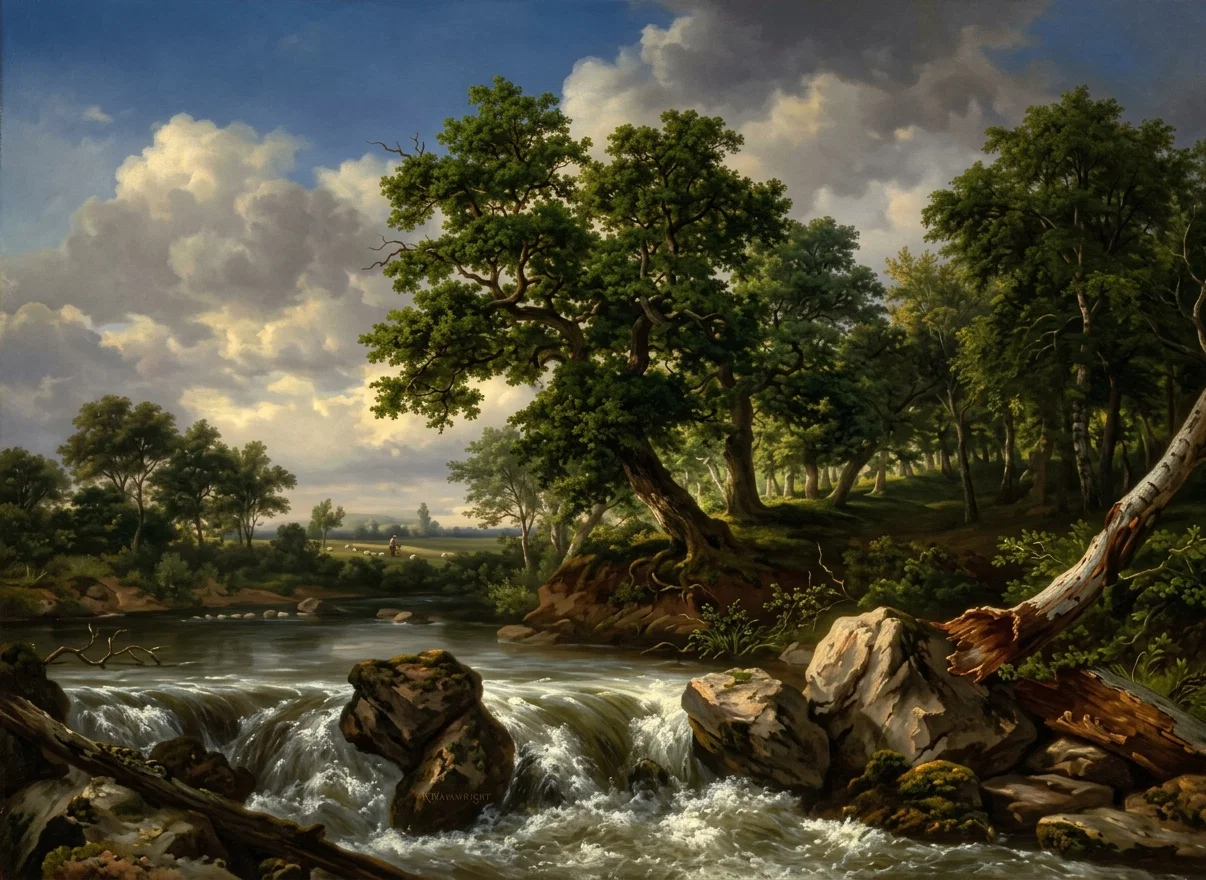
As the hillsides and the plains open a channel for the mountain stream to reach the sea, that which they give is repaid a hundredfold. The stream that goes singing on its way leaves behind its gift of beauty and fruitfulness. Through the fields, bare and brown under the summer’s heat, a line of verdure marks the river’s course; every noble tree, every bud, every blossom, a witness to the recompense God’s grace decrees to all who become its channels to the world.
LESSONS FROM THE SEED
Of the almost innumerable lessons taught in the varied processes of growth, some of the most precious are conveyed in the Saviour’s parable of the growing seed. It has lessons for old and young.
“The stream that goes singing on its way leaves behind its gift of beauty and fruitfulness.”
“So is the kingdom of God, as if a man should cast seed into the ground; and should sleep, and rise night and day, and the seed should spring and grow up, he knoweth not how. For the earth bringeth forth fruit of herself; first the blade, then the ear, after that the full corn in the ear.” Mark 4:26-28.
The seed has in itself a germinating principle, a principle that God Himself has implanted; yet if left to itself, the seed would have no power to spring up. Man has his part to act in promoting the growth of the grain; but there is a point beyond which he can accomplish nothing. He must depend upon One who has connected the sowing and the reaping by wonderful links of His own omnipotent power.
HIS LIFE-GIVING POWER MUST ACT ALSO
There is life in the seed, there is power in the soil; but unless infinite power is exercised day and night, the seed will yield no return. The showers of rain must refresh the thirsty fields; the sun must impart warmth; electricity must be conveyed to the buried seed. The life which the Creator has implanted, He alone can call forth. Every seed grows, every plant develops, by the power of God.
“The seed is the word of God.” Luke 8:11. “As the earth bringeth forth her bud, and as the garden causeth the things that are sown in it to spring forth; so the Lord God will cause righteousness and praise to spring forth.” Isa. 61:11. As in the natural, so in the spiritual sowing; the power that alone can produce life is from God.
The work of the sower is a work of faith. The mystery of the germination and growth of the seed, he cannot understand; but he has confidence in the agencies by which God causes vegetation to flourish. He casts away the seed, expecting to gather it manifold in an abundant harvest. So parents and teachers are to labor, expecting a harvest from the seed they sow.
SEEDS THAT LIE UNNOTICED
For a time, the good seed may lie unnoticed in the heart, giving no evidence that it has taken root; but afterward, as the Spirit of God breathes on the soul, the hidden seed springs up, and at last brings forth fruit. In our life work, we know not which shall prosper, this or that. This question it is not for us to settle. “In the morning sow thy seed, and in the evening withhold not thine hand.” Eccl. 11:6. God’s great covenant declares that “while the earth remaineth, seedtime and harvest . . . shall not cease.” Gen. 8:22. In the confidence of this promise, the husbandman tills and sows. Not less confidently are we, in the spiritual sowing,742to labor, trusting His assurance: “So shall My word be that goeth forth out of My mouth: it shall not return unto Me void, but it shall accomplish that which I please, and it shall prosper in the thing whereto I sent it.” Isa. 55:11.
THE DEVELOPING PLANT A FIGURE
The germination of the seed represents the beginning of spiritual life, and the development of the plant is a figure of the development of character. There can be no life without growth. The plant must either grow or die. As its growth is silent and imperceptible, but continuous, so is the growth of character. At every stage of development, our life may be perfect; yet if God’s purpose for us is fulfilled, there will be constant advancement.
COOPERATION WITH DIVINE AGENCIES
The plant grows by receiving that which God has provided to sustain its life. So spiritual growth is attained through cooperation with divine agencies. As the plant takes root in the soil, so we are to take root in Christ. As the plant receives the sunshine, the dew, and the rain, so are we to receive the Holy Spirit. If our hearts are stayed upon Christ, He will come unto us “as the rain, as the latter and former rain unto the earth.” Hosea 6:3.
The wheat develops, “first the blade, then the ear, after that the full corn in the ear.” Mark 4:28. The object of the husbandman in the sowing of the seed and the culture of the plant, is the production of grain,—bread for the hungry, and seed for future harvests. So the divine Husbandman looks for a harvest. He is seeking to reproduce Himself in the hearts and lives of His followers, that through them He may be reproduced in other hearts and lives.
THE CHILD’S DEVELOPMENT
The gradual development of the plant from the seed is an object lesson in child training. There is “first the blade, then the ear, after that the full corn in the ear.” He who gave this parable, created the tiny seed, gave it its vital properties, and ordained the laws that govern its growth.
Parents and teachers should aim so to cultivate the tendencies of the youth that at each stage of life they may represent the beauty appropriate to that period, unfolding naturally, as do the plants in the garden.
The little ones should be educated in childlike simplicity. They should be trained to be content with the small, helpful duties and the pleasures and experiences natural to their years. Childhood answers to the blade in the parable, and the blade has a beauty peculiarly its own. Children should not be forced into a precocious maturity, but as long as possible should retain the freshness and grace of their early years. The more quiet and simple the life of the child,—the more free from artificial excitement and the more in harmony with nature,—the more favorable it is to physical and mental vigor and to spiritual strength.
CAUSE AND EFFECT WITH UNVARYING CERTAINTY
By the laws of God in nature, effect follows cause with unvarying certainty. The reaping testifies to the sowing. Here no pretense is tolerated. Men may deceive their fellow men, and may receive praise and compensation for service which they have not rendered. But in nature there can be no deception. On the unfaithful husbandman the harvest passes sentence of condemnation. And in the highest sense this is true also in the spiritual realm. It is in appearance, not in reality, that evil succeeds. The child who plays truant from school, the youth who is slothful in his studies, the clerk or apprentice who fails of serving the interests of his employer, the man in any business or profession who is untrue to his highest responsibilities, may flatter himself that, so long as the wrong is concealed, he is gaining an advantage. But not so; he is cheating himself. The harvest of life is character; and it is this that determines destiny, both for this life and for the life to come.
REPRODUCTIONS THAT END IN RUIN
The harvest is a reproduction of the seed sown. Every seed yields fruit “after its kind.” So it is with the traits of character we cherish. Selfishness, self-love, self-esteem, self-indulgence, reproduce themselves, and the end is wretchedness and ruin. “He that soweth to his flesh shall of the flesh reap corruption; but he that soweth to the Spirit shall of the Spirit reap life everlasting.” Gal. 6:8. Love, sympathy, and kindness yield fruitage of blessing, a harvest that is imperishable.
In the harvest, the seed is multiplied. A single grain of wheat, increased by repeated sowings, would cover a whole land with golden sheaves. So widespread may be the influence of a single life, of even a single act.
What deeds of love the memory of that alabaster box broken for Christ’s anointing has through the long centuries prompted! What countless gifts that contribution, by a poor unnamed widow, of “two mites, which make a farthing,” has brought to the Saviour’s cause!
MAKE THE CHILDREN’S LESSONS PRACTICAL
As parents and teachers try to teach these lessons, the work should be made practical. Let the children themselves prepare the soil and sow the seed. As they work, the parent or teacher can explain the garden of the heart, with the good or bad seed sown there, and that as the garden must be prepared for the natural seed, so the heart must be prepared for the seed of truth. As the seed is cast into the ground, they can teach the lesson of Christ’s death; and as the blade springs up, the truth of the resurrection. As the plant grows, the correspondence between the natural and the spiritual sowing may be continued.
The youth should be instructed in a similar way. From the tilling of the soil, lessons may constantly be learned. No one settles upon a raw piece of land with the expectation that it will at once yield a harvest. Diligent, persevering labor must be put forth in the preparation of the soil, the sowing of the seed, and the culture of the crop. So it must be in the spiritual sowing. The garden of the heart must be cultivated. The soil must be broken up by repentance. The evil growths that choke the good grain must be uprooted. As soil once overgrown with thorns can be reclaimed only by diligent labor, so the evil tendencies of the heart can be overcome only by earnest effort in the name and strength of Christ.
WHY THESE WANDERERS FROM EDEN?
Thus while the children and youth gain a knowledge of facts from teachers and textbooks, let them learn to draw lessons and discern truth for themselves. In their gardening, question them as to what they learn from the care of their plants. As they look on a beautiful landscape, ask them why God clothed the fields and woods with such lovely and varied hues. Why was not all colored a somber brown? When they gather the flowers, lead them to think why He spared us the beauty of these wanderers from Eden. Teach them to notice the evidences everywhere manifest in nature of God’s thought for us, the wonderful adaptation of all things to our need and happiness.
Many illustrations from nature are used by the Bible writers; and as we observe the things of the natural world, we shall be enabled, under the guiding of the Holy Spirit, more fully to understand the lesson of God’s word. It is thus that nature becomes a key to the treasure house of the Word.
COMPARE THE BIBLE WITH NATURE
Children should be encouraged to search out in nature the objects that illustrate Bible teachings, and to trace in the Bible the similitudes drawn from nature. They should search out, both in nature and in His word, every object representing Christ, and those also that He employed in illustrating truth. Thus may they learn to see Him in tree and vine, in lily and rose, in sun and star. They may learn to hear His voice in the song of birds, in the sighing of the trees, in the rolling thunder, and in the music of the sea. And every object in nature will repeat to them His precious lessons.
To those who thus acquaint themselves with Christ, the earth will never be a lonely and desolate place. It will be their Father’s house, filled with the presence of Him who once dwelt among men.